English Literature Mark Scheme: How Examiners Award Marks
You've probably had that moment after an English Literature paper where the essay felt solid, the quotes were there, and the argument seemed sensible, only for the result to land lower than you expected. That gap between “I wrote loads” and “the mark scheme liked it” is where most students get stuck, and it's exactly where examiners make their decisions. The good news is that the English Literature mark scheme isn't a secret code. It's a pattern, and once you can read that pattern, your revision gets much sharper.
A lot of students revise the text, the themes, and a few quotations, then hope the exam will reward effort. Examiners don't work that way. They read for level descriptors, judge the response by best fit, and then decide where the script sits overall. That means a response can look polished and still miss marks if it leans too hard on summary, context dumping, or isolated technique spotting.
That's why understanding the mark scheme is such a high-impact move. It changes how you plan, how you write, and how you review your own work. It also helps teachers spot why a student is hovering in the same band again and again, even when the writing looks better on the page.
What an English Literature Mark Scheme Actually Is
You can write what feels like your strongest Macbeth essay, walk out convinced you've nailed it, then open the paper later and realise the mark sits two bands lower than expected. That usually isn't because the examiner “missed” the quality of the answer. It's because the response didn't line up with the level descriptor the examiner was using.
Mark schemes are frameworks, not answer sheets
An English Literature mark scheme is not a list of right answers. It's a structured framework that tells examiners what different levels of performance look like, then asks them to place a response where it fits best. They don't tick off a quotation, then a metaphor, then a context point like a shopping list. They read the whole answer, judge the overall quality, and decide which band it most closely matches.
That matters because two essays can use the same quotation and still land in very different places. One response might use the quote to build an argument about character, language, and structure. Another might just mention it and move on. The mark scheme rewards the first because it shows analysis, not just knowledge.
Practical rule: if your paragraph sounds like a plot recap with a few literary terms bolted on, the examiner will usually read it as low-level response, even if the writing is fluent.
It also helps to separate three things students often blur together. Mark schemes explain how marks are awarded, examiner reports show common strengths and weaknesses seen in real scripts, and grade boundaries show where a grade cut-off sat in a particular exam series. A student who only reads the text and ignores the mark scheme is revising blind.
For a clear place to compare how that works across papers, the MasteryMind A-Level mark schemes page is useful because it groups the idea of marking, objectives, and question demands in one place.
Assessment Objectives and How They Shape Your Marks
Two essays can describe the same scene and still finish in very different bands. The difference is usually not who knows more, but who gives the examiner the clearest evidence that the answer fits the Assessment Objectives, usually shortened to AOs. In GCSE English Literature, Ofqual's conditions set AO1 at 35 to 40%, AO2 at 40 to 45%, AO3 at 15 to 20%, and AO4 at 5% across the specification, so the largest share of credit goes to analysis of language, form, and structure, while spelling, punctuation, and grammar still carry a smaller but explicit weight in the mark scheme. AQA's published assessment overviews show the same principle in practice, because the mark allocation is built around the objectives rather than hidden behind vague grade language Ofqual's GCSE English Literature conditions, AQA GCSE scheme of assessment, AQA A-level scheme of assessment.
What each AO is really asking for
AO1 rewards a clear argument and relevant evidence. Examiners are looking for a response that stays focused, uses quotations with purpose, and develops a line of thought. AO2 is where marks often rise or fall fastest, because it asks you to explain language, form, and structure. AO3 is context, but only if it helps the reader understand meaning. AO4 matters in comparison tasks.
The common trap is imbalance. A script that retells the plot with a few technical terms may look full, yet it gives the examiner very little to reward. A script that drops in historical detail without showing why it changes the interpretation has the same problem. I have marked many answers that sit in the middle because they show knowledge, but not enough shaped analysis.
Examiner thinking is closer to a judgement of overall fit than a checklist. If a paragraph about Macbeth spends most of its time explaining what happens, then only briefly mentions a metaphor, the examiner will usually read that as weaker than a paragraph that explains how the metaphor shapes meaning and links it to the argument. That is the best-fit logic in action.
A useful way to practise that judgement is to compare your own paragraph with a literature review step-by-step guide, because strong academic reading also depends on selecting evidence for a clear purpose rather than collecting facts for their own sake literature review step-by-step guide.
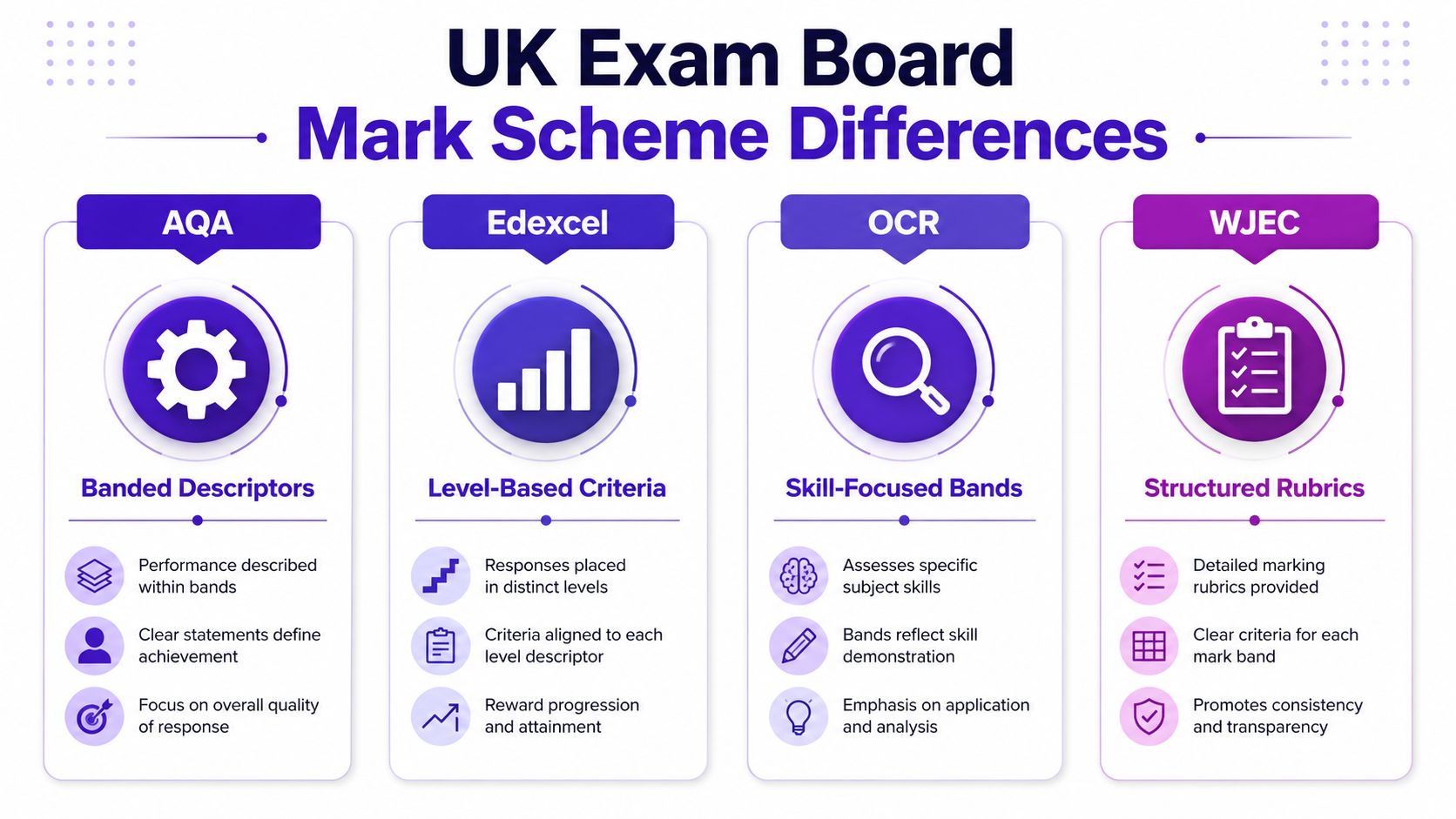
Differences Between AQA, Edexcel, OCR, and WJEC Mark Schemes
The boards all test literary response, but they do not reward exactly the same habits. A student can feel fluent on one paper and boxed in on another. That is usually not about ability. It is about whether the answer matches the board's preferred shape.
AQA and the feel of banded descriptors
AQA uses a best fit approach with banded descriptors, and its GCSE literature materials make the AO split visible across questions AQA inside assessment for English Literature. In practice, the examiner asks, “Which band does this response mostly resemble?” rather than counting every feature with equal weight. The GCSE and A-level schemes also show how marks are divided across objectives and components, so you can see that the same quality of writing is not treated in the same way at each level AQA GCSE scheme of assessment, AQA A-level scheme of assessment.
That matters because a strong AQA answer usually sounds tightly analysed and clearly argued, especially where AO2 carries the heaviest share. If a script spends most of its time retelling events and only briefly touches method, the band tends to slip.
Edexcel, OCR, and WJEC in practice
Edexcel often rewards answers that keep building an interpretation across the whole response. A useful clue is how clearly the argument stays connected from start to finish, rather than dropping into separate observations. OCR puts more visible pressure on interpretation and alternative readings, so a response that only gives one fixed view can feel thin. WJEC is often experienced by students as more guided, with the wording of the task and the response structure doing more of the steering.
Concrete examples help here. On Edexcel, a student who tracks a theme through several moments in the text usually looks safer than one who makes a single sharp point and then stops. On OCR, a stronger answer often signals that another reading is possible, even if it does not spend long on it. On WJEC, students are often helped by the shape of the question itself, because the mark scheme tends to reward a response that engages directly with the prompt and keeps that line of thought steady. Those are practical differences, not branding differences.
Teacher's eye: the biggest error I see is students copying a style that worked on one board and assuming it transfers unchanged. It rarely does.
A useful comparison point is grade boundaries. AQA's June 2026 GCSE English Literature paper was out of 160, with grade 9 at 136, grade 8 at 127, grade 7 at 113, grade 6 at 97, grade 5 at 81, and grade 4 at 66. Pearson Edexcel's June 2025 paper was also out of 160, but grade 9 was 135 and grade 4 was 73 AQA grade boundaries PDF, AQA grade boundaries explanation. That does not mean one paper was easier. It does show that boundaries move, and the board's mark scheme design shapes what counts as secure performance.
For students working out how to revise to a board's logic, the Prompt Builder's higher education guide is a useful example of how structured prompts and criteria-based feedback can sharpen thinking, even if the subject is very different.
Annotated Example Answers Showing Why Marks Were Won or Lost
A low-scoring answer usually isn't weak because it has nothing to say. It's weak because the examiner can't see enough method in the thinking. A high-scoring answer, by contrast, keeps showing exactly why the text matters, line by line.
Band 3 and Band 5 responses to the same question
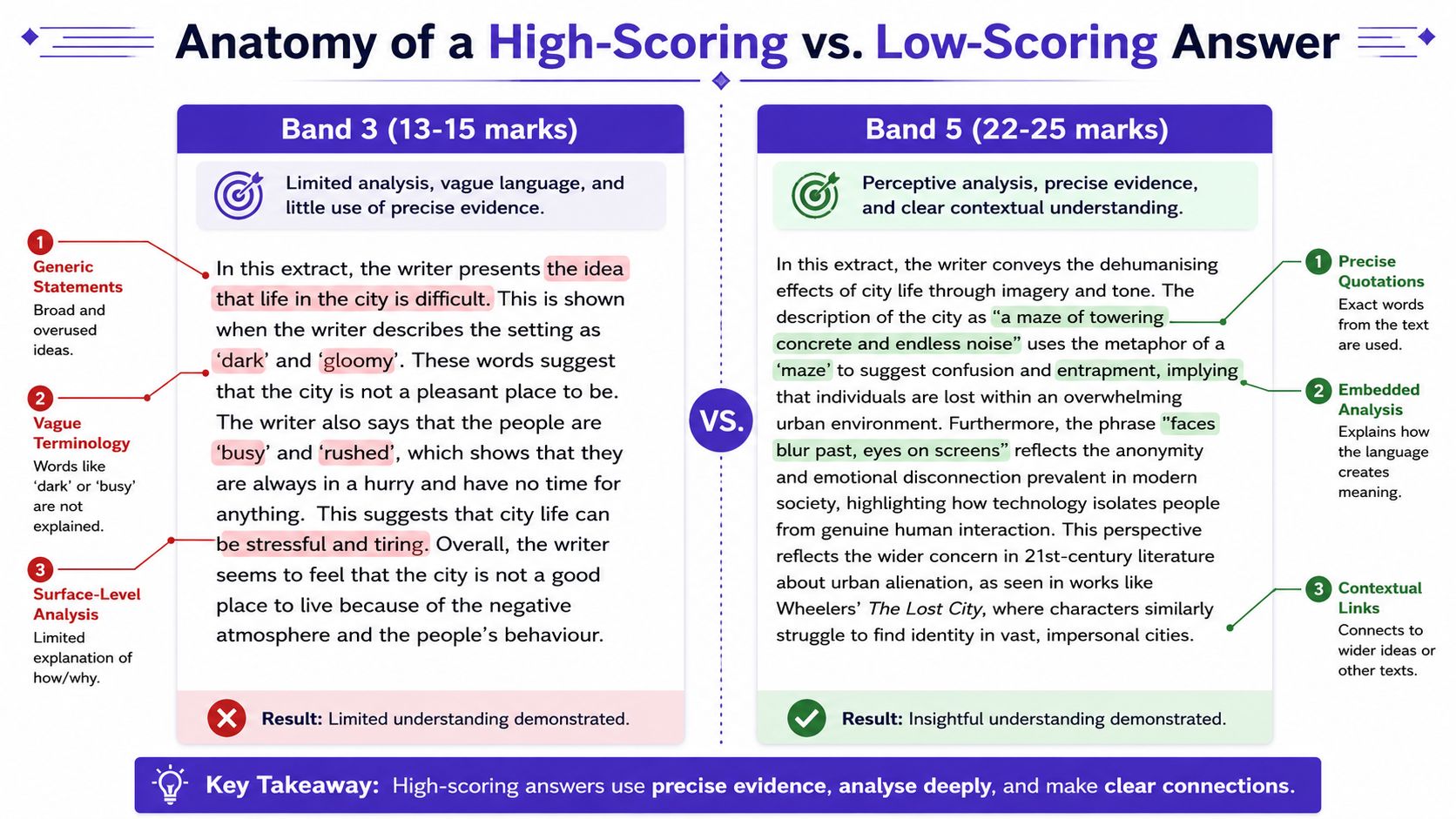
Take a GCSE-style question on Macbeth, asking how Shakespeare presents ambition. A Band 3 answer often sounds like this, even if the wording changes:
“Macbeth is ambitious because he wants to be king. He listens to the witches and then decides to kill Duncan. This shows that ambition leads to tragedy. Shakespeare wrote this for a Jacobean audience who believed in kings and order.”
The issue is not that any part of this is false. The issue is that it stays general. The first sentence is mostly assertion, the second is plot summary, and the context arrives at the end like an add-on. AO1 is there in a basic sense, AO3 is present but detached, and AO2 is barely doing any work.
A Band 5 answer sounds more controlled:
“Shakespeare presents Macbeth's ambition as corrosive from the moment he starts to imagine power as something he can seize. The phrase ‘vaulting ambition’ makes ambition sound unstable and overreaching, and the image of a rider throwing himself over a jump suggests Macbeth already senses the danger in his own desire. Shakespeare doesn't present him as heroic here, but as someone whose imagination runs faster than his judgement. For a Jacobean audience, that collapse of self-control would make his downfall feel morally and politically inevitable.”
Here, AO1 carries a clear line of argument. AO2 is doing real work through the wording of ‘vaulting’ and the image itself. AO3 is relevant because it supports the meaning, not because it sits in a separate historical sentence.
What changed in the writing
The gap between the two answers isn't just sophistication. It's control. The Band 5 response keeps returning to meaning, keeps the quote embedded, and keeps the paragraph moving forward rather than sideways.
The same pattern shows up in A-level, but the expectation rises again because AO5 enters the picture. A strong extract response at that level doesn't just analyse methods. It also shows awareness that a text can be read in more than one way, and it treats those alternatives seriously rather than as a token phrase.
“Different interpretations only help if they change the argument.”
If you want to practise that style of response on older essays and compare them with model structures, the A-Level Past papers section is a sensible place to start.
Practical Strategies for Planning and Writing High-Scoring Answers
The fastest route to better marks is not writing longer essays. It's writing essays that line up with the mark scheme from the first paragraph. That starts before you draft a single sentence.
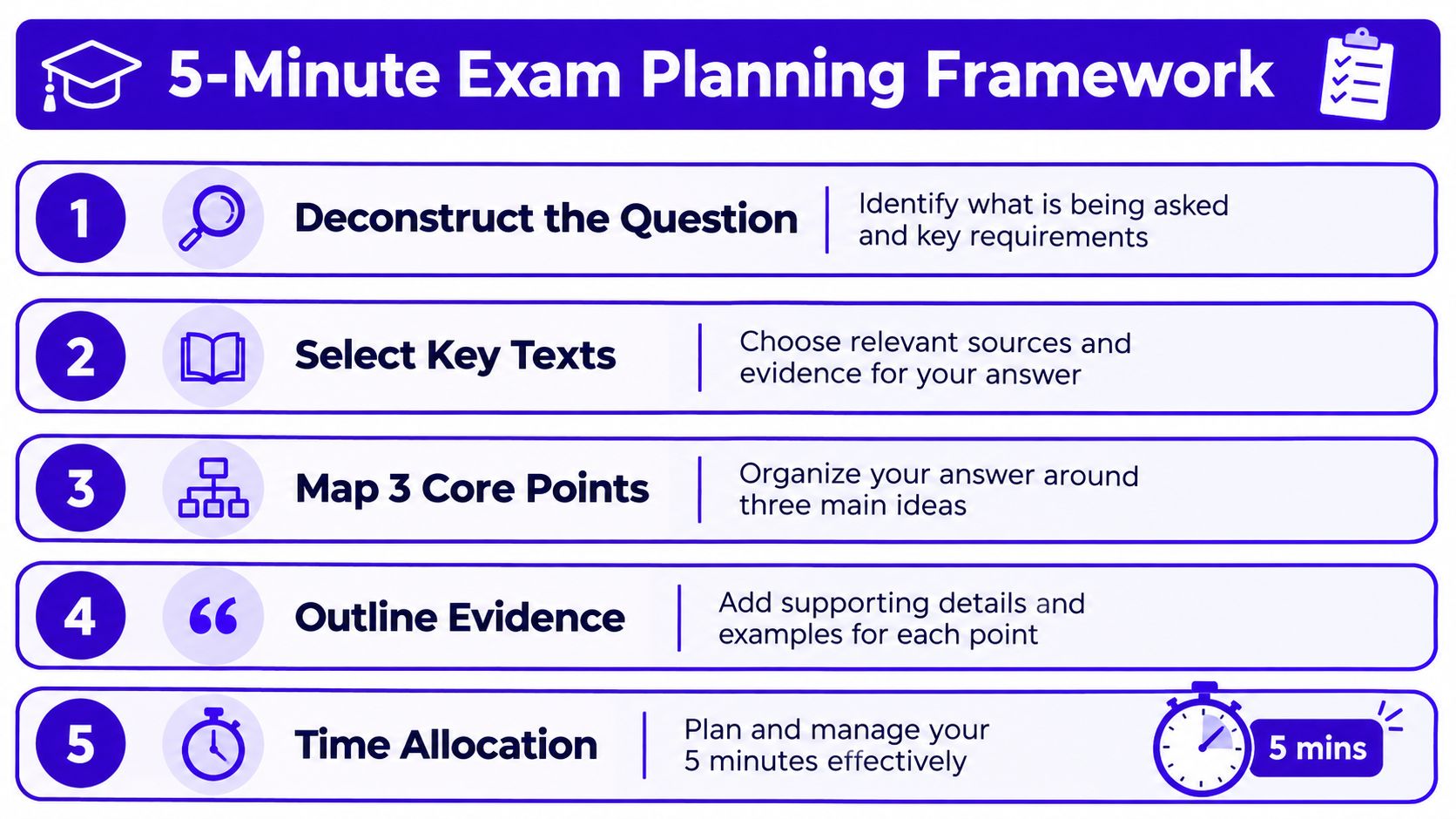
Use the first five minutes properly
In the first few minutes, read the question twice and split it into task, focus, and method. Then jot down which AO each part of the answer needs to hit. If it's a comparison question, comparison needs to appear from the start, not as a final flourish.
A useful planning shape is simple: point, evidence, analysis, context. The point states your argument. The evidence is a short quotation, not a whole line of copied text. The analysis explains how the writer's choices create meaning. The context only stays if it deepens the idea.
Practical rule: if a quotation doesn't earn its place by proving a point, leave it out.
Write to the band, not to a feeling
Students often say they “explained it well”, but examiners are reading for visible qualities, not your sense of effort. That means you need to show sustained argument, precise references, and careful language analysis across the answer. Use literary terms naturally, not as a list. Saying “metaphor”, “contrast”, or “structure” should support your point, not replace it.
A lot of students lose time by over-writing the first answer and then rushing the final one. That's a marking problem, not just a time problem, because incomplete work can't demonstrate enough of the AOs. Keep a rough pace in mind, and don't let the opening paragraph swallow the whole paper.
For structured timed practice, the Exam Practice for A-Level feature is relevant because it supports working under exam conditions rather than only revising notes.
Using MasteryMind to Practise with Examiner-Style Feedback
Students usually improve fastest when feedback is specific enough to show exactly where marks were gained or lost. That's where a tool like MasteryMind fits into revision, because it gives practice responses examiner-style feedback that maps back to the AO structure used in UK literature marking. For English Literature revision, that means students can see whether the problem is weak AO2 analysis, thin AO1 argument, or context that sits awkwardly outside the main line of thought.
Why feedback matters more than another essay
Writing answer after answer without detailed marking just repeats the same habits. The better loop is simple. Write a response, get targeted feedback, revise it, then resubmit. That cycle helps students notice patterns in their own writing much faster than waiting for a one-off teacher mark.
A student who keeps under-developing analysis will see that problem show up again and again. Another student may find that their A-level responses mention interpretation only once, instead of threading it through the whole essay. Once those weaknesses are visible, they stop feeling mysterious.
The point isn't that a tool replaces teaching. It doesn't. It does mean students can practise with more frequency and more precision, especially when they need to learn how a mark scheme behaves in real time. If you want to see the marking side directly, you can also see MasteryMind's marking tool.
Your Action Plan for Mastering the Mark Scheme
The three essentials are simple. Know the AO weightings, write to level descriptors instead of chasing isolated techniques, and practise with examiner-style feedback until the structure feels familiar. Once those are in place, revision gets more efficient because every practice answer has a purpose.
Four weeks out, reverse-engineer a few mark schemes and annotate what each band rewards. Two weeks out, time individual paragraphs against the band you're aiming for and cut anything that doesn't prove a point. In the final revision sessions, use feedback to clear recurring weak spots and rehearse the first five minutes of planning until it feels automatic.
On exam day, read the question twice, annotate the extract for AO1 and AO2 at the same time, and spend five minutes planning before you start. The mark scheme isn't a trap. It's a transparent framework, and students who work with it deliberately usually stop guessing and start improving.
If you want a clearer way to practise English Literature answers against real criteria, MasteryMind gives you AO-based feedback, timed practice, and mark-scheme-aligned support that shows what's working and what isn't. Use it to test your essays, compare them with the level descriptors, and build the kind of exam response that examiners reward.
Ready to master this topic?
Practise with quizzes, blurt exercises and exam questions on MasteryMind.
7 days Premium · Then free forever · No card, no charge