English Poetry GCSE: The Ultimate Guide to Ace Your Exam
You open the poetry paper, read the question, look at the poem, and your brain gives you nothing. Not a clever interpretation. Not a quote. Not even a decent panic. Just static.
That feeling is normal. It happens to students who've revised loads, students who've barely started, and it's what many teachers spend the most time trying to solve. Poetry can feel like a private joke everyone else understands. But english poetry gcse isn't a guessing game. It's a skill set. Once you know what the examiner is rewarding, the poem stops feeling like a trap and starts feeling like a puzzle with a method.
If you're behind, this guide will help you recover. If you're aiming high, it will help you sharpen what already works. And if writing speed is part of the problem once you do know what you want to say, this guide on how to boost writing speed and clarity can help you turn ideas into readable exam answers under pressure.
That Blank Page Feeling And How To Beat It
A student reads an unseen poem and says, “I don't get it.” Most of the time, what they mean is, “I don't get it instantly, so I think I'm already failing.”
That's the first thing to fix.
Poetry in GCSE English Literature is not about having a magical first impression. It's about building an interpretation from clues. You don't need to understand every line immediately. You need to stay calm long enough to notice what the poem is doing.
What that panic usually looks like
It often goes like this:
- You see unfamiliar language and assume the whole poem is beyond you.
- You hunt for techniques because that feels safer than meaning.
- You freeze on the introduction because you think your first sentence has to sound brilliant.
- You forget the question and start writing everything you know about the poem.
None of that means you're bad at poetry. It means you need a process.
Practical rule: Your first job is not to be impressive. Your first job is to become clear.
A lot of weaker answers fail for the same reason. They treat poetry like a checklist. Metaphor. Enjambment. Alliteration. Done. But examiners reward something better than feature-spotting. They reward students who explain how a writer shapes meaning.
The shift that changes everything
Start thinking like this:
- What seems to be happening?
- What is the speaker feeling or noticing?
- Which methods create that effect?
- Why might the poet shape it that way?
That's it. That's the engine of a strong answer.
When you approach english poetry gcse this way, the blank page stops being a judgement on your intelligence. It becomes the place where you build an argument, one clear thought at a time.
Decoding The Examiner's Mindset What The AOs Really Mean
Most students hear “Assessment Objectives” and switch off. Fair enough. The official language can sound like it was written by a committee that has never met a tired Year 11.
But the AOs are useful once you translate them into plain English. They're basically the examiner's quest log. Hit these targets, and your answer starts picking up marks in the right places.
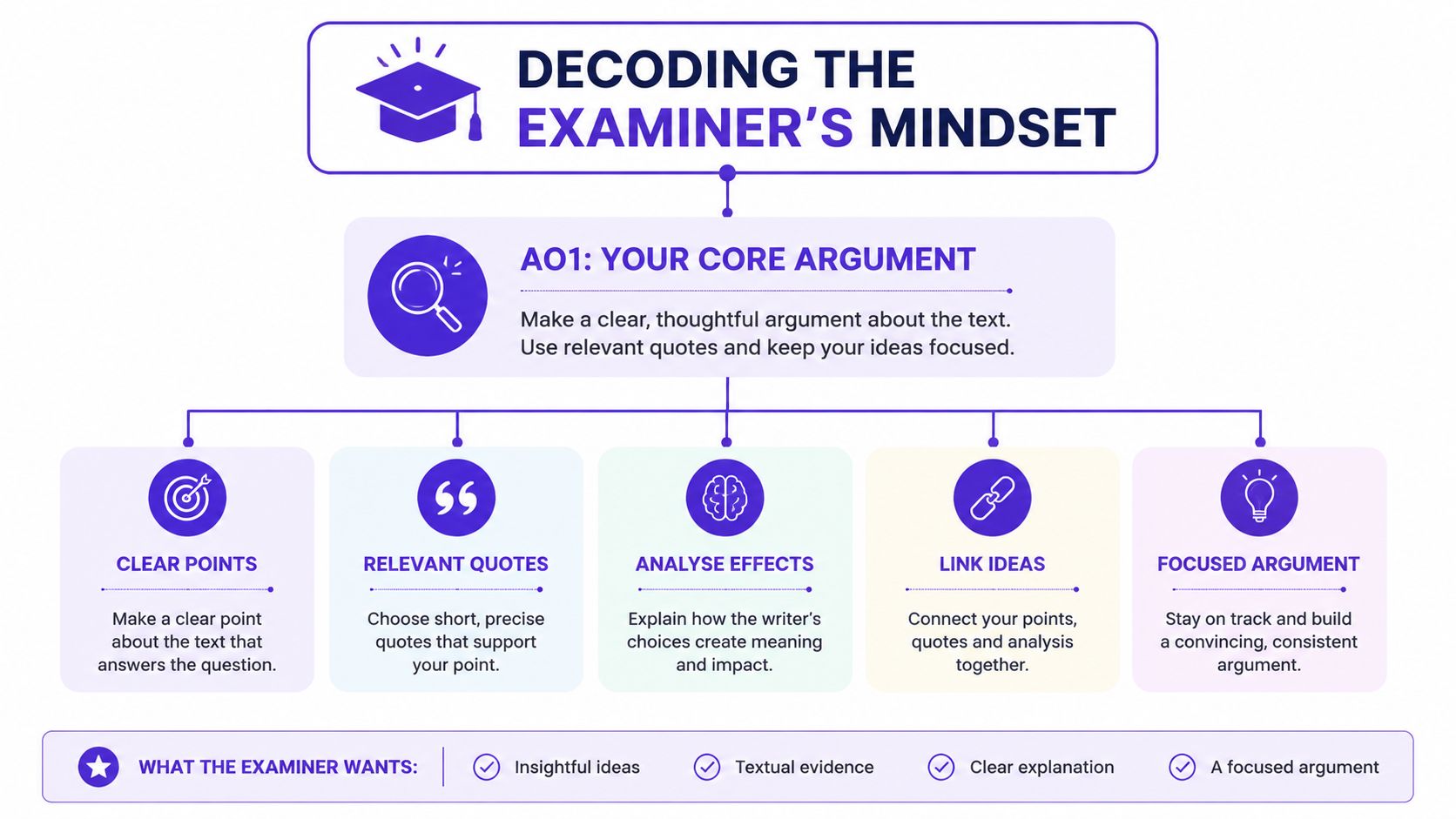
AO1 means make a real point
AO1 is your argument. Not a summary. Not “this poem is about war and it is sad.” It's your ability to show that you understand the poem and can support your ideas with references.
In student language, AO1 means:
- Answer the question directly
- Say what the poem suggests
- Use evidence to back it up
- Compare clearly when needed
If the question asks how power is shown, don't start with a biography dump or a list of devices. Start with a judgement. For example: The poet presents power as unstable because human pride fades, even when rulers try to make themselves permanent.
That already sounds like a student who knows where they're going.
AO2 means explain the writer's moves
AO2 is often where marks rise or fall. This requires your analysis of language, form and structure. Across GCSE poetry specifications, students gain an advantage here because exam boards reward method-based interpretation rather than just retelling content. Eduqas, for example, states that Section B assesses AO1, AO2 and AO3, while its unseen poetry section assesses AO1 and AO2, and it requires learners to consider “the poets' use of language, structure and form” when comparing unseen poems in its GCSE English Literature specification.
That means the examiner is thinking:
- Did you notice a method?
- Did you explain its effect?
- Did you link that effect to the poem's meaning?
Good AO2 isn't naming enjambment. It's explaining what the enjambment does to the reader's experience or the speaker's thought.
Try this upgrade:
- Weak: The poet uses enjambment.
- Better: The enjambment pushes the line forward, which mirrors the speaker's racing thoughts and makes the emotion feel less controlled.
AO3 means context that actually matters
AO3 is context, but not random facts you memorised the night before. Context should help explain meaning.
Useful context sounds like:
- the poet's concerns
- the historical situation
- social attitudes
- ideas about conflict, class, identity, nature, power
Weak context sounds like:
- birth dates
- trivia
- copied textbook lines that don't connect to the question
What the examiner wants on the page
Think of your answer as doing three jobs:
| AO | What it really asks | What to do in your essay |
|---|---|---|
| AO1 | Do you understand the poem? | Make a clear argument and use references |
| AO2 | Can you analyse craft? | Explain language, form and structure |
| AO3 | Can you connect the poem to its world? | Add relevant context only when it deepens meaning |
If you want a way to practise this under realistic pressure, Exam Practice for GCSE gives you a straightforward way to rehearse examiner-style responses.
Know Your Exam A Guide to AQA Edexcel OCR and WJEC
One reason students get caught out in english poetry gcse is simple. They revise as if all boards ask the same thing. They don't.
The core skills overlap a lot. You'll still need interpretation, comparison, and analysis of language, form and structure. But the task shape changes. That matters because revision should match what you'll face in the exam hall.
The board snapshot that actually matters
Here's the practical version.
| Exam Board | Paper & Section | Task Type | Key Focus |
|---|---|---|---|
| AQA | Literature paper poetry sections | Anthology comparison and unseen comparison | Build comparisons across familiar and unfamiliar poems |
| Edexcel | Poetry sections vary by specification | Anthology study and analytical response | Precise comparison and secure method analysis |
| OCR | Poetry sections vary by cluster and paper design | Anthology response with comparison elements | Thematic links and writer's methods |
| WJEC Eduqas | Section B and unseen poetry section | Comparative anthology work and unseen analysis | AO-led reading of language, structure and form |
That table is deliberately simple, because students usually don't need a bureaucratic breakdown. They need to know what to practise.
Why AQA students need a comparison mindset
For AQA GCSE English Literature (8702), poetry is built into a 2 hour 15 minute paper worth 96 marks and 60% of the GCSE, with Section B requiring one comparative response on a named poem plus one other anthology poem, and Section C requiring comparison of one unseen poem with a second unseen poem, according to AQA's specification at a glance.
That tells you something important straight away. AQA isn't rewarding students who only know one poem really well. It rewards students who can transfer ideas across poems.
So if you're on AQA, your revision has to include:
- Named poem reactions so you don't waste time deciding what the printed poem is about
- Second-poem selection so you can quickly choose a comparison that fits
- Unseen comparison practice so you can compare methods, not just themes
If your revision is all single-poem flashcards with no comparison practice, you're training for the wrong task.
What changes across boards and what doesn't
Teachers know this already, but students often need it said plainly. Your board affects the format, but not the heart of the skill.
What stays constant:
- You need an argument.
- You need evidence.
- You need analysis of method.
- You need to stay close to the question.
What changes:
- how comparison is framed
- whether the poem is printed or recalled
- how much context matters in that task
- the wording of the command
That's why board-specific practice matters more than generic revision videos. If you need a clean place to find material matched to the way your exam works, GCSE Past Papers are useful for seeing patterns in wording and task style.
A smart revision decision
Don't revise “poetry” as one giant blob. Revise your board's poetry paper as a set of repeatable moves.
For one student, that means sharper anthology comparisons. For another, it means learning not to panic when an unseen poem arrives. Same subject. Different pressure points.
Your Step-By-Step Method for Anthology Comparison
The anthology question feels hard because students often do too much too soon. They try to remember every poem, every quote, every theme, and every context point all at once. That's why the answer becomes messy.
A better approach is procedural. UK GCSE poetry guidance consistently points students towards a repeatable method: read the poem several times, identify form and structure, analyse language, and evaluate themes and context. The Power and Conflict anthology, widely taught in England, includes 15 poems, which is one reason students need a comparison system rather than random memory recall, as outlined in this GCSE poetry anthology essay guide.
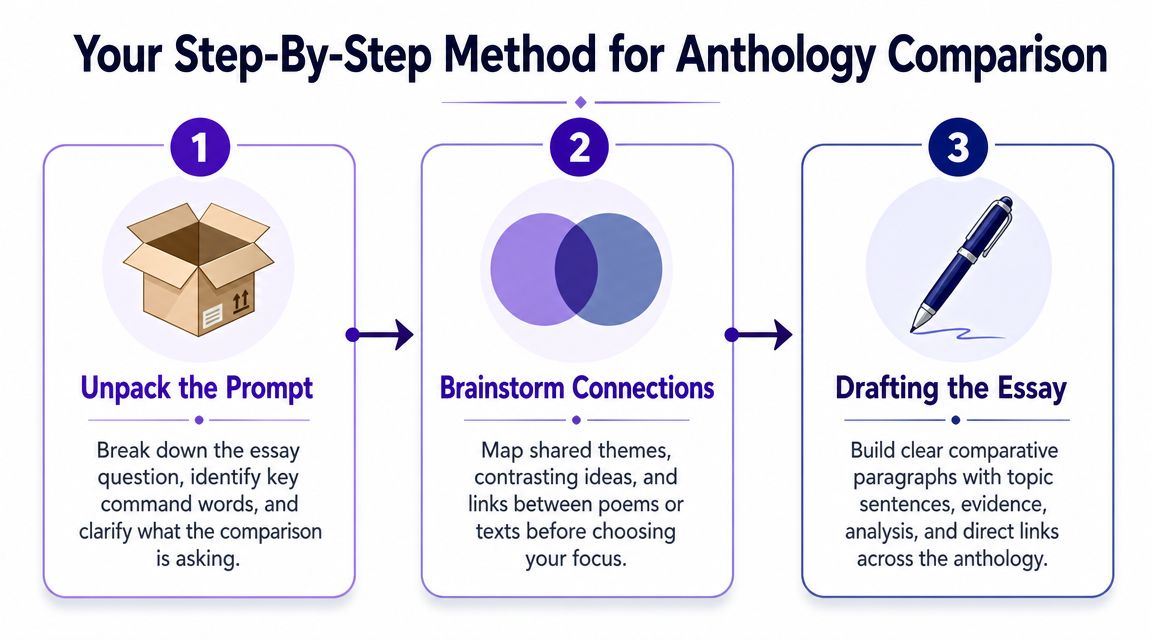
Step one unpack the prompt
Read the question and strip it to its core idea.
If the question is about power, don't just write “power” in your plan. Be more specific:
- political power
- power of nature
- abuse of power
- loss of power
- psychological power
Then read the named poem with that angle in mind. Ask:
- where in the poem is that idea strongest?
- does the poem admire it, fear it, criticise it, complicate it?
This helps you avoid the classic weak answer where a student writes everything they know about the named poem, whether it fits the task or not.
Step two choose the comparison on purpose
Your second poem should not be the one you remember best. It should be the one that gives you the clearest comparison.
Good pairing logic sounds like this:
| Question focus | Strong comparison move |
|---|---|
| Nature's power | Pick a poem that presents nature differently |
| Memory and conflict | Pair one personal memory poem with one public or historical one |
| Control and authority | Choose a poem where power collapses or is resisted |
For example, if the named poem shows a ruler trying to dominate, you might choose another poem where power looks temporary, chaotic, or morally weak. That gives you something to compare, not just something to mention.
Examiner mindset: Comparison isn't “both poems use imagery.” Comparison is “both poets explore power, but one presents it as performative while the other presents it as fragile.”
Step three build comparative paragraphs
A lot of students know PETAL. For poetry comparison, add the comparison all the way through rather than bolting it on at the end.
Try this paragraph rhythm:
- Point about the shared theme or key difference
- Evidence from the named poem
- Technique analysis
- Comparison to the second poem
- Link back to the question
A model sentence shape:
- Both poets present conflict as destructive, but while one focuses on immediate violence, the other explores its long aftermath.
That kind of sentence immediately sounds controlled.
What to include in each paragraph
Don't just chase quotes. Look for methods that help you think.
- Language choices such as violent verbs, soft imagery, contrast
- Form such as dramatic monologue, sonnet, narrative voice
- Structure such as volta, stanza shifts, cyclical endings, fragmentation
- Context only where it sharpens interpretation
If you're writing about Power and Conflict, you don't need to force every poem into the same idea. Your job is to show that you can connect poems intelligently and explain how each poet shapes meaning in a different way.
How To Conquer Unseen Poetry When You Don't Understand It
The worst unseen-poetry myth is that clever students “just get it” on the first read. They usually don't. They just know what to do next.
A common GCSE poetry anxiety is exactly this feeling of not understanding the poem immediately. AQA-style guidance makes clear that unseen poetry is a test of interpretation, not just spotting techniques, and students are encouraged to read, pause, reflect and re-read instead of expecting instant comprehension, as explained in this guide to approaching the unseen poetry question.
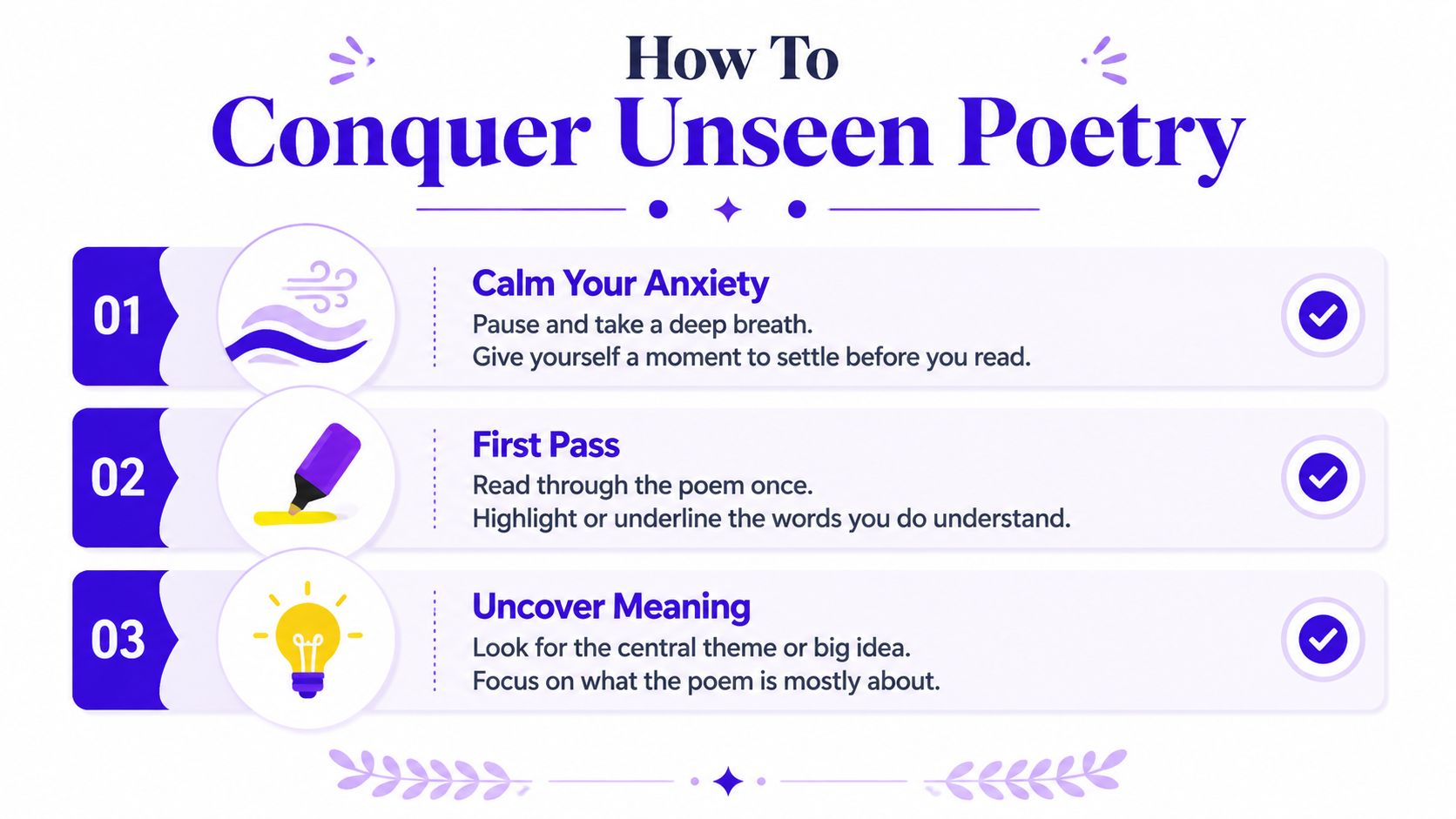
Your first five minutes
When the poem looks strange, do this instead of spiralling.
First read
Read for the basic situation. Who's speaking? What seems to be happening? What mood do you notice first?Second read
Circle or underline words that feel emotionally loaded. Look for contrast, repetition, shifts in tone, changes in stanza, and anything odd.Third read
Write one rough sentence in the margin: This poem seems to suggest that...
That sentence does not need to be beautiful. It needs to be useful.
The examiner doesn't need instant genius. The examiner needs visible thinking.
Later in the answer, you can refine your interpretation. But if you never build that first working idea, you'll drift into disconnected comments.
What to look for when meaning feels slippery
Students often say a poem is “confusing” when what they mean is “it's indirect.” Poetry often hides its meaning in voice, image, and structure.
Use this checklist:
- Speaker. Who is talking, and how certain do they sound?
- Tone. Is the voice calm, bitter, reflective, guilty, awed?
- Imagery. Which images keep appearing, and what do they suggest?
- Structure. Does the poem turn at a certain point? Does it become more chaotic or more controlled?
- Ending. Does the final line resolve anything, or leave tension hanging?
Here's the key point. You don't need to decode every single line before you can write a strong answer. If you can work out the central emotional movement of the poem, you've got a route in.
A helpful walkthrough can make that process feel less abstract, so this video is worth using as part of practice rather than passive watching:
The sentence starter that saves marks
If you're stuck, begin like this:
- At first, the poem appears to present...
- As the poem develops, the speaker seems to...
- The shift in tone suggests...
- The image of ___ could imply...
Those sentence stems keep you in interpretation mode. That's exactly where unseen poetry rewards students.
From 'Good' to 'Grade 9' What Top Analysis Looks Like
The jump from a decent answer to a top answer usually isn't about knowing more quotes. It's about thinking more sharply about the quote you've already chosen.
Let's use a familiar example from Ozymandias: “Look on my Works, ye Mighty, and despair!”
A middle-range answer often does something like this:
- This shows Ozymandias is powerful and arrogant. The imperative “Look” shows he is bossy.
That's not wrong. It's just thin. It identifies a method and a basic meaning, then stops.
What the stronger version does differently
A more developed response might say:
Shelley presents Ozymandias's power as self-glorifying but ultimately hollow. The imperative “Look” sounds commanding, as if the ruler expects permanent admiration, while “despair” suggests he wants other powerful people to feel defeated by his greatness. However, the force of this command becomes ironic because the surrounding ruins show that his authority hasn't lasted. Shelley turns the ruler's own words against him, exposing how political pride collapses over time.
That answer is stronger because it does more than spot a device.
It:
- interprets the line in context
- explains the effect of word choices
- connects the quotation to the poem's bigger idea
- notices irony
- moves from language to message
The difference in a simple table
| Mid-grade response | Higher-grade response |
|---|---|
| Names the technique | Explains why the technique matters |
| Gives one meaning | Explores layered meaning |
| Stays on the quote | Connects the quote to the whole poem |
| States effect simply | Considers irony, tension, or alternative readings |
What top analysis sounds like on the page
You don't need to write like a university lecturer. But you do need a few habits.
Zoom in on precise words
Don't say “this quote shows power” and move on. Pick the word doing the work.Track movement across the poem
Strong answers notice changes. Does the speaker become less certain? Does the image darken? Does the ending undercut the opening?Offer a second possibility when it fits
Sometimes a phrase can suggest more than one thing. That shows confidence, as long as both readings are plausible.
Better analysis usually comes from asking “why this choice?” and “why here?” rather than “what technique is this?”
A quick upgrade formula
Try turning basic comments into stronger ones with this pattern:
Word or method + immediate effect + bigger meaning + link to whole poem
Example:
- Basic: The metaphor shows nature is strong.
- Better: The metaphor makes nature seem overwhelming and uncontrollable, which supports the poem's wider idea that human beings are small beside forces they can't master.
If you want more help shaping that into full essay paragraphs, this guide can help you impress your examiners with better essays.
Your Personalised GCSE Poetry Revision Plan
Poetry revision goes wrong when it stays passive. Students reread notes, highlight everything, and hope familiarity turns into marks. Usually, it doesn't.
That matters even more because GCSE English Literature is one of the compulsory humanities-style qualifications taken at age 16, the current system was introduced in 1986, and the reformed GCSEs phased in from 2015 in England with a 9 to 1 grading scale and more emphasis on unseen analysis, quotation use, and higher-order comparison, as outlined in this GCSE English Literature curriculum guide. In other words, the course rewards active, skills-based revision.
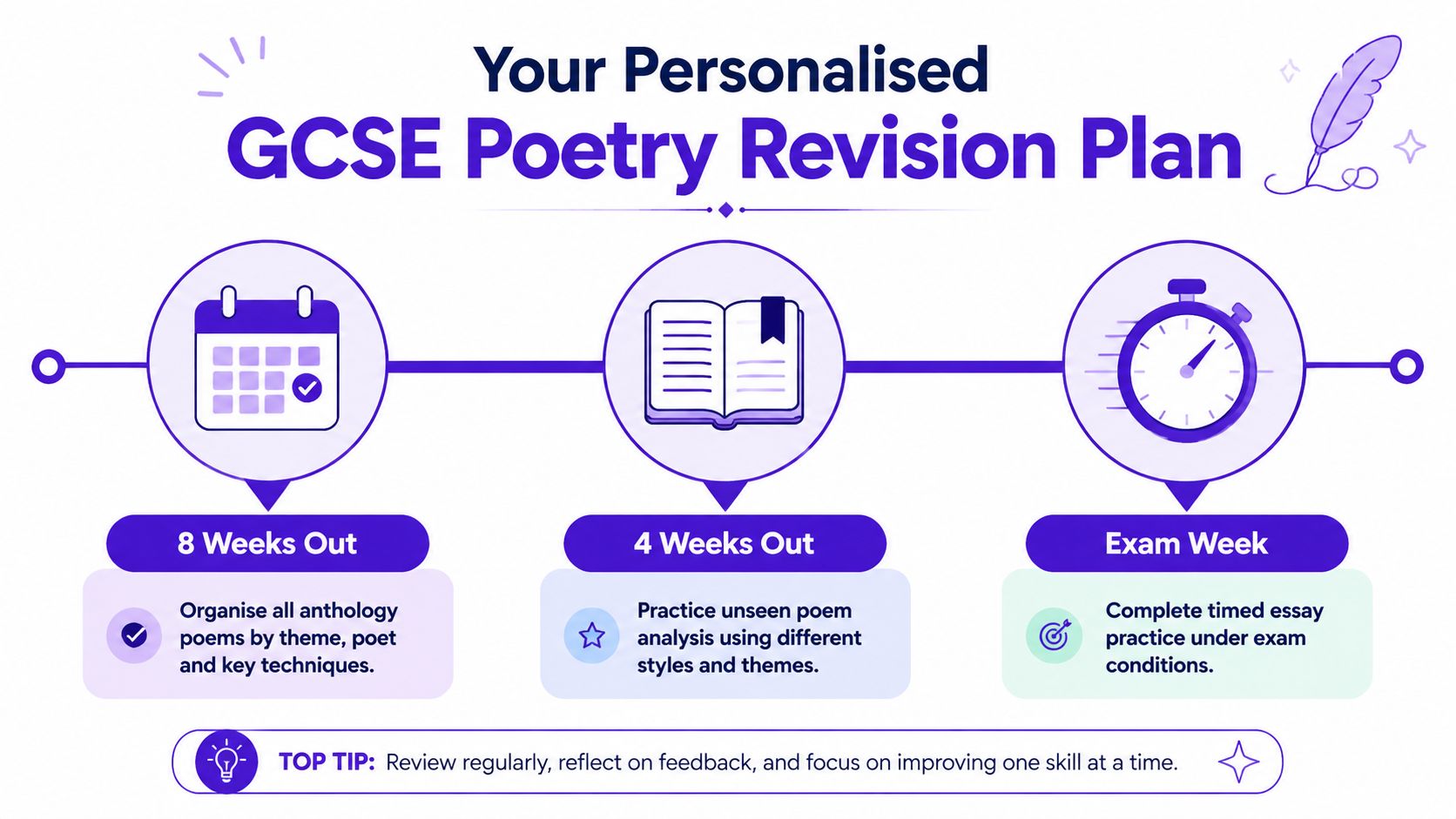
A revision plan that's actually usable
Eight weeks out
Focus on organisation and coverage.
- Sort your anthology poems into theme groups
- Build quote banks with short, flexible quotations
- Write one-sentence summaries for each poem's main argument
- Make comparison pairs that you can reuse
Four weeks out
Move into practice mode.
- Plan anthology answers from real questions
- Do unseen poems regularly using the three-read method
- Practise paragraph writing rather than only full essays
- Test yourself aloud instead of rereading
If spoken recall helps you improve information retention, use it for poetry too. Saying a poem's big ideas, key methods, and possible comparisons out loud is often far more useful than staring at colour-coded notes.
Exam week
This is not the time for making beautiful resources.
- Write timed responses
- Review weak spots only
- Memorise a few versatile quotations
- Practise opening paragraphs and thesis statements
Your self-check list
Use this effectively. If a line feels shaky, revise that skill next.
- I can explain what a poem suggests, not just what happens
- I can analyse language, form and structure together
- I can compare poems by idea, not just by technique
- I can handle a poem I don't fully understand on first read
- I can write a clear argument under timed conditions
For students who want a structured place to organise that practice, one option is revision tips for UK GCSE English. If you're using digital tools more widely, keep them practical. Flashcards, timed plans, voice blurts, and examiner-style prompts are useful. Endless scrolling through model answers isn't.
The best poetry revision is active, slightly uncomfortable, and specific. That's how you build exam confidence that survives the exam hall.
MasteryMind helps UK learners practise the exact skills this guide focuses on, including board-aligned English questions, unseen poetry work, essay practice, and feedback linked to assessment objectives. If you want a structured way to turn revision into regular, examiner-style practice, you can explore MasteryMind.
Ready to master this topic?
Practise with quizzes, blurt exercises and exam questions on MasteryMind.
7 days Premium · Then free forever · No card, no charge