How to Write a Perfect Essay and Ace Your Exams
Let's be real: writing a "perfect" essay isn't about using ridiculously long words or complicated sentences. The real secret is way simpler. It all comes down to answering the question directly, building a clear argument, and structuring it so logically that the marker can’t help but give you marks.
Whether you're aiming to smash your exams or just scrambling to save your grade, this guide is your blueprint. Think of it less as creating art and more as building something solid that won't fall down under pressure.
What Examiners Actually Want in a "Perfect" Essay
We’ve all been there. Staring at a blank page, the clock ticking, and the pressure to write something amazing feels crushing. But what does a perfect essay even look like to the person marking it?
Forget the myth that you need a thesaurus full of fancy words or that you have to write pages and pages. What really pushes a grade from a C to an A* is strategy. It's about knowing a few practical tips on how to improve academic writing and focusing on the things that actually score points: structure, clarity, and sticking to the question like glue.
This isn't a magic trick. It’s about mastering a few core techniques that work every single time. And the best part? It all starts with a plan you can knock out in the first two minutes.
Your Two-Minute Exam Blueprint
Those first moments after you read the question are make-or-break. A solid plan now is your best defence against waffling later. The goal is to set your direction immediately, laying the groundwork for a top-tier answer before you've even written a word.
This simple process is all it takes to get started on the right foot.
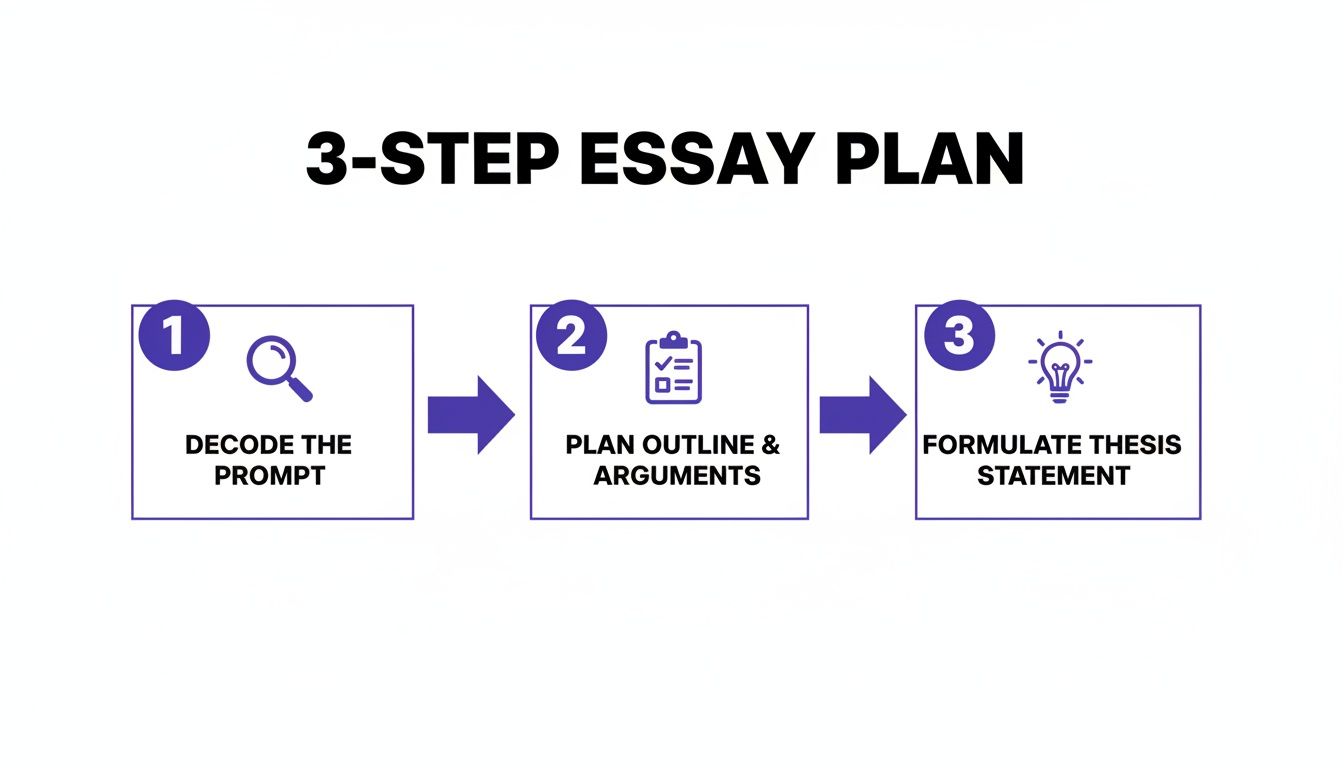
Getting this right makes sure your essay has a clear purpose and stays laser-focused from start to finish.
This blueprint breaks down into three quick, actionable tasks:
- Decode the Question: First, spot the command word (like 'Analyse', 'Evaluate', 'Compare'). Then, pinpoint the exact topic. This tells you what to do and what to write about. No guesswork.
- Scribble a Mini-Plan: On your rough paper, jot down three main points. Just three. These will be the engine for your main body paragraphs.
- Form a Thesis: Now, write one sentence that sums up your overall argument. This is your essay's North Star, keeping everything you write on track.
The single biggest mistake students make is writing a brilliant essay that doesn’t actually answer the question they were asked. A two-minute plan forces you to tackle the prompt head-on. That's half the battle won before you even start.
Of course, to make this second nature when you're under pressure, you need to practise. The only way to build that muscle memory is by putting these ideas into action with real exam questions.
If you're serious about seeing your grades climb, mastering these planning steps is the fastest way to add marks. You can put this method to the test with our exam-mode practice feature.
Before you even dream of putting pen to paper, you need to get inside the examiner's head. The biggest reason students drop marks isn't because their writing is poor; it's because they've written a brilliant answer to a question that wasn't actually asked.
Learning to write a top-tier essay begins with mastering the art of deconstruction. It’s all about spotting the two most important parts of any essay question: the command word and the topic focus. A good tip is to physically highlight or underline these. It’s a simple action that instantly clarifies your mission. The topic focus tells you what to write about, but it's the command word that tells you how.
Unpacking Command Words
Think of command words as direct instructions from the person marking your paper. Ignoring them is like switching off your sat-nav and just hoping you end up at the right destination. Each one demands a completely different approach.
Here are a few of the big ones:
- Analyse: This means you need to break the topic down into its core parts and show how they connect. You’re exploring the ‘how’ and the ‘why’ behind something, not just describing it.
- Compare: This one’s pretty straightforward—find the similarities and differences between two or more things. But for top marks, don't just list them. You need to decide which side is more significant, effective, or important.
- Evaluate: This is a top-level skill, and questions with this command word are where A* students really shine. You have to weigh up the strengths and weaknesses to come to a well-supported judgement about its overall worth.
An 'evaluate' question isn't a trick. It's an open invitation to show off your critical thinking. It’s your chance to move beyond just listing facts and offer a sophisticated, well-supported opinion—which is exactly what examiners are looking for.
Nailing these higher-order skills is often what separates a good grade from a great one. Nationally, 27.2% of A-Level students achieve A/A* grades, but there are some interesting regional differences. In the South East, that figure rises to 30.3%, while in the North East, it’s 22.0%. This gap is often down to mastering evaluative skills under Assessment Objective 3 (AO3). For GCSE and A-Level, hitting those top bands starts with understanding that words like 'evaluate' can be worth a huge chunk of the marks—up to 9 out of 24 in some specifications. You can see more details on A-level and GCSE entry statistics on GOV.UK.
Building a Plan from the Keywords
Once you’ve locked onto your command word and topic focus, you can sketch out a quick but powerful plan. Let’s use a classic History question as an example: “'The Treaty of Versailles was a complete failure.' Evaluate this statement.”
Your plan needs to directly respond to both parts of that question.
- Command Word: Evaluate (Okay, so I need to argue for AND against the statement, then give a final, decisive judgement).
- Topic Focus: The failure of the Treaty of Versailles.
A quick plan in the exam hall might look something like this:
- Argument For: Yes, it was a failure (e.g., caused deep resentment in Germany, which fuelled extremism).
- Argument Against: No, it had some successes (e.g., created new nations, established the League of Nations).
- Overall Judgement: Was it a complete failure? Probably not. It was a flawed compromise that ultimately failed in its main goal of securing long-term peace.
This simple structure forces you to keep linking back to the precise wording of the question. It’s the surest way to make sure you're ticking every box on the examiner's mark scheme. The best way to get good at this is to practise, and you can find plenty of questions in our library of GCSE Past Papers.
Build Your Argument with the PEEL Paragraph Method
Your paragraphs are the building blocks of your entire argument. If they’re weak or disconnected, the whole essay feels wobbly and won't convince the examiner. This is why getting your paragraph structure right isn't just nice to have; it's the single most important writing skill you can master.
You’ve almost certainly heard of the PEEL method. The problem is, most students only scratch the surface of what it can do. We’re going to look at how you can sharpen this technique to lock in those top-grade marks. PEEL stands for Point, Evidence, Explain, Link, and understanding what each part does is what separates a good essay from a great one.
From Good to Great: Elevating Each Part of PEEL
Simply knowing what the letters stand for isn't enough. You have to understand what each part is doing for your argument. It’s the difference between blindly following a recipe and actually understanding the science behind it.
Point: This isn't just a topic sentence; think of it as a mini-argument. Each point must be a sharp, debatable claim that directly answers the question and supports your overall thesis. Never just state a fact.
Evidence: Don't just chuck in a quote for the sake of it. Your evidence has to be specific, relevant, and deliberately chosen to prove your point. This could be a direct quote, a specific historical detail, or a piece of data.
Explain: This is where the real analysis happens—and where you win big marks for AO2. You absolutely must unpack the evidence and show the examiner what you think. The best way to do this is to ask yourself: "So what? Why is this piece of evidence so important? What does it truly reveal?"
Link: Finally, you have to tie it all back. Your closing sentence must explicitly connect your paragraph's mini-argument back to the main essay question. This keeps your writing focused and proves you're answering the question.
When you're trying to pull together your 'Evidence' and 'Explain' sections, having a strong set of notes is a massive advantage. If you can improve your note-taking skills, you'll find it so much easier to have the right quotes and ideas ready to go.
PEEL in Action: A History Example
Let's put this into practice. Imagine you're answering the question: "'The Treaty of Versailles was a complete failure.' Evaluate this statement."
Here’s what a high-scoring PEEL paragraph might look like:
Point: One of the most compelling reasons the Treaty of Versailles should be seen as a failure is that its harsh terms created deep and lasting resentment within Germany, directly paving the way for political instability.
Evidence: For instance, Article 231, the notorious 'War Guilt Clause', forced Germany to accept sole responsibility for the war, while the staggering reparations of £6.6 billion crippled its economy.
Explain: This was far more than a financial penalty; it was a national humiliation. The German people felt utterly betrayed, giving rise to the powerful 'stab in the back' myth and creating fertile ground for extremist parties, like the Nazis, who promised to tear up the treaty and restore German pride.
Link: Therefore, by fostering such a toxic political environment instead of reconciliation, the treaty ultimately failed in its most fundamental objective: to secure a long-term and stable peace in Europe.
This structure is a lifeline in the pressure of an exam. In a subject like GCSE English, where more than 754,910 students sat exams last summer, essay performance is what separates the top grade brackets. While 23.0% of scripts achieved a grade 7 or above, flawless structure is a key differentiator. PEEL directly targets AO2 (analysis), which is a core part of what examiners are looking for. Mastering it is a clear path to a better grade. You can dive deeper into the statistics behind recent GCSE performance on gov.pdf.
Crafting Your Introduction and Conclusion
Think of your introduction as the first handshake with the examiner and your conclusion as the final, decisive word. So many brilliant essays lose marks because of a weak start or a flimsy finish, which can undermine all the great analysis you've packed into the middle.
Getting these two bookends right isn't just a finishing touch; it’s a core skill for scoring highly.
The Anatomy of a Powerful Introduction
A top-tier introduction gets straight to the point. This isn't the time for a long, waffling warm-up. Your intro has three simple jobs to do, and it needs to do them quickly and with confidence.
It's your first chance to show the examiner you've understood the question and have a clear, logical plan.
A winning introduction must have:
- A Snippet of Context: Just one sentence to set the scene. Steer clear of grand, generic statements like "Since the dawn of time..." Be specific to the question.
- Your Thesis Statement: This is, without a doubt, the most important sentence in your entire essay. It’s your direct answer to the question, your core argument, boiled down into a single, assertive statement.
- A Quick Outline: Briefly signpost the main points you’re going to use to support your thesis. This gives the examiner a roadmap, showing them you have a well-structured argument they can easily follow.
Think of your introduction as a GPS for your examiner. It tells them your destination (your thesis) and the route you're going to take (your main points). A clear map at the start makes the journey much smoother for them to follow and mark.
To build a strong argument, you need a solid structure for your paragraphs. Methods like PEEL are fantastic for ensuring every point you make is well-supported and directly contributes to your overall thesis.
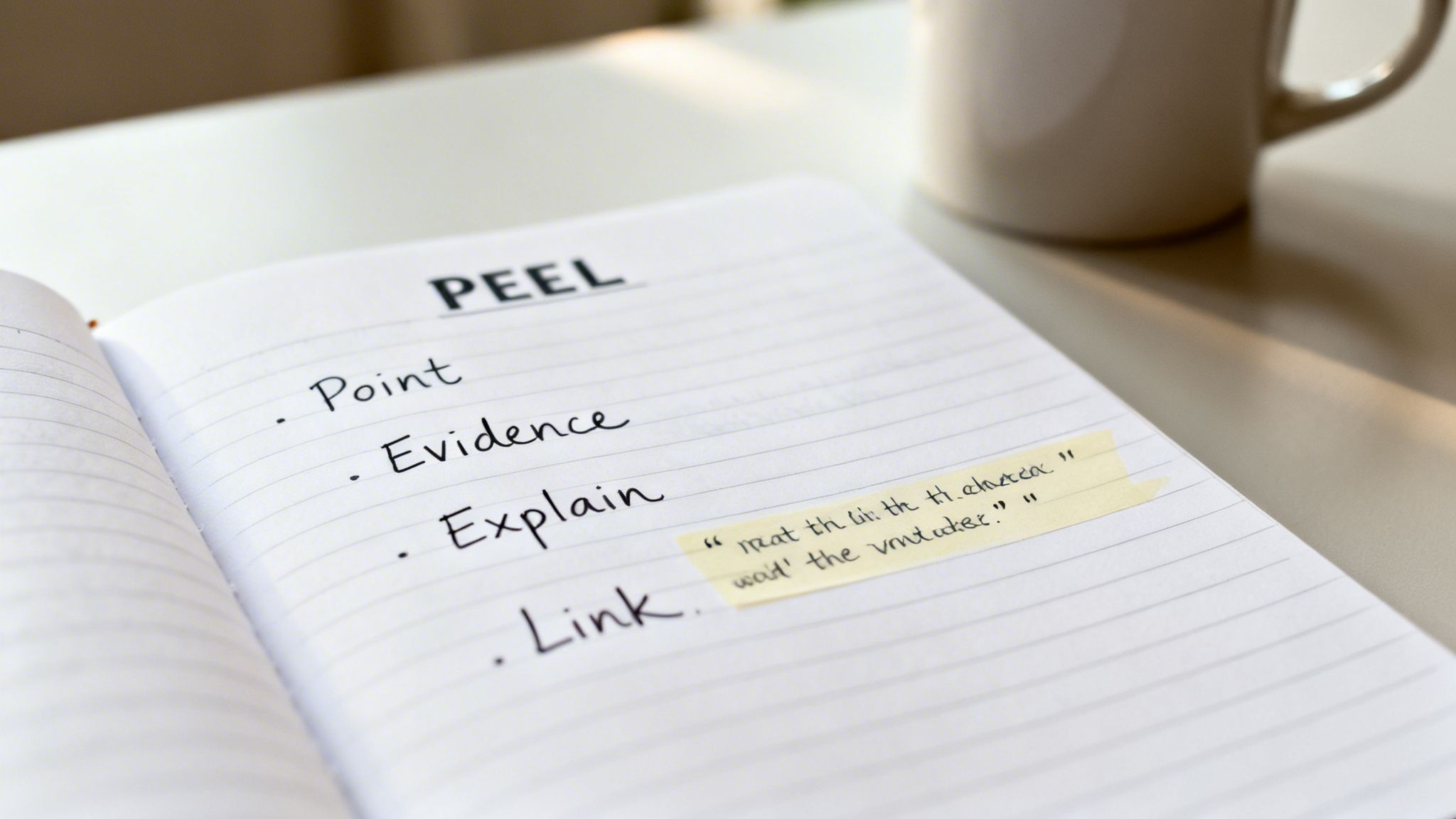
Mastering a technique like this helps you solidify the core arguments you'll need to signpost in your intro and bring together in your conclusion.
Writing a Conclusion That Leaves a Mark
Your conclusion is so much more than a simple summary. Just repeating your points word-for-word is a huge missed opportunity. This is your last chance to impress the examiner, pull all your arguments together, and prove why your perspective is the most convincing one.
A great conclusion works in the opposite way to an introduction. Instead of going from broad context down to your specific thesis, you'll start with your thesis and then zoom out to consider the bigger picture.
Here’s what every strong conclusion should do:
- Re-state Your Thesis: You’ve spent the whole essay proving it, so state it again with renewed confidence. Use fresh wording to show you’re not just repeating yourself.
- Synthesise Your Points: Don't just list what you've discussed. Briefly explain how your main paragraphs have worked together to prove your thesis. Show the logical connection between them.
- Offer a Final, Insightful Thought (The 'So What?'): This is where you really push for those top-band marks, especially for AO3. End with a powerful comment on the broader implications of your argument. Why does this topic matter? What's the wider significance? It's this memorable, final thought that makes your essay stand out.
Polish Your Essay with a Strategic Review
Finished writing? So many students think that means "pencils down". But those final few minutes aren't for resting – they're your golden opportunity to grab marks that other tired, rushed students leave behind.
Treating the review as an afterthought is a classic mistake. The real difference between a good and a great essay often comes down to a sharp, strategic polish at the end. This isn't about frantically rereading everything. It’s about a quick, targeted check with a clear purpose.
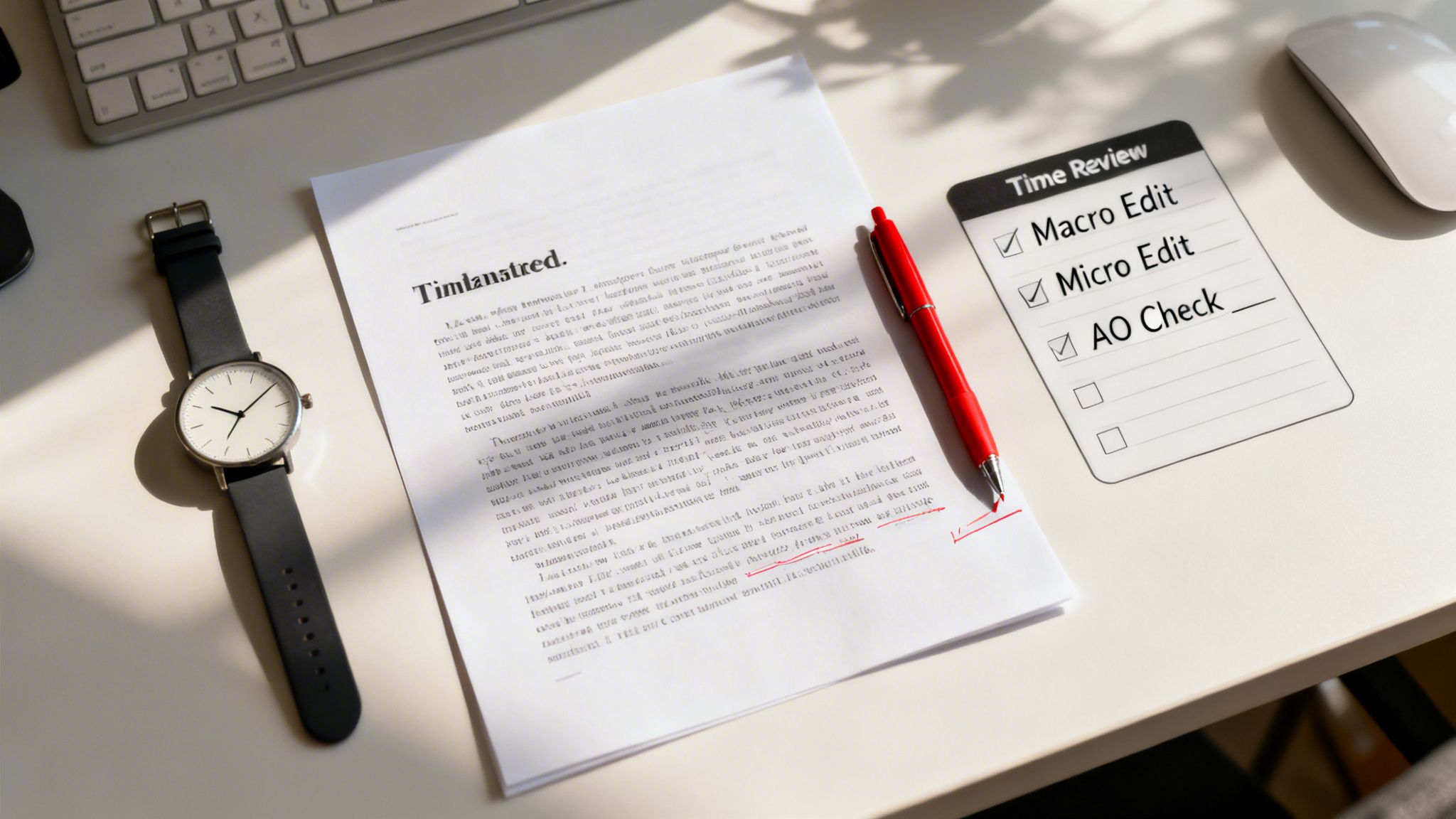
You can think of this as three efficient sweeps: the big-picture check, the fine-detail hunt, and the all-important mark scheme review.
The Macro Edit: Big-Picture Focus
First, zoom out. Take a deep breath and ask yourself the most important question of all: Does my essay actually answer the question? A simple but powerful trick is to read your introduction and your conclusion back-to-back. Do they align? Does the argument you set out at the start match the one you land on at the end?
Once you're happy with that, scan just the first sentence of each of your main paragraphs. These topic sentences should tell a logical story on their own. This is your chance to spot a paragraph that’s gone off-topic or an argument that doesn't quite hang together. A quick arrow to move a paragraph or adding a better linking phrase ("Consequently...", "However...") can make a huge difference to the flow and clarity.
The Micro Edit: Hunting for Easy Marks
Okay, now it's time to zoom in for the easy wins. This sweep is all about hunting for the silly errors that cost you marks in Spelling, Punctuation, and Grammar (SPaG), especially when fatigue kicks in. You don’t need to read every single word; instead, you’re scanning for common culprits.
- Repeated Words: Your brain often skips these when you’re writing under pressure. Actively look for slip-ups like "the the" or "and and".
- Common Mix-ups: Be on high alert for their/they're/there, your/you're, and its/it's. Fixing these is quick and makes your writing look instantly more polished.
- Missing Punctuation: A quick scan for full stops at the ends of sentences and capital letters at the start is an absolute must.
These small errors might seem minor, but an examiner sees them pile up, which can subtly affect their perception of your work. Nailing the basics is a cornerstone of effective writing, and you can find more techniques in our guide to planning, drafting, and editing your work.
The AO Check: Securing Your Grade
Finally, for the most crucial sweep, you need to put your examiner hat on and do a rapid Assessment Objective (AO) check. This is where you can turn a B-grade essay into an A-grade one.
With 806,410 A-Level entries projected for 2026 and top grades stabilising around 27.2%, every single mark is crucial. For the average student taking 2.65 A-Levels, the gap between grades often boils down to this final check. Simple SPaG errors or a weak evaluation can be the decider.
A Quick AO Checklist:
- AO1 (Knowledge): Have I backed up my points with specific, relevant evidence? Look for names, dates, or key quotes in every main paragraph.
- AO2 (Analysis): Does every paragraph have a clear 'Explain' section that actually digs into the evidence? Have I shown why my point is important?
- AO3 (Evaluation): Is my overall judgement clear in both the intro and conclusion? Have I shown that I've considered different viewpoints or counter-arguments?
Learning to spot these issues quickly turns a frantic final five minutes into a strategic, mark-grabbing exercise. This is how you learn to write a top-tier essay, even when the clock is ticking.
Frequently Asked Questions About Essay Writing
We've walked through the entire process, from breaking down the question to polishing that final draft. But even with the best blueprint, certain questions always crop up, especially for GCSE and A-Level students feeling the exam pressure.
Getting straight answers to these common worries can be the difference between panic and confidence. Here are the things students—and their teachers—ask us most often.
How Long Should My Essay Be?
This is the classic question, but the answer isn't about word count. It's about quality and smart time management. An examiner would much rather read a sharp, focused, and complete essay than a long, rambling one that runs out of steam.
For a standard 45-minute GCSE essay, a great target is an intro, three well-argued PEEL paragraphs, and a conclusion. This usually lands somewhere around 4-5 pages of average handwriting. For A-Levels, where you need more depth, you might push for four body paragraphs, but only if you can manage the time.
What really matters is how you use your clock:
- Planning: Take the first 5 minutes. No excuses. Use this time to decode the question and map out your argument.
- Writing: The next 35 minutes are for pure writing—get that intro and your main paragraphs down.
- Reviewing: You must save the final 5 minutes to proofread and edit. It’s non-negotiable.
A complete essay with three strong points will always outscore an unfinished essay with four. Never sacrifice your conclusion to chase another paragraph. A finished structure signals control and confidence to the examiner.
What if I Run Out of Time?
It happens to the best of us. The trick is to have a game plan and not to panic. If you look at the clock and see you only have five minutes left while you're still mid-paragraph, stop writing it.
Your new priority is to hand in a finished piece of work. Just finish the sentence you’re on and jump straight to your conclusion. Write a short, decisive final paragraph that quickly summarises the points you did manage to make and restates your main argument with conviction.
A finished essay, even a shorter one, feels structurally sound. An essay that just trails off with a half-written paragraph screams "poor time management". Always, always prioritise a complete structure over one last, unfinished point.
How Do I Add My Own Voice or Critical Analysis?
This is how you unlock those top-band marks for Assessment Objective 3 (AO3). Your "voice" isn't about using flowery language; it's about your personal judgement and analysis. It's the part of the essay that shows the examiner you are doing the thinking.
This magic happens in the 'Explain' part of your PEEL paragraphs. After presenting your evidence, you need to ask yourself, "So what? Why is this actually significant?" Your answer to that question is your analytical voice.
Critical analysis is all about showing you can see the bigger picture. Here are three practical ways to inject it into your writing:
- Acknowledge a counter-argument: Use phrases like, "Some might argue that... however, this view is perhaps limited because..."
- Evaluate your own evidence: Show you're thinking about your sources. For instance, "While this source is useful for showing X, its weakness is that it completely overlooks Y."
- Connect your ideas: Don't treat your paragraphs like separate islands. Link them together to build a more sophisticated and layered argument.
Your conclusion is the perfect stage for a final display of critical skill. This is your chance to weigh up the different strands of your argument and deliver a final, reasoned judgement.
Can I Use AI to Help Write My Essay?
This is a massive question right now, for both students and teachers. The answer is a definite 'yes' for practice and an absolute 'no' for your final submission. Let's be crystal clear: never submit work written by an AI as your own. This is plagiarism, and it will be flagged under the official JCQ regulations.
That said, using AI as a revision partner can be a brilliant move. Think of it as your personal tutor, not a ghostwriter. It's a tool to help you prepare smartly, not a shortcut to cheat the system.
Here’s how to use it constructively:
- Brainstorming: Ask it for potential arguments or different perspectives on a topic you're stuck on.
- Grammar Checks: Paste in paragraphs you've written yourself to get feedback on spelling, punctuation, and grammar (SPaG).
- Structure Critique: Ask an AI tool to review an essay plan or a practice essay you've written. Does it flow logically? Is the argument clear?
Using a platform specifically designed for revision helps you develop your own skills, which is the whole point of your education. Simply copying and pasting is a surefire way to get a zero mark and face serious academic consequences.
Are you ready to stop guessing and start writing essays that consistently hit the top marks? MasteryMind is built for UK students who want to practise with exam-board-specific questions and get instant, examiner-style feedback. Transform your revision and walk into your exams with confidence. Explore our features and start for free at https://masterymind.co.uk.
Ready to master this topic?
Practise with quizzes, blurt exercises and exam questions on MasteryMind.
7 days Premium · Then free forever · No card, no charge