Essay Writing Format for GCSE and A-Level
The advice to write an introduction, three body paragraphs and a conclusion sounds reassuring. It's also incomplete. An examiner doesn't award marks for reaching a paragraph count. They look for an answer that does what the question asks, supported by evidence and clear reasoning.
A useful essay writing format gives each paragraph a job. Whether you're catching up after patchy revision or pushing for a top grade, the aim is the same: make the skills being assessed easy to see.
The Essay Shape Markers Can See
A GCSE or A-level essay is a short argument, not a container you fill with everything you remember. Copy this skeleton into your planning space, then choose material that earns its place.
Exam essay parts and what each one must do
| Part | Job | Include | Leave out |
|---|---|---|---|
| Introduction | State the line of argument | Thesis and two or three signposts | Plot summary or every quotation |
| Body paragraph | Prove one point | Claim, short evidence, reason or method, link | A second topic halfway through |
| Comparative paragraph | Hold both texts in one point | Shared idea, Text A method, Text B method, compared effect | Two mini-essays joined by one sentence |
| Conclusion | Answer the question | Judgement and the strongest reason | New quotations or a copied introduction |
Give each block a clear job
Your introduction should answer the question before you start proving the answer. A thesis is your central argument; signposts name the main reasons you'll develop. You don't need a dramatic opening about humanity, society or the beginning of time.
As a planning guide, give the introduction about a tenth of your writing time. Use that space for a thesis and two or three signposts, not a catalogue of quotations. A short, direct opening leaves room for the analysis that follows.
Each body paragraph develops a distinct claim. Add a short embedded quotation or precise example, explain the reason or writer's method, and connect the result to your argument. Start a new paragraph when the point changes, rather than because the current paragraph looks long.
Comparative writing needs its own plan row. Put the texts beside each other under a shared issue so you can explain their relationship, rather than making the reader remember a separate essay about each.
Planning rule: Choose evidence because it helps answer the question, not because it's the quotation you remember most confidently.
Plan time as well as content
For a hypothetical 45-minute response, try five minutes planning, thirty-five writing and five checking. Treat that as a practice starting point, not an exam-board rule. Adjust it if you know you need longer to read the extracts.
For English Language writing, also name the form, audience and purpose. A speech to classmates needs different organisation and address from a newspaper article, even when both argue the same position.
The conclusion gives your answer in fresh words, identifies the strongest reason and stops. The skeleton stays useful, but the middle changes when the command word changes.
PEEL Paragraphs Thesis Lines and Links
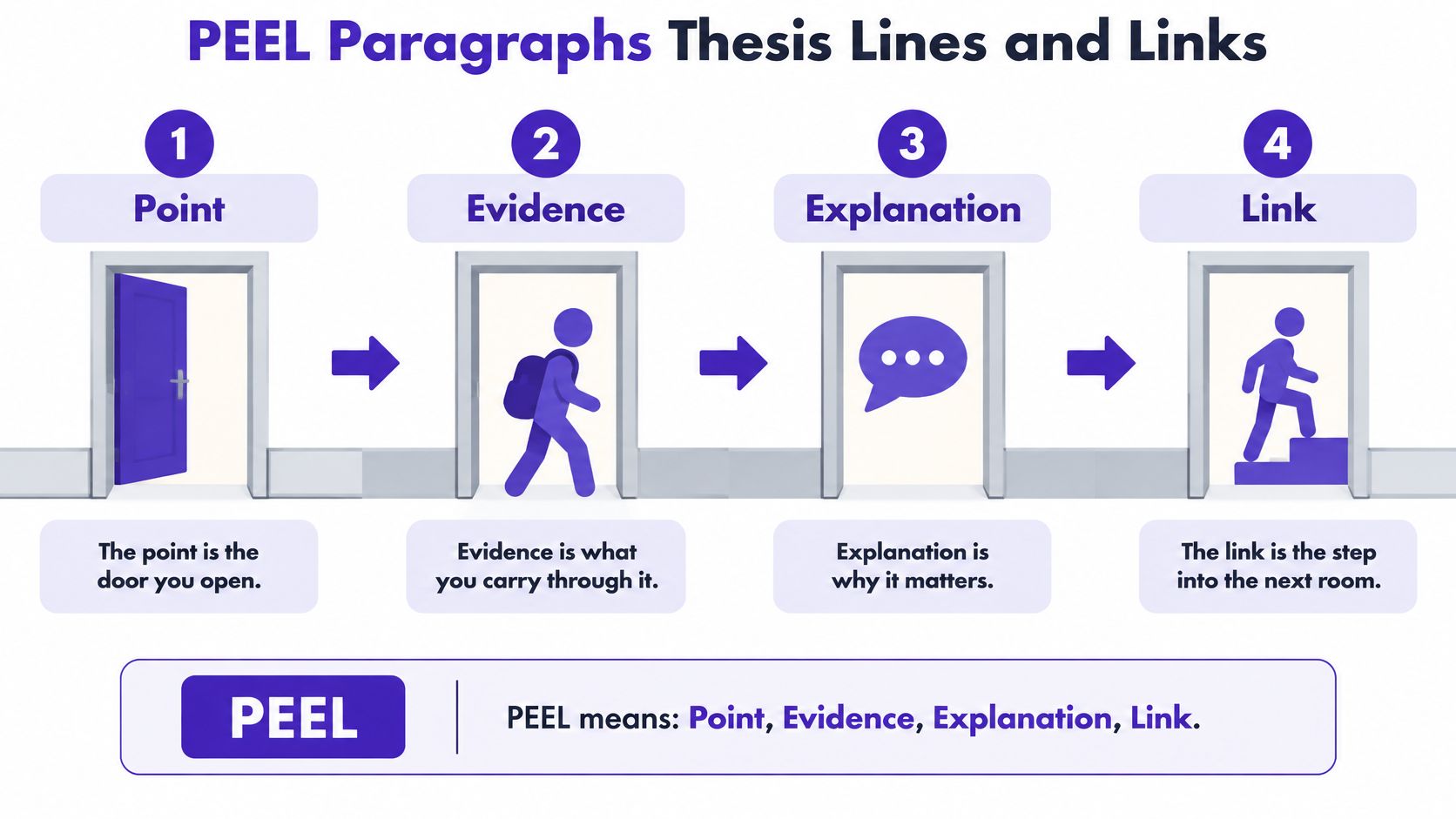
A paragraph works like a corridor. The point is the door you open, evidence is what you carry through it, explanation shows why the load matters, and the link takes you into the next room.
PEEL means Point, Evidence, Explain, Link. Some teachers use Explanation for the third step; the job is identical. PEA means Point, Evidence, Analysis, which suits English especially well because analysis must explain a writer's choices rather than retell the text. Whichever acronym your teacher uses, each step exists to make the assessment objective visible: the point states what you are doing, the evidence grounds it, the analysis earns the marks, and the link shows the examiner the through-line. How much weight each step carries shifts with the task. A question asking you to analyse loads the explanation; one asking for a judgement expects the link to deliver it.
A pattern you can practise
When you're unsure how to develop a point, try this six-sentence pattern. Treat it as a training aid; real paragraphs can run shorter or longer.
- Make the claim. Write a topic sentence using the question's key idea.
- Supply evidence. Embed a short quotation or give a precise example.
- Name the method or reason. Identify what produces the meaning or supports the claim.
- Examine a detail. Zoom in on a word, image, figure, contrast or cause.
- Explain the significance. Show what this suggests to the reader or establishes in the argument.
- Connect the result. Return to the thesis or prepare a related next point.
The difference between explanation and analysis often causes confusion. Explanation makes an idea clear; literary analysis examines how the writer constructed it. Identifying a metaphor earns little until you say what its particular comparison suggests.
The same sequence works beyond literature. Say a history source is a recruitment poster: your claim might be that it has limited value for judging public enthusiasm. Its celebratory image supplies the evidence; its persuasive purpose explains why it emphasises support and leaves reluctance out.
The poster still has worth. Your final judgement can separate its value as evidence of official persuasion from its weakness as evidence of private opinion. In a science evaluation, measured data fills the evidence slot, followed by reasoning about reliability or the conclusion.
Write an argument, not an announcement
A thesis should be an arguable sentence. Instead of announcing that you'll discuss ambition in Macbeth, argue that Shakespeare presents ambition as destructive once Macbeth lets imagined rewards outweigh moral judgement.
For an explanatory assignment, an expository outline revision checklist helps you test whether each supporting point genuinely belongs under the central idea. The checklist tests your reasoning; the paragraphs still have to sound like you.
Choose linking words by their job:
- Addition: similarly, another reason.
- Contrast: however, whereas, despite this.
- Cause: because, therefore, consequently.
- Judgement: on balance, more convincingly, the stronger reason is.
Firstly, secondly, thirdly at every turn flattens the writing. A transition such as The stronger reason is tells the reader how your ideas relate.
Finish with the thumb test: cover the quotation. Your remaining sentences should still carry a clear point and explanation. If they can't, the evidence is doing work you haven't explained.
How Command Words Change the Format
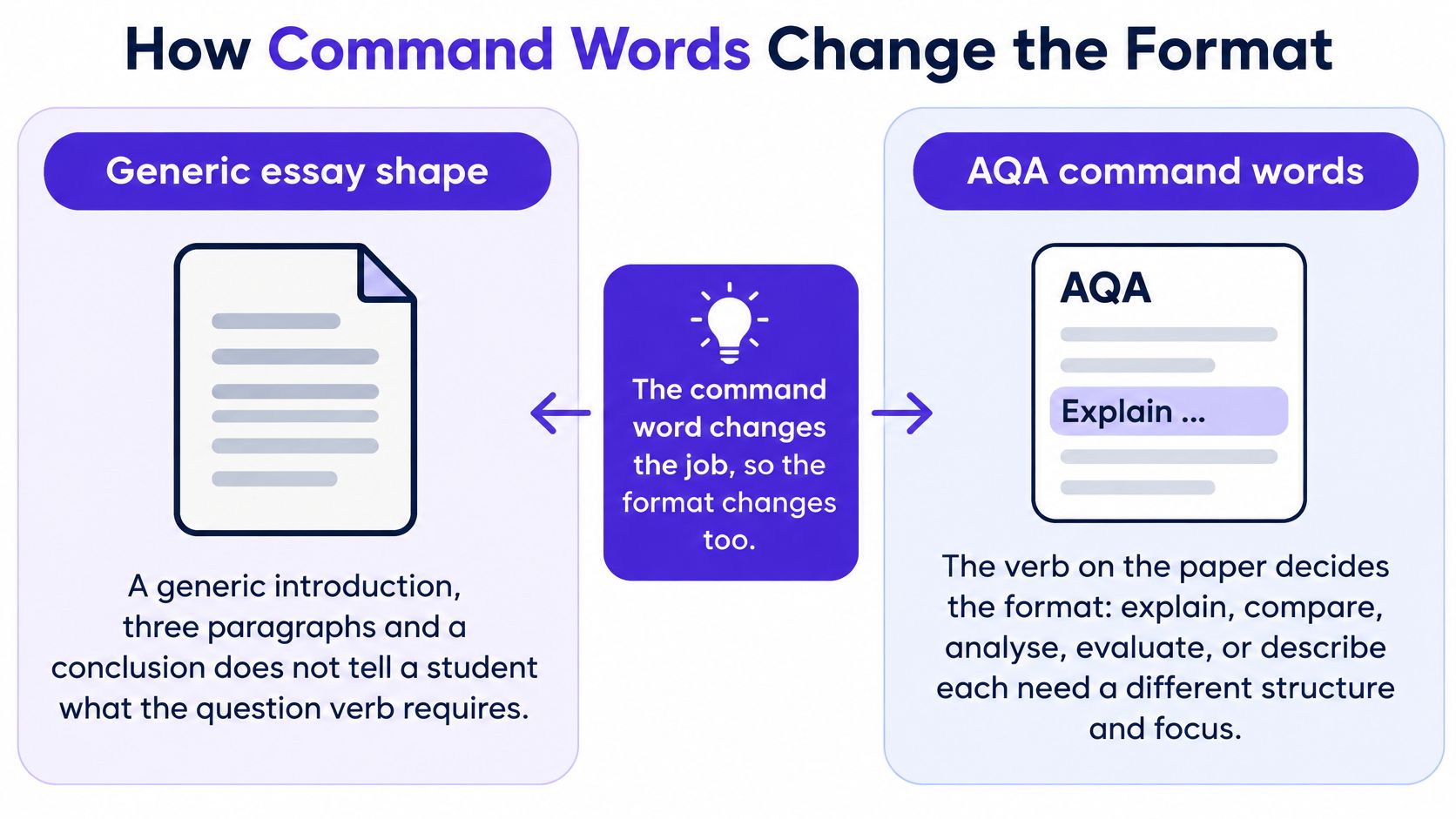
A generic introduction, three paragraphs and conclusion doesn't tell you what the verb on the paper requires. You can write fluent paragraphs and still miss the task by explaining when you should be evaluating.
AQA's command-word guidance defines analyse as separating information into components and identifying characteristics, assess as making an informed judgement, and compare as identifying similarities or differences. Those distinctions should change your plan before they change your sentences.
Command words and the paragraph they need
| Command word | Paragraph job | Where judgement sits |
|---|---|---|
| Analyse | Separate the method or issue into parts and say what each does | Not required unless the question also asks for a judgement |
| Assess or Evaluate | Make an informed judgement and support it with evidence | In the thesis and again at the end of key paragraphs |
| Compare | Show a similarity or difference in ideas and in how they are made | Inside every paragraph, not only the final sentence |
| Discuss | Explore more than one angle, including a counter-point | After the counter-point, as a decision rather than a shrug |
| Explain | Make a meaning or cause clear and tie it to the question | A reason, not a verdict and not a definition dump |
Use this comparison to spot the difference between completing a template and performing the task.
Same topic, different paragraph
Suppose you're answering a question about a poem's presentation of power. These possible topic sentences take different routes:
- Analyse: The poet uses the contrast between the ruler's confidence and the ruined setting to expose the fragility of power.
- Discuss: Although the ruler appears politically dominant, the ruined setting suggests that time exercises a greater power.
- Evaluate: The poem's most convincing challenge to political power comes from its ruined setting, because physical decay undermines the ruler's claims more decisively than direct criticism would.
The analyse response needs close examination of the contrast. The discuss response must explore the competing kinds of power. The evaluate response has already made a judgement and must justify why that feature matters most.
A comparison also needs care: comparing doesn't automatically mean deciding which writer is better. Your judgement may concern how their viewpoints differ, not which text wins.
Change the plan box
Under timed conditions, change the plan, not your handwriting speed. Two developed points that perform the verb are more useful than five loosely relevant points that ignore it.
A-level work still needs personal interpretation, accurate terminology and relevant context. Those skills belong inside your answer to the command word; they aren't substitutes for it.
For practice, use a teacher-set question, a past paper or Exam Practice for GCSE, then circle the command word before planning. A teacher auditing the response can ask a blunt question: does the paragraph perform that verb?
Where AQA Literature Marks Actually Sit
For AQA GCSE English Literature, AO2 carries 42.5%, AO1 37.5%, AO3 15% and AO4 5%, according to the AQA GCSE English Literature scheme of assessment. These are qualification-wide weightings, not a formula for allocating sentences in every individual answer.
AQA GCSE English Literature essay objectives
| Objective | Share | What to write |
|---|---|---|
| AO1 response and references | 37.5% | A personal line of argument backed by short textual references |
| AO2 language, form and structure | 42.5% | Most of the analytical development on method and effect, not plot |
| AO3 context | 15% | A brief link where context changes meaning |
| AO4 vocabulary and accuracy | 5% | Clear sentences, accurate spelling and punctuation |
Turn weighting into writing decisions
AO1 rewards a critical, informed personal response supported by quotations or other textual references. AO2 assesses how the writer uses language, form and structure to create meanings and effects. That combination means you need both an interpretation and an explanation of how the text supports it.
Retelling Macbeth's decisions establishes what happens. Examining how Shakespeare uses a private speech, repeated image or shift in sentence structure explains how he presents those decisions.
Don't interpret the table as a demand to count technique names. A paragraph naming imagery, repetition and punctuation without developing an interpretation can still be thin. It's usually more productive to examine a relevant choice carefully than to collect labels.
Context should sharpen your reading. A claim about kingship, social expectations or religious belief needs a clear relationship with the particular text, rather than becoming a detached history lesson.
A contextual fact earns its place when it changes how you understand the writer's choice.
Audit sentences, not paragraph length
After drafting, mark sentences by function:
- Response and evidence: Your interpretation and the textual detail supporting it.
- Method analysis: How language, form or structure produces meaning.
- Context: The relevant relationship between the text and its circumstances.
Then inspect the gaps. Evidence without explanation needs analysis; context without a textual connection needs connecting or cutting. A sentence that merely repeats the question may need replacing with a more precise interpretation.
A useful revision might replace a general statement that Macbeth feels guilty with an explanation of how an imagined sound interrupts his confidence. The improvement comes from identifying a meaningful dramatic choice, not adding more plot.
Check the task-specific descriptors alongside the qualification objectives using your specification, teacher feedback or AQA marking resources on MasteryMind. These Literature weightings shouldn't be pasted onto another board, subject or qualification. The transferable habit is to check what your actual task rewards before deciding how to develop it.
How English Language Marks Map to Your Essay
A longer essay does not automatically earn more marks. In English Language, the task's command word and assessment objectives determine what each paragraph needs to do. Reading asks you to analyse someone else's choices; writing asks you to make deliberate choices of your own.
Use the objectives attached to the question as a map. Each paragraph should make the work carrying the most marks easy to see.
AQA GCSE English Language objectives and what each needs
| Objective | Share | What to write |
|---|---|---|
| AO1 identify, interpret and synthesise | Question-specific | Explicit and implicit points supported by evidence |
| AO2 language and structure effects | 17.5% of GCSE specification | Explain how a method creates an effect on the reader |
| AO3 compare ideas and perspectives | Question-specific | Show how two writers convey their ideas and viewpoints |
| AO5 communication and organisation | 24 of 40 marks per writing question | Shape tone, style, register, organisation and cohesion |
| AO6 vocabulary and accuracy | 16 of 40 marks per writing question | Use sentence structures, spelling, punctuation and grammar accurately |
Tag the work you've actually done
A relevant quotation can support AO1, but it does not automatically analyse a method. To show AO2, explain how the writer's language or structure shapes meaning. For a comparison, identify how each writer presents a viewpoint and explain the choices that convey it.
In a writing task, organisation is more than putting ideas in separate paragraphs. The sequence should guide the reader, while tone and register should suit the audience. Accurate spelling supports the response, but it cannot make unrelated ideas form a coherent argument.
- Reading check: Is your interpretation supported by evidence, and have you explained the method's effect?
- Writing check: Does each paragraph have a clear place in the argument, with a tone suited to the audience?
- Board check: Are you using the objectives and allocation for your qualification and question?
The figures shown are AQA-specific. For another board, use its mark scheme and keep the question's content demands separate from technical accuracy.
Worked Paragraphs You Can Copy
Say you know the text but freeze when you have to turn notes into a paragraph. Copy the sequence of moves below, not a prepared answer that might miss your exam question.
Keep your practice page simple enough to annotate.
A Literature paragraph with visible analysis
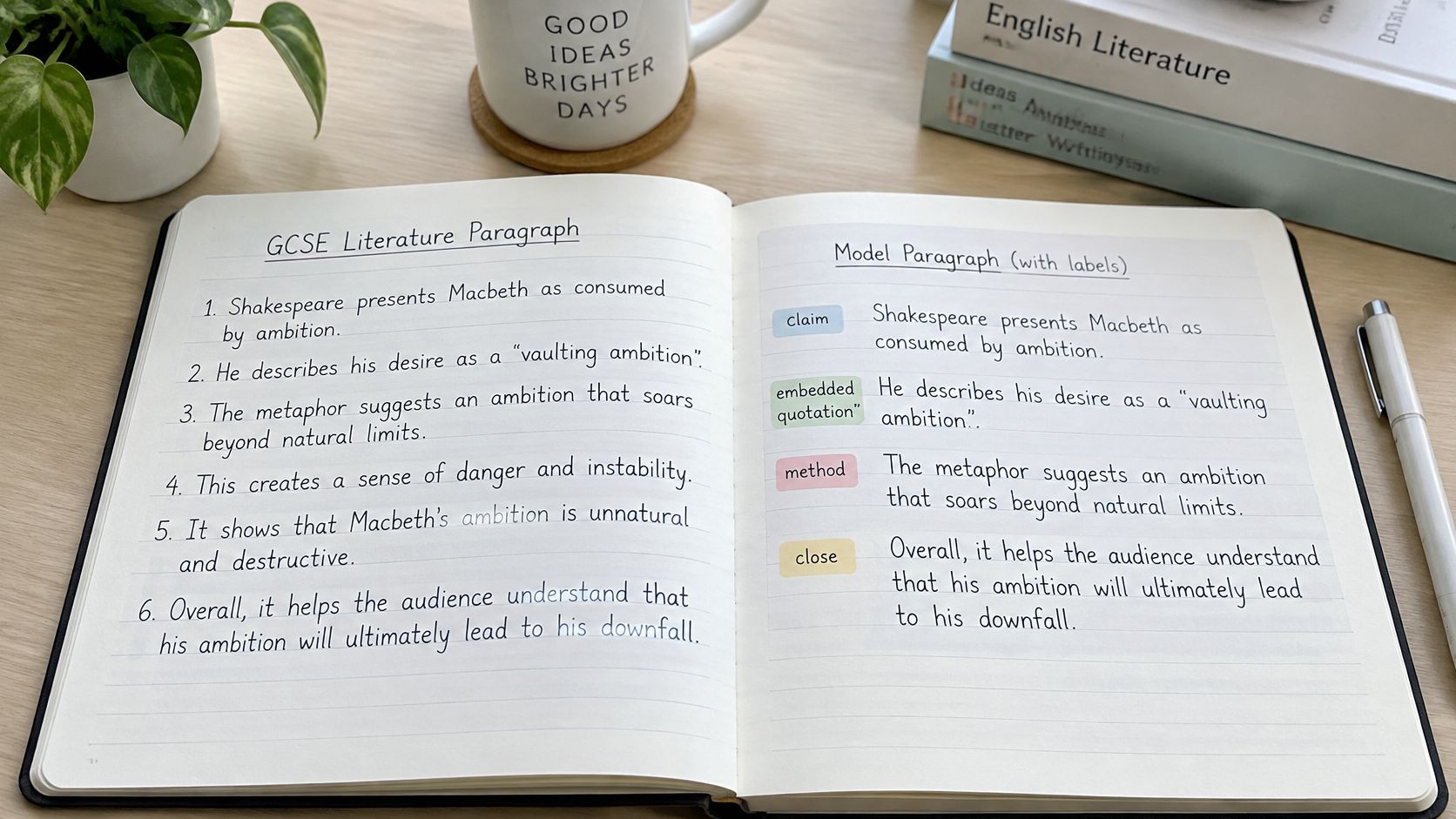
This model answers a practice question about how Shakespeare presents guilt in Macbeth. It uses a precise textual reference rather than risking an inaccurately remembered quotation.
Shakespeare presents guilt as a force that destroys Macbeth's sense of security. After Duncan's murder, Macbeth imagines a voice condemning him to sleeplessness. Shakespeare uses an imagined sound to turn private guilt into an accusation Macbeth seems to hear. The focus on sleep makes the punishment intimate, because an ordinary source of rest becomes something he believes he has lost. The audience sees that gaining political power cannot protect him from his own mind. His distress therefore presents regicide as an inward as well as a political violation, challenging the rightful order of kingship.
Margin notes
- Claim: The opening answers how guilt is presented.
- Evidence: The reference identifies a specific moment.
- Method: The imagined sound explains a dramatic choice.
- Close analysis: The discussion examines the significance of sleep.
- Effect: The audience's understanding follows from the detail.
- Link and context: The ending returns to inward damage and briefly connects it to kingship.
An embedded quotation could replace the reference if you remember the exact wording. Don't force a quotation into the paragraph just because you've learnt it.
A paired Language paragraph
For this invented practice example, Text A describes a crowded station through an image of a swallowing crowd. Text B presents the station as an orderly sequence of arriving trains.
Both writers present the station as powerful, but they differ over whether that power threatens or reassures travellers. Text A describes the crowd as swallowing the narrator. This predatory metaphor makes the individual seem vulnerable within an overwhelming public space. By contrast, Text B describes trains arriving in a steady sequence. The regular progression of arrivals suggests coordination and control rather than danger. Whereas Text A presents collective movement as a loss of individuality, Text B presents it as evidence that the station functions reliably.
The paired structure makes comparison part of the reasoning, rather than an extra sentence attached to isolated mini-essays. AQA's assessment guidance distinguishes interpretation, analysis of methods and comparison as different assessed skills.
For another practice session, use the video alongside your own annotated paragraph.
Reproduce the plan without the model
Use this blank structure with a question from GCSE Past Papers:
- Thesis line: My answer to the exact question is…
- Point one: Claim… Evidence… Method or reason…
- Point two: Claim… Evidence… Method or reason…
- Judgement line: The strongest conclusion is… because…
Check method-to-evidence coverage: after each selected quotation, explain a specific lexical, grammatical, structural or presentational choice rather than paraphrasing it. For A-level, extend the reasoning with a plausible alternative interpretation and accurate terminology, not a completely new format.
Your done test is practical: a friend should be able to underline your answer to the question in the opening sentence and recognise its developed form in the ending.
Accuracy Checks and the Last Look
Start the accuracy pass with sentence boundaries. Find places where you've joined complete sentences with only a comma, then separate them or add a suitable conjunction. Check capitals, full stops and whether each paragraph develops a clear idea.
For AQA GCSE English Language, 16 of the 40 marks per writing question reward technical accuracy, and AO6 represents 20% of the qualification, according to AQA's exam information. Accuracy deserves protected checking time, not whatever seconds remain.
Make corrections the examiner can read
- Paragraphing: Indent new paragraphs in handwriting, or use clear spacing when typing.
- Apostrophes: Use them for possession or omission, not ordinary plurals.
- Key spellings: Check character names, subject terms and words copied from the question.
- Presentation: Keep handwriting legible, embed quotations, and underline titles or use inverted commas.
- Audience: Remove expressions that don't suit the required purpose and tone.
For coursework and researched A-level assignments, acknowledge borrowed ideas and include a bibliography. If your department uses author-date referencing, give the author and year in the sentence or citation; other systems use footnotes. Timed school essays rarely need that apparatus.
Avoid inflated thesaurus words, announcements about what the essay will cover, quotation dumps and conclusions that introduce fresh arguments.
The six-check last look
- Exact answer: Does the introduction answer this question?
- Command word: Does each paragraph perform the required task?
- Support: Does evidence come with a reason or method?
- Comparison: Are relationships explained within paragraphs where required?
- Conclusion: Does it judge without introducing new quotations?
- Accuracy: Are sentence boundaries and key spellings clean?
Don't judge practice against a universal percentage target. Ofqual's grading guidance explains that exam boards set boundaries after exams, when marking is nearly complete, using comparisons with previous years; 70% doesn't always mean grade 7, and boundaries can differ by board and series.
Write a timed paragraph, apply the checks and practise the weakest move again. Pair teacher feedback with a structured option such as Online Revision for GCSE rather than repeatedly writing full essays without reviewing them.
MasteryMind offers exam-aligned practice and examiner-style feedback with assessment-objective breakdowns. Visit MasteryMind to practise an essay question, review which skills your answer demonstrates and choose a specific improvement for your next draft.
Choose your next course task
Use this idea in your next study session. Confirm the qualification, awarding organisation and course version before choosing practice, assignment preparation or evidence planning.
Find your course and next task