Eukaryotic and Prokaryotic Cells: A GCSE & A-Level Guide
If you've ever looked at a biology revision guide and thought, “I know there's something about a nucleus, but it all blurs together,” you're in very normal territory. Eukaryotic and prokaryotic cells sit right near the base of GCSE and A-Level biology, which means they keep coming back in different disguises. One question asks you to label a diagram. Another asks you to compare structures. Then practical papers suddenly want you to connect cell size to what you can see under a microscope.
That's why this topic matters so much. If you understand it properly once, a lot of later biology gets easier. DNA organisation makes more sense. Cell division makes more sense. Microscopy questions stop feeling random. If you're building your revision plan, structured support like Online Revision for GCSE can help you practise these ideas in an exam-style way, and if you want a practical feel for microscopes rather than just textbook drawings, this Playz guide for exploring the unseen world is a useful starting point.
Your Crash Course on the Building Blocks of Life
You look down a school microscope, adjust the focus, and expect to see the neat textbook shapes you revised the night before. You usually do not. Real cells often look faint, uneven, and far less tidy than the diagrams. That is exactly why this topic catches students out in exams. You need to know the simplified model, but you also need to know what the model is trying to represent.
All living things are made of cells, but cells come in two main types: prokaryotic and eukaryotic. The split is not just a naming detail. It changes where the DNA is found, how the inside of the cell is organised, and what sort of organism you are dealing with.
A useful big-picture idea is the three-domain system of life: Bacteria, Archaea, and Eukarya. At school level, Bacteria and Archaea are grouped as prokaryotes, while Eukarya includes plants, animals, fungi, and protists, which are eukaryotes. You do not always need the three domains for a one-mark definition, but examiners like students who can place the cell type into this wider biological framework.
The one difference that gets the mark
If a question asks for the core difference, write the point that examiners are looking for:
- Prokaryotic cells do not have a membrane-bound nucleus and do not have membrane-bound organelles
- Eukaryotic cells have a membrane-bound nucleus and do have membrane-bound organelles
That wording is safe and precise.
Students often lose marks by writing prokaryotes are simple and eukaryotes are complex. Those ideas are too vague on their own. They can support an answer, but they do not replace the nucleus point. A bacterium is not just a "basic" cell. It still carries out all the functions needed for life.
What this looks like in real life
Under a school microscope, you are far more likely to see a clear eukaryotic example, such as onion cells or cheek cells, than to see fine internal detail in a prokaryote. Textbook diagrams make organelles look bold and separate, almost like labelled rooms on a floor plan. In reality, most school microscopes do not show that level of detail. So if you cannot see a nucleus in every classroom slide, that does not mean the definition has changed.
A good analogy is this. A eukaryotic cell works like a building with separate rooms. The nucleus keeps the DNA inside its own compartment. A prokaryotic cell works more like a single open workspace. The DNA is still there, but it is not sealed inside a membrane-bound nucleus.
Why students get confused
The biggest myth is that prokaryotic means "no nucleus, so hardly anything is going on." That is wrong. Prokaryotic cells still have a cell membrane, cytoplasm, ribosomes, and DNA. They are small and organised differently, not incomplete.
Keep this order in your head:
- Ask where the DNA is
- Check whether a membrane-bound nucleus is present
- Then decide whether the cell is prokaryotic or eukaryotic
That sequence works well in both diagrams and written questions.
If you are building revision around exam-style practice, Online Revision for GCSE can help you rehearse these distinctions clearly. If you want a better sense of what cells look like through beginner equipment rather than polished textbook art, this Playz guide for exploring the unseen world is a useful reference.
Meet the Prokaryote The Original Blueprint
A prokaryotic cell is the biological version of a studio apartment. Everything important is there, but there aren't separate rooms with doors. It's compact, efficient, and built to get the essentials done fast.

The first thing to say about a prokaryote is what it doesn't have. It doesn't have a true nucleus. Its DNA sits in a region called the nucleoid, which is not enclosed by a membrane. It also lacks membrane-bound organelles like mitochondria, chloroplasts, and the Golgi apparatus.
What a prokaryotic cell does have
Despite that, it still has the core structures needed for life:
- Cell membrane for controlling what enters and leaves
- Cytoplasm where reactions happen
- Ribosomes for protein synthesis
- Cell wall for support and protection
- DNA in the nucleoid region
For many exam questions, that shared machinery matters. Students sometimes think prokaryotes are missing loads of basics. They aren't. They still have DNA, ribosomes, a plasma membrane, and cytoplasm.
DNA in prokaryotes
The genome architecture is a major exam point. Prokaryotic DNA is generally circular and sits in the nucleoid rather than inside a nucleus. Many prokaryotes also carry plasmids, which are small extra loops of DNA that can carry useful genes, such as genes linked to antibiotic resistance or survival in particular conditions, as described in this discussion of key differences in eukaryotic and prokaryotic cells.
That means if an examiner asks for the role of plasmids, don't say “they are the main DNA of the cell.” They aren't. They are additional genetic material.
A strong GCSE answer uses the word nucleoid rather than saying the DNA is “floating around”.
What prokaryotes actually look like
Under a school microscope, prokaryotes are awkward. They are small and often don't show much internal detail in the neat way textbook diagrams suggest. In a practical context, they may appear more like tiny shapes than like beautifully labelled textbook bacteria.
That's one reason students overestimate how much they're supposed to “see.” You're usually expected to understand their structure from biology knowledge, not to expect a classroom light microscope to reveal every feature.
For wider context on microbial survival and environmental exposure, this piece on threats in high-traffic environments can help you think about where prokaryotic organisms are found and why they matter.
Meet the Eukaryote The Complex City
If the prokaryote is a studio apartment, the eukaryotic cell is a city. It has separate compartments, each with a specialised role. That organisation is why eukaryotic cells can usually become larger and support more complex life.

The most important structure is the nucleus, where the cell stores its DNA. In eukaryotes, DNA is usually linear and organised into multiple chromosomes inside that nucleus. This arrangement supports much more regulated control of gene expression than the stripped-back setup in prokaryotes.
The organelles that examiners expect
At GCSE, you usually need to recognise and describe the main jobs of the best-known organelles.
- Nucleus. Stores genetic material.
- Mitochondria. Site of aerobic respiration.
- Ribosomes. Make proteins.
- Cell membrane. Controls movement of substances.
- Cytoplasm. Site of many chemical reactions.
A-Level students often need a bit more depth, especially on membrane-bound organelles such as the endoplasmic reticulum and Golgi apparatus, because compartmentalisation is part of the reason eukaryotic cells can run many specialised processes at once.
Animal and plant cells
Both animal and plant cells are eukaryotic, but students lose marks when they blur their differences.
Here's the clean version:
| Cell type | Features you should expect |
|---|---|
| Animal cell | Nucleus, cytoplasm, cell membrane, mitochondria, ribosomes |
| Plant cell | All of the above, plus cell wall, chloroplasts, and a large permanent vacuole |
Plant cells often appear more regular in shape because of the cell wall. Animal cells often look less fixed in outline.
Plant and animal cells are both eukaryotic. The presence of a cell wall does not automatically mean a cell is prokaryotic.
Why this matters beyond memorising labels
Compartmentalisation is the key idea. In a eukaryotic cell, different parts can carry out different jobs in different places. That separation helps with control and specialisation.
If you're also revising how cell structures connect to chemistry, these expert biological molecules insights are useful because organelles don't work in isolation. Membranes, enzymes, proteins, and nucleic acids all link together.
Prokaryotic vs Eukaryotic A Head-to-Head Comparison
In a school lab, this comparison becomes very real very quickly. Onion cells usually look large, clear, and easy to map out. Bacteria on a prepared slide are far smaller and usually appear as tiny dots or short rods unless the stain and focus are spot on.
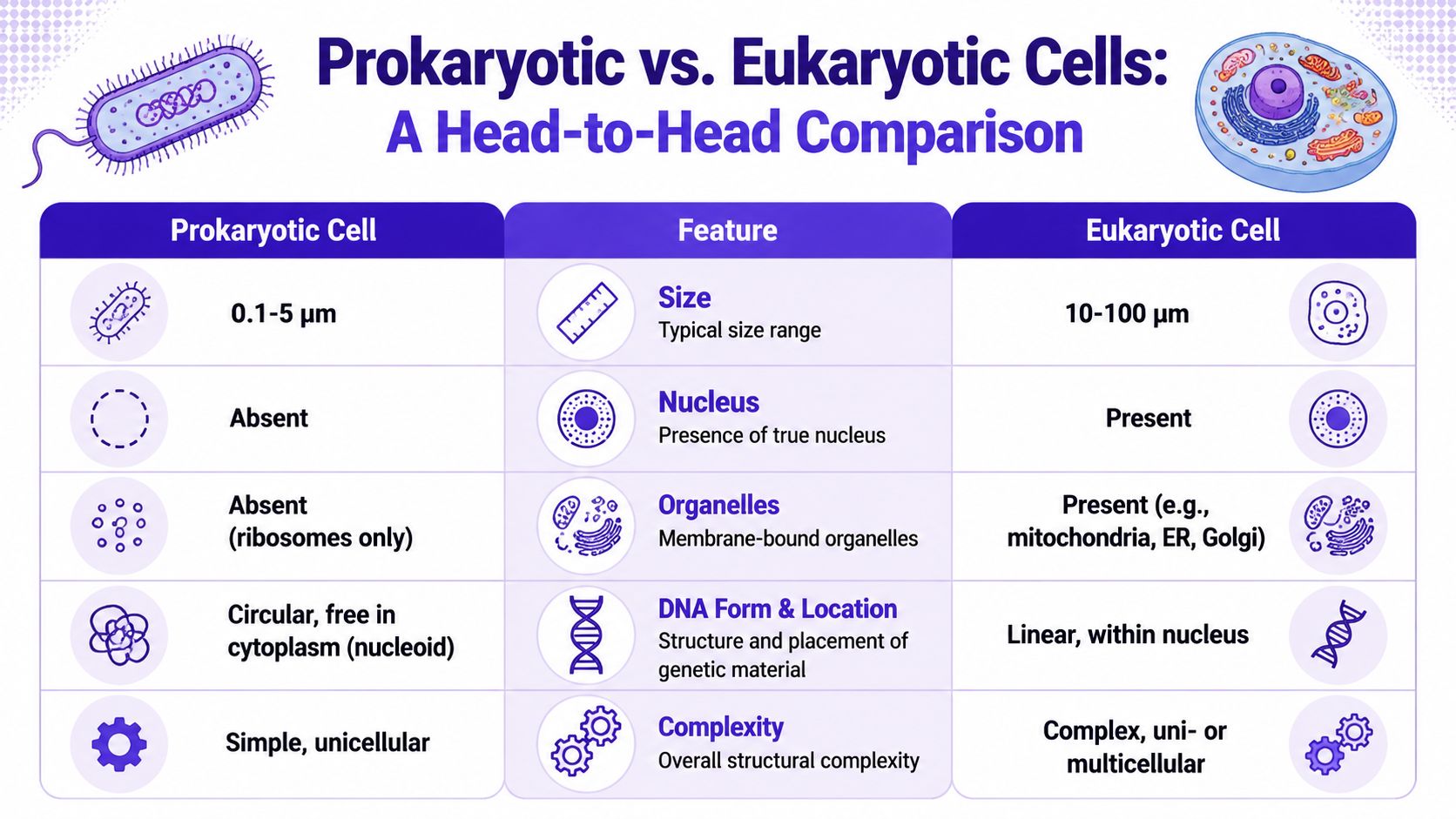
That is why exam answers work best when they compare features directly. The examiner is looking for paired contrasts, not two separate descriptions that they have to match up for themselves.
Prokaryotic vs. Eukaryotic Cells Key Differences for Your Exam
| Feature | Prokaryotic Cell | Eukaryotic Cell |
|---|---|---|
| Nucleus | No true nucleus. DNA is free in the cytoplasm, in a nucleoid region | True nucleus present, surrounded by a nuclear membrane |
| DNA | Usually circular and not arranged into chromosomes in the same way as eukaryotic DNA | Usually linear and organised into chromosomes |
| Membrane-bound organelles | Absent | Present, for example mitochondria and, in plant cells, chloroplasts |
| Ribosomes | Present, but smaller | Present, but larger |
| Size | Usually smaller | Usually larger |
| Cell division | Binary fission | Mitosis and, for gametes, meiosis |
| Examples | Bacteria and Archaea | Animals, plants, fungi, protists |
A common myth loses marks. Students sometimes write that prokaryotes have "no organelles." That is too vague. Prokaryotes do have ribosomes. The accurate phrase is no membrane-bound organelles.
Another easy place to gain marks is significance. A eukaryotic cell separates jobs into different compartments, a bit like a school with different classrooms for different subjects. That separation improves control. A prokaryotic cell is more like a single open room where the key jobs happen in the same shared space.
The DNA point also needs careful wording. In prokaryotes, the DNA is not enclosed in a nucleus. It sits in the cytoplasm in a region called the nucleoid. In eukaryotes, the DNA is enclosed within the nucleus, which helps organise genetic material and control access to it.
A microscope point can strengthen a longer answer. Eukaryotic cells are generally easier to see clearly in school practicals because they are larger. Prokaryotic cells are much harder to make out in detail, so students should not expect to see a tiny labelled textbook bacterium staring back at them from the eyepiece.
A quick video can help if you want a second explanation in a different style.
The comparison points that win marks
State the contrast precisely
Write "prokaryotes lack a true nucleus" rather than "prokaryotes have no nucleus at all." Examiners reward accurate biological language.Name the type of DNA
"Circular DNA in a nucleoid region" versus "linear DNA in chromosomes" is stronger than just saying "different DNA."Use the full organelle point
"No membrane-bound organelles" is better than "simpler inside."Link structure to function if the question allows it
Eukaryotic compartmentalisation lets different processes happen in separate places at the same time.Avoid overclaiming from microscope images
Under a school microscope, you usually identify size, shape, and whether structures such as a nucleus are visible. You do not usually see every organelle shown in revision diagrams.
A model comparison sentence
Prokaryotic cells lack a true nucleus and membrane-bound organelles, and their DNA is usually circular and found in a nucleoid region, whereas eukaryotic cells contain a nucleus and membrane-bound organelles, with linear DNA organised into chromosomes.
If your course links cell biology to infection, it also helps to explore human disease pathogens so you can connect bacterial cells, which are prokaryotic, to real examples in medicine.
From Bacteria to Blue Whales Examples and Significance
Once you leave the diagram page, this topic becomes much more interesting. Prokaryotes are not just “those tiny cells in the first chapter of biology.” Eukaryotes are not just “the ones with a nucleus.” Together, they cover the living world from microbes to oak trees to humans.
For prokaryotes, the main examples are Bacteria and Archaea. For eukaryotes, your familiar groups include animals, plants, fungi, and protists. A bacterium is prokaryotic. A blue whale is made of eukaryotic cells. So is a mushroom. So is pondweed. So is an amoeba.
Why prokaryotes matter far more than students think
A-Level biology often pushes you to think at planetary scale, not just cell scale. Scientists estimate that Earth contains about 4–6 × 10^30 prokaryotic cells, and their total carbon content is roughly 60%–100% of the carbon stored in plants, based on this classic synthesis of global prokaryotic abundance.
That's a huge reminder that “small” does not mean “unimportant.” Prokaryotes are extensively involved in nutrient cycling, decomposition, and the movement of carbon through ecosystems.
The living examples examiners like
A good answer often includes named groups rather than vague phrases.
Prokaryotic examples
Bacteria in soil, bacteria involved in decomposition, Archaea living in unusual environmentsEukaryotic examples
Human cheek cells, onion epidermal cells, yeast, algae, tree cellsMixed relevance in health
Biology students often meet pathogens when revising disease. If you want a broad overview that helps separate cell-based life from other infectious agents, this guide to explore human disease pathogens is useful for context.
The evolutionary big picture
The broad school-level story is that prokaryotes are the older cell type, while eukaryotes represent a later, more compartmentalised way of organising life. That's enough for most GCSE answers.
For stronger answers, phrase it carefully. Don't drift into saying prokaryotes are “primitive” as if they are failed versions of eukaryotes. They are extraordinarily successful cells with a different design strategy.
A tiny bacterial cell and a whale cell solve the problem of staying alive in different ways. Biology isn't a ladder. It's a set of working designs.
That kind of wording shows understanding without becoming vague.
Busting Myths and Nailing Exam Technique
A significant number of marks are often lost. Not because the content is impossibly hard, but because students repeat half-true shortcuts.
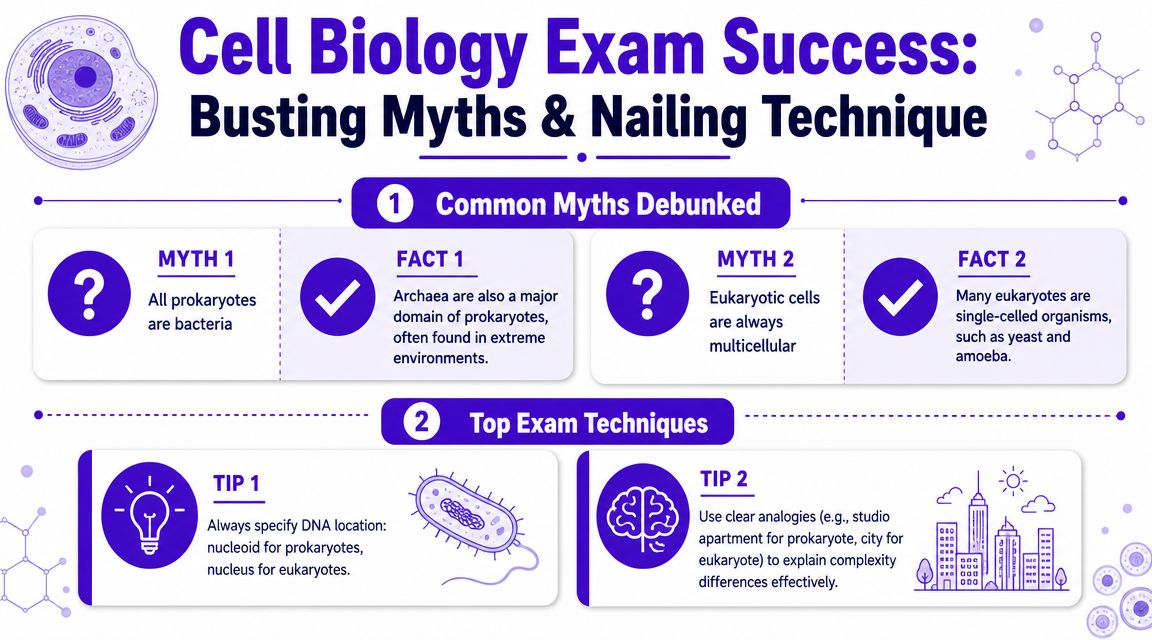
Myth one Prokaryotes are just simple blobs
At GCSE level, calling prokaryotes simpler than eukaryotes is usually acceptable. But for higher-level thinking, that's only a school-level simplification. A review using electron cryotomography described a “more complicated and beautiful view” of prokaryotic cell biology, showing that their internal organisation is richer than old textbook summaries often suggest, as discussed in this review of prokaryotic cell biology.
That doesn't mean the nucleus rule is wrong. It means the rule is useful, but incomplete.
Myth two If I can memorise a diagram, I'm sorted
Not quite. In practical work, what you can see matters. A useful school-level comparison is that prokaryotes are typically about 0.2–2.0 μm, whereas eukaryotic cells are often 10–100 μm, which helps explain why bacteria are harder to visualise clearly with standard classroom microscopes than plant or animal cells, according to this explanation of prokaryotic and eukaryotic cell size in microscopy.
So if a question asks why cheek cells are easier to observe than bacteria, the safe answer is about larger size and easier visibility under a school light microscope.
Fast exam habits that work
- Name the DNA location properly. Say nucleoid for prokaryotes and nucleus for eukaryotes.
- Use the word membrane-bound when describing organelles. That phrase often separates a vague answer from a precise one.
- Don't say all eukaryotes are multicellular. Yeast and many protists show that eukaryotes can be single-celled.
- Revise through questions, not just notes. Resources like GCSE Past Papers help because this topic is nearly always tested through application, not just recall.
If a question says “compare”, give similarities and differences. If it says “describe”, don't slip into explaining why unless the mark scheme invites it.
A memory shortcut
A simple one students remember is:
- PRO = NO nucleus
- EU = think proper nucleus
It's not a scientific definition, but it can stop panic in the exam hall.
Exam Corner Practice Questions and Examiner Feedback
Here are some exam-style questions in the way a teacher or examiner might expect them.
Question one
Compare the structure of a prokaryotic cell and a eukaryotic cell.
Model answer
Both prokaryotic and eukaryotic cells have a cell membrane, cytoplasm, ribosomes and DNA. Prokaryotic cells do not have a true nucleus, so their DNA is found in a nucleoid region and is generally circular. Eukaryotic cells have DNA enclosed in a nucleus and the DNA is usually linear and organised into chromosomes. Prokaryotic cells also lack membrane-bound organelles, whereas eukaryotic cells contain organelles such as mitochondria.
Examiner feedback
This would score well because it gives similarities and differences. It also uses accurate technical vocabulary like nucleoid, true nucleus, and membrane-bound organelles. To push it even higher, a student could add a clear size comparison.
Question two
Describe the role of plasmids in prokaryotic cells.
Model answer
Plasmids are small extra circles of DNA found in many prokaryotic cells. They carry additional genes that are not part of the main chromosome and can provide useful functions, such as antibiotic resistance or adaptation to particular conditions.
Examiner feedback
This is focused and accurate. It avoids the common mistake of saying plasmids are the main genetic material. That would lose marks.
Question three
Explain why plant cells are usually easier to observe under a school light microscope than bacterial cells.
Model answer
Plant cells are usually easier to observe because they are much larger than bacterial cells. Their structures are easier to distinguish under a school light microscope.
Examiner feedback
Short, but effective. It applies knowledge rather than listing facts. For more exam-style practice across command words and mark schemes, Exam Practice for A-Level can help students test whether they can use the content under pressure.
If you want one place to turn this kind of biology knowledge into exam-ready answers, MasteryMind offers curriculum-aligned revision, past-paper style practice, and examiner-style feedback built for UK learners preparing for GCSEs and A-Levels.
Ready to master this topic?
Practise with quizzes, blurt exercises and exam questions on MasteryMind.
7 days Premium · Then free forever · No card, no charge