How to Master Formal Letter Structure for GCSE and A-Level
You're sitting in an exam hall, the question looks simple, and your mind goes straight to the same worry, did I set this letter out properly? That panic is common, because formal letter structure is one of those topics that looks basic until marks depend on it. Get the layout, tone, and paragraphing right, and you give yourself a cleaner path through GCSE and A-Level assessment, especially when every line has to look controlled and purposeful.
Understanding the Formal Letter Layout
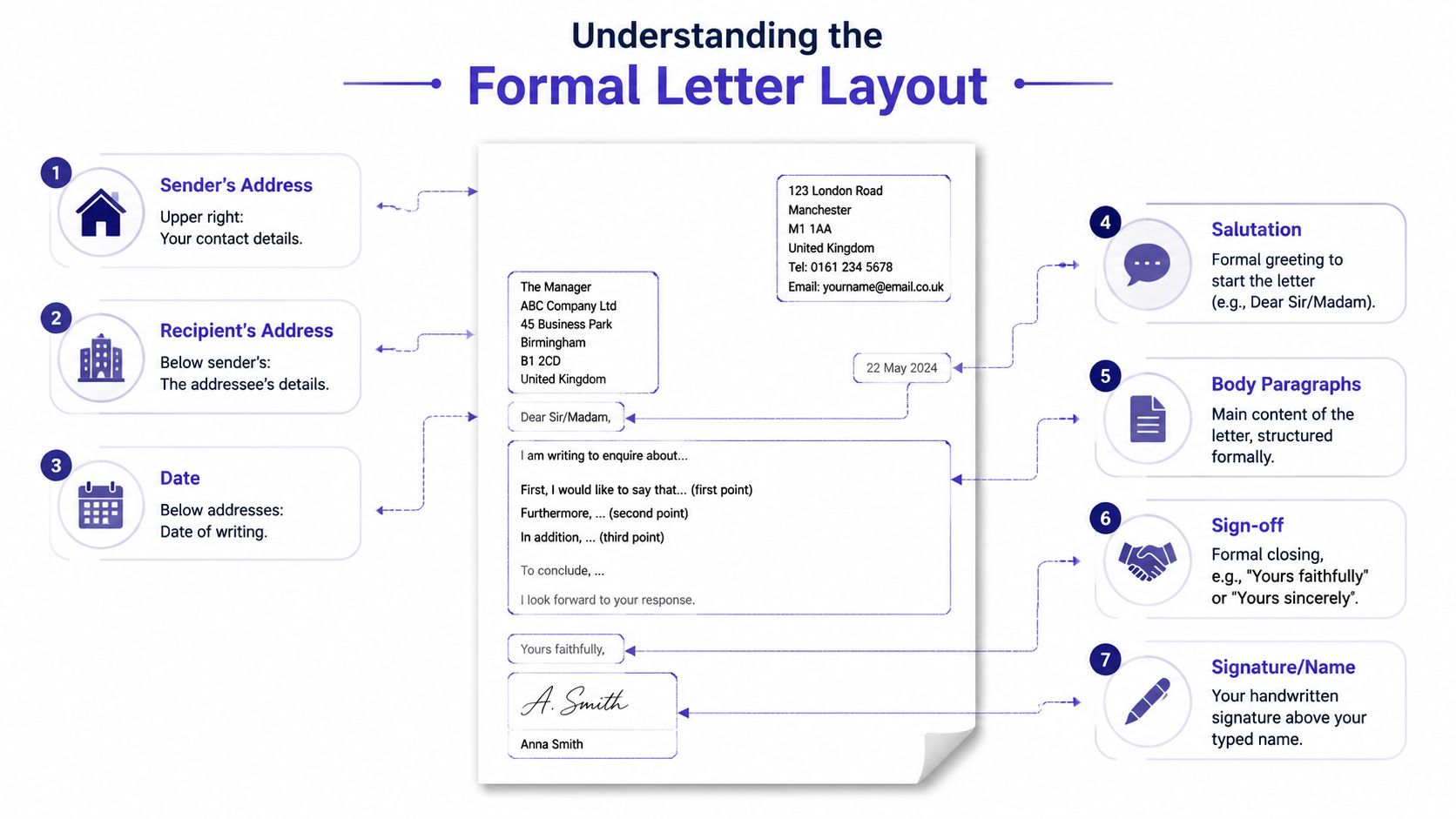
If an exam asks you to write a formal letter, the first thing the examiner notices is the page. Before they even read the argument, they can see whether you've used the expected structure, and that matters because UK classroom guidance treats layout as a standard feature of formal correspondence. BBC Bitesize presents the familiar GCSE version with the sender's address in the top-right corner, the recipient's address on the left, and the date underneath, with the date written in full rather than as a short form, which is the clearest historical anchor for the modern UK pattern BBC Bitesize on formal letter structure.
Start with the address block
The sender's address goes first, usually on the right, because the layout has grown from postal convention and remains the standard in UK revision resources. Under that, on the left, sits the recipient's address, then the date, then the salutation. That sequence helps the examiner tick off the basic communication features quickly, because the letter now looks like a real formal message rather than a free-form paragraph exercise.
A good way to visualise it is to think in blocks, not in a flowing essay. Each section should be clearly separated, and the whole piece should stay manageable on one page where possible, with a clean block format and no visual clutter formal business letter guidance from Indeed UK.
Keep the opening and ending predictable
After the address and date, use a formal greeting such as Dear Sir/Madam if you do not know the person's name. If you do know the person's name, that changes the ending later on, which is why the structure and the sign-off work together rather than standing alone.
For a deeper subject-linked route into writing across the course, the skills sit neatly alongside A-Level English Language study. The page layout may look simple, but it carries real assessment value because it shows the examiner you understand audience, purpose, and control from the first line.
Structuring Paragraphs with Purpose
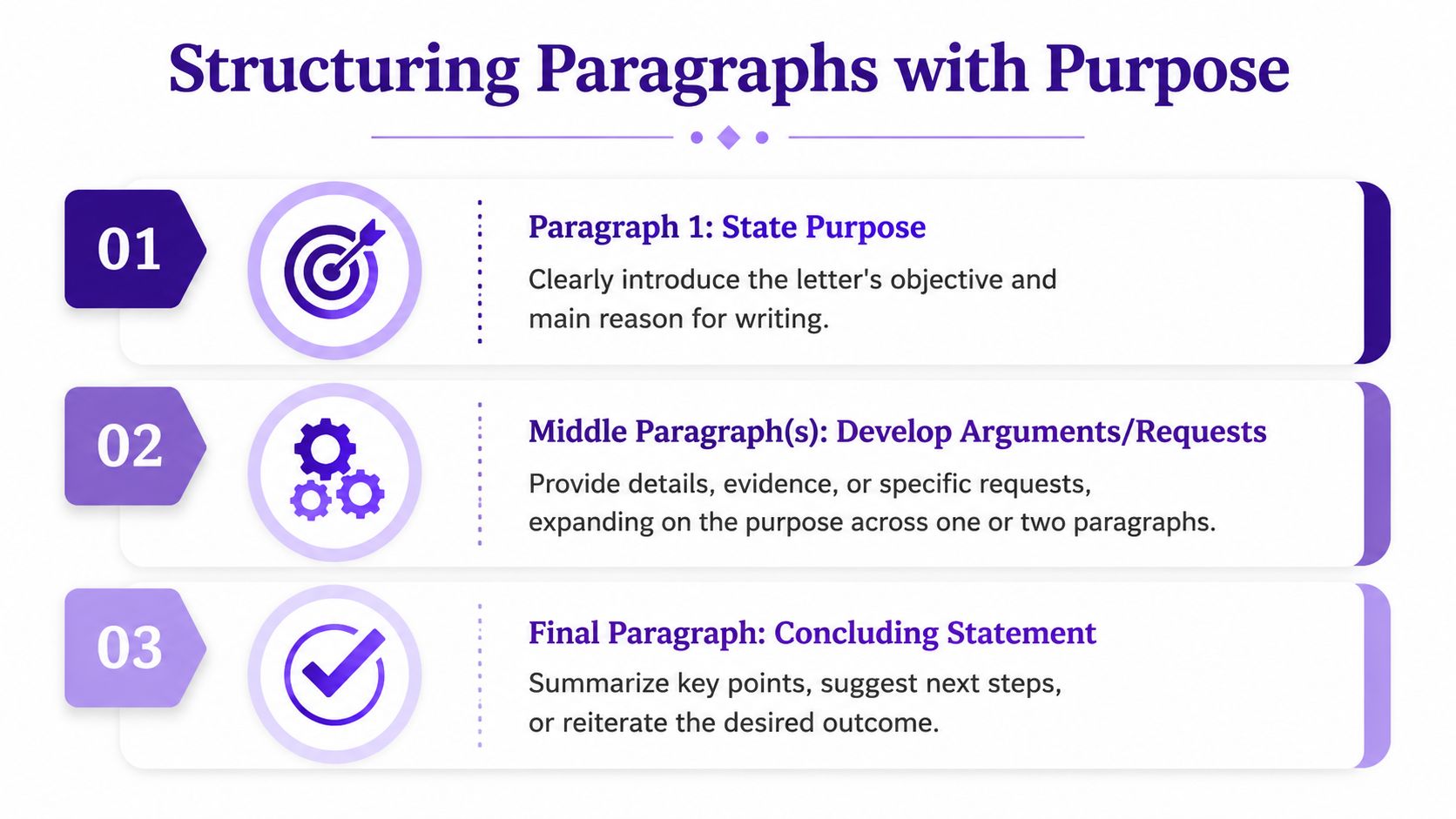
A formal letter that starts with a long story can make the reader search for the point. In an exam, that usually weakens control and can blur the writer's purpose. A better approach is a tight 3 to 4 paragraph structure, where the opening states the reason for writing and the ending rounds off the request or outcome. That pattern also matches the way examiners reward clear organisation in GCSE and A-Level responses, because the letter feels planned rather than improvised.
Paragraph one says why you are writing
The first paragraph should reach the point quickly. A sentence such as I am writing to... works because it is direct, formal, and easy for the examiner to follow. You are not trying to sound dramatic, you are showing that you understand purpose from the first line.
This first paragraph often carries the most weight for AO clarity, because it tells the reader exactly why the letter exists. If the task is a complaint, a request, or an application, name that purpose in the opening sentence. If you are writing to a headteacher, a council, or a company, the reader should know straight away what the letter is trying to achieve.
Middle paragraphs develop the detail
The middle one or two paragraphs should develop the main points without drifting away from the task. In these paragraphs, sentence starters like Could you please... and I would be grateful if... help students stay polite while making a clear request. They also stop the tone from slipping into chatty or demanding language.
A useful comparison is the body of a press release, where each paragraph has to move the message on rather than repeat the heading. The same principle appears in guidelines for press release structure, and it helps students see that formal writing works best when each paragraph has a clear job.
The same planning habit helps with structured revision tools for students, because good revision makes it easier to choose one main idea for each paragraph before the writing starts.
The final paragraph closes the loop
The last paragraph should bring the letter to a tidy close and restate what you want to happen next. That might be a reply, an action, or consideration of your request. If you are unsure how much detail to include, a simple test helps, one paragraph should do one job. If a paragraph starts to hold two different ideas, split it.
That rule is useful in assessment because it keeps the response organised and easy to mark. It also matches the kind of control examiners look for when they assess whether a student can shape a formal letter with clear purpose from start to finish.
Selecting Tone and Style
A formal letter can be neatly laid out and still lose marks if the tone sounds wrong. A student might know the structure, yet write in a way that sounds too chatty, too blunt, or too eager to impress. Examiners look for language that fits the audience and the purpose, so every word should help the reader take the letter seriously.
Use language that matches the situation
A greeting such as Hey there or a closing like Thanks a bunch sounds out of place in GCSE and A-Level formal writing. It weakens audience awareness, which is one of the first things teachers notice when they judge tone. A safer opening is Dear Sir or Madam, and a more suitable closing is Thank you for considering my request.
A formal letter should sound respectful without sounding frozen. If the writer is complaining, the wording can still stay calm. If the writer is asking for help, the request can still sound confident. The aim is a voice that feels controlled, not like a message sent to a friend.
Keep the tone respectful, but don't bury the point.
This is where exam technique matters. In assessment, strong tone shows that the writer understands audience, purpose, and register, which are all linked to how well the response is shaped for the task. A teacher marking the work is not looking for fancy vocabulary for its own sake. They want wording that suits the situation and keeps the letter sounding purposeful from the first line to the last.
Make the page look controlled
A letter also needs a layout that matches the voice. Clear structure helps the tone feel deliberate, just as tidy presentation helps a science answer look easy to follow. UK business-style guidance recommends single spacing, one blank line after each section, left-aligned paragraphs, one-inch margins, and a block format that keeps the letter visually tidy Indeed UK business letter format. In an exam, those choices reduce visual clutter, so the examiner can focus on whether the writing is accurate and appropriate.
Consistency matters just as much. If the first paragraph sounds formal but later lines slip into slang, the whole letter loses authority. Keep the register steady from salutation to sign-off, and avoid unnecessary emotion or filler. A good test is simple, if you would not say the phrase in a serious conversation with a headteacher, it probably does not belong in the letter.
Identifying Common Pitfalls
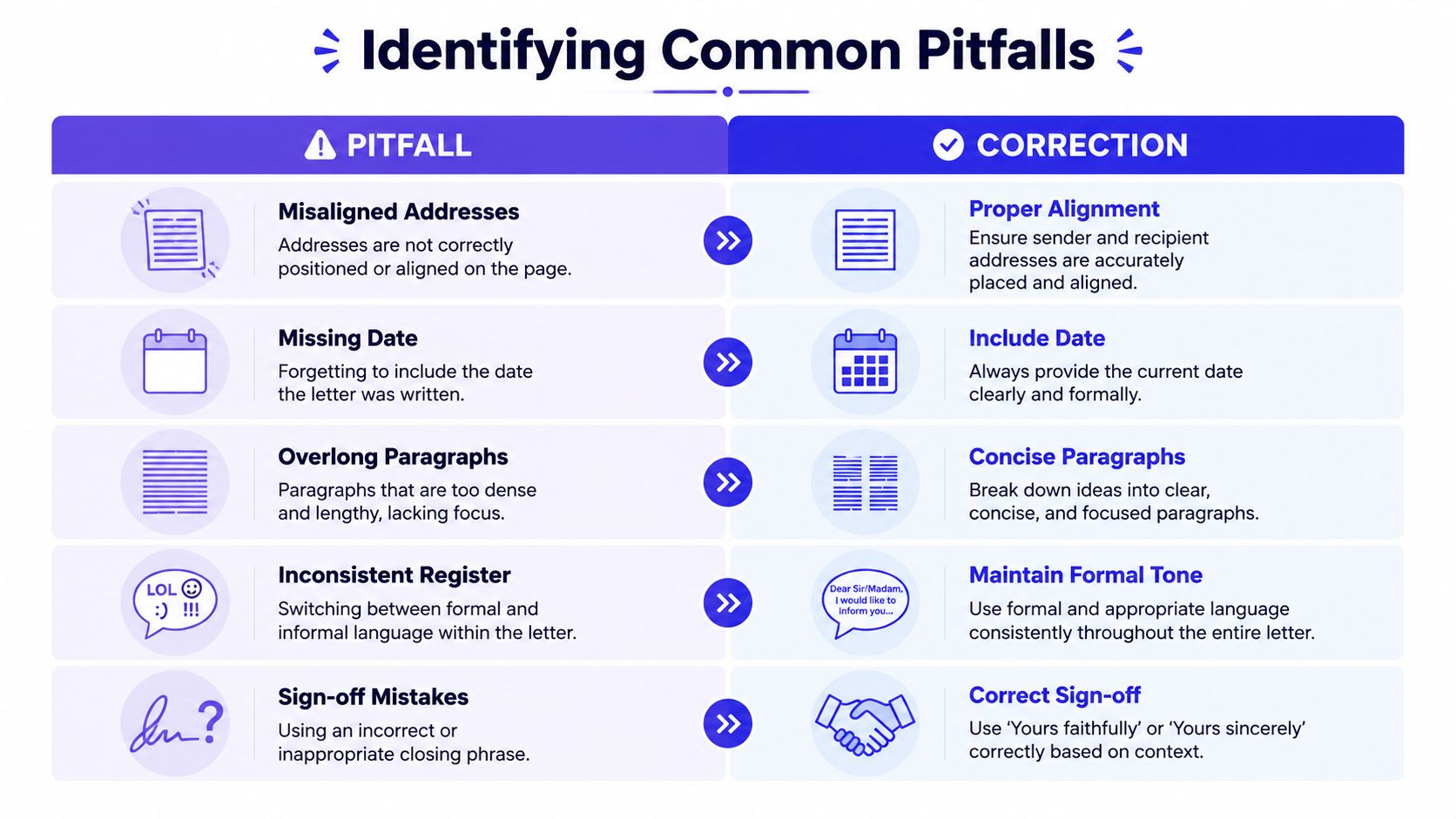
The easiest marks to lose are often the small ones. Miss the date, misplace the address, or forget the correct closing formula, and the letter can look uncertain straight away. The good news is that these errors are easy to spot if you know what to check first, and that matters in GCSE & A-Level mark schemes because layout and accuracy are both visible evidence of control.
Fix layout errors before anything else
A letter with misaligned addresses can look unfinished, even if the ideas are sound. Place the sender's address in the expected position, keep the recipient's details clear, and make sure the date is present and properly placed. These are usually the first visual checks a teacher or examiner makes, rather like checking the heading on a maths paper before reading the working.
Cut wordy paragraphs down
Overlong paragraphs make formal letters harder to read. They can hide the main point, just as a messy page can hide a clear answer in classwork. Keep each paragraph focused on one job, and trim any sentence that repeats the same idea in different words. A short, controlled paragraph is easier for an examiner to follow, and it shows that the writer can shape content to fit the task without drifting into filler.
Match the sign-off to the greeting
This is the sign-off rule students often miss. If you know the person's name, end with Yours sincerely. If you do not know the person's name, use Yours faithfully. That pairing is the standard way to show that the opening and ending belong together, so the letter feels complete rather than patched together at the end Using English on letter writing.
Teachers also notice when the tone slips. A letter that begins with Dear Sir/Madam but ends with slang or an over-familiar phrase weakens its own authority. Keep the register steady from start to finish, and avoid sudden changes in formality. If a phrase would sound wrong in a serious message to a headteacher, it probably does not belong in the letter either.
Examiner-Marked Exemplar Letters
A strong formal letter usually looks calm on the page. A weak one often feels busy before you even reach the mistakes. That contrast matters because examiners are looking for content that answers the task, organisation that guides the reader, language that stays appropriate, and accuracy that does not distract.
High-band example
Dear Headteacher,
I am writing to request permission for our year group to organise a charity fundraiser after school. The event would give students a chance to support a local cause while also showing responsibility and teamwork.
We would plan the activity carefully so that it would not disrupt lessons. Students could help with setting up, collecting donations, and supervising stalls. I believe this would be a positive event for the school because it would bring people together for a worthwhile purpose.
If this is possible, I would be grateful if you could consider the idea and let us know the next steps. Thank you for your time and support.
Yours sincerely,
Amina Khan
This version scores well because the purpose is clear, the paragraphs are controlled, and the sign-off matches the named recipient. The examiner can see the writer knows how to shape a letter for audience and purpose. That is exactly the kind of control GCSE and A-Level mark schemes reward in the organisation and communication parts of the assessment GCSE & A-Level mark schemes. The three-paragraph pattern also works because each paragraph has a single job, a bit like a well-planned answer in class where every section earns its place.
Lower-band example
Hi Sir,
I'm writing because we want to do a thing after school and I think it would be really fun. There are loads of ideas and I could tell you more if you want.
It would be great and everyone would enjoy it. Please can you say yes because it would be amazing for us and we need to know soon.
Bye,
Amina
This version loses control quickly. The opening is too casual, the second paragraph is vague, and the ending uses the wrong register and sign-off. Examiners would also notice that the writer does not sound secure about who the letter is for, which weakens the sense of audience awareness. The structure looks rushed, so the message feels less convincing, even though the basic idea is understandable.
A useful way to judge both examples is to ask a simple question. Which letter sounds like it was written with the mark scheme in mind, and which one sounds like a first draft that needs careful checking? The answer usually becomes obvious once you compare the tone, paragraph control, and sign-off side by side.
Practice Prompts and Self Checklists
A strong practice prompt should feel like an actual exam task, not a loose writing exercise with no clear audience. Try a complaint to a shop manager, a request to the school canteen, or an application for a club leadership role. These prompts work because they force you to choose the right layout, register, and level of detail, which is exactly what examiners look for in AO5 and AO6. For timed repetition, Exam Practice for GCSE gives students a safe way to rehearse that pressure before the actual paper.
Before you hand in any letter, use a quick checklist and read it like a teacher marking for control.
- Layout: the sender's address, recipient's address, date, greeting, body, and sign-off appear in the correct order.
- Paragraph purpose: each paragraph does one job, so the letter does not drift.
- Tone: the whole letter stays formal, with no slang or chatty phrases.
- Sign-off: the ending matches whether you know the person's name.
- Proofreading: names, dates, and spelling are all accurate.
A checklist like this helps students catch the details that examiners notice straight away. A letter can have a decent idea behind it, yet still lose marks if the layout is muddled or the tone slips into everyday speech. That is why the safest habit is to check the basics before you think about anything else. It is a bit like checking a uniform before assembly. If one part is out of place, the whole impression changes.
For GCSE writing, the aim is not to fill space. It is to show control. Strong letters make the reader feel that the writer knows the audience, understands the purpose, and can keep the structure steady from the greeting to the sign-off. If you want the format to feel familiar under pressure, use the same kind of timed practice students get from Exam Practice for GCSE and then compare your draft against the checklist above.
If you want to turn this into a habit, practise one formal letter tonight with a timer, then check it line by line against your usual mistakes. Use the structure, keep the tone steady, and test yourself again with a fresh prompt so the pattern feels familiar before the exam paper even starts.
Ready to master this topic?
Practise with quizzes, blurt exercises and exam questions on MasteryMind.
7 days Premium · Then free forever · No card, no charge