GCSE English Language Writing: A Complete Guide
The clock is moving, and you're still staring at the writing question. You know you should use ambitious vocabulary, vary your sentences and include a rhetorical question, but none of that tells you what to write next. Then time runs out, your final paragraph is rushed, and the mark feels lower than the effort you put in.
That problem is fixable. Strong GCSE English Language writing isn't about collecting techniques like souvenirs. It's about identifying the thing that is limiting your response, then practising that specific weakness until it becomes manageable under pressure.
Why GCSE English Language Writing Matters More Than You Think
A student opens Paper 1, sees the writing task, and decides to leave it until the end. Reading takes longer than expected. The last minutes disappear. The student writes a short paragraph, adds a rushed ending and leaves the room hoping the rest of the paper will rescue the grade.
That's a dangerous strategy because writing isn't a small extra at the edge of the exam. Under the current AQA GCSE English Language specification, each of the two written papers is worth 80 raw marks, making 160 marks in total. Writing accounts for 40 marks on each paper, or 25% of the overall GCSE, so across the full qualification it contributes 80 of 160 raw marks, or 50% of the examination papers. AQA's specification overview sets out the full assessment structure.
That makes writing one of the clearest parts of the qualification to improve through deliberate practice. You can't predict the exact extract or topic, but you can prepare how you plan, shape paragraphs, control sentences and check accuracy.
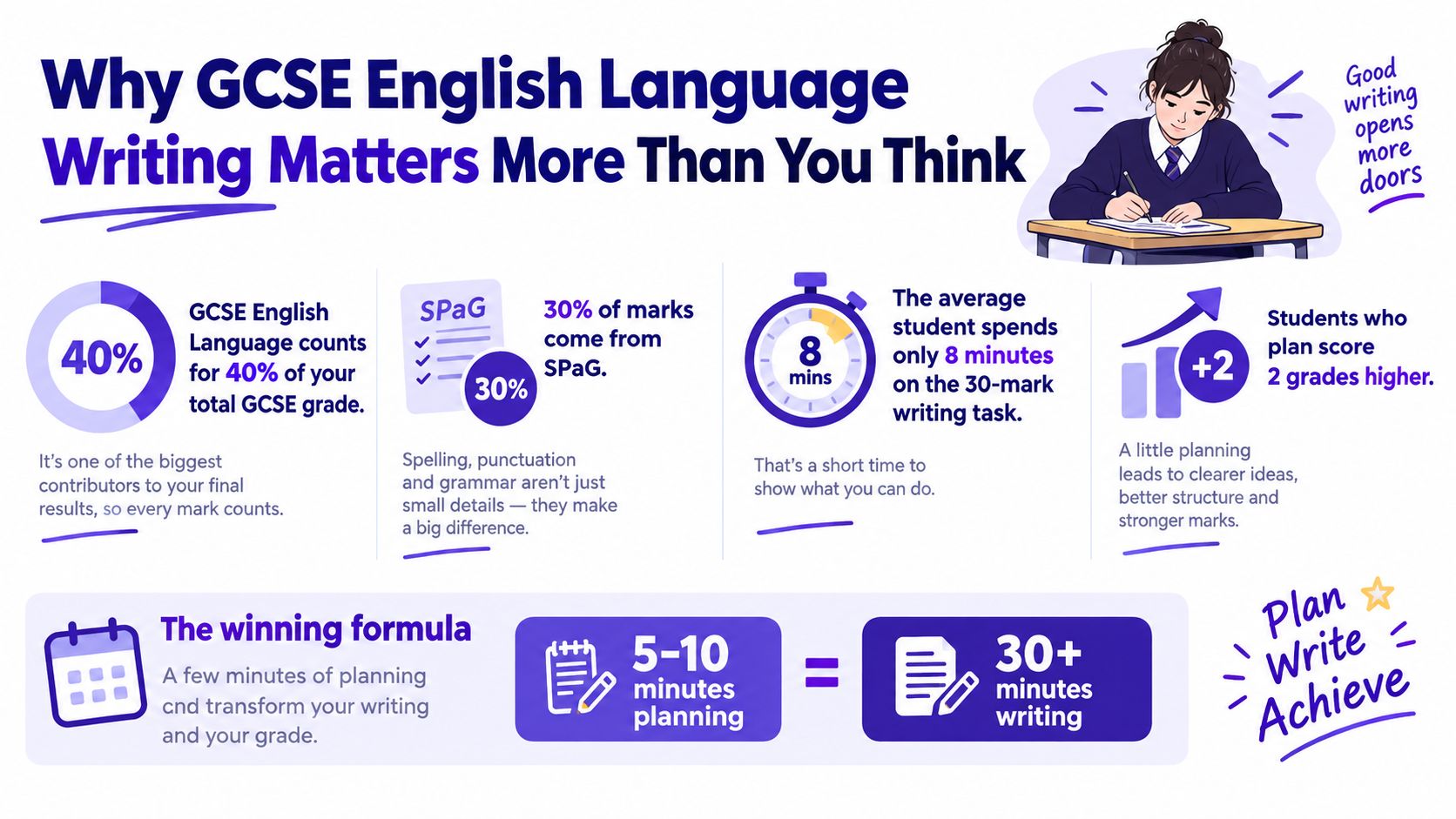
The marks are spread across different skills
A response can contain exciting ideas and still lose marks if the organisation is unclear. It can also be well structured but weakened by sentence boundaries, spelling or punctuation. That's why writing revision needs more than a list of persuasive devices.
For a student recovering a grade, the first useful question isn't “How can I sound cleverer?” It's “Where am I dropping marks?” Perhaps you write too little under timed conditions. Perhaps your speech sounds like an essay, your story has no real development, or your punctuation becomes uncertain whenever your sentences get longer.
For a student aiming high, the challenge is different. You may already have ideas and control, but you need precision, deliberate structure and a consistent response to the exact task. A reliable routine of structured English Language practice should therefore include planning, drafting, feedback and targeted correction, not just occasional full answers.
The honest message is simple. Writing deserves a proper strategy because it carries substantial marks, and because many weaknesses are visible, diagnosable and trainable.
How the Mark Scheme Actually Works
AQA divides extended writing between AO5 and AO6. You don't need to fear the labels, but you do need to understand what they mean while you practise.
AO5 is your communication and organisation
AO5 asks whether you communicate clearly, effectively and imaginatively. It also considers whether you adapt your tone, style and register to the form, purpose and audience, then organise ideas into a coherent and cohesive whole.
That means an article for teenagers shouldn't sound like a formal government report unless the task demands it. A speech needs to sound speakable. A letter needs a clear relationship between writer and recipient. A narrative needs movement, selection and development, rather than a collection of unrelated descriptions.
AO5 also rewards the way you shape the reader's experience. You might delay information to create tension, move from a broad setting to a precise detail, or arrange an argument so that each point builds towards a conclusion.
AO6 is how cleanly you express those ideas
AO6 covers vocabulary, sentence structures, spelling and punctuation. AQA's extended writing task is worth 40 marks, split into 24 marks for content and organisation and 16 marks for technical accuracy. In other words, 60% rewards what you communicate and how you structure it, while 40% rewards vocabulary, sentence control, spelling and punctuation. AQA's writing guidance shows this split.
Useful mental model: AO5 is what you say and how you shape it. AO6 is how accurately and deliberately you say it.
Students often treat AO6 as proofreading at the end. That's too late. If you begin a sentence without knowing how it will work, add commas where you pause and choose a difficult word that doesn't mean what you intend, the problem is happening during composition.
Use the MasteryMind mark schemes alongside your practice. Read them before writing, not only afterwards. You'll start making decisions based on the criteria rather than on vague ideas about what “sounds impressive”.
Creative Writing and Transactional Writing Compared
The first decision is not which technique to use. It's what kind of writing the question requires.
Creative writing usually asks you to describe, narrate or present a point of view. Transactional writing asks you to communicate with a practical purpose, often through an article, letter, speech, essay or report. Both require clear organisation and accurate writing, but they create different expectations for the reader.
| Feature | Creative Writing | Transactional Writing |
|---|---|---|
| Main purpose | Create an experience, scene, viewpoint or sequence of events | Inform, explain, persuade, argue or advise |
| Audience | Often implied by the task or shaped through narrative choices | Usually stated or strongly suggested |
| Language | Sensory detail, imagery, precise verbs and controlled description | Clear reasoning, purposeful vocabulary and persuasive or informative choices |
| Structure | Pacing, shifts in focus, tension, moments and development | Introduction, connected points, evidence or examples, and a purposeful ending |
| Register | Selected to suit the narrator, viewpoint and situation | Selected to suit the relationship with the audience and the form |
| Common mistake | Description without movement or a story with no developed direction | A beautiful paragraph that doesn't actually answer the argument or purpose |
Creative writing needs control, not constant decoration
Showing rather than telling can help, but it isn't a command to hide every emotion. “She was frightened” may be useful if it's followed by a specific action, thought or physical detail that develops the moment. A short sentence can create impact; a longer one can slow the reader down or connect details.
Transactional writing needs a real relationship with the reader
A speech should sound as though someone could deliver it aloud. An article should have a clear angle. A letter should make the relationship between writer and recipient visible through its register. If the task asks you to argue, listing techniques won't replace a line of reasoning.
Students who are working on formal clarity may also find it useful to polish essays without altering meaning. The principle applies here too. Improve precision and control without replacing your actual point with words you wouldn't naturally use.
AQA, Edexcel, OCR and WJEC/Eduqas use different task formats, but the underlying distinction remains useful. Before writing anything, identify the purpose, audience, form and focus. A descriptive passage won't succeed if the prompt asks for a balanced argument, however polished the imagery may be.
Planning, Structuring and the Technique Toolkit
A good plan isn't a miniature essay. It's a route map that stops you wandering.
Eduqas recommends spending 5 to 10 minutes planning narrative responses and reports that responses well below the expected 300 to 400 words rarely score well because they lack range, detail and development. Successful candidates sustain a clear focus on audience and purpose. The Eduqas examiner report makes an important point here: development comes from preparation, not from rushing into the first idea that appears.
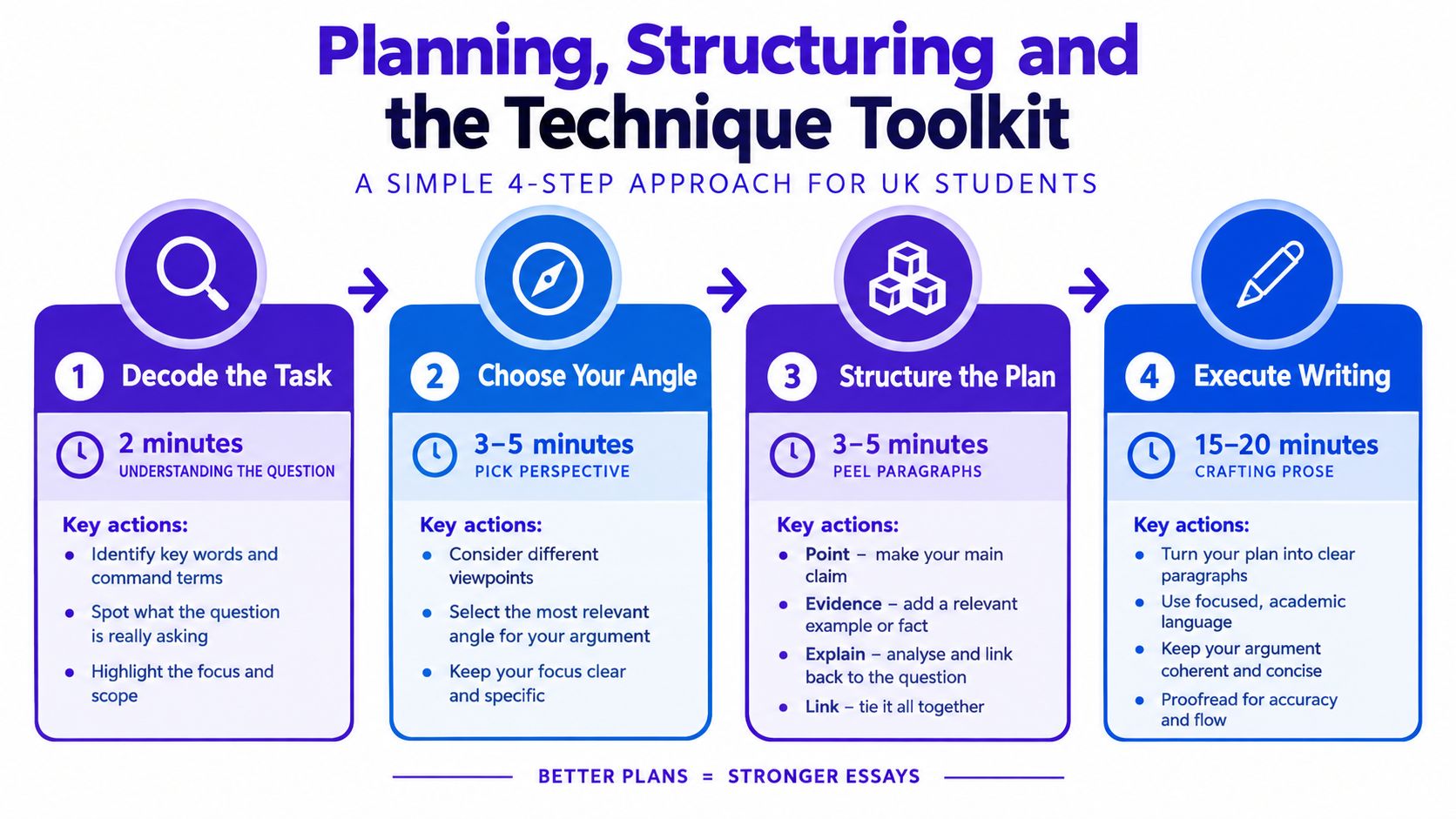
A practical planning sequence
Decode the task. Underline the form, purpose, audience and exact focus. If the question asks you to describe a place at a particular moment, don't turn it into an unrelated adventure story.
Choose an angle. Decide what the reader should notice or believe. In a narrative, choose the central change or tension. In an argument, choose your position and the strongest reasons for it.
Select a sequence. Give each paragraph a job. A description might move from distance to detail, then from setting to a person's reaction. A speech might begin with a shared concern, develop two connected arguments and finish with a clear demand.
Build moments, not labels. Instead of writing “I will use a metaphor here”, note the image, action or contrast you want. A plan should contain meaning, not just technique names.
Reserve time to check. Read the final sentences slowly. Look for missing full stops, unclear pronouns, repeated words and spellings you regularly get wrong.
Techniques become useful when they solve a communication problem. A rhetorical question can involve an audience, but one inserted randomly sounds artificial. Antithesis can sharpen a contrast. Parenthesis can add a controlled aside. A semantic field can create a consistent atmosphere, while a sudden shift in pace can make a turning point feel significant.
Sentence variety also needs purpose. Use short declaratives for emphasis, subordinate clauses to explain relationships and coordinated structures to connect ideas. A fragment may create an effect in a narrative, but repeated accidental fragments suggest lost control.
Planning test: If you can't explain what a technique makes the reader think, feel or understand, you probably haven't chosen it for a reason.
For narrative work, an interactive storytelling framework can help you think about beginning, development and change without forcing every story into the same formula. Your plan still needs to respond to the actual prompt.
The Common Mistakes That Quietly Cost Marks
The advice to “use ambitious vocabulary” is incomplete. Difficult words don't earn marks just because they're difficult, and long sentences don't count as complex if the punctuation can't hold them together.
OCR's 2025 examiner report says most candidates used a wide range of sentence structures, yet very few could punctuate accurately within a sentence. It also identifies precise vocabulary as an important discriminator and notes that spelling wasn't always a reliable indicator of success. The OCR report supports a more useful revision question: can the reader understand exactly what you mean, and does each choice create the intended effect?
Diagnose the real weakness
Read a draft and ask:
Did I answer the exact focus? AQA's published guidance states that if a candidate doesn't directly address the focus of the task, the AO5 communication mark is capped at the top of Level 2, which is 12 marks. The AQA mark-scheme guidance makes clear that impressive writing cannot compensate for drifting away from the task.
Is my register consistent? A formal letter can include personality, but casual slang may weaken the relationship with its intended audience. A speech can be direct and emotional without becoming vague.
Are my sentences controlled, not merely varied? Circle every full stop. Then inspect commas, colons, semicolons and brackets. If you can't explain the relationship between two clauses, split or restructure the sentence.
Is my vocabulary precise? Choose “uneasy” instead of “bad” when you mean quiet discomfort, but don't choose a grander word if it changes the meaning. Precision gives the reader something exact to picture.
The mistakes teachers see repeatedly
Brevity is one problem, but padding is another. A response can be long and still underdeveloped if it repeats the same point without adding detail, consequence or change.
Register mismatch is quieter. Students often begin a speech with direct address and finish in essay-like analysis, or start a formal article with language so casual that the intended audience disappears.
Punctuation errors often sit inside otherwise promising writing. A student may use varied sentence openings but join complete ideas with commas, producing a comma splice. The fix isn't “use more punctuation”. It's learning what each boundary does.
The best correction is specific. Don't write “make it better”. Write “develop the second paragraph with a consequence”, “replace this vague verb with one that shows the movement”, or “turn this comma into a full stop because the ideas are complete.”
Practice Tasks and Annotated Exemplars
A timed response can look polished while hiding the exact habit that costs marks. Use practice tasks as diagnostic tests: identify whether the bottleneck is brevity, weak development, register, punctuation, or vocabulary that sounds ambitious but lacks precision. Then choose an exercise that addresses that problem rather than repeating a generic checklist.
Three tasks to diagnose different weaknesses
- Descriptive task: Describe a crowded station just before an important announcement.
- Narrative task: Write a story about a decision that cannot be undone.
- Transactional task: Write an article for students arguing whether schools should provide more quiet study spaces.
The descriptive task tests selection and sensory control. The narrative task tests development, pacing and consequence. The transactional task tests register, reasoning and awareness of the intended audience. Set a time limit, leave a few minutes to edit, and keep the prompt visible while you write.
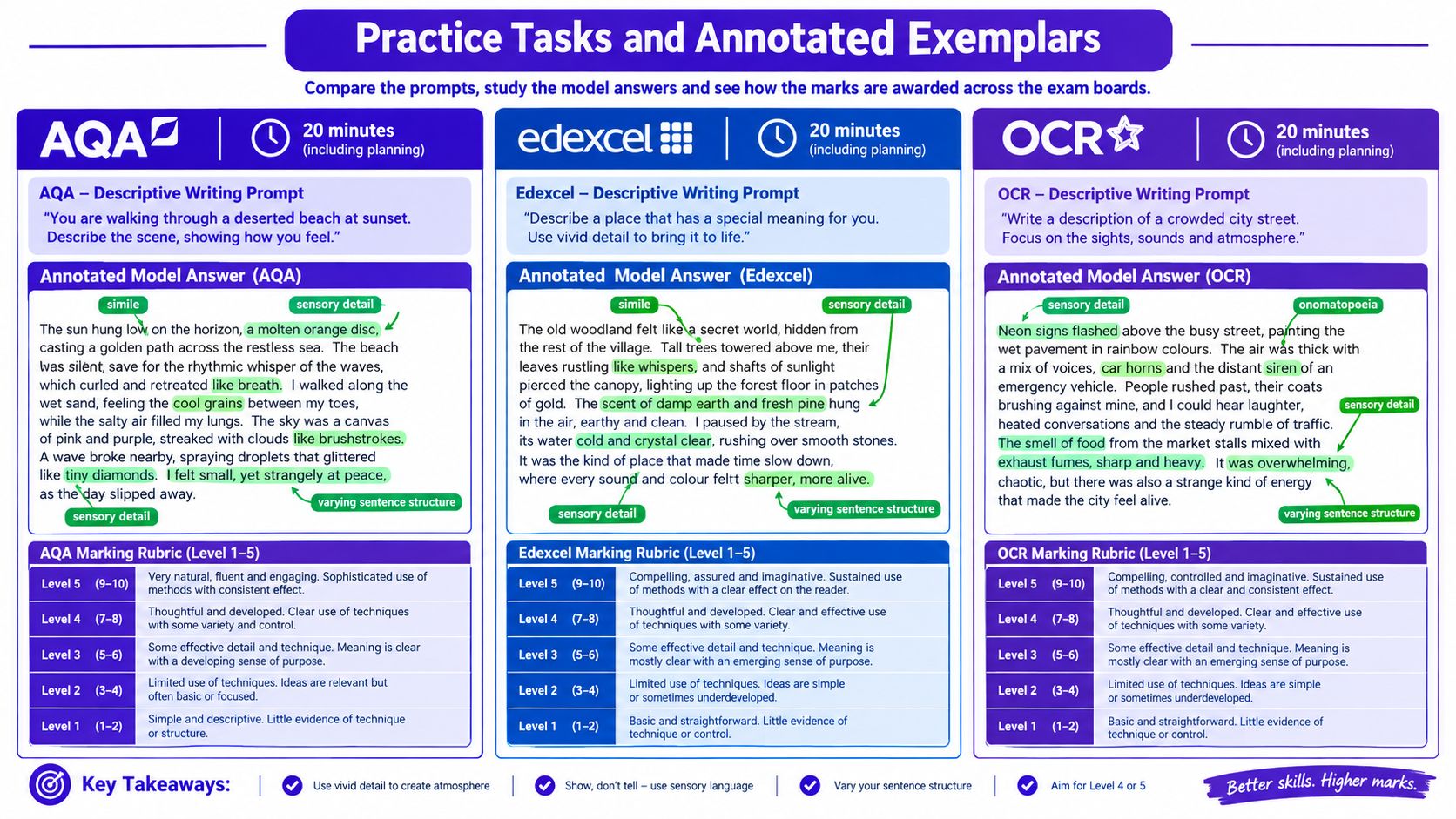
What the annotations should reveal
Developed fragment: “The announcement cracked through the station noise. Conversations stopped in uneven patches, first near the ticket barrier, then beneath the departure board.”
The verb “cracked” gives the sound force, while the second sentence narrows the reader's attention across the station. It develops the first sentence instead of restating it. The punctuation also supports the movement, showing how a precise choice can improve both content and control.
Partly controlled fragment: “The announcement was loud, everyone looked up, and the station became quiet but people were still moving around and they didn't know what to do.”
The meaning is clear, yet too many relationships are packed into one sentence. Separate the initial reaction from the continuing movement, then replace “looked” with a verb that shows the response more exactly. This is a sentence-control problem, not a request for random extra punctuation.
Under-developed fragment: “The station was busy. There were lots of people. An announcement happened.”
These sentences are understandable, but they make almost no deliberate choices. Add a viewpoint, a specific sound, a movement and a consequence. “Busy” and “lots” tell the reader very little, so precise detail must do the work.
Label the weakness accurately. A repetitive structure or thin idea mainly affects AO5. A comma splice, spelling error or uncontrolled sentence mainly affects AO6. One response can contain both, which is why “use better techniques” is too vague to guide the next draft.
Use GCSE Past Papers to find prompts, then review each answer with a clear record: one effective choice, one habit that lost control, and one action for the next attempt. Practice improves fastest when the next task targets the weakness you have clearly identified.
A Targeted Revision and Practice Plan
Your revision plan should look different if you're trying to recover a grade from a weak starting point than if you're already pushing towards the highest levels. Both students need consistency, but they shouldn't spend every session doing the same thing.
AQA states that technical accuracy must constitute 20% of the marks for the specification as a whole, so punctuation and spelling deserve targeted revision rather than a quick polish at the end. AQA's scheme of assessment gives technical accuracy a defined place in the qualification.
For students recovering marks
Start with one timed response each week. It can be the AQA 40-mark extended writing task, an Edexcel transactional question or an OCR writing-for-impact task, depending on your course.
On a separate day, complete a short diagnostic drill:
- If you write too little, plan three developed paragraph ideas and expand each with a specific detail or consequence.
- If your register slips, rewrite the same point as a speech, formal letter and article opening.
- If punctuation is the bottleneck, edit one paragraph for sentence boundaries, then explain why each major punctuation mark belongs.
- If vocabulary is vague, replace general verbs and adjectives with precise choices that preserve the meaning.
Keep a correction log. Record the error, the corrected version and the rule or decision behind it. That turns feedback into something you can use again.
For students aiming for the highest levels
Study a strong exemplar with a pen in hand. Mark where the writer changes pace, introduces a new focus, develops an argument or controls the reader's expectations. Then imitate one structural decision in your own response, without copying the words.
Use a weekly cycle of one full task, one focused AO5 or AO6 drill and one review of previous corrections. For a stronger writing foundation, resources such as build a stronger writing foundation can support wider work on clarity and control, but your exam-board mark scheme must remain the final reference point.
For either route, revisit old mistakes after a gap. If the same punctuation error returns, it needs a smaller, more focused exercise. If your ideas are strong but your endings collapse, practise planning conclusions separately before attaching them to full answers.
Tools can help organise this routine. Online Revision for GCSE provides exam-board-aligned practice, AO-focused feedback and spaced review for learners who want their writing tasks and corrections kept in one workflow. Use it as part of a routine, alongside teacher feedback and your own careful reading.
The aim isn't to produce a perfect answer every time. It's to make the next answer more controlled than the last one, then prove that the improvement survives under timed conditions.
MasteryMind offers GCSE English Language practice for creative and transactional writing, with examiner-style AO feedback and spaced review to help you target the weakness costing most marks. Visit MasteryMind and use your next writing task to build a focused revision routine rather than another generic checklist.
Choose your next course task
Use this idea with English Language. Confirm the qualification, awarding organisation and course version before choosing practice, assignment preparation or evidence planning.
Choose your English Language course