GCSE English Unseen Poetry: How to Score Top Marks
The most popular advice about GCSE English unseen poetry is also the advice that traps many students: spot as many techniques as possible. A page full of metaphors, similes and alliteration can look busy, but it won't automatically earn strong marks. Examiners need to see what those choices mean, how they shape the poem, and why they matter in relation to the question.
That distinction matters whether you're trying to recover an exam after doing too little revision or aiming for the highest grade. You don't need to recognise every device. You need a repeatable way to turn a small number of observations into clear, developed judgements under pressure.
Why Feature Spotting Will Not Get You Top Marks
A sentence such as “The poet uses a metaphor” is only a starting point. It identifies a method, but it doesn't explain the poet's decision or the reader's response. A stronger comment asks what the comparison suggests, what associations the chosen image creates, and how it contributes to the poem's central idea.
Terminology is useful only when it clarifies meaning. AQA-linked guidance stresses that technical vocabulary helps when it is connected directly to language, structure or form, while the whole response remains coherent around a central argument. You can read the AQA-aligned guidance on unseen poetry analysis for the same principle in mark-scheme terms.
Replace labels with decisions
When you notice a technique, move through three questions:
- What has the poet chosen? Identify the exact word, image, line break or sound pattern.
- What does that choice suggest? Explore associations, implications and possible meanings.
- Why might it matter here? Link the effect to the question, the speaker's attitude or a change in the poem.
For example, “The repeated word suggests the speaker can't escape the memory” is more useful than “There is repetition”. It explains the connection between form and meaning. If the repetition becomes more forceful near the end, you can also argue that the poem's structure makes the feeling seem increasingly difficult to control.
Practical rule: Never leave a technique name as the final sentence of an analytical point.
Independent interpretation matters because you won't have memorised an answer to the poem in front of you. A technically perfect label is less valuable than a thoughtful explanation that remains rooted in the words on the page. If you're building wider revision habits, MasteryMind subject listings can help you organise English Literature alongside your other GCSE subjects, but your poetry response still has to come from your reading of the unseen text.
Your First Five Minutes with an Unseen Poem
Feeling unsettled when you meet an unfamiliar poem is normal. The first reading isn't a test of whether you understand every word immediately. It gives you an overall impression, which becomes the thread connecting your later analysis.
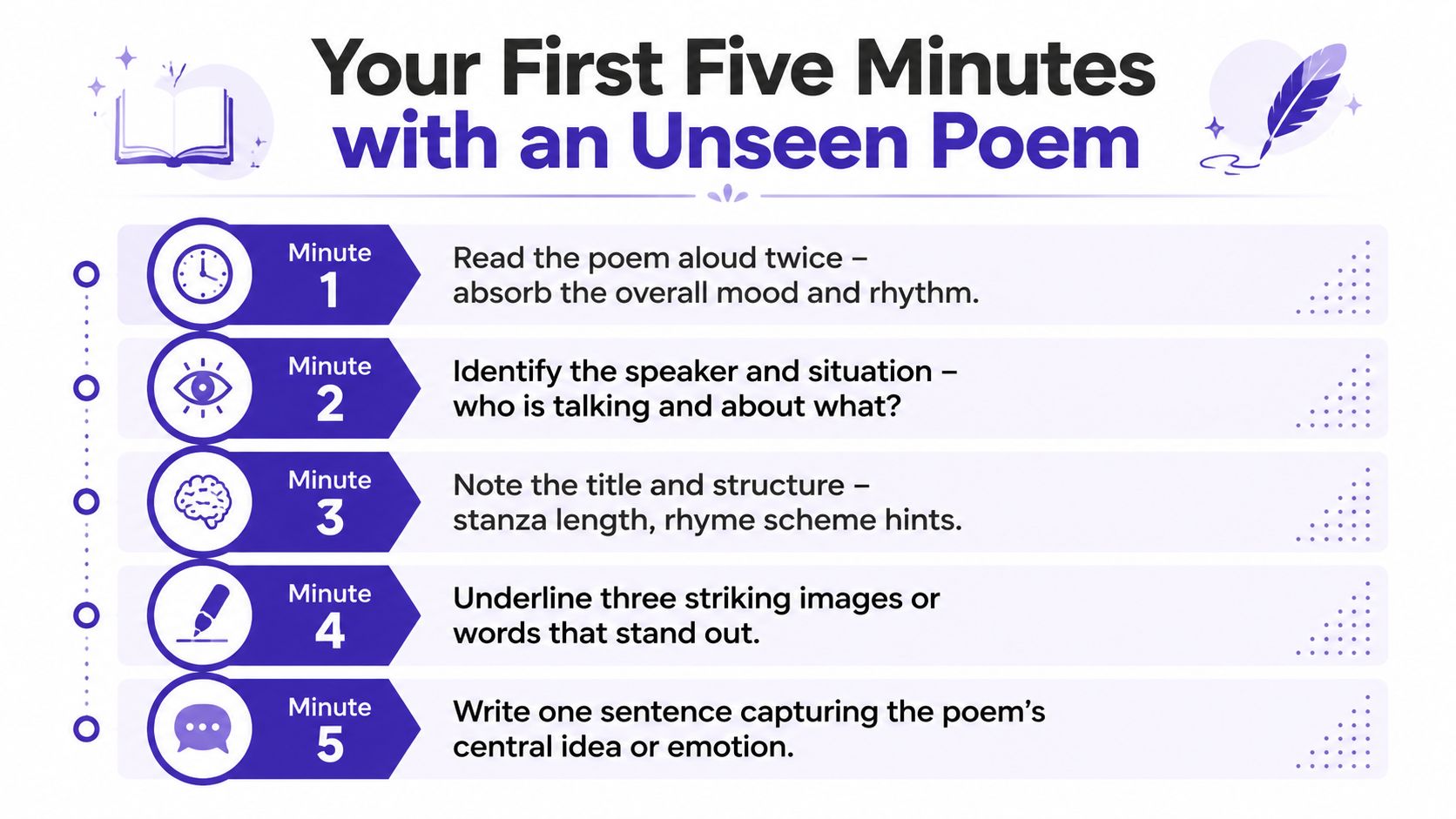
Read for the whole before the detail
Use the opening minutes actively:
- First read: Read the poem aloud in your head, or softly if the room allows it. Notice the broad mood, movement and voice without stopping at every difficult phrase.
- Second read: Find the speaker, the situation and the emotional direction. Is the voice remembering, observing, accusing, celebrating or questioning?
- Title and shape: Check what the title prepares you to expect. Notice stanza divisions, line lengths, punctuation and any obvious movement from one part of the poem to another.
- Select evidence: Underline a few words or images that feel important, unusual or emotionally charged. Don't colour-code the entire page.
- Write a working idea: Form one sentence about what the poem seems to communicate and how the speaker feels.
That final sentence can change. It isn't a contract with the examiner. It gives you a provisional argument, which is far more useful than beginning with disconnected technique labels.
When the poem feels difficult
You can still write well if a line remains unclear. Use the surrounding words, punctuation and tone to make a cautious inference. Words such as “perhaps”, “this may suggest” and “the image could imply” allow you to explore ambiguity without pretending that your interpretation is certain.
If syntax is complicated, locate the main verb and identify who appears to be doing what. If vocabulary is unfamiliar, focus on the emotional or sensory associations around it. A response that analyses a few secure details is stronger than one that invents a confident meaning for every line.
Practise this routine with Exam Practice for GCSE, especially if you tend to freeze when a text looks unfamiliar. The aim isn't to force every poem into one rigid template. It's to give your first reading enough structure to keep you thinking.
Understanding the Mark Scheme and Timing Strategy
A strong unseen-poetry response is built around marks, not the number of techniques you can name. On AQA, the section contains 32 marks: 24 marks for the first poem and 8 marks for comparison with a second poem. The first response is split between AO1 and AO2, with 12 marks for each. The comparison question is assessed on AO2 only, as explained in the AQA mark allocation guidance.
AO1 rewards your understanding and interpretation. You demonstrate it through a clear argument, relevant references and a convincing reading of the poem. AO2 rewards analysis of the writer's methods, including language, structure and form. Your marks rise when these elements work together. Technique labels without meaning are feature spotting. Interpretations without textual evidence are mere assertion.
Compare the boards carefully
The allocation differs by exam board, so check the specification and paper your school uses.
| Exam Board | Question 1 Marks | Question 2 Marks | Total Marks | Recommended Time |
|---|---|---|---|---|
| AQA | 24 | 8 | 32 | About 30 minutes, then 15 minutes |
| Edexcel | Not separated in the provided allocation | Not separated in the provided allocation | 20 | Follow your paper's instructions |
| OCR | Not specified as separate question marks in the provided guidance | Not specified as separate question marks in the provided guidance | 25% of total marks | About 45 minutes overall |
For Edexcel, the unseen poetry task assesses AO1 and AO2, with 8 marks for AO1 and 12 marks for AO2, giving 20 marks in total, according to the Edexcel assessment guidance. OCR guidance places unseen poetry in Paper 2 and describes it as worth 25% of the total marks, with about 45 minutes overall. That includes around 15 minutes for Question 1, 25 minutes for Question 2 and 5 minutes for checking, as outlined in OCR unseen poetry guidance.
Your timing should reflect the mark value. For AQA, allow roughly 5 minutes for reading and annotation, then about 30 minutes for the main response and 15 minutes for comparison. Use the longer answer to develop a clear argument, but protect time for the second question. Its smaller mark value still requires precise comparison of methods, so a rushed ending can cost marks that were available.
A useful rule is simple: after each observation, ask what it shows, then connect that meaning to the question. That extra step turns notes into evaluative writing under pressure.
Annotation That Helps You Write
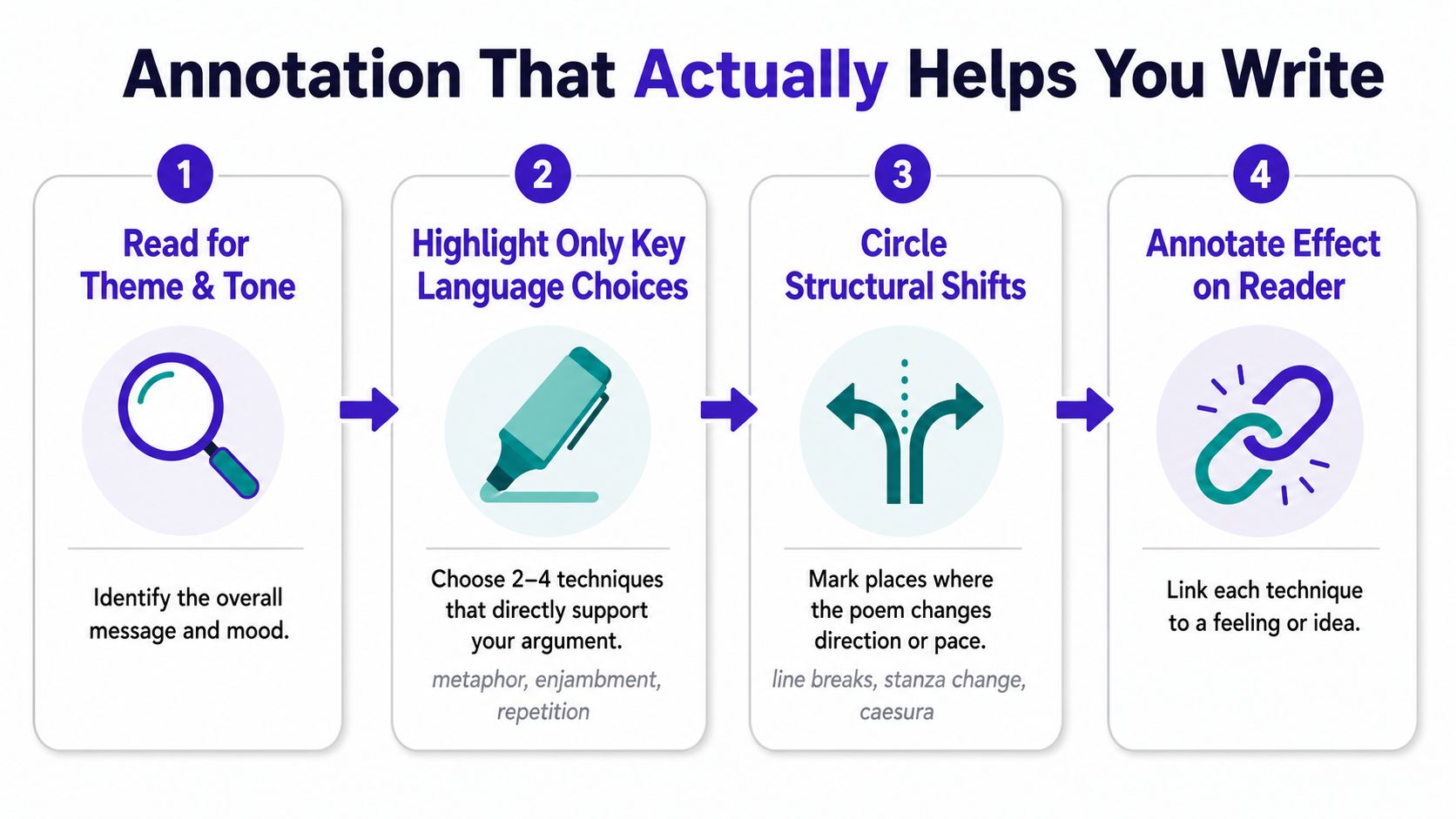
Annotation should shorten the route from observation to evaluative paragraph. Treat each mark as a small piece of reasoning, not decoration. If a detail cannot help answer the question, leave it unmarked.
Build an argument bank
Begin by tracking the poem's broad movement. Then gather evidence under four headings:
- Language: Circle a striking noun, verb or adjective. Add the association, feeling or judgement it creates.
- Structure: Mark a change in stanza, punctuation, line length or focus. Note what shifts and why that moment matters.
- Form and sound: Consider rhyme, rhythm, repetition or conversational form. Decide whether the poem feels controlled, unsettled, reflective or urgent.
- Tone: Label the speaker's attitude and record any development. A note such as “the speaker becomes guarded” gives you an interpretation to test in a paragraph.
Write notes that already point towards analysis. Beside enjambment, you might record that the line carries the thought onward, making the speaker seem unable to contain it. Beside a caesura, note that the interruption briefly unsettles the confidence of the voice. A technique label identifies a feature. Its effect and meaning create an argument.
Your annotations should function as paragraph plans. For each selected detail, record the observation, its likely meaning and its connection to the question. Under time pressure, this prevents you from staring at a page of highlighted words and having to invent an argument during writing.
Stop before annotation takes over
Select a small group of details that support your main interpretation. Underlining everything removes priority and leaves less time for writing. Let the question filter your choices. If it asks how the poet presents isolation, keep a sound pattern only when it contributes to distance, separation or the speaker's emotional state.
Use one practical test: could this note become a sentence in the essay? If the answer is no, leave it. Try the poem independently before using the video below as a visual reminder of the process.
You can use Online Revision for GCSE to practise turning a marked word into an explanation. The exam skill is transfer, so make the connection yourself when the poem is unfamiliar.
Building Paragraphs That Score Marks
PEE and PEEL are useful training wheels, but a top response needs more than a point, quotation and technique label. Each paragraph should make a claim about the poem, prove it with precise evidence, analyse the writer's choices and return to the question.
For the main response
A reliable paragraph shape is:
Interpretation: State what the poet presents and how the speaker's attitude appears.
Evidence: Embed a short word or phrase rather than copying a whole line.
Method and meaning: Explain the connotations of the word, the image or the structural choice.
Evaluation: Consider the effect on the reader, an alternative possibility or the wider implication.
Link: Return to the question and the poem's developing argument.
For instance, a paragraph might begin: “The poet initially presents the speaker's memory as comforting, but the soft imagery also suggests that the past is becoming unreachable.” After a quotation, you could write: “The verb creates a gentle movement, encouraging the reader to see the memory as intimate. However, its delicacy may also imply fragility, so the comfort cannot last.” That is evaluative because it tests more than one possible effect.
Don't force every paragraph to contain a new technique. A paragraph about a change in tone may analyse diction, punctuation and stanza movement together if they support one clear idea.
For the comparison response
The shorter comparison needs side-by-side writing. Use a structure such as:
“Both poets present loss as difficult to escape, but they create this effect differently. In the first poem, the repeated image suggests ..., whereas the second poem's abrupt line endings make ...”
Then explain the difference in method and effect. Comparison words should connect ideas, not decorate the paragraph. Similarly, in contrast, whereas and both poets are useful only when the sentences compare the poems.
Avoid writing a complete mini-essay on the first poem followed by a separate mini-essay on the second. That approach delays the comparison and makes the relationship between the poems difficult to follow.
A strong paragraph doesn't collect methods. It proves a judgement about meaning.
Finish the main response with a brief statement that gathers your argument. You don't need to repeat every point. Show how the poem's language, structure or form has developed the feeling or idea named in the question.
Common Mistakes and How Examiners Spot Them
The same weak habits appear across many scripts. They aren't signs that a student can't analyse poetry. They usually show that the student has mistaken preparation for explanation.
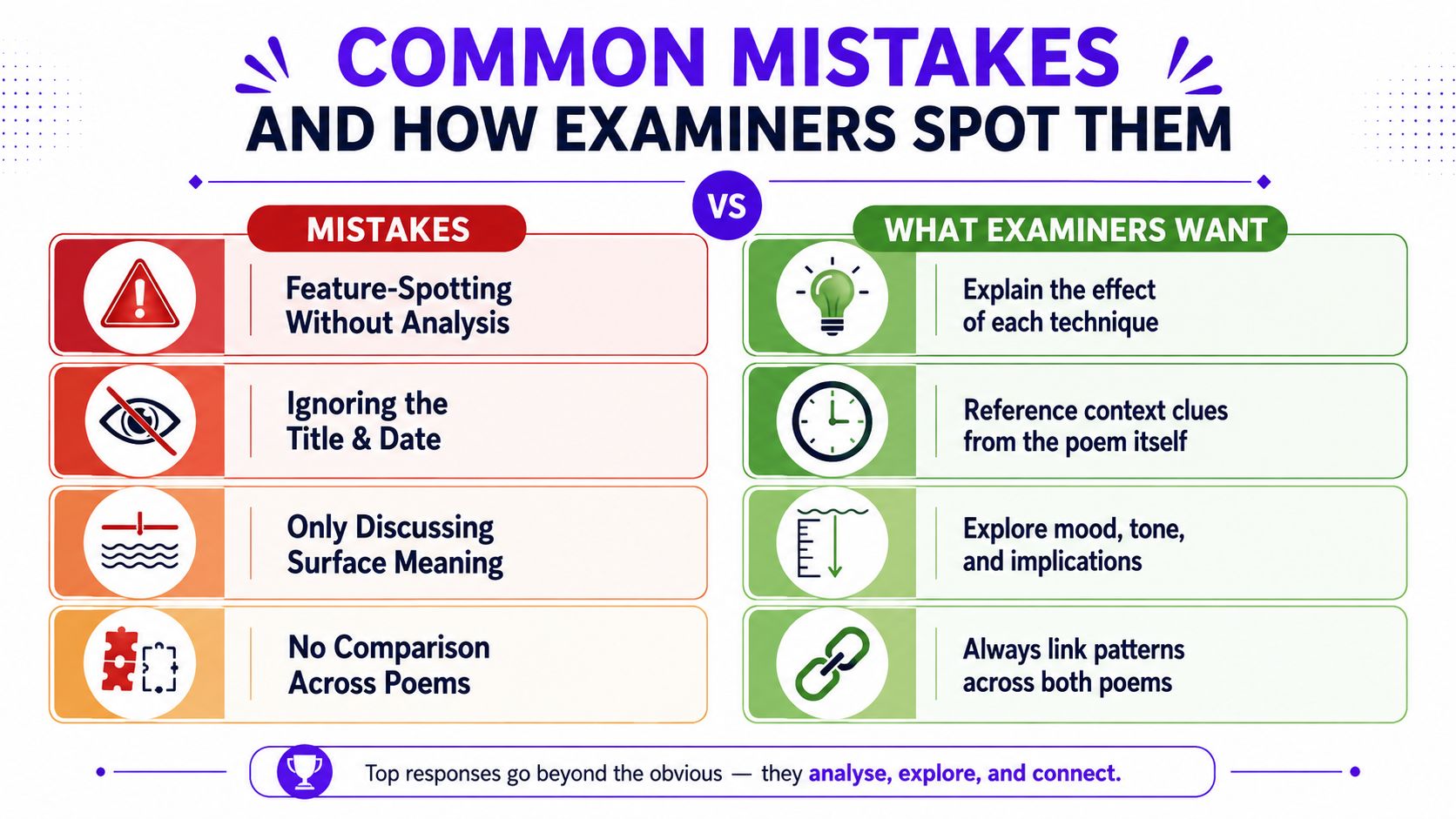
Put the weak and strong versions side by side
| Common approach | Stronger alternative |
|---|---|
| “The poet uses a metaphor.” | “The metaphor makes the memory seem physically heavy, suggesting the speaker carries emotional pressure.” |
| “This makes the reader feel sad.” | “The restrained verb creates sympathy because the speaker appears unable to express the full depth of the loss.” |
| Retelling what happens in each stanza | Explaining how each shift changes the speaker's attitude |
| Writing about one poem, then the other | Comparing methods and effects within the same paragraph |
AQA-linked materials identify feature spotting without explanation as a high-cost mistake. Terminology earns its place only when you connect it to meaning created through language, structure or form. That is why “there is enjambment” is incomplete, while “the enjambment carries the thought into the next line, making the speaker sound unable to contain the memory” gives the examiner something to reward.
Check what your sentence is actually doing
Retelling can show that you've followed the poem, but it doesn't show why the poet has presented events in that way. Vague emotional comments have the same problem. “The reader feels sad” could apply to almost any poem about difficulty, so specify the response and its cause. Does the reader feel sympathy, discomfort, uncertainty or admiration? Which word or structural decision creates that response?
“Perceptive” doesn't mean mysterious or overloaded with jargon. It means your interpretation notices an implication and explains it convincingly. “Evaluative” means you weigh an effect, consider a possible alternative or judge how successfully a choice communicates the idea.
If you write creatively as well as analytically, it can help to review broader guidance on first-time author mistakes because the same problems, such as vague wording and weak structure, can affect both forms of writing. Before moving on, ask whether every paragraph answers the question, uses evidence and explains a deliberate choice.
Practice Strategies and Model Answer Breakdown
Reading advice won't build fluency by itself. You need repeated attempts in which you can identify exactly where your explanation becomes stronger.
Start without a clock. Take an unfamiliar poem, write a one-sentence interpretation and produce one paragraph using a single image or structural choice. Then review it with three questions: Did I make a clear judgement? Did I analyse a precise word or pattern? Did I explain why the choice matters?
Move next to timed sections. Practise the main response separately from the comparison so you can concentrate on one skill at a time. After that, complete the whole section using the timing appropriate to your board. GCSE Past Papers give you material for this, while a method designed to boost retention with this method can help you revisit the analytical moves you repeatedly miss.
A compact model breakdown
Suppose a poem presents a speaker watching a familiar place become strange. A weak paragraph might say:
“The poet uses personification when the house is described as watching. This makes the reader feel sad. The speaker remembers the place and feels lonely.”
The paragraph identifies a method, but the explanation stays general. It doesn't examine the verb, connect the image to the speaker's changing perspective or develop the meaning of loneliness.
A stronger version would be:
The personification makes the house seem like an active observer rather than an empty setting. By suggesting that it ‘watches' the speaker, the poet reverses the expected relationship between person and place, creating unease because the familiar building appears to judge or remember him. The image therefore presents loneliness as psychological as well as physical. The speaker isn't alone in the house, he feels separated from the belonging it once represented.
The first sentence gives an interpretation. The next analyses the method and its implication. The final sentences evaluate the wider meaning and return to the emotional idea. That is how a small quotation becomes a developed paragraph.
Build a personal bank of moves, not memorised answers. Useful moves include exploring a verb's connotations, tracing a tonal shift, comparing how two poets use contrast and testing an alternative interpretation. Practise those moves until they feel natural, then apply them to poems you haven't seen before.
MasteryMind offers GCSE English Literature practice that includes unseen poetry analysis and comparison, with questions organised around exam-board command words, assessment objectives and mark allocations. Visit MasteryMind to practise from short questions through developed responses and use examiner-style feedback to target your next improvement.
Ready to master this topic?
Practise with quizzes, blurt exercises and exam questions on MasteryMind.
7 days Premium · Then free forever · No card, no charge