GCSE Equivalent in Scotland: National 5s Explained 2026
You've just moved from England to Scotland, or maybe your child is asking why their friends talk about National 5s instead of GCSEs. The names change, the structure changes, and suddenly the whole system feels harder than it should be. The good news is that the gcse equivalent in Scotland is much easier to understand once you know what is important, and most of the confusion disappears fast.
| Scottish National 5 vs English GCSE Grade Equivalents | National 5 Grade | Equivalent GCSE Grade | SCQF Level | RQF/CQFW Level |
|---|---|---|---|---|
| Scottish National 5 vs English GCSE Grade Equivalents | A | Roughly 9 to 7 | 5 | 2 |
| Scottish National 5 vs English GCSE Grade Equivalents | B | Roughly 6 to 5 | 5 | 2 |
| Scottish National 5 vs English GCSE Grade Equivalents | C | Roughly 4 | 5 | 2 |
| Scottish National 5 vs English GCSE Grade Equivalents | D | Below a standard pass comparison | 5 | 2 |
Cracking the Code of Scottish Qualifications
A family moves from Manchester to Fife, and the first question lands on the kitchen table. “What counts as the Scottish version of a GCSE?” It is a fair question, because the UK shares broad ideas about school stages, but each nation runs its own qualification system.
The short answer is that National 5 is the closest qualification to a GCSE in Scotland. It sits at SCQF Level 5 and is usually taken in S4, age 15 to 16, which is the same age many students in England sit GCSEs. That is the level that usually matters most if you are comparing school records, checking university entry requirements, or reading a job application form. A common mistake is to see “SCQF Level 5” and assume it refers to a school year or a separate English framework, when it is really Scotland's way of showing where a qualification sits on its own ladder.
Practical rule: Do not get stuck on the label alone. For most comparisons, the question is whether the qualification sits at the same broad level and what grade was achieved.
The other thing that trips people up is history. Scotland used to have Standard Grade, but the last Standard Grade qualifications were awarded in August 2013, after which National Qualifications became the main route for schools. That is why older relatives may still use outdated terms that no longer match what schools teach today.
If you are checking pathways beyond school, the comparison gets wider. A useful cross-check is the Scotland-focused explanation of vocational routes at MasteryMind's qualifications guide, because not every learner follows the same route after the broad school stage.
Meet the Nationals Your Guide to Scottish Exams
A family moving from England often expects a direct GCSE-style label, then finds Scotland uses a different structure. The day-to-day reality is simpler than it first looks. Pupils work through the Broad General Education in the earlier years, then move into the Senior Phase, where qualifications start to shape subject choices, college plans, and job applications.
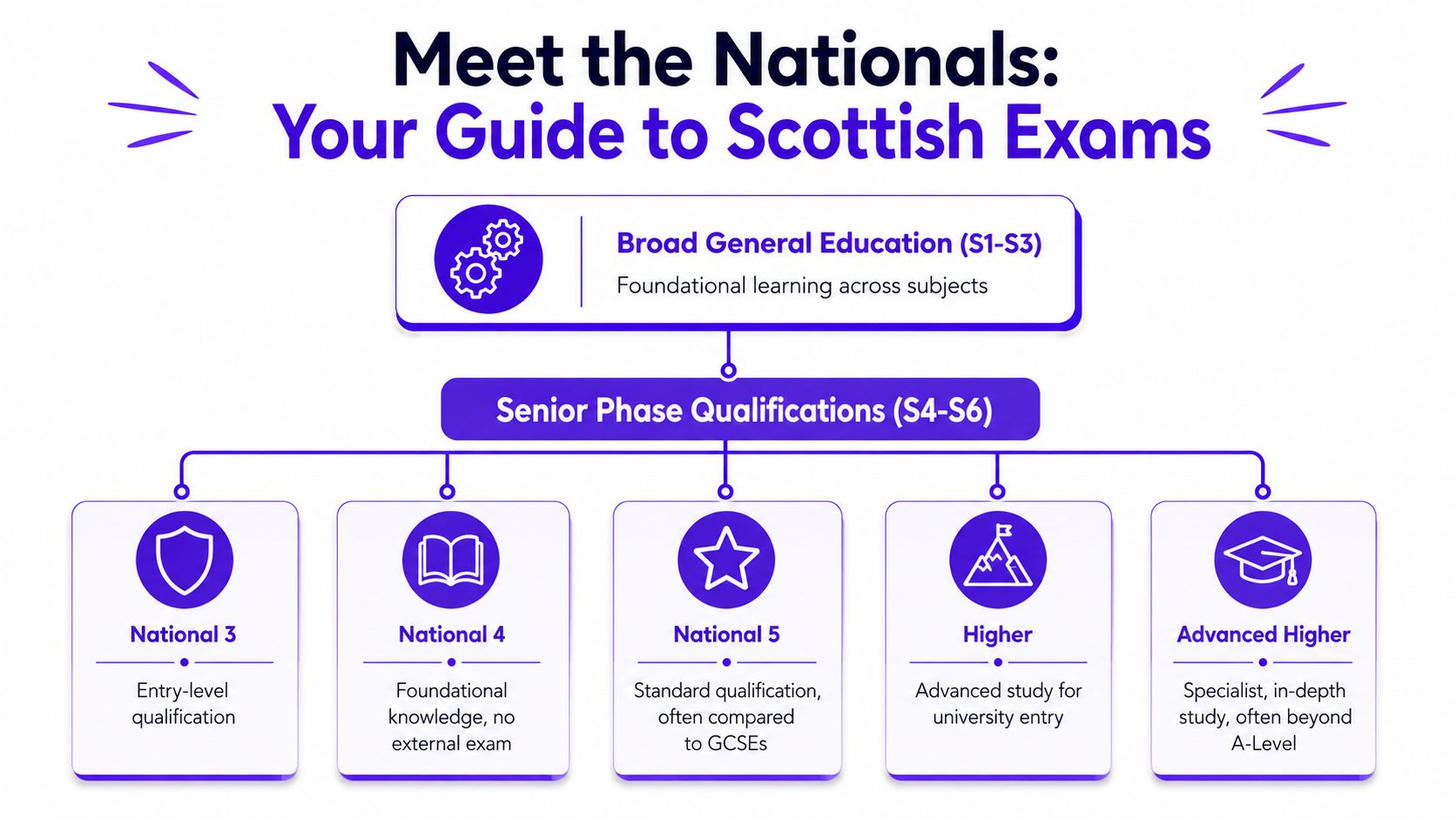
The names you will hear most often are National 3, National 4, National 5, Higher, and Advanced Higher. They work like steps on a ladder, with each one preparing a pupil for the next stage. The Scottish framework places National 4 at SCQF Level 4, National 5 at SCQF Level 5, and Higher at SCQF Level 6, as shown in the SCQF comparison table from SRUC.
For parents, the practical point is this. A Scottish pupil does not automatically swap “GCSE” for “National 5” and carry on as before. National 5 is the qualification people usually compare with GCSEs, but it sits inside Scotland's own ladder of qualifications, so the year group, subject mix, and next step all matter together. Guidance for Scottish learners also shows that National 4 and National 5 are taken in S3 and/or S4, while Highers usually come later in S5 and Advanced Highers in S6 eduscot.co.uk.
A pupil can be the same age as a child in England and still be working towards a different stage. That is why school year and qualification level both need checking, especially if you are comparing reports or planning a move between systems.
The old Standard Grade system is part of why some families still search for an outdated comparison. Today, National 5 is the modern benchmark for anyone asking for the gcse equivalent in Scotland, especially when a school is checking transfer documents or a form asks what level a learner has reached. For subject planning, it also helps to look at wider subject choices through the GCSE and A-Level subjects guide, because the subjects a pupil takes at this stage can shape what they are able to study next. If you are comparing pathways from an English perspective as well, the Access Courses Online guidance gives a useful overview of how equivalent qualifications are usually treated.
National 5 vs GCSE A Detailed Grade Comparison
Grades are where many families first pause, because the labels look familiar but the systems do not work in quite the same way. Scottish and English qualifications both recognise strong performance, yet they use different grading scales, so a simple swap from one grade to another can cause confusion.
In Scotland, National 5 awards A, B, C, or D. UK guidance often links National 5 A to C with roughly GCSE grades 9 to 4 GoStudyUK. That gives you a useful broad match, but it is not a perfect one-to-one translation. If a school, college, or employer asks for GCSE grade 4 or above, a National 5 C is usually the point people are trying to compare against.
| Scottish National 5 vs English GCSE Grade Equivalents | National 5 Grade | Equivalent GCSE Grade | SCQF Level | RQF/CQFW Level |
|---|---|---|---|---|
| Scottish National 5 vs English GCSE Grade Equivalents | A | Roughly 9 to 7 | 5 | 2 |
| Scottish National 5 vs English GCSE Grade Equivalents | B | Roughly 6 to 5 | 5 | 2 |
| Scottish National 5 vs English GCSE Grade Equivalents | C | Roughly 4 | 5 | 2 |
| Scottish National 5 vs English GCSE Grade Equivalents | D | Below a standard pass comparison | 5 | 2 |
Use that table as a translation aid, not as a rulebook. When people compare records, they are usually trying to judge whether the qualification shows the level of achievement needed for the next step. The key point is that National 5 sits at SCQF Level 5, and the official Scottish framework places it alongside the same general level as GCSE grades 4 to 9 at RQF Level 2 Qualifications Scotland.
That matters in practical terms. A family moving from England may see a National 5 certificate and wonder whether it “counts” in the same way as a GCSE result. It does, but the grade label needs careful reading, because a C is often treated as the standard pass comparison, while an A shows a much stronger result. For applications, the important question is usually not the exact label, but whether the grade meets the entry requirement written on the form.
Parents also run into confusion when different organisations describe the same level in slightly different language. The Access Courses Online guidance is useful for seeing how UK equivalents are commonly explained, especially if you are comparing Scottish results with English entry criteria or course descriptions.
If a pupil is revising for a Scottish exam but using GCSE material, the exam skill itself still matters. Working through GCSE Past Papers can help with timing, question style, and checking how answers are marked, even though the qualification name is different.
The Scottish Student Journey From S3 to University
A Scottish pupil usually does not reach National 5 by chance. The route begins earlier, and the decisions made in S3 shape the rest of the Senior Phase. For a family moving from England, that can feel unfamiliar at first, because the system works as a sequence of stages rather than one single exam moment.
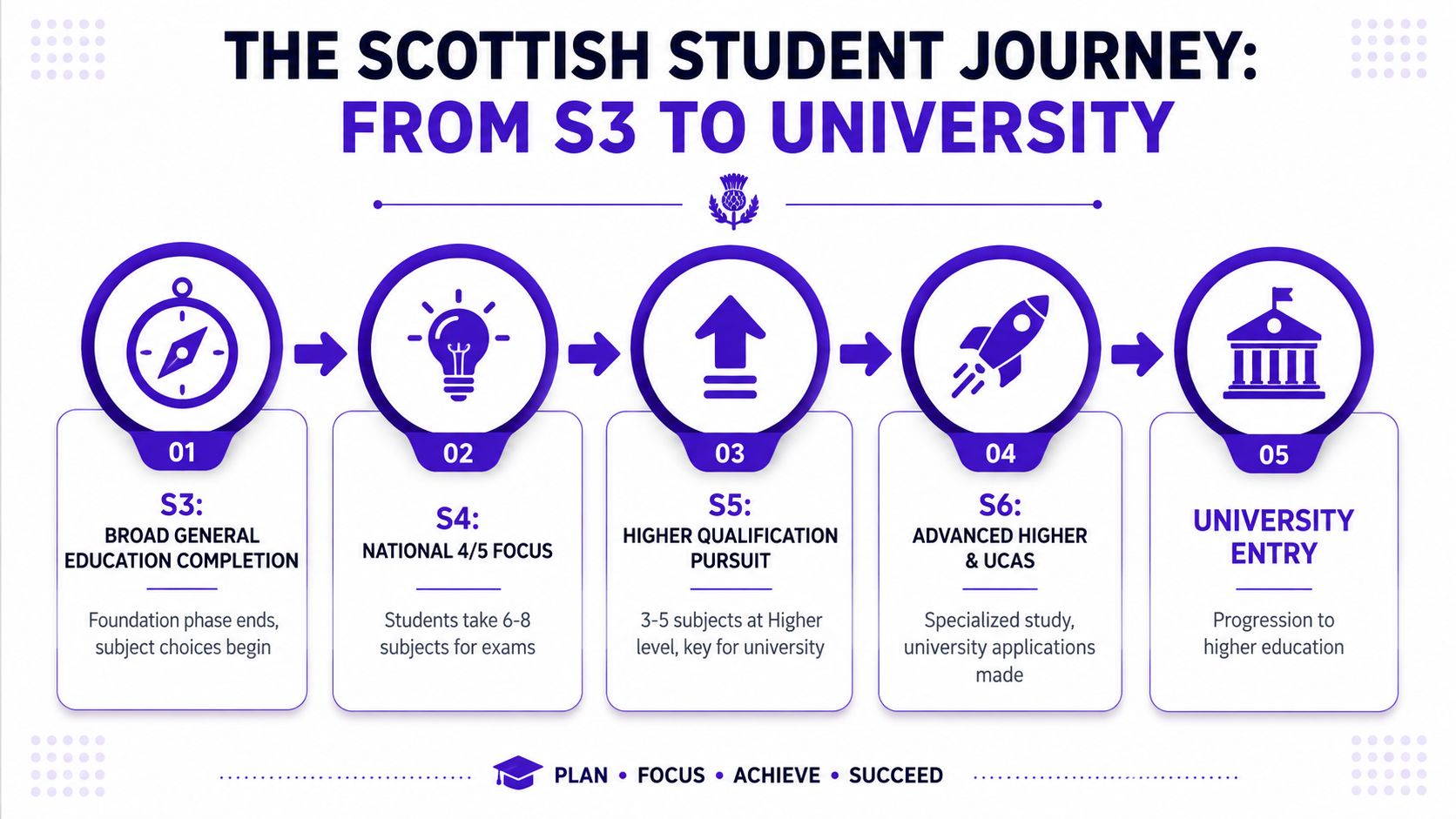
A typical route starts with broad subject learning in S1 to S3, then moves into more focused exam subjects. Pupils usually take National 4 and National 5 in S3 and/or S4, then progress to Highers in S5 and Advanced Highers in S6 eduscot.co.uk. That is why the gcse equivalent in Scotland is only one part of the story. It marks an early qualification point, but it does not tell you everything about a pupil's next step.
Here is the practical difference. In England, many pupils and parents focus on GCSEs first, then sixth form qualifications. In Scotland, the path is more layered, because National 5 gives the first major exam result, while Higher often carries more weight for university courses. The Scottish framework from SRUC places those qualifications on a clear ladder, so the move from one stage to the next is built into the system.
A strong National 5 profile can open the door to the next level, but it is the Higher stage that often matters most for university planning.
That shapes subject choice. If a pupil wants science, languages, or another competitive route later on, they need to think ahead in S3, not only react in S4. Parents often want a simple conversion chart, but the key question is whether the subject mix supports the next qualification stage and the courses the pupil may want later.
For revision support that follows familiar exam habits, Exam Practice for GCSE can still help students work on timing and recall, especially when they are moving between systems and want structured practice.
Practical Implications What This Means for You
For a student, the first task is straightforward. Know which qualification you have, know the level it sits at, and write it clearly on applications. For a parent, the job is to stop confusion before it turns into poor choices, especially if your child is moving between Scotland and England.

One point families often miss is that official records do not always use neat one-to-one labels. Scotland's census qualification metadata groups GCSE, O Grade, and National 3/4/5 together in a broad level category, which shows why people still need clear translation guidance for forms and admissions checks Scotland Census metadata. That broad grouping does not mean the qualifications are identical. It means the system is comparing them at a high level rather than by exact title.
For a CV, the safest approach is to name the qualification exactly as awarded, then add the broad comparison only if it helps the reader understand. A line like “National 5 English, SCQF Level 5” is clearer than trying to replace it with a GCSE label. On a UCAS form, the same rule applies. List the qualification as it appears on the certificate, because admissions staff understand Scottish awards and will read them in context.
If you are moving a child into a Scottish school, the biggest mistake is assuming the curriculum will mirror England subject for subject. Teachers usually look at prior learning, current stage, and where the pupil needs to go next, not just the old qualification name. That is why it helps to ask about the subject set, the assessment style, and whether the pupil is aiming for National 4, National 5, or a later Higher route.
A useful check for families is to ask, “What does this qualification let the pupil do next?” That question keeps the focus on progression rather than labels. A child who needs more confidence may benefit from structured practice that feels closer to the exam room, while a pupil who is changing systems may need help with timing, question styles, and keeping their record of results tidy.
For a student rebuilding confidence, the useful question is not “Which system is better?” It is “Which qualification do I need next, and what proof will the school, college, or employer accept?” Clear revision, past-paper style practice, and simple record-keeping all help with that. A resource like Exam Practice for GCSE can support students as they practise in a more exam-like way and get used to the demands of whichever route they are on.
University Admissions and UK-Wide Recognition
A family moving from England often worries that Scottish qualifications will be read as “different” rather than “equal”. Universities across the UK are used to Scottish qualifications, though, and admissions teams see National 5s, Highers, and Advanced Highers every year. The labels change, but the qualifications are still understood, so there is no need to treat them as second-best because they do not look like GCSEs on the page.
The helpful part is the level behind the name. Qualifications Scotland confirms that National 5 sits at SCQF Level 5, while GCSE grades 4 to 9 map to RQF Level 2, which is also aligned to SCQF Level 5. That means the two systems sit at the same benchmark level across the UK, even if the grading language is different.
For university entry, the later qualifications usually matter more. Highers and Advanced Highers sit above National 5 in the Scottish ladder, and admissions teams often focus on them because they show more advanced study and a clearer subject direction. A Scottish applicant should therefore present the full pattern of study, not only the qualification that looks most like GCSE.
Useful mindset: National 5 is the foundation, Higher is the main currency for many university routes, and Advanced Higher can strengthen specialist applications.
UCAS and admissions tutors understand this structure. They are used to comparing systems fairly, so a Scottish student does not need to rewrite their results into an English format just to be understood. The better approach is to list each qualification accurately, keep the subject names clear, and let the admissions team read the record as it stands.
For families, that usually takes away the last bit of worry. The systems are different, but they are not barriers. A strong Scottish profile still counts, and universities know how to read it alongside English qualifications, apprenticeships, and other routes into study or work.
If you want more clear, exam-focused guidance on Scottish and UK qualifications, visit MasteryMind for revision support, subject tools, and practical help that fits the way UK learners study. It is a useful place to build confidence with exam-style practice, especially if you are comparing Scottish qualifications with GCSE routes or planning the next step after National 5.
Ready to master this topic?
Practise with quizzes, blurt exercises and exam questions on MasteryMind.
7 days Premium · Then free forever · No card, no charge