GCSE French Grammar: Exam-Focused Guide & Tips
French grammar isn't a decorative extra in GCSE exams. Under current UK subject conditions, exam boards must allocate at least 10% of the marks in both AO2 and AO4 to accurate knowledge and application of grammar and structures, making grammar a regulated assessment requirement rather than a classroom theme. The government's GCSE modern foreign languages guidance also sets writing tasks at at least 90 words for Foundation tier and 150 words for Higher tier, so you need enough grammatical control to keep sentences accurate under time pressure.
That matters to a large group of students. French remains England's strongest modern language by GCSE entries. In 2022/23, French accounted for about 125,000 entries, compared with about 120,000 for Spanish and 34,000 for German, according to the House of Commons Library briefing on language learning. Whether you're recovering after leaving revision late or aiming for the highest grade you can reach, the smart approach is selective: learn the structures that repeatedly control marks for your tier, then practise using them accurately.
Why Grammar Decides Your GCSE French Grade
GCSE French, German and Spanish are generally statistically more difficult than many other GCSE subjects, while grammar and structures receive a defined place in assessment. The government's grading standards evidence identifies grammar and structures as receiving 5% of marks in the relevant assessment design. The exact weighting can look different across specifications, so check your exam board, but the practical lesson is consistent: grammar can decide whether a response stays understandable, earns a higher band, or loses accuracy marks.
A vocabulary-heavy answer can still underperform if its verbs, agreements and time frames keep changing. For example, Hier, je vais au cinéma mixes a past-time marker with a present-style verb form. A reader may understand your meaning, but the sentence shows weak control. By contrast, Hier, je suis allé(e) au cinéma et c'était excellent gives the examiner a clear past event followed by a description or background judgement.
Marker's rule: A familiar word used in a correct structure is usually more useful than an ambitious word placed in an inaccurate sentence.
The table below is a revision guide, not an official grade boundary. Your exam board's mark scheme remains the authority.
| Grade Band | Typical Grammar Accuracy | Mark Range (Writing) | Common Error Types |
|---|---|---|---|
| Foundation pass range | Mostly understandable, with control of familiar structures | Depends on the board and paper | Verb endings, gender, plural agreements |
| Secure middle performance | Usually accurate in simple sentences, with some successful time frames | Depends on the board and paper | Tense confusion, missing agreements, word order |
| Strong Higher performance | Accurate basic structures plus controlled complex forms | Depends on the board and paper | Conditional formation, pronoun placement, subordinate clauses |
| Top-band performance | Consistent control, including time frames and less familiar combinations | Depends on the board and paper | Occasional slips rather than repeated structural errors |
AQA makes the principle particularly clear. Its specification defines grammar through morphology and syntax, and students must show receptive and productive control of the prescribed grammar across reading, listening, speaking and writing. Foundation candidates work from the Foundation list, while Higher candidates apply Foundation grammar plus Higher additions. The AQA grammar requirements are therefore a better revision checklist than a random online tense table.
French also has four papers weighted equally in AQA's current design, listening, speaking, reading and writing, with a total scaled mark of 200, as set out in the AQA specification overview. Grammar can affect every one of those papers. Use GCSE Past Papers to find recurring structures, but mark your errors by type rather than counting completed papers.
Nouns and Adjective Agreement Made Simple
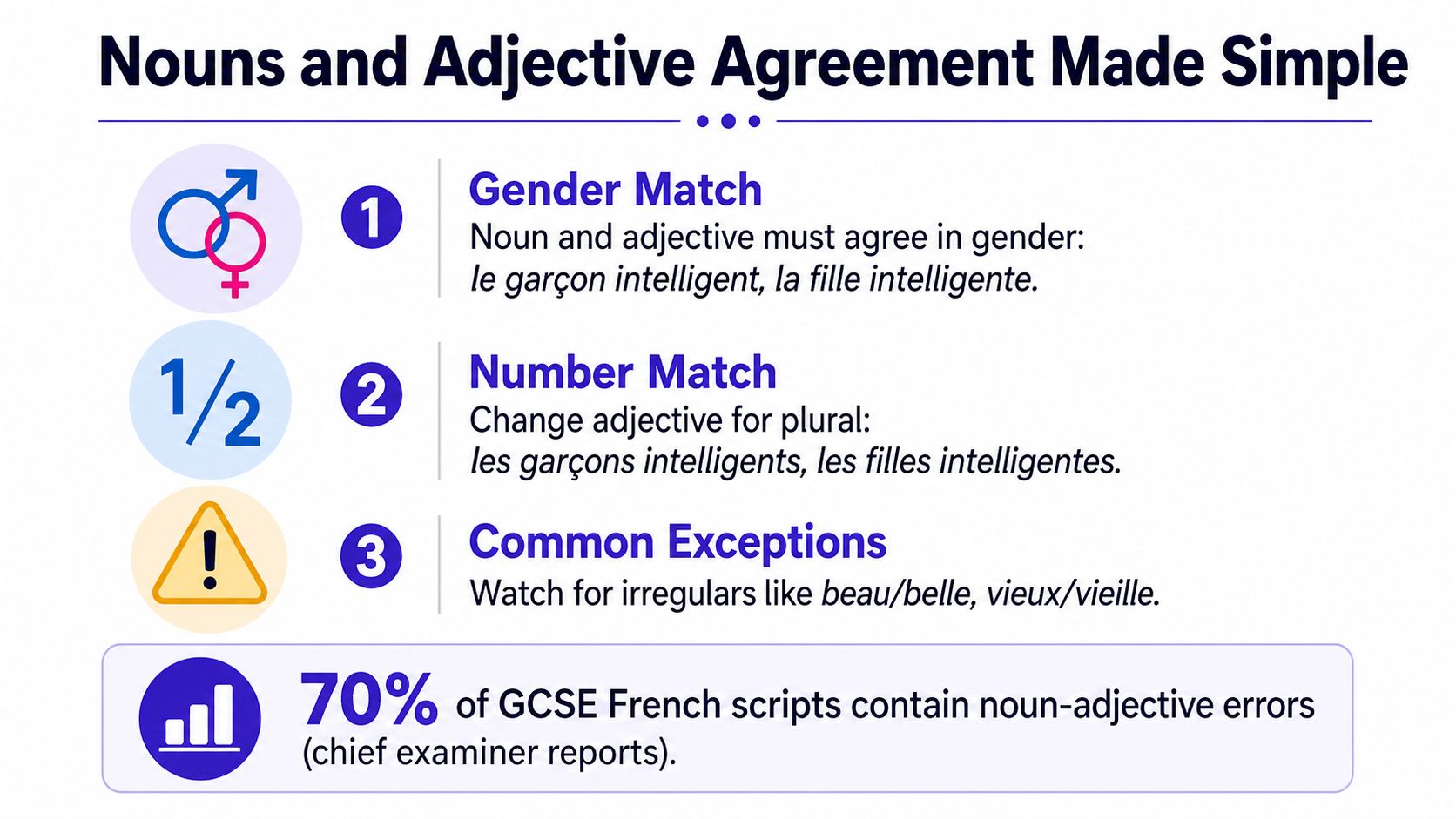
Agreement becomes easier when you stop treating it as a spelling trick. Every adjective must match the noun it describes in gender and number. Start by identifying the noun, then ask two questions: is it masculine or feminine, and is it singular or plural?
- le garçon intelligent
- la fille intelligente
- les garçons intelligents
- les filles intelligentes
The usual feminine form adds -e, and the plural usually adds -s, but you must watch the adjective's ending. A masculine adjective ending in -eux often changes to -euse, as in heureux, heureuse. An adjective ending in -if often changes to -ive, as in sportif, sportive. These patterns are more useful than memorising isolated mistakes because they help you build unfamiliar forms.
Placement matters too
Most adjectives come after the noun, as in une maison moderne. A small group commonly comes before it. The BAGS reminder helps: beauty, age, goodness and size. Examples include un beau film, une vieille voiture, un bon restaurant and un grand problème. It isn't a complete list of pre-noun adjectives, but it's a useful exam trigger.
Some forms change more dramatically. Learn these as pairs:
| Masculine | Feminine | Example |
|---|---|---|
| beau | belle | un beau paysage, une belle plage |
| nouveau | nouvelle | un nouveau collège, une nouvelle école |
| vieux | vieille | un vieux château, une vieille maison |
| blanc | blanche | un pantalon blanc, une chemise blanche |
| long | longue | un long voyage, une longue journée |
Don't add changes where French doesn't require them. Colour adjectives such as marron and orange are commonly treated as invariable, so write des chaussures marron and des pulls orange. The noun is still plural, but the colour word doesn't take the usual plural ending.
Quick proofread: Circle every noun in your writing. Draw a line to its adjective. Then check gender, number and placement. This catches more errors than rereading the paragraph from the beginning.
The most damaging mistakes are often tiny: la fille est intelligent, les activités est amusantes, or des vacances intéressant. Build a final agreement scan into every writing task, especially after c'est, il est and elle est. Those short phrases often introduce descriptions where feminine or plural agreement is easy to overlook.
Mastering the Five Key French Tenses
A strong GCSE answer doesn't use every tense it knows. It chooses the tense that matches the time reference, then keeps that choice accurate. The five key GCSE French tenses are the present, perfect, imperfect, simple future and conditional.
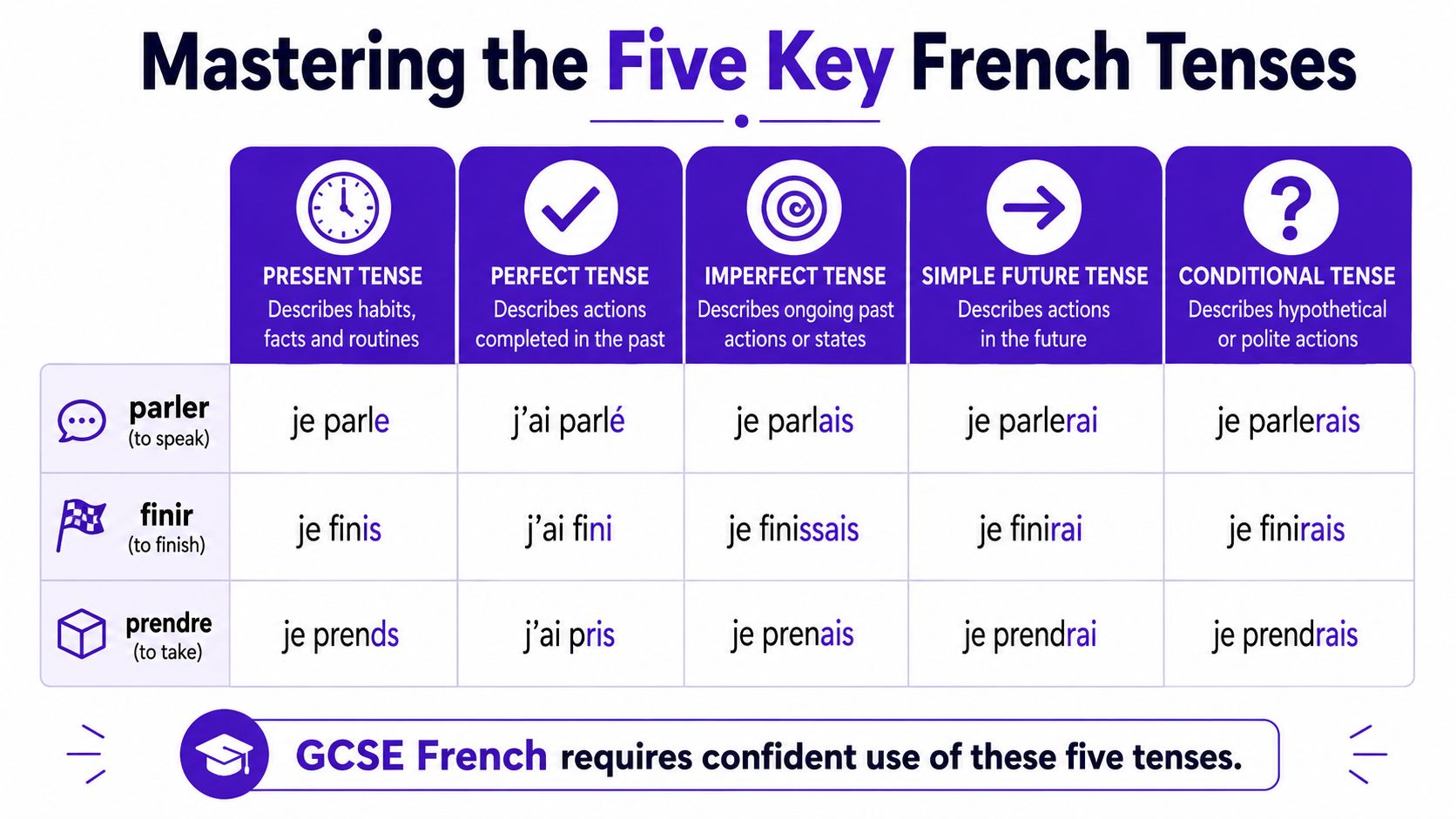
| Tense | Main use | Model |
|---|---|---|
| Present | What happens now or generally | Je joue au tennis. |
| Perfect | A completed past event | J'ai joué au tennis. |
| Imperfect | Habit, background or ongoing past description | Je jouais au tennis. |
| Simple future | What will happen | Je jouerai au tennis. |
| Conditional | What would happen or what you would like | Je jouerais au tennis. |
Match the tense to the signal
The present describes habits and current situations: D'habitude, je mange à la maison. The perfect usually reports a completed event: Hier, j'ai mangé au restaurant. The imperfect supplies background or repeated action: Quand j'étais petit(e), je mangeais souvent chez mes grands-parents.
The contrast matters. Hier, j'ai regardé un film means you watched a film as a completed event. Quand j'étais jeune, je regardais souvent des films describes a repeated habit. In a longer response, combine them: Quand j'étais plus jeune, je regardais beaucoup de films, mais samedi dernier j'ai vu un documentaire intéressant.
For the perfect tense, remember the auxiliary and past participle. Most verbs use avoir, some movement and reflexive verbs use être, and the past participle must be learned with irregular verbs such as fait, vu, pris, mis, lu and écrit. With être, agreement matters: Elle est allée, ils sont partis.
Build future and conditional forms carefully
The simple future commonly uses the infinitive with the appropriate ending: je parlerai, tu finiras, nous prendrons. Irregular stems still need attention, including j'irai, je ferai and je serai. The conditional uses the same future stem but imperfect-style endings: je parlerais, je finirais, je prendrais.
A useful Higher-tier pattern is the si sentence:
- Si j'avais plus de temps, je ferais du sport.
- Si je pouvais, j'irais en France.
The verb after si isn't conditional. Use the imperfect after si, then the conditional in the result clause. For extra guided practice, LenguaZen French tenses revision offers another way to review formation and usage. You can also organise tense work alongside the MasteryMind curriculum subjects, particularly when you need to connect grammar with topic vocabulary.
Use this short model as a pattern, not a script:
Normalement, je fais mes devoirs après l'école. Hier, j'ai fini mes devoirs rapidement parce que j'étais fatigué(e). À l'avenir, je travaillerai davantage et, si j'avais plus de temps, je lirais en français.
The present establishes routine, the perfect reports a completed event, the imperfect gives a reason or background, and the future and conditional extend the response. That is controlled range, not tense collecting.
Pronouns, Negatives and Question Forms
Pronouns, negatives and questions become less confusing when you build them around the verb. In a simple sentence, object pronouns normally come before the conjugated verb: Je le regarde, je lui parle, je leur téléphone. In a compound tense, they still come before the auxiliary: Je l'ai vu and je lui ai écrit.
The main distinctions are practical. Le and la replace a direct object, while lui replaces “to him” or “to her”. Leur replaces “to them”. Y can replace a place or an idea introduced by à, while en can replace something introduced by de or a quantity: J'y vais and J'en parle.
Negatives wrap around the conjugated verb in simple tenses: Je ne regarde pas la télévision. In a compound tense, they wrap around the auxiliary: Je n'ai pas regardé la télévision. With rien and personne, position needs extra care: Je n'ai rien vu and Je n'ai vu personne. The pattern changes from the simple sentence you may first learn, so practise complete examples rather than single-word translations.
| Structure Type | Form | Example | Common Error |
|---|---|---|---|
| Direct object | le, la, les | Je les connais. | Putting the pronoun after the verb |
| Indirect object | lui, leur | Je leur téléphone. | Confusing leur with les |
| Place or idea | y | J'y vais demain. | Repeating the full phrase unnecessarily |
| De phrase or quantity | en | J'en veux deux. | Using y instead of en |
| Standard negative | ne…pas | Je ne comprends pas. | Forgetting ne in formal writing |
| Expanded negative | ne…jamais, ne…plus | Je ne sors jamais. | Treating every negative like pas |
| Question | intonation, est-ce que, inversion | Est-ce que tu viens ? | Mixing structures incorrectly |
Choose a question form deliberately
Intonation is natural in speech: Tu aimes le français ? Est-ce que is clear and reliable in both speech and writing: Est-ce que tu aimes le français ? Inversion is more formal: Aimes-tu le français ? Use the form that suits the task, but make sure the subject and verb remain correctly connected.
You can combine structures without making the sentence unmanageable: Est-ce que tu ne lui parles jamais ? or Pourquoi est-ce que tu n'y vas pas ? Higher performance doesn't come from forcing complicated sentences everywhere. It comes from showing that you can control a structure when it helps your meaning.
For realistic timed practice, use Exam Practice for GCSE, then add pronoun and negative errors to your personal log. If you repeatedly write je lui vois, don't just memorise the correction. Record the reason: voir quelqu'un takes a direct object, so the replacement is je le vois or je la vois.
Comparatives, Commands and Complex Structures
These structures help you move beyond a sequence of short statements. Start with comparisons:
- plus intéressant que, more interesting than
- moins cher que, less expensive than
- aussi pratique que, as practical as
- le plus important, the most important
- la moins utile, the least useful
Watch the irregular forms meilleur and pire. Write C'est un meilleur choix, not un plus bon choix, and la pire solution, not la plus mauvaise solution when you're using the standard irregular form.
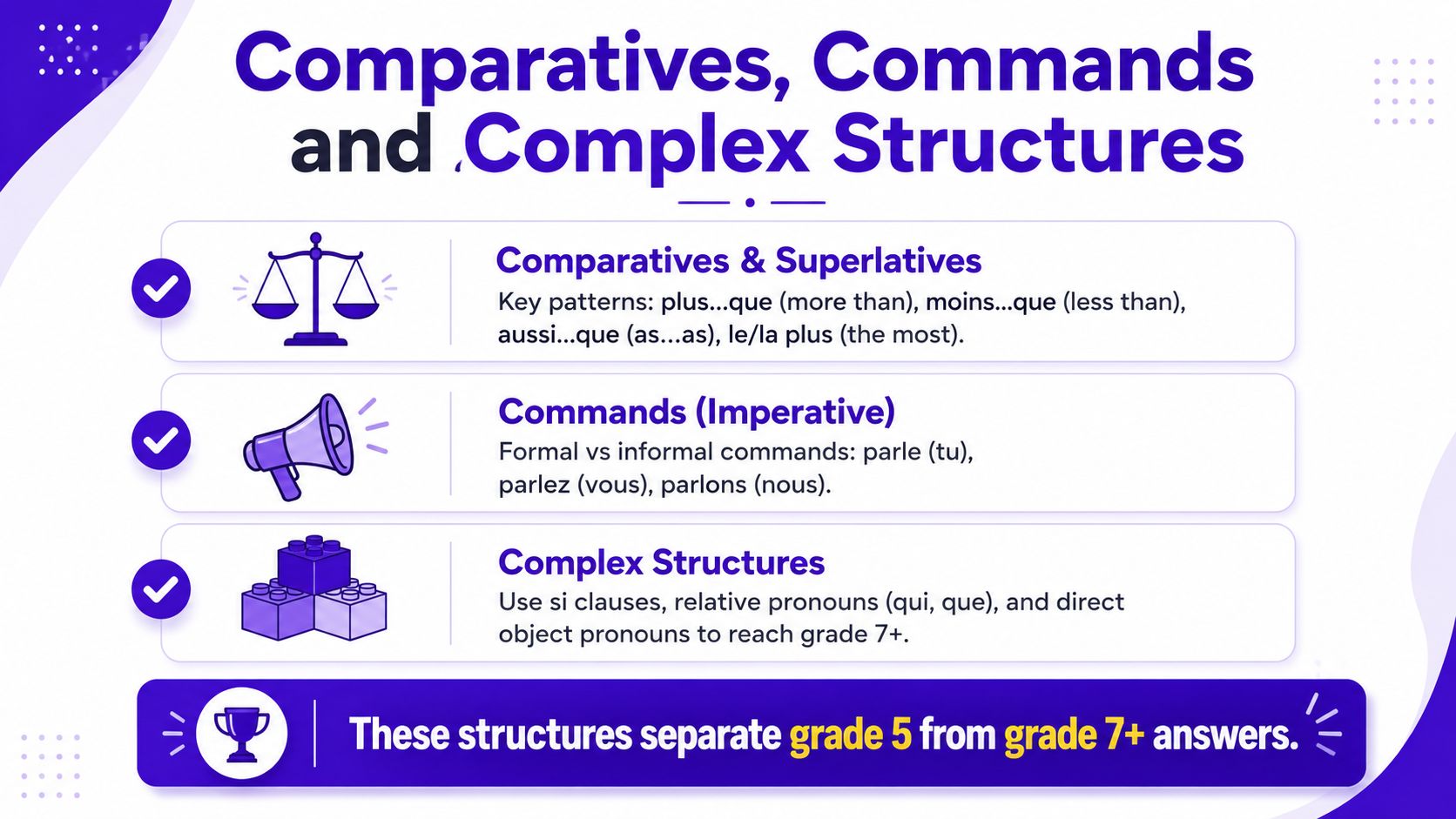
The imperative has three main forms. For a regular -er verb, the tu form drops the final -s: parle ! The other common forms are parlons ! and parlez ! For finir, use finis !, finissons ! and finissez ! Keep object pronouns after the affirmative imperative, with a hyphen: Écoute-moi ! Negative commands return the pronoun before the verb: Ne me parle pas !
Add complexity without losing control
Infinitive structures are efficient ways to extend an answer:
- Avant de sortir, je fais mes devoirs.
- Pour réussir, il faut travailler régulièrement.
- Je regarde des vidéos sans utiliser les sous-titres.
- Après avoir fini mes devoirs, je me repose.
You can also use en plus the present participle: En travaillant régulièrement, on progresse. Relative pronouns make ideas connect: J'aime le film que j'ai regardé and C'est une activité qui me détend. A conditional sentence adds evaluation: Si j'avais le choix, je voyagerais davantage.
Compare the effect:
- Basic: Le sport est bon. Je fais du sport. J'aime le football.
- Developed: Le sport est meilleur que les jeux vidéo pour rester en forme, et je fais du football parce que c'est une activité qui me détend.
The second version isn't automatically perfect, but it gives you more opportunities to show agreement, comparison, conjunctions and a reason. Use a checklist before submitting:
- Time frame: Have I used a clear past, present or future reference?
- Agreement: Do adjectives match their nouns?
- Connection: Have I linked at least some ideas with qui, que, parce que, si or an infinitive phrase?
- Accuracy: Have I checked verb endings and pronoun position?
- Purpose: Does each complex structure express a real idea?
Better advice: One accurate complex sentence is more valuable than several impressive-looking sentences you can't control.
What Changed in the 2024 and 2026 Specification Reform
Older revision guides can mislead you because the relationship between Foundation and Higher grammar has changed. The older GCSE modern foreign languages content document stopped applying to French, German and Spanish for teaching from September 2024, according to the updated government subject guidance. That marks a substantial specification reset, so always identify the version and exam year before using a past paper as a grammar checklist.
The important practical change is that some grammar previously associated with Higher tier is now included at Foundation tier. The AQA update on GCSE French, German and Spanish specifically highlights reflexive verbs in singular and plural forms and plural reflexive pronouns within the revised Foundation content. It also clarifies that derived forms can be used across skills when they're clearly recognisable.
| Grammar Structure | Pre-Reform Foundation | Post-Reform Foundation | Higher Tier |
|---|---|---|---|
| Basic present forms | Core familiar forms | Core forms remain examinable | Core forms plus wider application |
| Perfect tense | Core forms | Core forms with revised coverage | Foundation forms plus Higher additions |
| Imperfect and conditional | Coverage depended on the specification | Check the current board list | Broader application and complexity |
| Reflexive verbs | Some forms could be treated as Higher content | Singular and plural forms are included in revised content | Foundation forms plus further prescribed grammar |
| Derived forms | Older guidance may be narrower | Recognisable derived forms can be used across skills | Wider controlled use remains important |
Don't assume every board presents the change in exactly the same way. AQA, Edexcel, OCR and WJEC candidates should read their own current specification and prescribed grammar list. The safe revision rule is simple: use pre-reform papers for vocabulary, comprehension and general timing, but don't use an old paper alone to decide what your tier can be tested on.
Foundation students should no longer dismiss structures just because an older guide labels them “Higher”. Higher students still need the Foundation core, but they must extend it accurately into longer and less predictable responses. In both tiers, grammar is becoming something you recognise and use across skills, not a private list of endings studied separately from communication.
Your Targeted Grammar Revision Plan
Passive rereading feels productive because the page looks familiar. It doesn't prove that you can produce the structure under pressure. Use a four-week cycle that moves from accuracy to timed application.
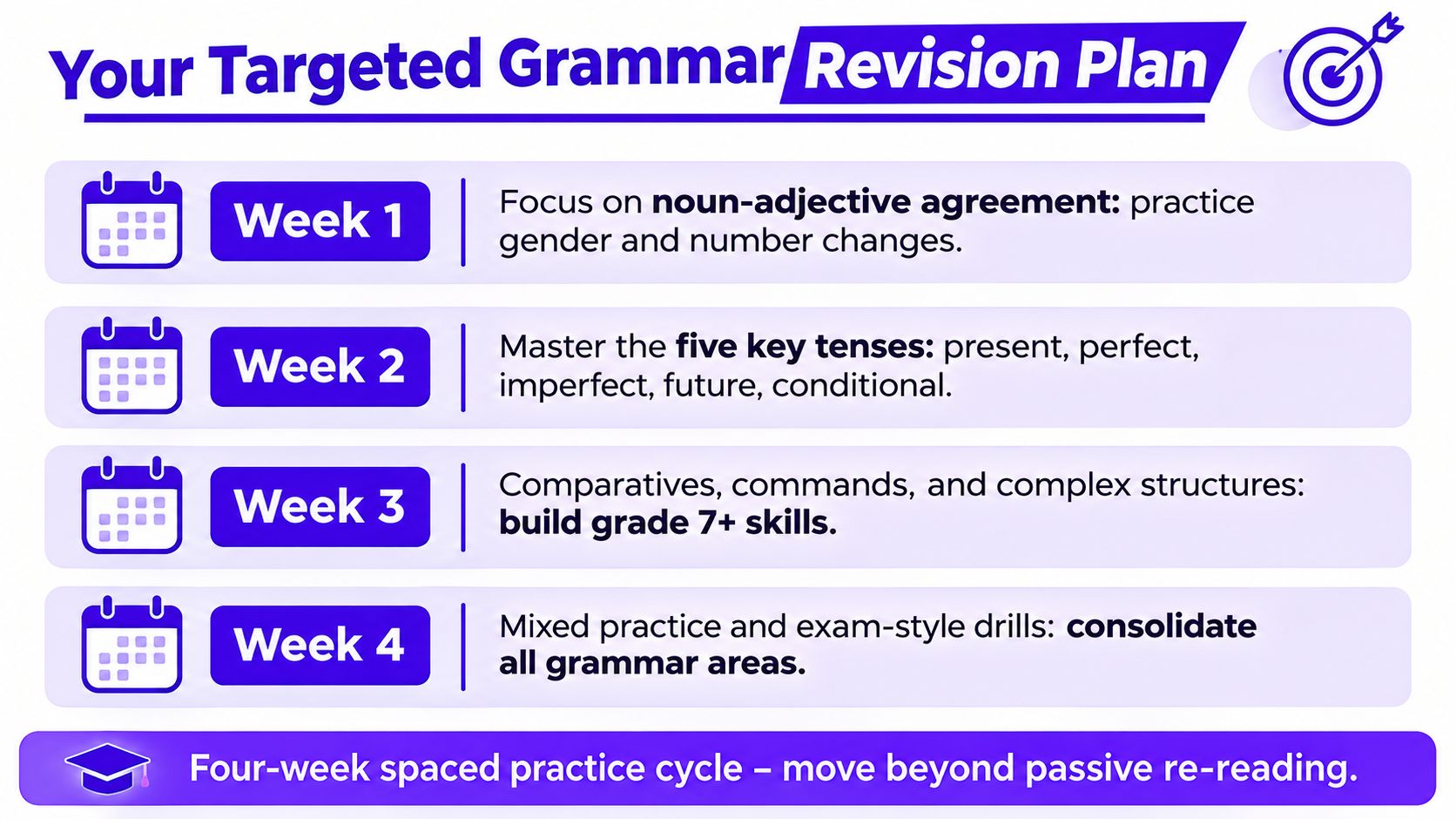
Week one builds the base
Begin with noun gender, adjective agreement and the present tense. Use a blank page, write the endings you remember, then check them. Translate short sentences both ways, such as The girls are sporty and Les filles sont sportives. Keep an error log with separate headings for gender, number and verb formation.
Week two adds time frames
Practise the perfect and imperfect side by side. Write paired sentences about a completed event and a past habit, then combine them in a short paragraph. Add the simple future and conditional once the first three are stable. Don't copy a model answer repeatedly. Cover it, reconstruct it, and explain why each tense appears.
Week three targets control
Work on pronouns, negatives, questions, comparisons, commands and relative clauses. Set a short writing task and require yourself to include a pronoun, a negative, a comparison and a clear time frame. Mark it immediately, then rewrite only the inaccurate sentences.
Week four simulates the paper
Use full past-paper questions under your actual exam-board conditions. AQA students should include translation and structured writing tasks. Edexcel students should practise picture-based and extended writing prompts. OCR preparation should include role-play and general conversation work, while WJEC students should use stimulus-based responses. Check the current specification because task formats and requirements can change.
Active recall should stay central throughout the cycle:
- Blank-page tests: Conjugate verbs without looking at notes.
- Sentence flashcards: Translate complete sentences, not isolated vocabulary.
- Error logs: Categorise mistakes and revisit the category that keeps returning.
- Timed rewrites: Improve an inaccurate answer while preserving its original meaning.
- Mixed practice: Combine old and new grammar so recognition doesn't depend on the order of your notes.
Before exam day, check present, perfect, imperfect, future and conditional forms, adjective agreement, reflexive verbs, pronoun placement, negative structures, questions, comparisons and si clauses. You can combine this approach with Online Revision for GCSE, using specification-aligned practice to move from quick recall to exam-style responses. MasteryMind provides GCSE French revision materials organised around exam-board content, grammar practice and feedback on mistakes, so it can sit alongside your teacher's lessons, a textbook and past papers rather than replace them.
MasteryMind gives GCSE learners specification-aligned French practice across exam boards, with grammar questions, adaptive difficulty, spaced review and examiner-style feedback to help identify the structures costing you marks. Visit MasteryMind and start with your weakest grammar category today, then use the feedback to plan your next focused practice session.
Ready to master this topic?
Practise with quizzes, blurt exercises and exam questions on MasteryMind.
7 days Premium · Then free forever · No card, no charge