GCSE Maths Practice Questions That Actually Work
You're staring at a desk that's already cluttered with maths papers, your phone keeps buzzing, and Sunday night is creeping up fast. You've done “revision”, but the first awkward algebra question in a real paper still makes your brain stall. That's the point where gcse maths practice questions either start helping, or keep wasting your time.
Most students don't need more worksheets. They need a cleaner system. The right practice moves from recall, to application, to exam-style work, and it does that in a way that matches how GCSE marks are earned. If you want a refresher on learning a topic properly before you test yourself, it's worth pairing practice with a method that helps you understand any topic deeply. For a simple revision hub, Online Revision for GCSE is one place to keep organised instead of collecting random tabs.
Why Most GCSE Maths Practice Does Not Stick
The classic mistake is easy to spot. A Year 11 student sits down with a pile of random questions, grinds through them for an hour, and still freezes when the paper changes the wording. That is usually a sign of practice without a system.
A worksheet can feel productive because your hand is moving and the page is filling up. GCSE maths rewards more than busy work. The exam boards want students to recognise the type of question, choose the right method, and show enough working to pick up marks even when the final answer goes wrong.
Practical rule: If a question only feels easy because it looks familiar, you probably have not learned it properly yet.
Rote grinding can make students feel calmer, but it does not always raise grades, especially at the margins. A borderline 4 to 5 student often needs fewer questions, but better sequencing. A 6 to 7 student usually needs the next layer, where they stop relying on memory alone and start choosing methods under pressure.
The smarter revision habit is simple, do the right questions in the right order, then review them properly. If you are serious about raising a grade, that matters. A random pile of questions gives you effort. A phased system gives you transfer. That is also why teachers care about question banks that match AQA, Edexcel, and OCR properly, because the wording, emphasis, and mark demands are not identical across boards. Use a tidy hub like Online Revision for GCSE to keep that system organised instead of scattering your work across random tabs.
Picking Question Banks That Match Your Exam Board
Not all question sources do the same job. Some are brilliant for first contact with a topic, some are better for board-specific drill, and some are just messy enough to waste your time. If you're a teacher, quality control matters most, because generic packs often blur the line between an Edexcel-style question and an OCR-style one.
Here's the simple breakdown.
| Source | Best for | Watch out for |
|---|---|---|
| Board-specific past papers | Real exam wording, real tier demands, real mark schemes | Can be too hard too soon if students haven't built basics |
| Free banks like Physics & Maths Tutor and Maths Genie | Topic practice and extra variety | Some sets are broad compilations, not always tightly sequenced |
| School textbooks and worksheets | Matching classroom teaching and core skill drills | Can become repetitive if they stop at recall |
| AI-powered platforms | Fast feedback, adaptive practice, mixed-topic sequencing | Quality varies, so you need examiner-style alignment, not vague chat |
That board split matters because GCSE maths is not one blob. The government's subject content is built around number, algebra, ratio, proportion and rates of change, geometry and measures, and statistics and probability (DfE GCSE Mathematics subject content). BBC Bitesize also lists Probability and statistics as a core practice area, which is exactly why mixed revision sets need to cover the full spread, not just the student's favourite topic (BBC Bitesize GCSE maths practice).
Third Space Learning's statistics resources are useful because they explicitly treat statistics as collecting, processing and analysing data, with exam questions and mark schemes for GCSE boards (Third Space Learning statistics maths). That's the kind of structure to look for. If a resource only gives you a pile of exercises without a clear link to specification skills, it's not doing enough.
A sensible rule is this, use one board-matched source, one topic bank, and one feedback system. More than that, and you end up managing tabs instead of revising maths. If you want a cleaner subject map, the key stage revision subjects page is a useful way to keep the wider revision picture in one place.
Building a Phased Practice Plan From Recall to Exam Style
Stop treating every question the same. A good revision cycle has three phases, and each one does a different job.
Phase 1 recall
Start with short, untimed topic sets. Keep them tight. Five questions on algebraic fractions is better than a 40-question marathon if the student still hesitates on the basics. The goal is automaticity, not endurance.
Students should say the method out loud, jot down working, and correct mistakes immediately. If they can't do a topic without support, they're not ready to jump ahead. They need to repeat the bare skill until it's less effortful.
Phase 2 application
Once the basics are there, mix two related skills together. That might mean algebra with ratio, or angle facts with equation setup. The point is to stop students seeing every topic as a separate drawer in the filing cabinet.
A simple weekly rhythm works better than cramming. Two recall sessions early in the week, one application session midweek, then a harder mixed set before the weekend is a decent pattern for Year 10 or 11. Students who only revise the night before are just rehearsing panic.
Phase 3 exam style
When recall and application are stable, move to exam-style questions that look like the paper. That includes 3 to 5 mark reasoning items, because those are where the wording, the setup, and the explanation all matter. OCR's question-paper guidance is useful here, because it shows that exam papers need familiar contexts, consistent vocabulary, and enough space for working, so practice should mirror that style instead of looking like random maths homework (OCR question paper guidance).
The shift between phases should be earned. If a student still needs hints on the basics, they stay in Phase 1. If they can do the method but fail when two ideas are combined, they're in Phase 2. If they can explain their steps clearly under timing, they're ready for full-paper work.
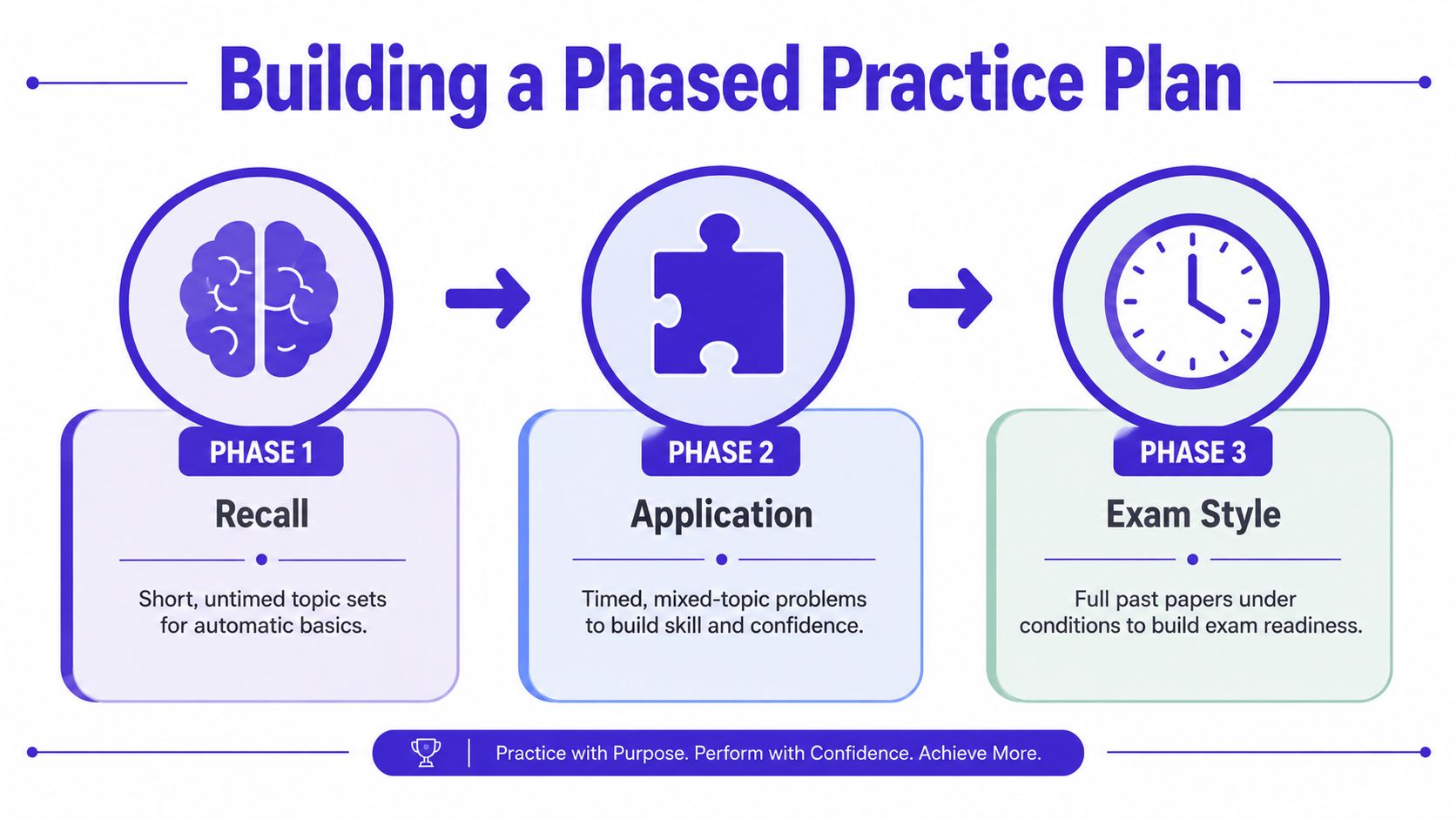
If you want a place that already organises practice in this style, GCSE Past Papers is the kind of feature to look for. The important bit is the sequence, not the label.
Running a Timed Past Paper Without Burning Out
A timed paper at home should feel like a real mock. Put the phone in another room, print the paper, and use only the equipment allowed in the exam. A laptop tab open with notifications pinging beside you is not exam practice, it is noise with a worksheet underneath it.
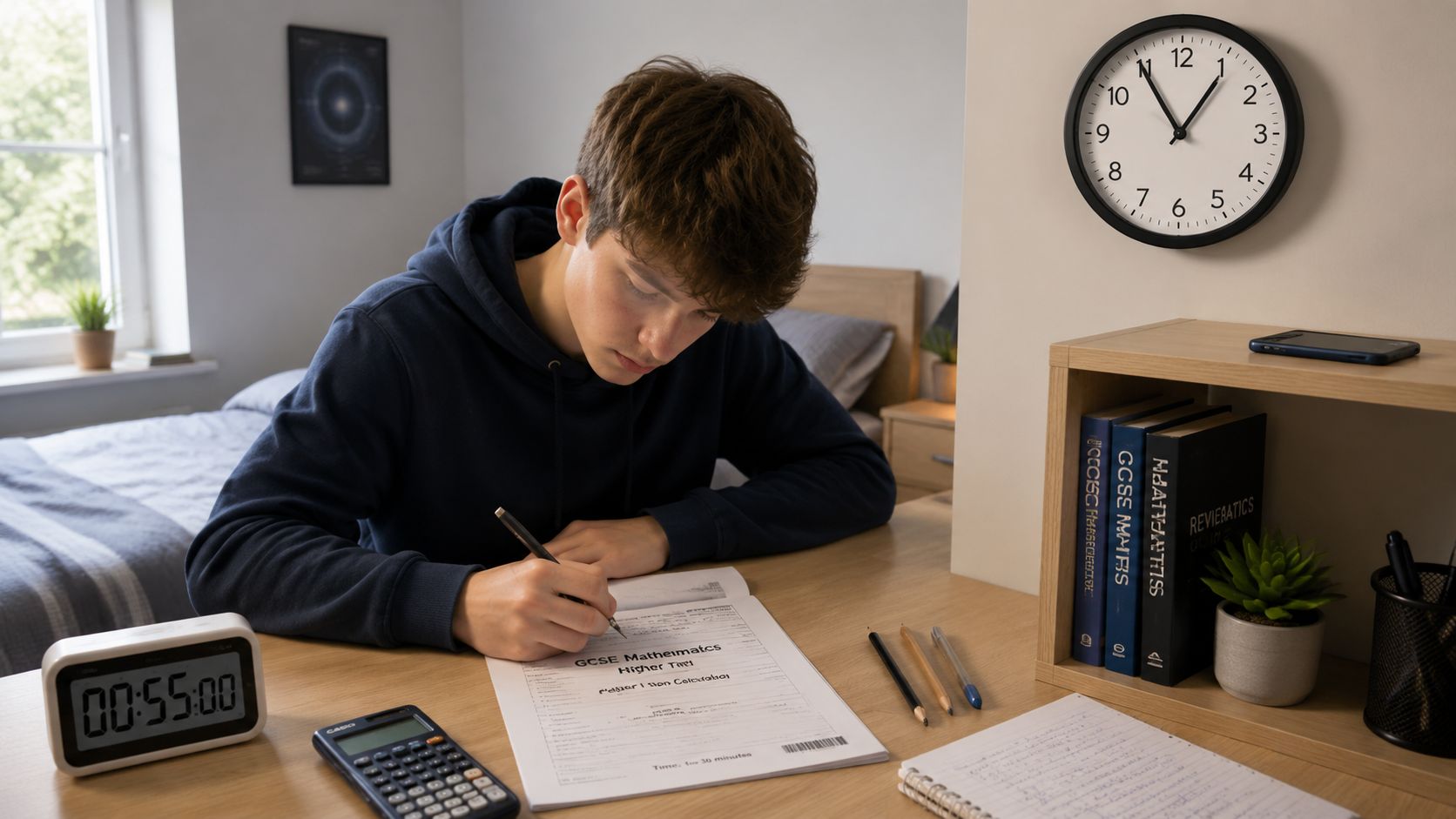
If you want structured revision sessions already organised, it helps to book students via TrainingBooker for test-prep support that keeps the routine steady. The routine matters more than the mood on the day.
How to handle the paper
Spend the first minute scanning the whole paper. Mark the questions that look straightforward and take the early confidence marks first. Do not waste ten minutes arguing with question 1 while easier marks are sitting later on the page.
Keep the last 5 minutes for checking. That is enough time to catch a stray sign, a missing unit, or an answer that still needs simplifying. As the Pearson chief examiner report reminds students, show all working so method marks are available even when the final answer goes wrong, and that habit protects you when the arithmetic slips.
Foundation and Higher need different pacing
Foundation papers reward control, so students should not burn time on one messy problem. Higher papers ask for more resilience, because the harder questions usually combine steps and expect a cleaner chain of reasoning. Either way, the rule stays the same, move on when a question stops paying marks.
Show the line of thought, not just the answer. If you cannot check your own working, the paper checks you.
A full paper once a week is enough for most students. More than that, and topic study starts getting squeezed out. Less than that, and stamina never builds. If you want a more exam-like practice mode, Exam Practice for GCSE is the sort of setup that keeps conditions close to an actual exam.
Marking, Error Logs and Examiner-Style Feedback
Self-marking is where the revision happens. Do it within an hour of finishing the paper, not the next day when your memory has gone fuzzy and you can't remember why you wrote 3 instead of 30. Waiting kills the value of the mistake.
A basic red-cross tally is useless on its own. You need a four-bucket error log.
- Topic gap: You didn't know the method.
- Silly mistake: You knew it, but rushed or dropped a sign.
- Time pressure: You reached the idea, but not fast enough.
- Method error: You chose a plausible path, then broke the steps.
That split matters because each bucket needs a different fix. A topic gap means more Phase 1 recall. A silly mistake needs slower checking and maybe writing units beside the answer. Time pressure means more timed drills. Method error means the student must unpack the question and show every move, because the maths may be there even when the final answer isn't.
A short angles example shows why this works. Say a question gives two angles in a triangle and asks for the missing angle after building an equation. If a student stops at the final number, they might still lose the method mark. If they write the equation, solve it, and then check whether the angle makes sense, they protect themselves against a small arithmetic slip and make the teacher's job easier too.
That is the kind of feedback GCSE maths practice should give. Not just tick or cross, but the exact line where the answer started to drift. If you're looking at AI tools, that's the standard to judge them by, because generic chat is not enough. You want step-by-step verification, exam-board alignment, and a clear breakdown of what went wrong, which is exactly the kind of structure teachers and parents should insist on before trusting a platform with revision time.
The best habit is simple. Mark the paper, log the error, fix the error, then repeat a similar question the same day. That's how feedback turns into marks.
Spaced Review, Mixed Topics and Long-Term Retention
Redoing the same worksheet the next week feels safe, but it doesn't force memory to last. Spaced review does. The clean rhythm is 1 day, 3 days, 1 week, 2 weeks, because each return makes the brain work a bit harder to pull the method back out.
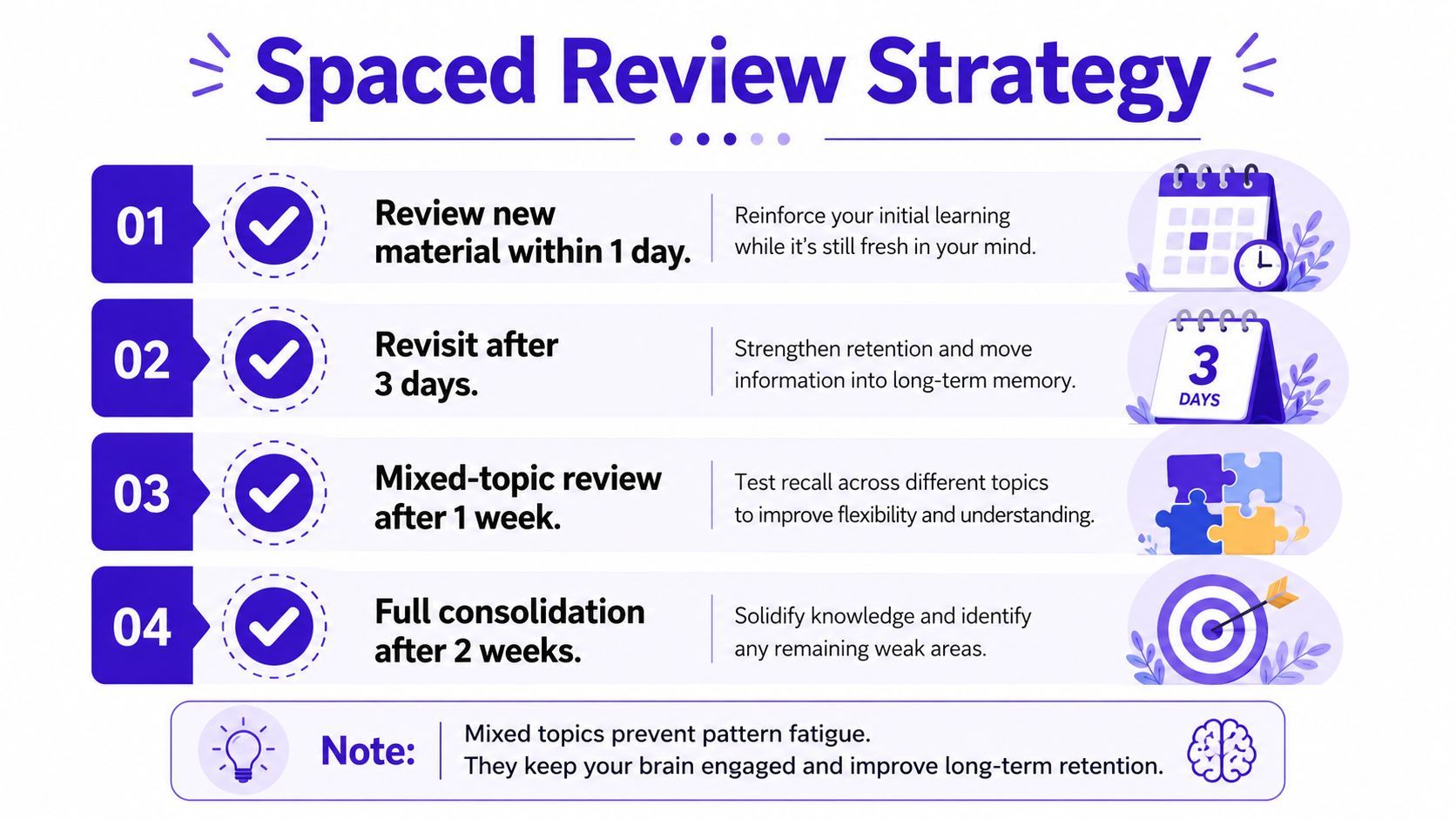
Mixed topics matter just as much. Pairing similar triangles with sine rule questions, or histograms with cumulative frequency, stops students from pattern-matching one topic in isolation. That's also why some learners get stuck with geometry and statistics, they know the rule but can't tell which rule the question is asking for.
For AI feedback, teachers should be sceptical in the right way. A decent tool should show examiner-aligned comments, not just generic reassurance. Look for AO-style breakdowns, mark estimation, and proof that the system can catch where a method breaks, because that's the difference between revision support and a flashy chatbot.
If you want a tracker for retention and repeated practice, viewer retention tools are useful as a model for how to keep a student coming back to the right material at the right time. The principle is the same in maths, if a topic keeps disappearing, it needs another planned revisit, not another random worksheet.
A realistic weekly rhythm is easy enough to keep for a term. One short recall session, one mixed-topic drill, one timed question set, one marked review, then a spaced return to the weak spots. That's enough to keep moving without drowning in revision.
If you want a revision setup that keeps gcse maths practice questions organised by topic, tier, and feedback style, visit MasteryMind and use it to turn loose worksheets into a proper practice routine. It's built for students who need clearer steps and for teachers who want exam-aligned work they can trust.
Ready to master this topic?
Practise with quizzes, blurt exercises and exam questions on MasteryMind.
7 days Premium · Then free forever · No card, no charge