GCSE Maths Topics - Foundation & Higher Exam Guide
You open a revision guide, scroll through page after page of gcse maths topics, and your brain does one of two things.
It either goes blank because the list looks endless, or it starts racing because you want top grades and suddenly every weak spot feels dangerous.
Both reactions are normal.
Most students do not struggle because the syllabus is impossible. They struggle because the syllabus looks flat. Everything seems equally urgent. Fractions sits next to quadratic graphs. Circle theorems sits next to cumulative frequency. You end up revising in a panic instead of revising in a pattern.
A better way to see GCSE Maths is as a map. Once you know how the course is organised, which topics sit together, and what your tier expects from you, the subject gets much easier to manage. Teachers know this already. Examiners definitely do. Strong students usually work it out at some point. The sooner you do, the less time you waste.
Feeling Overwhelmed by GCSE Maths Topics? Start Here
A student I’ve taught before revision season usually says one of two things.
“I’ve done nothing and I don’t know where to start.”
Or, “I’m revising loads but I still don’t feel in control.”
Those sound like different problems, but they usually come from the same issue. The student is looking at gcse maths topics as one giant pile instead of a structured course.
GCSE Maths is taught through the main UK exam boards such as AQA, Edexcel, OCR, and WJEC. The wording and paper style can vary, but the core course structure is much more similar than many students realise. That matters because it means your revision should focus less on random topic-hopping and more on learning the shape of the subject.
There is also the question of Foundation and Higher tier. That is where panic often starts. Students hear that one tier is “easier” and the other is “harder”, but that is too simplistic. A key difference is what kind of thinking the paper demands from you, and that affects how you should practise.
Stop treating the syllabus like one giant to-do list
If you feel behind, your first move is not to print ten worksheets and hope for the best.
Your first move is to sort the course into chunks you can track.
- Know your board: Check whether you are on AQA, Edexcel, OCR, or WJEC.
- Know your tier: Foundation and Higher do not test exactly the same depth.
- Know your weak spots: “Bad at maths” is useless feedback. “I lose marks on ratio, algebraic manipulation, and geometry proofs” is useful.
- Know what to do next: One clear session beats three hours of stressed drifting.
If your head feels noisy before you even begin, this guide on what to do when feeling overwhelmed is worth reading. It is not maths-specific, but it is good on getting out of that frozen, overloaded state.
What smart students do differently
They do not just ask, “What topics are on the exam?”
They ask better questions:
- Which topics are the backbone of the course?
- Which ones connect to each other?
- Which mistakes cost easy marks?
- What does my tier expect me to do under pressure?
That is the shift from vague revision to strategic revision.
If you want one place to organise topic-by-topic study, paper practice, and targeted review, Online Revision for GCSE can help you keep everything in one system instead of scattered across notebooks, screenshots, and random tabs.
Tip: If you feel behind, do not try to “catch up on everything” in one week. Build control first. Then build coverage.
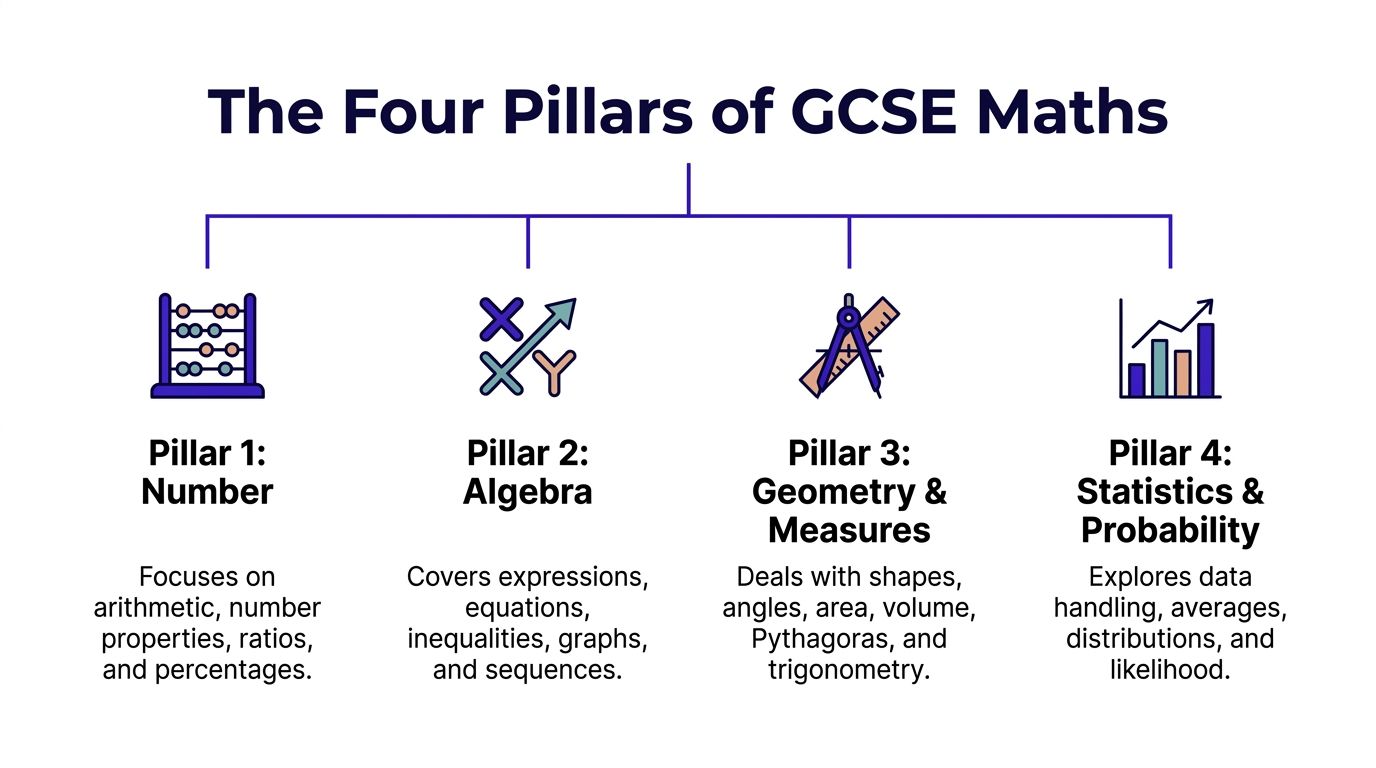
The Four Pillars of GCSE Maths
The cleanest way to understand gcse maths topics is to stop seeing them as dozens of separate mini-subjects.
Think of the course as a building held up by four pillars. If one pillar is weak, your score starts wobbling. If all four are steady, the paper feels much more manageable.
According to this overview of the four core topic areas in GCSE Maths, the course is built around Number, Algebra, Geometry and Measures, and Statistics and Probability.
Number
This is the bedrock.
Number includes place value, rounding, factors, multiples, primes, fractions, decimals, percentages, ratio, proportion, standard form, indices, and surds. If that sounds basic in places, good. Basic does not mean unimportant. It means everything else leans on it.
A student can understand a harder topic in theory and still lose marks because they mishandle a fraction, a percentage change, or a negative number.
Typical warning signs here include:
- Fraction errors: especially when adding or dividing
- Percentage confusion: mixing up increase, decrease, and reverse percentage
- Standard form slips: correct idea, wrong power of ten
- Weak estimation: no feel for whether an answer is sensible
Algebra
Algebra is where the course starts to feel more abstract.
You work with expressions, equations, inequalities, quadratic equations, simultaneous equations, sequences, and graphs with transformations. At first, students often think algebra is just “solving for x”. It is much broader than that. Algebra is really about spotting structure and expressing relationships clearly.
One student sees 3x + 5 = 17 and solves it. Another sees a graph, a sequence, a rearranged formula, and a contextual problem, and realises they are all algebra in different clothes.
That is the jump.
Geometry and Measures
This pillar covers angles, triangles, circles, area, perimeter, volume, Pythagoras’ theorem, and trigonometry.
Students often revise geometry by memorising isolated rules. That helps up to a point. Then the exam gives them a shape with several clues, a diagram that is not drawn to scale, and a problem where two or three ideas have to be used together. That is where structure matters more than memory.
Statistics and Probability
This area includes averages such as mean, median, mode, and range, plus probability rules, graphs, charts, scatter diagrams, and correlation.
It also reaches into ways of representing and interpreting data. Students need to handle things like bar charts, line graphs, pie charts, stem-and-leaf diagrams, two-way tables, Venn diagrams, cumulative frequency charts, box plots, histograms, and frequency density at Higher tier, as outlined in the same Revision Genie topic guide linked above.
Why this framework matters
When you revise by pillar, you stop bouncing randomly between topics.
Try organising your work like this:
| Pillar | What to focus on first |
|---|---|
| Number | Accuracy and fluency |
| Algebra | Methods and pattern recognition |
| Geometry and Measures | Rule selection and working out |
| Statistics and Probability | Interpretation and presentation |
Key takeaway: If a topic feels messy, ask which pillar it belongs to. The moment you can classify it, it becomes easier to revise.
Foundation vs Higher Tier What is the Key Difference
Students often ask which tier is “better”. That is not the right question.
A better question is: which paper matches the level of thinking you can do accurately, consistently, and under time pressure?
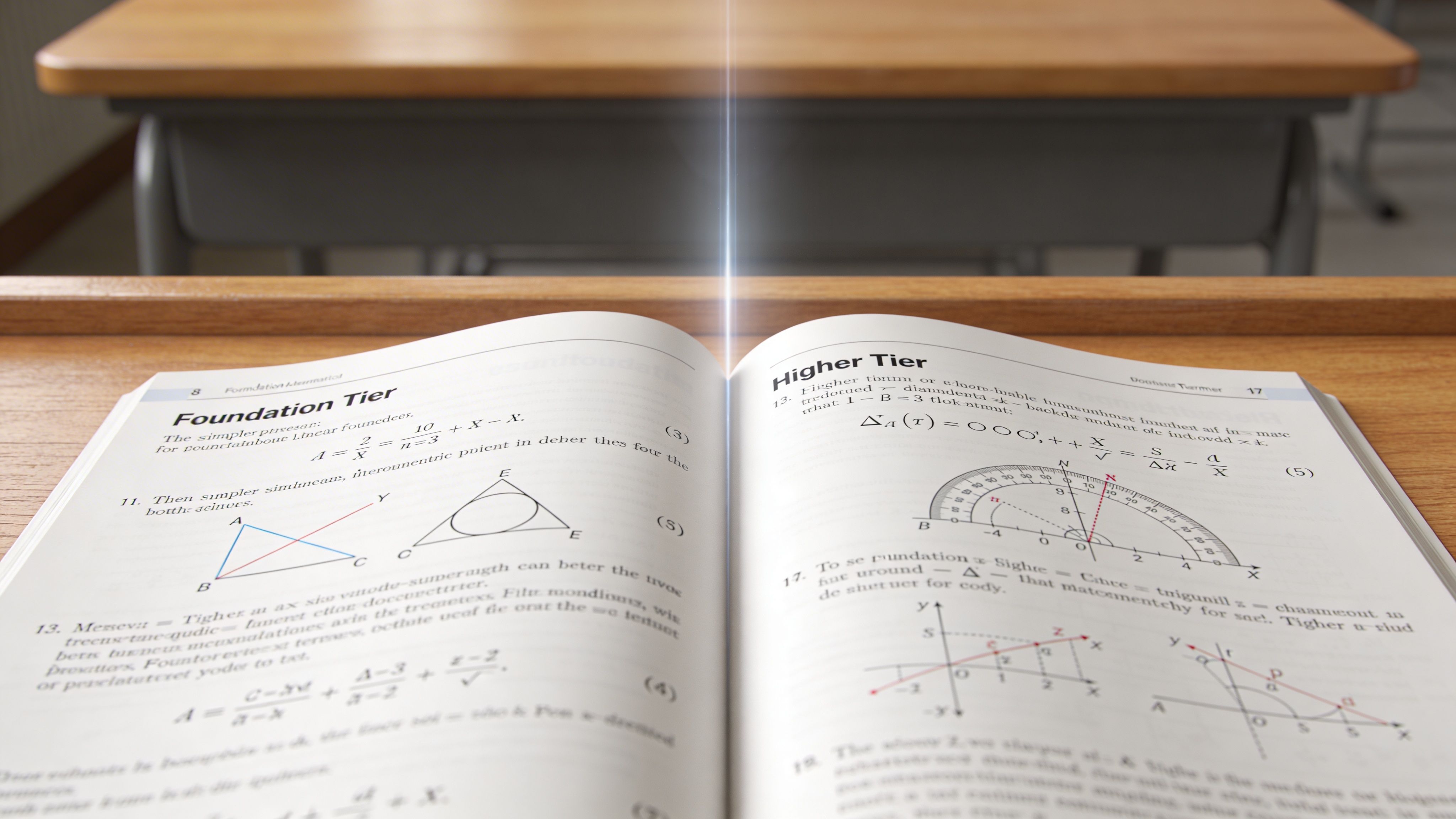
Foundation and Higher are not just different in difficulty. They differ in depth, abstraction, and the number of steps hidden inside a question.
What Foundation usually feels like
Foundation questions are usually more direct.
You still need method. You still need accuracy. But the route through the question is often more visible. A student might solve a straightforward equation, work out a percentage, use a graph, or calculate an area with fewer hidden twists.
That does not mean Foundation is easy. It means the paper usually asks for clearer, more contained steps.
What Higher really adds
Higher demands stronger algebraic control and more flexible thinking.
In UK GCSE Maths specifications, the algebra topic includes completing the square, algebraic fractions, iteration, and transformations of graphs, and these are absent from Foundation tier. The same topic guide notes that algebra makes up about 35% of total marks across boards, and that higher-tier iteration questions create divergence traps in 15% of attempts without calculator bounds in Third Space Learning’s question analysis, as summarised in this GCSE Maths topics guide.
That tells you something important. Algebra is not just one topic among many at Higher. It is one of the main places where stronger students separate themselves.
Side-by-side thinking
Here is the simplest way to compare the tiers.
| Skill area | Foundation | Higher |
|---|---|---|
| Equations | Solve more direct equations | Solve and interpret more complex forms |
| Graphs | Read and plot standard graphs | Transform, analyse, and connect graph forms |
| Problem solving | Fewer linked steps | Multi-step reasoning is common |
| Algebra | Core manipulation | More advanced manipulation and abstraction |
A concrete algebra example
A Foundation student may be asked to solve a linear equation and show clear steps.
A Higher student may need to do something more layered:
- Rearrange a formula.
- Solve a quadratic.
- Recognise whether factorising is sensible.
- Switch method if it is not.
- Interpret the result on a graph.
That is why some students feel “fine in class” and then find Higher papers brutal. Their knowledge is not always the problem. Their flexibility is.
Borderline students need honesty
If you are choosing between tiers, ask yourself:
- Do I cope well with multi-step algebra under pressure?
- Can I recover when my first method fails?
- Do I understand graphs, not just draw them?
- Am I accurate enough for the harder content to pay off?
Teachers tend to be cautious here for good reason. A shaky Higher entry can go badly if the student is not secure on the basics. On the other hand, a student aiming for top grades needs regular exposure to harder algebra long before exam season.
Tip: If you want success on Higher, do not just practise harder questions. Practise switching methods when one method stalls.
How to Master Geometry and Measures Questions
Geometry is where many students say, “I knew the rules, but I still got the question wrong.”
That usually means the problem was not memory. It was selection.
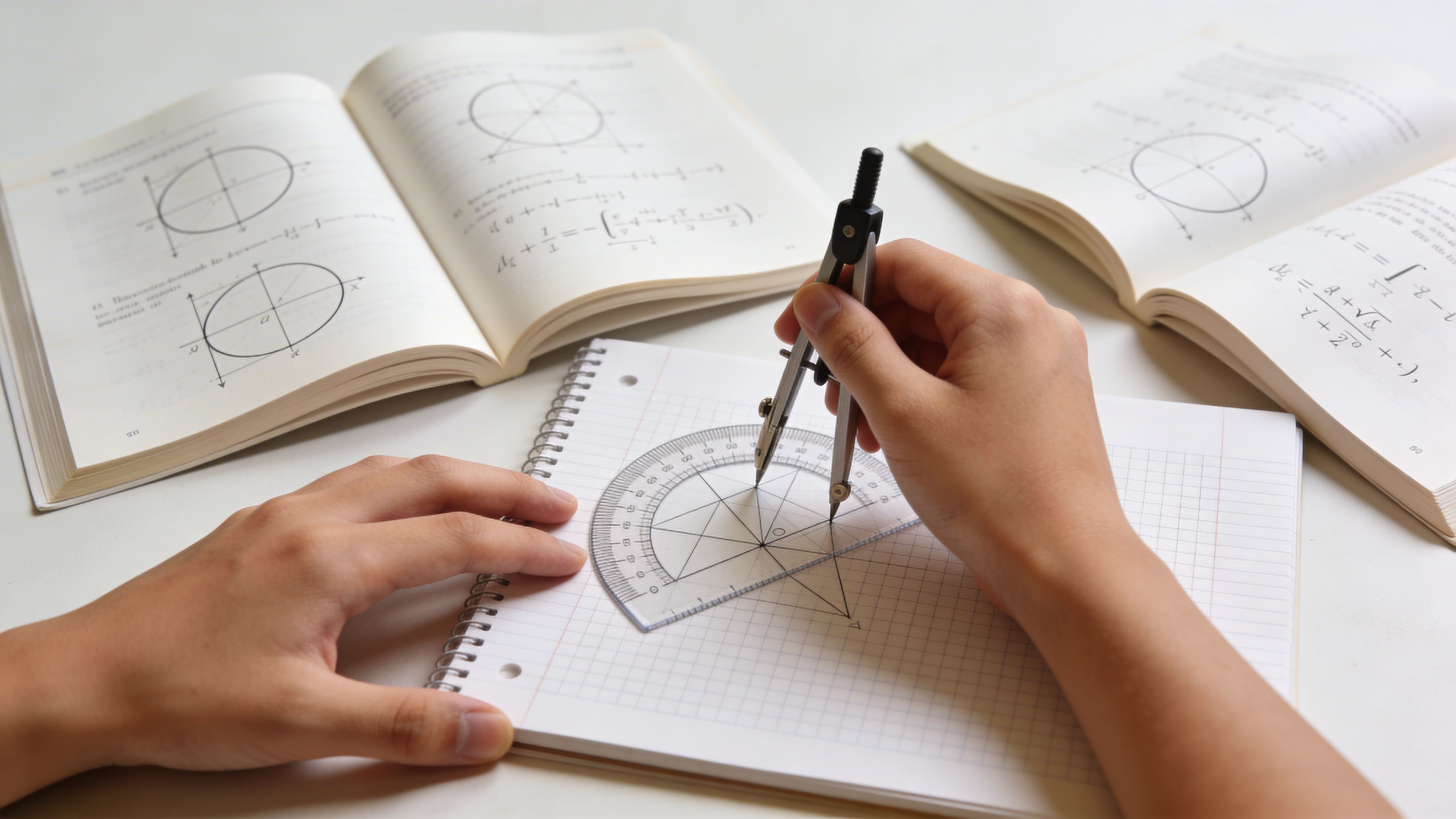
The hardest geometry and measures questions are rarely about one isolated fact. They ask you to notice which facts belong together. Many resources focus on separate angle rules, but give much less help on the multi-step questions where students must combine several rules at once. This becomes harder because UK exam boards increasingly use contextual geometry problems, and students often face a high cognitive load when they need to synthesise 2-3 angle properties in a single question, as noted in this discussion of angle-rule problem solving.
Why geometry goes wrong
Students tend to make one of four mistakes:
- They grab the first rule they remember instead of reading the full diagram.
- They skip labelling and then lose track of what each angle or side means.
- They do the right maths for the wrong shape.
- They jump to the answer and do not show enough reasoning for method marks.
Geometry punishes messy thinking.
A better routine for multi-step questions
Use this sequence every time you meet a larger geometry problem.
Read the diagram like a detective
Before you calculate anything, mark what is already visible.
Look for:
- parallel lines
- isosceles or equilateral clues
- right angles
- radii and tangents
- triangles hidden inside larger shapes
- angles on a straight line, around a point, or inside polygons
You are looking for structure, not just numbers.
Write the rule next to the step
Do not just scribble x = 58.
Write the reason. For example, “angles on a straight line” or “alternate angles”. This keeps your working organised, and it stops you from mixing up similar facts.
Teachers often see students who know the content but present it in a way that makes their logic impossible to follow. In geometry, visible reasoning matters.
Solve one mini-problem at a time
A complex geometry question is usually a chain of simpler ones.
If a shape needs three steps, do not hold all three in your head at once. Solve step one cleanly. Label it. Then use that result in step two.
That matters especially in angle problems, where one correct value often unlocks the rest.
The jump from textbook geometry to exam geometry
A textbook might ask you to use one angle rule.
An exam question might place that same rule inside a design, construction, or shape problem where you need to:
- identify the useful angle relationships
- connect them in the right order
- justify each move clearly
That is why students who are “good at the basics” still lose marks on bigger geometry questions.
If you want board-aligned support on this area, this guide on GCSE geometry and measures is a useful place to focus your practice.
Where students get confused most often
Circle theorems
Students often memorise the theorems but do not recognise them in unfamiliar diagrams.
Fix that by collecting different diagram styles for the same theorem. The theorem has not changed. Only the drawing has.
Trigonometry
The method usually breaks because the student picks the wrong ratio or does not identify opposite, adjacent, and hypotenuse relative to the given angle.
Write those labels on the diagram first. Then choose the ratio.
Area and volume
The formula may be known, but the units, conversions, or composite shape layout trip students up.
Slow down enough to ask, “What is the shape made of?”
Tip: Geometry gets easier when you stop treating diagrams as pictures and start treating them as evidence.
Building a Smart Revision Plan That Works
Some revision feels productive because it is familiar.
Reading notes again. Highlighting examples. Watching someone else solve questions. Sorting flashcards into nice piles.
That can feel organised. It does not always build exam performance.

Passive revision is comforting. Active revision changes scores
Maths improves when you retrieve, apply, and correct.
That means your revision should include things like:
- Active recall: close the book and reproduce a method from memory
- Spaced review: return to topics after a gap instead of cramming them once
- Mixed practice: switch between topics so you learn to choose methods, not just copy them
- Error review: keep a record of mistakes and revisit the exact type, not just the topic name
A student who does twenty similar questions in a row can feel confident very quickly. Then the exam mixes percentages, graphs, and algebra on the same paper, and that confidence falls apart.
The hidden problem is often older than GCSE
A lot of GCSE struggle starts earlier.
Some students think they are weak at polygon angles, when a core issue is much more basic. UK GCSE students often struggle because gaps in KS3 understanding build up over time, and generic resources often fail to identify the exact missing foundation. A diagnostic approach can spot whether the problem comes from weak protractor use, confusion over angle types, or misunderstanding of polygon properties, which allows for a more personalised path, as discussed in this diagnostic angle-learning overview.
That idea matters far beyond geometry.
A student who keeps failing algebra may not be an algebra student problem. They may have a fractions problem. Or a negative number problem. Or a rearranging formula problem.
Build your revision around diagnosis, not mood
Do not revise based on what feels urgent that evening.
Revise based on what your work shows.
A strong weekly plan usually includes:
| Session type | What it does |
|---|---|
| Diagnostic practice | Finds weak areas and pattern mistakes |
| Targeted repair | Fixes one method or prerequisite gap |
| Mixed review | Trains switching between topics |
| Past paper work | Tests timing, judgement, and resilience |
A practical weekly rhythm
Try something like this.
Early in the week
Do a short mixed quiz or a few questions from different pillars.
Your goal is not a high score. Your goal is to expose what is shaky.
Midweek
Take one weak area and work on it properly.
That means examples, independent questions, and correction. Not just reading notes.
Later in the week
Do a small set of mixed questions again.
This checks whether the topic still works when it appears out of context.
A useful explainer on active retrieval and blurting is below. It is worth watching after you have already tried a short recall session yourself.
What “smart practice” looks like in maths
Smart practice is not doing more questions at random.
It is doing the right kind of questions for the stage you are at.
- If you are lost: work from one clear model and copy the process carefully.
- If you are inconsistent: mix similar-looking topics so you must choose the method.
- If you are aiming high: use questions that force explanation, not just calculation.
- If you keep repeating mistakes: build a personal error log and revisit it every week.
Key takeaway: The best revision plan does not just ask, “What topic am I on?” It asks, “What exactly is breaking, and what kind of practice fixes it?”
Your Strategic Path to Exam Success
Success in GCSE Maths usually looks dramatic from the outside.
A student goes from panic to control. From low confidence to solid papers. From “I’m bad at maths” to “I know how to tackle this.”
From the inside, though, it is usually much less dramatic. It is structure, honesty, and repetition.
First, know the map. The four pillars give you a way to sort the full list of gcse maths topics into something manageable.
Second, know your paper. Foundation and Higher are not just labels. They ask for different levels of fluency, confidence, and problem solving.
Third, know your revision method. Smart practice beats vague effort. A shorter session that diagnoses a real weakness is worth more than a long session of passive review.
Keep your focus on controllable things
You cannot control the exact questions that turn up.
You can control:
- the range of topics you cover
- the mistakes you correct
- the methods you practise from memory
- the way you review weak areas
- the amount of mixed and timed work you do
That is where marks are built.
One final reality check
If you are behind, you are not doomed.
If you are aiming for a 9, you do not need magical talent.
You need a plan that reflects how the exam works. Learn the structure. Practise actively. Keep returning to weak spots until they stop being weak spots.
When you are ready to test your judgement on real exam-style material, working through GCSE Past Papers is one of the most useful ways to turn topic knowledge into paper performance.
Tip: Confidence in maths usually comes after evidence. Build evidence first. Confidence follows.
Frequently Asked Questions About GCSE Maths Topics
Is GCSE Statistics the same as the statistics part of GCSE Maths
No.
GCSE Maths includes a statistics and probability pillar, but there is also a separate GCSE Statistics qualification. The Edexcel GCSE Statistics (1ST0) and AQA GCSE Statistics (8382) courses have almost identical content and are structured around Collection of Data, Processing, Representing and Analysing Data, and Probability. They build on prior maths knowledge, but they are distinct from the statistics content inside standard GCSE Maths, as explained in this GCSE Statistics topic guide.
If you only take GCSE Maths, you still study statistics. You just do not study the full separate statistics course.
Is there an easiest exam board for GCSE Maths
Students ask this every year.
The honest answer is that the main boards test the same broad course, even if question style and wording vary. It is more useful to know your own board’s phrasing and paper habits than to hunt for a mythical “easy board”.
A student who knows the content and practises their board’s style will usually do better than a student who keeps blaming the board.
Which topic matters most
There is no single winner, but some areas create more knock-on problems than others.
If number skills are weak, other pillars suffer because you make basic errors inside harder questions. If algebra is weak, Higher-tier performance usually becomes much harder to stabilise. If geometry is weak, students often lose method marks because they cannot organise multi-step reasoning clearly.
So the better question is not “Which topic matters most?” It is “Which weak topic is causing damage elsewhere?”
How are gcse maths topics usually weighted
The exact weighting varies by board and paper, but a common pattern across AQA, Edexcel, and OCR looks like this:
| Topic Pillar | Foundation Tier Weighting | Higher Tier Weighting |
|---|---|---|
| Number | Typical substantial share | Typical substantial share |
| Algebra | Typical substantial share | Often the largest share |
| Geometry and Measures | Typical substantial share | Typical substantial share |
| Statistics and Probability | Typical smaller but important share | Typical smaller but important share |
The one clear quantitative point already covered earlier is that algebra accounts for about 35% of total marks across boards in the cited analysis for GCSE Maths topics.
Do I need to revise every topic
Yes, but not with equal time.
Students waste effort when they give every topic the same attention. A better approach is:
- Secure the basics first: fractions, percentages, ratio, equations, graphs
- Repair prerequisite gaps: especially anything from KS3 still causing errors
- Keep mixed practice running: so topics do not only work in isolation
- Stretch if you are on Higher: particularly in algebra and multi-step reasoning
What if I keep forgetting topics I already revised
That is normal.
Forgetting does not mean revision failed. It means the topic needs to be retrieved again after a gap. Maths sticks when you return to it, use it, and correct it repeatedly. Students who expect one neat revision session to “finish” a topic usually get frustrated fast.
The goal is not one perfect session. The goal is durable recall under exam conditions.
If you want a cleaner way to diagnose weak topics, practise exam-style questions, and build revision around the way UK exam boards test, try MasteryMind. The free plan gives you a practical place to start finding strengths, spotting gaps, and turning gcse maths topics into a revision plan you can follow.
Ready to master this topic?
Practise with quizzes, blurt exercises and exam questions on MasteryMind.
7 days Premium · Then free forever · No card, no charge