10 GCSE Practice Questions Resources for 2026
You've revised the content, highlighted the textbook and watched the videos. Then the paper puts a six-, twelve- or twenty-four-mark question in front of you, and your mind goes blank. A teacher faces a different problem: how can they tell whether a practice task reflects the right specification, command word, tier and mark scheme rather than just looking exam-like?
The best GCSE practice questions resource depends on the job you need it to do. A quick recall quiz can expose missing facts. A topic set can repair a specific weakness. An exam-style response trains structure and command words, while a timed paper tests whether you can perform when the clock is running. Mark-scheme review turns a wrong answer into a useful next step.
That distinction matters across the UK GCSE system. In the 2026 results cycle in England, 5,720,045 GCSE results were issued across more than 40 subject areas, while 1,047,750 students in 6,040 schools and colleges received results, according to the GCSE results data referenced by SimpleStudy. Students aren't preparing for one shared exam. They're preparing for different subjects, boards, tiers and assessment objectives.
The resources below are organised by what they help you do in a complete revision routine. There isn't one universal winner. The practical choice is a combination that helps you find gaps, answer accurately, practise under pressure and learn from every lost mark.
1. MasteryMind
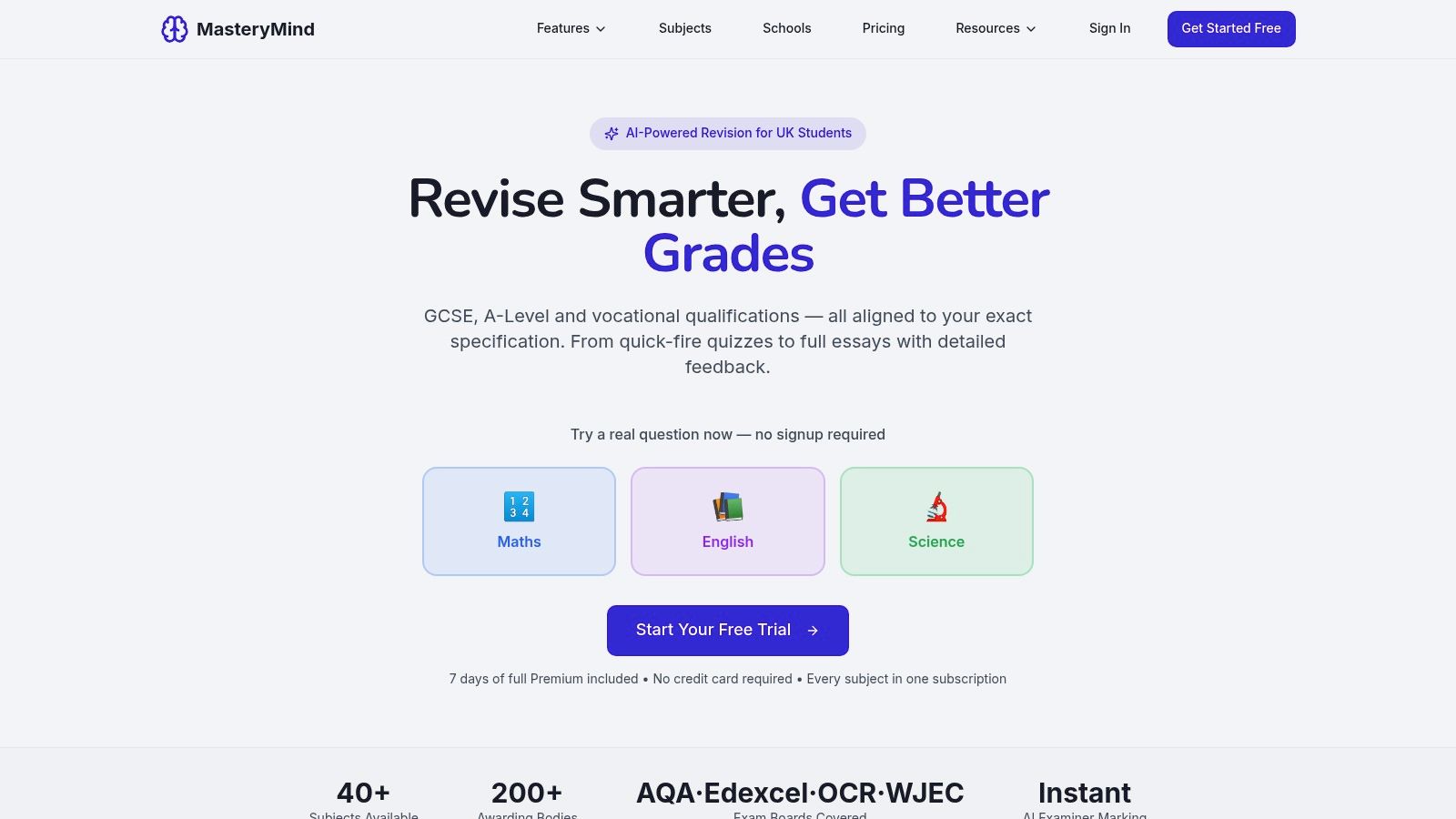
MasteryMind is the strongest all-round option when you want GCSE practice questions and feedback in one exam-focused workflow. It's built for UK learners across Years 3 to 13, with practice for GCSEs, A-Levels and vocational qualifications. Its main advantage is that it treats a question as more than a prompt. The command word, mark allocation, assessment objective and expected response all matter.
The platform aligns questions with AQA, Edexcel, OCR and WJEC specifications, and its site describes coverage across more than 200 awarding bodies and 40-plus subjects. Students can move from quick recall quizzes to extended responses, including 24-mark essays, while difficulty develops from AO1 knowledge through AO3 analysis and evaluation.
Where it earns its place
The useful feature isn't just instant marking. Feedback can break an answer down by assessment objective, explain why a point has or hasn't earned credit, and give subject-specific guidance. Maths answers can receive step-by-step verification, while other subjects support tasks such as unseen poetry, computer science trace tables, and binary or hexadecimal problems.
That focus responds to a genuine exam skill gap. OCR guidance on question papers explains that command words guide how students should respond. “Explain” doesn't ask for the same answer as “describe”, “calculate” or “write down”. MasteryMind's value is highest when you use the feedback to identify that difference and rewrite the answer, rather than accepting the generated comment and moving on.
Practical rule: Treat AI feedback as a first marking pass, not a replacement for a teacher who knows your class, specification and recurring misconceptions.
The platform also includes spaced review, mixed-topic practice and the voice-powered Blurt Challenge for active recall. Its NEA Coach gives JCQ-compliant Socratic guidance, mark estimation and a checklist without rewriting coursework or supplying direct answers. There's a free forever plan and a seven-day Premium trial with no card required. Public pricing beyond those options isn't displayed, and the site doesn't list formal awards, third-party certifications or named customer testimonials, so schools and families should test the workflow before committing.
Best for: Students who need board-aligned practice, feedback and a structured route from recall to extended answers.
Trade-off: It's powerful for independent correction, but students still need to check difficult interpretations with a teacher.
2. Save My Exams
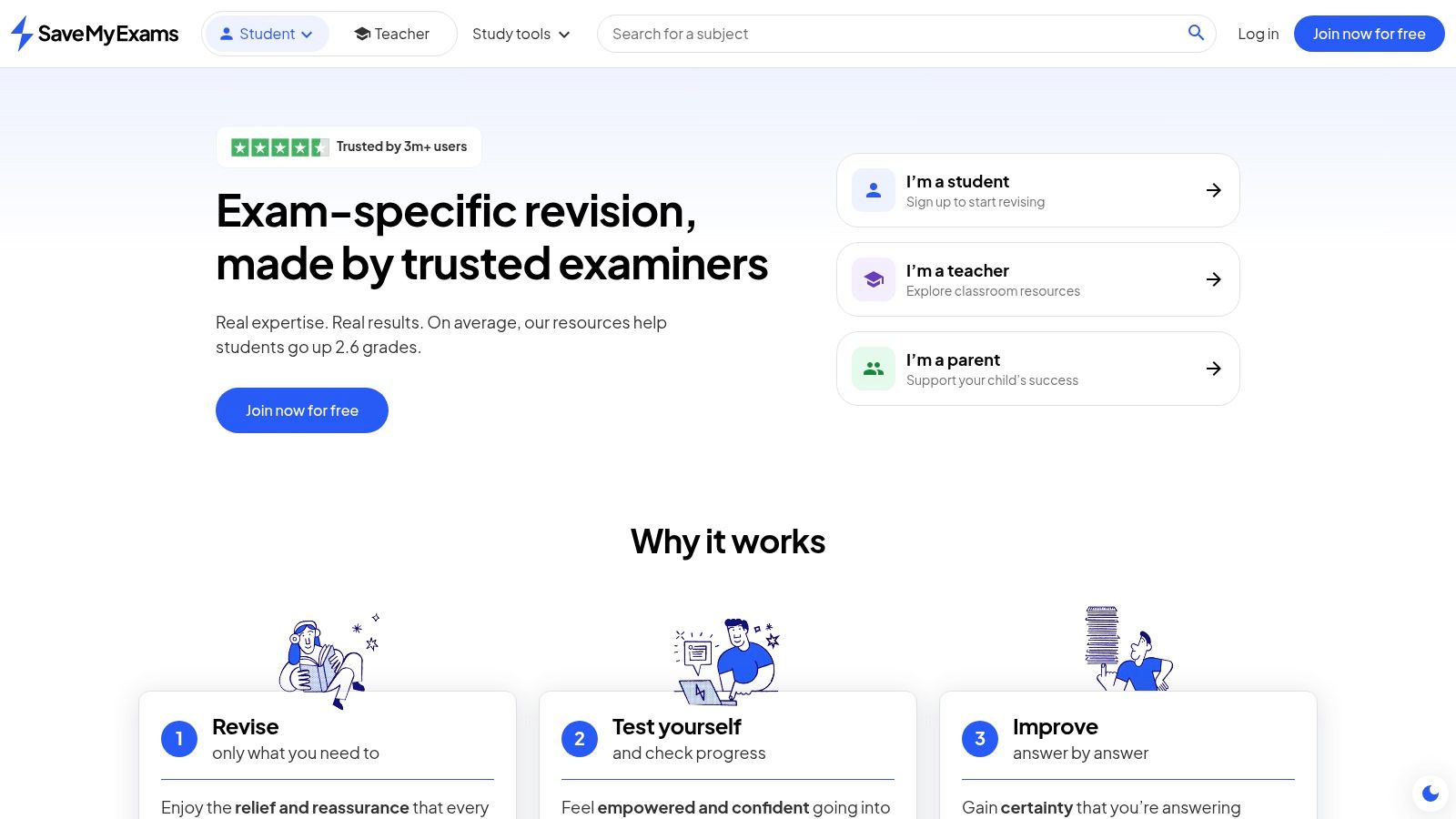
Save My Exams works best when you already know the topic you need to practise and want a large, orderly bank of exam-style questions. It organises material by subject, topic and exam board, making it easier to move from “I'm weak at this” to a focused set instead of opening a random paper and hoping the right questions appear.
The platform covers boards including AQA, Edexcel and OCR, alongside other specifications. It combines topic questions with mark schemes, model answers and past papers. The reveal-as-you-go format is useful for students who want to attempt a question, check the marking, then continue without opening several documents.
Best use in a revision session
Use it after a diagnostic paper has shown a clear weakness. For example, a student who loses marks on a particular biology topic can complete several related questions, annotate the mark scheme and then attempt a fresh question without looking at the model answer. That final step matters. Reading a perfect answer can create recognition without proving that you can produce the response yourself.
The formatting also supports exam technique. Students see how short-answer questions, calculations and longer explanations are presented, rather than relying only on notes or flashcards. The learning hub provides guidance on using the question tools, which can help younger students avoid treating mark schemes as answer sheets.
Full access to all answers and model solutions requires a paid membership, and exact pricing details are shown after login. That creates a practical limitation for families comparing resources in advance. Free material can still help, but you'll need to check what is available before planning a whole revision programme around it.
For a broader comparison, see this comparison of revision platforms.
Best for: Topic-by-topic exam practice across several GCSE subjects.
Trade-off: It has strong depth and consistency, but the most useful marking support sits behind membership.
3. Physics & Maths Tutor
Physics & Maths Tutor, usually called PMT, is the dependable free option for students who want a deep library of questions without building an account or paying for access. Despite the name, its GCSE collection reaches beyond physics and maths into other sciences, with revision notes, worksheets, past-paper questions and mark schemes.
Its biggest strength is filtering. You can work by topic, exam board and, where relevant, foundation or higher tier. That makes it useful after a lesson, a class test or a past paper has identified one specific skill that needs attention.
A strong repair tool, not a complete planner
PMT's layout is practical rather than polished. Students generally need to choose the topic, download or open the material, complete it and mark it manually. There isn't the same sense of automated progress tracking you'll find on adaptive platforms, so a simple revision log is useful.
The depth can also become a problem. A large topic page may offer more questions than a tired student can sensibly complete in one sitting. Choose a short sample, mark it carefully and only return for more if the same error continues. Completing every available question isn't automatically better revision.
Many papers include mark schemes, and some areas provide model answers or video solutions. Those resources are particularly valuable for maths and science, where a final answer can hide a method error. Students should write the exact issue in their notes, such as “used the wrong equation” or “didn't state the unit”, instead of recording only the topic name.
For students who want a more controlled timed workflow, Exam Practice for GCSE offers a useful contrast to PMT's manual approach.
Best for: Free, targeted maths and science practice by topic and tier.
Trade-off: The library is deep, but the interface is utilitarian and students must manage their own sequence and progress.
4. Seneca Learning
Seneca Learning is built for low-friction revision. You answer short questions, receive immediate responses and move quickly through board-specific courses. That makes it a good choice for the awkward moments when you have limited energy or only a short study window, but still need to retrieve information rather than reread notes.
The free tier includes 600-plus board-specific courses, while Premium adds access to 800-plus courses and modes, including AI-marked exam-style questions, mini-mocks, predicted papers, Cram mode and additional analytics. Those figures come from Seneca's own product presentation, so check the current course and feature availability for your subjects before relying on a particular mode.
Where short answers help
Seneca is particularly effective at the recall stage. A student can use Quiz mode for question-only practice or Cram mode for a faster review before moving into longer written tasks elsewhere. The immediate response keeps the session moving, which can be useful for students who procrastinate because traditional revision feels too slow.
The limitation is that quick-answer success can feel easier than producing a full response. A learner may recognise the correct term in a quiz but still struggle to explain, compare or evaluate it in an exam. Premium's exam-style questions and mini-mocks help close that gap, but advanced features require Premium and specific pricing requires login.
Teachers should also distinguish between completion and evidence. A high activity streak doesn't prove that a student can answer a six-mark question. Ask students to follow a Seneca session with one written answer and a mark-scheme check.
Students comparing broader tools may also want to see Seneca Learning for A-Level prep, particularly if their revision needs will continue beyond GCSE.
Best for: Fast retrieval, recap and short study sessions across many subjects.
Trade-off: It reduces friction brilliantly, but short quizzes shouldn't be mistaken for full exam-response practice.
5. BBC Bitesize
BBC Bitesize is the most approachable starting point for students who don't yet have a reliable revision routine. Its GCSE hub provides free subject guides, board-mapped quizzes, sample exam questions and mobile-friendly revision tools. The interface feels less intimidating than a folder of past papers, which matters when a student is recovering after doing too little revision and needs an easy first step.
Its public GCSE practice offering includes over 1,000 free exam questions, and each quiz generates a new set of 10 questions, according to the BBC Bitesize practice resource described by Cambridge Assessment. The same description highlights feedback, worked examples, step-by-step solutions and downloadable past papers with mark schemes. That combination makes Bitesize useful for short, repeatable practice rather than one-off browsing.
Keep its role clear
Use Bitesize for a quick check after learning a topic, especially when you're not ready for a full written task. The quizzes can show whether basic knowledge is secure, while the explanations help correct straightforward misunderstandings.
It isn't always the best final destination for extended responses. Compared with specialist past-paper and assessment sites, some subjects have fewer full written question sets, and depth varies by topic. A student preparing for an English Literature essay or a long geography response should move from the quiz to a board-specific question and mark scheme.
Teachers can also use the site as a low-stakes entry task, but should confirm the precise specification and assessment demands before assigning it as evidence of exam readiness. GCSE Past Papers can provide the longer, more formal practice that Bitesize doesn't always supply.
Best for: Free recall quizzes, recap and building confidence before harder practice.
Trade-off: It's accessible and broad, but it won't replace written exam questions or timed papers.
6. Corbettmaths
Corbettmaths is a maths-only resource with a simple idea that works well: make a small amount of practice routine. Its “5-a-day” sets provide graded daily questions from Foundation through Higher and Plus, giving students a manageable way to revisit skills instead of waiting until a mock exam exposes months of forgetting.
The daily format supports spaced retrieval. You can complete the questions without notes, mark them with the answers and watch an explanation for any method you can't reconstruct. Topic worksheets and exam-style questions then let you spend longer on the skill that caused trouble.
The method matters more than the score
Corbettmaths is most useful when students show working. A correct answer reached through a fragile method may not transfer to a changed question, while an incorrect answer can reveal whether the problem was algebra, interpretation, arithmetic or calculator use. Video explanations help students compare their process with a worked method rather than just copy a final number.
The core material is free, with optional paid books and printables. Its limitation is scope. It doesn't cover English, science or humanities, and it offers fewer mixed-topic timed papers than dedicated past-paper libraries. Use it as the daily maths layer, then schedule complete board papers separately.
A student who has done little revision shouldn't begin by attempting the hardest available set. Start at a secure level, record recurring errors and step up when the method is reliable. A short daily habit is more useful than downloading worksheets that never get attempted.
Best for: Daily maths retrieval and clear worked explanations.
Trade-off: It builds consistency well, but it needs another resource for full papers and non-maths subjects.
7. Maths Genie
Maths Genie is a straightforward GCSE maths site for students who want visible progression. Topic questions are arranged by difficulty, and the site combines worksheets, past papers, mark schemes and worked solutions. That grading makes it easier to avoid the common mistake of jumping into demanding questions before the underlying skill is secure.
A useful session might begin with easier topic questions, continue with a more demanding set and finish with one past-paper question. The student can then compare not just the answer, but the method and the amount of working expected. Maths Genie also includes a marking helper for past papers, which can make self-assessment more practical when a teacher isn't available immediately.
Good for rebuilding confidence
The uncluttered navigation suits students who become overwhelmed by large revision platforms. You can choose a topic, work through a set and move up the difficulty ladder. That clarity is especially helpful after a poor mock, when “revise maths” is too vague to act on.
It remains maths only, with a plain interface and basic progress tracking. It also shouldn't replace teacher guidance for interpreting unusual solutions or deciding whether a student is ready to move from Foundation-focused work to Higher-style demands.
Use the official mark scheme carefully. Don't award yourself marks because an answer “looks close”. In maths, check the method, units, accuracy and whether the response answers the exact question. Then write one sentence describing the error before attempting a similar question without help.
Best for: Graded maths topic practice and simple past-paper self-marking.
Trade-off: Its clarity helps independent learners, but it doesn't provide cross-subject planning or detailed tracking.
8. Cognito
Cognito offers a useful middle ground between learning content and answering questions. Its GCSE hub combines videos, quizzes, flashcards, dedicated Exam Questions sections and Past Papers areas across science, maths and several humanities. The subject pages are mapped to boards including AQA, Edexcel, OCR, iGCSE and SQA where available, so students can begin with the relevant course rather than a generic topic.
This board mapping is the main reason to use it. A student can revise a concept, complete a quiz and then move into exam questions within the same subject hub. Maths and combined science areas include Higher and Foundation filters, helping learners avoid practising material that doesn't match their tier.
A learn-then-practise route
Cognito is effective when the problem is partly content knowledge and partly exam application. Watch or review the explanation, close it, answer questions from memory and then check the solution. If you can answer recall questions but lose marks on application, stop rereading and prioritise exam questions.
Some areas rely on external past-paper links, and pacing and depth vary between topics. That means students should check that a linked paper belongs to the right board and specification before starting. A free account can save progress, but it won't remove the need for a personal error log.
Teachers can assign Cognito as preparation, then use a written question in class to test transfer. The platform is strongest when it feeds into a broader routine rather than becoming another place where students watch explanations without producing answers.
Best for: Board-aware learning followed by quizzes and exam-question practice.
Trade-off: It offers a good range of formats, but coverage and depth aren't identical across every topic.
9. DrFrostMaths
DrFrostMaths is particularly strong when a teacher needs to see what students can do, not merely what they have completed. The platform provides interactive GCSE maths questions, worksheets, homework and assessments, with a system designed for assignments and monitoring. Questions draw on past-paper styles, and the platform also provides a past-paper interface.
A school or tutor can set focused work on a topic, review responses and use explanatory feedback to identify patterns across a class. That makes DrFrostMaths useful for diagnosis. If several students make the same error, the teacher can reteach the method. If one student struggles alone, the task can be adjusted without giving the whole class unnecessary repetition.
Why schools tend to prefer it
The tracking and teacher-managed workflow are the main advantages. Students receive a clear task, while teachers can inspect performance rather than relying on a completed worksheet. This is a better fit for homework that needs evidence and follow-up.
The best experience usually requires a school or teacher account. Solo learners can access the platform, but the setup is less straightforward and the main benefits are less visible without someone assigning and reviewing work. It also focuses on maths only.
Students working independently should use it alongside a paper-based error log. Record the question type, the failed step and the correction. Teachers should check that assigned tasks match the intended board, tier and current teaching sequence rather than relying on a generic topic label.
Best for: Teacher-assigned, trackable GCSE maths practice and targeted diagnosis.
Trade-off: It's excellent for monitored school work, but less convenient as a standalone self-study platform.
10. tutor2u
tutor2u is the specialist choice for GCSE Business, Economics, Geography, Sociology and related humanities and social sciences. Its assessment resources are built around specifications and exam-style structures, with themed practice papers and question packs available through the tutor2u Shop. It also provides occasional free samples and is developing online tools such as Examiner AI for marking and feedback.
The main benefit is subject-specific realism. A Business student doesn't just need to remember definitions. They need to apply a case context, analyse consequences and evaluate a judgement in the form the board expects. A well-designed tutor2u pack can provide that structure more effectively than a generic quiz.
Paid depth for specification-heavy subjects
The trade-off is cost. Most question banks and assessment resources are paid, and pricing varies by resource because purchases are made per pack or course. Before buying, check the exam board, subject code, paper coverage and whether a mark scheme is included.
GCSE assessment rewards more than general understanding. AQA's English Literature specification, for example, weights AO1 at approximately 37.5%, AO2 at 42.5%, AO3 at 15% and AO4 at 5%, as shown in the GCSE specification information available from Latimer Tuition. The figures illustrate why a resource that only tests plot or vocabulary can't fully prepare a student for the assessment objectives.
Use tutor2u when you need realistic extended responses and judgement. Pair it with shorter recall tools for facts and terminology, then mark answers against the official scheme rather than rewarding length alone.
Best for: Specification-mapped exam practice in Business, Economics, Geography, Sociology and other humanities.
Trade-off: The subject depth is valuable, but paid packs require careful selection.
Top 10 GCSE Practice Question Resources, Comparison
| Product | Key features (✨) | UX / Quality (★) | Pricing / Value (💰) | Target (👥) |
|---|---|---|---|---|
| MasteryMind 🏆 | ✨ Exam-board aligned AI marking, AO breakdowns, Blurt voice recall, NEA Coach, spaced & mixed practice | ★★★★★ Examiner-style instant feedback, dashboards, step-by-step maths verification | 💰 Free plan + 7‑day Premium trial (no card); school/tutor pricing on request | 👥 Years 3–13 GCSE & A‑Level learners, schools & tutors |
| Save My Exams | ✨ Large bank of topic-organised past papers, mark schemes & model answers | ★★★★☆ Exam-style consistency; reveal-as-you-go self-marking | 💰 Free content; full answers via paid membership (pricing after login) | 👥 GCSE students & self-study learners |
| Physics & Maths Tutor (PMT) | ✨ Deep topic pages, past papers, video solutions, tier filtering | ★★★★ Trusted, utilitarian interface; manual tracking | 💰 Free | 👥 Maths & science GCSE learners, schools |
| Seneca Learning | ✨ Adaptive board-specific courses, cram/quiz/mini-mocks, AI-marked Premium content | ★★★★☆ Fast, interactive recall; analytics & mini-mocks in Premium | 💰 Free tier; Premium unlocks AI-marking & mocks (pricing via login) | 👥 Broad GCSE/A‑Level students seeking active recall |
| BBC Bitesize (GCSE) | ✨ Board-mapped guides, auto-marked quizzes, apps & flashcards | ★★★★ Friendly UX; ideal for recap & quick checks | 💰 Free | 👥 Broad KS3–KS4 learners & teachers |
| Corbettmaths | ✨ '5‑a‑day' graded sets, videos, worksheets & worked solutions | ★★★★ Bite-size daily practice; habit-forming retrieval | 💰 Free core; optional paid books/printables | 👥 GCSE maths learners |
| Maths Genie | ✨ Graded topic questions, past papers, on-site marking helper | ★★★★ Clear progression; simple UX | 💰 Free | 👥 GCSE maths learners |
| Cognito | ✨ Exam Questions & Past Papers per board, higher/foundation filters | ★★★★ Board-mapped resources; varied depth | 💰 Free account option to save progress | 👥 Broad GCSE learners across subjects |
| DrFrostMaths | ✨ Interactive question bank, homework, past-paper interface, teacher tools | ★★★★ Strong diagnostics & assignment features (school-focused) | 💰 Free (best experience via school accounts) | 👥 GCSE maths students & teachers |
| tutor2u (GCSE) | ✨ Exam-style packs for Business/Economics/Geography, specification-mapped mocks | ★★★★ High-quality paid packs; specialist humanities depth | 💰 Mostly paid per pack; pricing varies by resource | 👥 GCSE humanities & social-science students, teachers |
Turn Questions Into a Reliable Revision Routine
Collecting resources feels productive, but a folder full of links won't improve an answer by itself. The Revision Census dataset covers 33,435 students across 56 English schools, with nearly 40,000 responses collected across 2020, 2022 and 2023. It found that 37% of UK learners' revision time still went to rereading, highlighting and note-making, which points to a clear practical problem. Students need to spend more of their available time retrieving, answering, checking and correcting, not just making the page look familiar. See the Revision Census analysis for the dataset context.
A reliable routine has five jobs.
- Diagnose gaps: Start with a short quiz, a mixed-topic set or part of a past paper. Don't choose revision topics only because they feel comfortable.
- Practise by topic: Use PMT, Save My Exams, Cognito, Maths Genie or a similar bank to repair the exact weakness. Select the correct board and tier, then attempt questions without notes.
- Build exam technique: Move to longer responses and focus on command words. “Explain”, “describe”, “calculate” and “write down” require different types of answer, as OCR's question-paper guidance makes clear.
- Complete timed papers: Once the content and response structure are reasonably secure, sit a full paper under realistic conditions. A paper isn't a useful test if you pause to search for a definition or spend unlimited time on one question.
- Review mistakes: Mark immediately while you still remember your reasoning. Record the exact error, not just “bad at chemistry” or “weak at algebra”, then attempt a related question later.
The order can change by subject. A maths student may use Corbettmaths for a daily set, DrFrostMaths for teacher-assigned diagnosis, Maths Genie for graded repair and an official paper for timed practice. An English Literature student may use a quick recall quiz for quotations, then practise an AO2 paragraph, followed by a longer essay marked against the relevant objectives.
The useful question after marking isn't “What grade did I get?” It's “Which decision in my answer cost me the mark?”
Teachers should apply a quality check before assigning any resource. Confirm the exam board, specification, paper, tier where relevant, command word, mark allocation and mark scheme. Check whether the layout gives students enough room to write and whether the task reflects the accessibility demands of a real paper. OCR's assessment-story material for GCSE English Language identifies clear layout, adequate response space and a plain tone as part of accessible assessment, so a cramped online prompt may not prepare students for the actual interface between reading, time and written response.
The same care applies to question design. Pearson's GCSE Geography update removed unstructured four-mark Explain and Suggest items because the fourth mark was often inaccessible even to high-achieving students. That example shows why question quality matters more than raw volume. More questions won't fix a student who misunderstands the command word or never studies why a mark scheme awards credit.
Students resitting English or maths need an especially focused plan. In England, learners on a 16 to 19 study programme without a grade 4 or above in GCSE English or maths must continue studying those subjects, and they may resit in the autumn if they and their institution consider them ready, according to the National Careers Service guidance on resits. For these learners, broad revision is less useful than repeated practice on the exact threshold skills, followed by honest marking and targeted correction.
A smaller set of carefully reviewed GCSE practice questions, used consistently and marked accurately, beats collecting every available paper. Choose one tool for recall, one for topic repair, one for extended responses and official papers for timed testing. Then keep returning to the mistakes you made, because that's where the next marks are usually found.
MasteryMind brings board-aligned GCSE practice questions, command-word guidance, assessment-objective feedback, adaptive difficulty, mixed-topic practice and spaced review into one workflow. Visit MasteryMind to start with the free plan and build practice that moves from quick recall to examiner-style answers.
Ready to master this topic?
Practise with quizzes, blurt exercises and exam questions on MasteryMind.
7 days Premium · Then free forever · No card, no charge