GCSE Revision English Language AQA: The Ultimate Guide
You've opened a past paper, read the first question twice, and still aren't sure what the examiner wants. Then you notice the clock, your plan disappears, and the writing question becomes a rushed final paragraph. If that sounds familiar, you're not bad at English. You probably need a revision method built around AQA's actual assessment objectives, question sequence and mark scheme, rather than general advice to “read more books”.
The same applies if you're already aiming high. Strong vocabulary and interesting ideas help, but they won't rescue an answer that doesn't address the command word, explain the effect of a quotation or control its punctuation. Effective GCSE revision English Language AQA preparation is practical: retrieve the method, apply it to an unseen text, check it against the mark scheme, then repeat under increasing time pressure.
Understanding the AQA English Language Exam Structure
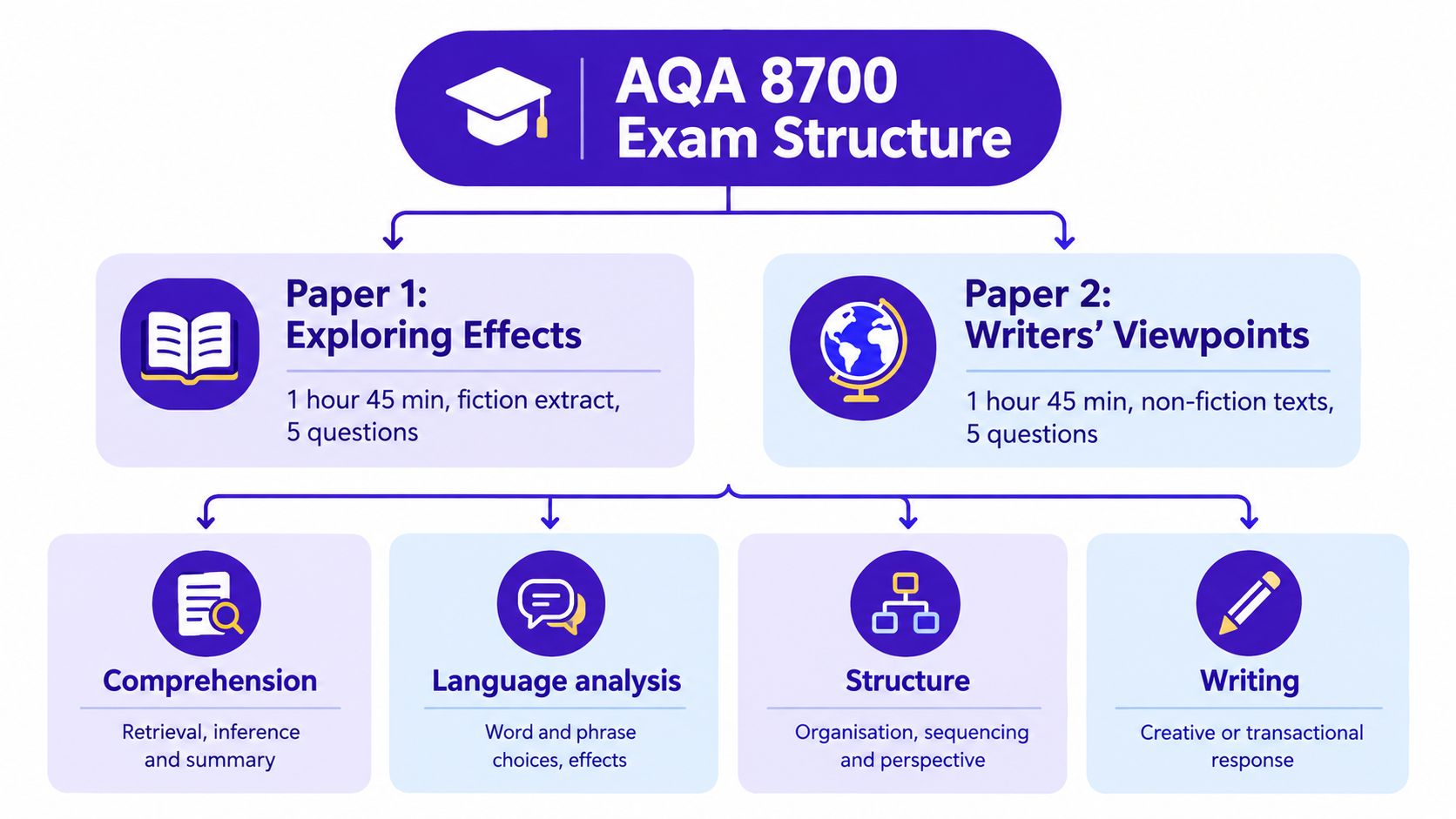
Before revising, remove the biggest source of stress: uncertainty about the paper. AQA GCSE English Language 8700 is designed as a two-year course with all assessments at the end. It has two equally balanced papers, each worth 50% of the GCSE, and each lasts 1 hour 45 minutes, giving students 3 hours 30 minutes of terminal assessment overall. The AQA English Language 8700 specification sets out this structure clearly.
Know what each paper is asking you to do
Paper 1 is creative reading and writing. You'll read a fiction extract and answer questions about what happens, how language works and how the text is structured before completing descriptive or narrative writing.
Paper 2 is writers' viewpoints and perspectives. You'll work with two linked non-fiction texts and answer questions involving comprehension, language, comparison and evaluation before producing viewpoint writing.
Each paper has 80 raw marks, as shown in AQA's scheme of assessment. Don't treat those marks as one undifferentiated pile. Each question has a particular job, and AQA deliberately sequences the questions so that they test distinct assessment objectives and build across the paper.
That means “revise English” is too vague. Revise how to retrieve information, how to analyse a writer's choices, how to discuss structure, how to compare viewpoints, how to evaluate a statement, and how to write accurately for a purpose. A student who understands those separate demands can make better decisions than a student who memorises a list of techniques.
Turn the structure into a revision map
Make a page with two columns, one for each paper. Under each paper, write the question purpose in your own words. Then add a short note about the skill you need to demonstrate.
- Paper 1 reading: Track meaning, analyse language, explain structure and evaluate the text.
- Paper 1 writing: Shape a description or narrative with deliberate choices and accurate technical control.
- Paper 2 reading: Understand two texts, analyse methods and compare viewpoints or perspectives.
- Paper 2 writing: Present a clear viewpoint with an appropriate tone, structure and persuasive control.
The MasteryMind AQA revision tools can help you organise practice around question types and mark schemes, but a simple exercise book works too. The important part is that every practice task has a named purpose.
Practical rule: Don't ask, “Have I revised English today?” Ask, “Which assessment objective did I practise, and what did my answer do better?”
This is also why a broad resource such as a no-limits English learning path can support general confidence but shouldn't replace AQA-specific practice. General language development is useful. The exam rewards your ability to apply that development to a fixed sequence of tasks.
Mastering the Reading and Analysis Questions
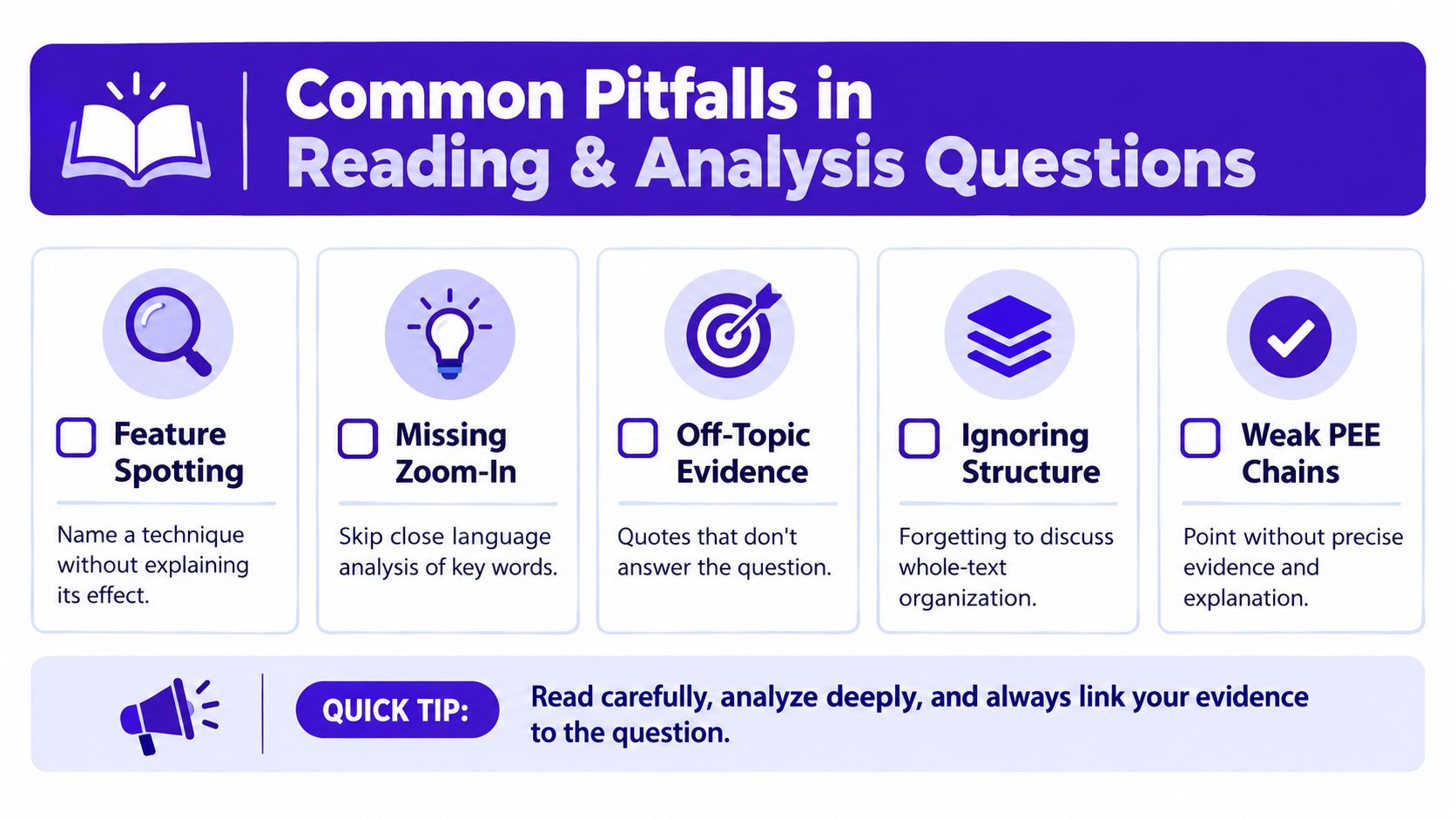
Reading marks often disappear through small habits rather than a complete lack of understanding. A student spots a metaphor, copies half a sentence and writes that it “creates tension”. The answer sounds like English revision, but it hasn't explained what the particular word suggests or why the writer has used it at that moment.
Independent UK examiner guidance highlights recurring problems including feature spotting without effect, vague structural comments, overlong quotations and weak technical accuracy, including comma splices and missing paragraph breaks. AQA English Language examiner guidance also warns against generic assertions that aren't rooted in the extract.
Use a precise three-step answer protocol
For most language and structure analysis, use this sequence:
- Select a short detail. Choose a word, phrase, sentence or structural moment that directly answers the question.
- Name the method only if it helps. You might identify a verb, image, contrast, sentence type or shift in focus. Terminology isn't the point by itself.
- Explain the precise effect. Discuss what the detail suggests, how it shapes meaning, what it makes the reader notice or how it changes the text's direction.
For example, instead of writing, “The writer uses a short sentence to create tension”, write something closer to this:
The isolated sentence, “He stopped”, interrupts the movement of the paragraph. The verb suggests a sudden decision, while the abrupt pause makes the reader wait for an explanation and share the character's uncertainty.
That answer doesn't rely on a memorised claim. It explains the actual detail and its position in the passage. You don't need to copy this wording in an exam. You need to make the same kind of connection.
Match the command word
A question's command word should control your response.
- Identify: Give a direct answer and avoid unnecessary analysis.
- Summarise: Select the main ideas or differences and keep your focus on what the question asks.
- Analyse: Explain how the writer's language or structural choices create meaning.
- Evaluate: Make a judgement about how far you agree, then support it with relevant evidence.
- Compare: Discuss both texts and use clear connections such as similarly, whereas or in contrast.
For Paper 2 comparison, avoid writing one full response about the first text and then bolting on the second. Build each paragraph around a shared idea, then show how the writers differ in attitude, tone, method or viewpoint. A comparison is not just a hunt for two techniques.
A useful revision exercise is to take a paragraph you've already written and underline every sentence that explains why the evidence matters. If there are lots of quotations but very little explanation, your next target is clear. Use the GCSE Past Papers library to practise one question at a time before attempting whole papers.
It can also help to practise separating evidence from opinion. If you're unsure about the difference between reporting a text accurately and adding your own judgement, revise what an objective summary is before returning to summary questions.
Crafting High-Scoring Creative and Viewpoint Writing
Paper 1 and Paper 2 writing are not the same task wearing different clothes. Paper 1 asks you to create a description or narrative, so the reader needs a controlled sense of place, movement, character or atmosphere. Paper 2 asks you to communicate a viewpoint, which means your argument, audience and purpose need to remain clear from the opening to the final paragraph.
Plan before you draft
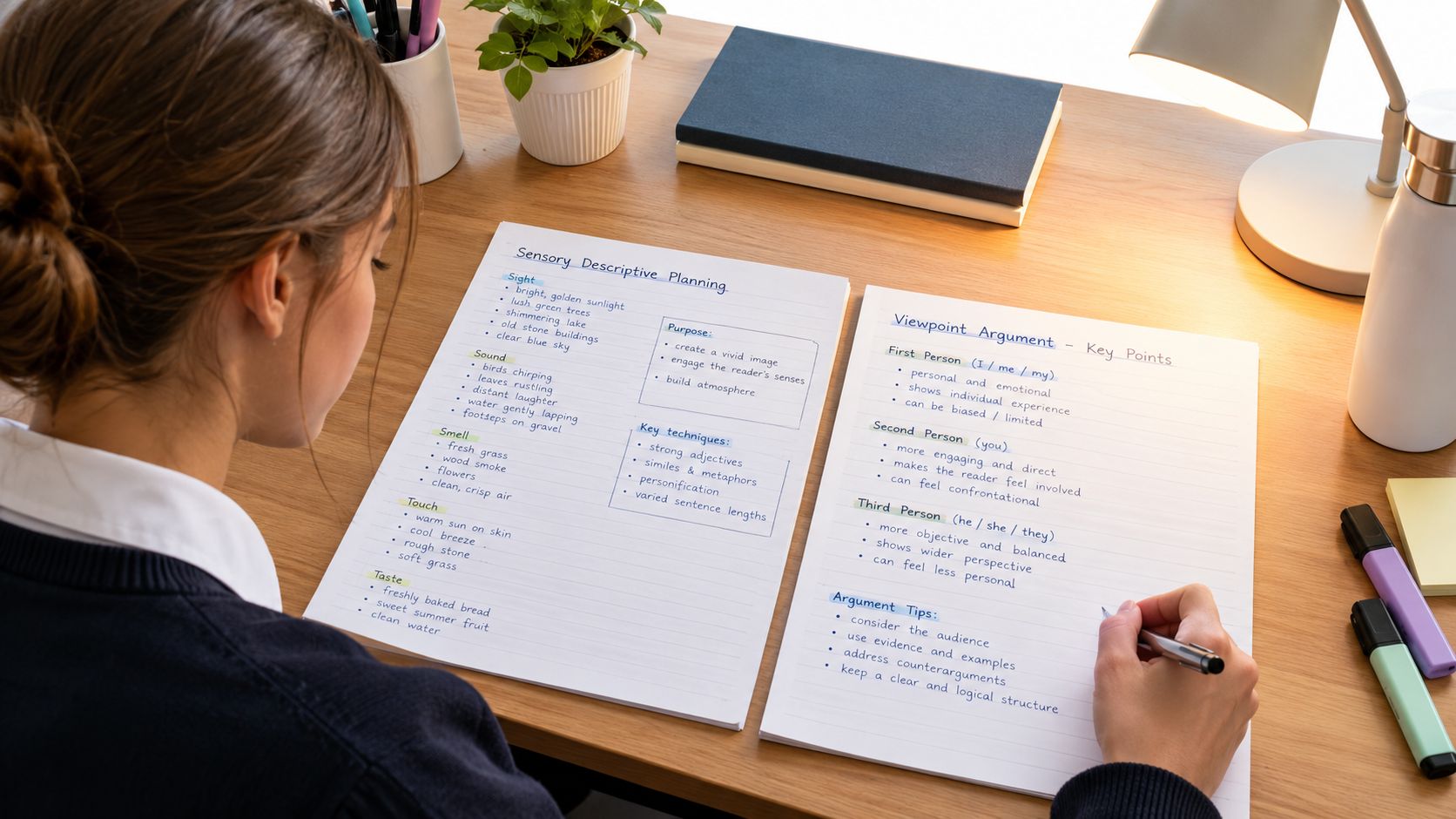
Use the first five minutes to make decisions rather than staring at the page. For a creative task, sketch an opening image, a change or development, and an ending that connects back to the central idea. For viewpoint writing, decide your position, your strongest reasons, the order of your argument and the tone suited to the audience.
A plan doesn't need to be a mini-essay. It might look like this:
- Opening: Establish the setting or viewpoint immediately.
- Development: Add a change, complication, example or opposing idea.
- Control: Vary sentence lengths and paragraph sizes for a reason.
- Ending: Leave the reader with a final image, judgement or call to think differently.
Keep the two writing forms distinct
In description, sensory detail should support the atmosphere rather than become a list of random adjectives. A cold street becomes more convincing when the detail is selected and connected: the metal railing bites into a hand, footsteps vanish beneath traffic, and a doorway offers the only patch of warmth.
In narrative, don't force a dramatic plot if you can control a small moment well. A character waiting outside a hospital, hearing a key turn or deciding whether to speak can provide a clear structure when the writing carefully develops tension and perspective.
Viewpoint writing needs a different kind of discipline. A speech, article or letter should sound as though it has a real audience. Use a clear position, develop reasons and choose persuasive devices because they fit your purpose. Rhetorical questions, direct address and emotive language are options, not compulsory decorations.
Protect your technical accuracy
Examiners can't reward meaning that becomes difficult to follow. Watch for comma splices, where two complete sentences are joined with only a comma. Check sentence demarcation, capital letters, full stops, apostrophes and paragraph breaks. Missing paragraphs make your ideas harder to track and can weaken the sense of deliberate structure.
Clear, controlled writing beats ambitious vocabulary that you can't control.
Build a personal error list from your marked work. If you repeatedly write long sentences that lose their subject, practise dividing them. If commas replace full stops, read each sentence aloud and check whether it contains one complete idea or several. Don't memorise a perfect story. Prepare flexible openings, structural choices and persuasive moves that you can adapt to the prompt.
Using Active Recall and the Blurt Method
Reading notes feels productive because the page looks familiar afterwards. Familiarity isn't the same as being able to retrieve a method when an unseen extract and a clock are in front of you. English Language revision improves when you practise producing the knowledge, not just recognising it.
The Blurt Challenge is a straightforward way to do this. Close your notes, choose one exam skill and speak everything you can remember. Explain how you would answer a language question, describe the difference between Paper 1 and Paper 2 writing, or talk through the checks you need before submitting an answer.
Make your blurts exam-specific
A weak blurt asks, “What are language techniques?” A useful one asks, “How would I analyse one word without feature spotting?” The second prompt forces you to retrieve a response process.
Try prompts such as:
- “Explain the three steps for analysing a short quotation.”
- “What does a structure question require me to track across the whole text?”
- “How should a Paper 2 comparison paragraph connect both sources?”
- “What must I decide before writing a description?”
- “Which punctuation errors appear most often in my own work?”
- “How would I check whether my answer has fully addressed the command word?”
Speak for long enough to expose gaps, then open your notes and compare your response with the assessment objective. Don't just reread the missing information. Close the page and repeat the explanation in your own words.
Turn gaps into follow-up practice
Suppose your blurt covers metaphor and simile but says nothing about shifts in focus. That gap becomes a targeted task. Find a structure question, identify where the text changes direction and write a short explanation of why that movement matters.
A voice-powered tool can compare a spoken response with curriculum objectives and generate follow-up questions. You can also do the process manually with a phone recording, a checklist or a willing study partner. The method matters more than the technology.
The active recall for GCSE and A-Level guidance can help you build retrieval into revision across subjects. Keep each session focused. One short blurt, one correction, one application task is more useful than an hour spent colouring notes.
If you can explain the method without looking, apply it to a fresh extract and correct your own weakness, you're rehearsing the real exam skill.
Use blurting at the start of a session to reveal what you know and at the end to test whether the correction has stayed in memory. Over time, mix old prompts with new ones. That stops revision becoming dependent on the order in which you studied your notes.
Building Your Step-by-Step Revision Schedule
A strong revision schedule begins with evidence from your work, not a guessed list of topics. Review a marked response or past paper and identify the pattern behind the lost marks. Perhaps you selected evidence but did not explain its effect, treated comparison as two separate paragraphs, rushed the writing task or made frequent sentence-boundary errors. That pattern should decide your next practice task.
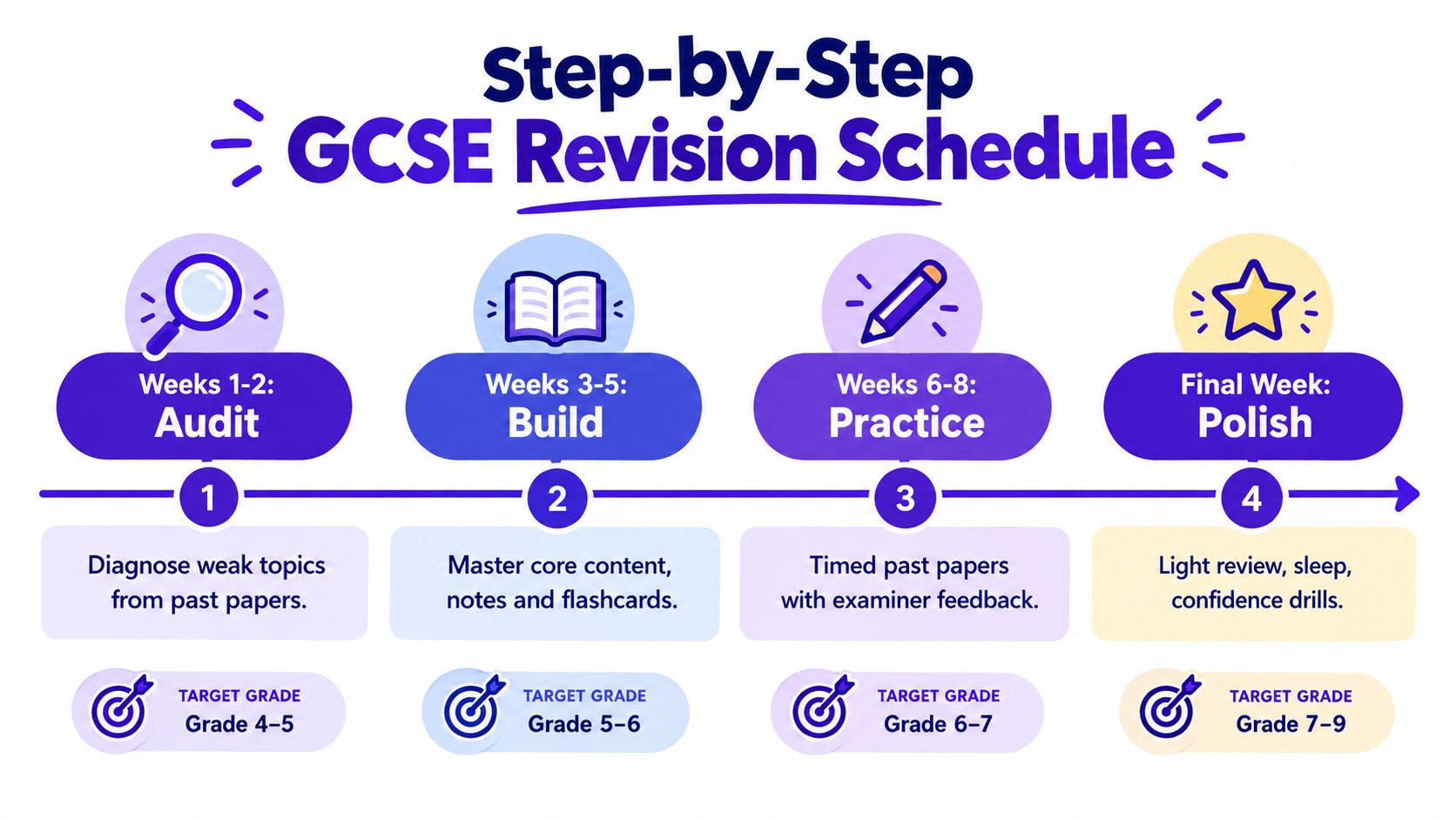
Phase one is an honest audit
Choose a short list of targets. A student working towards a pass may need to answer each command word, select relevant evidence and complete every section. A student aiming for the highest grades may need to develop interpretations, control whole-text structure and sustain a convincing viewpoint. The assessment objectives give both students a clearer route than just reading more books.
Write each target as an action:
- Analysis: Explain the effect of every chosen detail.
- Structure: Track a change in focus, perspective or pace.
- Comparison: Link both texts within each developed idea.
- Writing: Plan a deliberate beginning, development and ending.
- Accuracy: Check sentence boundaries and paragraph breaks.
Phase two builds reliable habits
Practise individual question types before attempting full papers. Start with a prompt that tests the relevant assessment objective, complete one focused task, then compare your response with the mark scheme. On another day, plan and write a creative or viewpoint response before checking its technical accuracy.
Keep earlier skills in rotation. After practising language analysis, retain it with a brief retrieval prompt while you work on writing. This keeps the method available without allowing one question type to dominate your timetable.
Phase three introduces pressure
Add timed work gradually. Begin with a clear question and enough room to think. Then reduce the support, mix question types and reproduce the order of the paper. Review is part of the practice, not an optional extra. Add a missing explanation, replace a vague sentence and record the precise change to make next time.
A useful schedule moves from accuracy to speed, much like learning a route before driving it in heavier traffic. You first make the method reliable, then practise using it when attention and time are limited.
Phase four is controlled polishing
Near the exam, return to your error list instead of trying to relearn the entire course. Practise the question types that still cause difficulty and complete realistic sections under timed conditions. Keep recall prompts short and specific. Sleep, food, equipment and a calm routine cannot write the answer, but they help you use your preparation.
For students considering a retake, begin with a practical decision rather than shame. AQA's June 2026 results data record 623,435 overall English Language entries in the official release. Independent UK analysis reports 82,900 November 2025 entries, a 7.7% year-on-year increase, and a 37.5% November 2025 pass rate compared with 20.9% for the following summer resit cohort in its discussion of the resit data. Those figures do not choose your route. Consider how close you are to grade 4, how much preparation time you can protect and whether a November attempt gives you a realistic chance to improve.
Exam Day Technique and Final Checks
Exam technique means directing your time and attention towards the marks available. If one question feels difficult, keep the paper moving so it does not take time from answers you can still complete well.
Use the mark allocation to guide your pace. Each paper has 80 marks and lasts 1 hour 45 minutes, so higher-mark responses need more planning and writing time than short retrieval questions. Check the clock at sensible points, but avoid abandoning a strong answer just because your planned minute has ended. Move on when further effort is producing little progress.
Keep the paper moving
Read the question before studying the extract closely. Underline the command word and identify its precise focus. For analysis, choose short evidence that supports a clear point. For comparison, keep both texts visible in your thinking. For writing, use a brief plan to decide what you want the reader to think, feel or understand.
If you freeze, write one direct, valid point. A precise sentence linked to the text earns more value than a general introduction about the writer's intentions. Leave space to return to a difficult question, rather than allowing it to remove time from a later section.
Use the final ten minutes intelligently
Use the final ten minutes as an accuracy sweep. Check:
- Sentence boundaries: Repair fragments and comma splices.
- Punctuation: Look for missing full stops, capitals, commas and apostrophes.
- Paragraphs: Separate each new idea, shift or stage of the writing.
- Question focus: Confirm that you answered the command word.
- Evidence: Check that quotations are short, relevant and explained.
- Writing completion: Make sure the ending is not an abandoned sentence.
A full practice paper on Exam Practice for GCSE can reproduce time pressure and give you a structured way to review performance. Use a printed mark scheme alongside teacher feedback. Each missed check should become a specific habit for the next paper.
AQA's June 2025 examiner report recorded an increase in the overall mean mark from 36.6 in June 2024 to 40.5 in June 2025, as reported in the official examiner report. The practical revision order is clear: secure method marks, strengthen analysis, then apply both skills in mixed, timed practice.
MasteryMind offers AQA GCSE English Language practice organised around question types, command words and mark allocations, with examiner-style feedback and active recall through the Blurt Challenge. Visit MasteryMind to build revision around the skills your next paper will test.
Ready to master this topic?
Practise with quizzes, blurt exercises and exam questions on MasteryMind.
7 days Premium · Then free forever · No card, no charge