GCSE Revision Timetable Template: Build One That Works

You've got five subjects open on your desk, homework due tomorrow, and a blank timetable that already feels out of date. Whether you're trying to rescue grades you know you've neglected or push strong subjects even higher, you don't need more hours logged. You need a GCSE revision timetable template you can rebuild every Sunday from your marks and exam dates, so it still makes sense in week two.
The Five Blocks Every Revision Session Needs
Copy this grid first. It's the working unit for everything that follows.
| Block | Length | What you do | Output to record |
|---|---|---|---|
| Warm-up retrieval | 10 minutes | Recall last week's topic with no notes | Score, and a list of what was missed |
| Focused topic block | 25-40 minutes | Revise one named topic from the specification | Summary written in your own words |
| Exam-style application | 30 minutes | Answer a past-paper question under timed conditions | Marked answer checked against the mark scheme |
| Correction task | 15 minutes | Rewrite missed answers and add them to an error log | Corrected answer and one error log entry |
| Weekly catch-up | 60 minutes | Reschedule any sessions missed during the week | Updated plan for the following week |
Each block leaves something behind. The warm-up tells you what has faded, the focused block fills a named gap, and the timed question tests whether you can use it. The correction task stops the same mistake returning, while the catch-up stops one missed evening wrecking the whole week.
A normal school evening
You don't run all five every night. A warm-up plus two focused blocks comes to 60 to 90 minutes, which fits alongside homework for most students. Add the timed question on two or three evenings a week, using GCSE Past Papers or paper copies from school, and save the catch-up for the weekend.
Put the grid in a spreadsheet, notebook or printed sheet, with one row per block and one column per day. Write the topic, not just the subject, in each cell. If you miss a warm-up, pick it up the next day. Never double it.
Practical rule: If a block produces no score, summary, marked answer or correction, it was reading, not revision.
You're not alone in juggling this. In England, the government recorded 5,777,020 GCSE entries for the summer 2025 examination series, according to the provisional entries for GCSE, AS and A level summer 2025. The rest of this guide builds your term, week and day plans from these five blocks.
Term, Week and Day Plans You Can Copy
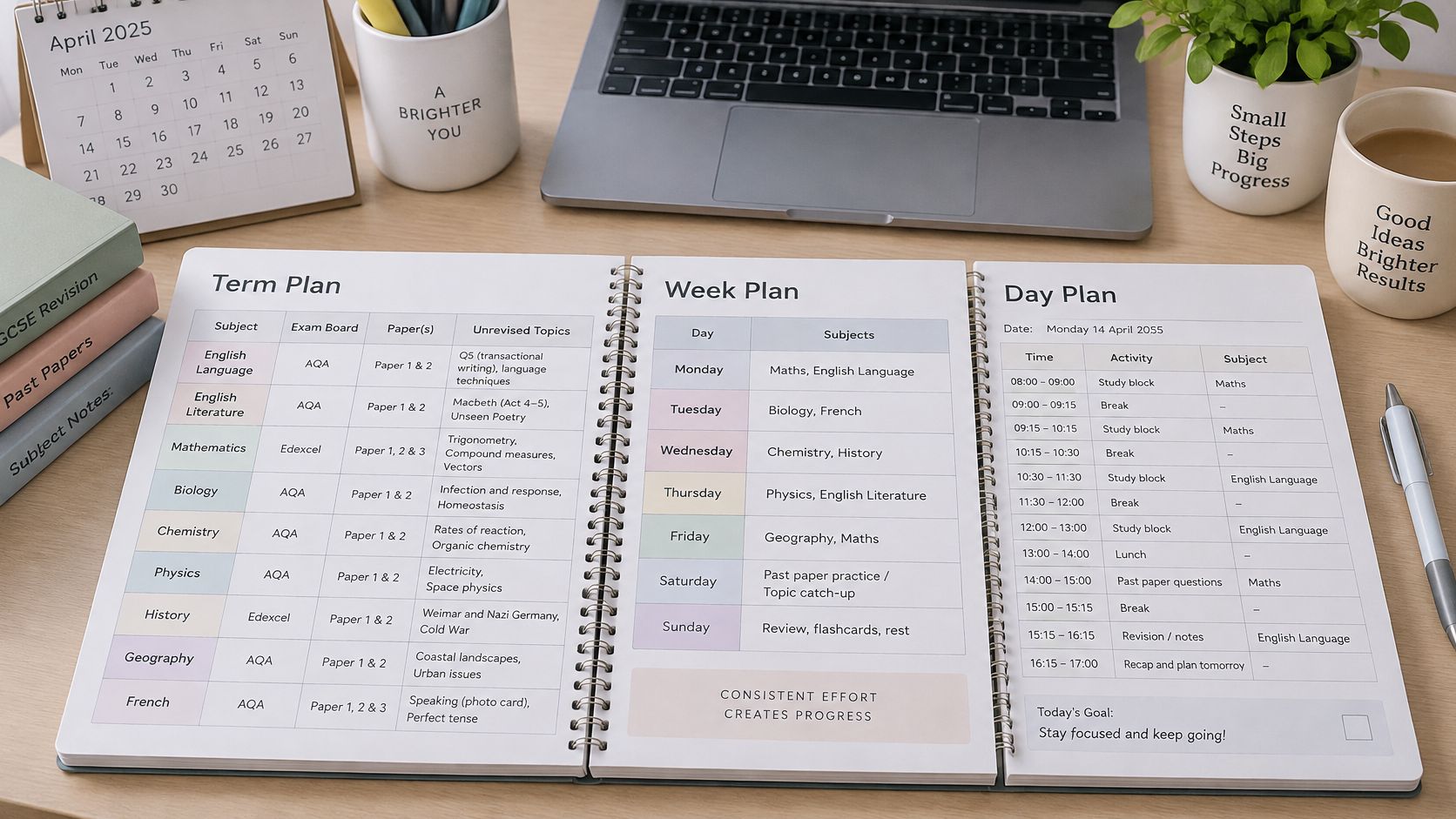
One view can't do every job. You need a distant view for coverage, a weekly view for choices, and a daily view for starting without faffing about.
| Planning level | What it covers | How often to update | Example entry |
|---|---|---|---|
| Term | Every subject, its exam board, papers and unrevised topics | Once at the start of term, then monthly | Biology, eight topics left, Paper 1 in May |
| Week | Two or three sessions per subject, one catch-up slot and one past paper | Every Sunday | Mon, Biology cell biology block; Tue, History source question |
| Day | Three or four named blocks with start times | Each evening, five minutes | 4:30pm 25-minute retrieval; 5:15pm 30-minute past-paper question |
A Year 11 example
Say you're sitting Biology, French, History, Maths and English. In the weeks before their papers, Biology and Maths get the most blocks because those dates are closest. French and History rotate in second place, and English keeps one maintenance session a week so it doesn't go cold. That weighting changes as later papers move closer.
Don't spread hours evenly just to look fair. The Ofqual student guide to exams and assessments in 2026 states UK GCSE exams in 2026 run from 7 May to 23 June, with a contingency day on 24 June. Take your exact dates, board and morning or afternoon session from your school, not from any template.
If two hard papers land on consecutive days, plan a lighter evening and a recovery block after them. Sleep and a short retrieval session beat a panicked marathon. If a date moves, shift the next session forward rather than adding hours.
With fewer than six weeks left, drop a secure subject such as English to one weekly block and give your weakest subject the first two weeks.
Your Sunday rebuild is where this works. Keep later subjects ticking over, push imminent papers up, and stay available through the contingency day.
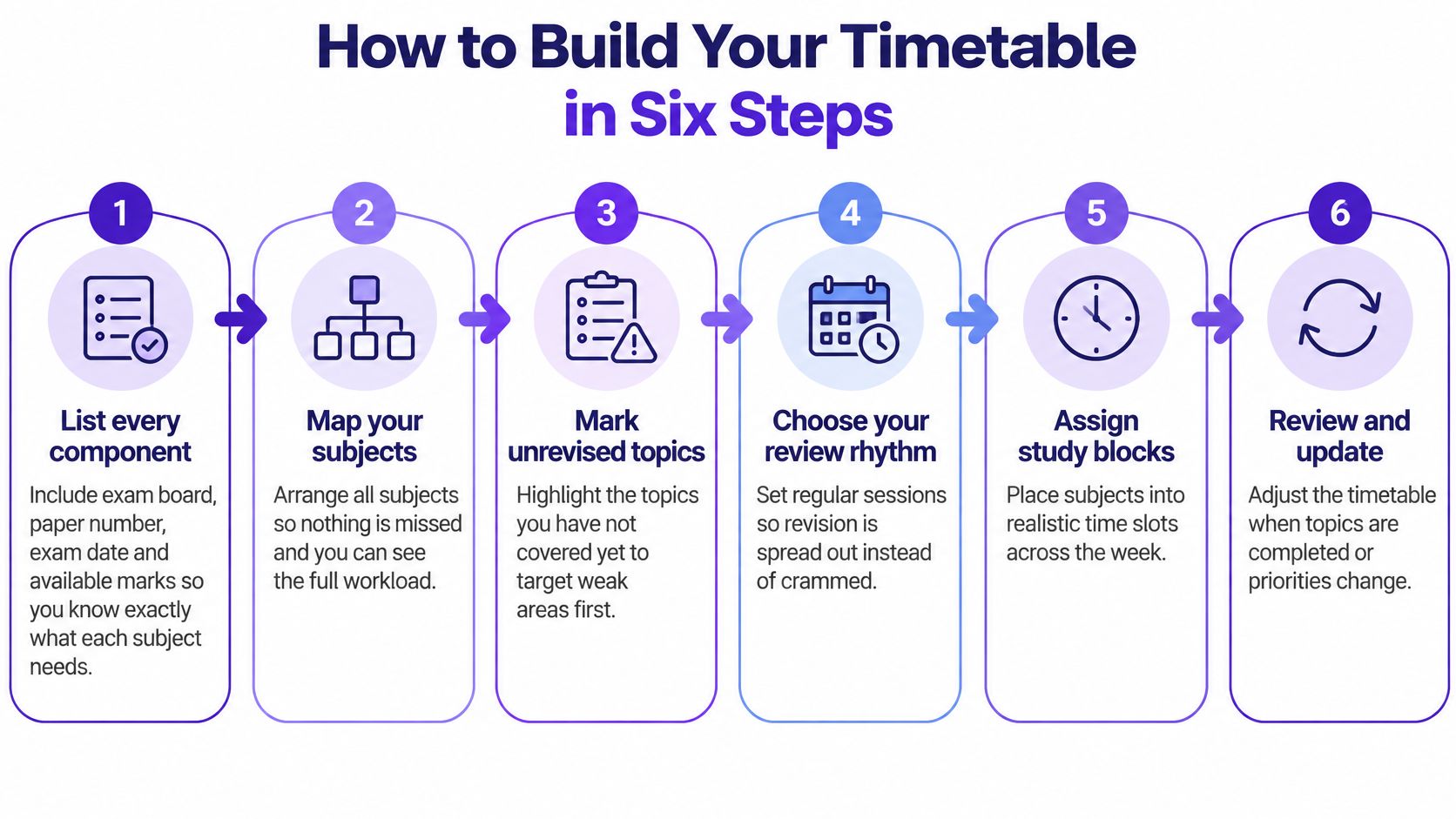
How to Build Your Timetable in Six Steps
Build it in this order. Swapping the steps is how students end up with colourful grids and no idea which topic matters most.
List every component. For each subject write the exam board, paper number, exam date and available marks. One GCSE can contain several papers, so counting subjects alone understates the work.
Count backwards. Work out the weeks to each exam. The nearest papers get the most blocks, while later papers keep a smaller maintenance slot.
Rank every topic. Use your last quiz or past paper and label each topic strong, shaky or unseen. Don't use how familiar it feels when you reread it.
Assign blocks to topics. Shaky and imminent topics go first. Strong topics move to a maintenance rotation through warm-ups and occasional timed questions.
Build the week. Use the five blocks and cap each day at two focused blocks. A plan that survives a bad Tuesday beats a heroic plan that collapses by Thursday. If you like blocking time visually, a focused planning guide for busy professionals shows the same basic idea applied to work calendars.
Review every Sunday. Record accuracy and confidence for each topic, set the next review date, and move missed work into the catch-up slot. Then rebuild next week from what the marks say.
Why the loop matters
Steps one to six form a plan, monitor and evaluate loop. The Education Endowment Foundation Teaching and Learning Toolkit reports that metacognitive and self-regulated learning strategies produce an average of eight additional months' progress over a year across 355 studies. It also warns that these strategies work best alongside specific subject content, not as generic study skills.
That's why "revise biology" isn't a block. Write "explain osmosis using a concentration gradient diagram" instead, with a closed-book recall, an exam question, marking and a correction.
Quick check: Before you start any block, can you name the output you'll have when it ends?
Spacing and Mixed Practice Without the Guesswork
Spacing means returning to a topic after gaps that grow, instead of cramming it once and hoping. Use this schedule as your starting point.
| Days after first study | Review type | Session length | Check |
|---|---|---|---|
| 1 day | Quick retrieval of the same topic | 10-15 minutes | Can you recall the key points without notes? |
| 3 days | Short quiz or blurt | 15 minutes | Missed points go on the error log |
| 7 days | Past-paper question on the topic | 25-30 minutes | Marked against the mark scheme |
| 14 days | Mixed-topic practice with two other subjects | 30 minutes | Recall without prompts |
| 28 days | Timed question or mock section | 40 minutes | Confidence rating and next review date |
Treat the intervals as adjustable. If you've forgotten the topic before its date, bring the review forward. If you recall it easily and answer a timed question well, push the next review further out and give that slot to something shakier.
Mixing topics on purpose
Mixed practice puts two or three subjects in one day, or interleaves topics inside one subject. You have to choose the method each time, not repeat the one you've just used. Students using mixed-topic revision with MasteryMind can automate that selection, but a paper planner works if you vary the order deliberately.
A Tuesday might look like this:
- Biology review: Cell transport retrieval from last week, then one timed question.
- French vocabulary quiz: Words that were missed on day three, spoken and written.
- History source question: A new source, marked for inference and provenance.
Yes, mixing feels harder and slower. That difficulty is useful because the exam won't warn you which method comes next. Let mixed sessions take a larger share of your week as exams approach, placing the day 14 and day 28 reviews directly into your week view.
Using Spaced Review and the Blurt Challenge
Paper works if you keep updating it. Software helps mainly by remembering dates, mixing topics and marking patterns you might miss. MasteryMind is one option, with questions aligned to AQA, Edexcel, OCR and WJEC specifications and a free plan for starting before you decide about Premium.
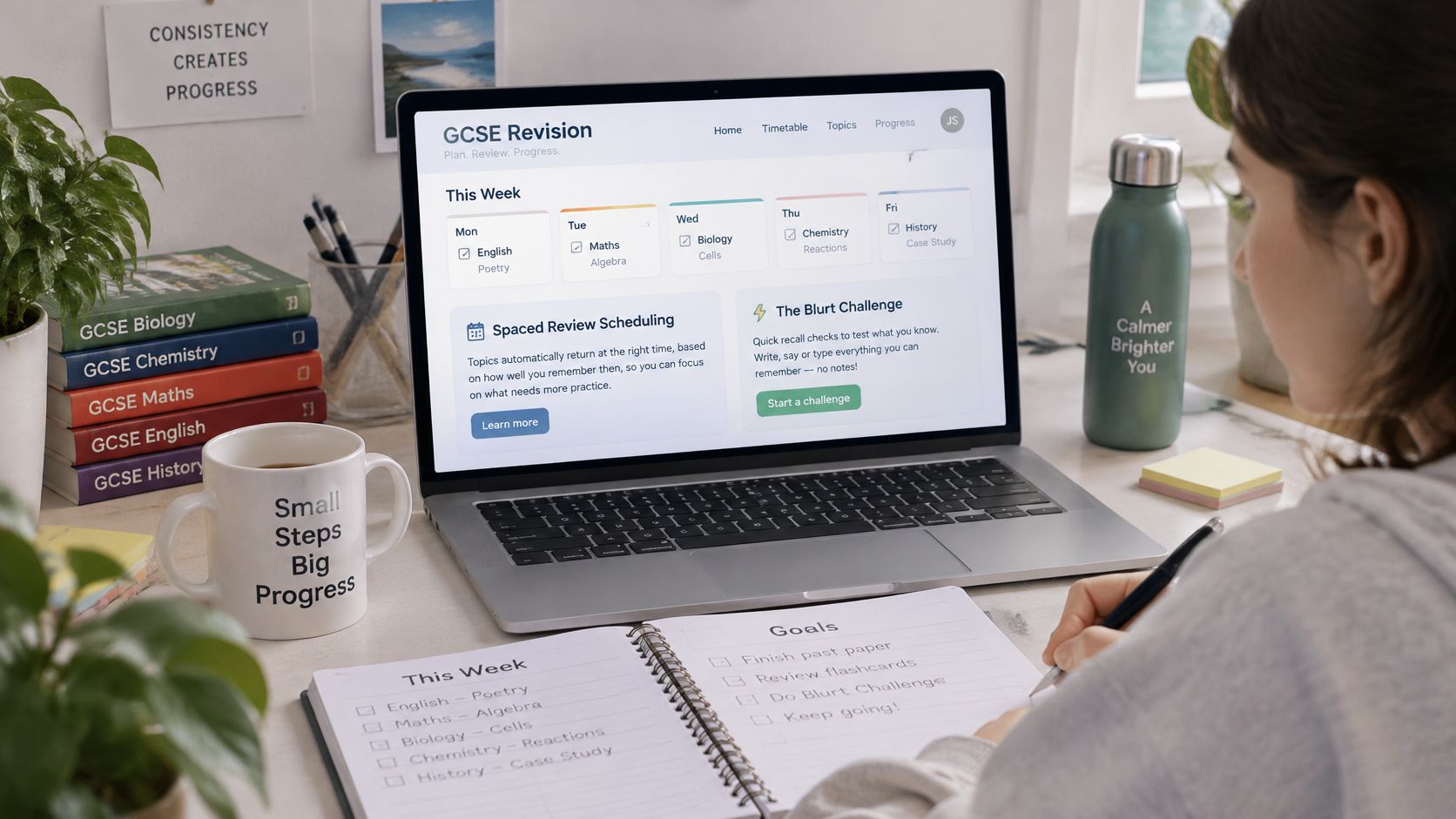
- Spaced review scheduling: Brings topics back at widening intervals and moves them if you recall them easily or forget them early.
- Mixed-topic practice: Combines subjects and topics so you're choosing methods, not repeating a pattern.
- Blurt Challenge: You speak an answer, it's compared with curriculum objectives, and targeted quizzes follow. You can try blurting for GCSE revision as a warm-up block.
- Topic progress dashboard: Tracks marks over time so Sunday decisions use evidence, not vibes.
- Examiner-style feedback: Gives AO breakdowns, step-by-step checks for maths and structured guidance for 24-mark essays.
Coursework needs a clear line
For coursework, NEA Coach offers Socratic guidance and mark estimation. It doesn't rewrite work or give direct solutions, and you still choose what to revise and write. That limit matters for teachers checking that support hasn't replaced the student's own authorship.
The JCQ instructions for conducting coursework, effective from 1 September 2025, state candidates must not copy internet or AI-generated material and claim it as their own. You must reference material in detail, keep a non-editable copy such as a screenshot, and submit a brief explanation of how it was used. Teachers must authenticate the work before submission.
So timetable sessions for understanding a brief, planning, drafting independently and checking sources. Don't timetable outsourcing the writing.
Why Timetables Slip and How to Fix Them
Completion beats ambition. In the Department for Education's LSYPE2 research, pupils who reported completing all homework achieved higher KS4 attainment than those completing most homework, by 10.3 points, or some or none, by 21.7 points. Homework isn't identical to revision, but the lesson transfers. Small, trackable commitments beat vague multi-hour targets.
| Symptom | Likely cause | Fix |
|---|---|---|
| Missed sessions pile up by Thursday | Too many blocks planned each day | Cut to two focused blocks a day and reschedule missed work, do not double it |
| The same topics get revised every session | Staying in the comfort zone and avoiding weak topics | Rank topics by last quiz score and put the weakest first |
| The plan looks full but nothing gets marked | Reading notes instead of answering questions | Add a marked question or error log entry to every block |
| Weekends are always empty | No catch-up slot built in | Reserve a 60-minute weekly catch-up block |
| Five subjects are touched but none feel finished | Too many subjects in one week | Move to one main subject per day and rotate through the week |
Fixes teachers recognise
If you're a teacher reading this with a sceptical eyebrow raised, you're asking the right question. Where's the marking? A timetable with no mark scheme, correction or error log is a reading plan, not a revision plan, however neat it looks.
For students, the fix is rarely "try harder". It's usually fewer blocks, weaker topics earlier, and an observable output you can't fake. Review completion each week, rescue what's missed into the catch-up slot, and delete what no longer matters.
A plan that breaks in week two is normal. Edit it. Don't abandon it and start again from guilt.
Run One Week Before You Change Anything
Follow the template for a full week before editing it. If one evening goes wrong, leave the rest of the plan alone and review the pattern on Sunday.
Compare planned blocks with completed ones. Record marks by paper and question type, then note which topics have shifted from shaky to strong. Set the next review dates and use Exam Practice for GCSE for a timed check if it suits your plan.
Use marks to track progress, not to promise a grade. GCSEs in England use grades 9 to 1, and grade boundaries vary by subject and exam series. Check targets against the relevant exam board mark scheme and recent boundaries. The same marks record can help whether you are working towards a grade 4 or aiming for a grade 9.
After the week, shorten blocks if you missed more than a third. Move a subject earlier in the week if its marks are falling, and remove secure topics from warm-ups. Copy the five blocks, add your exam dates, and run the timetable for seven days. Each Sunday, adjust it against your marks and upcoming exams.
Copy the five blocks and weekly grid today. Then let MasteryMind handle spaced review scheduling and mixed-topic practice for you, with examiner-style feedback on your answers. Start free, run one honest week, and rebuild on Sunday from your actual marks.
Choose your next course task
Use this idea in your next study session. Confirm the qualification, awarding organisation and course version before choosing practice, assignment preparation or evidence planning.
Find your course and next task