Giant Covalent Structures: Ace Your GCSE & A-Level Chem

You're probably here for one of two reasons. Either you've left chemistry revision later than you meant to, opened a question on bonding, and realised giant covalent structures still feel slippery. Or you already know the basics and want the sort of explanation that translates knowledge into marks.
This topic matters because examiners love it. Diamond, graphite, graphene, silicon dioxide. Same core idea, different wording, lots of opportunities to drop marks if your explanation stays too vague. The good news is that giant covalent structures are much easier once you stop trying to memorise disconnected facts and start thinking like a marker.
Why This Topic Trips Up So Many Students
A very common exam moment goes like this. You turn the page and see a question asking why diamond is hard, why graphite conducts electricity, or why both have high melting points even though they're made of the same element. You know you've seen it before. But under pressure, everything blurs into “strong bonds” and “layers” and you're not fully sure what earns the marks.
That's why this topic catches so many students out. It isn't usually the first fact that causes trouble. It's the link between structure, bonding, and property. Students often know one of those pieces, sometimes two, but not how to connect all three in a sentence that an examiner can reward.
The pressure is real. In Summer 2024, the UK GCSE pass rate at grade C/4 or above was 67.6% according to Statista's UK GCSE pass rate data. That means every secure mark matters, especially on topics that appear again and again.
Where students usually lose marks
- They describe instead of explain. Saying “diamond is hard” gets you very little. Saying it's hard because each carbon atom is covalently bonded to four others in a rigid 3D lattice gets you into mark-scheme territory.
- They mix up bond types. A lot of students say graphite has weak covalent bonds. It doesn't. The weak part is between the layers.
- They forget the examiner's sequence. Most mark schemes want: structure first, bonding next, property last.
Regional results also show that outcomes aren't equal everywhere. In 2024, London had 28.6% of entries at grade 7+ compared with 17.8% in the North East, a gap of 10.8 percentage points, according to the Education Policy Institute's analysis of GCSE results day 2024. That isn't a reason to panic. It's a reason to revise in a focused way.
The students who improve fastest on this topic usually aren't the ones who memorise the most. They're the ones who practise saying the cause and effect clearly.
If you want structured support while you rebuild the basics, Online Revision for GCSE can help you turn weak spots into repeatable exam answers.
What Exactly Are Giant Covalent Structures
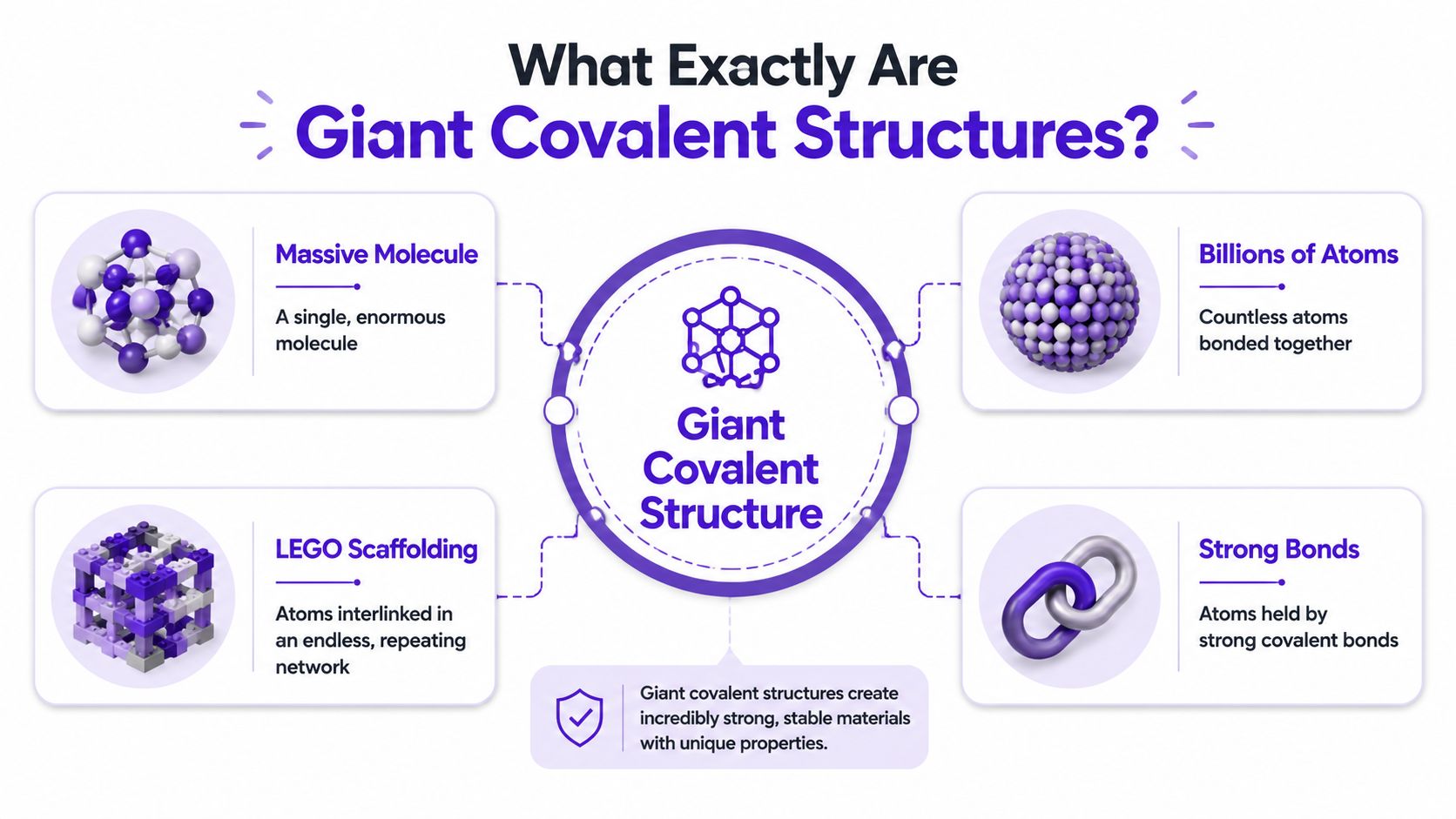
A giant covalent structure is not a collection of small molecules sitting next to each other. That's the first idea to lock in.
Instead, think of it as one enormous network of atoms joined by covalent bonds. A better picture is endless scaffolding. Every atom is connected into a repeating framework, and the structure keeps going through the whole solid.
The key idea students need
In a simple molecular substance, such as water, you have separate molecules. Those molecules are small, fixed units. In a giant covalent structure, there are no separate molecules. The whole crystal is one continuous arrangement.
That's why formulas can confuse people. A formula like SiO₂ tells you the ratio of silicon to oxygen atoms. It doesn't mean there's one tiny SiO₂ molecule floating around on its own. It shows the proportion of atoms in the giant network.
A simple comparison
| Type of substance | What it's made of | What holds it together |
|---|---|---|
| Simple molecular | Small separate molecules | Covalent bonds within molecules, weaker forces between molecules |
| Giant covalent | One continuous lattice of atoms | Strong covalent bonds throughout the structure |
This is the idea that reveals the whole topic. If there are no separate molecules, then you can't explain melting by talking about “forces between molecules”. There aren't any molecules to separate in the first place.
How to say it in an exam
A strong answer often uses wording like this:
Practical rule: If the substance is giant covalent, write “giant lattice” or “continuous network” before you write about properties.
That one phrase keeps your answer on track. It signals to the examiner that you know what kind of structure you're dealing with.
A useful way to picture it is LEGO built without edges. You don't stop at one small shape. You keep adding bricks in all directions. The result is a rigid framework, not a handful of separate pieces.
For GCSE, that's enough to build a solid foundation. For A-Level, you'll need to be more precise about arrangements and electron behaviour, but the same core idea still runs underneath everything.
Diamond vs Graphite The Ultimate Showdown
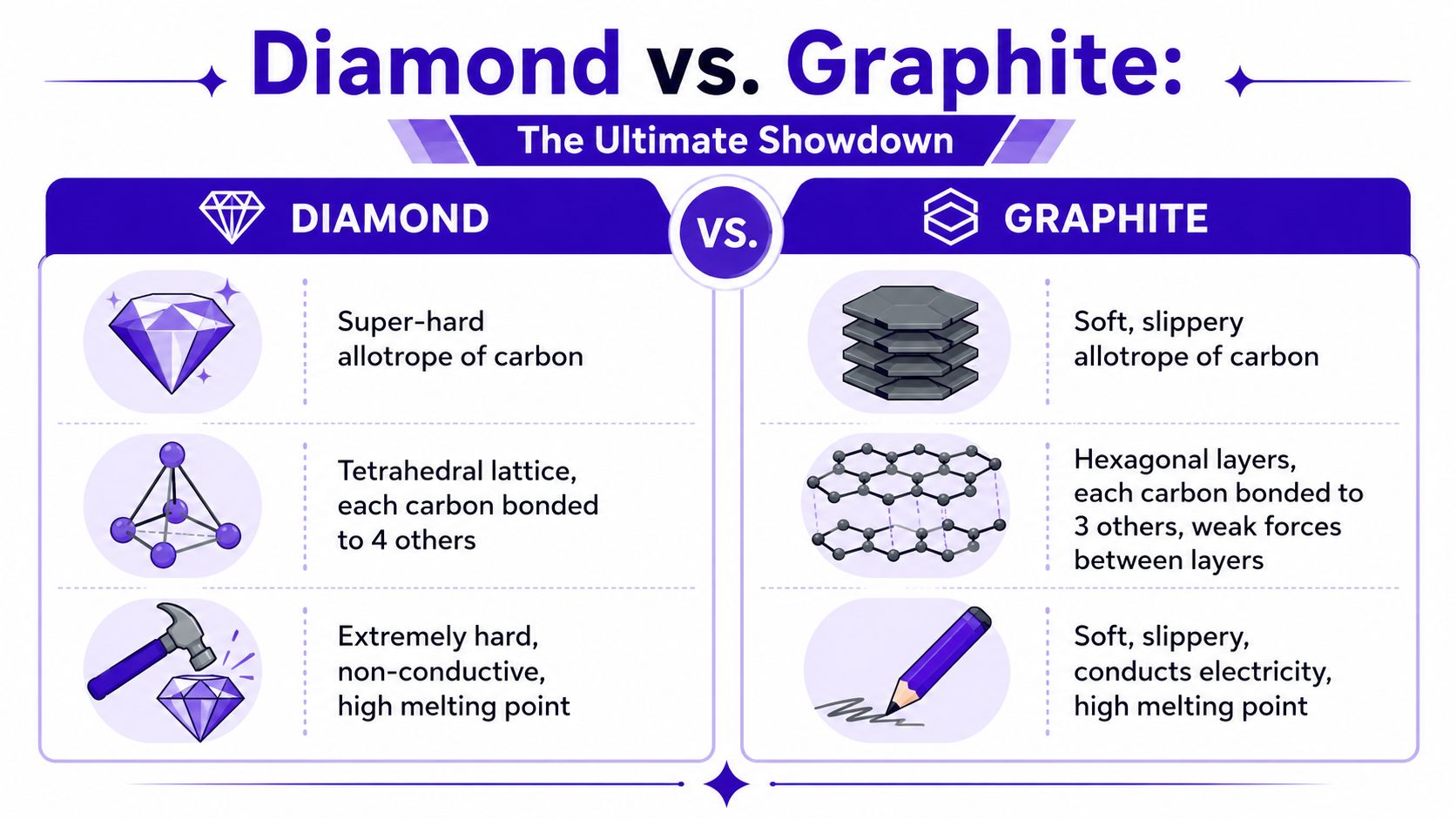
Diamond and graphite are both made only of carbon. That's what makes this comparison so useful. Same element, very different structure, very different properties.
Diamond
In diamond, each carbon atom is covalently bonded to four other carbon atoms in a tetrahedral arrangement. The bonding extends in three dimensions, making a rigid structure throughout the crystal.
According to BBC Bitesize on giant covalent substances, diamond is the hardest known natural material, and giant covalent structures such as diamond have melting points over 3,600°C because melting requires breaking huge numbers of strong covalent bonds.
What matters for exams is the chain of reasoning:
- Structure: each carbon bonds to four others
- Bonding: strong covalent bonds in all directions
- Result: rigid, hard, high melting point
Diamond also doesn't conduct electricity. Students often forget to explain that part. In diamond, all the outer electrons are involved in bonding, so there aren't mobile delocalised electrons free to carry charge.
Graphite
Graphite has a different arrangement. Each carbon atom bonds to three others, forming flat hexagonal layers.
Inside each layer, the covalent bonds are strong. Between the layers, the attractions are weak enough that the layers can slide over one another. That's why graphite feels soft and slippery, and why it works in pencils and as a lubricant.
Graphite can also conduct electricity. One electron from each carbon atom isn't used in bonding and becomes delocalised, meaning it can move through the structure and carry charge.
Here's the comparison students need to keep straight:
| Property | Diamond | Graphite |
|---|---|---|
| Bonding pattern | Each carbon bonded to 4 others | Each carbon bonded to 3 others |
| Shape | 3D tetrahedral lattice | Layered hexagonal sheets |
| Hardness | Very hard | Soft and slippery |
| Conductivity | Does not conduct | Conducts electricity |
If you want a real visual example of natural crystal structure, this salt and pepper diamond crystal is useful because it helps students connect the abstract lattice idea to an actual specimen rather than just a textbook diagram.
A short video can also help if the 3D shapes still feel abstract:
The exam pitfall that appears every year
Graphite is not soft because its covalent bonds are weak. It is soft because the layers can slide due to weak forces between layers.
That distinction matters. If you write “weak covalent bonds” for graphite, you're likely throwing away marks you could have kept.
Exploring Other Key Network Structures
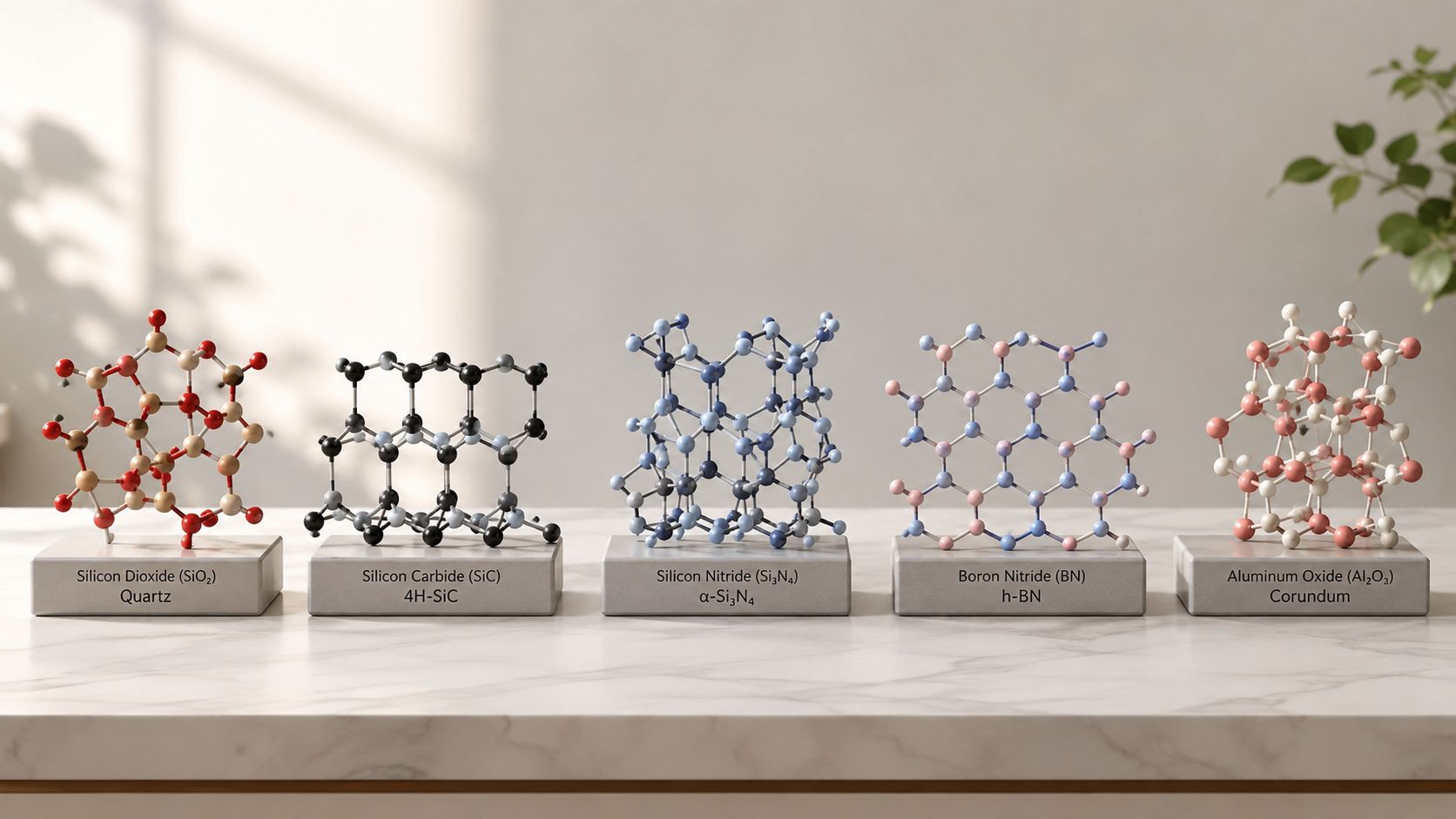
Diamond and graphite dominate exam questions, but they're not the whole story. Once you understand the basic pattern, other giant covalent structures become much easier to handle.
Graphene
Graphene is basically a single layer of graphite. Strip graphite down until just one sheet remains, and you've got graphene.
That means it keeps some important features from graphite:
- Hexagonal arrangement of carbon atoms
- Strong covalent bonding within the sheet
- Delocalised electrons that allow electrical conduction
Students often find graphene easier to understand once they stop treating it as a completely separate substance. It's better to think of it as graphite without the stack of layers.
Because it's only one atom thick, graphene is also lightweight. Yet the bonding within the sheet makes it very strong. In exam terms, that gives you a nice chance to apply the same “structure leads to property” logic you used with graphite.
Silicon dioxide
Silicon dioxide, often called silica, is another classic giant covalent structure. Sand and quartz are familiar examples linked to it.
The important thing is the pattern. Silicon and oxygen atoms form a large network. Each silicon atom bonds to oxygen atoms, and each oxygen links silicon atoms together, creating a rigid structure rather than separate molecules.
That's why silicon dioxide is usually described as:
- Hard
- High melting point
- Not a simple molecular substance
What examiners like here
A higher-level answer doesn't just list examples. It recognises the common rule behind them.
If the whole solid is a bonded network, expect properties linked to strong bonding across the structure, not weak attractions between tiny molecules.
That's the transferable idea. Once you've got that, an unfamiliar question becomes much less scary because you're not relying on memory alone. You're applying a model.
A quick way to sort examples
| Substance | Big structural idea | Useful property link |
|---|---|---|
| Graphene | Single carbon layer in hexagonal network | Conducts electricity |
| Silicon dioxide | Giant network of bonded atoms | Hard, high melting point |
For A-Level students, the topic now starts to feel more joined-up. You're no longer learning separate case studies. You're learning one principle and spotting it in different structures.
Linking Atomic Structure to Physical Properties
Cultivating top-mark answers requires specific attention. Examiners don't reward property lists very generously on their own. They reward clear links from atomic arrangement to observable behaviour.
Why melting points are so high
In giant covalent structures, the solid is one enormous bonded network. That means melting isn't about nudging apart a few molecules. It means breaking a vast number of strong covalent bonds.
The BBC Bitesize revision guide on giant covalent substances states that giant covalent structures like diamond have melting points over 3,600°C because melting requires breaking billions of strong covalent bonds, and the whole crystal is a single macromolecule that can contain from 50,000 to over 1,000,000,000 carbon atoms.
That's why “high melting point because of strong bonds” is only half an answer. The better answer is “high melting point because many strong covalent bonds must be broken throughout the giant lattice”.
Why some are hard
Hardness depends on how the atoms are arranged. In a rigid 3D network, atoms can't move easily, so the structure resists scratching or deformation. That's the logic behind diamond.
In layered structures, things change. Strong bonding may still exist within each layer, but if layers can slide over one another, the material feels softer. That's the logic behind graphite.
Why conductivity changes
This is the property that students often overgeneralise. They hear “giant covalent” and assume all of them either conduct or don't conduct.
A safer approach is this:
- Diamond: no mobile delocalised electrons, so it doesn't conduct electricity
- Graphite and graphene: delocalised electrons can move, so they do conduct electricity
- Silicon dioxide: no freely moving electrons, so it doesn't conduct
Examiner mindset: Never say “all giant covalent structures conduct” or “none of them conduct”. Check whether there are mobile electrons.
Why they're usually insoluble
A simple exam-friendly explanation is that these structures are held together too strongly for a solvent to pull apart easily. The giant network stays intact.
That's enough for most GCSE questions. At A-Level, you may phrase this more carefully, but the main point stays the same: the bonding within the structure is the dominant feature.
The answer pattern that wins marks
Use this order:
Name the structure
Giant covalent lattice, layered structure, tetrahedral network.Describe the bonding
Strong covalent bonds throughout, or strong covalent bonds within layers plus weaker forces between layers.Link to the property
Hardness, high melting point, softness, conductivity, insolubility.
If your chemistry answers feel too vague, practising this exact structure while Revising Chemistry for UK exams can make your explanations much sharper.
Tackling Exam Questions Like a Pro
A strong chemistry student doesn't just know facts. They know how to turn them into mark-scheme language under time pressure.
The good news is that marking has become more stable. The proportion of top grades 9 to 7 in 2024 was 22.6%, according to Schools Week's coverage of GCSE 2024 results. That stability matters because it means clear past-paper practice is a reliable way to improve.

A classic 6-mark question
Explain why diamond is hard while graphite is soft and slippery, even though both are made of carbon.
A student answer that sounds clever but scores badly might say:
“Diamond has strong bonds so it is hard. Graphite has weak bonds so it is soft.”
That's too thin. It misses the real comparison.
A model answer
Diamond has a giant covalent structure in which each carbon atom is covalently bonded to four other carbon atoms in a rigid three-dimensional arrangement. These strong covalent bonds act in all directions, so the structure is very hard.
Graphite also has strong covalent bonds, but each carbon atom is bonded to three others, forming layers. The covalent bonds within each layer are strong, but the forces between the layers are weak, so the layers can slide over each other. This makes graphite soft and slippery.
Why that answer scores
| Part of answer | Why it earns marks |
|---|---|
| “giant covalent structure” | Identifies the structure type |
| “bonded to four other carbon atoms” | Specific structural detail for diamond |
| “rigid three-dimensional arrangement” | Explains hardness clearly |
| “bonded to three others, forming layers” | Specific structural detail for graphite |
| “weak forces between the layers” | Explains softness accurately |
| “layers can slide” | Links bonding to property |
Write as if the examiner is ticking boxes. Because they are.
Keywords worth memorising properly
- Lattice
- Tetrahedral
- Layers
- Delocalised electrons
- Strong covalent bonds
- Weak forces between layers
Don't just learn the words. Learn what each one is doing in the explanation.
If you want extra practice applying this under timed conditions, challenging molecular questions can be useful for stretching your explanation skills beyond recall.
For students who need the pressure of a timed setup, Exam Practice for GCSE is the kind of environment that helps you stop overthinking and start answering in exam format.
Common Misconceptions and Revision Hacks
The biggest misconception is this: graphite does not have weak covalent bonds. The covalent bonds inside the layers are strong. What's weak is the attraction between the layers.
Another common mistake is calling giant covalent structures “molecules”. They aren't separate molecules. They're continuous networks of bonded atoms.
Maths resits show how tough STEM recovery can be. The pass rate for students aged 17+ in Mathematics rose by only 1.0 percentage point to 17.4% in 2024, according to FFT Education Datalab's analysis of GCSE results 2024. Chemistry can feel the same if revision stays passive.
Revision hacks that actually help
- Draw from memory: Sketch diamond, graphite, graphene, and silicon dioxide without notes. Then label what each bond arrangement means.
- Say the explanation aloud: If you can explain why graphite conducts and diamond doesn't, using full sentences, you probably understand it.
- Mix topics on purpose: Don't revise bonding in isolation forever. Swap between structure, bonding, and properties so retrieval gets stronger.
- Use real exam questions: Practise with GCSE Past Papers so you learn the wording examiners use, not just the textbook version.
The fastest way to improve is to correct one precise mistake at a time.
If you want a revision tool built for UK specifications, MasteryMind is worth a look. It's designed for GCSE and A-Level students who need examiner-aligned practice, quick feedback, and a clearer route from “I sort of get it” to “I can answer this under pressure.”
Ready to master this topic?
Practise with quizzes, blurt exercises and exam questions on MasteryMind.
7 days Premium · Then free forever · No card, no charge