Government Intervention: Your Guide to Acing UK Economics
You've probably had that moment where you open your notes, see government intervention, and realise the topic looks bigger than it should. Taxes, subsidies, regulation, price controls, market failure, evaluation, diagrams. It can feel like one of those A-Level areas that's everywhere in the course but never seems fully nailed down.
That's also why it's such a high-value topic. If you understand it properly, you can use it in micro questions, macro questions, policy essays, and real-world evaluation. And if you're aiming to recover a shaky grade, this is exactly the kind of topic that can move you from vague waffle to clear analysis.
What Is Government Intervention Anyway
Government intervention is when the state steps into the economy to change what the free market would do on its own. That can mean taxing something, subsidising it, setting rules, capping prices, or directly providing a service like education or healthcare.
A simple way to think about it is this. If firms and consumers are left alone, they make choices based on private costs and private benefits. But society cares about wider effects too. That gap is where intervention happens.
Take a sugary drink. The price on the shelf is not just about the ingredients, branding, and shop costs. The government may also want to discourage consumption because of wider health effects. Or think about a bus ticket. The fare you pay can be shaped by subsidies, regulation, and decisions about public transport funding.
Practical rule: if the market outcome isn't best for society, that's where economists start asking whether government intervention is justified.
For exam purposes, keep the definition tight. Government intervention means deliberate action by the state to influence prices, output, consumption, production, or distribution of income.
Why does this matter for your grade right now? Because the benchmark many students are aiming for is a secure pass, and in Summer 2024 the UK GCSE pass rate for grades C/4 or higher was 67.6% according to Statista's GCSE pass rate data. Strong topic control helps you get to that level and then push beyond it.
If you want a clean, structured explanation alongside classroom revision, these A-Level Economics courses online can help make the theory feel less abstract. For topic-by-topic revision support, MasteryMind Economics is also useful when you need focused practice rather than another wall of notes.
Why Governments Step In to Fix Markets
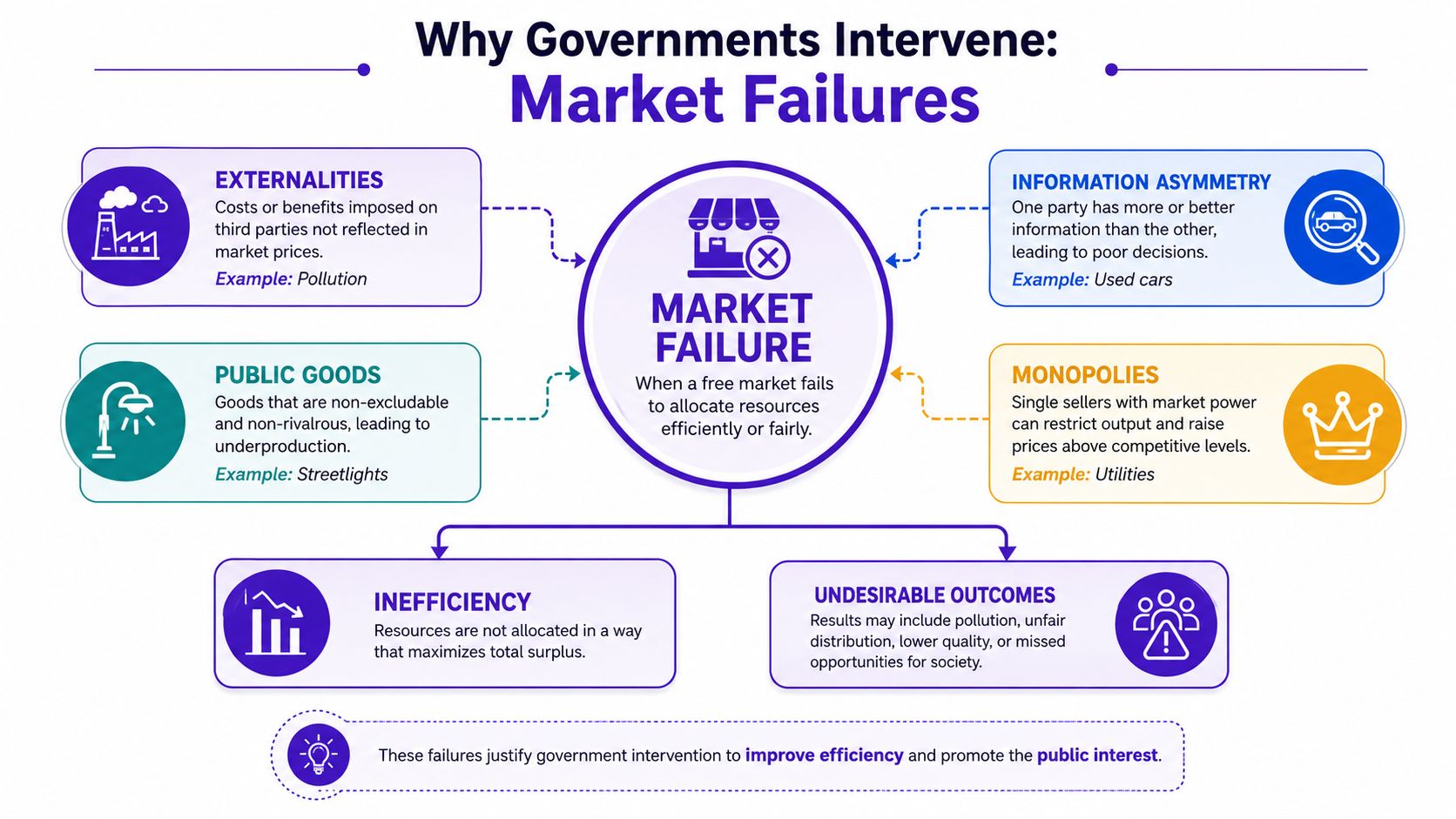
The core reason governments intervene is market failure. That means the free market doesn't allocate resources efficiently, so society gets too much of some things, too little of others, or a very unfair outcome.
Externalities
An externality happens when a decision affects someone who isn't directly involved in the transaction.
If a factory dumps waste into a river, the firm might avoid paying for proper disposal. That lowers the firm's private costs, but local residents and wildlife carry the damage. Economists call that a negative externality. The market price is too low compared with the true social cost, so too much gets produced.
A positive externality is the opposite. Education is the classic one. A student gains private benefits from learning, but society gains too. A better-skilled workforce can improve productivity and decision-making. Left alone, the market may underprovide it because buyers only consider their own benefit.
Public goods and information gaps
Some goods are difficult for private markets to provide because people can use them without paying. Streetlighting is the classic example. Once it's there, one person using it doesn't stop another person using it, and it's hard to exclude non-payers. That makes it a public good, so the government often provides it directly.
Then there's information asymmetry. One side in the market knows more than the other. Used cars are the textbook example. If buyers can't tell a reliable car from a bad one, they may become unwilling to pay a fair price. That can drag down the whole market.
A quick exam memory grid helps here:
| Market problem | Typical result | Common intervention |
|---|---|---|
| Negative externality | Overproduction | Tax, regulation |
| Positive externality | Underconsumption | Subsidy, state provision |
| Public good | Underprovision | Government provision |
| Information asymmetry | Poor choices, mistrust | Regulation, information rules |
| Monopoly power | Higher prices, less choice | Competition policy, regulation |
Monopoly and equity
Governments also step in when firms gain too much market power. A monopoly can restrict output, charge higher prices, and reduce consumer choice. In essays, this gives you another route into intervention beyond externalities.
The final reason is equity. A market outcome can be efficient in a narrow economic sense and still feel unacceptable. If income and opportunity are heavily uneven, governments may use taxes, benefits, or spending programmes to reduce inequality.
That matters because recent UK analysis found a harsh problem. A 2024 report found interventions and investment avoided the most deprived 20% of local areas, helping explain why inequality reduction has failed over a long period, as discussed in New Start Magazine's report on UK inequality. That's a useful evaluation point in essays. Intervention isn't automatically effective just because the intention sounds fair.
Markets can fail. Governments can also target the wrong places. High-mark answers usually recognise both.
The Toolkit Part 1 Taxes and Subsidies
Taxes and subsidies are two of the most examined forms of government intervention because they work so neatly with supply and demand diagrams.
How to analyse an indirect tax diagram
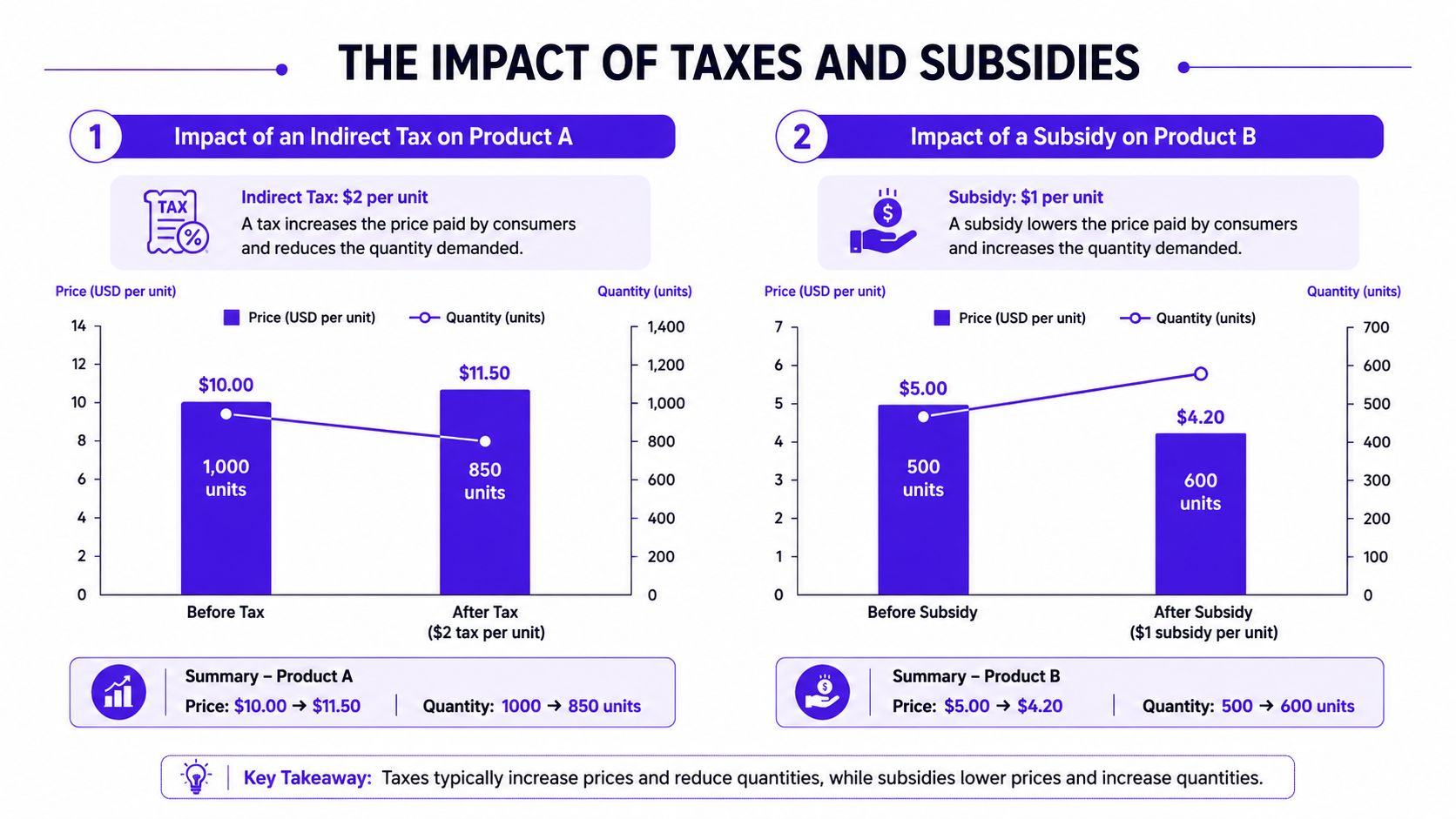
An indirect tax is a tax on spending. In a diagram, you normally show it as an upward or leftward shift of the supply curve because the tax raises firms' costs.
Follow this sequence in the exam:
- Start at the original equilibrium where demand meets supply.
- Shift supply left to show the tax.
- Mark the new equilibrium.
- Show that consumer price rises.
- Show that producer revenue per unit falls, because firms receive the market price minus the tax.
- Show quantity falls.
That gives you analysis marks because you've built a chain of reasoning. Tax raises cost. Supply contracts. Price to consumers rises. Quantity falls.
The gap between what consumers pay and producers receive is the tax per unit. That leads to tax incidence, which means who really bears the burden. If demand is inelastic, consumers take more of the hit. If demand is elastic, producers may carry more of it.
What examiners want from your paragraph
A weak answer says, “tax increases price and lowers demand.”
A stronger one says:
The tax shifts supply left because firms face a higher cost per unit. This raises the market price and lowers equilibrium quantity. As a result, consumers buy less of the demerit good, which can reduce the welfare loss caused by overconsumption.
That's analysis, not just description.
A lot of students also forget deadweight loss. This is the loss of welfare from trades that no longer happen after the tax. On a diagram, it's the welfare triangle between the old and new quantities.
Later on, if you want extra practice with question styles and mark schemes, these AQA, Edexcel, OCR, WJEC study guides are useful because they force you to apply the diagram rather than just memorise it.
How a subsidy works
A subsidy is money from the government to producers or consumers to encourage production or consumption. In diagrams, it shifts supply right if producers receive it.
That usually leads to:
- Lower prices for consumers
- Higher effective revenue for producers
- Higher quantity bought and sold
This is why subsidies are often used for merit goods or activities with positive externalities, such as greener production or training.
Here's a simple comparison:
| Policy | Supply effect | Consumer price | Quantity | Common use |
|---|---|---|---|---|
| Indirect tax | Left shift | Rises | Falls | Demerit goods, negative externalities |
| Subsidy | Right shift | Falls | Rises | Merit goods, positive externalities |
A short explainer can help if diagrams still feel slippery:
Real-world judgement
You'll often hear discussion around policies such as the sugar tax when studying taxes on demerit goods. The exam skill isn't memorising one news story. It's judging whether a tax changes behaviour enough, whether demand is price elastic, and whether low-income households are affected more heavily.
That's where wider reading helps. This piece on tax policy for growth is useful for thinking about the trade-off between raising revenue, changing behaviour, and protecting efficiency.
The Toolkit Part 2 Regulation and Price Controls
Taxes change incentives through prices. Regulation changes behaviour more directly. The government can ban, limit, require, or enforce.
That might mean age restrictions on alcohol sales, safety rules for food, or environmental standards for firms. In economics terms, regulation is often used when policymakers think prices alone won't fix the problem quickly enough.
Price ceilings
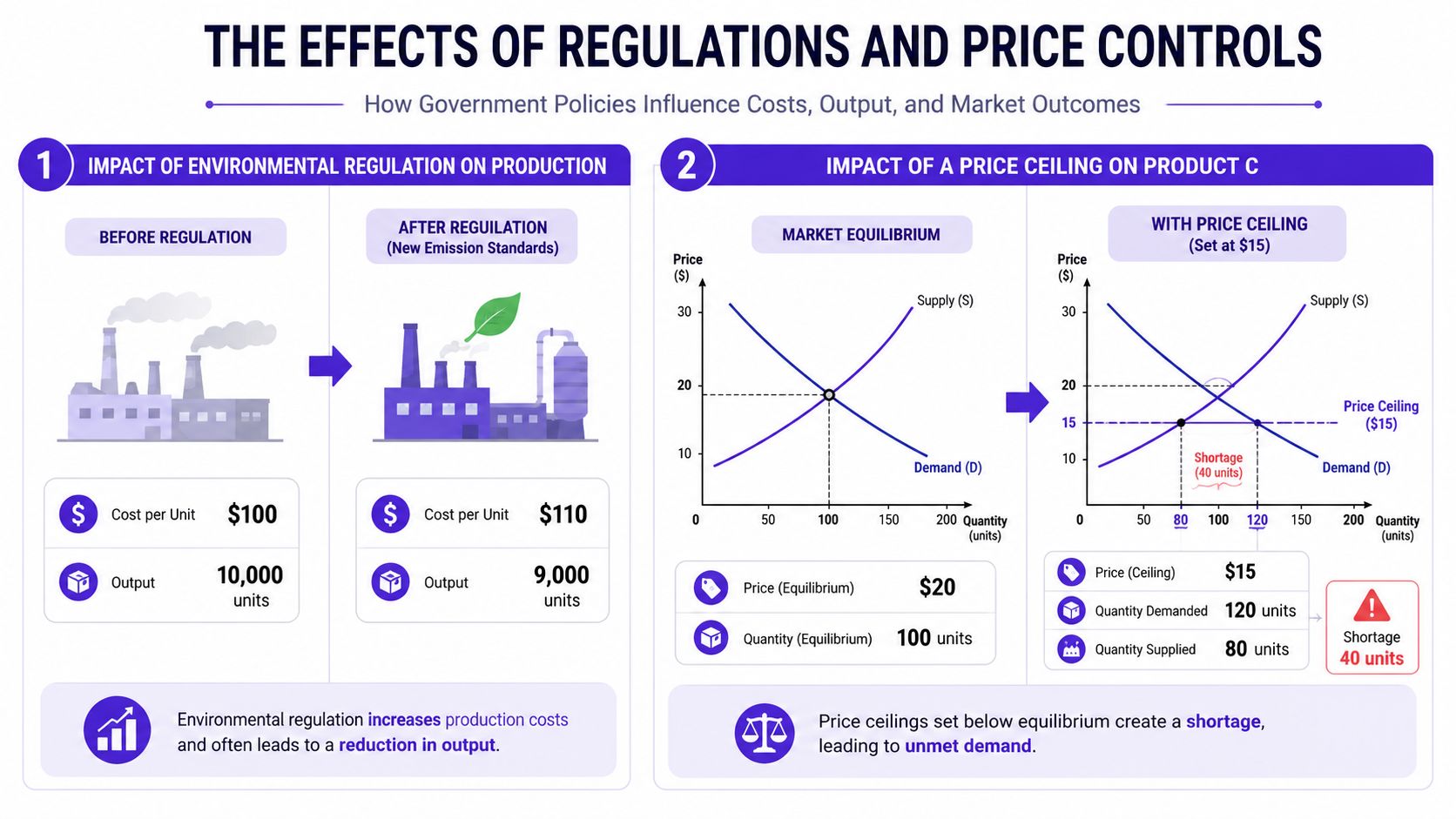
A maximum price or price ceiling is a legal upper limit on price. Governments use it when they think the market price is too high.
The classic diagram logic is:
- price ceiling set below equilibrium
- quantity demanded rises
- quantity supplied falls
- shortage appears
That shortage matters. A lower price sounds great for consumers, but if suppliers don't want to produce as much at that price, there may be queues, rationing, or reduced quality.
A strong evaluation paragraph doesn't stop at “shortage.” It asks what happens next. Do firms leave the market? Does quality fall? Does the policy help all consumers equally, or mainly the ones who get access first?
Price floors
A minimum price or price floor is a legal lower limit on price. Wages are the easiest example to remember. If the government sets a minimum wage above the market equilibrium for some low-skilled labour, the textbook result is excess supply of labour, which means unemployment.
Here's the chain:
- Wage is pushed above equilibrium.
- More workers are willing to work at that wage.
- Some firms hire fewer workers because labour is now more expensive.
- Labour supply exceeds labour demand.
That's your diagram story. But evaluation matters. If employers value better staff retention, productivity, or morale, the fall in employment may be smaller than the simple model predicts.
Exam shortcut: for any price control, always ask who gains, who loses, and what happens to quantity.
Regulation versus state provision
Not every intervention means controlling private firms from the outside. Sometimes the government provides the good itself.
State education and the NHS are the standard examples. The reason links back to market failure and equity. If these services were left entirely to the market, some people would be priced out, and society might get too little consumption of goods with large social benefits.
A short comparison helps keep the options distinct:
| Tool | What the government does | Main aim |
|---|---|---|
| Regulation | Sets rules or restrictions | Limit harmful behaviour |
| Price ceiling | Caps price | Improve affordability |
| Price floor | Sets minimum price | Protect incomes or producers |
| State provision | Produces or funds the service directly | Increase access and equity |
The tricky evaluation point
The strongest answers don't pretend regulation is costless. Firms may face higher compliance costs. Governments may struggle to monitor everything. Rules can also be too blunt. One standard applied to every firm may ignore big differences in technology, size, or local conditions.
That issue appears in wider debates about infrastructure too. Analysis of the UK's levelling-up and infrastructure agenda has pointed to weak decision-making and poor differentiation between places, as discussed in the Town and Country Planning Association journal. For A-Level evaluation, that's gold. Intervention can be justified in theory but still badly designed in practice.
Modern Strategies for Intervention
A-Level essays get stronger when you move beyond the basic toolkit and show that intervention doesn't always mean a simple tax or regulation. Some policies try to use market incentives rather than fight against them.
Tradable pollution permits
A tradable pollution permit system works by setting a limit on total pollution and then allowing firms to buy and sell permits. A cleaner firm that can cut emissions cheaply may reduce pollution and sell spare permits. A dirtier firm that finds cuts expensive may buy permits instead.
That creates a market in the right to pollute. It sounds odd at first, but the logic is smart. The government controls the overall cap, while the market helps decide where reductions happen most cheaply.
This often gives you a sharper evaluation line than basic regulation:
- regulation tells every firm what to do
- permits allow flexibility
- firms have an incentive to innovate if cleaner production saves them money
Industrial strategy
Some intervention is much broader. Instead of fixing one market failure, governments try to shape the direction of the economy. That's industrial strategy.
The UK government's 10-year Industrial Strategy and National Wealth Fund aim to trigger over £70 billion in private investment, according to the UK government's economic growth mission page. That's a useful case study because it shows intervention as long-term coordination, not just short-term correction.
The same policy area also includes targeted social infrastructure. The Affordable Homes Programme received an additional funding boost and reached a higher annual budget, showing how intervention can target housing supply and distribution as well as pure growth.
Why this matters in the exam
A lot of middling answers treat intervention as a menu of separate tools. Better answers see a deeper question. What kind of state is being used here?
Sometimes the state corrects a price signal. Sometimes it sets a rule. Sometimes it invests directly. Sometimes it creates a new market and lets firms respond within that framework.
If you struggle to judge your own written analysis on questions like that, automated exam marking can be handy because it shows whether you've stayed descriptive or built evaluation.
Evaluating Intervention The Good The Bad and The Ugly
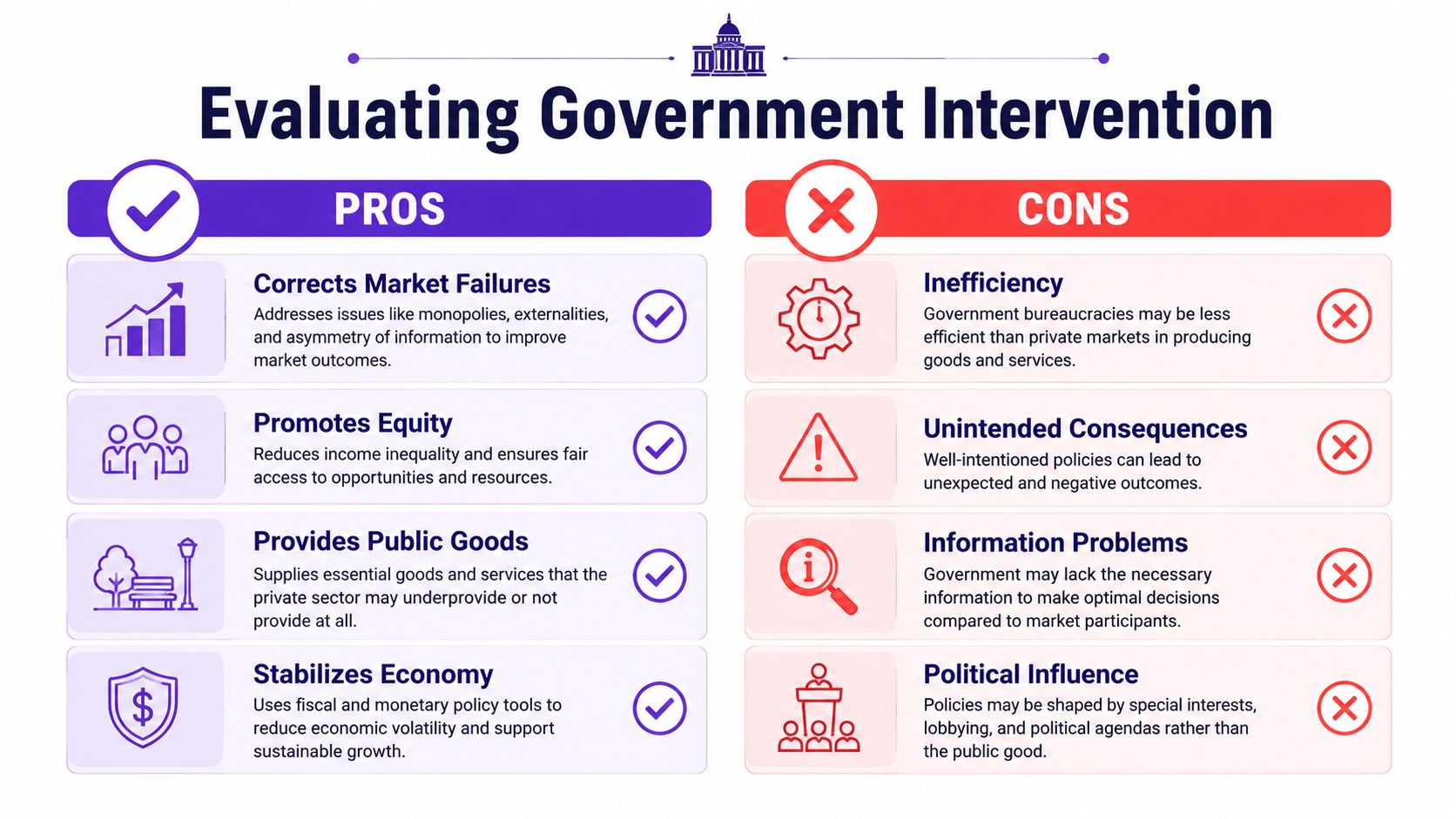
Top grades don't come from saying intervention is good or bad. They come from judging when, why, and under what conditions it works.
The good
Intervention can correct market failure, support vulnerable households, and stabilise the economy during shocks.
The clearest UK example is the pandemic response. Government support through schemes such as the Coronavirus Job Retention Scheme and business lending support reduced the share of UK SMEs reporting negative earnings and extended the survival time of cash-burning firms, according to the COVID support study on UK SMEs. That's exactly what intervention is supposed to do in a crisis. It prevents temporary disruption turning into permanent collapse.
The bad
Intervention can also be expensive, clumsy, and politically distorted. Governments don't have perfect information. They may target the wrong problem, act too slowly, or create side effects they didn't intend.
Government failure is a relevant point. The state may try to fix market failure and end up making welfare worse. Administrative costs, poor incentives, lobbying, and weak forecasting all fit here.
If you want a neat way to think about evidence and causation in policy debates, this piece on econometric analysis explained helps with the logic behind testing whether a policy really caused the outcome people claim.
The ugly
Sometimes intervention is not just inefficient. It can deepen existing problems.
The sharpest contrast in UK policy is between post-2010 austerity and pandemic support. The 2010 UK austerity programme reduced national output and cost the average household £4,000, while COVID support prevented negative earnings for 10% of UK SMEs and extended their survival by up to 55 days, as summarised in the UK government austerity programme overview. That's a dramatic reminder that intervention isn't one thing. Cutting public spending hard is also intervention. So is injecting emergency support.
A fuller evaluation point is worth making here. The austerity programme starting in 2010 was described as the most extensive deficit reduction effort in any advanced economy since World War II. It cut welfare spending, lowered local government funding, raised VAT from 17.5% to 20% in January 2011, and reduced spending on non-ring-fenced services including police, courts, and prisons. Critics argued it delayed recovery and damaged public capacity.
What to write in evaluation paragraphs
Use this structure when you're stuck:
| Step | What you do |
|---|---|
| Make a judgement | “This intervention may improve efficiency” |
| Add a condition | “if demand is responsive to price” |
| Weigh a drawback | “however, it may be regressive or poorly targeted” |
| Reach a conclusion | “so success depends on context and design” |
Good evaluation usually starts with “it depends” and then actually explains what it depends on.
That's what examiners reward. Not fence-sitting. Reasoned judgement.
Ace Your Exam Practice Questions and Model Answers
Knowing the theory is one thing. Writing under time pressure is another. Use these like a mini paper.
Question 1
Analyse how an indirect tax on a demerit good affects market equilibrium.
Model answer
An indirect tax increases firms' costs of production, so the supply curve shifts left. This causes the equilibrium price paid by consumers to rise and the equilibrium quantity to fall. Producers receive less per unit after tax than the price consumers pay, because the difference between the two is taken as tax revenue. If the good creates negative externalities, the fall in output may reduce overconsumption and move the market closer to the socially efficient level.
Why this scores
- AO1 identifies indirect tax, supply shift, and equilibrium effects.
- AO2 applies the idea to a demerit good.
- AO3 builds a chain of reasoning from tax to price to quantity to welfare.
Question 2
Evaluate whether subsidies are the best way to increase consumption of merit goods.
Model answer
Subsidies can be effective because they lower costs and can reduce the price paid by consumers, encouraging higher consumption. If a merit good creates positive externalities, this may increase social welfare by moving consumption closer to the socially optimal level.
However, subsidies are not always the best option. The government may subsidise the wrong activity or pay for consumption that would have happened anyway. This creates a fiscal cost and may reduce efficiency. In some cases, direct state provision or information campaigns may work better, especially where consumers lack knowledge rather than money.
Overall, subsidies can work well when price is the main barrier to consumption and the good generates strong external benefits. They are less effective when the issue is poor information, weak targeting, or administrative waste.
Why this scores
- AO1 defines subsidy and merit good.
- AO2 applies theory to positive externalities.
- AO3 explains likely effects.
- AO4 weighs alternatives and ends with conditional judgement.
Question 3
Evaluate the view that government intervention always improves economic outcomes.
Model answer
Government intervention can improve outcomes when markets fail. Taxes, subsidies, regulation, and state provision can reduce external costs, increase access to merit goods, and protect consumers. In severe shocks, intervention may also stabilise the economy and preserve firms that would otherwise fail for temporary reasons.
But intervention does not always improve outcomes. Governments may face information problems, political pressure, and administrative inefficiency. Policies can create unintended consequences such as shortages, unemployment, or weak incentives. UK evidence gives mixed results. Pandemic support helped many firms remain viable, while post-2010 austerity is widely criticised for reducing output and weakening public services.
The best judgement is that intervention is not automatically beneficial or harmful. Its success depends on policy design, timing, targeting, and the specific market failure involved.
Why this scores
- AO1 uses key concepts accurately.
- AO2 applies them to UK policy.
- AO3 explains mechanisms clearly.
- AO4 reaches a balanced, supported conclusion.
For timed practice, especially if you want familiar exam wording, working through A-Level Past papers is one of the fastest ways to turn this topic from “I sort of get it” into marks on the page.
If you want revision that feels like the exam itself, MasteryMind is built for that. It gives UK students examiner-style practice, AO-linked feedback, adaptive quizzes, essay support, and past-paper style questions across major exam boards, so you can tighten weak topics like government intervention before they cost you marks.
Ready to master this topic?
Practise with quizzes, blurt exercises and exam questions on MasteryMind.
7 days Premium · Then free forever · No card, no charge