History a Level Essay Structure That Actually Scores
You've got forty-five minutes left, the question is sitting in front of you, and your mind has suddenly decided that every fact about the Cold War or the Reformation is equally important. You start writing what happened, hoping the argument will appear somewhere along the way. It usually doesn't. The examiner sees knowledge, but not enough control.
A reliable history A level essay structure gives that knowledge a job. It helps you answer the precise question, organise evidence, and show the assessment skills examiners are looking for. Whether you're rebuilding your confidence after under-preparing or pushing for the top grade, the aim is the same: make every paragraph prove something.
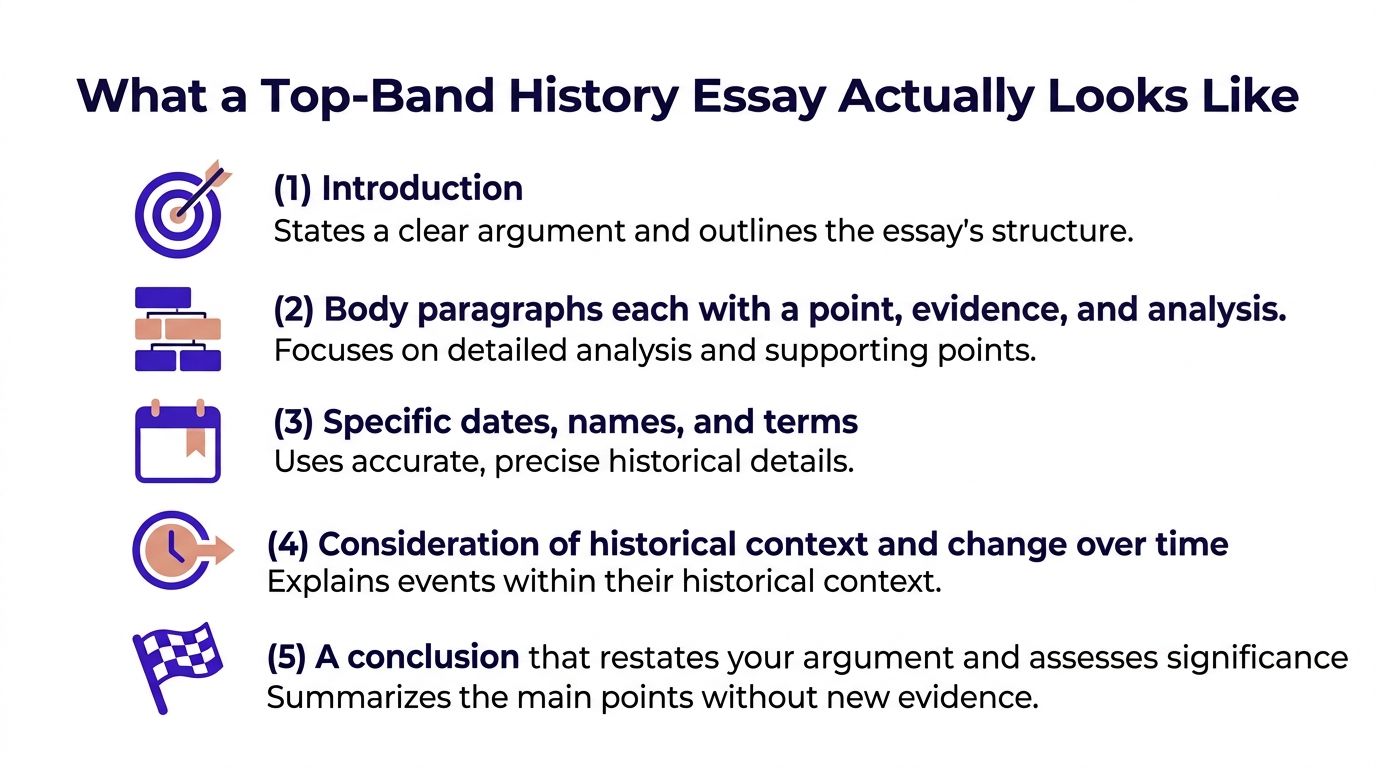
What a Top-Band History Essay Looks Like
A marker reading a top-band essay can identify its judgement early. The essay selects knowledge to prove that judgement, tests competing explanations, and ends by deciding how far the evidence supports the answer. Dates and names matter, but they are the bricks, not the building.
For AQA A-level History 7042, Section B essays are 25 marks each, and students answer two of three questions. Each question tests AO1 across a broad, coherent chronology covering a minimum of 20 years, as set out in AQA's scheme of assessment. A narrow account of one event cannot meet that demand. The argument must hold across the period, with relevant knowledge selected rather than everything remembered.
The qualification has a total scaled mark of 200, divided across Breadth Study, Depth Study and Historical Investigation. An essay is therefore a marks-based task, not a general piece of writing. Its structure should make your knowledge, analysis and judgement visible to the examiner.
Four features markers reward
A debatable argument appears early. The introduction must state what you think, rather than announce the topic. If the question asks whether economic problems caused unrest, answer their relative importance. A list of economic difficulties leaves the central judgement unanswered.
Every paragraph makes an analytical point. One paragraph might argue that religious belief mattered less than political opportunity. It should not just march through events year by year. Treat each paragraph as a case in the wider argument.
Evidence is woven into reasoning. A date, law, speech or historian earns its place when you explain what it shows and why it supports, qualifies or challenges the paragraph's claim. Knowledge without that explanation sits beside the argument instead of doing work for it.
The conclusion reaches a judgement. Weigh the factors and answer the question's wording. Repeating the introduction is not enough. The final paragraph should make clear which factor mattered most, or how far the stated view is convincing.
Practical rule: Keep a sentence if it supplies evidence, explains evidence, compares factors or sharpens your judgement. Cut it if it does none of those jobs.
Across the UK boards, the assessment objectives vary in emphasis and wording, but the underlying demand is similar. Use AO1 knowledge, AO2 analysis and evaluation of historical interpretations or sources, and AO3 argument and judgement where the paper requires them. Students seeking a more organised route into history exam preparation for A-Level can practise this structure until each paragraph has a clear purpose.
Writing an Introduction That Earns Marks Fast
Your first five minutes should prevent the blank page from controlling you. Read the question twice. Circle the command word, such as how far, how important, how accurate or to what extent. Underline the precise topic and identify the time period or factors being tested.
Then write a one-sentence answer before you begin the full introduction. This is your working thesis. It can change as you write, but it gives every paragraph a direction.
A dependable four-sentence formula
- Context sentence: establish the relevant situation without beginning a long narrative.
- Scope sentence: clarify what the key term or period means in this question.
- Line of argument: answer the question and state your overall judgement.
- Roadmap: identify the themes or factors you'll test.
Take this question:
How accurate is it to say the Cold War was caused by misperception?
A weak opening might look like this:
After the Second World War, the United States and the Soviet Union became rivals. The USA had capitalism and the USSR had communism. There were disagreements about Poland, Germany and Eastern Europe. The Truman Doctrine was introduced, and the Marshall Plan followed. Later, tensions increased through the Berlin Blockade.
This isn't useless knowledge, but it's a chronology. It doesn't define misperception, compare it with other causes or state how important the factor was.
A stronger version would make the argument visible immediately:
The Cold War developed from growing conflict between the United States and the Soviet Union after 1945, particularly over the future of Europe. Misperception means that each side interpreted the other's defensive actions as evidence of aggressive expansion. Misperception was important because it intensified existing ideological and security tensions, but it wasn't the fundamental cause, since competing aims in Eastern Europe and Germany created the conditions for distrust. The argument is strongest when misperception is treated as an accelerant, alongside ideology, security concerns and the breakdown of wartime cooperation.
The second introduction gives the examiner a position to test. It doesn't claim that every factor mattered equally, and it doesn't waste space retelling the whole Cold War.
| Sentence | Weak Intro, narrative | Strong Intro, analytical |
|---|---|---|
| Context | The USA and USSR became rivals after 1945. | Conflict grew from disagreements over the post-war settlement in Europe. |
| Scope | There were problems over Poland and Germany. | Misperception means interpreting the other power's defensive actions as aggressive. |
| Argument | The Cold War was caused by several things. | Misperception intensified tensions, but competing security and ideological aims created the deeper conflict. |
| Roadmap | The Truman Doctrine and Marshall Plan followed. | The essay will test misperception against ideology, security concerns and the collapse of cooperation. |
What to avoid
Don't open with “Since the dawn of time” or a sweeping statement about human nature. Don't quote a dictionary. Don't spend the entire introduction moving through the period in order. Markers skim introductions, so your argument needs to land within the first few sentences.
The introduction doesn't need to contain every fact you know. It needs to tell the examiner what your essay will prove and how you'll prove it.
Body Paragraphs Using PEA and PEEL the Right Way
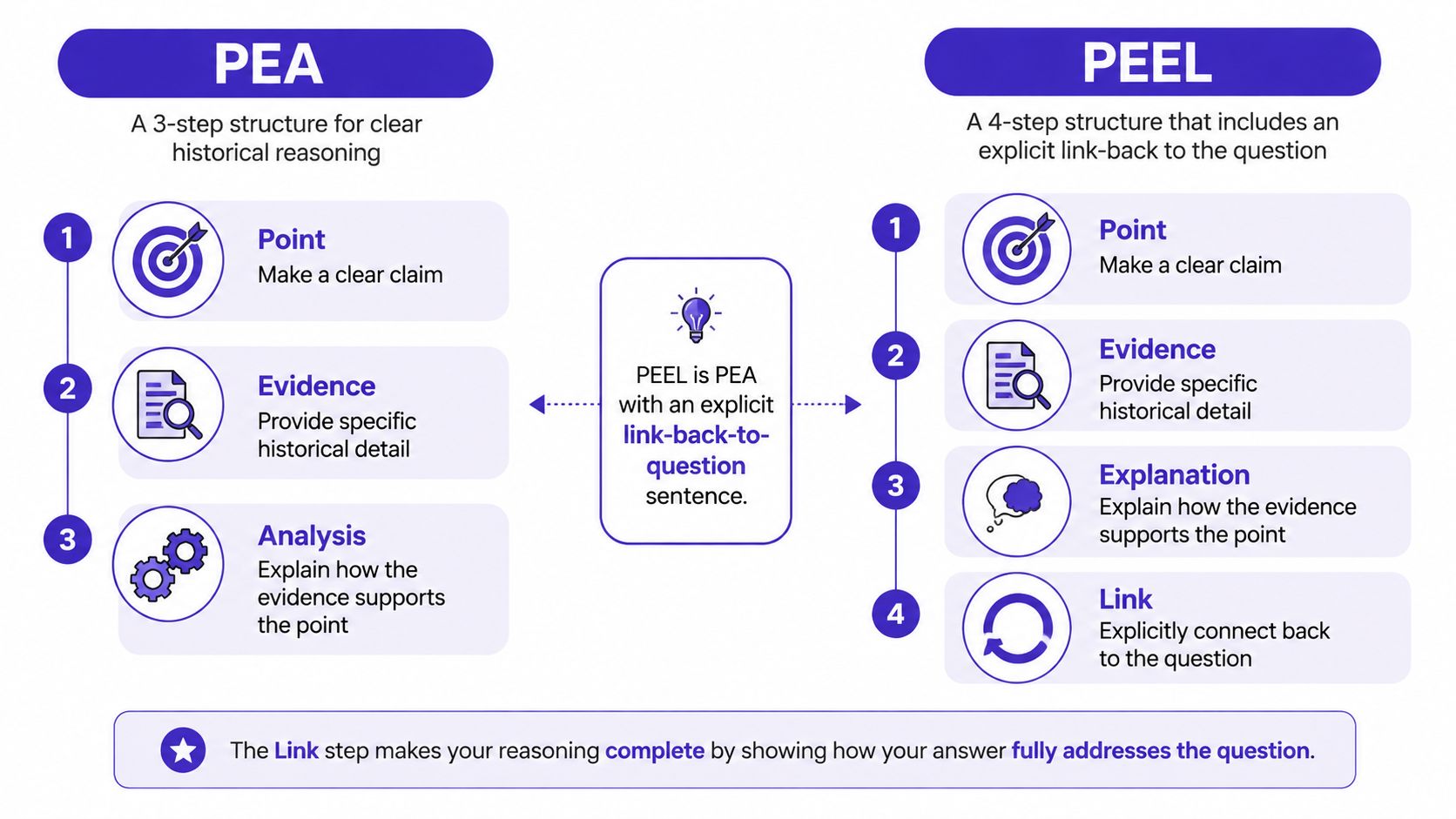
PEA means Point, Evidence, Analysis. PEEL means Point, Evidence, Explanation, Link. In practice, PEEL is PEA with an explicit sentence connecting the paragraph back to the question.
| Structure | What it does | The question to ask yourself |
|---|---|---|
| Point | Makes a specific claim | What factor or argument am I advancing? |
| Evidence | Supplies precise knowledge | Which event, policy, person or interpretation proves this? |
| Analysis or Explanation | Shows why the evidence matters | How does it support my point? |
| Link | Returns to the exact question | What does this mean for my overall judgement? |
The analysis stage is where marks are commonly won or lost. If you write, “Luther published the ninety-five theses in 1517, which challenged indulgences,” you've supplied relevant knowledge. You haven't yet explained how that evidence answers a question about starting the Reformation.
Consider this question:
How important were Luther's ninety-five theses in starting the Reformation?
A worked paragraph
Luther's ninety-five theses were important because they turned criticism of indulgences into a public challenge to Church authority. Published in 1517, the theses questioned the spiritual value of purchasing indulgences and challenged the assumptions behind Tetzel's preaching. Their importance, however, came less from the original academic debate than from the way printing and political protection allowed Luther's criticisms to circulate beyond Wittenberg. This meant that a dispute about indulgences became connected to wider resentment of papal authority and the interests of German princes. As historian Euan Cameron argues in his work on the European Reformation, Luther's protest needs to be understood within broader religious and political developments rather than as an isolated event. The theses were therefore a significant starting point, but they became historically transformative because other conditions enabled their message to spread and survive.
The first sentence is the Point. It gives the paragraph a clear claim rather than beginning with a date. The second and third sentences provide Evidence and begin the analysis. The explanation then shows how printing, political protection and existing resentment expanded the impact of the theses.
The historian reference isn't decoration. It sharpens the debate by supporting the interpretation that Luther's actions mattered within a wider context. The final sentence is the Link because it answers the question about importance and qualifies the judgement.
For more practice with paragraph planning, a A-Level study guides platform can help you turn a topic into points, evidence and analysis before you write.
Two errors to remove
Explaining the evidence instead of using it happens when a student describes an event in detail but never connects it to the argument. Ask, “So what?” after every major piece of knowledge.
Ending with a quotation is another common problem. A quotation can support your paragraph, but it shouldn't be the final word. End with your own analytical judgement about the question.
Matching Your Paragraphs to AO1, AO2 and AO3
The assessment objectives sound technical, but you can translate them into three practical jobs.
AO1 is the factual core. You select accurate, relevant knowledge and use it to support an argument. It isn't a memory dump. A precise example only helps if it answers the question.
AO2 is the reasoning. You explain causation, consequence, change, continuity, similarity, difference or significance. You show why one factor mattered more, why an event changed the situation, or why continuity limits an argument.
AO3 is interpretation and judgement. You engage with historians or interpretations where the question requires it, and you weigh competing views rather than naming scholars as ornaments.
A strong body paragraph might move like this:
- AO1: State a factual claim and provide specific supporting detail.
- AO2: Explain the relationship between that detail and the question.
- AO2 again: Compare the factor with another cause or assess its limits.
- AO3: Use a historian's position to deepen the debate.
- AO3 conclusion: Make a measured judgement about the factor's importance.
AQA's assessment objectives show that AO1, AO2 and AO3 are all used across the qualification. In the AS scheme, AO1 carries 50% overall, while AO2 and AO3 each carry 25%. The exact distribution varies across A-level components and examination papers, so you need to check your own specification rather than applying one formula blindly. (StudyVector's AO guide)
| Board | AO1 % | AO2 % | AO3 % |
|---|---|---|---|
| AQA | 50% in the AS scheme | 25% in the AS scheme | 25% in the AS scheme |
| Edexcel | Check the paper-specific specification | Check the paper-specific specification | Check the paper-specific specification |
| OCR | Check the paper-specific specification | Check the paper-specific specification | Check the paper-specific specification |
| WJEC | Check the paper-specific specification | Check the paper-specific specification | Check the paper-specific specification |
What markers dislike
An unsupported assertion sounds like this: “This was the most important reason.” The sentence makes a judgement but provides no comparison or proof.
A historian dropped in for decoration sounds like this: “Historian A says this, while Historian B says that.” Unless you explain why one interpretation is more convincing, the names haven't improved the argument.
A conclusion that merely restates the essay also misses the point. Judgement means deciding why a factor mattered, how far it mattered and what limited its importance.
How AQA, Edexcel, OCR and WJEC Structure Differ
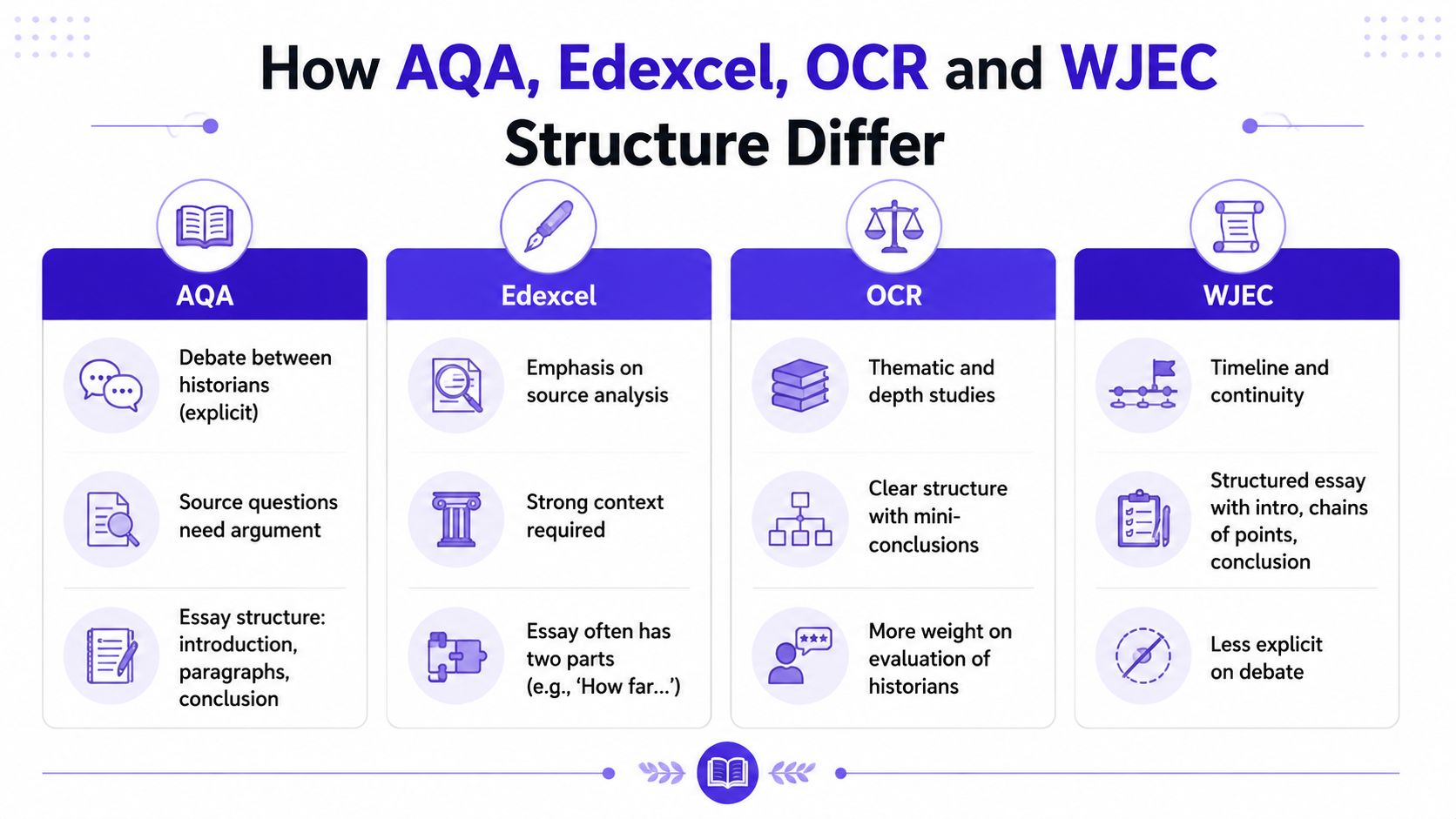
A student can write a well-informed essay and still lose marks by using the wrong shape for the question. The shared habits are clear argument, relevant knowledge and sustained evaluation, but each board places emphasis differently. Treat the paper's assessment objectives and mark scheme as the blueprint, not as a suggestion.
AQA
AQA includes a compulsory Section A question on historical interpretations, worth 30 marks, followed by Section B essay questions worth 25 marks each, with students answering two from three. (The published assessment instructions)
For an interpretation question, explain the view, test it against precise own knowledge, consider the alternative, and reach a supported judgement. The interpretation should act like a lens through which you examine the evidence. A detached paragraph that names a historian will not show evaluation.
Edexcel
Edexcel rewards accurate explanation and assessment of the claim in the question. Words such as how far and assess require comparison, so each paragraph should establish not only why a factor mattered, but also how its importance compares with other factors.
Keep evidence selective. A short paragraph containing precise knowledge and clear analysis will score more reliably than a longer narrative that leaves the question behind. Use the wording of the stem throughout, so the examiner can see the judgement developing rather than appearing only in the conclusion.
OCR
For interpretation essays, OCR's guidance recommends a four-paragraph structure. Start by explaining both interpretations and locating the debate in its wider context. Evaluate Interpretation A with own knowledge, then apply the same test to Interpretation B. End with a balanced judgement about which view is more convincing and why. (OCR's assessment guide)
OCR guidance also warns against descriptive, irrelevant or weakly judged writing. Long answers do not automatically gain more credit. Keep every paragraph tied to the question and make the comparison between interpretations explicit. (Pass History Exams' structure guidance)
WJEC
WJEC essays need a controlled introduction, a connected sequence of relevant points and a decisive conclusion. Put accurate factual knowledge into the topic sentence, then explain its significance. Chronology can organise the material, but it must support the argument rather than become a timeline.
| Board | Structural adjustment |
|---|---|
| AQA | Make interpretation debate and source use explicit. |
| Edexcel | Keep explanations precise and compare the factors named by the question. |
| OCR | Use the required interpretation structure when the question calls for it. |
| WJEC | Combine secure factual recall with a clear analytical chain. |
Your teacher's mark scheme remains the final authority. Use mark schemes for revision to compare your paragraphs with the assessment language for your board and paper.
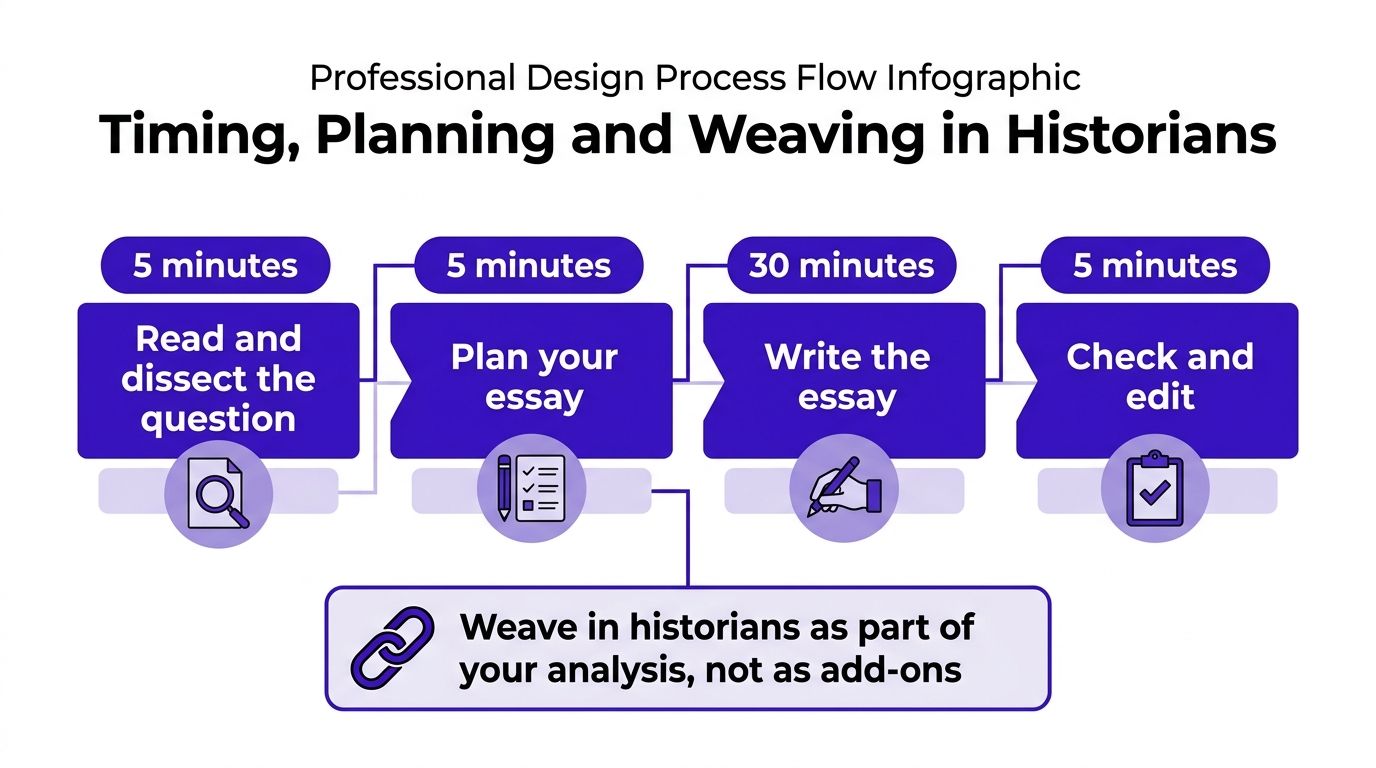
Timing, Planning and Weaving in Historians
A typical 45-minute essay slot can be divided into roughly 5 minutes reading and dissecting the question, 5 minutes planning, 30 minutes writing and 5 minutes checking. (MyTutor's A-level structure guidance) Treat those minutes as a working routine, not a rigid law. If your introduction takes too long, the conclusion will suffer.
Write this compact plan in the margin:
- Question keywords: circle the command word and underline the topic.
- Line of argument: write one sentence answering the question.
- Theme paragraph one: point, evidence, analysis, historian.
- Theme paragraph two: point, evidence, analysis, historian.
- Theme paragraph three: point, evidence, analysis, historian.
- Optional fourth paragraph: use it only if it adds a distinct factor.
- Conclusion sentence: decide which factor mattered most and why.
Historians should do a job
Use one named historian in a paragraph when that reference opens a debate or strengthens your evaluation. Don't list several names in one sentence. “Historian A agrees with Historian B” is not analysis unless you explain what their agreement reveals and whether their interpretation fits the evidence.
You can bring a second or third historian into the conclusion if they help you escalate the judgement. For example, one historian might explain a development through ideology, while another stresses political calculation. Your conclusion can decide which explanation accounts for more of the evidence and why.
A historian's name is useful only when it changes the quality of your judgement.
If time is running short, cut repetition first, not analysis. Abbreviate the weakest paragraph if necessary, but protect the introduction, your strongest evidence and the conclusion. If you've started slowly, make your second paragraph your strongest one, then use its argument to establish momentum.
Teachers may also find a separate resource on novel planning and structure useful when helping students make planning visible before they write. For timed practice, Exam Practice for A-Level can provide a focused setting for testing the routine under pressure.
A Final Checklist You Can Use in Every Essay
Use this checklist during planning, writing and the final check:
- Restate the question: Put the issue into your own words so you know exactly what you're answering.
- Write the argument: Give a direct answer to the command word in the introduction.
- Plan themed points: Choose three to five distinct factors or lines of reasoning.
- Select evidence: Use precise knowledge that proves the point, rather than everything you remember.
- Analyse each example: Explain causation, consequence, change, continuity, similarity, difference or significance.
- Use historiography purposefully: Place historians inside your strongest analytical paragraphs, not in a detached name list.
- Check AO1, AO2 and AO3: Make sure the essay contains knowledge, reasoning and evaluation where the paper requires them.
- Judge the factors: Compare importance and explain why one factor carries greater weight.
- Finish the answer: End with a conclusion that answers the question asked, without introducing a new point.
The silent mark-losers are predictable. Students drift from the wording, pad paragraphs with narrative, include a claim with no evidence, or write a summary instead of a judgement. You can prevent most of these errors by practising the checklist until it becomes a habit rather than something you remember only during revision week.
Write one timed essay this week using the plan, then mark every paragraph by underlining the point, boxing the evidence and circling the analysis. Any paragraph with no circles needs rewriting.
MasteryMind offers UK learners specification-aligned practice across AQA, Edexcel, OCR and WJEC, including History questions with examiner-style AO feedback and structured essay guidance. Visit MasteryMind to practise turning historical knowledge into focused arguments before your next timed essay.
Ready to master this topic?
Practise with quizzes, blurt exercises and exam questions on MasteryMind.
7 days Premium · Then free forever · No card, no charge