7 History GCSE Quiz Sources for Better Revision

You know some of the dates, names and turning points, but the facts disappear when a question asks you to explain significance or use a source. Or perhaps you're trying to recover your grade quickly, while your teacher needs proof that your revision reflects the actual GCSE rather than a random set of trivia questions. The right history GCSE quiz can help, but different tools solve different problems.
This list compares topic coverage, question depth, feedback, adaptive or spaced practice, classroom usefulness and access. MasteryMind is the most directly exam-focused option here, while the other sources are stronger for narrower jobs such as daily recall, teacher-set homework, scaffolded learning, games or free checks. Check your exam board and topic combination before starting, then use quizzes alongside written exam practice. Quizzes can expose gaps, but they can't replace source analysis, interpretation work or timed answers. Students looking for broader study support can also explore AI tools for students to study smarter.
1. MasteryMind
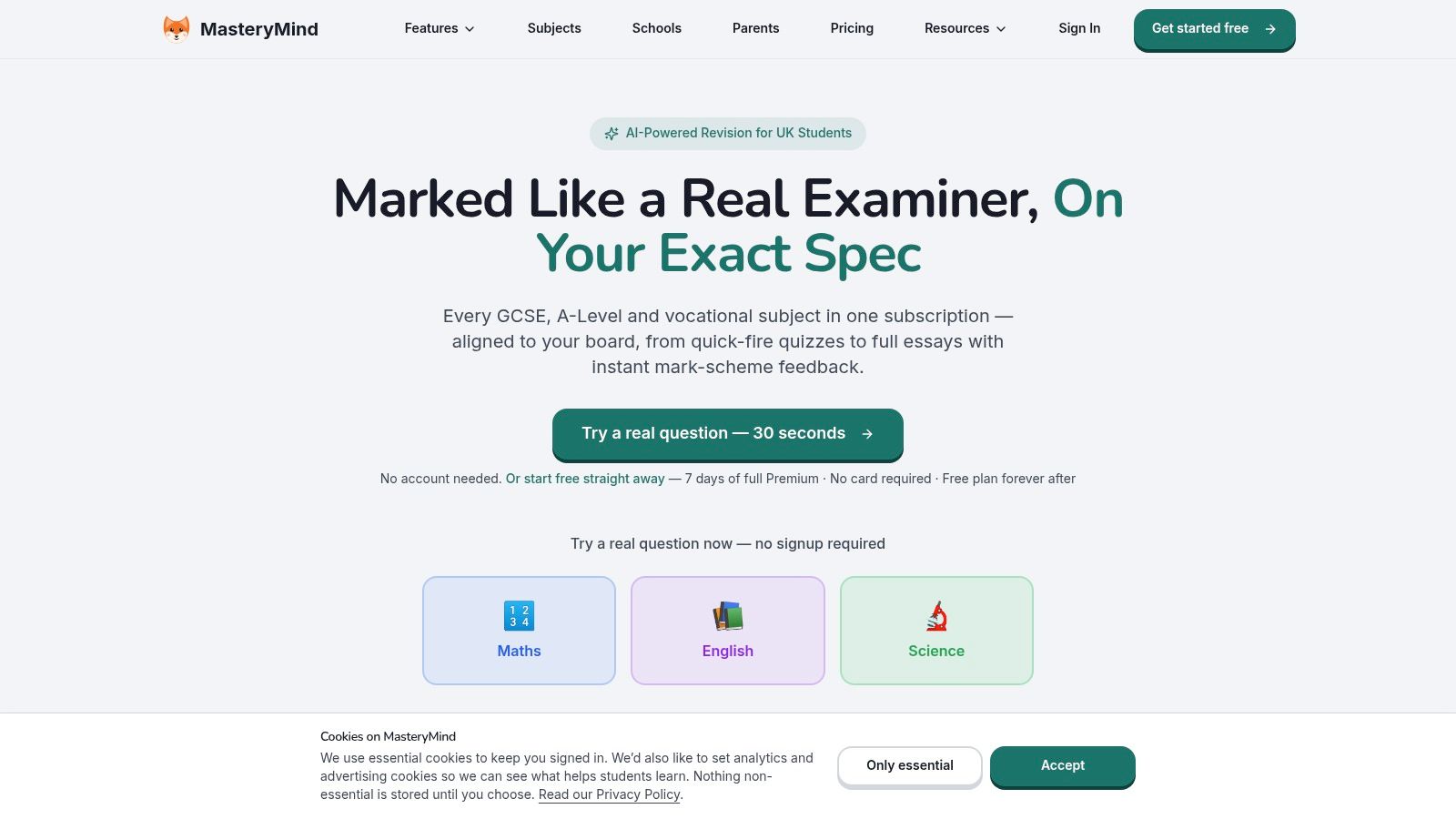
MasteryMind is the strongest choice in this comparison if you want a quiz to lead into real GCSE exam practice rather than stop at fact recall. It's an AI-powered revision platform for UK GCSE and A-Level learners, with History practice matched to specifications from AQA, Edexcel, OCR and WJEC. Questions, command words and mark allocations are designed to reflect the board and topic you're studying, so a question on causation, significance or interpretation has a clearer exam purpose than a generic online quiz.
The progression matters. Students can begin with quick recall, move into application and explanation, and work towards extended answers, including 24-mark essays where the relevant course structure supports them. Examiner-style feedback breaks performance down by assessment objective, highlights missing reasoning and identifies common pitfalls. That gives a student a more useful response than “correct” or “incorrect”. You can see whether the problem was missing knowledge, weak explanation, poor evaluation or an answer that didn't follow the command word.
Stronger practice after the quiz
MasteryMind combines adaptive sequencing with active recall, spaced review and mixed-topic practice. In practical terms, the platform can bring back a weak topic later instead of letting you move on after one lucky answer. The voice-powered Blurt Challenge also lets students explain what they know aloud, compare the response with specification objectives and generate follow-up questions.
Teachers and tutors get topic-level progress dashboards and mastery tracking, which makes it easier to identify whether a student needs to relearn content or practise writing. The platform also includes specialised tools for other subjects, such as a maths workspace, computer science task support, unseen-poetry practice and an essay editor. Its NEA Coach provides Socratic guidance and mark estimation without rewriting coursework or supplying direct solutions, which is designed to respect JCQ requirements.
Practical rule: Use the quiz result as a diagnosis. If you miss a question because you can't recall the fact, review it. If you know the fact but can't explain it, write or speak a short answer next.
There's a free plan, plus a 7-day full Premium trial with no card required. Premium provides deeper examiner-aligned practice and features such as NEA Coach. Current subscription prices and school licences aren't shown in the supplied product information, so check the MasteryMind website before choosing a paid plan. For a closer look at the format, use the MasteryMind practice quiz guide.
Best for: Students who want adaptive, board-aligned progression and teachers who need examiner-style feedback.
Watch out for: It won't produce finished coursework answers. That's a safeguard, but students who want instant model text will need teacher guidance as well.
2. Seneca Learning
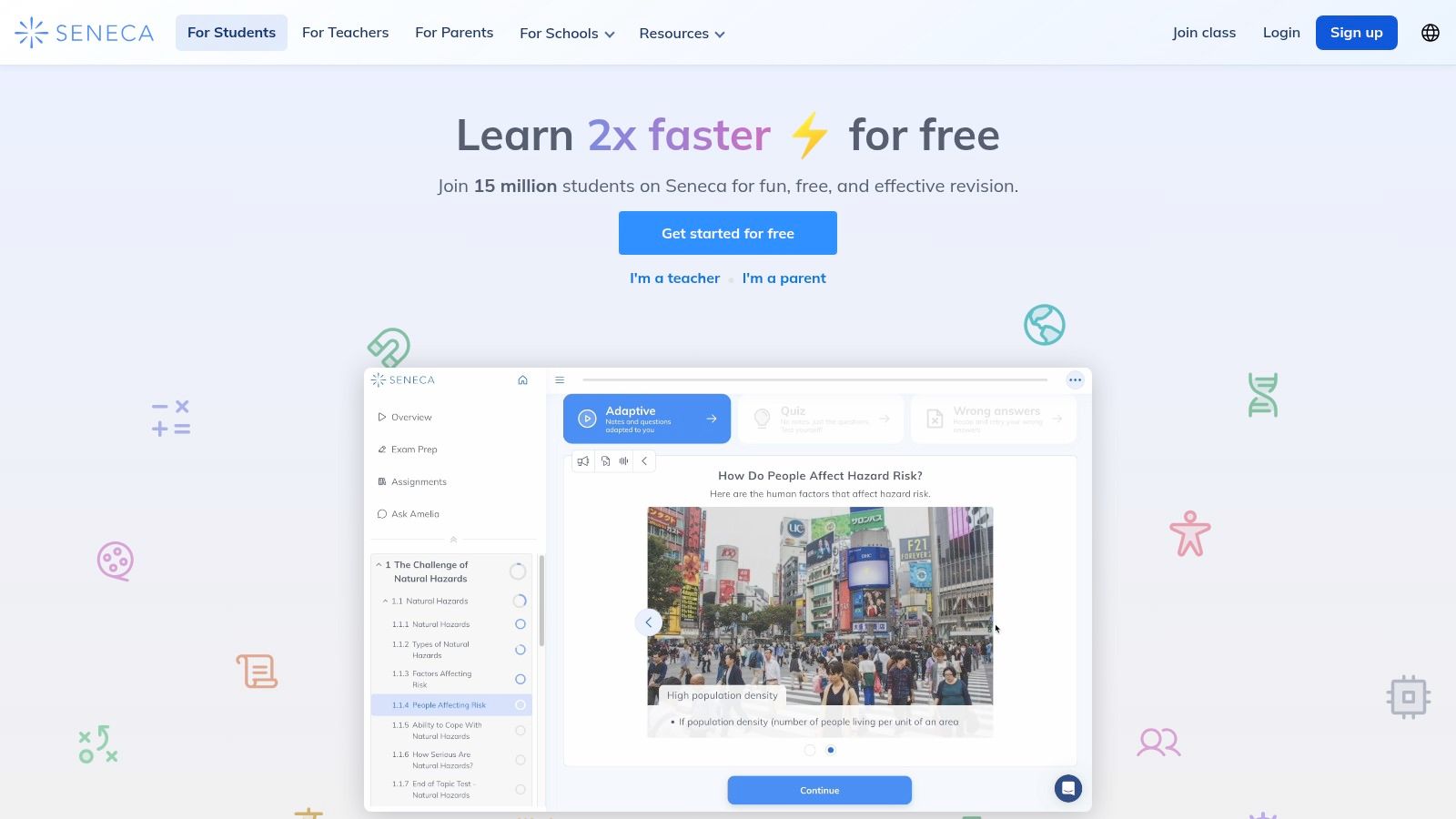
Seneca Learning suits students who need a guided course rather than a blank question bank. Its GCSE History courses combine short explanations with interactive, auto-marked questions, and students can revise independently or complete assignments set by a teacher. That structure is useful when you're not sure where to start, especially after falling behind and needing a clear route through a topic.
Teachers can set homework, view reports and use live games in class. Students who respond well to quick feedback may also like Magic Quiz and the platform's game modes. Premium adds features such as AI-marked exam answers, Smart Learning Mode and Predicted Papers, although the exact availability and terms should be checked before subscribing.
What it does well
Seneca's main advantage is ease of use. A teacher can assign a course without building every question from scratch, while a student can move through content in manageable steps. The free tier covers substantial material, making it a practical starting point for schools and families who want to test the routine before paying.
The limitation is depth. Some students may find that free courses contain relatively short reading sections and fewer questions than they want for intensive practice. Auto-marked recall is helpful, but it won't automatically prove that you can build a convincing explanation, evaluate a source or sustain an extended response. You'll still need written questions and mark-scheme review.
“A high score on a short quiz means you're ready for the next practice step, not that the whole topic is exam-ready.”
Board and topic matching still matter. Check the course title against your school's specification, then use Seneca for learning and retrieval before completing a proper exam-style answer. You can also read this MasteryMind vs Seneca Learning comparison if adaptive marking and exam feedback are your main priorities.
Best for: Accessible, course-based revision and teacher-set assignments.
Watch out for: Don't treat short auto-marked activities as a substitute for extended response practice.
Visit Seneca Learning to check the current GCSE History courses and teacher tools.
3. Educake
Educake is built around the school question-bank workflow. Its History offering includes thousands of auto-marked questions for AQA and Edexcel GCSE History, alongside KS3 content. A teacher can assign a quiz, students receive instant feedback, and the resulting data can support gap analysis and targeted intervention.
That makes Educake particularly useful when a department wants more than individual scores. If several students struggle with the same area, the teacher can identify the pattern and plan a short reteaching activity. If one student has a narrower gap, the department can set focused homework rather than repeating an entire unit.
Useful data for departments
Educake supports classes, school-wide administration and reporting. Question reuse also helps teachers create repeated checks without rebuilding every assignment. The published school pricing and straightforward setup may appeal to departments that need to plan costs and establish a consistent homework routine.
Students should understand what the tool is best at. Auto-marked questions are effective for checking knowledge and spotting omissions, but a correct answer doesn't necessarily show that you can explain a factor, analyse a source or compare interpretations. Teachers should pair Educake results with written work, especially where students need to practise command words and structure.
Educake's advertised History board coverage appears focused on AQA and Edexcel. If your class follows OCR or Eduqas, confirm availability before you build a revision plan around it. The same applies to option combinations. A quiz can be well written and still be irrelevant if it tests a different depth study.
Best for: School homework, departmental reporting and targeted intervention.
Watch out for: It's primarily a school subscription, and board coverage should be checked before assigning work.
You can review the Educake History platform for current course details, pricing and school features.
4. Tassomai
Tassomai is designed for students who struggle to revise consistently. Its GCSE History courses use short, adaptive quizzes and daily goals, so revision can fit into a short session rather than requiring a free afternoon. The app tracks progress and uses retrieval practice to bring knowledge back regularly.
That low friction is the attraction. A student who hasn't done enough revision may find it easier to complete a small daily target than to open a large textbook and decide what to study. The same routine can cover multiple GCSE subjects, not only History, which helps families managing a busy timetable.
Retrieval is only the first layer
Tassomai is strongest for dates, people, events, causes, consequences and other knowledge that needs regular recall. It's less suited to extended response practice. If you can identify the reason for the Norman Conquest but can't explain it in a developed paragraph, a micro-quiz may reveal the gap without giving you enough space to fix the writing skill.
Use the app as a daily foundation. After a session, choose one weak area and explain it aloud, create a causal chain or write a short exam paragraph. That extra step turns retrieval into preparation for application.
Tassomai offers school licences and family subscriptions. Its FAQs note a free trial, and a conditional grade-guarantee scheme is available for qualifying subscribers, subject to its terms. Family-plan pricing isn't listed on one public tariff page, so check the current offer before committing. This vs Tassomai review may help if you're comparing daily retrieval with broader adaptive exam practice.
Best for: Little-and-often revision and students who need a daily routine.
Watch out for: Pair it with written answers because its extended-response depth is limited.
Explore Tassomai History to check the current course and subscription options.
5. GCSEPod from Access Education
GCSEPod takes a more scaffolded approach. Students watch or listen to short topic “Pods”, then complete Check & Challenge quizzes that offer hints, explanations and feedback. That combination works well when a student doesn't just need to know that an answer is wrong, but needs support understanding why.
Teachers can assign Pods and quizzes, monitor improvement and use the wider content library through the mobile apps. A student might watch a short explanation on a difficult topic, attempt the related questions, then repeat the activity after reviewing the feedback. This makes GCSEPod useful for independent study that still connects to teacher-set work.
A gentler route into difficult topics
The scaffolding can help students who feel overwhelmed by long revision guides. Hints reduce the chance of giving up after the first mistake, while explanations give a route back into the content. Teachers can also use the platform as a starting point before asking students to complete a less-supported exam question.
There is a trade-off. GCSEPod is primarily school-licensed, and individual pricing isn't standard. Package costs vary by cohort size and school requirements, so departments need to request a quote. Students also shouldn't assume that completing a Check & Challenge quiz proves they can write a full answer under exam conditions. The tool supports understanding and recall, but written practice remains essential.
Best for: Scaffolded independent revision and schools that want assignments with built-in support.
Watch out for: Confirm the package and licence arrangements, then add unsupported source, interpretation and essay practice.
See the current GCSEPod History resources for information about content, school access and mobile use.
6. SchoolHistory.co.uk
SchoolHistory.co.uk offers a broad mix of GCSE topic courses, self-marking quizzes, revision games, past papers, worksheets and downloadable assessments. It's a good fit for students who lose concentration when every revision session looks the same. You might complete a quiz, switch to a game such as Penalty Shootout or Noughts & Crosses, then print a worksheet to organise the topic.
Teachers can use the site for classroom activities, homework and printable resources. Students can also work through courses with progress tracking and end tests. The mixture is valuable because History revision isn't only about clicking answers. A short quiz can check recall, while a worksheet or past paper shows whether that knowledge can be selected and used.
Flexible, but check the individual resource
SchoolHistory.co.uk has individual and school membership options with clearly presented plans. That makes access easier to judge than platforms that require a school quote. Some material sits behind a paywall, however, and free access is limited.
The site has been available for a long time, so the interface and presentation can vary between topics. Teachers should review the exact resource before assigning it, checking dates, terminology, board fit and question quality. Students should do the same, especially if their course includes a specific option code or an unusual combination of topics.
Best for: Mixed revision using quizzes, games, printable resources and past papers.
Watch out for: Resource quality and style can differ by topic, so preview materials rather than assigning them automatically.
Visit SchoolHistory.co.uk GCSE History courses and quizzes to compare the available memberships and topic resources.
7. Revision World
Revision World is the simplest option on the list. It provides free GCSE History topic pages and themed multiple-choice quizzes, and many activities can be used without creating an account. That makes it useful when you have a few minutes between lessons, want to check a topic before homework or need a no-cost starting point.
The navigation is straightforward. Pick a topic, answer the questions, note what you missed and return to the relevant notes. For a student trying to recover an exam grade, that first routine matters. You don't need a complex dashboard to discover that you can remember the event but not its consequence.
Keep the results in perspective
Revision World is less detailed than paid platforms and doesn't provide advanced analytics. Coverage and question depth vary by topic, so a high score should be treated as a quick knowledge check rather than a full judgement of exam readiness. It also won't replace teacher feedback on source evaluation, interpretations or extended writing.
Teachers can use the quizzes as a starter, exit ticket or low-pressure retrieval activity. Students can combine them with a notebook error log. Write down the question, the missing knowledge and the next action, such as relearning a fact, explaining a cause or writing a paragraph.
Best for: Free, quick retrieval practice without a login.
Watch out for: Use it as one part of a wider plan, because analytics and deeper exam-skill feedback are limited.
For more structured digital support after a free check, explore these AI History study tools. You can also access the Revision World GCSE History questions and quizzes directly.
7-Point Comparison: GCSE History Quiz Platforms
| Product | Implementation (🔄) | Resources & efficiency (⚡) | Expected effectiveness (⭐) | Ideal use cases (💡) | Key advantages (📊) | Access / Pricing |
|---|---|---|---|---|---|---|
| MasteryMind | High 🔄, complex AI marking, teacher dashboards and NEA workflows | Moderate–High ⚡, devices + teacher/admin setup; Premium features require subscription | High ⭐⭐⭐, exam‑board aligned practice, AO feedback, long‑term retention | Exam preparation, coursework coaching, whole‑school mastery tracking | Exam‑board AI marking, spaced review, interleaving, JCQ‑compliant NEA 📊 | Free plan + 7‑day Premium trial; full pricing/school licences via site/sales |
| Seneca Learning – GCSE History | Low–Moderate 🔄, easy classroom integration and teacher tools | Low ⚡, largely browser/mobile, substantial free content | Medium–High ⭐⭐, strong recall practice; Premium adds AI marking/predicted papers | Classroom assignments, independent revision, GCSE consolidation | Large content library, teacher reports, “Magic Quiz” and game modes 📊 | Free tier; Premium available (pricing not clearly published for consumers) |
| Educake – History | Moderate 🔄, teacher‑led homework workflows and class admin | Low–Moderate ⚡, school subscriptions, straightforward setup | Medium ⭐⭐, focused gap analysis and targeted intervention | Department homework, data‑driven intervention, KS3→GCSE transition | Detailed analytics, AQA/Edexcel question bank, reporting tools 📊 | School subscriptions with published school pricing; limited consumer plans |
| Tassomai – GCSE History | Low 🔄, minimal setup, micro‑quizzing routines | Very Low ⚡, quick daily sessions, low time investment | Medium ⭐⭐, effective for retrieval; limited extended‑response practice | Bite‑size daily retrieval, cross‑GCSE topic revision, families & schools | Adaptive micro‑quizzes, low friction, grade‑guarantee for qualifying plans 📊 | Family & school plans; trial noted (pricing not fully public) |
| GCSEPod (Access Education) – History | Moderate 🔄, integrates with school workflows and assignments | Moderate ⚡, mobile apps, multimedia content, teacher assignment features | Medium ⭐⭐, improves understanding via short AV “Pods” and scaffolds | Independent multimedia revision, teacher‑set homework, mobile study | Short audio‑visual pods, Check & Challenge scaffolds, large content library 📊 | School‑licensed packages; pricing varies by package/cohort (quotes required) |
| SchoolHistory.co.uk | Low 🔄, simple site, teacher/student friendly | Low ⚡, printable resources and web games, minimal tech needs | Low–Medium ⭐, varied depth across topics; useful mixed revision styles | Affordable individual study, classroom supplements, printable practice | Clear individual/school pricing, mix of games, worksheets and past papers 📊 | Affordable individual & school memberships; some content behind paywall |
| Revision World – GCSE History | Very Low 🔄, immediate access, no setup or login required | Very Low ⚡, free, browser‑based quick quizzes | Low–Medium ⭐, useful for rapid recall but limited depth/analytics | Quick, no‑cost retrieval practice and spot revision between sessions | 100% free, easy access to topic quizzes and resources 📊 | Free access; limited analytics and variable topic coverage |
Turn Quiz Scores into Exam Progress
The best tool depends on the revision job in front of you. Start by confirming your exam board, paper and topic. UK GCSE History specifications cover Medieval, Early Modern and Modern eras, with different time scales and geographical contexts, and British history must make up at least 40% of assessed content under the official subject content requirements (GOV.UK GCSE History subject content). A generic quiz may be interesting but still miss the material you'll be assessed on.
A sensible student routine is short and repeatable:
- Retrieve without notes: Complete a small question set before opening your revision guide.
- Classify each error: Decide whether you forgot a fact, confused chronology, misunderstood the question or couldn't explain the answer.
- Review weak knowledge: Relearn the missing point and bring it back through spaced practice.
- Apply the knowledge: Move from recall to a source, interpretation, consequence or causation question.
- Write under pressure: Finish with a timed paragraph or extended response when the platform supports it.
Teachers should judge question quality rather than counting activity volume. Check whether the resource matches the live specification, uses accurate command words, reflects the right mark allocation and gives feedback that explains improvement. A strong system should help identify whether a student needs more substantive knowledge, clearer explanation, source analysis or interpretation practice. AQA's 8145 qualification, for example, uses two equally weighted papers, each worth 84 marks and 50% of the GCSE (AQA scheme of assessment). Edexcel 1HI0 uses three papers with different timings, marks and weighting, so students must not assume that an AQA-style quiz format applies to every board (Edexcel GCSE History specification overview).
For quick free checks, choose Revision World. For daily recall, Tassomai is the natural fit. Educake and GCSEPod work well for school-led assignments, while SchoolHistory.co.uk is useful when you want games and printable resources alongside quizzes. Seneca is a strong accessible course-based option. Choose MasteryMind when adaptive, board-aligned progression and examiner-style feedback are the priority.
Every quiz answer should lead to a specific next action. Relearn, retry, explain aloud or write a timed response. That's how a score becomes exam progress.
MasteryMind offers GCSE History quizzes aligned to UK exam boards, adaptive practice that moves from recall towards analysis and evaluation, and examiner-style feedback to show why an answer needs improvement. Visit MasteryMind to start with the free plan and see whether its structured practice fits your revision routine.
Ready to master this topic?
Practise with quizzes, blurt exercises and exam questions on MasteryMind.
7 days Premium · Then free forever · No card, no charge