How to Annotate Poems for GCSE & A-Level Success
You're probably in one of two places right now. Either you've got a poetry exam coming up and you know your revision hasn't exactly been heroic, or you're the sort of student who wants to squeeze every last mark out of a poem because a decent answer isn't enough. Both groups usually make the same mistake.
They annotate like they're decorating the page.
The page ends up covered in circles, underlines, arrows and highlighted words. It looks busy. It feels productive. Then the essay starts, and suddenly there's nothing sharp to say. That's the gap. Knowing how to annotate poems isn't the same as knowing how to turn annotations into marks.
Good annotation is selective, purposeful and examiner-friendly. It helps you move from “I found a metaphor” to “this metaphor presents isolation as inescapable because...”. That shift is where grades move.
Why Your Highlighters Are Failing You
Most students don't have a spotting problem. They can usually find alliteration, metaphor, repetition and a sad tone. The trouble starts when they have to explain why any of that matters.
Teachers report that students often “identify major methods” in poems but struggle to “connect the analysis to the relevant context” or provide “original interpretation” without structured scaffolding, which is why heavily annotated pages can still lead to weak marks, as discussed by teachers in this TeachingUK discussion on annotating poems.
That's why random highlighting fails. It rewards recognition, not thinking.
Spotting isn't analysis
If you underline “dark”, circle “silent”, and write “imagery” in the margin, you haven't said anything useful yet. You've only named a feature. Examiners don't reward labels on their own. They reward interpretation.
A weak annotation habit looks like this:
- Technique hunting: You scan the poem looking only for methods you can name.
- Over-marking: You highlight half the poem, so nothing stands out.
- No hierarchy: Important ideas and throwaway details get treated the same.
- No link to the question: Your notes sit on the page but don't form an argument.
A stronger habit is much more ruthless. You mark less, but every note has a job.
Practical rule: If an annotation won't help you write a sentence about meaning, effect or theme, it probably doesn't deserve ink.
What actually lifts marks
The students who improve fastest usually stop treating annotation as a colouring exercise and start treating it as thinking on paper. They ask better questions. Why this word? Why here? Why this sound? Why this shift?
That's also why revision methods matter. If you want your annotations to stick, they need to be revisited and tested, not just admired once and forgotten. Techniques like active recall study methods work far better than rereading a beautifully highlighted anthology.
Annotation's main task is simple. It should help you build points that satisfy the examiner, especially around analysis and interpretation. Once you understand that, the page gets cleaner and your writing gets better.
The Two-Pass Read Before You Make a Mark
The biggest improvement most students can make is painfully simple. Don't pick up the pen straight away.
A proven method for GCSE and A-Level is to read the poem twice without annotating first to establish rhythm and tone, then scan for unfamiliar words before marking any devices, as set out in this GCSE and A-Level annotation walkthrough.

First read for sound and mood
On the first read, your job is not to be clever. Your job is to listen.
Read the poem all the way through. If you can, hear it in your head as a voice rather than as a puzzle. Notice whether it sounds calm, angry, hesitant, bitter, playful, bleak or reflective. Notice whether the lines rush or drag. Notice whether the ending feels resolved or unsettled.
Tone and rhythm often reveal the poem's emotional logic before the finer details do. Students who skip this stage often produce annotations that are technically correct but emotionally flat.
Try asking yourself:
- What's the atmosphere?
- Where does the voice feel strongest?
- Does the poem sound smooth, broken, repetitive or tense?
- What's my instinctive reaction?
Write nothing yet. Just decide what kind of poem you're dealing with.
Second read for clarity
On the second read, you're still not hunting for every technique. You're working out basic sense.
Look for confusion points. Which words are unfamiliar? Which phrases feel old-fashioned, symbolic or odd? Underline those, then write a quick synonym or plain-English meaning in the margin. This stops one difficult phrase from blocking the whole poem.
A lot of exam panic comes from one word the student doesn't know. Clear that word early and the poem usually becomes far less intimidating.
This second read also gives you your first proper line of interpretation. If the speaker sounds angry in the first half but reflective in the second, that's already worth more than six random labels.
Why this works under pressure
Students sometimes resist this because they think it wastes time. It doesn't. It saves time by stopping bad annotation before it starts.
If you mark too early, you tend to grab at obvious devices without understanding the poem's direction. Then your essay becomes a list. If you read twice first, your notes are more selective and your later paragraphs are easier to build.
Use this order:
- Read once for sound
- Read again for sense
- Clarify unfamiliar vocabulary
- Only then start annotating
That sequence feels slower for about a minute. After that, it speeds everything up.
Your Annotation Toolkit What to Mark and How
Once you've read the poem properly, you need a system. Not a chaotic set of scribbles. A system. The easiest one to remember is Language, Form, Structure and Tone.
If you annotate under those four headings, your page starts doing the sorting for you. It also stops you from writing a paragraph that talks only about metaphors and forgets everything else.
Language
Language is the obvious category, which is why students often overdo it. Don't circle every adjective. Mark the words that carry pressure.
Focus on:
- Powerful imagery: words that create a vivid picture or sensory effect
- Figurative language: metaphor, simile, personification, symbolism
- Sound choices: alliteration, sibilance, harsh consonants, repeated sounds
- Loaded diction: words with strong connotations
When you mark language, add a note about effect, not just the method. “Metaphor” is weak. “Metaphor suggests the speaker feels trapped” is useful.
If imagery and symbolism are the bit that slows you down, it helps to see worked examples of how readers unpack layered meanings. A practical place to discover symbolism and imagery solutions can help you sharpen that side of annotation without reducing everything to generic device spotting.
Form
Form is the shape the poem takes overall. Students often ignore it because it feels less obvious than language, but form can give you immediate access to intention.
Ask:
- Is it a sonnet, dramatic monologue, ballad, free verse or something looser?
- Does the rhyme scheme feel regular or unstable?
- Are the stanzas neat or uneven?
- Does the poem feel controlled or fragmented?
You don't need a technical lecture every time. You just need to ask what the form contributes. A tight form can suggest control, restraint or pressure. A loose form can suggest freedom, instability or natural speech.
If you're revising cluster poems, pattern-spotting proves particularly helpful. Students revising the conflict poetry anthology often score better once they stop memorising isolated quotes and start noticing which poems use rigid form versus disrupted structure to present power, fear or memory.
Structure
Many decent answers fall short; for top-band marks in AQA GCSE English Literature, students must explicitly analyse at least one structure technique, such as enjambment or caesura, because the mark scheme requires structure analysis for Level 5 or 6, as explained in this AQA Paper 2 guidance on poetry analysis.
That means structure is not optional if you're aiming high.
Mark:
- Enjambment where meaning spills across lines
- Caesura where punctuation interrupts flow
- Volta or turning point
- Stanza breaks
- Repetition patterns
- Beginnings and endings
Students who write strong language analysis but ignore structure often cap their own marks.
Structure answers the question: How does the poem move? If the opening is calm and the ending is fractured, annotate that shift. If the speaker interrupts themselves, mark it. If the final line lands differently because it's isolated, that deserves a note.
Tone
Tone is often the glue that holds your other annotations together. It's the speaker's attitude, and it can shift.
Mark tone changes in the margin with short labels such as:
- uncertain
- accusatory
- wistful
- defiant
- mocking
- resigned
Then add what causes the shift. A punctuation change, a sudden image, a contrast word like “but” or a move from past to present can all matter.
Annotation Symbols Quick Reference
| Symbol | What to Mark | Example |
|---|---|---|
| Underline | Key words or phrases | Underline a repeated word that drives the poem's main idea |
| Circle | Technique or image worth unpacking | Circle a metaphor and note what it suggests |
| Box | Structural feature | Box a caesura or isolated final line |
| Arrow | Connection between ideas | Draw an arrow between repeated images in different stanzas |
| ? | Unclear meaning or ambiguity | Mark a phrase that could be interpreted in more than one way |
| T | Tone shift | Write T beside the line where the speaker becomes more bitter |
| Th | Theme | Mark a line that clearly develops power, identity, loss or memory |
| S | Sound effect | Label alliteration, sibilance or harsh consonants if they affect mood |
A clean page with this kind of shorthand beats a rainbow explosion every time.
From Annotation to Analysis Turning Notes into Marks
This is the step students miss. They annotate, then hope the essay writes itself. It won't.
The 2014 GCSE reforms introduced unseen poetry analysis as a core skill, with exam boards like AQA defining it under Assessment Objective AO2, which is why turning notes into structured analysis matters so much in the first place, as outlined in this guide to analysing unseen poetry for GCSE English.
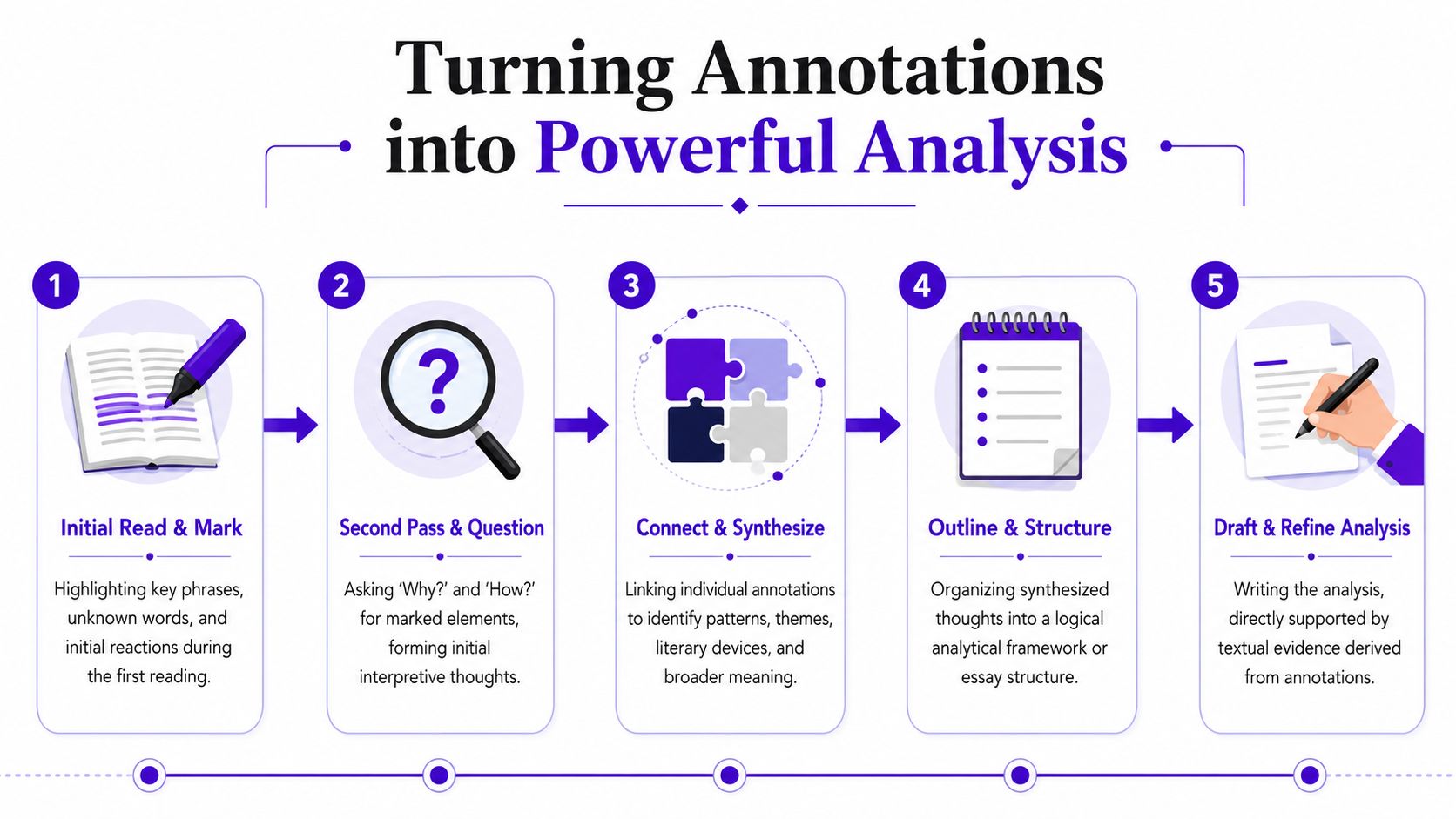
The formula that works
A useful conversion method is:
Technique + Evidence + Effect + Link to theme
That stops you from writing feature-spotting comments like “The poet uses enjambment here.” On its own, that earns very little. The examiner wants to know what that enjambment does.
Here's the difference.
Raw annotation on the page:
- “lonely as a cloud” circled
- “simile”
- “isolation”
- “floating”
Weak analysis:
The poet uses a simile in “lonely as a cloud”.
Stronger analysis:
The simile “lonely as a cloud” presents the speaker as physically separate from ordinary human life, and the image of floating suggests distance and detachment. This makes solitude seem natural but also slightly unsettling, linking to the poem's interest in isolation and perception.
The second version earns more because it interprets effect and connects it to a bigger idea.
Build from margin note to paragraph
A good annotation should act like a starter motor for a sentence. If your margin note says “enjambment = unstoppable thought”, you can build from that.
Try this sequence:
- Name the feature briefly
- Embed a short quotation
- Explain the effect
- Link to tone, theme or speaker
- Add a why here question if possible
That last part matters. Why does the poet place this image at the end of the stanza? Why does the speaker pause here? Why does the final line shrink to a single statement? The “why here” move often separates tidy Grade 5 thinking from sharper top-end analysis.
For students who struggle to turn page notes into usable writing, it can help to practise focused note taking as a separate skill. The habit of reducing a messy thought into one precise line is exactly what strong poetry analysis needs.
This short video is useful if you want to hear the process explained aloud before you practise it yourself.
The best annotations aren't the ones that prove you noticed something. They're the ones that make writing the paragraph almost automatic.
What examiners actually like
Examiners don't need ten methods in one paragraph. They'd usually rather see one or two details explored properly.
So when you annotate, think in terms of depth, not harvest. One structural point, one telling word, one tonal shift and one thematic link can be enough for a very strong paragraph if the explanation is clear.
That's the heart of how to annotate poems well. You're not collecting labels. You're building future sentences.
Pro-Level Strategies for Anthology and Unseen Poems
Top grades usually come from changing your approach depending on the kind of poem in front of you. Anthology poems and unseen poems are not the same job, so they shouldn't be annotated in exactly the same way.
For anthology poems, annotate for recall
For effective revision, students should learn a minimum of 5 quotes per anthology poem: one “absolute best” key quote and at least 4 others, ideally narrowed down to a few powerful words, according to this anthology poetry revision guide.
That means your annotation of set poems should be selective and memorable.
Use your page to mark:
- One quote that captures the whole poem
- A few shorter quotes for different themes
- A structural detail you can always mention
- A tonal shift that helps comparison
- Any context link that significantly affects meaning
If you annotate every line of an anthology poem, revision becomes foggy. If you annotate a handful of core lines brilliantly, revision becomes usable.
For unseen poems, annotate for argument
Unseen poetry is less about memory and more about judgement. You need to decide quickly what matters most.
That means your annotations should look for:
- the central feeling
- the biggest contrast or shift
- one strong language choice
- one structural movement
- the overall message
Students aiming high should also practise with timing pressure, because a good unseen answer depends on choosing quickly rather than noticing everything. That's where working through A-Level Past papers can sharpen your instincts. You start seeing the kinds of moves examiners repeatedly reward.
What stronger students do differently
They don't annotate to prove they've worked hard. They annotate to make comparison easier.
For an anthology poem, they might mark a quote that could compare on power, memory, conflict or nature. For an unseen poem, they note where the speaker's attitude changes, because that often becomes the centre of a good paragraph.
Exam habit: When you annotate an unseen poem, leave a tiny margin note for possible comparison points, such as “similar fear” or “different view of power”. It keeps your thinking flexible.
That's the difference between competent and ambitious. Ambitious students don't just read the poem. They prepare it for use.
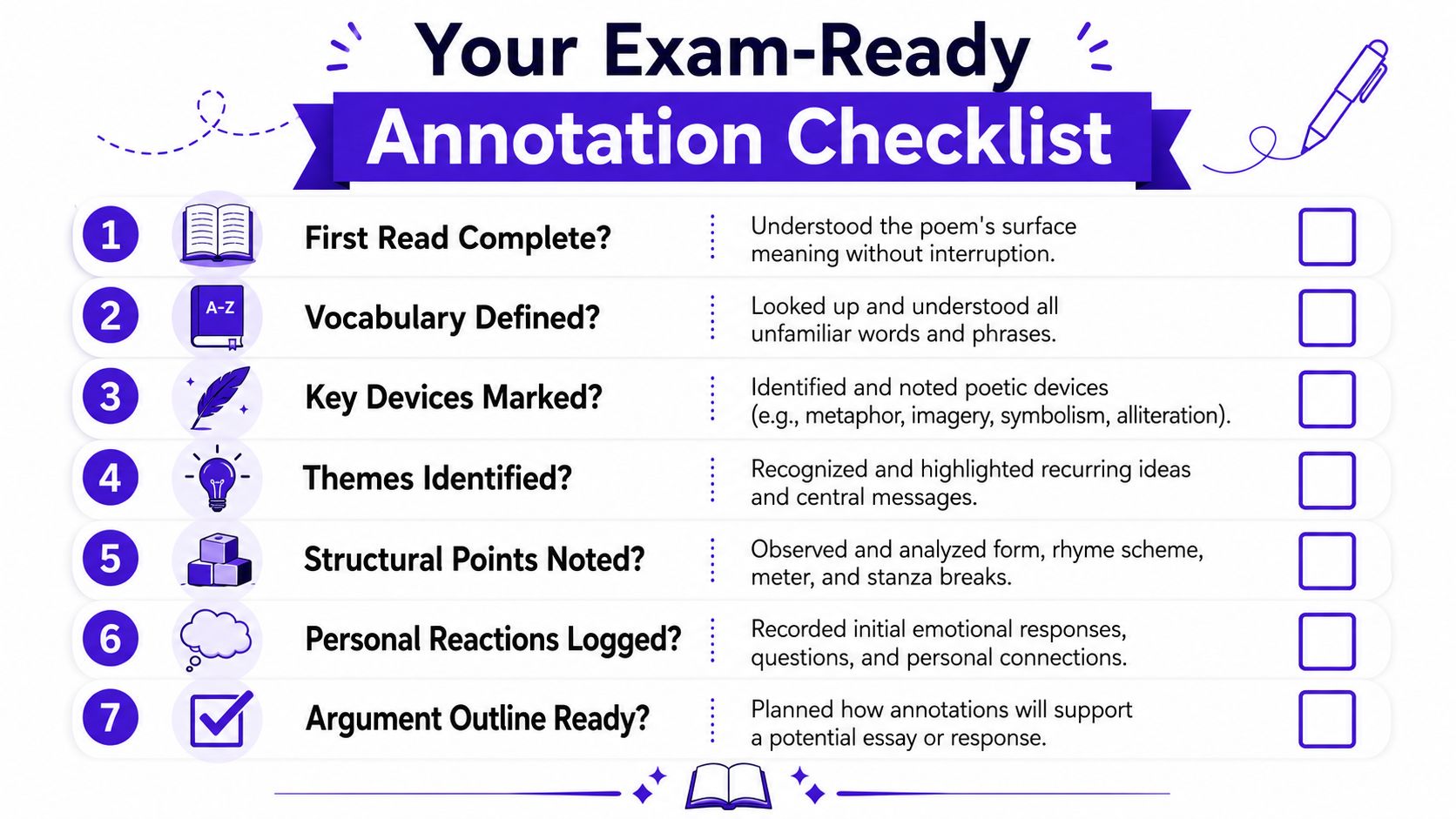
Your Exam-Ready Annotation Checklist
When you're revising, you don't need another vague reminder to “look for techniques”. You need a repeatable routine. Use this checklist until it becomes automatic.
The quick checklist
- First read complete: Read the whole poem without scribbling on it.
- Second read done properly: Clear up difficult vocabulary and basic meaning.
- Language selected: Mark only the words and images that carry meaning.
- Form noticed: Identify the overall shape and ask what it contributes.
- Structure included: Pick at least one movement, pause, break or shift worth analysing.
- Tone tracked: Notice where the voice changes or sharpens.
- Analysis ready: Turn each useful annotation into a sentence about effect and theme.
If you can't do the final point, the annotation isn't finished yet.
The questions to ask beside the poem
A strong page of annotations usually answers these questions:
| Question | Why it matters |
|---|---|
| What is the speaker feeling? | Gives you a line of argument |
| Which word or image matters most? | Stops over-annotation |
| Where does the poem change? | Opens up structure analysis |
| How does it sound? | Helps with tone and rhythm |
| What bigger idea is being developed? | Connects details to theme |
A lot of students know how to annotate poems in a basic way. Fewer know how to interrogate the poem so their notes become usable evidence. That second skill is the one that shifts marks.
Practice prompts you can use tonight
Try one of these straight away:
- Annotate “Ozymandias” for power and decay. Focus on one image, one structural choice and one tonal contrast.
- Annotate “Exposure” for suffering and helplessness. Track repetition, sound and the movement between stanzas.
- Take any unseen poem and give yourself one task only. Find the main tonal shift and write one paragraph explaining it.
If you want to practise under pressure, use Exam Practice for A-Level conditions. Annotation only becomes automatic when you've used it enough times that panic doesn't take over in the room.
A final rule. Keep your annotations legible and limited. If the page looks like a crime board, you've probably marked too much. If each note helps you write a sentence, you're doing it right.
MasteryMind helps UK students practise exactly the skills this article has focused on, especially turning poem annotations into examiner-pleasing AO-led analysis. If you want revision that mirrors real GCSE and A-Level demands, with structured feedback on unseen poetry, essays and comparison work, take a look at MasteryMind.
Ready to master this topic?
Practise with quizzes, blurt exercises and exam questions on MasteryMind.
7 days Premium · Then free forever · No card, no charge