How to Cite Sources the Smart Way for Essays and Coursework
You can write a strong essay and still lose easy marks if your sources look messy. That's the frustrating part for a lot of GCSE and A-Level students, especially when the argument is there but the evidence trail is hard to follow. Teachers notice it fast, and so do examiners, because citation is really about showing where your ideas came from and whether they can be checked.
Why Citations Matter More Than You Think
A Year 11 student can hand in a history answer with solid judgement, good structure, and relevant evidence, then lose marks because the sources are fuzzy. The teacher isn't guessing where the facts came from, and neither can the examiner. That's why how to cite sources matters from the first draft, not the final tidy-up.
Practical rule: a citation does three jobs at once, it gives credit, it shows your evidence trail, and it lets the marker verify your source quickly.
That third job is the one students usually underestimate. If a fact, quote, or image came from somewhere else, the marker needs to see it clearly enough to check it, and UK guidance treats that as part of good academic practice, not an optional extra. The core rule is simple, if you use material that didn't originate with you, it must be cited, whether that material is an idea, conclusion, visual, or data, and whether you've quoted it directly or paraphrased it (TAMU Writing Center).
There's also a big difference between intentional plagiarism and sloppy referencing. One is a serious honesty issue, the other is often a fixable skills gap, but both can weaken the work in the marker's eyes. UK exam boards and schools may treat the intent differently, yet they still expect you to make your sources visible and traceable.
For GCSE and A-Level, this connects directly to the marks that reward evidence-based thinking. AO2 and AO3 style marks often depend on how well you use and handle evidence, not just how confidently you write. If your reader can't tell where the evidence came from, your argument looks weaker than it really is.
If you want revision help that sits alongside this kind of source work, the A-Level study materials are a useful place to practise with actual exam-style tasks.
The Two Parts of Every Citation
A citation has two parts, the in-text signpost and the full reference entry. The first one tells the reader which source you are using in that sentence, the second one gives the full details so the source can be found again. In coursework, you need both, because one part on its own usually leaves the trail incomplete.
A clean sentence might look like this: In-text citation included. According to Patel (2023), revision works best when students test recall before they reread notes. The in-text citation points the reader to the source, while the reference list entry tells them exactly which Patel source you mean, not just that a Patel existed somewhere.
Now compare that with an uncited version: Revision works best when students test recall before they reread notes. The idea might be solid, but the marker cannot tell whether it is your own thinking or something you picked up from elsewhere. Citations make that borrowing visible instead of hidden, which is what protects your work when someone checks it closely.
A source must be cited whenever you use material that did not originate with you, including ideas, conclusions, information, words, visuals, or data taken from someone else, covering both direct quotation and other forms of reuse such as paraphrase. (TAMU Writing Center)
The two questions every citation has to answer are simple. Who said it? and Where can I find it? If either part is missing, the reader has to do extra work.
Timed exam answers usually do not include a full reference list, so the in-text part carries most of the load there. Coursework works differently, because the reference list is where the marker checks completeness and consistency. That is why students who only remember one half of the system often end up with patchy referencing.
For a broader set of A-Level and GCSE study insights, the A-Level and GCSE study insights page is a useful place to see how source work fits into real revision and assignment practice.
Picking a Style and Sticking With It
The easiest way to make citation work less painful is to choose a style early and keep it steady. UK advice on academic writing is clear on that point, pick one style, match it to the discipline or assignment brief, and keep it consistent throughout the paper. Using citation tools and proofreading the formatting before submission also saves a lot of last-minute panic (Teach Britannica).
Quick Comparison of Common UK Citation Styles
| Style | In-Text Example | Reference List Example | Most-Forgotten Rule |
|---|---|---|---|
| Harvard | (Smith, 2024) | Smith, J. (2024) Title. Publisher. | Keep author-date formatting consistent throughout. |
| APA | (Smith, 2024) | Smith, J. (2024). Title of page. Site Name. URL | Web pages normally need the site name and URL. |
| MLA | (Smith 24) | Smith, John. Title. Publisher, 2024. | Titles are handled differently, and punctuation trips people up. |
| OSCOLA | ^1 or footnote format | Author, Title (Publisher year) | Footnotes do the heavy lifting, not parenthetical in-text citations. |
Harvard is the one many UK students meet first, especially at A-Level and university. APA shows up a lot in psychology, sociology, and sciences. MLA is common in English and some humanities courses. OSCOLA is the law-heavy one, and it feels different because footnotes carry so much of the citation load.
The quickest way to avoid reformatting later is to check the brief, the subject guide, or the exam board's expectations before you start. If nothing is specified, use the style your school or department normally uses and keep every entry in that format. That matters more than trying to mix styles and hoping no one notices.
Marker reality: consistency usually beats fancy formatting. A simple, correct style is better than a polished-looking reference list that switches rules halfway through.
For comparison, the A-Level and GCSE study insights can help you spot the kind of assignment language that often hints at which style is expected.
Worked Examples for Books, Articles, Websites, Images, and Data
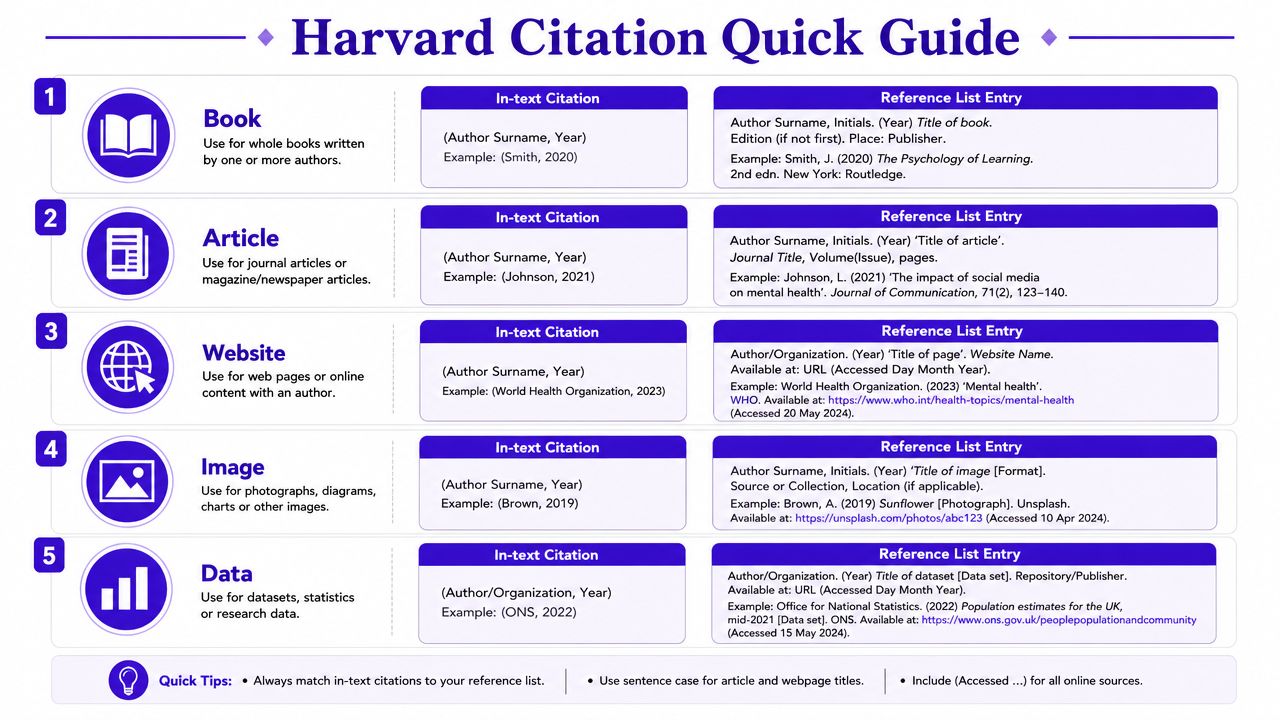
A lot of citation anxiety disappears once you stop trying to memorise whole examples and start recognising the pattern behind them. First, identify the source type. Then put the details into the right order. In Harvard style, that usually means author, year, title, and publication details. APA uses similar source details, but the punctuation shifts, and web sources often put extra weight on the date. If you want a style guide that breaks those conventions down clearly, the Boise State Writing Style Guide is a useful reference.
Book
In-text: (Orwell, 1949)
Reference list: Orwell, G. (1949) Nineteen Eighty-Four. Secker & Warburg.
This is the easiest kind to practise because the parts stay fixed. The usual slip is adding extra publication details that your school style no longer asks for, or forgetting to italicise the title.
Journal article with a DOI
In-text: (Ahmed, 2022)
Reference list: Ahmed, S. (2022) ‘Memory and revision in adolescent learning', Journal of Educational Studies, 18(2), pp. 45-58. doi:10.1234/jes.2022.0012.
The DOI matters because it gives the article a stable identifier. In APA, the article title would use sentence case, and the journal title would still be italicised, but the main job stays the same, give the reader enough detail to find the article without guessing.
Webpage with an individual author
In-text: (Khan, 2024)
Reference list: Khan, R. (2024) ‘How to revise history effectively', Study Skills Hub. Available at: https://example.com/revise-history (Accessed: 27 July 2026).
Webpages cause trouble because students often skip the access date, especially when the page can change. A web source also needs a clear enough trail for someone else to check it again, which is why the author, title, site name, URL, and access date all matter. If you want a second guide to compare formatting choices, the Salem State Library Guide lays out the same basic logic in a different style.
Image or figure from a website
In-text: (National Gallery, 2023)
Reference list: National Gallery (2023) The Hay Wain. Available at: https://example.com/hay-wain-image (Accessed: 27 July 2026).
Visual sources still need citations. That catches a lot of students out because the image is doing the work in the assignment, so it feels less like a “source” and more like decoration. Markers do not see it that way. If you use the image, the source still has to be traceable.
Statistic or dataset
In-text: (Office for National Statistics, 2024)
Reference list: Office for National Statistics (2024) UK population estimates dataset. Available at: https://example.com/ons-dataset (Accessed: 27 July 2026).
For datasets, cite the specific dataset or the exact location where you found the statistic, not just the organisation name. That keeps the trail clear for a reader who wants to check the figure against the original record. UK guidance treats a statistic like any other source type, so the underlying item still needs the author, title, publication date, and location details.
Quoting Versus Paraphrasing Without Getting Marked Down
Here's a short source passage: “Active recall helps learners remember more because they retrieve information rather than just reread it.” That one sentence can be used in three different ways, and each one needs to be handled differently.
Direct quote
“Active recall helps learners remember more because they retrieve information rather than just reread it” (Brown, 2021, p. 14).
This keeps the original wording and needs quotation marks plus a page number when one is available. Open textbook guidance is clear that direct quotations need page numbers, and paraphrases usually do not unless you're pointing to a very specific part of the work (Open Text BC).
Paraphrase
Brown (2021) explains that learners remember information better when they practise retrieving it instead of only rereading notes.
The meaning stays the same, but the wording is yours. You still cite it, because the idea didn't originate with you, but the page number is usually optional unless your teacher wants it for precision.
Summary
Brown (2021) argues that retrieval practice is more effective than passive review for memory retention.
This is shorter again and rolls several points into one. The danger here is over-paraphrasing, where students swap a few words and keep the structure too close to the original. Markers spot that quickly, and it can look like you're trying to disguise the source rather than use it properly.
Useful habit: introduce the source with a signal phrase, then explain why it matters in your own words. That keeps the quote from floating in the paragraph like a random bit of borrowed text.
A good rule is this, quote when the wording matters, paraphrase when the idea matters, and summarise when you only need the core point. That choice helps your writing sound less stitched together and more like you understand the source.
Your Pre-Submission Citation Checklist
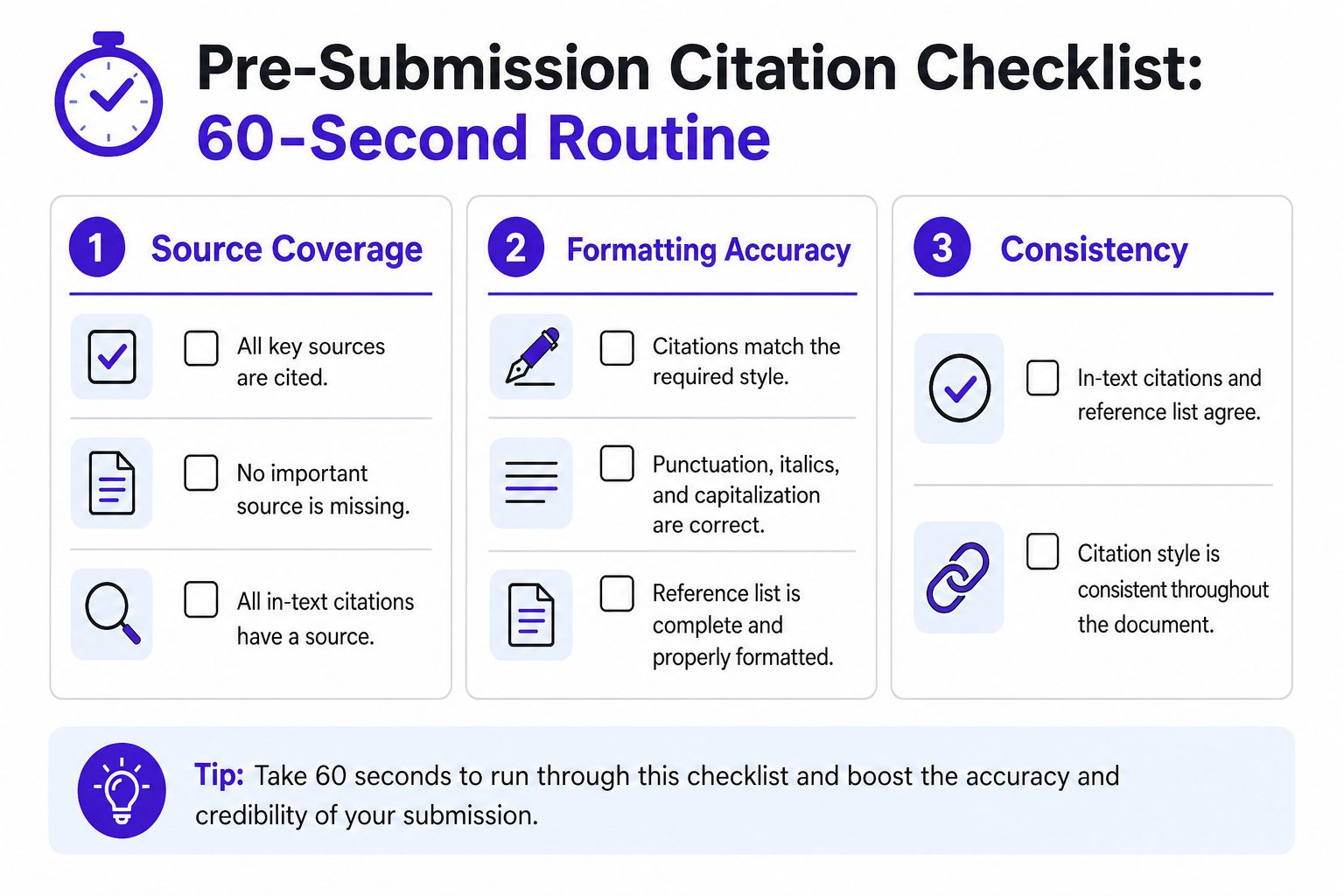
A quick check before submission catches the mistakes that waste marks for no good reason. If you've ever lost points for missing a page number or a half-finished reference, this is the bit to run through before you hand anything in.
Source coverage
- Quoted material: every quotation has quotation marks and a citation.
- Paraphrased material: every borrowed idea still has a citation.
- Images and data: every external visual, figure, or dataset is credited.
Formatting accuracy
- Names and titles: spell author names correctly and italicise the right titles.
- Capitalisation and punctuation: keep the style's rules consistent.
- Access dates: include them where your style or source type expects them.
Consistency
- One style only: don't mix Harvard, APA, MLA, and OSCOLA in one piece.
- Matching entries: every in-text citation should have a full reference.
UK guidance on academic writing also recommends checking author credentials, publication date, methodology, and cross-checking across databases when you can, because good formatting can't rescue a weak source (Wisc Writing Handbook). If you like using digital support, the automated assessment for learners can make it easier to spot missing or inconsistent reference details before the deadline.
Pulling It All Together With Real Coursework and Exam Scenarios
A strong NEA-style paragraph usually starts with reading, then drafting, then checking where each fact came from. Say a student writes about post-war Britain and uses a textbook, a museum webpage, and a journal article. The final paragraph should weave the sources into the argument, then list the full references so the marker can see the trail from claim to evidence.
Timed exams are different because there's usually no reference list to build. In that setting, the sensible move is to name the historian, text, or source directly in the answer if you're expected to refer to one, then keep the focus on the argument rather than formal bibliography style. If you only saw a source quoted inside another source, be careful, because secondary citation should only be used when the original can't be accessed after a real attempt to find it, which is why the actual source matters so much in proper academic work (ORI guidance).
That's also where AI tools need a bit of honesty. For UK coursework, JCQ rules matter, so a tool should support planning, checking, and self-testing, not write the work for you. The NEA Coach capabilities are most useful when you want Socratic prompts, mark estimation, and structure help without crossing into direct answers.
If you're worried about fake or muddled references from any tool, students can ensure accuracy by checking every source against the original page or document before it goes into your work. Tonight, build one habit, attach a citation the moment you use a source. Try one tool, whether that's a reference manager or a study platform that checks structure. Fix one mistake, and make sure your in-text citations match your reference list every time.
MasteryMind helps UK students practise the exact skills that sit behind good referencing, from source use to examiner-style written answers. If you want structured support for essays, NEAs, and revision that keeps your work in your own voice, visit MasteryMind and see how it can fit into your study routine.
Ready to master this topic?
Practise with quizzes, blurt exercises and exam questions on MasteryMind.
7 days Premium · Then free forever · No card, no charge