How to Factor Polynomials the Smart Way

You're halfway through an exam question. You've turned a polynomial into neat brackets, underlined the result, and feel relieved. Then you notice the question said solve, find the roots, or show that. The factorisation was only the middle of the job.
That moment is common because factoring isn't just a collection of tricks. You need to recognise the shape of an expression, choose a method for a reason, rewrite it as a product, and then use that product to finish the question. This guide focuses on those decisions, including the mistakes that often cost marks in GCSE and A-Level work.
The Real Reason Factorisation Trips Students Up
Many students think they're bad at algebra when the problem is more specific. They may know how to expand brackets but not recognise when expansion needs to be reversed. They may reach the correct factorised form but stop before solving the equation. Or they may use a valid technique while ignoring the command word that the examiner wanted them to follow.
OCR notes that algebra misconceptions can begin with arithmetic misconceptions, and that learners may struggle to recognise equivalent expressions as being the same. It also highlights a particularly important problem: some learners can factorise successfully but then stop without using the result to complete the problem. OCR's algebra guidance is useful because it points towards the reasoning gap, not a lack of practice.
The three jobs of factorisation
Every reliable factorisation method has three jobs:
- Find a common structure. Look for a shared factor, a special pattern, paired terms, or numbers that fit a sum-and-product relationship.
- Rewrite the expression as a product. Products use multiplication, so they can reveal roots and make equations easier to solve.
- Check by expanding. Multiply the factors back out and confirm that you get the original expression.
BBC Bitesize describes factorisation as a reverse process and stresses checking by expanding. That check isn't decoration. It catches a wrong sign, a missing term, or a factor that was copied incorrectly before the mistake spreads through the rest of the question.
Practical rule: Don't ask only, “Which formula do I remember?” Ask, “What shape is this polynomial, and what structure can I expose?”
This is the misconception-first approach. If the answer is wrong, inspect the decision before blaming the algebra. Did you miss a greatest common factor? Did you choose grouping when the expression was a difference of squares? Did you factorise fully but forget to solve the resulting equation?
Factorisation becomes much less mysterious when you treat it as a decision. The mechanics still matter, but method selection comes first.
Starting with the Building Blocks GCF and Simple Quadratics
Before using a more advanced technique, make sure you can handle the two foundations: greatest common factor, often called the GCF, and simple quadratic factorisation.
Pull out the greatest common factor
Take:
[
6x^3-9x^2
]
Both terms share (3x^2). Factor it out:
[
6x^3-9x^2=3x^2(2x-3)
]
The factor (3x^2) must multiply back to both original terms:
[
3x^2(2x)=6x^3
]
[
3x^2(-3)=-9x^2
]
That expansion check takes seconds and confirms that the common factor was chosen correctly. A frequent error is to take out (3x), which is still valid but leaves a less fully factorised expression:
[
3x(2x^2-3x)
]
The second bracket has another common factor of (x), so the factorisation isn't finished.
Factor a monic quadratic
For a quadratic such as:
[
x^2+5x+6
]
look for two numbers that:
- multiply to give (6)
- add to give (5)
Those numbers are (2) and (3), so:
[
x^2+5x+6=(x+2)(x+3)
]
You can verify it:
[
(x+2)(x+3)=x^2+3x+2x+6=x^2+5x+6
]
The signs matter. For:
[
x^2-5x+6
]
the numbers must multiply to (6) but add to (-5). They are (-2) and (-3):
[
x^2-5x+6=(x-2)(x-3)
]
Handle a negative leading coefficient
A negative (x^2) often makes students choose the wrong signs. Start by factoring out (-1):
[
-x^2+5x-6=-(x^2-5x+6)
]
Then factor the quadratic:
[
-(x^2-5x+6)=-(x-2)(x-3)
]
You could also write:
[
(2-x)(3-x)
]
because multiplying those brackets gives the same expression. In an exam, the first form makes the extracted negative sign clearer, while the second may be useful if the question suggests particular factors.
For structured Online Revision for GCSE, keep practising the recognition step rather than memorising isolated answers.
Check before moving on: Expand your final brackets. A factorised answer that doesn't return to the starting polynomial isn't finished.
This habit becomes even more valuable with cubics, where one sign error can affect several later lines.
Picking the Right Method Grouping Difference of Squares and Trinomials
Several factorisation methods can appear in the same exercise, but they aren't interchangeable guesses. Count the terms, inspect the signs, test for perfect squares, and see whether pairs reveal a common factor.
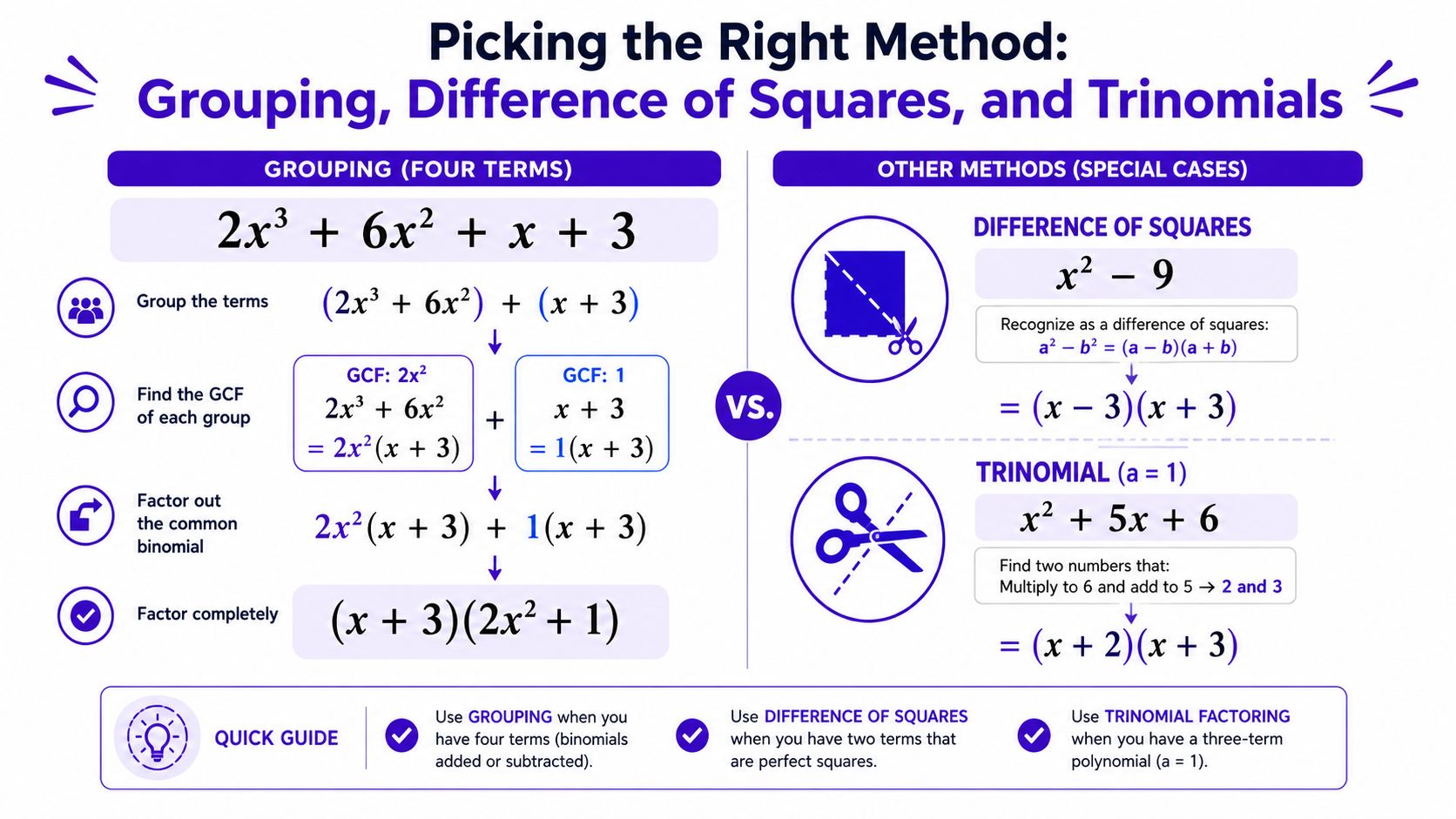
Grouping four terms
Consider:
[
2x^3+6x^2+x+3
]
There isn't one obvious GCF shared by every term, but pair the terms:
[
(2x^3+6x^2)+(x+3)
]
Factor each pair:
[
2x^2(x+3)+1(x+3)
]
Now ((x+3)) is common:
[
(x+3)(2x^2+1)
]
The method works because both pairs have been arranged to produce the same bracket. If the brackets don't match, try a different grouping or check for a sign error.
Difference of two squares
The signal is subtraction between two perfect squares:
[
x^2-9
]
Since (9=3^2):
[
x^2-9=(x-3)(x+3)
]
The signs are opposite. This is different from a sum of squares, such as (x^2+9), which doesn't factorise into real linear brackets using this pattern.
A cubic can hide the same structure:
[
x^3-9x
]
First take out the GCF (x):
[
x(x^2-9)
]
Then use difference of squares:
[
x(x-3)(x+3)
]
This is why checking for a common factor comes first, even when another pattern is visible afterwards.
A trinomial with a leading coefficient
For:
[
6x^2+11x+3
]
multiply the first and last coefficients:
[
6 \times 3=18
]
Find two numbers that multiply to (18) and add to (11), namely (9) and (2). Split the middle term:
[
6x^2+9x+2x+3
]
Group:
[
3x(2x+3)+1(2x+3)
]
So:
[
6x^2+11x+3=(3x+1)(2x+3)
]
The split-middle-term method is really grouping in disguise. It creates two pairs with the same bracket.
Here's a compact comparison.
| Method | Signal in the polynomial | Quick check | Typical form |
|---|---|---|---|
| GCF | Every term shares a factor | Multiply the outside factor into each term | (6x^3-9x^2) |
| Grouping | Four terms form matching pairs | The extracted brackets must match | (ab+ac+db+dc) |
| Difference of squares | Two perfect squares separated by subtraction | Factors have opposite signs | (a^2-b^2) |
| Trinomial factoring | Three terms with a workable product and sum | Expand the two brackets | (ax^2+bx+c) |
A short decision aid is enough:
- Look for a GCF.
- Count the terms.
- Check for subtraction between perfect squares.
- Try grouping if there are four terms.
- Use trinomial methods for three terms.
- Factor again if any bracket can still be simplified.
The methods are teammates. A cubic may need a GCF first and difference of squares afterwards. A non-monic trinomial may use a split middle term followed by grouping.
A visual walkthrough can help you compare the shapes before trying examples.
Moving Up to A Level Factor Theorem and Synthetic Division
At A-Level, factorisation often starts with a root rather than an obvious bracket. The factor theorem says that if (f(a)=0), then ((x-a)) is a factor of (f(x)).
Take:
[
f(x)=x^3-6x^2+11x-6
]
Test (x=1):
[
f(1)=1^3-6(1)^2+11(1)-6
]
[
f(1)=1-6+11-6=0
]
Because (f(1)=0), ((x-1)) is a factor.
Sign trap: A positive root (a) gives the factor ((x-a)). A negative root gives ((x+\lvert a\rvert)).
Use synthetic division
The coefficients are:
[
1,\ -6,\ 11,\ -6
]
Use the root (1):
[
\begin{array}{r|rrrr}
1 & 1 & -6 & 11 & -6\
& & 1 & -5 & 6\
\hline
& 1 & -5 & 6 & 0
\end{array}
]
The quotient is:
[
x^2-5x+6
]
and the remainder is (0), which confirms the factor theorem result.
Now factor the quadratic:
[
x^2-5x+6=(x-2)(x-3)
]
Therefore:
[
x^3-6x^2+11x-6=(x-1)(x-2)(x-3)
]
Synthetic division is a quicker version of polynomial long division. It isn't a separate piece of magic. You bring down the first coefficient, multiply by the root, add to the next coefficient, and repeat. A sign slip in the root or in the factor can change every number in the quotient.
To verify the final answer, multiply:
[
(x-1)(x-2)=x^2-3x+2
]
Then:
[
(x^2-3x+2)(x-3)=x^3-6x^2+11x-6
]
That expansion returns the original cubic.
For A-Level Maths exam preparation, practise writing the theorem line before dividing. It shows the examiner that you followed the requested method.
If (f(1)) isn't zero, the attempt hasn't failed as a whole. It only tells you that (x=1) isn't a root. Try small integer candidates suggested by the constant term and leading coefficient, evaluate each one carefully, and continue with a root that produces a zero remainder. Once you find one factor, the remaining polynomial is usually easier to handle.
Where Marks Get Dropped Common Pitfalls and Examiner Pet Mistakes
A correct factorisation can still earn fewer marks if it doesn't answer the question. Examiners look for the complete chain, not just the attractive middle line.
The bracket isn't always the destination
Suppose you reach:
[
(x-2)(x-3)=0
]
If the question asks you to solve, use the zero-product rule:
[
x-2=0 \quad \text{or} \quad x-3=0
]
so:
[
x=2 \quad \text{or} \quad x=3
]
Writing only the factorised equation leaves the roots unresolved. The same issue appears in simplification questions, where you may need to cancel a common factor, state a restriction, or continue manipulating the expression.
Signs reveal whether you understand the root
If the root is (3), the factor is ((x-3)), not ((x+3)). If the factor is ((x+3)), its root is (-3). Keep the relationship visible rather than relying on memory.
A useful check is to substitute the claimed root into the factor. For ((x-3)), putting in (x=3) gives zero. For ((x+3)), putting in (x=-3) gives zero.
Follow the command word
A question that says “by using the factor theorem” expects you to show (f(a)=0), not only perform synthetic division. Synthetic division may support the solution, but it doesn't replace the required statement.
MEI identifies errors involving command words, the wrong division form when a root is known, and sign mistakes in polynomial division. MEI's polynomial guidance also reflects the wider difficulty of choosing the right method in multi-step questions.
Protect the easy marks
Before moving on, scan for these predictable faults:
- Stopping early: Factorise fully, then solve or simplify what the question asks.
- Changing a sign: Match positive roots with factors of the form ((x-a)).
- Dropping a term: In grouping, copy every term into the new line.
- Cancelling incorrectly: Only cancel factors that are common to numerator and denominator.
- Skipping verification: Expand the factors, especially after synthetic division.
Use A-Level Past papers to practise reading the command word before touching the algebra. Mark your response for method as well as the final answer. A tidy line can still be wrong, while a clearly labelled correction can help you identify the precise habit that needs work.
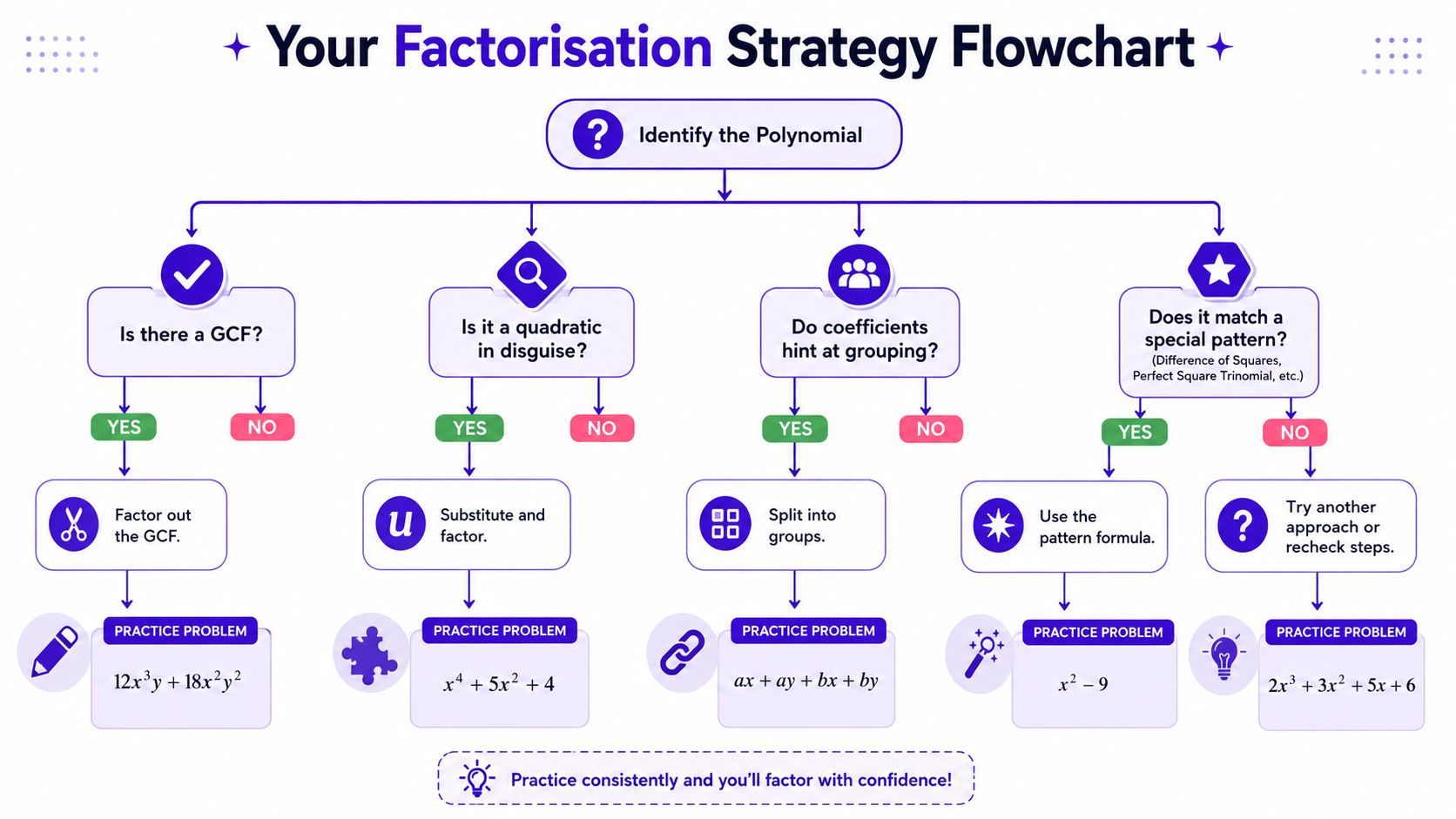
Your Factorisation Strategy Flowchart and Practice Round
When a new polynomial appears, run this decision tree:
- Is there a GCF? Take it out first.
- Is the expression a quadratic in disguise? For example, powers may allow a substitution such as (u=x^2).
- Do the terms suggest grouping? Pair them and look for matching brackets.
- Does it match a special pattern? Check difference of squares and perfect square trinomials.
- Is it a higher-degree polynomial with a likely root? Use the factor theorem, then divide.
- Is the result fully factorised? If not, keep going.
- Does expansion return the original? If not, find the first incorrect line.
Practice one
Factorise:
[
4x^2-12x
]
Take out the GCF (4x):
[
4x^2-12x=4x(x-3)
]
Examiner-style feedback: The method mark comes from identifying and extracting the common factor. A missing (x) outside the bracket leaves the second term incorrect when expanded.
Practice two
Factorise:
[
x^3-9x
]
First extract (x):
[
x(x^2-9)
]
Then apply difference of squares:
[
x(x-3)(x+3)
]
Examiner-style feedback: The answer isn't complete at (x(x^2-9)). The quadratic factor still has a special pattern, so you need to continue.
Practice three
Given:
[
f(x)=x^3-6x^2+11x-6
]
show that ((x-1)) is a factor and factorise fully.
Evaluate:
[
f(1)=1-6+11-6=0
]
Therefore, by the factor theorem, ((x-1)) is a factor. Synthetic division gives:
[
x^2-5x+6
]
so:
[
f(x)=(x-1)(x^2-5x+6)
]
[
f(x)=(x-1)(x-2)(x-3)
]
Examiner-style feedback: State (f(1)=0) explicitly because the command asks for the factor theorem. A quotient left as (x^2-5x+6) isn't fully factorised.
For targeted Exam Practice for GCSE, mix familiar quadratics with unfamiliar shapes so method selection becomes part of the practice.
Last-minute checklist
- Look for a GCF first.
- Choose the method by the polynomial's shape.
- Factor fully, not just once.
- Carry the factorised result through to solve the full question.
- Check by expanding.
MasteryMind offers curriculum-aligned GCSE and A-Level maths practice, including algebra questions, step-by-step verification, and examiner-style feedback. Use the MasteryMind platform to practise choosing factorisation methods, checking your working, and finishing the complete exam question rather than stopping at the brackets.
Ready to master this topic?
Practise with quizzes, blurt exercises and exam questions on MasteryMind.
7 days Premium · Then free forever · No card, no charge