How to Improve Recall for GCSE and A-Level Success

You've read the same Chemistry page three times, highlighted half of it, and still feel as though someone has removed the information from your brain. Then a question appears in a mock exam and your mind offers you one lonely word, usually the least useful one. That doesn't mean you're stupid or “bad at remembering”. It means recognition has been doing more work than recall.
The good news is that how to improve recall isn't a mystery reserved for naturally organised students. You can build a system that starts with remembering facts, then moves towards explaining, applying and evaluating them under exam conditions. It works whether you're trying to recover a shaky GCSE subject or push an A-Level grade higher.
Why Your Brain Forgets and What That Means
You revise a topic, recognise every line on the page, then meet a question later and find the answer has gone missing. That awkward gap is common. Familiarity tells you information looks known. Recall requires you to produce it without the page in front of you.
Hermann Ebbinghaus's classic work on the forgetting curve showed that memory fades when it is left alone, while spaced review makes later recall easier. In one comparison, he needed 68 repetitions to reach 100% on a test one week later when learning was compressed, compared with 38 repetitions when the same learning was spread out. The point is not to count every repetition. Timing changes the effort your brain must make later, which is why a planned spaced repetition study strategy is more useful than one enormous revision session.
Three jobs that students often mix up
Encoding means taking new information in. You might read about covalent bonding or listen to a lesson on the causes of the Cold War.
Storage means keeping that information available over time. Sleep, meaningful connections and repeated practice all support it.
Retrieval means bringing information back without looking. You retrieve when you answer a flashcard, explain a process aloud or write a paragraph from a question.
Rereading mainly creates recognition. The page looks familiar, so your brain says, “Yes, I know this.” An exam gives you a command word and a limited set of clues, then expects you to build the answer yourself. That is a different job.
The useful discomfort: A slight struggle before checking the answer gives you practice with the part of memory the exam uses.
A major 2021 systematic review screened nearly 2,000 research abstracts and 50 experiments, finding that most effect sizes were medium or large in favour of retrieval practice. Its focus on applied school settings makes the findings relevant to GCSE and A-Level revision, not only laboratory tasks. The review of retrieval practice research also connects retrieval practice with Education Endowment Foundation guidance for pupil learning.
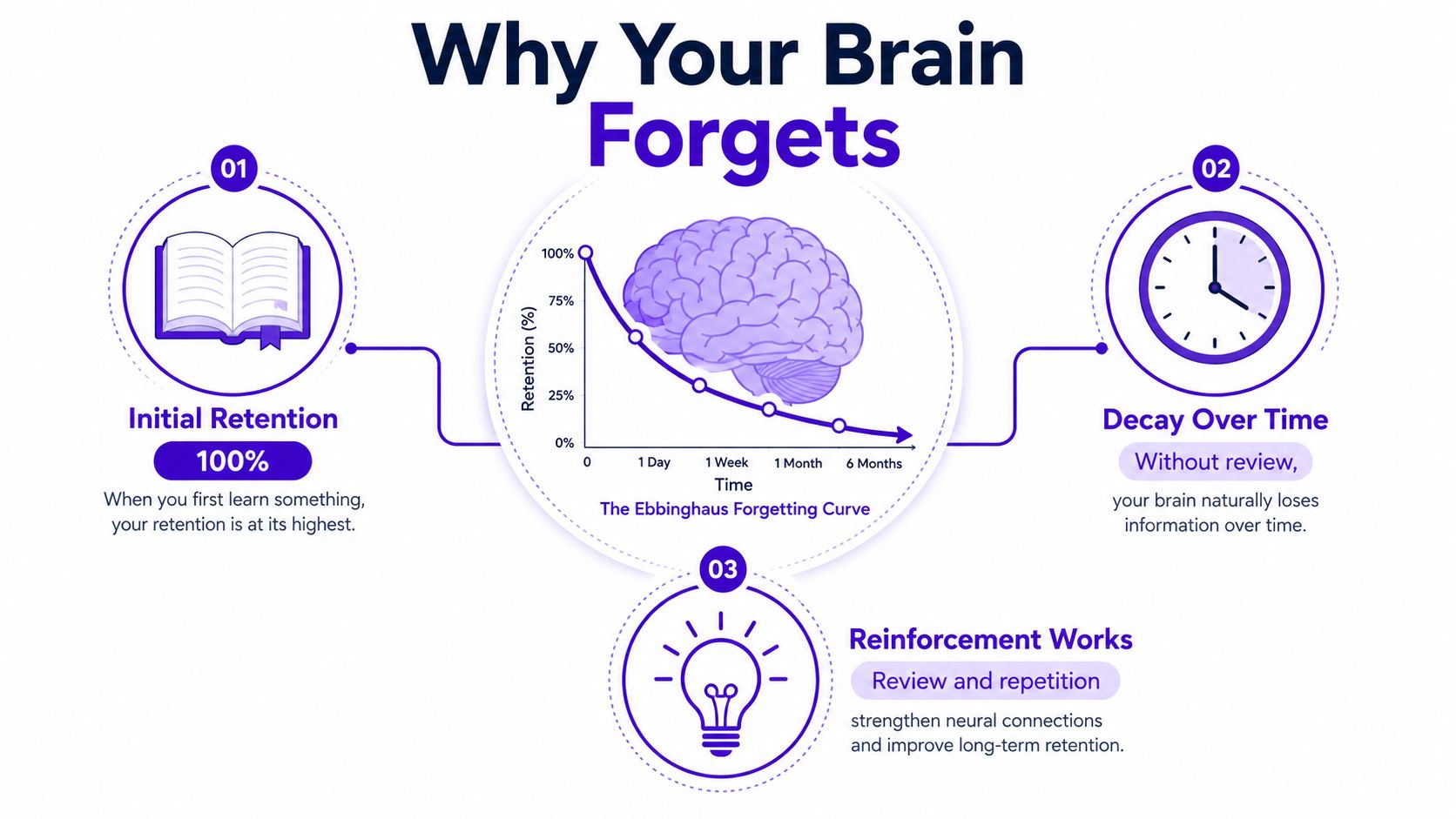
Use forgetting as information, not as a verdict. Ask yourself: if your notes disappeared right now, what could you explain about the last topic you revised? The missing parts become your next prompts. As your answers improve from definitions to explanations and then exam-style application, you can see whether memory is strengthening rather than trusting a page that merely looks familiar.
Active Recall and Spaced Repetition Working Together
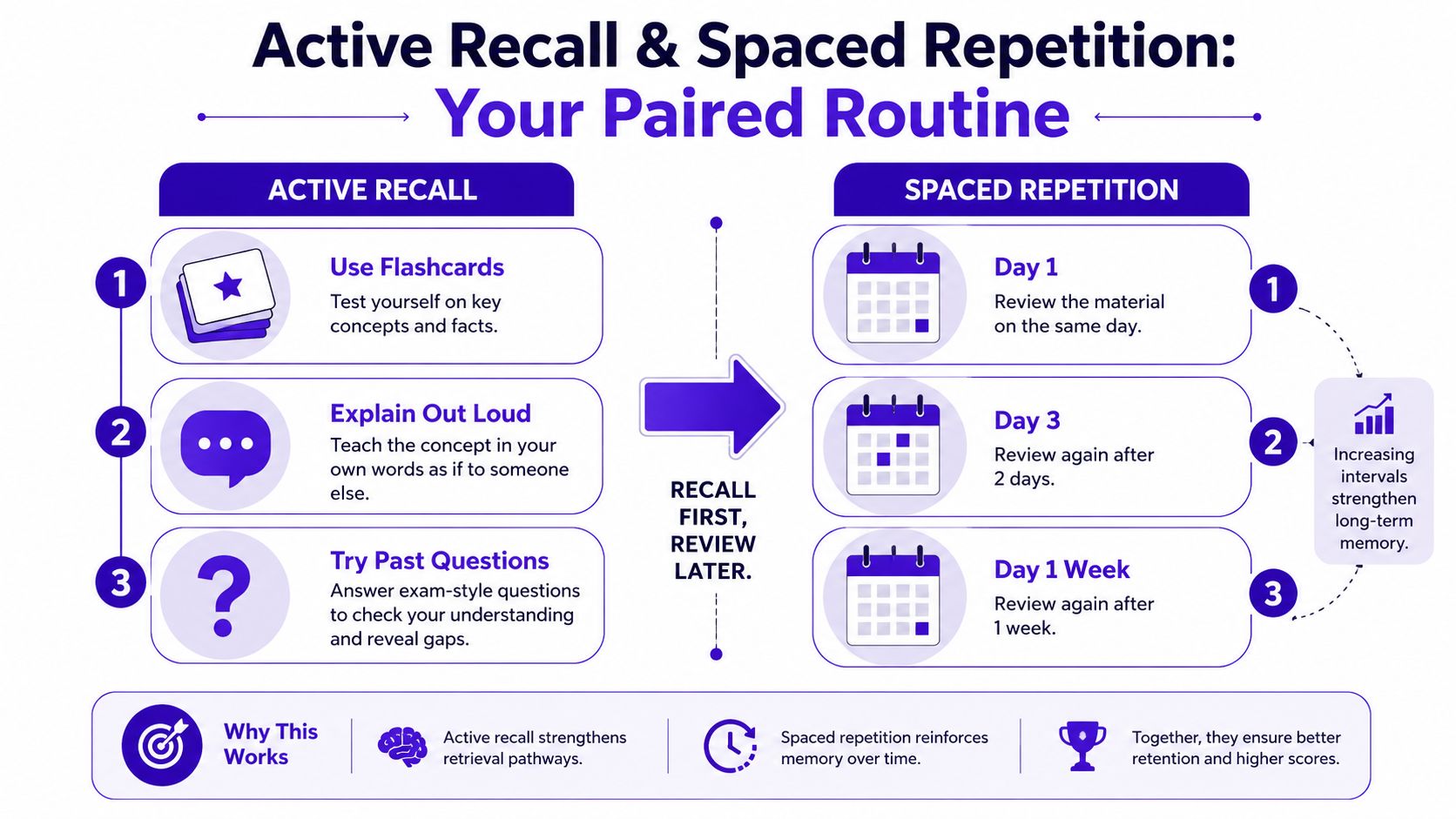
A revision session can feel productive while testing very little. You reread a page, recognise the headings and leave with a pleasant sense that the topic is familiar. Active recall interrupts that comfort by making you retrieve the answer, while spaced repetition decides when to make you retrieve it again.
Active recall means closing the book and making your brain search. Choose a method that matches the knowledge you need:
- Flashcards: Answer the prompt before turning the card.
- Blurting: Write everything you remember on a blank page, then compare it with your notes.
- Past-paper questions: Attempt the question without copying a model answer.
- Teaching aloud: Explain a process to a friend, sibling, pet or extremely patient wall.
- Memory maps: Rebuild a topic's structure from memory before checking the original.
The active recall guide gives a fuller explanation of these approaches. The point is the same: retrieve first, check second, then use the result to choose your next task.
Spaced repetition spreads those retrieval attempts across time. You might review a new topic on day 1, return on day 3, revisit it on day 7 and test it on day 14. Treat that pattern as a starting point, not a rule carved into stone. If you miss a prompt, bring it back sooner. If you answer confidently, leave a longer gap. Any spacing is more useful than postponing every review until the night before.
Build prompts that demand thinking
A weak Biology card asks:
Front: What is diffusion?
Back: The net movement of particles from high concentration to low concentration.
That checks a definition. Stronger prompts make you explain a reason, process or condition:
- Why does diffusion happen?
- How does surface area affect diffusion?
- Explain why a fish's gills are efficient exchange surfaces.
- What would happen if the concentration gradient became smaller?
As you move from fact-learning towards exam application, raise the demand. In A-Level Chemistry, ask what attacks what, why a bond breaks and which conditions matter. In History, ask what happened, why it mattered and how it supports an argument. A good recall system changes with you, rather than keeping every card at the same difficulty.
Try the Blurt Challenge
- Read one focused topic for 10 minutes.
- Close your notes completely.
- Write everything you can recall for 5 minutes.
- Check the notes and mark missing or inaccurate points in red.
- Turn the red gaps into questions for the next review.
The red marks show the difference between recognising information and producing it. Keep a simple record of how many prompts you answer accurately, which ones need help and whether your explanations are becoming more complete.
OCR recommends retrieval tasks that are quick, non-threatening and not known in advance, alongside spaced review that brings earlier topics back over time. Its guidance on spaced review and interleaving also emphasises feedback. Check mistakes promptly, because repeating an incorrect answer merely rehearses the error.
Digital tools handle prompts and review schedules in different ways. ChatPal's app comparison guide can help you compare those practice features before choosing one.
If every review feels effortless, the gap may be too short. Memory needs a manageable challenge, not a victory lap.
Mixing Topics and Question Types on Purpose
Blocked practice feels tidy. You spend 30 minutes on quadratic equations, then another 30 minutes on the same method. Each question resembles the last, so your answers become smoother.
Interleaving feels messier. You might move from a quadratic equation to simultaneous equations, then to trigonometry, forcing yourself to identify the method before solving. The session feels slower, but varied retrieval gives you more than one route back to the knowledge.
| Factor | Blocked Practice | Interleaving |
|---|---|---|
| Topic order | One topic repeated together | Topics or question types shuffled |
| Main demand | Apply a method you've just used | Choose the correct method first |
| Immediate feeling | Smooth and reassuring | Difficult and less fluent |
| Exam relevance | Limited when questions are mixed | Closer to unpredictable exam conditions |
| Common risk | Mistaking repetition for mastery | Quitting before the benefit appears |
GCSE Maths
Try a 45-minute slot containing quadratic equations, simultaneous equations and trigonometry. Don't put all the quadratics first. Shuffle the questions so that each new problem begins with a decision: what kind of problem is this, and which method fits?
Keep a short log. Write down the topic, the method you chose and the error you made. A wrong method is useful information because it shows that recall needs to include recognition of the situation, not just the steps once someone has named them.
A-Level English Literature
Interleaving also works with thinking, not just formulas. Switch between comparison questions, context prompts and extract analysis. One question might ask you to compare two characters, another to connect a quotation with context, and another to analyse how a writer shapes meaning in a short extract.
The aim is flexible access. Exam questions don't arrive sorted into the exact categories you revised. Varied cues create more retrieval paths, so you practise reaching an idea from different angles.
Use two or three topics or question types in each slot. Expect it to feel harder at first, and track whether your confidence becomes more accurate over later sessions. If you want more examples of the method, browse the interleaving guide.
A Realistic Revision Week You Can Stick To
Priya is in Year 11, aiming for a 7 in Chemistry and a 6 in English. Biology, Maths, History, homework, family noise and the occasional need to stare out of a window still exist, so her plan leaves room for real life. It works because each session has a clear job rather than relying on endless motivation.
On Monday evening, she learns one Chemistry topic and turns it into questions instead of copying notes. On Tuesday morning, her 20-minute bus ride becomes a quick Biology retrieval session. She writes down keywords from memory, checks them later and circles anything she could not explain. The bus is not a mobile library. It is a small, useful slot.
Wednesday is more varied. After school, Priya takes a 10-minute break, eats something and steps away from her screen. Later, she alternates Maths past-paper questions with History flashcards. Maths makes her choose the right method, while History asks for causes, consequences and evidence. She ends when the planned block ends, rather than turning revision into a miserable late-night endurance test.
Thursday pairs Chemistry practice with English essay planning. Priya writes a thesis from a prompt, recalls supporting quotations and checks the mark scheme language afterwards. She does not rewrite a flawless essay every time. She targets the parts most likely to disappear under exam pressure, then records what needs another retrieval attempt.
Friday is for missed questions, followed by a proper stop. On Sunday afternoon, she reviews the week's toughest topics. Meals, breaks and changing plans remain part of the timetable. A routine that falls apart after one busy evening was too rigid to begin with.
Use this pattern:
- New learning: Understand one focused section and make prompts.
- Short retrieval: Test it the next day without notes.
- Mixed practice: Combine older and newer material later in the week.
- Weekly repair: Revisit errors, not only topics that feel comfortable.
- Recovery: Protect meals, sleep and time away from revision.
Move the days around your timetable. Keep the sequence, the checks and the return to mistakes. That matters more than designing a beautiful schedule you never open again.
A short visual walkthrough can show how retrieval and spacing fit into an ordinary study routine:
Sleep, Food, Breaks, and Stress That Run Your Memory
Picture a revision evening that starts well, then slides downhill. You copy notes late into the night, reach for an energy drink at 4pm, and scroll until your alarm. The problem is not a shortage of motivational quotes. Your brain is trying to learn under poor conditions.
Aim for a regular 8 to 9 hour sleep window. Sleep helps consolidate what you revised, while late-night cramming can leave you with less durable recall than the extra hour suggests. Keep your phone outside the bedroom if possible. If that is unrealistic, put it somewhere that makes automatic checking annoying.
Make tonight easier
- At 4pm, choose water or fruit juice instead of an energy drink. This reduces the chance that stimulation interferes with later sleep.
- Take a 10-minute walk instead of another hour of scrolling. Movement gives your attention a clean break before you return to work.
- Eat something ordinary and filling. Fruit, yoghurt, a sandwich or a proper meal supports revision better than treating it like an endurance stunt.
- End with one sentence. Write, “Tomorrow I'll retrieve the causes of…” Then leave your desk with a clear starting point.
These choices work like maintenance for a revision system. They do not replace retrieval practice, but they help your brain use it properly.
Stress can narrow working memory. In the five minutes before an exam, stop trying to learn a new chapter. Breathe slowly, relax your shoulders, read the first question carefully and identify its command word. Your task is to make existing knowledge easier to access, rather than crowding your mind with panic.
Sleep also affects mood. For further context on the relationship between sleep quality and emotional steadiness, read this practical guide to REM sleep for better mood. You do not need a perfect wellness routine. Repeatable choices are enough to keep exhaustion from sabotaging recall.
How MasteryMind Fits Into a Daily Revision Routine
A recall method only helps if you use it. Many students understand active recall, spacing and interleaving, then spend their evening deciding what to revise. That planning can replace the revision itself.
A platform can reduce that friction by assigning each technique a moment. The AI Powered Revision platform is built for UK GCSE and A-Level preparation, with questions aligned to AQA, Edexcel, OCR and WJEC specifications. Its role in a recall routine is practical: prompt retrieval, schedule revisits, then add exam-shaped application.
A 45-minute session
Minute 1 to 5, surface the gaps. Start with the Blurt Challenge. Write or speak everything you remember about the chosen topic before opening notes. The point is to expose half-remembered ideas while they're still easy to repair.
Minute 6 to 15, correct the map. Check your response against the curriculum material. Separate facts you missed from ideas you misunderstood. Don't spend the whole session making the page look nicer. Your red corrections are more useful than a new colour scheme.
Minute 16 to 28, retrieve from the daily inbox. Spaced review brings back topics on a day 1, day 3 and day 7 rhythm. You answer without notes, then use the feedback to decide whether a topic needs another short review or can wait for a longer interval.
Minute 29 to 40, practise the exam demand. Use AO-aligned quizzes to move beyond fact recall. A Biology keyword may become an explanation, a Chemistry idea may become a mechanism, and an English Literature point may become an argument supported by evidence. Adaptive difficulty can move practice from recall towards analysis and evaluation.
Minute 41 to 45, summarise and choose the next repair. Record the error that matters most. A useful summary says what you can now do, what still fails and when you'll test it again.
Without a structured tool, the same block might become note sorting, searching for resources and choosing questions at random. With a routine that schedules review and gives feedback, more of the session can involve answering. The app isn't a replacement for thinking. It's a way to make the thinking harder to avoid.
MasteryMind also includes examiner-style feedback, AO breakdowns, step-by-step maths verification and guidance for essays, unseen poetry and computer science tasks such as trace tables and binary or hexadecimal problems. Those features matter because durable exam performance requires transfer, not just remembering isolated facts.
Troubleshooting and Your 30-Day Recall Plan
If you cram and forget, the fix isn't “try harder next time”. Start the next review sooner, then widen the gap gradually. Birmingham City University gives a usable sequence after a lesson: summarise straight away, test yourself the next day, then again three days later and one week later, as described in its spaced repetition revision guidance.
If you blank under timed pressure, your practice may be too comfortable. Replace some flashcards with short-answer questions, timed paragraphs or mixed past-paper problems. Recall can create confidence without transfer if you never practise command words, application and mark-scheme decisions. ResearchSchool's review warns that quizzing usually beats restudying, but results vary, so feedback and exam-style practice still matter. Read its evidence review of retrieval practice with that caution in mind.
If your flashcards never return, reduce the daily quota. A small deck that reappears is better than a heroic deck abandoned after a few days. If motivation crashes in the third week, change the format, shorten the session and keep the appointment. You don't need to feel enthusiastic before beginning.
| Week | Phase Focus | 15-Minute Daily Action |
|---|---|---|
| Week 1 | Foundation | Blurt one small topic, check it and create prompts from the gaps |
| Week 2 | Consolidation | Retrieve older prompts using increasing review gaps |
| Week 3 | Application | Complete a short exam-style question and self-mark it |
| Week 4 | Exam-style drilling | Mix question types, work under time pressure and repair recurring errors |
The Education Endowment Foundation's SMART Spaces trial found no overall GCSE Chemistry outcome gain, with only weak evidence of small recall gains, as reported in its project evaluation. That's a useful warning for teachers and students: retrieval alone isn't a magic grade machine. Scheduling, feedback, subject-specific practice and transfer all belong in the system.
Audit yourself tonight:
- I retrieve before rereading.
- I check answers and correct errors.
- I revisit topics across widening gaps.
- I mix topics and question types.
- I practise the command words my exam uses.
- I track errors rather than only completed pages.
- I protect sleep, food and proper breaks.
Pick one weak topic now. Blurt it, mark the gaps, create three useful questions and put the next review in your calendar. That's how recall improves, one honest attempt at a time.
MasteryMind offers UK-aligned quizzes, spaced review scheduling, mixed-topic practice and a voice-powered Blurt Challenge that turns forgotten points into targeted follow-up questions. Visit MasteryMind and use one short session tonight to find your gaps, practise the exam demand and schedule the next retrieval.
Ready to master this topic?
Practise with quizzes, blurt exercises and exam questions on MasteryMind.
7 days Premium · Then free forever · No card, no charge