How to Revise a Level Maths: A Killer Plan for 2026
You've probably got one of two moods right now.
Either you've looked at your class notes, your mock result, and the calendar, then felt that nasty little drop in your stomach. Or you're doing reasonably well already, but you know A-Level Maths has a habit of humbling people the second they get cocky.
Both are normal. A-Level Maths is passable for most students, but “passable” and “comfortable” are not the same thing. In 2025, the overall A-Level pass rate for Mathematics in England was 98.1%, compared with 97.4% across all subjects, according to Tutorful's summary of A-Level pass rates. That's reassuring. It's also a trap if it makes you think you can wing it.
If you're trying to work out how to revise A-Level Maths properly, the answer isn't “do loads of random questions and hope”. It's a system. You diagnose what's going wrong, repair weak topics properly, practise under exam conditions, and keep bringing old content back before your brain bins it.
Teachers reading this will recognise the pattern. Students often aren't failing because they never saw the content. They're failing because their revision method doesn't match the exam.
Why Your Old Revision Habits Won't Cut It
GCSE revision lets a lot of people get away with bad behaviour. Last-minute flashcards. One heroic weekend. A random binge of questions on whatever topic feels least annoying. A-Level Maths is much less forgiving.
That's not because students suddenly become lazy or less clever. It's because the course structure changed.

The course is built for memory over time
The 2017 structural reform replaced the old modular system with a linear assessment where all exams are taken at the end of the two-year course. That shift made cumulative revision critical, because 68% of students who failed the new linear format cited knowledge decay from Year 1 as a primary factor, compared to 32% under the old modular system, as noted in these A-Level revision notes.
Under the old setup, students could bank chunks of the course earlier. Under the current one, Year 12 content can stroll back into Paper 2 like it owns the place. Because, annoyingly, it does.
Practical rule: If you haven't revisited a Year 12 topic for months, don't call it “done”. Call it “missing in action”.
That's why cramming feels productive but often collapses in the exam. You might remember the method on Tuesday night. You may not retrieve it three weeks later under pressure when the question is disguised inside a modelling problem.
A-Level Maths rewards connections, not isolated tricks
A lot of students revise as if topics live in separate boxes. Trigonometry in one box. Calculus in another. Statistics somewhere far away because they don't want to think about it yet.
Exams don't work like that. They mix ideas. You might need algebraic rearrangement before differentiation, careful interpretation before a statistics calculation, or a clear setup before any mechanics method works. That's why a smarter routine matters more than doing “more revision”.
If your current approach is mainly rereading notes, highlighting, and then hoping confidence will magically become marks, it's worth changing now. A good starting point is learning how to study smarter, then applying those habits specifically to Maths.
What to change this week
A better revision model looks like this:
- Keep old topics alive: Bring Year 12 work back every week, even briefly.
- Mix Pure and Applied: Don't leave Statistics or Mechanics until panic season.
- Test recall, don't just reread: If you can't do the method cold, you don't own it yet.
- Use structured support: Tools such as Online Revision for A-Level can give you organised topic practice instead of endless folder-diving.
The main point is simple. Your old revision habits probably weren't built for a course that expects retention across two years. Your new ones need to be.
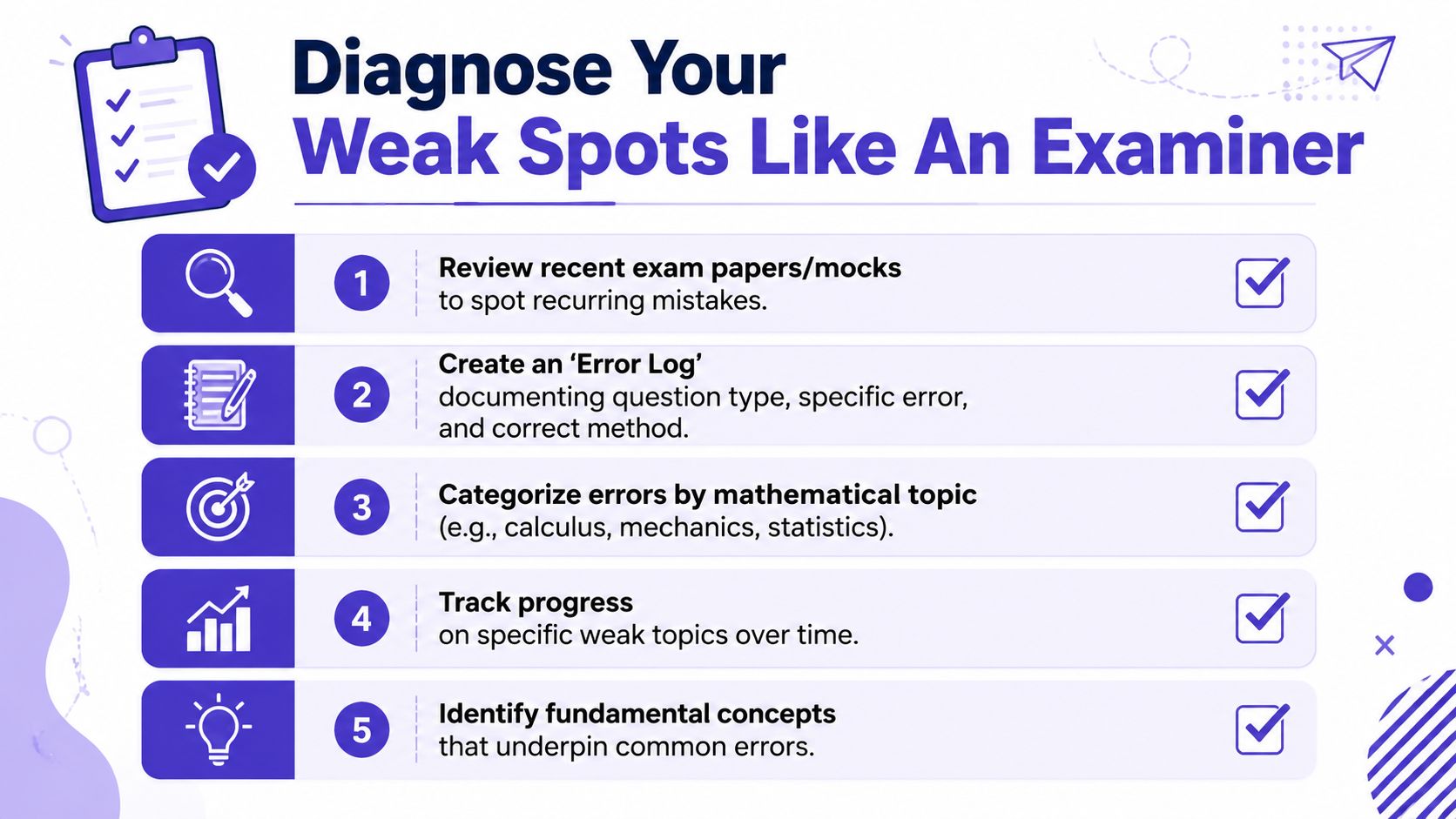
Diagnose Your Weak Spots Like An Examiner
Most students say they're “bad at maths” when what they really mean is one of four narrower things has gone wrong. That's good news, because specific problems are fixable. “I'm just rubbish” isn't a revision plan.
The biggest waste of revision time is doing a paper, seeing red crosses, then vaguely revising the whole topic again. That feels responsible. It's sloppy.
Use four error types, not one big “wrong”
A useful error log splits mistakes into four types:
Knowledge
You didn't know the formula, rule, theorem, or process.Setup
You knew the maths, but misread the context, chose the wrong variable, used poor notation, messed up units, or set the problem up incorrectly.Execution
Your plan was fine. Your algebra, arithmetic, calculator entry, or manipulation went off the rails.Checking
You could have caught it. A sign error, impossible probability, negative length, or answer that didn't match the question.
That distinction matters. The underserved problem in revision advice is exactly this: most revision guides fail to address diagnostic error classification, and students who only revisit wrong questions without classifying the error type often keep repeating mistakes, especially in Statistics and Mechanics, as discussed in The Student Room's guide to revising A-Level Maths.
Turn one paper into actual data
Don't start with ten papers. Start with one, then squeeze it for information.
Use this routine:
- Do the paper properly: Silent room, timed, no phone, no “just checking one thing”.
- Mark it accurately: No sympathy marks because you “basically meant that”.
- Log every dropped mark: Write the question number, topic, error type, and what the correct route should have been.
- Look for repeats: If five errors are setup errors, your issue isn't content coverage. It's interpretation.
Here's what an error log entry might look like:
| Question | Topic | Error type | What happened | What I need to do |
|---|---|---|---|---|
| Q7 | Integration | Knowledge | Forgot integration by parts structure | Relearn worked example, then do 6 targeted questions |
| Q11 | Hypothesis testing | Setup | Mixed up null and alternative hypotheses | Practise writing hypotheses from context |
| Q14 | Algebra | Execution | Sign error during expansion | Slow down and line up steps clearly |
| Q16 | Mechanics | Checking | Final answer had wrong unit | Add end-of-question unit check |
A short explainer can help if you want to see another take on spotting weak areas before you dive back into questions:
If a student keeps saying “I revised that” but the same type of mistake returns, the revision probably targeted the topic name, not the failure point.
What students usually get wrong here
A common confusion is thinking setup errors mean you “don't know the topic”. Not always. In Applied Maths especially, you may understand the mechanics or statistics method perfectly well and still lose marks because you translated the wording badly.
Teachers know this already. Students often don't. Once you classify errors properly, your revision gets sharper very quickly.
Build Rock-Solid Topic Mastery
Once your error log points to a weak topic, don't just fling yourself at a harder worksheet and hope for character development. Repair work needs structure.
A simple system is Red, Amber, Green.
Use red, amber, green properly
Most students misuse this by labelling a topic green because they recognised a worked example. That's not green. That's “I've seen this before and I'm getting overconfident”.
Try this instead:
- Red: I can't start without help, or I panic when the question is phrased differently.
- Amber: I can do standard questions, but I wobble on mixed or unfamiliar ones.
- Green: I can solve exam-style questions cold and explain why the method works.
If integration by parts is red, don't immediately throw in a mixed paper. Rebuild the topic in layers.
Repair a topic in the right order
Go from support to independence:
Read one clean worked example
Not six. One. Follow every line and say why each step happens.Copy one example from memory
If you can't reconstruct it, you haven't learned it.Do a small set of focused questions
Start with same-skill questions before mixing variants.Finish with exam-style questions
The question should look like an actual exam question before you call the topic improved.Revisit it later in mixed practice
Otherwise it falls straight back into the red zone.

A lot of students also need to tidy their materials. If your notes are scattered across exercise books, screenshots, and the back of a worksheet that's somehow survived in your bag since November, sort that first. This guide on transforming messy notes is useful if your revision materials currently look like an archaeological dig.
Pure and Applied need different repair methods
Pure topics often improve through repeated method practice. Applied topics often break down at interpretation.
That means your repair should match the problem:
- For Pure Maths: Focus on algebraic fluency, standard methods, and showing clear lines of working.
- For Statistics: Practise defining variables, hypotheses, conditions, and interpreting outcomes in words.
- For Mechanics: Focus on diagrams, sign conventions, units, and translating the scenario before calculating.
A good test: Can you explain the first line of your solution before you write it? If not, you're probably still guessing the setup.
One useful option here is MasteryMind, which offers topic-based maths practice with examiner-style feedback and step-by-step verification. That kind of tool is most helpful during repair work, when you need to catch procedural habits before they harden into repeat mistakes.
Use Past Papers And Mark Schemes Like A Pro
Past papers work. Randomly doing them doesn't.
The difference is huge. Strong students don't just complete papers. They use papers to train timing, judgement, and examiner awareness.
Timed papers matter because the exam is timed
This bit sounds obvious, but students ignore it constantly. If you always pause, check notes, or “just think about it for a bit longer”, you're not doing past paper practice. You're doing assisted rehearsal.
The strongest evidence in the data points one way: 72% of top-grade achievers (A/A) use timed past papers as their primary revision method*. Students who completed at least 15 full past papers scored, on average, 12.4% higher than those who did fewer than 5, and 85% of those who regularly used mark schemes to self-verify work showed significantly improved accuracy, according to Casio's A-Level Statistics revision guide.
That doesn't mean “race through papers and ignore learning”. It means timed practice exposes the exact pressure points that ordinary revision hides.
Blind marking changes how you think
After finishing a paper, leave it briefly if you can. Then mark it against the official scheme with zero sentimentality.
Use a process like this:
- Mark method first: Did you earn the method marks even if the final answer was wrong?
- Check presentation: Was your notation clear enough for an examiner to credit?
- Notice command words: “Prove”, “show that”, “explain”, and “state” are not the same instruction.
- Write one reason for every lost mark: Not “silly mistake”. Be specific.
A lot of students are shocked by how many marks are available for a correct process even when the answer goes wrong near the end. That's why sloppy working is expensive.
Here's a simple post-paper review frame:
| After the paper | What to ask |
|---|---|
| Before marking | Which questions felt slow or confusing? |
| During marking | Where did I lose marks for method, setup, or accuracy? |
| After marking | Which three issues came up most often? |
| Before the next paper | What will I deliberately change? |
Mark schemes are a training tool, not just an answer sheet
Students often glance at the final answer and move on. That misses the best bit.
Mark schemes show you what examiners reward. That includes valid methods, acceptable forms, and where working needs to be visible. If you want a central place to practise with A-Level Past papers, use them the same way. Timed first. Brutal marking second. Error log third.
Exam-hall truth: The student who shows clean, logical working usually beats the student who “kind of knew it” but kept everything in their head.
Design Your Perfect Spaced Practice Timetable
Cramming feels intense, so students mistake it for effectiveness. It isn't. It's revision theatre.
A-Level Maths sticks when you come back to it repeatedly, with gaps in between, and when you mix topics enough that your brain has to identify the method instead of running on autopilot.
Shorter, repeated sessions win
A sensible weekly structure beats a giant Sunday meltdown every time. The recommended pattern from the verified revision protocol is cyclic: Monday for weak-topic repair, Tuesday for Statistics plus mixed retrieval, Wednesday for a Mechanics mini-paper, Thursday for pure mixed review, Friday for a timed past-paper section, Saturday for a full paper and error analysis, and Sunday for light formula recall. It also stresses that re-attempting every dropped-mark question 48 hours later is essential for retention, as outlined in this no-fluff A-Level Maths revision plan.
That 48-hour reattempt is the bit most students skip. It's also one of the most useful. Getting a question right once, right after reading the method, proves almost nothing. Getting it right two days later proves much more.
A weekly timetable you can actually follow
Here's a realistic model for 60 to 90 minutes a day:
| Day | Focus Activity (60-90 mins) |
|---|---|
| Monday | Weak-topic repair in Pure Maths |
| Tuesday | Statistics practice plus mixed retrieval |
| Wednesday | Mechanics mini-paper |
| Thursday | Pure mixed review |
| Friday | Timed past-paper section |
| Saturday | Full paper plus error analysis |
| Sunday | Light formula recall and error log review |
Notice what this timetable doesn't do. It doesn't ask you to revise everything every day. It gives each day a job.
Why mixed practice feels harder and works better
If you spend an hour doing nothing but differentiation, every question starts to look like differentiation. Lovely for your ego. Not so lovely for the exam, where you have to spot the method yourself.
Mixed practice forces recognition. You have to decide whether this is a trig identity problem, a substitution problem, or a statistics setup issue before you can solve it. That extra retrieval effort is exactly why it helps.
If you want a clearer structure for revisiting content over time, this guide on how to improve revision with spaced repetition is useful.
Your brain stores what you retrieve repeatedly, not what you stare at for three hours while drinking bad squash and pretending it's all going in.
Keep the timetable flexible, not flimsy
Some weeks will go wrong. You'll be tired. You'll have coursework, tests, or a complete collapse over one horrible proof question. Fine. Shift the session. Don't scrap the system.
A good timetable is not one you follow perfectly. It's one you can return to quickly.
Master Your Calculator Proofs And Nerves
Some students lose marks because they don't know enough maths. Plenty lose marks because they know the maths and then fumble the equipment, the wording, or their own panic.
That's fixable too.
The student who forgets the booklet
A very common Statistics problem goes like this. A student revises the method for hypothesis testing, memorises a version of it, sits down in the exam, then confidently uses the wrong value or structure because they don't properly use the formula booklet.
That isn't rare. It's one of those painful own goals that feels avoidable because it is.
Analysis of 2022 exam results showed that 63% of students who failed Statistics questions related to hypothesis testing did not correctly reference the formula booklet, while 55% of students who lost marks could have avoided errors by knowing their calculator's exam mode functions. Those figures were reported in the same Casio guide cited earlier, so I'm keeping this point qualitative here to avoid repeating the source link.
The fix is straightforward:
- Practise with the official booklet: Don't leave it untouched until exam day.
- Know where things live: Especially distributions and hypothesis testing material.
- Use your calculator deliberately: Learn the functions you're allowed and likely to need.
If you want to rehearse under realistic conditions, Exam Practice for A-Level can help you get used to timed mixed questions rather than neat textbook sequencing.
The student who sees a proof and mentally leaves the building
Proof questions make a lot of students freeze before they've even read properly. They see “proof by contradiction” or “show that”, assume doom, and stop thinking.
Don't do that. Start mechanically.
Try this approach:
- Write down what is given.
- Write what must be shown.
- Name the proof style if you recognise it.
- Take the first legal step, even if it feels small.
For induction, that often means checking the base case and writing the induction hypothesis cleanly. For contradiction, it means assuming the opposite of what you need to prove and pushing that assumption until it clashes with a fact.
You do not need to feel inspired. You need to get moving.
The student who panics mid-paper
Panic usually arrives when a question looks unfamiliar. Then time speeds up, your handwriting turns feral, and your brain starts offering very unhelpful thoughts.
Use a routine:
- Pause for a breath: Not a dramatic one. Just enough to stop rushing.
- Underline the task: What are they asking for?
- Take the marks seriously: A 2-mark question doesn't need a philosophical crisis.
- Skip cleanly if needed: Move on, then return later with a calmer head.
The exam is not measuring how calm you feel. It's measuring what you can still do when you don't feel calm.
Your Final Checklist For Exam Success
When revision works, it usually looks less glamorous than students expect. It's organised. Repetitive. Slightly boring in places. Very effective.
Keep your approach simple:
- Diagnose first: Don't revise blindly. Use an error log.
- Repair properly: Turn weak topics from red to amber to green.
- Practise under pressure: Timed papers and honest marking matter.
- Repeat with spacing: Bring topics back before they fade.
- Train the little things: Calculator habits, formula booklet use, proof structure, and checking.
If you're aiming to recover a grade, this system gives you a route back. If you're aiming for the top grades, it stops you wasting time on revision that looks serious but doesn't change your marks.
One last useful context point. In 2025, boys achieved 29.8% of A*/A grades in Maths while girls achieved 29.2%, a 0.6 percentage point difference, according to BBC reporting on the results. That gap is small, but it's a reminder that outcomes aren't fixed. Specific revision habits can shift performance.
You do not need perfect notes, perfect confidence, or a perfect start. You need a method you'll stick to.
If you want a structured way to put this into practice, MasteryMind gives A-Level students examiner-aligned maths practice, timed exam mode, step-by-step verification, mixed-topic review, and progress tracking by topic. It's a practical option if you want your revision to be organised without having to build the whole system from scratch.
Ready to master this topic?
Practise with quizzes, blurt exercises and exam questions on MasteryMind.
7 days Premium · Then free forever · No card, no charge