How to Revise GCSE Science: A Real-World Plan That Works

You open your science folder and find a chaos of highlighted pages, half-finished mind maps and worksheets you haven't looked at since Year 9. Your mocks are close, your phone has several revision videos queued, and a late-night binge suddenly feels like a plan. It isn't too late, but watching more content won't fix the core issue. You need a method that makes you retrieve information, apply it to questions and notice exactly where your marks disappear.
The most useful answer to how to revise GCSE science isn't “read your notes more carefully”. It's a structured routine that treats biology, chemistry and physics differently, uses your exam board's wording, and gives your memory repeated chances to recover information.
The Honest Starting Point
You open a mock paper and meet a question on a topic you revised yesterday. The page in your folder looks familiar, but the answer will not come out. That gap between recognising information and producing it is the honest starting point for GCSE science revision.
GCSE science builds knowledge across biology, chemistry and physics, so each subject needs slightly different handling. Fact-heavy areas depend on accurate definitions and processes. Calculation-heavy units require you to choose an equation, substitute values and show working. Across all three, active recall, flashcards, spaced learning and past-paper practice usually do more for exam performance than rereading notes. BBC Bitesize's GCSE Science revision guidance describes flashcards as question-and-answer prompts that another person can use to test you.
Why last-minute cramming feels useful
Cramming creates fast familiarity. You watch a video, highlight a page and feel that you know the topic. The exam removes the page and asks you to define, calculate, explain or evaluate. Recognition has become retrieval, and those are different skills.
GCSEs in England were reformed and first taught from 2016, with the 9-1 grading system and more demanding end-of-course exams replacing the old modular approach. Regular preparation therefore gives knowledge more chances to stick than a brief burst followed by weeks of neglect. A UK school science revision guide recommends specification-led preparation, a revision timetable, and a move from topic notes to timed questions.
Your materials may be untidy. Start by checking what you can recall without help, then sort resources around those gaps. A structured revision tool such as MasteryMind's GCSE revision platform can sit alongside school resources. It should support your routine, not become another collection of pages to read.
The useful question isn't “How many hours have I revised?” It's “What can I now answer without looking?”
Build the routine around three habits: review new learning after 2, 5 and 10 days, test yourself instead of rereading, and practise command words used by AQA, Edexcel, OCR and WJEC. Read “describe” as a request for what happens, while “evaluate” asks you to weigh evidence or advantages and disadvantages before reaching a judgement. Your notes do not need to look perfect. They need to help uncertain knowledge become marks.
Building a Schedule That You Will Actually Follow
A timetable only works if it survives normal life. Sixth form applications, homework, a part-time job, family plans and tired evenings all matter, so start with a Monday-to-Sunday grid rather than an imaginary week in which every evening is free.
Plan three Science sessions each week, each lasting around 60 to 90 minutes. Inside each session, use two 25-minute focused blocks with a 10-minute break between them. You can use the remaining time for checking answers, organising cards or completing a short review slot.
Make spacing visible
Suppose you learn rates of reaction on Monday. Put a short retrieval review in your Thursday column, a deeper review on Saturday, and another reinforcement review the following Thursday. These are the 2, 5 and 10 day intervals recommended in school revision guidance, adapted to fit your actual calendar.
Keep a review log with four columns:
- Topic: Write the exact specification point, not just “chemistry”.
- First study date: Record when you learned or rebuilt it.
- Next reviews: Add the planned 2, 5 and 10 day checks.
- Result: Mark it “secure”, “uncertain” or “not yet”.
Colour-code the timetable. Blue could represent biology, green chemistry and orange physics. The colours aren't magic, but they make it obvious when you've spent the whole week avoiding calculations or revising only the subject you already like.
Leave room for real life
Protect one full evening off. Don't plan back-to-back Science blocks, because tired retrieval becomes careless copying. Every Sunday, move sessions around based on what happened during the week.
| Day | Block 1, 25 min | Break | Block 2, 25 min | Review slot |
|---|---|---|---|---|
| Monday | Biology definitions | 10 min | Biology recall questions | Review last week's weak cards |
| Tuesday | Physics equations | 10 min | Unit and calculation practice | Quick biology review |
| Wednesday | Chemistry concepts | 10 min | Chemistry questions | Review physics errors |
| Thursday | Biology application | 10 min | Biology exam questions | Review Monday's topic |
| Friday | Physics calculations | 10 min | Mixed retrieval | Review chemistry cards |
| Saturday | Chemistry calculations | 10 min | Past-paper questions | Review Wednesday's topic |
| Sunday | Error review | 10 min | Specification checklist | Reschedule the coming week |
This structure creates repeated contact with topics without asking you to memorise everything in one sitting. Once the timetable exists, each block needs a task that forces an answer out of your head.
Active Recall Techniques That Beat Rereading
You close your book after twenty minutes and feel confident. Then an exam question gives you no keywords, and the answer disappears. Rereading feels productive because the page looks familiar, but recognition is not the same as retrieving information independently.
Use one retrieval method during each study block, then finish with a short quiz. Record what you miss, so later reviews target weak points instead of giving equal time to facts you already know. For more ideas, see MasteryMind's guide to active recall, then adapt its approach to GCSE questions.
Four ways to make your brain answer
Flashcards: Put one precise question on the front and its answer on the back. “What is osmosis?” tests knowledge more clearly than “Osmosis notes”. Answer before turning the card over, then separate cards into “got it” and “not yet” piles. Return to the “not yet” pile before the block ends. Keep the cards plain. The question should make you retrieve, not admire your formatting.
Read-cover-recite-check: Read a short paragraph once, cover it and say the key points aloud. Uncover the page, identify the gaps, then repeat the missing ideas. This suits definitions, sequences, processes and required practical details because it exposes exactly which part you cannot recall.
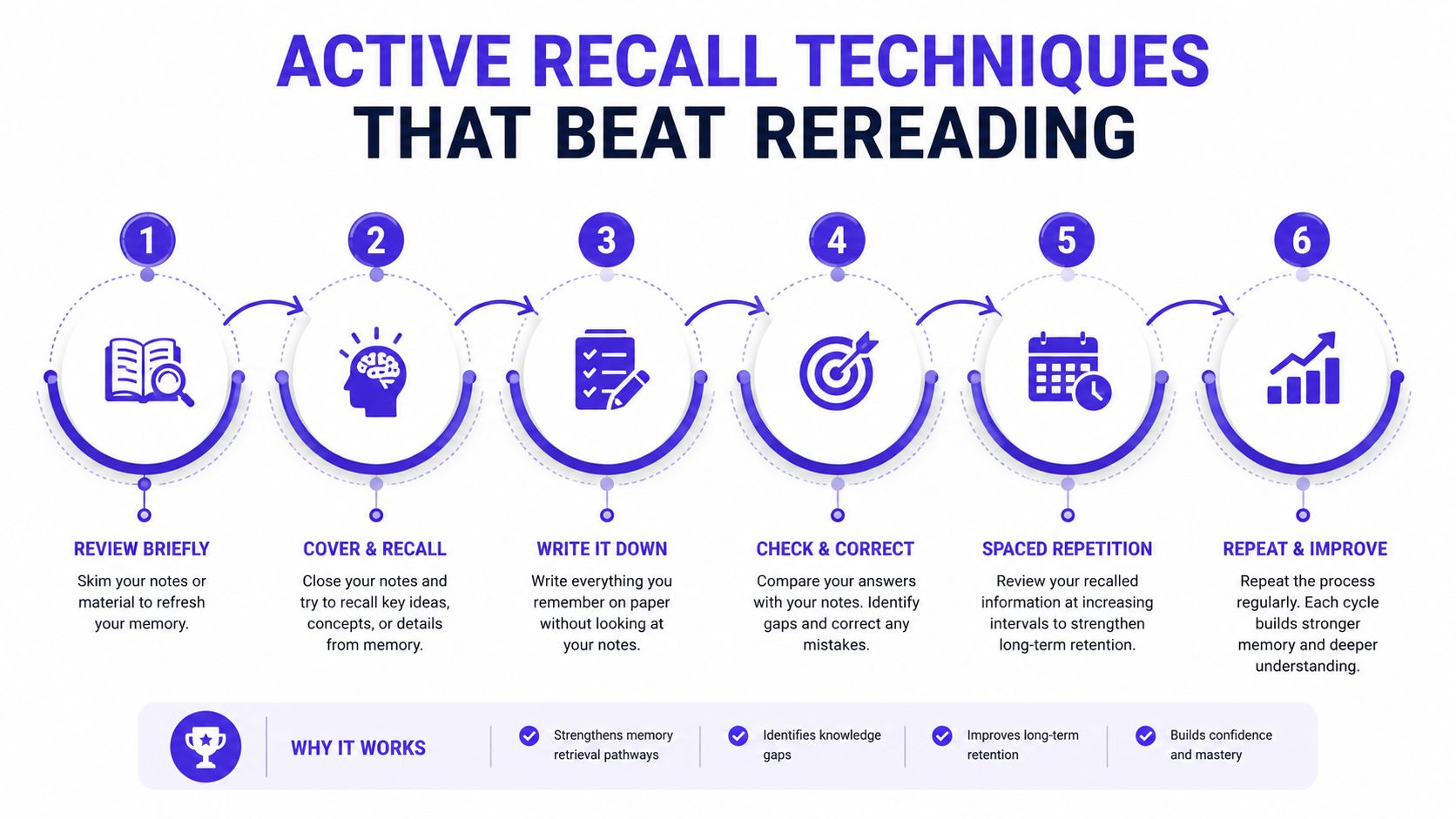
The Blurt Challenge: Take a blank A4 page and write everything you remember about one topic in five minutes. Use one colour for your first attempt and another for facts added after checking your notes. Repeat the page after 48 hours. Compare the missing ideas, not the neatness of your handwriting.
Low-stakes quizzing: End each 25-minute block with questions from Quizlet, Seneca, your textbook or your own exam-style prompts. Change the command word in some prompts. A question asking you to describe needs the relevant features or sequence, while one asking you to evaluate needs a judgement supported by evidence. Retrieving facts in the form the exam expects helps prevent lost marks caused by phrasing.
Turn mistakes into the next session
A wrong answer becomes useful when you identify its cause. Write “I knew the equation but converted minutes incorrectly” rather than “physics bad”. That precise note can become a flashcard, a unit-conversion drill or a question for your next review.
If you can only recognise the answer after seeing it, you haven't finished revising it.
Matching the Method to Biology, Chemistry and Physics
One blanket revision method creates avoidable problems. Biology often asks you to recall definitions, sequences and labelled structures. Physics and parts of chemistry ask you to select equations, use units, rearrange relationships and interpret a result.
For a quick triage, ask whether the task can be answered mainly from a diagram or keyword. If yes, it's probably fact-heavy and needs spaced retrieval. If you need numbers on the page, treat it as calculation-heavy and practise the structure of the solution repeatedly.
Choose the right tool
Biology terms such as enzyme, homeostasis and ecosystem can work well on flashcards, provided the cards ask for exact meanings or linked processes. Chemistry definitions also benefit from blurting, but mole calculations need worked examples followed by independent questions. In physics, don't just memorise that power is represented by P. Practise identifying the quantities, converting units and checking whether your final answer makes sense.
| Topic type | Example | Best method | Typical time |
|---|---|---|---|
| Fact-heavy biology | Definitions, processes and ecological keywords | Flashcards, blurting and read-cover-recite-check | One focused block, then spaced reviews |
| Fact-heavy chemistry | Required practical observations and key terminology | Question cards plus short written recall | One focused block, followed by application |
| Calculation-heavy physics | Equations such as P = IV and E = mcΔθ | Worked examples, formula cards and repeated calculations | Short, regular practice |
| Calculation-heavy chemistry | Mole calculations and formula use | Step-by-step drills with unit checks | Focused calculation block |
| Mixed application | Data, practical methods and unfamiliar contexts | Topic questions and mark-scheme analysis | Longer weekend practice |
A workable weekly rhythm could give Monday and Wednesday to biology recall, Tuesday and Thursday to physics calculations, Friday to chemistry calculation drills plus biology application, and the weekend to integrated past-paper questions. Adjust that pattern if your weak areas demand it, but don't let “I prefer biology” become a reason to avoid physics.
The point isn't to study every subject identically. It's to match the activity to the kind of thinking the question requires.
Exam Boards and Command Words Across AQA, Edexcel, OCR and WJEC
Command words tell you what shape your answer needs. They don't guarantee the number of marks, and the exact wording varies by paper, but they give you a reliable starting point across AQA, Edexcel, OCR and WJEC.
Your specification and past papers remain the authority. AQA Combined Science Trilogy, for example, has six written papers, each lasting 1 hour 15 minutes and worth 70 marks, with each paper worth 16.7% of the qualification. The course is available at Foundation and Higher tier. AQA's specification overview sets out that structure. OCR Gateway uses two exams per science, with papers covering topic groups and practical content, and each paper is 90 marks over 1 hour 45 minutes. OCR's question-paper guide explains that layout.
| Command word | What to write | AQA | Edexcel | OCR | WJEC |
|---|---|---|---|---|---|
| State | A short fact, name or value | Recall | Recall | Recall | Recall |
| Describe | What happens or what you observe | Sequence or features | Features or pattern | Observation or process | Features or pattern |
| Explain | A reasoned answer using scientific links | Point plus because chain | Linked scientific reasoning | Cause and effect | Scientific reasoning |
| Compare | Similarities and differences | Both sides | Both sides | Both sides | Both sides |
| Evaluate | Strengths, limits and a judgement | Evidence-based judgement | Evidence-based judgement | Evidence and conclusion | Data or context with conclusion |
| Calculate | Equation, substitution, answer and unit | Show working | Show working | Show working | Show working |
| Suggest | A scientifically sensible idea from context | Applied reasoning | Applied reasoning | Applied reasoning | Applied reasoning |
| Discuss | More than one viewpoint, then judgement | Balanced response | Balanced response | Balanced response | Balanced response |
The practical habit is simple. Underline the command word first. For explain, plan two clear points with linked reasons. For evaluate, include evidence, a limitation or counterpoint, and a justified conclusion. Describe doesn't require a reason, while explain does.
Tier matters too. AQA's assessment structure gives Foundation papers more low-demand content and Higher papers more high-demand content, while Pearson describes Foundation as aimed at grades 1–5 and Higher as aimed at grades 4–9, with an allowed grade 3 for candidates who narrowly miss the pass mark. Check your own board's guidance before choosing or discussing tiers. You can also browse past paper mark schemes to see how short answers differ from developed ones.
Two Worked Questions From Real Exam Style
The best way to improve exam technique is to narrate your decisions. Don't jump straight to an answer. Use the four-part scaffold: read, plan, write, check.
Calculation example
Question: A 2 kW heater runs for 30 minutes. Calculate the energy transferred.
Read: The quantities are power and time, and the requested quantity is energy.
Plan: Use the relationship energy transferred equals power multiplied by time. Convert kilowatts to watts and minutes to seconds before substituting.
Write:
2 kW = 2,000 W
30 minutes = 1,800 seconds
Energy = 2,000 × 1,800
Energy = 3,600,000 J
You could also express this as 3.6 MJ. The important marks come from choosing the relationship, showing the conversion and including a unit. A student who writes “3,600,000” without a unit may lose credit, depending on the mark scheme.
Check: Does the answer have the right energy unit? Is the size sensible for a heater operating for half an hour? Yes.
Extended-response example
Question: Evaluate the use of monoclonal antibodies.
Start with a benefit and explain the scientific reason. Monoclonal antibodies can bind to a specific target, so they can help detect or treat a particular substance or cell without affecting every cell in the body in the same way.
Add another developed point, then a counterpoint. Their specificity can make them useful in diagnosis, but producing or using them may involve practical limitations, side effects or cost. The exact detail must match the information given in the question and the knowledge expected by your board.
Finish with a judgement. Overall, monoclonal antibodies are valuable when their precise targeting provides a clear benefit, but their use should be judged against the risks and limitations in the stated context.
Don't repeat the question stem as your opening paragraph. Don't list disconnected advantages. An extended response needs linked reasoning and a conclusion that answers the word evaluate. Use GCSE Past Papers to practise this scaffold with real mark schemes.
Your Two-Week Timetable and Final-Week Checklist
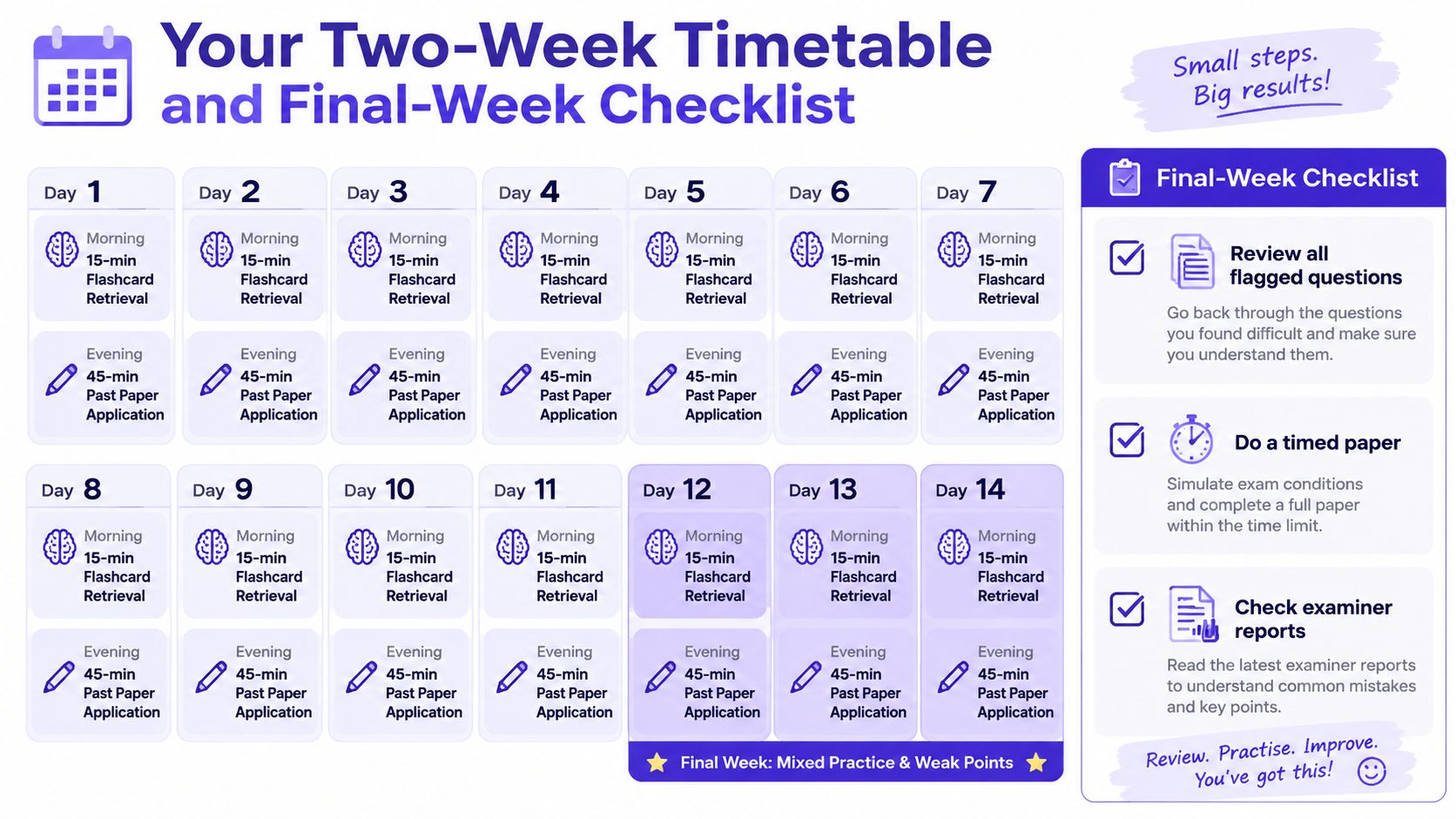
A two-week sprint should increase exam fitness without turning every day into panic. Use short morning retrieval to wake up the memory, then use evening application to practise the work your paper will demand.
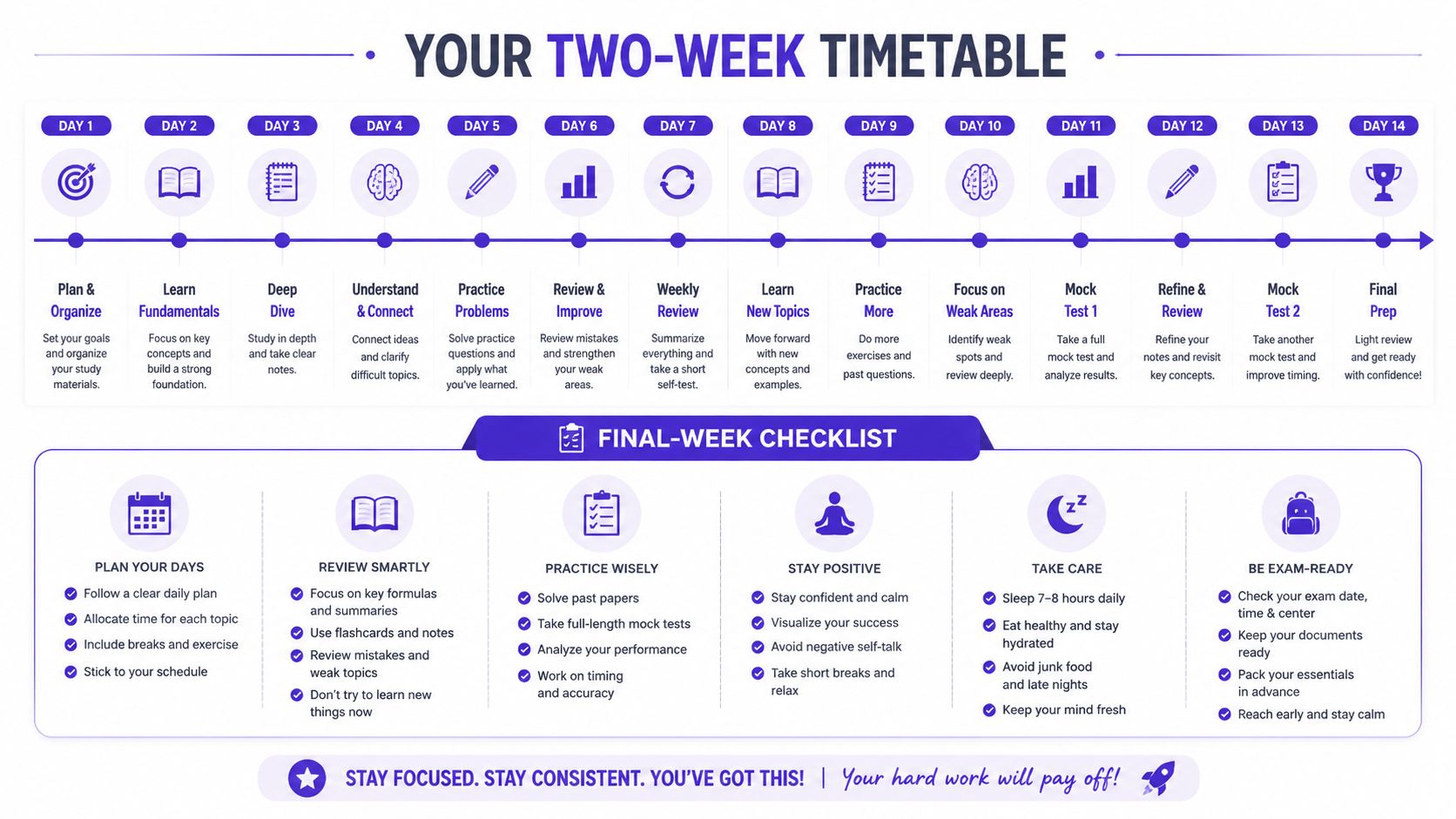
Days 1 to 7 build coverage
Each morning, complete a 15-minute flashcard blitz from your “not yet” pile. In the evening, spend 45 minutes answering past-paper questions by topic. Mark them straight away and turn every repeated error into a card, a blurt prompt or a calculation drill.
Use the Sunday review to inspect the week's mistakes. Move secure cards out of immediate rotation, keep uncertain cards close, and reshuffle the timetable towards the topics that cost you marks. Don't spend the whole session making a new timetable. Spend it deciding what needs another attempt.
Days 8 to 14 build exam fitness
In the second week, keep the morning retrieval, but shift evening work towards timed mixed questions and full papers under exam conditions. Drill command words separately, especially the ones you confuse, and include rest rather than treating tiredness as proof of commitment.
A simple pattern looks like this:
- Days 8 to 10: Complete timed sections, then review every error.
- Days 11 to 12: Attempt mixed-topic papers and practise extended responses.
- Day 13: Revisit personal weak spots and complete light retrieval.
- Day 14: Rest, organise equipment and do only a brief confidence review.
For the final 48 hours, avoid learning large new topics. Review familiar flashcards lightly, check your exam times and venues, lay out your equipment, pack water and snacks, and aim for early sleep on both nights. Complete one 20-minute confidence review of your personal weak spots, then stop.
A rested brain that can retrieve the essentials beats a tired brain carrying another unfinished video.
MasteryMind offers specification-aligned GCSE science quizzes, exam-style questions, spaced review scheduling and instant feedback across AQA, Edexcel, OCR and WJEC. Use it to turn the weak points from your timetable into targeted practice, then visit MasteryMind and start with the topics you're most likely to avoid.
Ready to master this topic?
Practise with quizzes, blurt exercises and exam questions on MasteryMind.
7 days Premium · Then free forever · No card, no charge