How to Revise History for GCSE and A-Level

You've got a half-finished timetable, three mock papers on the desk, and the uncomfortable feeling that you've memorised dates without understanding what caused anything. You've reread the same notes for weeks, yet your mock marks haven't moved. At this point, more highlighting won't rescue you.
The useful answer to how to revise history isn't another generic list of flashcards, blurting and past papers. History revision works when you treat it as a board-specific engineering problem. Your specification, paper structure, command words and weak skills determine what you should build and practise.
That matters because History remains a major UK qualification. JCQ reported 306,759 History entries in summer 2025, while 289,264 students sat History in England that year, according to the GCSE History entry and grade data. You're not revising for a subject that rewards vague enthusiasm. You're preparing for a structured assessment taken by hundreds of thousands of learners.
The system is straightforward: map the specification, build the right knowledge tools, train retrieval, then practise and correct exam responses. It works across AQA, Edexcel, OCR and Eduqas, but only after you adapt it to your exact papers. Whether you're in Year 11 or Lower Sixth, and whether you're recovering from weak preparation or chasing the highest grades, roughly 8 to 14 weeks is still enough time to make a serious climb if every session has a job.
When You Have Realised You Need to Get Serious
The panic usually arrives at an ordinary moment. You open your revision timetable and find large blank spaces. Your notes cover the causes of the First World War, but not the consequences. You know the date of the Treaty of Versailles, but if somebody asks whether it was the main reason for German resentment, your answer turns into a list.
A Year 11 student might tell herself, “I've revised this already.” What she means is that she's looked at it repeatedly. A Lower Sixth student might say, “I just need to remember more detail.” What he often needs is a clearer argument, better selection and a way to connect evidence to the question.
The uncomfortable diagnosis: rereading creates recognition, but examiners award marks for what you can retrieve, explain and judge without the page in front of you.
History isn't one single skill. A paper can test factual knowledge, causation, consequence, change, significance, source utility, interpretations or sustained judgement. Your exam board decides how those skills appear, so a revision method that suits one paper can waste time on another.
The four-part build
Start by treating your revision like a design job.
- Specification mapping: identify only the topics your school teaches and the questions your papers can ask.
- Revision artefacts: choose a timeline, organiser or source book based on the skill required.
- Retrieval training: practise recalling causes, consequences, interpretations and evidence without notes.
- Exam correction: write responses under realistic conditions, then diagnose the exact reason marks were lost.
This approach also helps teachers assess whether revision is producing genuine historical thinking rather than decorative notebooks. A useful outside resource for broader historical context is the history guide for delegates, particularly when a topic needs more than a textbook summary. For structured practice, you can also use Online Revision for GCSE to work through curriculum-aligned questions.
Your first job isn't to study harder tonight. It's to stop revising blindly. By the end of one focused afternoon, you should know which paper contains each topic, which command words appear, and which skill is currently holding your mark down.
Mapping Your Specification and Command Words
Download the official specification PDF from your exam board's website. Treat it as the single source of truth. Your textbook, teacher's booklet and revision website can explain the content, but the specification tells you what belongs in your examinable world.
Create a spreadsheet with one row for every topic or specified content block. Add columns for:
- Paper and section: record whether the topic belongs to Paper 1, Paper 2 or Paper 3.
- Content: list the required events, people, factors and interpretations.
- Question skill: mark whether the paper tests explanation, source work, significance, interpretations or another skill.
- Evidence: add dates, examples, policies and consequences you can use precisely.
- Confidence: use red, amber or green, based on what you can recall without notes.
- Next action: write “make causal chain”, “practise source utility” or “plan judgement”, not “revise”.
England's current History programmes of study were published by the Department for Education on 11 September 2013, and the government's Curriculum and Assessment Review reported that GCSE History take-up rose from 31% in 2009/10 to 42% in 2024/25, with 90% of state-funded schools entering students for GCSE History in 2024/25. The same review recorded A-level History's share of A-level entries slipping from 6% in 2009/10 to 5% in 2023/24. These figures reinforce a practical point, History is widely taught, but your exact course combination still determines your revision workload. Read the History programmes of study and review information rather than relying on a generic checklist.
Command words change the shape of the answer
A command word isn't decoration. It tells you what the examiner wants you to do with knowledge.
- AQA: “explain” requires developed reasons or consequences, “evaluate” requires a supported judgement, and “how far do you agree” requires weighing an interpretation or claim against alternatives.
- Edexcel: “assess the value” requires a judgement about usefulness, while source questions demand attention to content, provenance, context and limitations.
- OCR: “to what extent” requires a balanced judgement, while “analyse the reasons” requires comparison of relative importance rather than a chronological retelling.
- Eduqas: “examine the significance” asks you to judge importance, while contextual source analysis requires you to use the source alongside relevant historical knowledge.
| Exam Board | Common Command Words | What It Demands | Paper Weighting |
|---|---|---|---|
| AQA | Explain, evaluate, how far do you agree | Developed explanation, evaluation and a supported overall judgement | Check your official specification |
| Edexcel | Assess the value, explain, how useful | Judgement about value or utility, supported by content and provenance | Check your official specification |
| OCR | To what extent, analyse the reasons, explain | Relative importance, balance and analytical explanation | Check your official specification |
| Eduqas | Examine the significance, explain, analyse | Judgement about importance and contextual source analysis | Check your official specification |
The exact paper weighting varies by qualification and route, so don't copy a table from another student. Use your specification to confirm marks, timing and topic combinations. A MasteryMind history subject page can provide another organised place to practise, but it shouldn't replace your board's own document.
By the end of this step, your checklist should be colour-coded and brutally clear. You should be able to point to every Paper 1, Paper 2 and Paper 3 topic, identify its question types and name the skill you need to improve.
Building Timelines, Knowledge Organisers and Source Books
Students often build the tool they enjoy making rather than the tool the exam requires. A beautifully formatted timeline won't help much if you can't explain why an event mattered. A thick folder of notes won't prepare you for a source utility question unless you've practised provenance and limitations.
Use three artefacts for three different jobs.
The timeline gives you the spine
A timeline should be selective, not a biography of the entire period. Include turning points, causal arrows and roughly 8 to 12 dates per topic. That range is a practical organising guide, not a fact about exam requirements. The aim is to make sequence and causation visible.
For the Treaty of Versailles, your timeline might connect the end of the First World War, the peace negotiations, the treaty terms, German reactions and later political consequences. Add arrows such as “war guilt clause contributed to resentment” rather than copying paragraphs.
The organiser carries the argument
A knowledge organiser should fit on a dense A4 page. Include causes, events, consequences, key individuals, historians, interpretations and short quotations where your course requires them. This is the tool for a content-heavy extended response because it helps you retrieve evidence in categories rather than narrate the textbook.
A source book has a narrower purpose. Keep primary and secondary extracts together with notes on provenance, context, purpose, audience, useful evidence and limitations. Build it when your paper demands source analysis, such as AQA Source A/B questions or Edexcel source utility work.
| Artefact | Main purpose | What to include | Best exam use |
|---|---|---|---|
| Timeline | Chronology and causation | Turning points, arrows and selected dates | Breadth and sequence questions |
| Knowledge organiser | Dense factual and interpretive recall | Causes, consequences, historians and evidence | Extended explanation and judgement |
| Source book | Analysis and evaluation | Extracts, provenance, context and limitations | Source utility and contextual analysis |
For practical guidance on create a study guide that works, focus on whether the guide helps you answer a question, not whether it looks impressive.
Build the organiser first, because it reveals what you know. Build the timeline second, to secure chronology. Build the source book only when your paper requires source analysis. If you're spending more time designing pages than answering questions, stop.
Active Recall That Sticks for History
If you can recognise a page of notes but cannot answer a question without looking, your revision is failing at the point the exam begins. History revision must make you retrieve knowledge, turn it into an explanation and correct weak answers before those errors become habitual.
Match the method to the skill
Answer-based flashcards should test usable historical thinking. Avoid writing “Treaty of Versailles” on one side and a page of notes on the other. Ask, “Why did the Treaty of Versailles create resentment in Germany?” or “What was one consequence of the treaty for German politics?” The answer needs a concise explanation supported by precise evidence.
Answer aloud before turning the card over. Remove a prompt after you have answered it correctly twice, but bring difficult cards into the next session. Creating hundreds of attractive cards is wasted effort if you rarely answer them.
Blurt voice sessions reveal gaps that silent reading conceals. Set a historical problem, speak without notes in a timed burst, record the response, then compare it with a mark scheme or model answer. You will hear vague chronology, missing links and extended description quickly. The test is whether you can construct an explanation under pressure, not whether the recording sounds polished.
Source drills require a separate routine. Before checking the extract, identify its type, provenance, context, purpose, audience, useful evidence, limitations and relevant corroborating knowledge. Compare your prediction with the actual source afterwards. This develops selection and evaluation rather than simple factual recall.
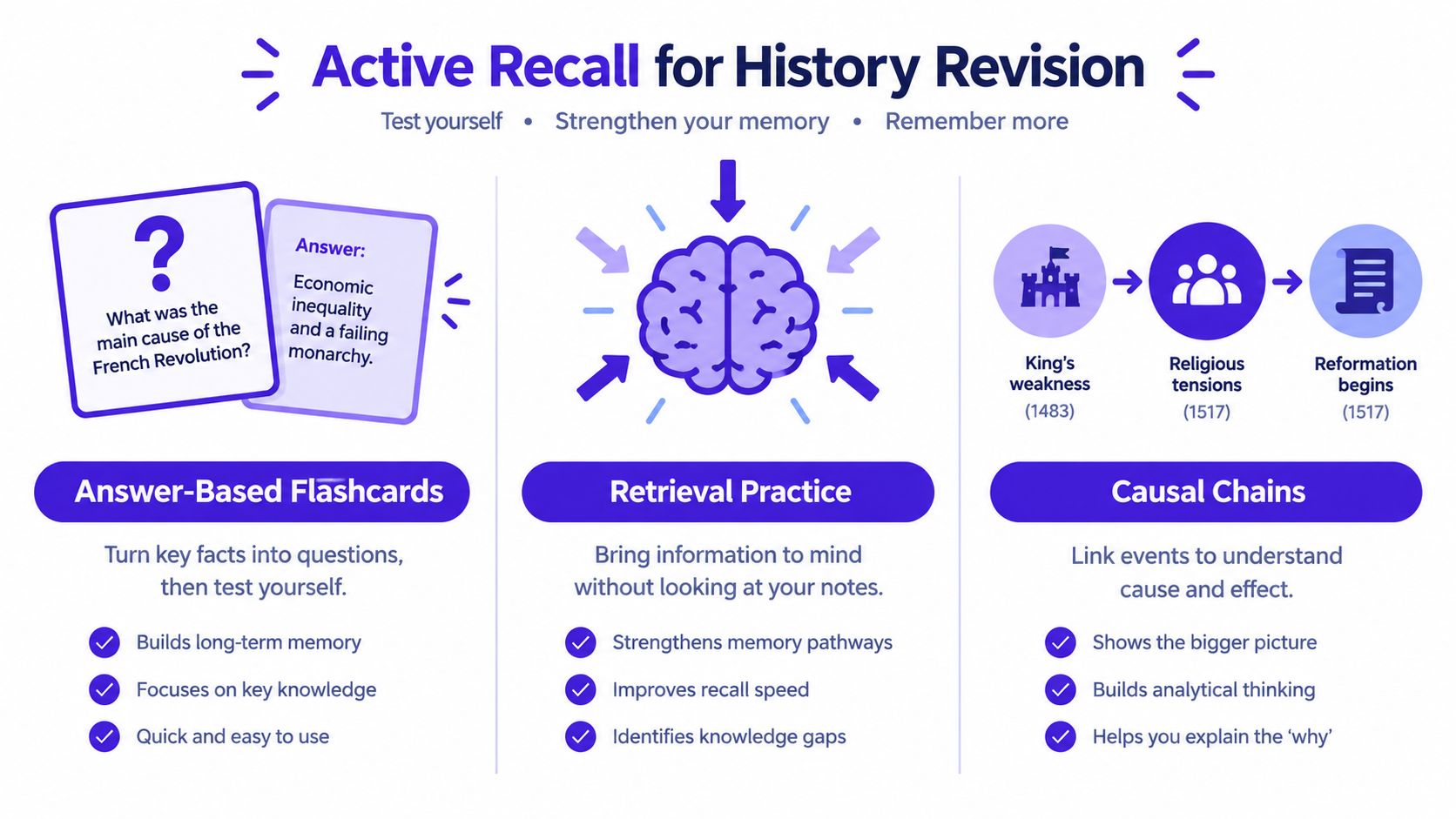
| Method | Main Skill | Best Use |
|---|---|---|
| Answer-based flashcards | Factual links and precise evidence | Causes, consequences, similarities and differences |
| Blurt voice recall | Explanation and essay fluency | Testing whether you can sustain an argument |
| Source drills | Selection, provenance and evaluation | Preparing for source questions |
Match the drill to your board's paper structure and command words. A source question needs provenance and evaluation, while an explanation question needs connected evidence and a clear line of reasoning. Use practise active recall with curriculum-aligned questions for prompts that resemble your course requirements.
Always combine retrieval with feedback. Repeating an incorrect explanation without correcting it rehearses the error.
Planning Essays for the 16 and 24 Mark Bands
High-mark essays aren't rewarded for retelling everything you know. They're rewarded for selecting relevant knowledge, developing an argument and reaching a judgement that answers the exact question.
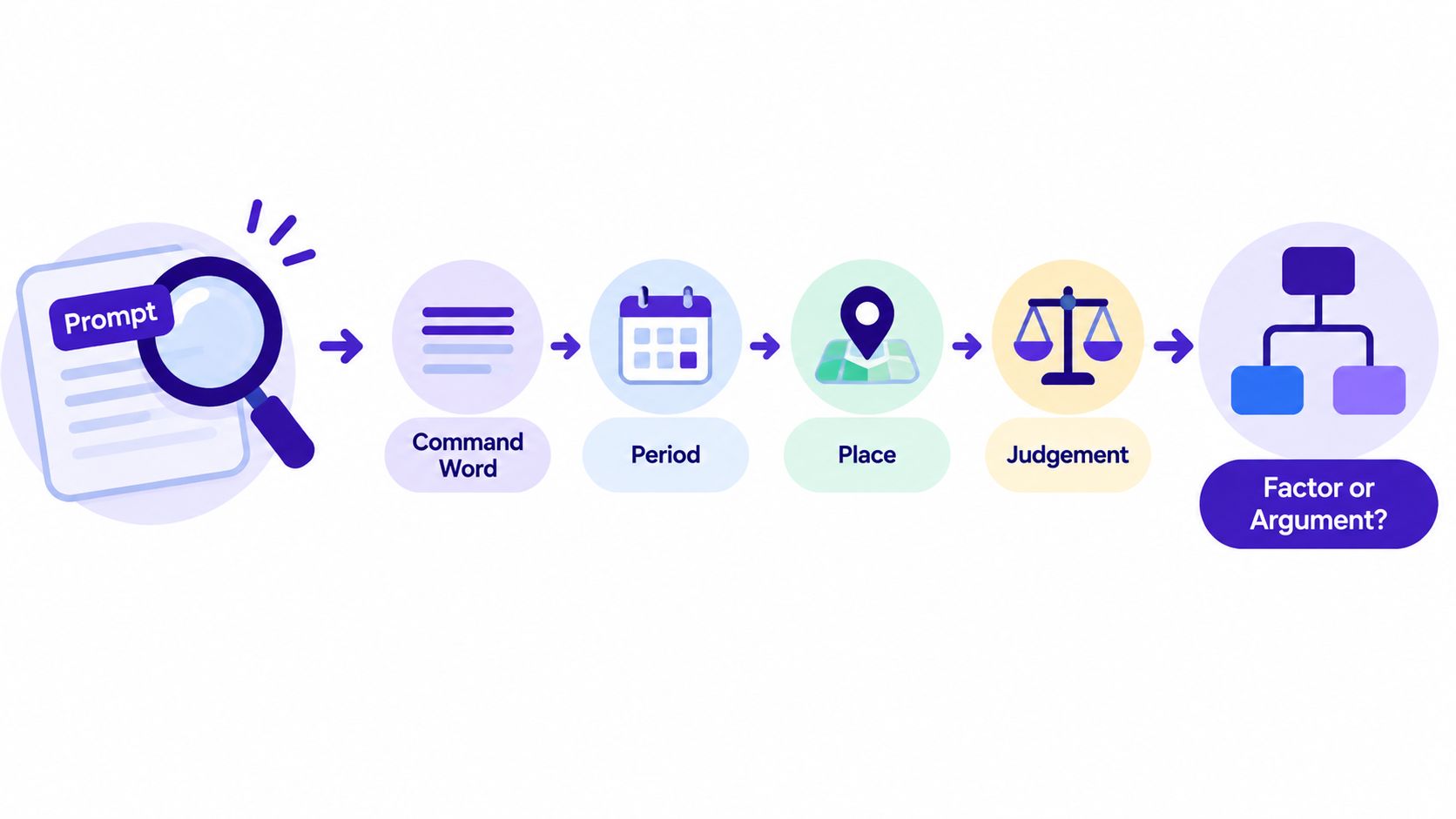
Read the prompt twice. Underline the command word, period, place and issue. Then classify the task as a question about factor, consequence, change, continuity, significance or interpretation.
Build the argument before the paragraphs
For a 16-mark question, spend roughly five minutes planning. Choose the factor or interpretation with the strongest support, decide how far it matters, group evidence in a logical order and write an introduction that answers the question directly.
Use this chain for each paragraph:
- Claim: make a clear judgement about the issue.
- Evidence: provide accurate, specific knowledge.
- Analysis: explain how the evidence supports the claim.
- Counterpoint: test the claim against another factor or interpretation.
- Link: return explicitly to the wording of the question.
Suppose the prompt asks whether the Treaty of Versailles was the main reason for German opposition to the Weimar Republic. A weak paragraph lists the treaty terms. A stronger one explains how particular terms generated resentment, then weighs that resentment against other causes, such as economic or political instability, using only evidence relevant to the question.
A 24-mark essay needs a sharper line of argument. Organise causes by changing importance, consequences by short-term and long-term effects, or interpretations by the strength of their supporting evidence. Your introduction should define the issue and state a thesis. Each paragraph must advance that thesis, and the conclusion should give a qualified judgement rather than repeat the paragraphs.
A plan with an argument, evidence, counterpoint and paragraph logic is more valuable than memorising a full model essay.
Practise one prompt twice. The first attempt tests whether you know the content. The second tests analytical quality. During correction, ask whether every paragraph answers the exact question, uses accurate chronology, links causes to consequences and moves beyond narrative.
A Practice Question Routine That Lifts Grades
You can know a topic well and still lose marks because you have not practised the decisions each paper demands: selecting evidence, managing time, judging importance and correcting weak reasoning. Build your routine around your board's paper structure and command words, not around long, infrequent cramming.
Use a short cycle that repeats each week. Complete one substantial source or essay task under timed conditions, then mark it in a fixed order:
- Requirement check: compare your response with the mark scheme and identify each explicit requirement you met.
- Error scan: highlight unsupported claims, missed chronology, irrelevant evidence and undeveloped judgement.
- Rewrite: replace the weakest paragraph with a clearer thesis, stronger evidence and a direct link to the question.
- Next target: write one sentence naming the next revision action.
A workable rhythm is:
| Day | Main task |
|---|---|
| Monday | Learn and organise one topic |
| Tuesday | Practise source work |
| Wednesday | Write one analytical paragraph |
| Thursday | Complete an essay or extended response |
| Friday | Correct errors and revisit weak areas |
| Weekend | Complete one mixed retrieval session |
Match practice to the demands of your board. Use short knowledge questions before timed essays, familiar topics before unfamiliar applications, and 16-mark responses before 24-mark demands. This shows whether the weakness is missing knowledge, poor structure or slow writing. Keep a spaced repetition explained for students schedule so weak content returns before it disappears.
Record the question, mark achieved, available mark, time taken, error category and next target. Replace “I did badly” with a precise diagnosis such as “missed provenance point”, “narrated two paragraphs” or “couldn't compare factors”. Ten focused questions followed by careful correction can teach more than rereading a whole chapter.
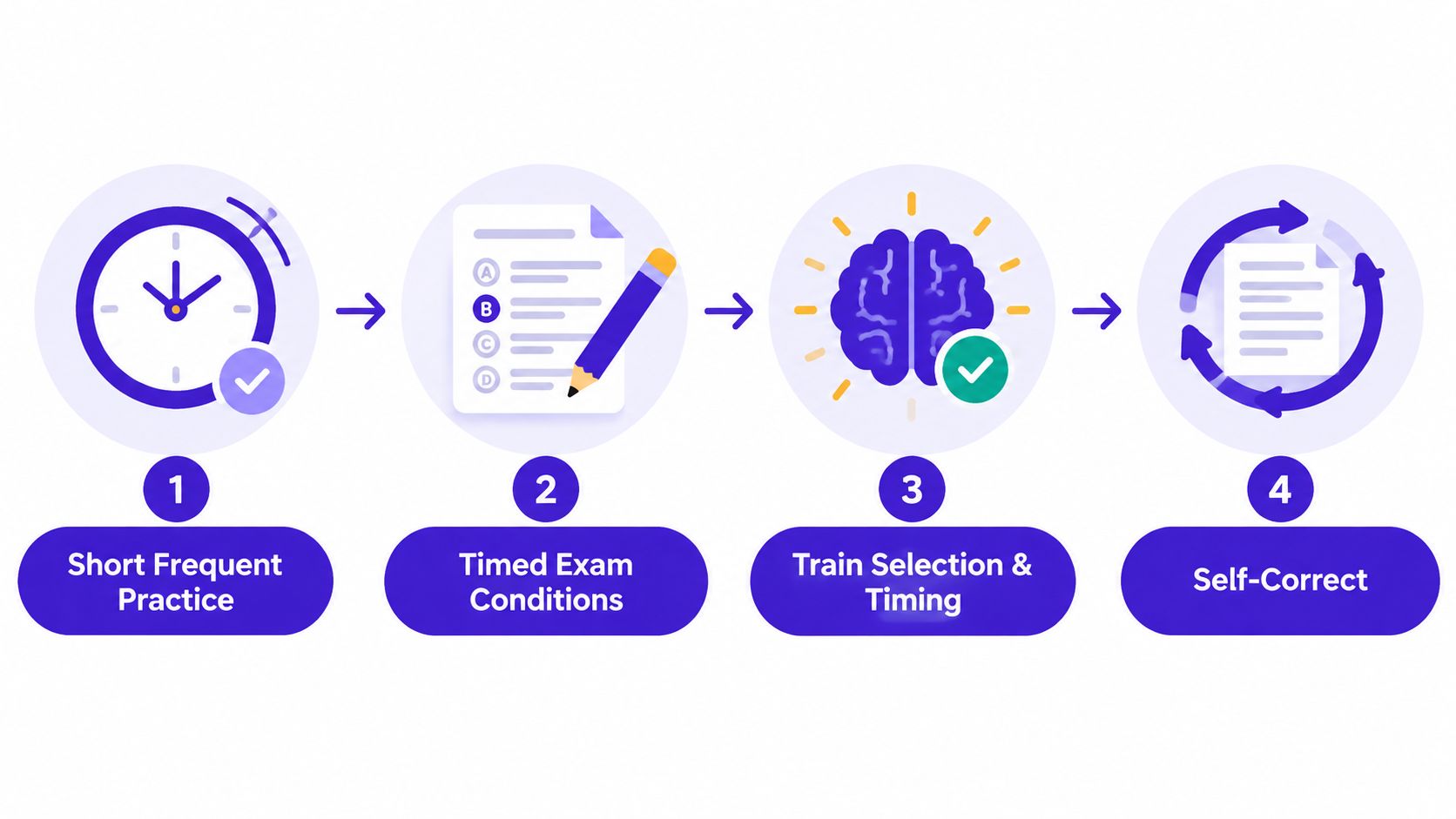
Use this routine when you practise:
If knowledge is missing, return to retrieval. If structure is weak, plan before writing. If timing is poor, practise timed sections instead of leaving the whole response open-ended.
Spaced Repetition, Mixed Topics and Tracking Progress
A topic you revised on Monday should return before Friday, then appear in a different exam task. Build a 2-3-5-7 ladder around each knowledge block: review new material the next day, revisit it after three days, return after five days, then complete mixed practice after seven. Guidance on spaced repetition supports scheduling repeated retrieval and planning backwards from the exam.
Match each return to your exam board. AQA's explanation, significance and interpretation questions, Edexcel's explain and assess demands, OCR's explain and how far questions, and Eduqas's explain and evaluate wording require different responses. Put the command word beside each review task. First retrieve key facts. Next answer a source question. Later plan a 16-mark response, compare factors, or write a timed paragraph. The test is whether your knowledge still works when the wording and context change.
Use a tracker with four columns:
- Topic: name the precise content block.
- Last score: record the mark from a question or timed response.
- Next due date: schedule the next retrieval pass.
- Weakest command word: identify the demand that exposed the problem.
Mix periods, topics and skills within one 90-minute block. Retrieve one modern topic, analyse a source from another and plan an essay from a third. This prevents you memorising the order of your notebook and matches papers that shift between themes, periods and question types.
Review the tracker on Sunday for ten minutes. Remove a card only after three successful recalls in a row. If a response fails under timed conditions, return that topic to the front of the queue. A tracker earns its place only when it changes next week's plan.
The wider exam context explains why recall alone is not enough. JCQ data reported 64.8395% of UK History candidates reaching at least grade 4/C in summer 2025, while 96.3809% achieved at least grade 1/G, as shown in the 2025 GCSE History results data. Your routine must therefore move from remembered facts to explanation, source use and judgement.
Use digital tools with clear boundaries. JCQ guidance allows AI in assessments only when it is referenced as required, and submitting AI-generated work as your own is malpractice. Use AI for prompts, questioning and feedback where your school permits it. Keep assessed work your own and follow your centre's rules.
Open your specification this afternoon. Colour-code each paper, list its command words and create the tracker before your next session. For board-specific practice, feedback and spaced review across GCSE and A-level History, visit MasteryMind and begin with the topic and command word you currently avoid.
Ready to master this topic?
Practise with quizzes, blurt exercises and exam questions on MasteryMind.
7 days Premium · Then free forever · No card, no charge