How to Revise Science and Actually Remember It
You've got a science exam coming up, your folder is full of neat notes, and yet a past-paper question makes your mind go blank. You recognise the topic when you see it, but recognising an answer isn't the same as producing it under pressure. Whether you're trying to recover after doing too little revision or aiming for the highest grade, how to revise science comes down to three linked jobs: learn the content, retrieve it without help, and use it in the form the exam rewards.
That approach works across GCSE and A-Level biology, chemistry and physics, but it shouldn't mean blindly following a generic checklist. Your exam board, command words, weak topics and available time all matter. The practical system below is designed to help students make progress while giving teachers a clear, evidence-informed structure they can inspect and adapt.
Why Most Science Revision Feels Busy But Does Not Stick
It is late, your science book is open, and your desk is covered with highlighted pages. You copy the definition of an enzyme into a fresh notebook and watch a revision video. The work looks organised, so the session feels productive. The next morning, however, you cannot explain why temperature affects enzyme activity without checking your notes.
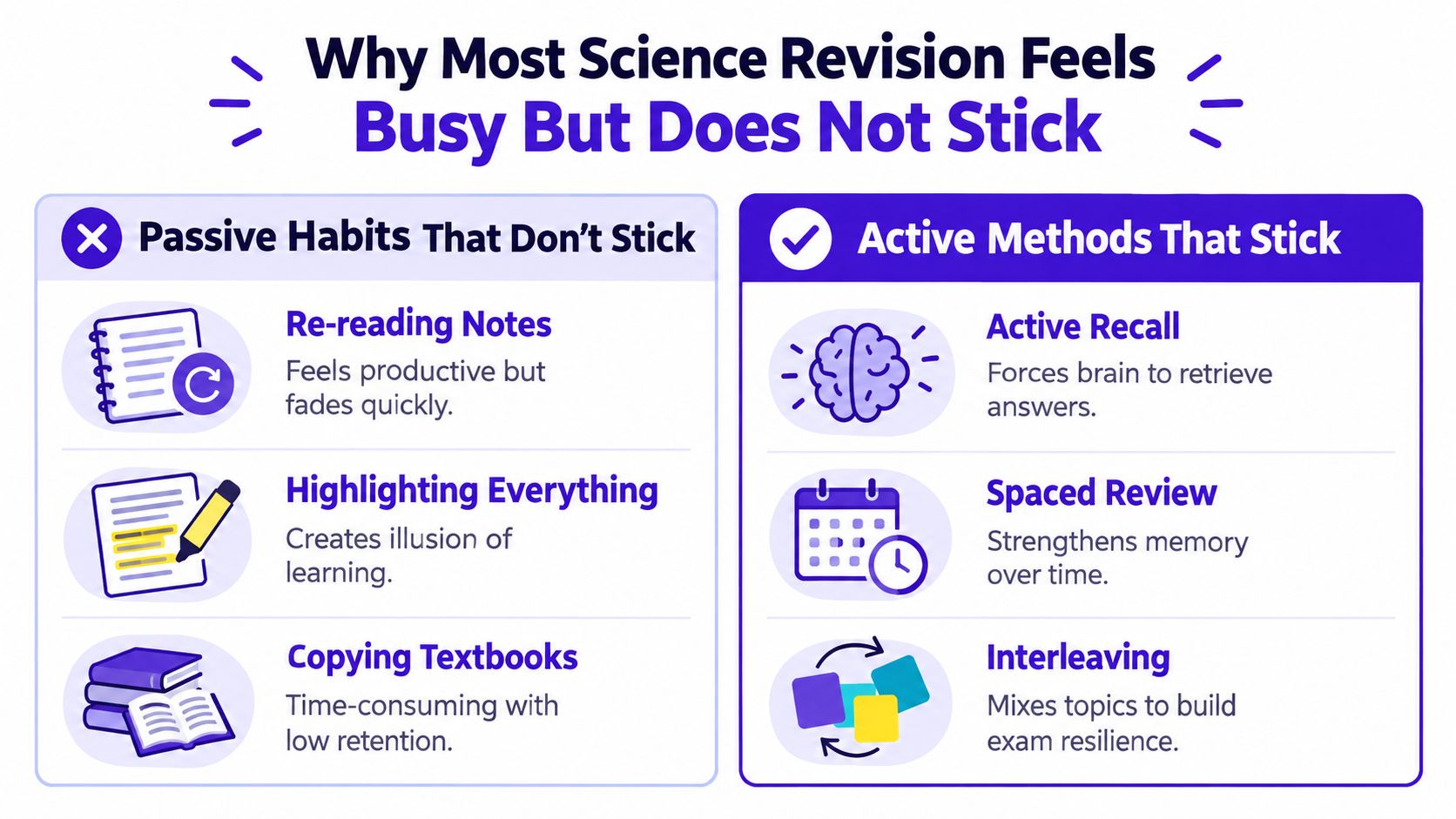
That happens because passive review creates familiarity, not dependable recall. A 2025 UK study of secondary school science revision found that students commonly made notes, reread information, and highlighted or underlined it, although these methods have lower utility for long-term retention according to the study's findings. Notes and highlighting still have a place while you first organise unfamiliar material. They become a problem when they take up most of your revision time.
Familiarity is not exam readiness
Rereading the stages of mitosis can make the words feel easy. Then an exam asks you to describe the process, and the order, terminology, or required detail disappears. The same gap appears with equations, required practicals, and chemical tests. You have practised recognising information, rather than pulling it out of memory.
Active recall reverses the direction of study. Close the notes and answer a question. Draw a circuit from memory. Balance an equation without copying the method. Explain osmosis to someone who has never studied it. Every attempt shows which parts you can produce and which parts still need work.
Practical rule: If your notes are open while you answer, you are studying the answer. If they are closed, you are testing your memory.
Match that testing to the way marks are awarded. A state question needs a precise fact, while describe usually needs an organised account of what happens. Explain requires a linked reason and outcome, and calculate requires a method as well as a final value. Mark allocation matters too. A one-mark recall point does not need the same response as a longer question testing application or analysis. Revising command words alongside content helps you practise producing the kind of answer the paper can credit.
Retrieval works best with spacing and correction. The University of Birmingham City guidance on active recall describes bringing information out of memory instead of repeatedly reading it, then reviewing it again later. Pupils need to learn knowledge securely before retrieval practice, and feedback must correct misconceptions rather than allow an incorrect answer to become familiar. Use a mark scheme, specification checklist, reliable textbook, or teacher explanation to check your work.
Practical work and models can give abstract ideas a physical shape. If diagrams or demonstrations help you connect cause and effect, choose resources that deepen learning with hands-on activities. Under time pressure, triage first: prioritise weak topics, high-mark command words, and questions where feedback can quickly improve your next answer.
Building a Science Revision Routine That Fits Real Life
A workable routine doesn't require perfect evenings or marathon sessions. It needs a clear sequence, so each topic moves from understanding to recall, correction and application. You can use the same structure for KS3, GCSE or A-Level, then adjust the difficulty and amount of content.
Start with a small learning target
Choose one manageable objective, such as explaining diffusion, calculating resistance, or describing how ions form. Read the relevant notes or watch a focused explanation, then put the resource away. Don't spend the whole session making the page attractive. Your first test is whether you can explain the idea clearly and identify the key terms the specification expects.
Next, run a short closed-book recall check. Write everything you can remember, answer a handful of questions, or speak an explanation into your phone. The University of Birmingham City spaced-repetition cycle recommends returning to material after the lesson, the next day, later in the week and again after a longer gap. The exact timetable can flex around school, homework, sport and work, but the principle stays stable: return after forgetting has begun, not only while the topic still feels fresh.
A simple weekly pattern might look like this:
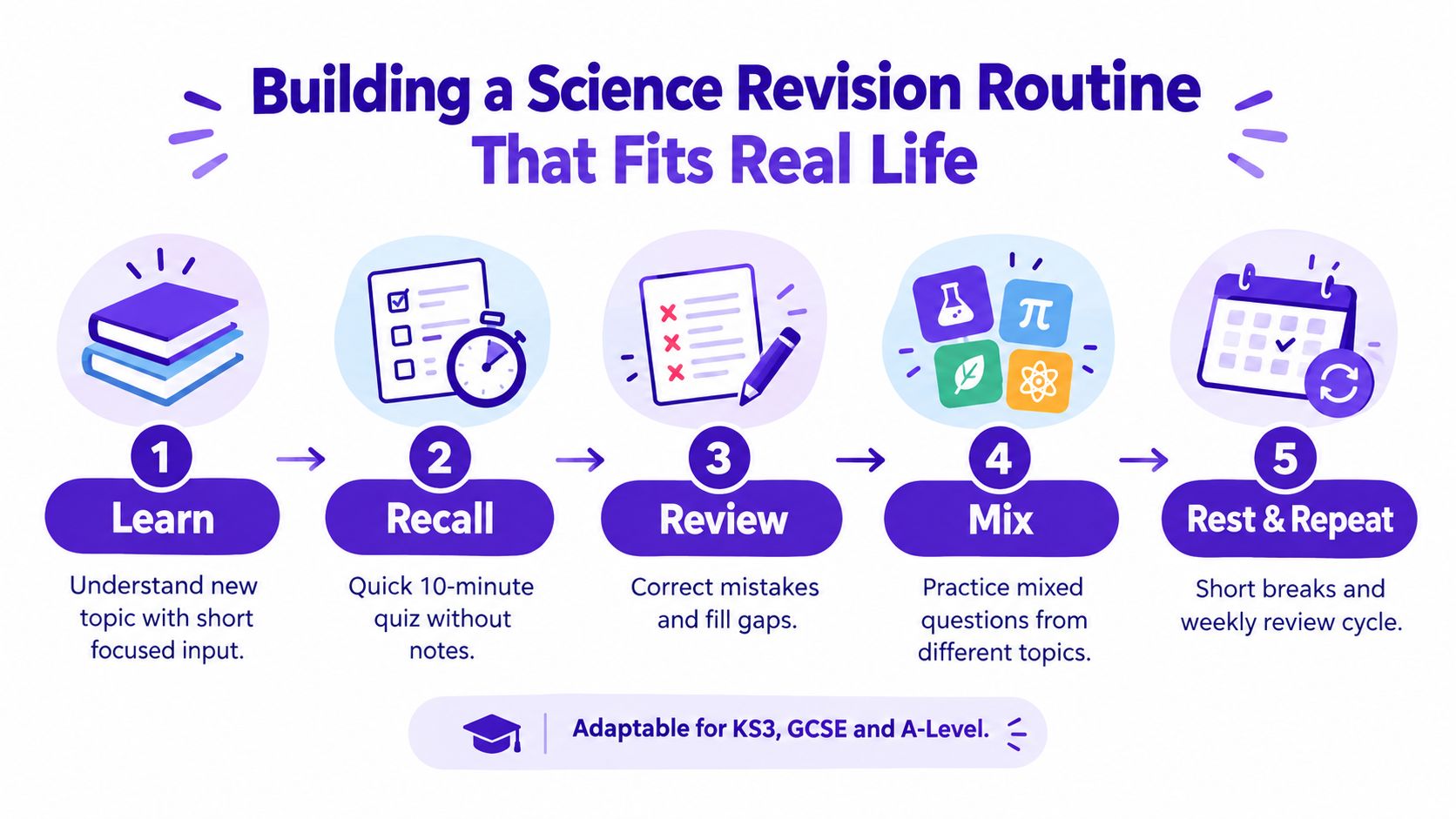
- Learn: Understand a focused idea using class notes, a textbook or a teacher-approved resource.
- Recall: Test the idea without notes. Include a diagram, definition, equation or explanation where appropriate.
- Review: Check every response, correct errors and write a short note explaining why the correction is needed.
- Mix: Add questions from older biology, chemistry or physics topics rather than staying inside one chapter.
- Rest and repeat: Take short breaks, then schedule the next review before you finish.
Know when to stay and when to move
Don't keep revising a topic because it feels difficult. First, check whether the error is a missing fact, a misunderstanding, a calculation mistake or a response-structure problem. If you can recall the core idea and answer straightforward questions, move on and revisit it later through mixed practice. If you can't explain the foundation, spend a short focused period relearning it before testing again.
For a busy student, a short daily recall session is more valuable than an occasional exhausting evening that ends with copying notes. A teacher can support this by using brief retrieval starters, correcting misconceptions immediately and making the intended knowledge clear before asking pupils to retrieve it. The routine should reduce decision-making, not create another source of stress.
Active Recall Techniques That Make Science Memorable
Active recall works best when the question demands the kind of thinking your exam demands. A vague instruction such as “revise cell biology” is hard to act on. A prompt such as “Describe how a red blood cell is adapted for oxygen transport” tells you what to retrieve and what shape the answer needs.

Turn notes into questions
Take a page of notes and convert each important statement into a prompt. For chemistry, write “What happens to particles when a substance changes state?” For physics, ask “How is power calculated, and what do the symbols represent?” For biology, ask “What is the role of the villi in the small intestine?”
Then use the questions with the notes closed. Don't just check whether the answer sounds familiar. Compare your response against the specification or mark scheme and identify the missing part. A definition may need precise wording. A calculation may need a unit. A process may require the correct sequence and a link between cause and effect.
The Blurt Challenge is useful when you want a fuller answer. Choose a topic, speak or write everything you know, then compare it with the curriculum objectives. Circle omissions in one colour and incorrect statements in another. Your next quiz should target those gaps instead of repeating questions you already answer comfortably.
Explain it as if you're teaching
The Feynman technique is a plain-language explanation test. Pick a concept such as electrolysis, natural selection or momentum, and explain it to an imaginary younger pupil without reading from the page. If you use a word like “energy” or “equilibrium”, define it rather than hiding behind it.
When the explanation breaks down, return to that precise point. You might know that enzymes are affected by temperature but not be able to explain denaturation, or remember the equation for density but not know how to rearrange it. That breakdown is useful because it shows what to study next.
For a board-aligned version of this process, the MasteryMind revision strategy uses active recall and targeted follow-up questions to connect spoken or written responses with curriculum objectives. You can reproduce the same method with paper, a voice recording and a specification checklist.
Test different forms of knowledge
Science exams don't only ask for isolated facts. Rotate through:
- Recall: State the equation for work done.
- Application: Use the equation in an unfamiliar situation.
- Explanation: Link each step in a process to the next.
- Practical reasoning: Identify variables, controls, risks or limitations.
- Evaluation: Judge a method or claim using evidence.
A good recall session therefore includes a mixture of flashcard-style prompts, diagrams, calculations and short exam questions. If you miss an answer, don't immediately reread the entire chapter. Write the smallest correction that fixes the problem, then test it again later.
How to Revise for Marks Not Just Topics
Knowing the topic is only half the job. A student may understand photosynthesis and still lose marks by giving a vague explanation when the question asks them to compare, calculate or evaluate. Command words tell you what kind of performance the examiner wants, while mark allocation signals how much developed content the answer probably needs.
The precise assessment-objective balance varies across AQA, Edexcel, OCR and WJEC, so use your own specification and mark schemes rather than assuming one board's wording applies everywhere. Public revision advice often recommends past papers and command words, but students still need to practise the difference between a short recall response, a developed explanation and an evaluation.
Match the task to the response
| Question Type | What Examiners Reward | Best Revision Drill |
|---|---|---|
| One-mark state or name question | The exact fact, term, unit or value requested | Use closed-book quick-fire cards and practise concise answers |
| Explain question | A linked chain of scientific ideas, not a list of disconnected facts | Write cause-and-effect sentences, then compare them with the mark scheme |
| Calculate question | Correct equation, substitution, working, answer and unit where required | Cover the worked example and solve a similar problem from memory |
| Compare question | A clear similarity or difference using both sides of the comparison | Build paired statements, such as aerobic versus anaerobic respiration |
| Evaluate question | A justified judgement that uses evidence, limitations or context | Practise weighing advantages and disadvantages before reaching a conclusion |
| Required practical question | Accurate method, variables, measurements, safety and evaluation | Reconstruct the method from prompts, then answer unfamiliar practical scenarios |
A four-mark explain question usually needs more than a definition. Suppose the question asks you to explain why increasing temperature can initially increase enzyme activity. A strong answer links temperature to particle movement, collision frequency and successful enzyme-substrate interactions. It then recognises the point at which the enzyme's structure changes, rather than stopping at “the particles move faster”.
A longer evaluative response needs a decision supported by science. Listing benefits and drawbacks without deciding which matter most leaves the examiner to do the reasoning for you. Practise writing a final judgement that directly answers the question and follows from the evidence you've used.
Build command words into every session
Don't leave command-word practice until the final past paper. Take one topic and ask it in several modes: “State the function”, “Describe the process”, “Explain the result”, “Calculate the value”, and “Evaluate the method”. This exposes whether your difficulty is knowledge, interpretation or written communication.
Use examiner-style feedback rather than guessing why a mark was lost. The Exam Practice for GCSE approach is one example of practising questions with attention to board, command word and mark allocation. A paper is most useful when you review the missed marks and turn each error into a new, targeted question.
Spaced Review and Mixed Practice Without the Overload
When time is short, revising every chapter in order feels sensible but can waste precious effort. You might spend an evening polishing a topic you already remember while a frequently forgotten, high-value area receives no attention. A better triage system ranks topics by forgetting risk, likely exam value and the type of mistakes you make.
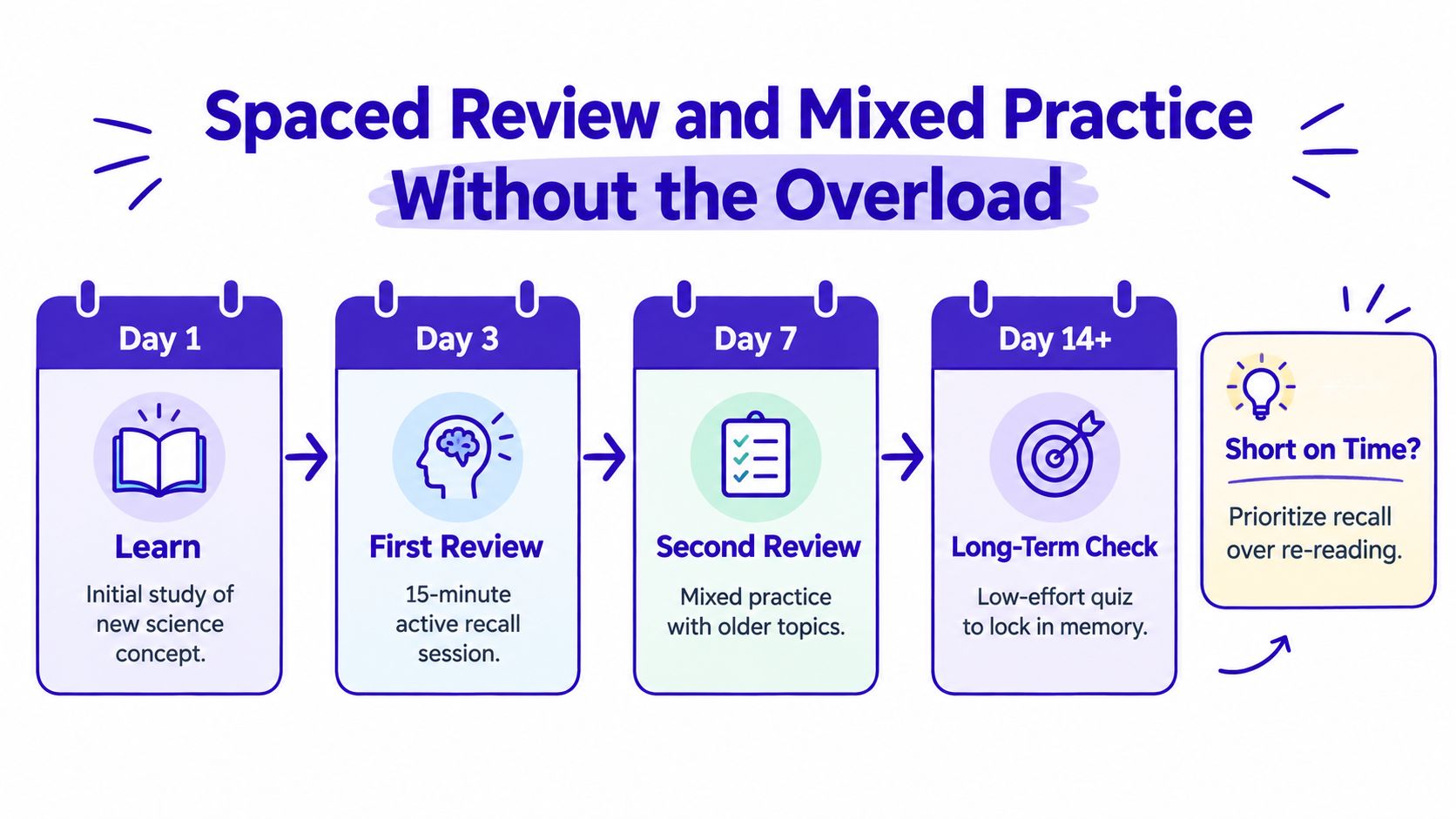
For students with more time, use a repeating calendar. A University-linked GCSE guide gives a practical pattern of Day 1 learning, Day 3 review, Day 7 testing, Day 14 attention to weak areas and Day 30 final recall checking in its month-long revision example. The dates aren't magic. They create enough separation for you to discover whether the memory is still available without notes.
Use a short-time triage sprint
If your exam is close, sort your revision into three groups:
- High risk and high yield: Topics you regularly forget, misunderstand or fail to apply. Start here.
- Secure but rusty: Topics you can explain but haven't tested recently. Use short retrieval checks.
- Secure and fluent: Topics you answer accurately under timed conditions. Maintain them with mixed questions rather than rereading.
Across a two-to-four-week sprint, begin with the first group and use mark schemes to identify the exact missing skill. Then move quickly into past-paper calibration, command-word drills and mixed-topic questions. Lower-attaining and mixed-attainment groups often need this prioritisation because a chapter-by-chapter plan can overload students without showing which gaps matter most.
Mix subjects and question types
Interleaving means mixing related but different material instead of completing a large block on one topic. A session might include a biology explanation, a chemistry calculation and a physics practical question. The switching feels harder because you must identify the right method before solving the problem. That difficulty is useful preparation for an exam paper, where questions don't arrive labelled by revision chapter.
The UK randomized controlled trial described in the Curriculum and Assessment Review found that a spaced-learning model using 24-hour intervals between sessions and 10-minute breaks within sessions was the only intervention in that trial to significantly improve attainment against the control, with d = 0.19, p < 0.05, translated by the authors into roughly a 4–5% increase in test score. The same evidence recommends at least a one-day spacing interval when revision must support exam preparation over weeks or months.
Use how spaced repetition boosts revision as a planning principle, not another reason to create an enormous timetable. If you only have a short session, prioritise recalling and correcting a small set of important ideas over rereading a whole unit.
Keep Improving With Feedback and Smart Tracking
A mark lost on a six-mark question is useful evidence, not a verdict. After each practice set, record what went wrong, correct it, then test the same skill again later. This loop stops a familiar-looking mistake from becoming a fixed misconception.
Use an error log with four columns: topic, question type, mistake and next action. “Cell biology” is too broad to plan from. “I could define osmosis but could not apply it to a potato investigation” points directly to application and practical reasoning.
Track the reason behind each lost mark
Classify each error:
- Knowledge gap: You did not know the fact, term or equation.
- Misconception: You remembered the idea incorrectly.
- Application gap: You knew the principle but could not use it in a new context.
- Command-word error: You described when the question asked you to explain or evaluate.
- Technical error: You lost a unit, sign, label or calculation step.
Match the correction to the cause. A knowledge gap needs a short learning input followed by retrieval. A command-word error needs differently worded questions that practise the required action. For a practical weakness, rebuild the method and then tackle an unfamiliar scenario, rather than rereading definitions.
Feedback should also match the exam's marking pattern. A one-mark recall item needs a precise fact. A calculation may need the equation, substitution, working and unit. A higher-tariff explain or evaluate question requires a developed chain of reasoning, so mark which link is missing. Tools such as quick-fire question grading can speed up checking, but you still need to read the correction and explain the science in your own words.
Retrieval works best after the knowledge has been taught securely and with feedback. Asking yourself to recall material you have not learned can create confusion and discourage further practice. Separate learning from checking, and treat an incorrect answer as information about the next task, not as proof that you cannot do science.
Increase difficulty in controlled steps
Start with straightforward recall. Then add diagrams, unfamiliar contexts, calculations and evaluative judgements. A student who cannot state the kinetic-energy equation needs a different next step from someone who knows it but cannot select it in a multi-step problem.
A paper tracker or progress dashboard can show performance across Years 3 to 13, but the label matters less than the evidence underneath. Record whether you can answer without notes, apply the idea and satisfy the command word. Schools using digital tools should follow the UK government's guidance and support materials for using generative AI safely and effectively in education settings, with teacher oversight and protection for pupil work.
Keep targets specific: “I corrected three errors in required practical questions” gives you a clear next session. Revisit the error log, mix older and newer material, and choose practice from the marks you are still losing.
MasteryMind provides UK exam-board-aligned science questions, adaptive quizzes, spaced review scheduling, mixed-topic practice, AO-focused feedback and the voice-powered Blurt Challenge for active recall. Visit MasteryMind to turn weak topics and command-word errors into a focused revision plan.
Ready to master this topic?
Practise with quizzes, blurt exercises and exam questions on MasteryMind.
7 days Premium · Then free forever · No card, no charge