How to Solve an Inequality: A GCSE & A-Level Guide
You’re halfway through a paper, things feel manageable, and then an inequality turns up. Suddenly it’s not just “solve for x” anymore. There’s a strange sign, maybe a number line, maybe a word like hence, and the whole question feels more fragile than a normal algebra one.
That reaction is common. The good news is that inequalities are not random. They follow a small set of rules, and once you understand those rules, they become one of the more predictable parts of GCSE and A-Level maths. If you’ve been searching for how to solve an inequality in a way that actually helps in AQA, Edexcel, or OCR exams, this is the version you want.
The Rules of the Game Change Here
An equation asks for exact equality. An inequality asks for a range of values. That’s the big shift.
If a question says:
- (x + 3 = 7)
you’re hunting for one value.
If it says:
- (x + 3 > 7)
you’re hunting for every value that makes the statement true.
That’s why students often feel less steady with inequalities. You’re no longer aiming at one answer. You’re describing a region, an interval, or a section of the number line. That feels different in an exam, even when the algebra steps look familiar.
Why this topic matters in real UK exams
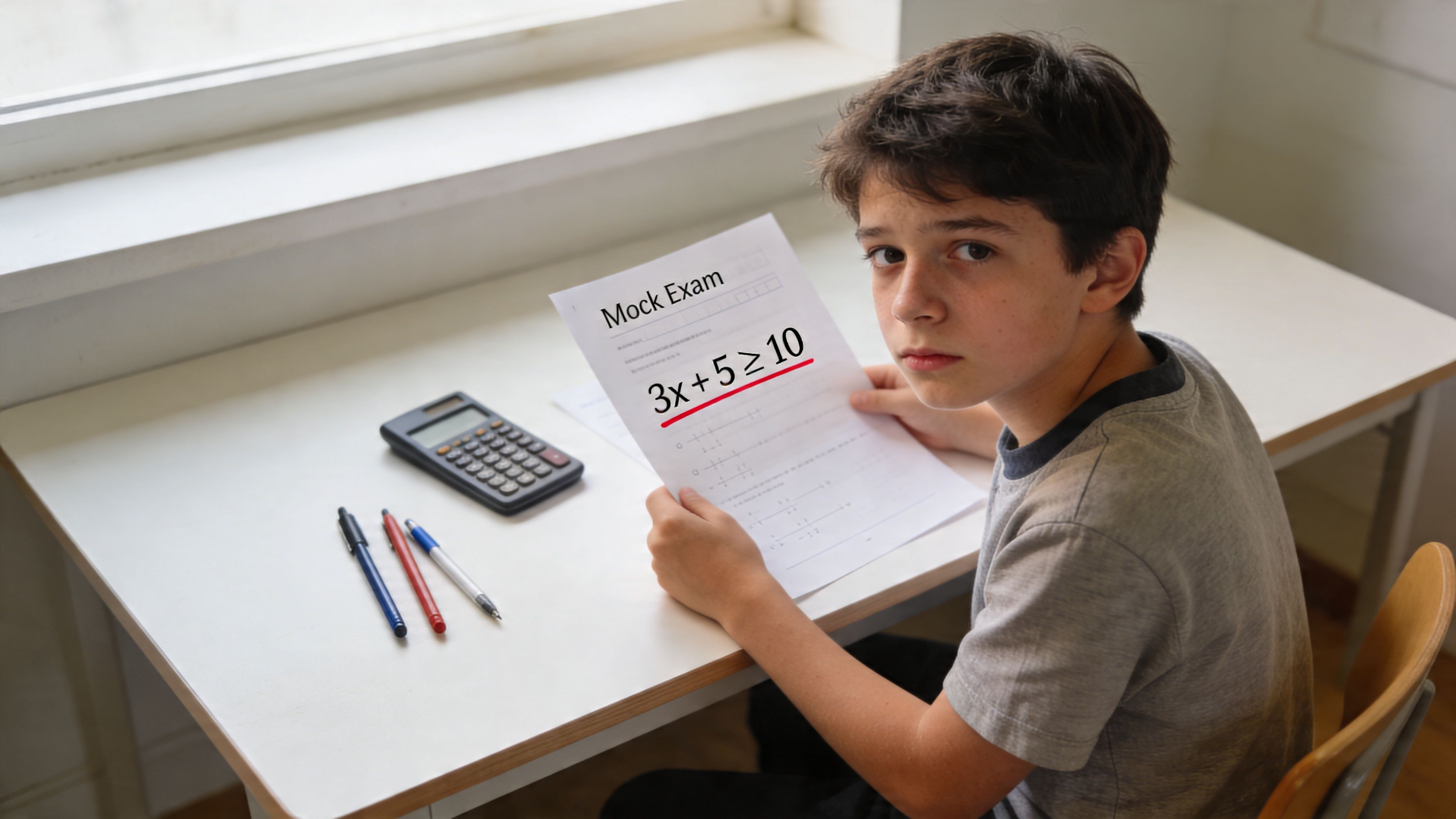
This isn’t a niche topic you can hope won’t appear. In UK GCSE maths, linear inequalities are a core algebra topic. 2023 Ofqual data reported that 62% of roughly 870,000 entrants were in the Foundation tier, where these ideas are introduced, and a 2024 NASUWT survey of 5,000 teachers found that 78% see inequalities as a high-impact revision area.
That tells you two things. First, exam boards expect you to know this content. Second, teachers know it’s a place where revision pays off.
What makes inequalities feel harder
Usually it’s not the arithmetic. It’s one of these:
| What students do | What the examiner wanted |
|---|---|
| Solve it like an equation and stop | Solve it, then show the range |
| Get the sign flip wrong | Reverse the sign only when multiplying or dividing by a negative |
| Write a value instead of a set of values | Use inequality notation, a number line, or interval notation if needed |
| Ignore whether the endpoint is included | Use open or closed circles correctly |
Practical rule: Inequalities are mostly ordinary algebra until the moment a negative multiplier appears. That’s where the rules change.
You don’t need a new brain for this topic. You need a cleaner checklist.
The Golden Rule and Your First Linear Inequalities
Linear inequalities are the best place to build confidence because they behave almost exactly like linear equations. The algebra is familiar. The difference is one rule, and it matters a lot.
The golden rule
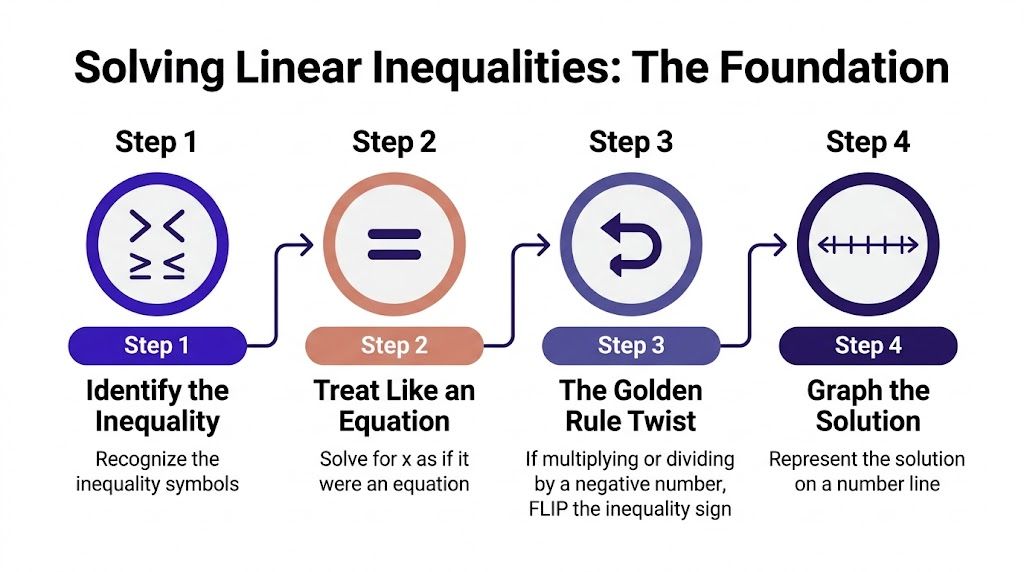
When you multiply or divide by a negative number, you flip the inequality sign.
That’s the whole thing.
If you forget that, you can do every other step perfectly and still lose the marks. If you remember it, a lot of Foundation and standard Higher questions become much more straightforward.
Start with one that feels easy
Solve:
(x + 4 < 9)
Subtract 4 from both sides:
(x < 5)
That’s it. Same method as an equation. No sign flip, because we didn’t multiply or divide by a negative.
On a number line, you’d put an open circle at 5 and shade to the left. Open circle means 5 is not included.
Now one with the twist
Solve:
(-3x \ge 12)
Divide both sides by (-3). Because you divided by a negative, flip the sign:
(x \le -4)
Students often write (x \ge -4), which feels natural if they’re on autopilot. That’s the trap.
Think of multiplying by a negative as turning the number line around. The order reverses, so the sign has to reverse too.
A clean step-by-step method
Use this every time:
Simplify each side if needed
Expand brackets or collect like terms.Move terms so the variable is on one side
Exactly as you would in an equation.Isolate the variable
Add, subtract, multiply, or divide.Check for the golden rule
If you multiplied or divided by a negative, flip the sign.Present the answer properly
Don’t just stop at the algebra. Use correct notation.
Worked example
Solve:
(5 - 2x > 11)
Subtract 5 from both sides:
(-2x > 6)
Divide by (-2), so flip the sign:
(x < -3)
That final sign matters more than the arithmetic.
How to show the answer
Examiners often want more than one line of working. They want to see you can communicate the solution clearly.
Here’s a quick guide:
- If the question says solve, writing (x < -3) may be enough.
- If it asks you to represent the solution, draw a number line.
- If you’re in A-Level or a Higher-style setting, interval notation might appear.
A quick reminder:
- (x < 4) means all values less than 4
- (x \le 4) means 4 is included
- (x > 1) means shade right from 1
- (x \ge 1) means include 1
A small but important exam habit
After solving, test one value.
If you got (x < -3), test (x = -4) in the original inequality. Then test something outside the solution, like (x = 0). This catches sign-flip mistakes quickly.
Students who want extra algebra practice in the same style as Edexcel can use a focused guide on GCSE algebra revision for Edexcel.
The mistake that keeps happening
Students often think the sign flips when you subtract a negative. It doesn’t.
Example:
(x - (-2) > 5)
This becomes:
(x + 2 > 5)
No sign flip. You only flip when you multiply or divide by a negative number.
That single sentence clears up a lot of confusion.
Levelling Up to Compound and Absolute Value Inequalities
Once linear inequalities feel steady, the next jump is usually into compound inequalities and absolute value inequalities. These look more intimidating than they really are. The trick is not speed. It’s structure.
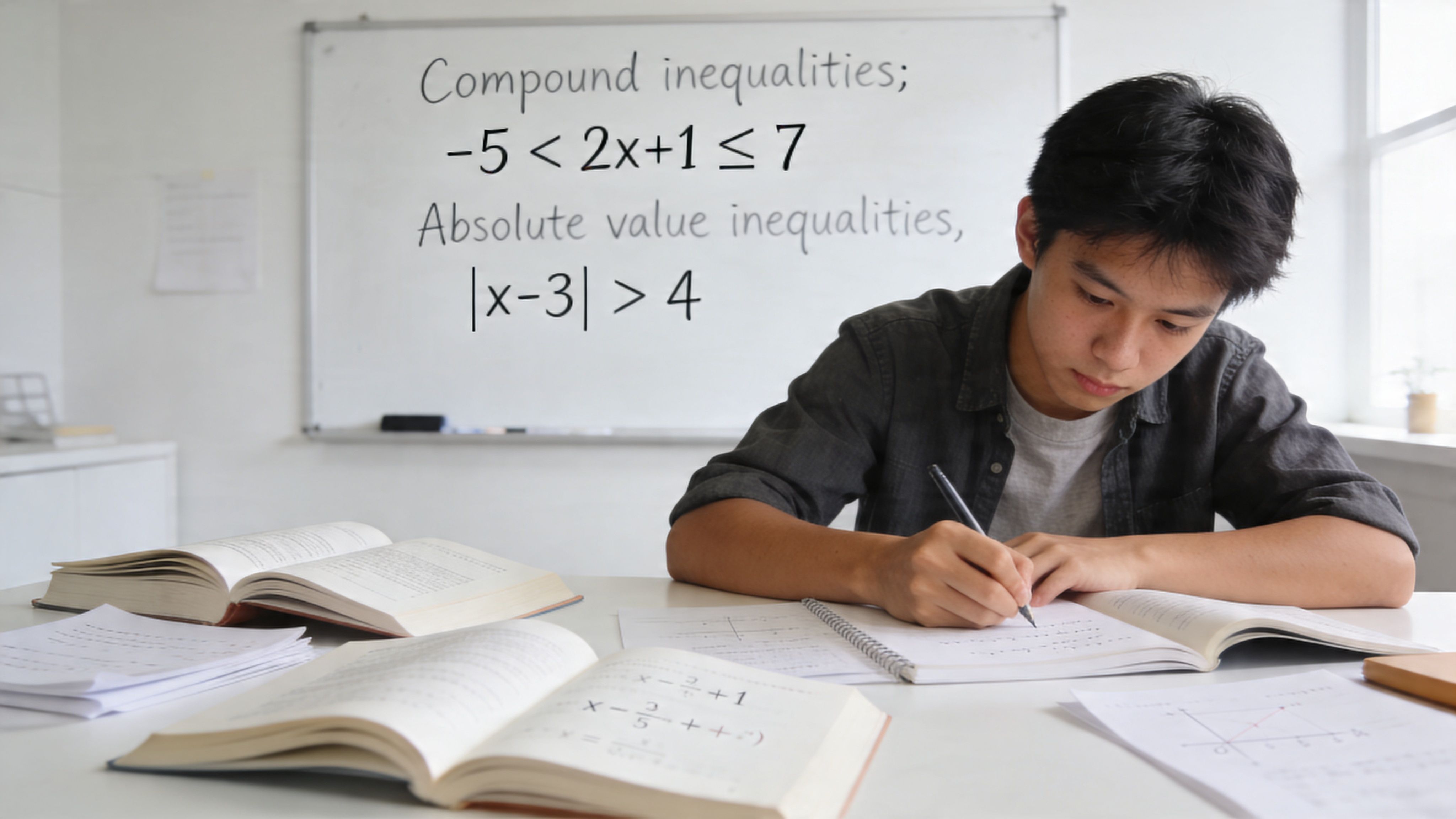
For A-Level students, this topic matters a lot. The 2017 reforms made inequalities compulsory content, and 2024 JCQ data shows they can account for 15 to 20% of marks on Paper 1. The same source notes that top A* grades are correlated with 85% accuracy on these sections, and 92% of WJEC A-Level papers since 2020 have required interval notation.
Compound inequalities with and
A compound inequality joins two conditions at once.
Example:
(2 < x + 1 \le 7)
Treat it like a three-part statement. Do the same thing to all three parts.
Subtract 1 from every part:
(1 < x \le 6)
That means x is bigger than 1 but can equal 6.
This is an and situation. Both parts must be true at the same time. So the answer is the overlap.
Compound inequalities with or
Sometimes you solve two separate inequalities and combine them with or.
Example:
(x < -2) or (x \ge 5)
That means two separate regions of the number line. Left of -2, or from 5 onwards.
Students can become tangled at this stage. They start mixing the two ideas:
- and means intersection, the overlap
- or means union, combine both sets
Here’s a simple way to remember it:
| Word | Meaning | Number line feel |
|---|---|---|
| and | both must be true | narrower |
| or | either can be true | wider |
If your answer to an and inequality gets bigger and bigger, stop and recheck. The answer should usually become more restricted, not less.
Absolute value inequalities
Absolute value, written with modulus bars like (|x|), measures distance from zero. So:
- (|x| < 3) means x is within 3 units of zero
- (|x| > 3) means x is more than 3 units from zero
That idea helps more than memorising disconnected rules.
The two-case method
Take:
(|2x - 1| < 5)
If something is less than 5 in absolute value, it sits between -5 and 5. So rewrite it as:
(-5 < 2x - 1 < 5)
Now solve the compound inequality:
Add 1:
(-4 < 2x < 6)
Divide by 2:
(-2 < x < 3)
That’s the full answer.
When the sign is greater than
Now try:
(|x + 4| \ge 7)
This means the expression is at least 7 units from zero. So split into two cases:
- (x + 4 \ge 7)
- (x + 4 \le -7)
Solve each one:
- (x \ge 3)
- (x \le -11)
Final answer:
(x \le -11) or (x \ge 3)
This is the pattern students need to trust:
- (|A| < k) turns into a double inequality
- (|A| > k) turns into two separate cases
Where students get caught
Three problems appear again and again:
Mixing up and and or
For modulus questions, the direction of the inequality changes the structure of the answer.Forgetting to solve both sides fully
Students sometimes split into two cases, solve one, and stop.Writing a half-answer
A correct idea with incomplete notation still drops marks.
A quick exam translation guide
Different wording can point to the same skill:
- Find the set of values of x means give the whole range clearly
- Solve means do the algebra and state the valid values
- Hence means use a result you’ve already found, not restart from scratch
These wording shifts matter more than many revision videos admit. In exam questions, the maths and the language work together.
Conquering Quadratic and Rational Inequalities
This is the stage where many otherwise strong students start guessing. That’s usually because they try to treat a quadratic inequality like a quadratic equation. You can’t.
If the question is:
(x^2 - 5x + 6 > 0)
the roots matter, but the roots are not the final answer on their own. They are only the turning points in the sign of the expression.
A useful fact from exam reporting is that, for quadratic inequalities, misreading the sign chart accounts for 41% of errors in a 2023 AQA chief examiner report. The recommended method is to rearrange to (ax^2 + bx + c > 0), find the roots, sketch the parabola, test intervals, and write the solution set.
The safer method for quadratics
Use this sequence every time:
- Rearrange so one side is zero
- Solve the matching equation to find the roots
- Use a sketch or sign chart
- Decide where the expression is positive or negative
- Write the solution set with the correct endpoints
Worked example with a sketch mindset
Solve:
(x^2 - 5x + 6 > 0)
Factorise:
((x - 2)(x - 3) > 0)
The roots are 2 and 3.
Now don’t stop. Ask: when is the product positive?
You can think visually. The graph of (y = x^2 - 5x + 6) is a parabola opening upwards. That means it sits:
- above the x-axis outside the roots
- below the x-axis between the roots
So the solution is:
(x < 2) or (x > 3)
Not (x = 2, 3). Those are just where the graph touches or crosses zero.
Why sign charts help
If graph sketching feels shaky, use a sign chart.
Critical values: 2 and 3
Test intervals:
- for (x < 2), try (x = 0)
- for (2 < x < 3), try (x = 2.5)
- for (x > 3), try (x = 4)
Then check whether the expression is positive or negative in each interval.
This is often safer than trying to remember a verbal rule.
Examiner habit: Mark the critical values first, then test one point in each region. It slows you down for ten seconds and saves a lot of lost marks.
Quadratic inequalities with equality included
Solve:
(x^2 - 4x + 4 \le 0)
Factorise:
((x - 2)^2 \le 0)
A square is never negative. It can only be zero when (x = 2).
So the answer is just:
(x = 2)
This is one of those questions where students overcomplicate things. If the expression is a perfect square, pause and use that fact.
Rational inequalities
Rational inequalities include fractions with algebra in the numerator or denominator.
Example:
(\frac{x - 1}{x + 2} > 0)
The key idea is the same as with quadratics. Find the critical values, then test intervals.
Here the critical values come from:
- numerator zero at (x = 1)
- denominator zero at (x = -2)
These split the number line into three regions:
- (x < -2)
- (-2 < x < 1)
- (x > 1)
Now test one value from each region.
- Try (x = -3): (\frac{-4}{-1}) is positive
- Try (x = 0): (\frac{-1}{2}) is negative
- Try (x = 2): (\frac{1}{4}) is positive
So the answer is:
(x < -2) or (x > 1)
But there’s one more check. You cannot include (x = -2), because that makes the denominator zero. You also cannot include (x = 1) here, because the inequality is strict (> 0), not (\ge 0).
A short visual explanation can help if you want to see this method in motion:
The mistakes to watch for
Treating roots as the answer
In inequalities, roots split the number line. They don’t usually finish the question.Ignoring excluded values
In rational inequalities, denominator values that give zero are never allowed.Misreading positive outside, negative inside
That pattern works for many upward-opening quadratics, but you still need to justify it by sketch or sign test.Forgetting open versus closed endpoints
Strict signs (<) and (>) exclude endpoints. Inclusive signs (\le) and (\ge) may include them, unless the denominator becomes zero.
From Solving to Scoring Exam Technique and Common Mistakes
Knowing how to solve an inequality is one thing. Getting all the marks is another. In GCSE and A-Level papers, students often lose marks not because the maths is impossible, but because the presentation is incomplete or the command word has been misread.
That matters more than many students realise. Ofqual’s 2025 GCSE Mathematics subject report says 28% of students lost marks on inequality questions because they misunderstood command words such as show that or hence. A 2024 JCQ analysis of 150,000 scripts also found that only 41% of GCSE students correctly handled inequality chains in Edexcel papers.
Command words change the job
A question that says solve is asking for valid values.
A question that says show that is asking you to present a logical sequence that proves the statement.
A question that says hence usually means, “Use the result you already have.” If you restart from scratch, you often waste time and may miss the link the examiner wanted.
What examiners usually reward
Here’s what tends to earn the marks cleanly:
Accurate algebra
Especially the sign change when dividing by a negative.Correct notation
Open or closed circles, inequality notation, interval notation if required.Clear logic
If it’s a sign chart or interval test, show enough to make your conclusion credible.A final answer in the requested form
If the question asks for a set of values, give a set of values. If it asks for a graph, draw the graph.
Five mistakes that quietly cost marks
The sign doesn’t flip when it should
This is still the classic error.The sign flips when it shouldn’t
Students sometimes flip after subtracting a negative, which is not a thing.And and or get muddled
A compound answer becomes the wrong region.Endpoints are mishandled
Students include values that should be excluded, especially with strict inequalities or denominators.The final line is too vague
“x is between 2 and 5” is not as secure as (2 < x \le 5).
“Good maths can still lose marks if the final answer is written loosely.”
A teacher habit worth copying
Good departments build inequality fluency into the way they sequence algebra, not as a one-off worksheet. If you’re a teacher or tutor planning that progression, it helps to think about topic order, misconceptions, and how command words get revisited across a year group. That’s the same kind of thinking behind writing an effective curriculum, especially when a topic like inequalities needs to move from procedure to reasoning.
A quick answer checklist before you move on
Use this in the exam:
| Check | Ask yourself |
|---|---|
| Sign flip | Did I multiply or divide by a negative? |
| Endpoints | Is the boundary included or excluded? |
| Denominator | Did I accidentally allow an impossible value? |
| Wording | Did the command word ask for more than solving? |
| Form | Have I written the answer the way the question wanted? |
If you want to practise this under timed conditions with examiner-style prompts, Exam Practice for GCSE is the kind of setup that helps you rehearse the wording as well as the maths.
Put It to the Test Practice Problems and Examiner Feedback
A good revision session doesn’t just ask, “Can you get the answer?” It asks, “Can you get the marks?” These three problems are designed in that spirit.
Question 1
Solve:
(3x - 7 \le 11)
Worked solution
Add 7:
(3x \le 18)
Divide by 3:
(x \le 6)
Examiner-style feedback
AO1 recall and procedure
You used standard algebra correctly.
AO2 application
You kept the inequality sign unchanged, which is correct because you divided by a positive number.
AO3 reasoning
A complete answer is (x \le 6). If the paper asked for a number line, that would need a closed circle at 6.
Common mistake
Writing (x < 6). That loses the equality mark.
Question 2
Solve:
(-4 < 2x + 6 \le 10)
Worked solution
Subtract 6 from all three parts:
(-10 < 2x \le 4)
Divide all three parts by 2:
(-5 < x \le 2)
Examiner-style feedback
AO1
You handled the chain properly by applying the same operation to each part.
AO2
You preserved the inclusive sign on the right.
AO3
The final statement is precise and readable.
Common mistake
Students sometimes split this into two separate inequalities and then recombine them badly. You can do that, but for a three-part chain, keeping it as one chain is often cleaner.
Question 3
Solve:
(x^2 - x - 6 \ge 0)
Worked solution
Factorise:
((x - 3)(x + 2) \ge 0)
Critical values are (-2) and (3).
Test intervals:
- (x < -2), try (-3): positive
- (-2 < x < 3), try (0): negative
- (x > 3), try (4): positive
So the expression is non-negative outside the roots, including the roots:
(x \le -2) or (x \ge 3)
Examiner-style feedback
AO1
Factorisation was correct.
AO2
You used interval testing properly.
AO3
Including the roots was essential because the inequality is (\ge 0), not (> 0).
Common mistake
Writing (-2 < x < 3). That gives the region where the expression is negative, which is the opposite of what the question asked.
What this kind of practice does better
A worksheet often tells you whether the answer is right. It doesn’t always tell you why your method would or wouldn’t score well. Examiner-style feedback fixes that. It shows where the mark scheme rewards:
- correct algebra
- correct interpretation
- correct communication
That’s why targeted practice matters more than just doing lots of random questions. If you want to keep going with exam-style maths questions in a familiar format, a bank of GCSE Past Papers is one of the most useful places to test whether your method still works under pressure.
The best way to get good at inequalities is to stop treating them like isolated tricks and start treating them like a repeatable exam skill. MasteryMind helps with that by giving UK students examiner-aligned maths practice, step-by-step feedback, and revision built around AQA, Edexcel, OCR, and WJEC wording. If you want practice that feels closer to the actual paper, it’s a strong place to start.
Ready to master this topic?
Practise with quizzes, blurt exercises and exam questions on MasteryMind.
7 days Premium · Then free forever · No card, no charge