Master International Trade: GCSE & A-Level Guide 2026
You've probably revised international trade at some point, looked at a textbook paragraph on comparative advantage, and thought: why does this feel harder than it should?
That's usually the problem. The topic itself isn't impossible. The way it's often taught is. You don't need foggy jargon. You need clear logic, memorable examples, and a sharp sense of what AQA, Edexcel and OCR reward.
For GCSE students trying to pull grades back up, this topic can rescue a paper because the core ideas repeat. For A-Level students chasing A or A*, it's one of those areas where strong chains of analysis and evaluation can separate you from everyone writing the same generic points.
Why Your Phone and Trainers Depend on Global Trade
Your phone is a trade story. Your trainers are a trade story. Even the playlist you stream can be part of a trade story if the service is sold across borders.
International trade means countries buying and selling goods and services with each other. Goods are physical things like hoodies, game consoles and coffee beans. Services are things like banking, insurance, software, education and streaming platforms. Once you see that, the topic stops looking abstract.
The UK is deeply tied into this. In 2024, the United Kingdom exported $417 billion worth of goods and services, making it the 14th largest exporter globally according to the UK trade profile on OEC. That matters because it shows trade isn't some side issue. It's woven into jobs, prices, business growth and living standards.
Why examiners love this topic
International trade pops up across specification areas:
- GCSE Economics: imports, exports, specialisation, globalisation, exchange rates, current account.
- A-Level Economics: comparative advantage, protectionism, balance of payments, trade blocs, development.
- Essay questions: easy to turn into balanced arguments because there are clear winners and losers.
If you're unsure where economics fits alongside your other revision, MasteryMind's subject offerings show how trade links with wider exam preparation across subjects.
The everyday version
Think about buying a pair of Nike trainers. The design might come from one place, the raw materials from somewhere else, the factory from another country, the shipping route from another region, and the marketing and payment systems from elsewhere again. One finished product can involve multiple countries.
Practical rule: if a product or service crosses a border at any stage, economics can treat that as part of international trade.
That's why this topic keeps appearing in real news. It explains why some products are cheap, why some shortages happen fast, and why governments care so much about trade deals and tariffs.
For exams, the first win is simple. Don't define trade in a cramped textbook way. Write clearly: countries specialise, exchange what they produce, and benefit because no country can efficiently produce everything it wants. That one idea carries a huge amount of the topic.
The Fundamentals Why Countries Bother Trading
Countries trade for the same basic reason people do. Nobody is equally good at everything, and nobody has unlimited time or resources.
A quick analogy helps. Suppose one friend is brilliant at editing TikTok clips and terrible at making revision notes. Another is the opposite. If each spends time doing what they're better at and then swaps, both end up with better results than if they tried to do everything alone. That's the logic of specialisation.
Scarcity comes first
Economics starts from scarcity. Resources are limited, but wants are not. That means choices have to be made.
Countries face the same problem. They have different:
- Natural resources such as oil, farmland or minerals
- Human resources such as skilled workers and education
- Capital resources such as machines, ports and digital infrastructure
Those differences push countries towards producing some things more efficiently than others.
From one worker to the whole world
You might already know division of labour from GCSE. One worker focuses on one task, another worker focuses on another task, and output rises because each gets faster and more skilled.
International trade is the global version of that idea.
A country with strong financial services, universities and legal expertise may specialise in services. A country with ideal farmland and climate may focus more on agricultural output. A country with lower production costs in manufacturing may export more manufactured goods.
That's also why businesses care about costs beyond the factory gate. If you're trying to understand the full price of importing products, it helps to protect margins with landed cost insights, because shipping, duties and handling can change whether trade is profitable.
What students often mix up
Many students write that countries trade because they “want money”. That's too weak for top marks. The stronger answer is that countries trade because specialisation raises efficiency and lets them consume beyond what they could produce alone.
A neat exam chain looks like this:
- Countries have different resource endowments.
- That leads to specialisation.
- Specialisation increases productive efficiency.
- Countries trade the surplus.
- Consumers and firms gain from greater choice and lower costs.
If you want more exam-board-focused support, aligned Economics content for UK students is useful because this topic is one where wording and application really matter.
Don't stop at “countries trade because they're different”. Push it to “those differences create efficiency gains through specialisation”.
That extra step is where analysis marks live.
Unlocking the Key Trade Theories for Top Marks
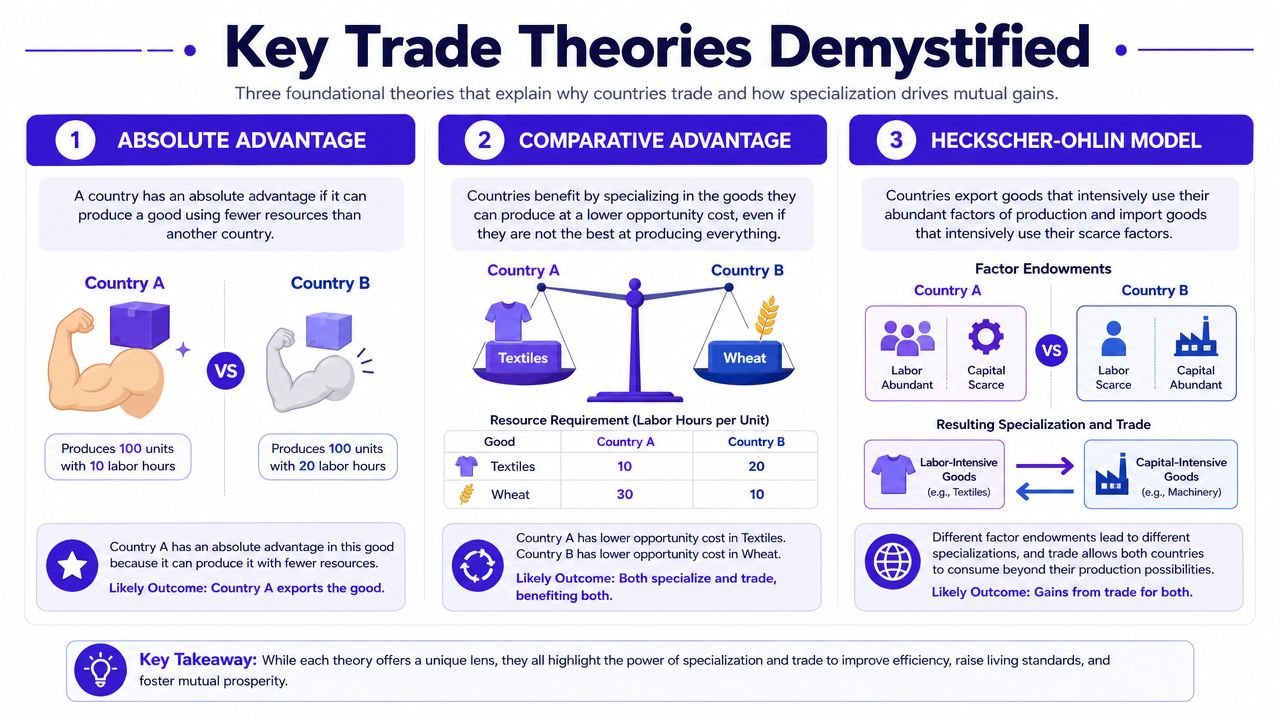
The theories sound more intimidating than they are. Strip away the labels and they're really answering one question: who should produce what?
Absolute advantage
A country has absolute advantage if it can produce more of a good using the same resources, or the same amount using fewer resources.
If Country A can make more cars than Country B with the same labour and capital, Country A has absolute advantage in cars.
That part is usually easy. The harder idea, and the one examiners really care about, is comparative advantage.
Opportunity cost is what you give up to produce one more unit of something.
Comparative advantage with a simple example
Use a tiny model. Two countries. Two products. No messy real-world detail yet.
| Country | If all resources go to trainers | If all resources go to streaming software |
|---|---|---|
| UK | 10 | 20 |
| Spain | 6 | 9 |
The UK is better at both. So some students think there's no reason to trade. That's the trap.
Now calculate opportunity cost:
- In the UK, producing 1 trainer means giving up 2 units of software.
- In Spain, producing 1 trainer means giving up 1.5 units of software.
Spain gives up less software when making trainers, so Spain has the comparative advantage in trainers.
Now reverse it:
- In the UK, producing 1 unit of software means giving up 0.5 trainers.
- In Spain, producing 1 unit of software means giving up about 0.67 trainers.
The UK gives up fewer trainers when making software, so the UK has the comparative advantage in software.
That's the key line for an exam answer: even if one country is better at producing everything, trade can still benefit both countries if they specialise according to comparative advantage.
Heckscher-Ohlin without the waffle
The Heckscher-Ohlin model says countries specialise according to the factors of production they have in greater abundance.
So if a country has lots of skilled labour, capital and advanced technology, it's more likely to specialise in goods or services that use those factors intensively. If another country has a larger supply of lower-cost labour, it may specialise in labour-intensive production.
That's why this theory is useful in essays. It links trade patterns to factor endowments, not just productivity.
A short explainer can help lock the theories in:
What the examiner wants to see
For A-Level responses, don't just name the theory. Do three things:
- Define it accurately
- Apply it to the country or industry in the question
- Explain the consequence, such as lower opportunity cost, higher output or gains from exchange
Students doing A-Level Economics revision should make sure they can draw a basic production possibility style example or at least explain the numbers logically in prose.
A common high-level sentence is this: a nation should specialise where its opportunity cost is lowest, not necessarily where its output is highest. If you can write that clearly and then apply it, you're already ahead of a lot of scripts.
The Gains and Pains from Global Trade
Trade creates benefits, but it also creates disruption. Strong answers don't sound like cheerleading. They weigh both sides.
The gains consumers and firms often notice first
Consumers usually feel trade through more choice and lower prices. If firms can source products or components from abroad more cheaply, shops can offer wider ranges of goods. That's one reason high streets and online stores can stock products from all over the world instead of relying only on domestic supply.
Firms gain too. International trade opens larger markets. A business that would hit a ceiling selling only at home can sell abroad, spread its costs over more customers, and sometimes invest more in technology or product quality. Trade can also speed up the spread of ideas. A country importing advanced machinery, software or business services may improve productivity because firms copy or adapt what works elsewhere.
The costs that make evaluation stronger
The gains aren't shared evenly. If cheaper imports undercut domestic producers, some firms shrink or shut. Workers in those industries may face structural unemployment if their skills don't match the jobs growing elsewhere.
A balanced answer often looks at time. In the short run, workers and communities can suffer badly when industries lose competitiveness. In the longer run, the economy may gain if resources move into more productive sectors. But that adjustment isn't automatic, and it isn't painless.
A strong evaluation point is that trade may raise total welfare while still harming specific groups.
A quick winners and losers frame
- Consumers win when prices fall and variety rises.
- Exporting firms win when new markets open up.
- Some domestic industries lose when they can't compete with imports.
- Workers may lose if jobs disappear faster than retraining happens.
- The environment may lose if trade encourages long-distance shipping or resource overuse.
That last point matters. Students often forget external costs. If goods move around the world through long supply chains, there can be extra pollution and transport emissions. You don't need made-up figures to make that point well. You just need clear logic.
For GCSE, this can become a tidy 6-mark or 9-mark answer. For A-Level, it becomes evaluation. The best judgement usually depends on conditions such as labour mobility, government support, and whether a country can shift resources into industries where it is more competitive.
Understanding Trade Policy and Protectionism
If trade brings gains, why do governments block it?
Because governments aren't marking exam papers. They're dealing with voters, jobs, strategic industries and political pressure. That's where protectionism comes in.
The main tools
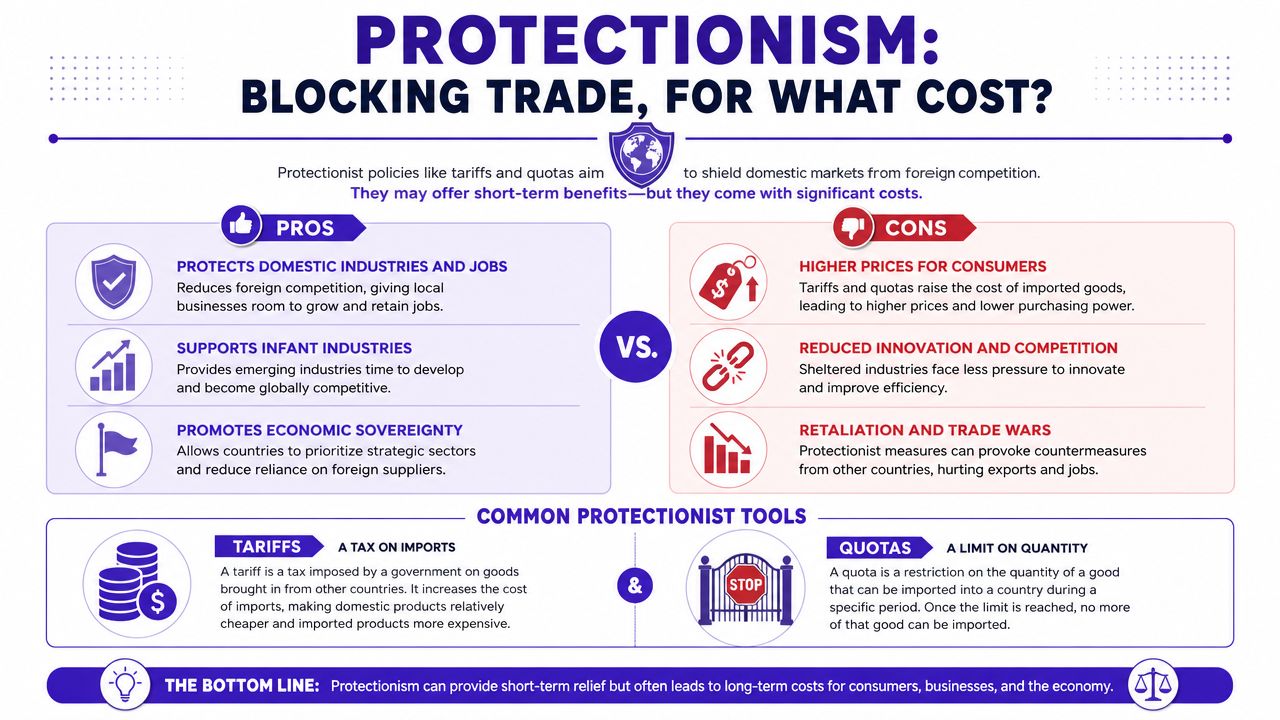
A tariff is a tax on imports. That raises the price of foreign goods, which can make domestic alternatives look more attractive.
A quota is a limit on how much of a good can be imported. Instead of making imports pricier through tax, the government restricts quantity directly.
A subsidy is a payment to domestic firms. That lowers their costs and can help them compete against imports.
Students often forget non-tariff barriers. These include rules, standards, paperwork and regulatory checks that make trade harder even when no formal tariff exists.
Why governments use them
Governments usually justify protectionism in a few familiar ways:
- Infant industries: new domestic firms may need temporary shelter before they can compete globally.
- Jobs: protecting local production can slow down unemployment in sensitive sectors.
- National security: some goods are too important to rely on foreign suppliers for.
- Anti-dumping concerns: governments may argue foreign firms are selling at unfairly low prices.
If you want a practical industry example of customs and trade rule issues, material on compliant Canadian imports can help you see how anti-dumping ideas work beyond the textbook.
The UK angle that adds evaluation
Protectionism isn't only about tariffs on finished goods; a sharper analysis shows it can also be about friction in supply chains.
While 92% of UK trade strategy mentions securing free trade in critical raw materials, existing content ignores how Brexit-created regulatory barriers raised costs by 84% for sectors like battery manufacturing, according to the Trade and Business blueprint. That's a useful reminder that barriers can damage producers who rely on imported inputs, not just consumers buying final goods.
Examiner move: when discussing protectionism, always ask “protected from what?” and “who pays the price?”
Domestic producers may benefit. Consumers may face higher prices or less choice. Firms using imported components may see costs rise. Governments may collect tariff revenue, but they can also trigger retaliation from trading partners.
That last point is gold in evaluation. A policy that helps one sector can hurt several others.
Global Trade in Action Patterns Blocs and Balances
Trade gets more interesting when you stop thinking about isolated countries and start thinking about systems. Countries join trade blocs, build patterns with major partners, and then track whether exports and imports are roughly balanced.
Trade blocs in plain English
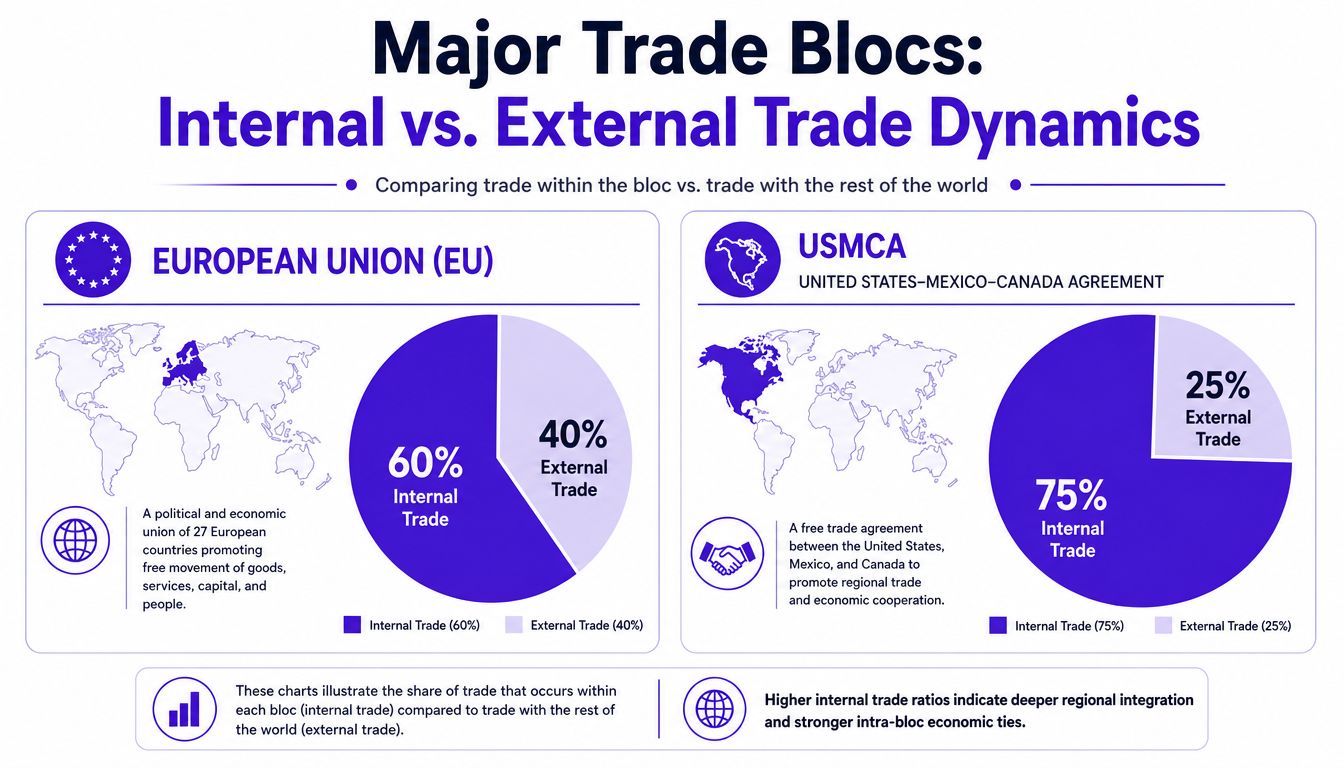
A trade bloc is a group of countries that reduce trade barriers with each other. The basic idea is simple. Inside the bloc, trade becomes easier. Outside the bloc, non-members may still face barriers.
For exam purposes, the main effects are:
- Trade creation: members buy from more efficient producers within the bloc
- Trade diversion: members switch away from cheaper non-members because bloc rules favour insiders
That's why trade blocs can be both efficient and politically controversial.
The UK's trade pattern right now
The UK's current picture is a strong example of how modern trade isn't just about containers full of goods. In 2025, UK total trade reached £1.9 trillion, with services exports growing 8.0% while goods exports fell 1.8%, and non-EU trade outweighing EU trade, according to the Trade and Investment Core Statistics Book. That's a major structural shift.
The services side matters a lot. It means the UK's trade story is heavily tied to sectors like finance, technology, education and other knowledge-intensive activities. That also changes how students should think about “exports”. It isn't just cars, food and machinery.
If you're trying to connect trade to how businesses get paid across borders, practical guides on global payment processing solutions can make the mechanics feel less abstract.
Balance of payments and trade balance
The balance of payments records a country's economic transactions with the rest of the world. One part of that is the current account, which includes trade in goods and services.
The UK has run a trade deficit for decades. The average balance of trade from 1955 to 2026 was -£1,218.40 million, and in April 2026 the UK trade deficit was £8.44 billion, as shown by Trading Economics on the UK balance of trade. That tells you imports have often exceeded exports.
Why exchange rates matter
Exchange rates affect competitiveness. If the pound falls, UK exports become cheaper for foreign buyers, while imports become more expensive for UK consumers and firms. In theory, that can reduce a trade deficit.
In practice, it depends on conditions. If demand for imports is inelastic, people may keep buying them despite higher prices. If UK firms can't quickly expand output, cheaper exports won't automatically solve the problem. That conditional thinking is exactly what A-Level evaluation rewards.
How Trade Shapes the Developing World
Trade can be a launchpad for development. It can also trap countries in weak positions. Both arguments matter.
One development story goes like this. A lower-income country builds an export sector, firms gain access to larger world markets, incomes rise, tax revenue improves, and the country invests more in skills and infrastructure. That's the hopeful version students often remember.
The other story is rougher. A country becomes dependent on a narrow set of low-value exports, often primary products or labour-intensive assembly work. If world prices move against it, or if buyers squeeze suppliers hard, growth becomes fragile.
Why the debate isn't simple
The strongest answers avoid saying trade is automatically good or bad for developing countries. Instead, ask what kind of trade is happening.
A country exporting raw materials with little value added may capture fewer gains than one moving into higher-skill manufacturing or tradable services. The issue isn't only whether a country trades. It's what it trades, who controls production, and how much value stays in the country.
A useful modern twist
Students often write about developing countries as if trade only means factories and farms. That's outdated. Services matter more than many people realise.
Most content focuses on goods, yet in the UK, 56% of services exports are generated by foreign-owned firms, and visa fees for foreign workers can act as a significant barrier to trade expansion in sectors like fintech and AI, according to the Centre for European Reform on UK services trade. Even though that's a UK-focused point, it helps you think more widely about development. Countries trying to grow through services need skills, digital systems, regulation and access to talent.
Development questions get better when you compare short-term export growth with long-term control over value, technology and skills.
That's a strong evaluation line for essays. A country may grow fast through trade and still remain vulnerable if profits, technology or decision-making sit mainly outside the country. On the other hand, shutting out global markets can limit opportunities, investment and learning. The best judgement depends on the structure of trade, not just the presence of trade.
Smash Your Exams Acing Trade Questions
Grades are subject to change. Plenty of students know a few definitions. Fewer can turn that knowledge into marks under pressure.
In Summer 2025, the UK GCSE pass rate at grade C/4 or higher was 67.4%, the lowest since 2019, and only 6,845 18-year-olds achieved A grades across all their A-Levels*, according to Statista's UK GCSE pass rate data. That doesn't mean panic. It means every definition, diagram and chain of logic matters.
For GCSE students
Most GCSE mistakes are basic but costly:
- Mixing up imports and exports
- Writing one-sided answers
- Forgetting application
- Using business studies language instead of economics
A reliable 9-mark structure is:
- Define the key term
- Explain one benefit or cost
- Develop the chain of reasoning
- Add a second side
- Finish with a judgement
For example, if asked whether free trade is good for the UK, don't stop at “prices fall”. Push it further: lower import prices can increase real income for consumers, which may increase spending elsewhere in the economy. Then balance it with domestic job losses in less competitive industries.
For A-Level students
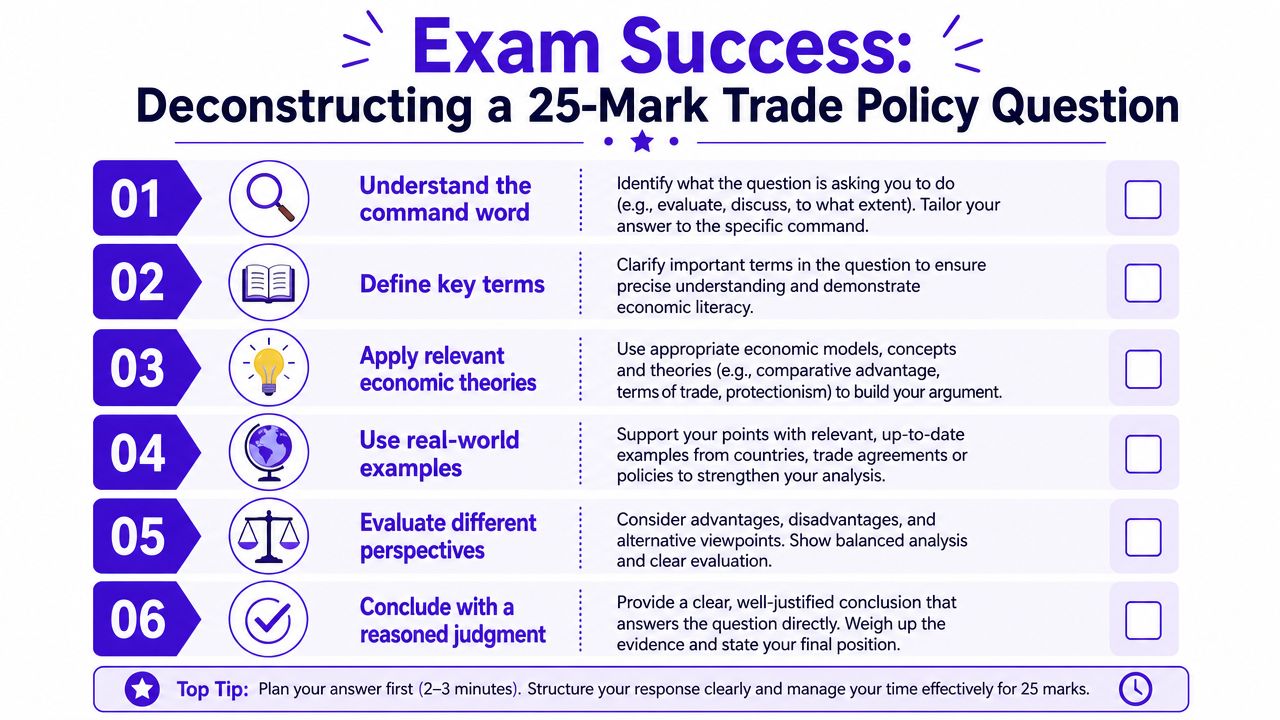
A 20- or 25-mark answer needs a visible structure. Use Define, Apply, Analyse, Evaluate.
A fast model plan
| Step | What you do | What it sounds like |
|---|---|---|
| Define | Explain tariff, quota, comparative advantage, trade deficit or whatever the key term is | “A tariff is a tax on imports…” |
| Apply | Link it to the context in the question | “For an economy reliant on imported components…” |
| Analyse | Build the chain | “Higher import costs raise firm costs, which may reduce competitiveness…” |
| Evaluate | Challenge your own point | “However, the effect depends on demand elasticity and whether domestic firms can expand supply…” |
Sentence starters that actually help
- Analysis: “This matters because…”
- Analysis: “That would increase costs for firms, so…”
- Evaluation: “However, the strength of this argument depends on…”
- Evaluation: “In the short run this is more likely, but in the long run…”
- Judgement: “Overall, the case is stronger when…”
Revision shortcut: memorise a few flexible evaluation phrases, not full essays.
The diagrams worth knowing
For trade, you should be comfortable with:
- Tariff diagram
- Quota diagram
- Comparative advantage or opportunity cost example
- Current account or trade balance interpretation where relevant
- Demand and supply shifts linked to imports or exports
Don't redraw diagrams from memory only once and hope for the best. Practise them repeatedly. Label them fully. Then write two sentences underneath explaining exactly what changes.
If you need a clean bank of exam-style practice, GCSE Past Papers are one of the best ways to see repeated patterns in command words and mark schemes.
Final checklist before the exam
- Know the core definitions: trade, imports, exports, tariff, quota, subsidy, comparative advantage.
- Use both sides: almost every strong trade answer needs benefits and drawbacks.
- Apply to the question: country, industry, firm type, or time period.
- Evaluate with conditions: elasticity, retaliation, labour mobility, capacity, exchange rate changes.
- End with judgement: not a summary, a decision.
Students who improve fastest aren't always the ones who “get economics” instantly. They're often the ones who stop revising passively and start practising responses that look like the actual exam.
If you want revision that feels like the actual paper instead of random notes and guesswork, MasteryMind is built for that. It gives UK learners examiner-aligned practice for GCSEs and A-Levels across boards like AQA, Edexcel and OCR, with feedback that helps you tighten definitions, sharpen analysis and improve evaluation before the exam does the judging.
Ready to master this topic?
Practise with quizzes, blurt exercises and exam questions on MasteryMind.
7 days Premium · Then free forever · No card, no charge