Issues and Debates in Psychology: Your Ultimate Exam Guide
You've probably had this moment already. You open your psychology notes, see issues and debates, and think, “Great. More abstract stuff to memorise.”
That's usually where students go wrong.
This topic isn't just a list of awkward phrases like reductionism or determinism. It's the part of the course that helps you turn a decent answer into a high-mark answer. If you know how to use these debates properly, you can evaluate almost any theory, study, or approach in psychology with much more confidence.
Teachers know this too. The strongest essays usually don't just describe a study and tack on a weak criticism. They use the debates to show real understanding. That's what gets AO3 moving.
Why These Debates Are Your Secret Weapon for Top Grades
A lot of students revise issues and debates as if they're definitions to learn once and then forget. That approach rarely works in the exam.
The value of issues and debates in psychology is that they give you a reusable way to evaluate. If a question asks about attachment, memory, schizophrenia, aggression, or research methods, these debates can slot straight into your paragraphs. They help you answer the examiner's silent question, which is always: Can you think like a psychologist, not just repeat the notes?
What examiners are really rewarding
AO1 gets you the knowledge. AO3 gets you the judgement.
That means you need to do more than say a theory is “good” or “limited”. You need to explain why it matters that a theory is biologically reductionist, or why it matters that a study takes a nomothetic rather than idiographic approach. Once you can do that, your essays stop sounding generic.
A simple way to think about it is this:
- Description tells the examiner what the theory says
- Debates tell the examiner what the theory means
- Evaluation tells the examiner whether that matters
Practical rule: if your AO3 point could fit into almost any subject, it's probably too vague. If it uses a debate and explains the consequence, it's probably stronger.
There's also a revision benefit. When your exam is getting close, psychology can feel like one long countdown. That's why students often find it helpful to understand the insights into our love for countdowns, because anticipation changes motivation, focus, and stress in very real ways.
If you're rebuilding your revision plan, tools like AI Powered Revision can help you practise the exact kind of evaluation that exam questions reward.
The shift that changes your marks
Instead of asking, “What does this debate mean?”, ask:
- Where could I use this in an essay?
- What weakness or strength does it expose?
- What real-world consequence can I mention?
- What sentence could I write under pressure in the exam?
That's the mindset that lifts marks.
The Foundational Face-Off Nature vs Nurture
The concept of nature vs nurture is often encountered before one studies psychology. In exam terms, though, students often keep it too basic. They write “nature means genes, nurture means environment” and stop there.
That won't get you far on its own.
This debate matters because many psychological explanations lean more heavily towards one side. Once you can spot that, you can evaluate much more sharply.
What each side actually means
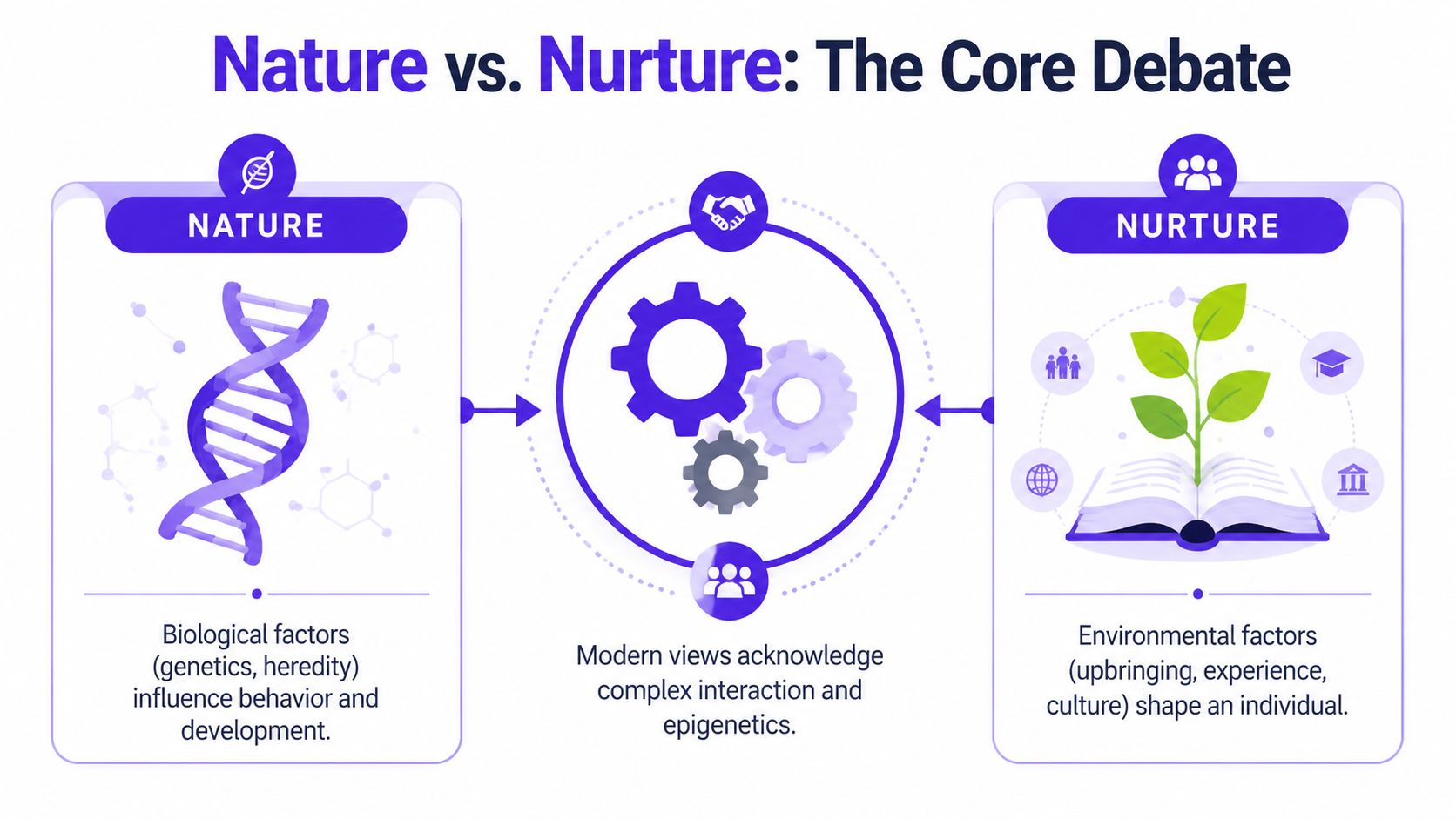
Nature says behaviour is strongly influenced by inherited factors. That includes genes, brain structure, hormones, and anything else you're born with.
Nurture says behaviour is shaped by experience. That includes parenting, learning, culture, education, trauma, and social environment.
A quick attachment example makes this easier:
- If you talk about attachment as an innate system, you're leaning towards nature.
- If you explain attachment through learning from experience, you're leaning towards nurture.
Neither side is silly. The issue is whether a theory becomes too narrow by overcommitting to one.
The answer that usually scores better
Top-band answers often move beyond the simple split and use an interactionist point.
That means behaviour develops through the interaction of biological factors and environmental experience. In other words, psychologists don't usually need to choose one side completely. They need to explain how the two work together.
A strong evaluative point often sounds like this: “This explanation may be limited because it overemphasises inherited factors and underestimates how experience shapes behaviour over time.”
That sentence is useful because it doesn't just define the debate. It applies it.
A video can help if this debate still feels slippery:
How to use this debate in essays
Students often ask, “Fine, but what do I write?”
Try this structure:
- Name the debate clearly
- Identify which side the theory supports
- Explain what gets ignored
- Link that to validity or application
Here are some adaptable sentence starters:
- This explanation takes a strongly nativist view because it assumes behaviour is rooted in inherited characteristics.
- A criticism is that it may be environmentally deterministic, as it treats behaviour as the result of experience alone.
- An interactionist view would be more convincing because behaviour is likely shaped by both predispositions and lived experience.
Common confusion to avoid
A lot of students mix up nurture with “good parenting” or “nice experiences”. It doesn't mean that. It just means environmental influence, which can be positive, negative, direct, indirect, social, or cultural.
Another mistake is assuming the examiner wants you to “pick a winner”. Usually, they don't. The more mature answer is often the balanced one.
| Essay situation | Better move |
|---|---|
| Theory is clearly biological | Evaluate whether it ignores learning and context |
| Theory is clearly learned | Evaluate whether it ignores inherited predispositions |
| Essay asks for discussion | Bring in interactionism for a more nuanced judgement |
For timed practice, Exam Practice for A-Level can help you get used to applying these points quickly rather than just recognising them in notes.
Big Picture vs Fine Details Holism vs Reductionism
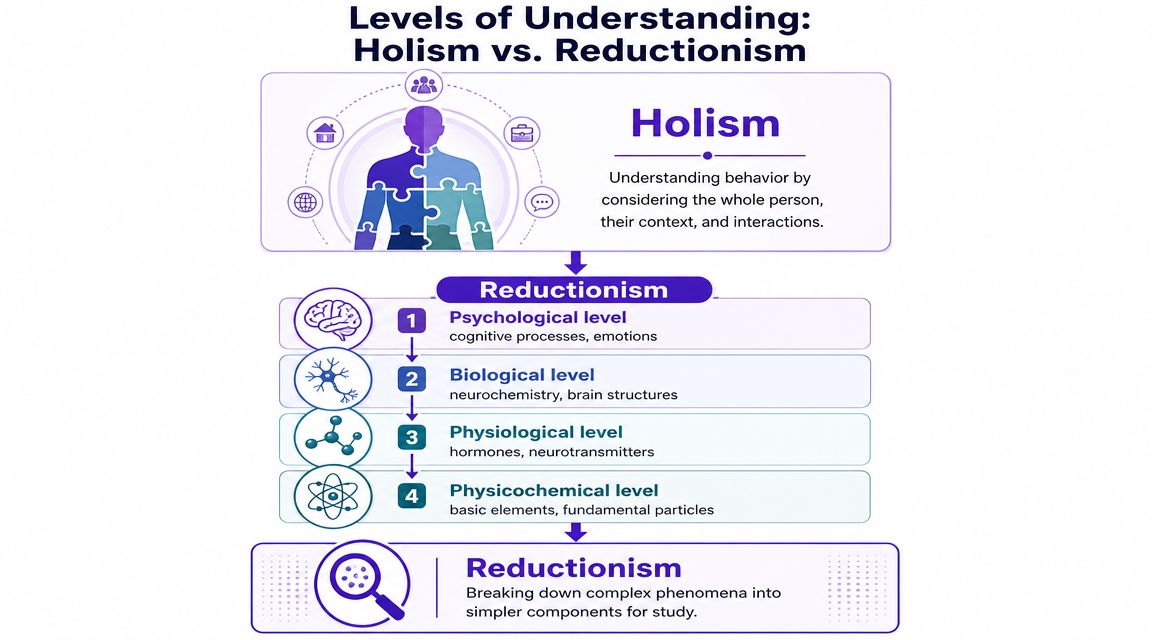
This debate asks a very practical question. Do you understand behaviour better by looking at the whole person, or by breaking behaviour into smaller parts?
That's holism vs reductionism.
Students often remember the terms but don't feel secure applying them. The easiest fix is to use a non-psychology analogy. Think of a car.
If a mechanic only studies the spark plugs, they may miss how the full system works together. That's the criticism of reductionism. But if they only say “the whole car matters” and never inspect parts, they may not find the fault. That's the criticism of extreme holism.
What reductionism looks like in psychology
A reductionist explanation breaks complex behaviour into simpler components.
There are different forms:
- Biological reductionism reduces behaviour to physical processes such as genes, neurotransmitters, or brain regions.
- Environmental reductionism explains behaviour in terms of learning history, conditioning, or reinforcement.
- Some cognitive explanations can also be reductionist if they simplify human experience into information processing steps.
Reductionism can be really useful because it makes behaviour easier to test scientifically. If you isolate variables, you can run controlled experiments and build clearer explanations.
That's why reductionist explanations often look more scientific.
Why holism still matters
A holistic explanation looks at the person as a complete system. It considers thoughts, emotions, biology, social context, and personal meaning together.
This is valuable because human behaviour is messy. Real life doesn't happen one variable at a time.
If someone experiences OCD symptoms, for example, a highly reductionist answer might focus tightly on neurochemistry. A more holistic view might also consider beliefs, stress, family environment, and the meaning the behaviour has for that individual.
Looking at one level of explanation can produce clarity. Looking at several levels can produce understanding.
That's a strong exam point because it shows you know there's a trade-off. Simplicity helps research. Complexity helps realism.
A useful way to write AO3
When you're evaluating a theory, ask:
- Is this explanation too narrow?
- Does it ignore the wider context?
- Or is it so broad that it becomes hard to test?
Those questions give you a direct route to evaluation.
Here are some model lines:
- This explanation is reductionist because it breaks complex behaviour into smaller biological mechanisms.
- A strength of this approach is that reductionism supports controlled scientific investigation.
- However, it may lack validity because it ignores how different influences interact in real life.
- A more holistic account may better reflect the complexity of behaviour, although it can be harder to test objectively.
The exam trick students miss
You don't always need to label a theory as one or the other in a dramatic way. Sometimes the better move is to place it on a spectrum.
| Type of explanation | Likely position |
|---|---|
| Neurochemical account | Highly reductionist |
| Behaviourist learning account | Environmentally reductionist |
| Humanistic account | Much more holistic |
| Mixed explanation using several influences | Less reductionist, more balanced |
That creates a more thoughtful paragraph than “reductionism is bad”.
Where this debate earns marks fast
This is one of the most flexible debates in the whole course. You can use it in biopsychology, psychopathology, attachment, learning theory, and approaches.
If you're stuck in an essay, a reliable move is:
- Identify the level of explanation.
- Explain what that level leaves out.
- Judge whether that limitation matters.
That's often enough to turn a weak AO3 comment into a proper evaluative paragraph.
Choice or Chains Free Will vs Determinism
This debate is philosophical, but it isn't just philosophy. It affects how psychologists explain behaviour, how society assigns responsibility, and how we think about treatment.
The basic question is simple. Do people choose what they do, or are their actions caused by forces outside their control?
The main positions
Free will says people can choose their actions and are capable of self-determination.
Determinism says behaviour is caused by internal or external forces, so what we do is not fully free.
That still feels broad, so it helps to break determinism down:
- Biological determinism links behaviour to genes, hormones, brain structure, or nervous system processes.
- Environmental determinism explains behaviour through learning, reinforcement, and past experience.
- Psychic determinism is associated with unconscious drives and conflict.
Then there's hard determinism, which says behaviour is fully caused, and soft determinism, which says behaviour may be caused but still allows some meaningful choice within those limits.
How exam answers usually use this
A behaviourist explanation is a classic deterministic example. If behaviour is learned through conditioning, then actions follow from past reinforcement history rather than free personal choice.
By contrast, the humanistic approach places much more emphasis on autonomy, agency, and personal growth. That's why students often use humanism when they need an example of free will.
The mark-winning bit is the consequence.
If a theory is highly deterministic, you can evaluate it by asking whether it gives a realistic picture of human decision-making. If a theory leans heavily on free will, you can question whether that is scientific enough, because freely chosen behaviour is harder to predict and control.
Exam insight: deterministic explanations often look stronger scientifically because causes can be identified and tested.
Why this matters outside the classroom
This debate shapes how people think about crime, punishment, and responsibility.
If someone's actions are determined by biology or environment, then punishment alone may seem less useful than treatment or rehabilitation. If people have genuine free will, then moral accountability becomes easier to defend.
That's one reason this debate is more than a wordy classroom topic. It changes how we interpret behaviour in everyday life.
Teachers also see this when they think about behaviour management. A practical discussion of reinforcement in schools can make behaviourism feel less abstract, and mastering positive classroom techniques gives a useful real-world angle on how environmental consequences can shape behaviour.
Sample sentences you can actually use
These work well in essays:
- This approach is deterministic because it assumes behaviour is caused by prior biological or environmental factors.
- A strength of determinism is that it supports the scientific aim of identifying lawful causes of behaviour.
- However, the explanation may be criticised for overlooking conscious choice and personal responsibility.
- A softer deterministic view may be more realistic because it allows behaviour to be influenced by causes without denying all agency.
A common misunderstanding
Students sometimes think determinism = bad and free will = good. That's too crude.
Determinism can be a strength because science depends on cause and effect. If behaviour had no causes at all, psychology couldn't explain anything. At the same time, a purely deterministic account can feel incomplete if it strips away all sense of human choice.
That tension is exactly what makes it useful in essays.
One Size Fits All Nomothetic vs Idiographic Approaches
This debate is about what psychology should aim to do.
Should it create general laws that apply broadly across people, or should it focus on the unique individual and their personal experience?
That's the difference between the nomothetic and idiographic approaches.
Side-by-side comparison
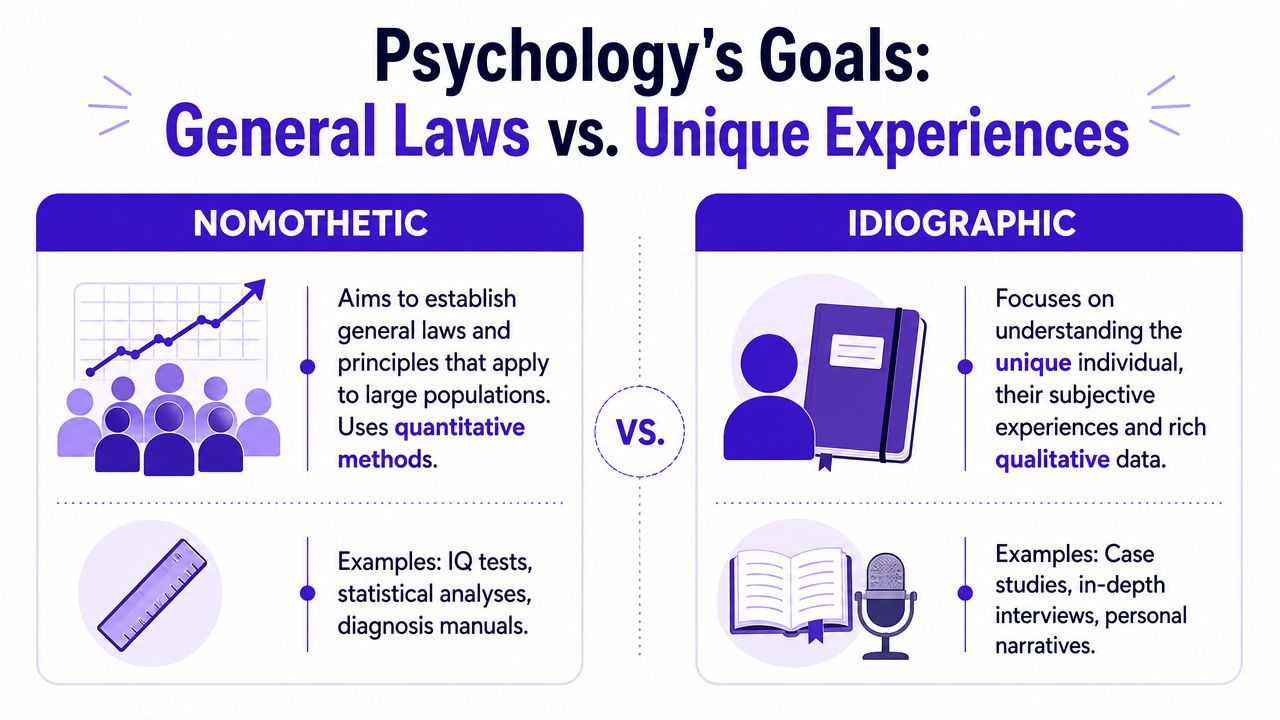
In UK A-level psychology, the nomothetic approach is treated as more scientific because it uses quantitative experimental methods to establish general laws and predict behaviour, while the idiographic approach is criticised for being subjective, less generalisable, and weaker for treatment applications in psychological disorders, as outlined in this A-level issues and debates workbook.
That sounds technical, but the basic contrast is manageable:
| Nomothetic | Idiographic |
|---|---|
| Looks for general rules | Looks for individual experience |
| Often uses quantitative data | Often uses qualitative detail |
| Larger samples are common | Single cases or small samples are common |
| Aims for prediction and generalisation | Aims for depth and richness |
Why students get confused
The confusion usually comes from thinking one must be “better”.
It's more accurate to say they do different jobs.
If you want to build diagnostic systems, compare groups, or test broad predictions, the nomothetic approach is useful. If you want to understand one person thoroughly, especially their subjective experience, idiographic methods can reveal things statistics miss.
A case study can show details that a large survey never would. But a case study also can't easily support claims about everybody else.
How to turn this into AO3
This debate is brilliant for evaluating research methods and approaches.
Use these moves:
- If a study uses experiments and large samples, praise its scientific and predictive value.
- If a study focuses on one person or a tiny sample, discuss depth versus generalisability.
- If an approach seems too statistical, question whether it loses the whole person.
Revision shortcut: nomothetic often helps with reliability and prediction. Idiographic often helps with insight and personal meaning.
Model lines:
- A strength of the nomothetic approach is that it can identify patterns across large groups and develop general laws.
- However, it may overlook individual differences by focusing on averages rather than lived experience.
- The idiographic approach offers rich detail, but its findings can be difficult to generalise beyond the person studied.
- A combination of both may give psychology broader scientific value without losing individual depth.
What exam boards like here
Examiners often reward students who connect this debate to methods, not just definitions.
So don't stop at “nomothetic uses numbers”. Go further. Explain what that means for prediction, application, and scientific status. Likewise, don't stop at “idiographic studies one person”. Explain what that means for understanding and limitation.
For targeted AQA A-Level Psychology preparation, it helps to practise writing these method-linked evaluations under timed conditions, because this debate turns up in more places than students expect.
Bias and Blind Spots Culture and Gender Bias
One of the most important ideas in issues and debates in psychology is that research can claim to explain “human” behaviour while reflecting a much narrower group.
That's where culture bias and gender bias matter.
A theory can look neat and convincing but still be limited if it treats one cultural viewpoint as universal, or if it builds its assumptions around male experience and then applies them to everyone.
The key terms that unlock the topic
Culture bias happens when psychologists interpret behaviour using the standards of their own culture.
A common form is ethnocentrism, where one culture becomes the reference point and others are judged against it.
Gender bias happens when theories or methods distort male and female behaviour.
Two key forms come up in exams:
- Alpha bias exaggerates differences between men and women.
- Beta bias ignores or minimises differences, often treating male behaviour as the default.
That last one is especially important because students often miss how damaging it can be. If you design criteria around one group, another group may be overlooked completely.
Why this matters in the UK
This debate isn't just theoretical. It affects diagnosis, treatment, and access to support.
A key issue is how gender and culture bias affect diagnostic accuracy in the UK. Minority groups are 20%–50% less likely to initiate mental health service use and 40%–80% more likely to leave treatment early, according to this review on mental health service use and pathways to care. The same review also supports the point that autism diagnostic criteria have historically been based around male-presenting symptoms, which has left many girls and women undiagnosed or misdiagnosed.
That gives you a powerful exam move. Bias doesn't just distort theories. It can shape who gets recognised, who gets help, and who gets missed.
What to write in an essay
Good AO3 here explains both the academic problem and the real-world consequence.
Try lines like these:
- This explanation may be culture biased because it assumes behaviour found in one cultural setting applies universally.
- A limitation of gender bias is that it can reduce diagnostic accuracy when criteria are based on one gender's presentation.
- This matters because biased theories may not just be incomplete. They can affect help-seeking, diagnosis, and treatment outcomes.
The bit many students leave out
Don't only say “the sample lacked diversity”. That's fine, but it's only the start.
Push it further:
- What assumptions were built into the theory?
- Who becomes the “normal” standard?
- What happens when real people don't fit that standard?
Bias in psychology isn't just a flaw in theory. It can become a flaw in care.
That kind of sentence shows maturity. It turns a textbook definition into a real evaluation point.
The Real-World Impact Socially Sensitive Research and Ethics
Some research findings stay in classrooms and journals. Other findings spill into policy, education, healthcare, and public opinion.
That's where socially sensitive research becomes so important.
This refers to research that may have consequences for the groups being studied or for wider society. Topics like intelligence, mental health, race, gender, and criminality often fall into this category because findings can be interpreted in ways that affect real lives.
Why this debate matters so much
Students sometimes treat ethics as a separate topic and socially sensitive research as an optional extra. It isn't.
A study can be methodologically strong and still create harm through the way its findings are framed, applied, or misused. That's why the debate goes beyond “did participants give consent?” It includes the social meaning of the research.
In the UK, socially sensitive research had direct policy impact when Cyril Burt's claims about the heritability of intelligence were later used to support the 11-plus selection system, shaping access to secondary education, as discussed in this overview of A-level psychology debates. That historical example matters because it shows research findings aren't politically neutral. They can be used to justify inequality.
What strong evaluation looks like
The best essays don't say socially sensitive research is “bad” or that psychologists should avoid difficult topics.
That would be too simplistic.
Psychologists still need to study controversial areas. If they avoid them completely, important inequalities may stay hidden. The central issue is how research is designed, interpreted, and communicated.
Here's a sharper way to view it:
- Research value matters because controversial topics can reveal important truths.
- Risk matters because findings can stigmatise groups or support unfair systems.
- Responsibility matters because psychologists need to consider how others may use the evidence.
Sample AO3 lines for essays
These are strong because they move beyond generic ethics comments:
- This research is socially sensitive because its findings could affect how a group is perceived or treated.
- A major issue is not only participant protection but also how findings may be interpreted in policy and public debate.
- The Burt example shows that psychological claims can influence educational systems and contribute to inequality when presented as evidence of fixed ability.
- Psychologists therefore have a responsibility to communicate limits, avoid overclaiming, and consider possible social consequences.
Research can be useful and risky at the same time. That tension is the whole point of the debate.
The exam payoff
This debate can lift your essays because it shows breadth. You're no longer only evaluating method or sample size. You're evaluating psychology's role in society.
That's often what separates a competent answer from a memorable one.
If you want more timed practice using these kinds of evaluative points, working through A-Level Past papers is one of the best ways to see how repeatedly these debates can be applied across very different questions.
If you want revision that closely resembles the exam, MasteryMind is built for exactly that. It gives UK learners examiner-aligned practice, feedback linked to AO marks, and support across GCSE and A-Level subjects, so you can turn topics like issues and debates from vague notes into marks on the page.
Ready to master this topic?
Practise with quizzes, blurt exercises and exam questions on MasteryMind.
7 days Premium · Then free forever · No card, no charge