Link Reaction a Level Biology: Master Your Exams

You're probably in one of two places right now. Either respiration has turned into a blur of glycolysis, Krebs, reduced NAD and random arrows, or you know the basics but keep feeling that the link reaction is the bit nobody explains properly.
That makes sense. A lot of students can tell you glycolysis happens first and the Krebs cycle happens later, but they can't clearly explain what joins them together. That gap costs marks. It also makes the whole topic feel harder than it really is.
The good news is that the link reaction in A-Level Biology is very learnable once you stop treating it like a tiny side note. It's the handover stage. It gets pyruvate ready for the Krebs cycle, and it contains a few exam traps that come up again and again.
The Link Reaction The Missing Piece in Respiration
Glycolysis happens in the cytoplasm. The Krebs cycle happens in the mitochondrion. Students often memorise those two facts, then hit a problem: how does the product of glycolysis become the starting material for the Krebs cycle?
That's exactly where the link reaction comes in.
Think of aerobic respiration like a relay race. Glycolysis runs the first leg and produces pyruvate. But pyruvate can't just enter the Krebs cycle unchanged. It has to be processed first. The link reaction is that handover stage.
Without it, there's a jump in logic. With it, the pathway makes sense.
Why it matters for understanding
The link reaction is the compulsory bridge between the breakdown of glucose in glycolysis and the next major stage of aerobic respiration. In exam answers, that idea matters because it shows you understand sequence, not just isolated facts.
Students who revise with structure often find this topic much easier, especially when they practise with Online Revision for A-Level materials that mirror the way exam boards phrase respiration questions.
The easiest way to remember the link reaction is this: glycolysis makes pyruvate, the link reaction converts pyruvate, and the Krebs cycle uses the converted product.
The big idea to hold onto
If you remember one thing here, remember this: the link reaction is not an optional extra. It is the conversion stage that prepares carbon from glucose for further oxidation.
That simple idea makes the details that follow far less messy.
What Is the Link Reaction and Where Does It Happen
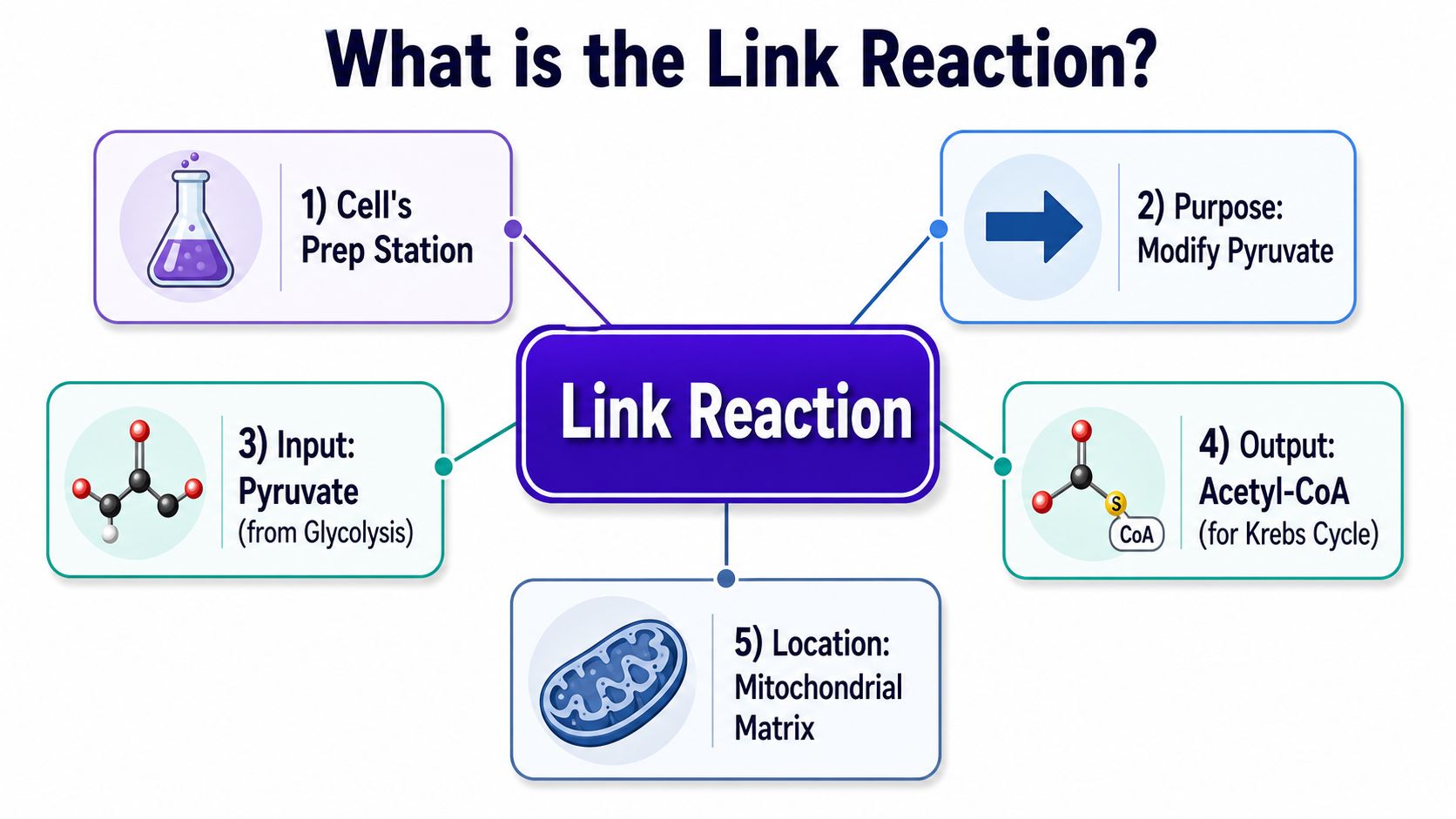
The link reaction is the stage where pyruvate from glycolysis is changed into acetyl-CoA, which can enter the Krebs cycle. If glycolysis is the cell breaking fuel down into a usable intermediate, the link reaction is the prep bench where that intermediate gets reshaped for the next process.
A good analogy is a factory. Glycolysis sends in a partly processed material. The Krebs cycle is the main production line. The link reaction is the prep station in between, where the material is trimmed, loaded properly, and sent on.
The location examiners want
The key location is the mitochondrial matrix. That's the place you need to write in an exam answer.
One of the clearest statements of this comes from Seneca Learning's AQA link reaction notes, which explain that the link reaction takes place specifically in the mitochondrial matrix, where pyruvate is actively transported into before undergoing decarboxylation, oxidation, and combination with coenzyme A to form acetyl-CoA. That location matters because students often mix it up with the cytoplasm, where glycolysis happens, or the inner mitochondrial membrane, where the electron transport chain sits.
Why that location matters
Cells separate processes into compartments for a reason. The matrix is where the machinery for this stage is found, and it places the products of the link reaction in exactly the right area for the Krebs cycle.
If you write “cytoplasm” for the link reaction, you're blending it with glycolysis. If you write “inner mitochondrial membrane”, you're drifting into oxidative phosphorylation. Both mistakes are common.
A quick memory hook helps:
- Cytoplasm for glycolysis
- Matrix for the link reaction
- Inner mitochondrial membrane for electron transport chain activity
If you want to compare this topic with other respiration content in one place, MasteryMind Biology A-Level is useful for seeing how these stages fit across the specification.
Practical rule: If the question asks where the link reaction happens, write mitochondrial matrix first. Don't waffle.
The Link Reaction Step by Step Mechanism
The link reaction looks much easier when you split it into three actions. Examiners like those action words, and so should you.
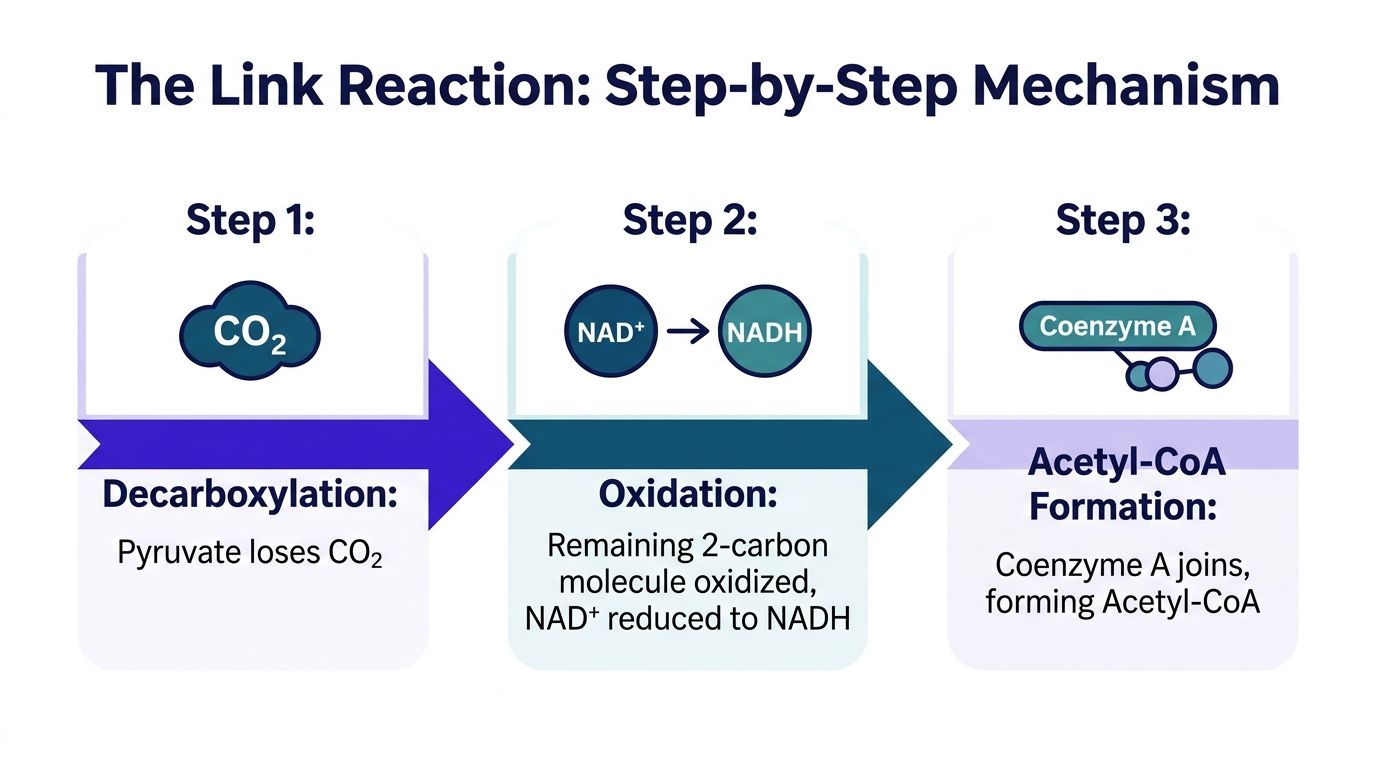
Step 1 Decarboxylation
Start with pyruvate, which is a 3-carbon compound.
In the first stage, one carbon is removed and released as carbon dioxide. This is called decarboxylation.
So the 3-carbon pyruvate becomes a 2-carbon fragment.
Step 2 Oxidation
That remaining 2-carbon fragment is then oxidised. In simple terms, it loses hydrogen.
Those hydrogen atoms don't vanish. NAD accepts them and becomes reduced NAD, often written as NADH.
Students need precision at this point. The molecule being oxidised is the fragment from pyruvate. The NAD is being reduced.
A short video can help lock in the order of events before you write it from memory:
Step 3 Acetyl-CoA formation
The 2-carbon fragment now joins with coenzyme A.
That forms acetyl coenzyme A, usually shortened to acetyl-CoA. This is the molecule that goes on into the Krebs cycle.
Coenzyme A is like a carrier. It picks up the 2-carbon acetyl group and delivers it where it needs to go next.
The enzyme doing the job
This whole reaction is catalysed by the pyruvate dehydrogenase complex. According to StudyRocket's A-Level revision page on the link reaction and Krebs cycle, the link reaction involves three coordinated enzymatic steps per pyruvate molecule: decarboxylation, dehydrogenation, and condensation with coenzyme A. The same source also states that per single glucose molecule, the link reaction produces 2 acetyl-CoA, 2 CO₂, and 2 reduced NAD.
That “per glucose” wording matters because students often answer “per pyruvate” by accident.
The shortest exam-ready version
If you need the clean exam sequence, write it like this:
- Decarboxylation. Pyruvate loses carbon dioxide.
- Oxidation. Hydrogen is removed and NAD is reduced to NADH.
- Acetyl-CoA formation. The 2-carbon acetate combines with coenzyme A.
A model memory phrase
Try this: cut, oxidise, carry.
- Cut off CO₂
- Oxidise the remaining fragment
- Carry it away as acetyl-CoA
That's not the language you'd use in the final exam answer, but it's a strong recall hook when you're revising.
The Official Equation and Carbon Accounting
This is the part where students either gain easy marks or throw them away by mixing up per pyruvate and per glucose.
The cleanest way to think about the link reaction is to track what goes in and what comes out.
For one pyruvate, the reaction can be written in words as:
pyruvate + NAD + coenzyme A → acetyl-CoA + CO₂ + reduced NAD
Why everything happens twice
One glucose molecule goes through glycolysis and produces exactly two molecules of pyruvate. That means the link reaction must happen exactly two times per glucose molecule, producing two molecules of acetyl-CoA, two molecules of carbon dioxide, and two molecules of NADH, as stated in the verified curriculum summary above.
This is one of the fixed bits of respiration maths. If the question starts with one glucose, don't answer with one pyruvate outputs unless the wording specifically tells you to.
Carbon tracking made simple
Here's the carbon story:
- Pyruvate has 3 carbons
- One carbon is removed as CO₂
- The remaining 2-carbon fragment becomes part of acetyl-CoA
That's why acetyl-CoA can enter the Krebs cycle as a 2-carbon input.
A lot of “mystery” in respiration disappears when you count carbons carefully.
Inputs and Outputs of the Link Reaction Per Glucose Molecule
| Molecule | Input Quantity | Output Quantity |
|---|---|---|
| Pyruvate | 2 | 0 |
| NAD | 2 | 0 |
| Coenzyme A | 2 | 0 |
| Acetyl-CoA | 0 | 2 |
| CO₂ | 0 | 2 |
| Reduced NAD | 0 | 2 |
Where students slip
The common errors are predictable:
- Writing per pyruvate when the question is per glucose
- Forgetting that glycolysis produces two pyruvates
- Losing track of carbon numbers
- Mixing up reduced NAD with ATP
If you're practising this kind of stoichiometry, doing timed questions from A-Level Past papers helps because examiners love turning simple biology into careful counting.
A good self-check is this: if you start with one glucose and don't end up with two acetyl-CoA after the link reaction, something has gone wrong.
Key Players The Enzymes and Coenzymes
Students often memorise the steps of the link reaction without thinking about who performs the work. That's fine for a very basic answer, but stronger responses explain the molecules involved.
The pyruvate dehydrogenase complex
The main enzyme system is the pyruvate dehydrogenase complex.
The word complex matters. It tells you this isn't just one tiny enzyme doing one tiny job. It's a coordinated enzyme machine handling the conversion of pyruvate into a form the Krebs cycle can use.
Its role is to control the sequence of reactions smoothly, rather than leaving each step to chance. That's why exam answers that name the pyruvate dehydrogenase complex sound much sharper than answers that just say “an enzyme”.
Coenzyme A as the carrier
Coenzyme A is best understood as a transport molecule.
The 2-carbon acetyl group can't enter the Krebs cycle on its own in the required form, so coenzyme A binds to it and forms acetyl-CoA. A simple way to remember this is the taxi analogy. The acetyl group is the passenger. Coenzyme A is the taxi that gets it to the next stage.
That's useful because it turns a vague name into a job you can picture.
NAD as the electron carrier
The third key player is NAD.
During the reaction, NAD accepts hydrogen and becomes reduced NAD. It's carrying energy-rich electrons onward, even though no ATP is made directly at this stage.
If you enjoy connecting different molecular processes across biology, it's also worth reading about how reverse transcription works. It's a completely different topic, but it's another good example of how enzymes and helper molecules control a sequence of reactions with high specificity.
Don't just learn molecule names. Learn each molecule's job. That's what makes an answer easier to write under pressure.
Common A Level Exam Traps and Misconceptions
Grades often move at this point. Not because the content is harder, but because the wording gets stricter.
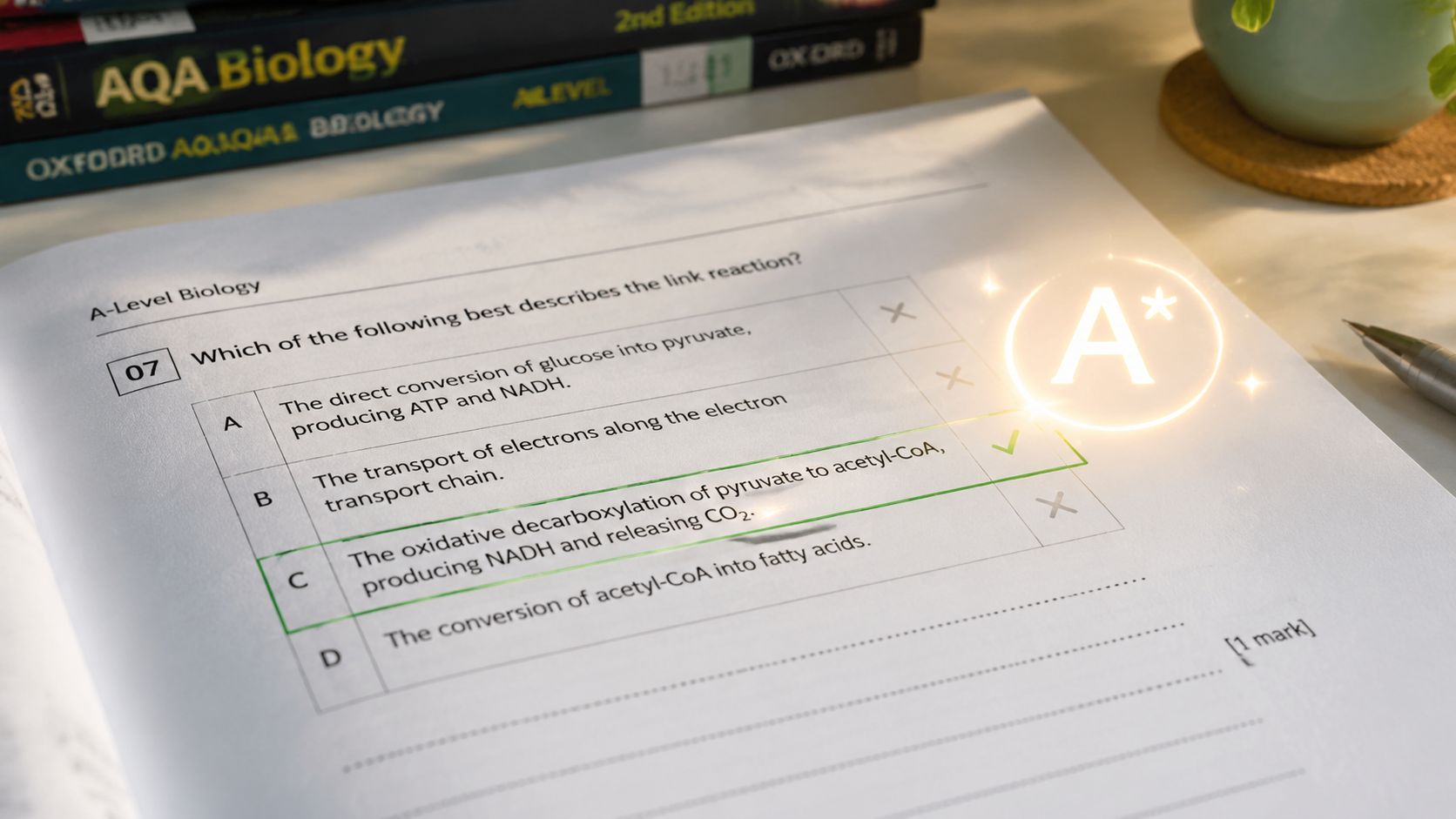
Trap 1 The pyruvate diffusion myth
A lot of online summaries say pyruvate “diffuses” into the mitochondrion. That sounds harmless. In an exam, it can cost marks.
According to this AQA-focused textbook material hosted by Lovat, pyruvate is actively transported via a pyruvate-H+ symport mechanism, and a 2024 analysis of AQA mark schemes indicated that “active transport” is a required keyword for full marks on transport-related respiration questions. The same analysis noted that this detail is missing from 70% of free online summaries.
That's a classic exam trap. Students repeat the simplified version they saw online, then wonder why they dropped a mark.
What to write instead
If the question asks how pyruvate gets into the mitochondrial matrix, write:
- Pyruvate is actively transported
- It enters the mitochondrial matrix
- If you know it, adding pyruvate-H+ symport shows excellent precision
Don't write diffusion unless the mark scheme specifically supports it.
Trap 2 Why does the link reaction produce no ATP
This one confuses loads of students because the link reaction clearly releases energy in some form, so they assume ATP must appear.
It doesn't.
The key point is that no ATP is produced directly in the link reaction. The energy from oxidation is captured in reduced NAD, not packaged immediately as ATP.
That means the link reaction contributes to energy yield indirectly. Reduced NAD goes on to oxidative phosphorylation, where its electrons are used in the electron transport chain.
The misconception behind the mistake
Students often treat every energy-releasing step as if it must make ATP on the spot. But respiration doesn't work like that. Sometimes energy is transferred first into coenzymes, then used later.
A good mental distinction is this:
- ATP made directly means substrate-level phosphorylation
- Reduced NAD made first means the energy is being stored for later use
If you want to stress-test your wording under timed conditions, Exam Practice for A-Level is the kind of thing that helps because these tiny keyword differences are exactly where marks disappear.
Quick-fire examiner traps
- Wrong location: writing cytoplasm instead of mitochondrial matrix
- Wrong transport term: writing diffusion instead of active transport
- Wrong product: saying ATP is made directly
- Wrong scale: answering per pyruvate when asked per glucose
Write what the examiner can tick. “Active transport”, “mitochondrial matrix”, “decarboxylation”, and “reduced NAD” are the sort of keywords that rescue marks.
How the Link Reaction Fits Into the Big Picture
By this point, the link reaction should feel less like a random middle step and more like a controlled checkpoint in respiration.
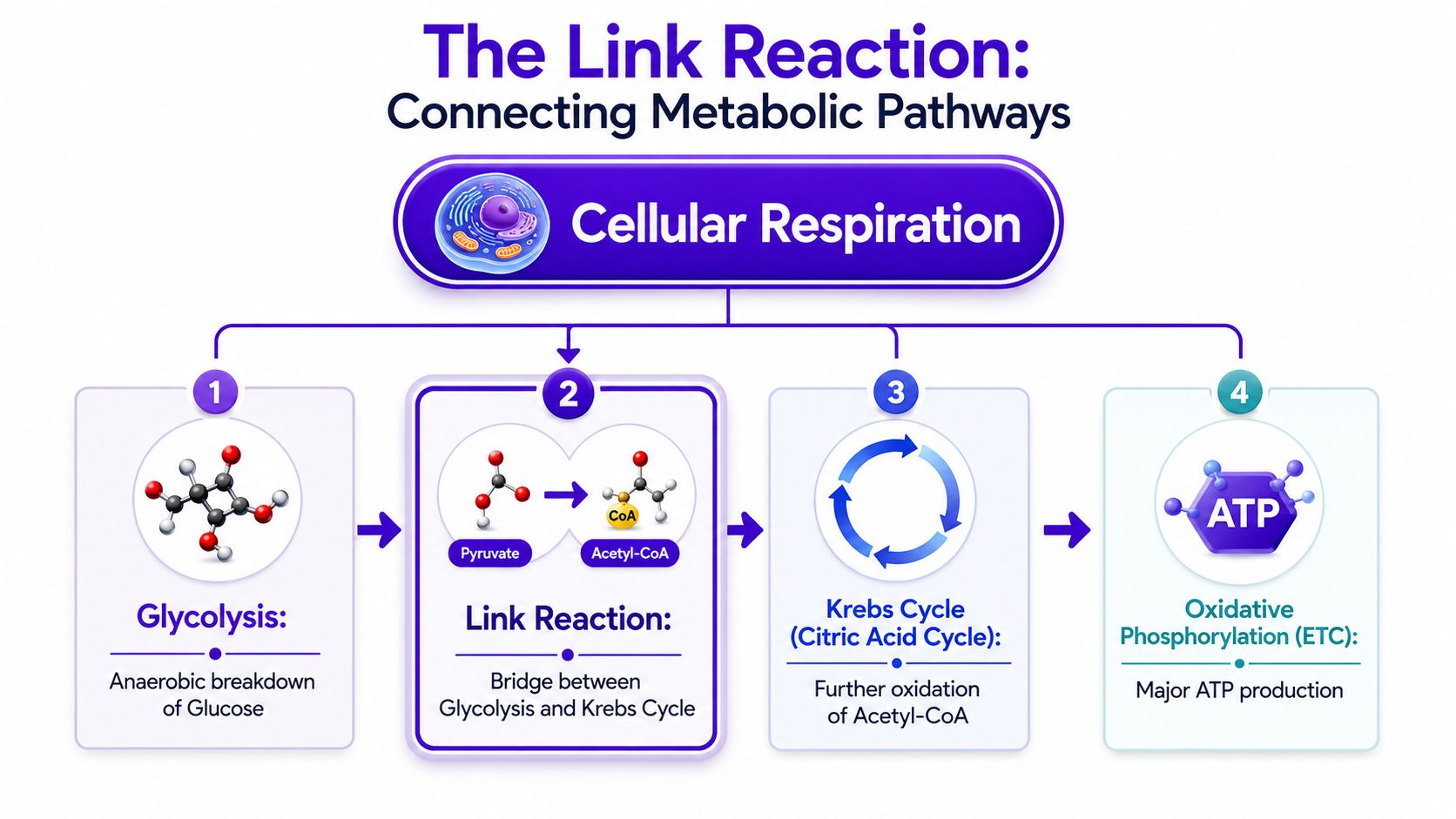
The flow through respiration
The overall pathway looks like this:
- Glycolysis breaks glucose down and produces pyruvate
- Link reaction converts pyruvate into acetyl-CoA
- Krebs cycle oxidises the acetyl group further
- Oxidative phosphorylation uses reduced coenzymes to drive major ATP production
That makes the link reaction the connector between an early breakdown stage and the later stages of full aerobic energy extraction.
Why the checkpoint matters
The link reaction is also a control point. Cognito's guide to the link reaction notes that the decarboxylation step is irreversible under physiological conditions, helping ensure the unidirectional flow of carbon towards complete oxidation. The same source also makes a point students need in exams: no ATP is produced directly in the link reaction, and the energy yield comes from the production of 2 NADH per glucose.
That matters because it explains the role of this stage without pretending it does everything itself. The link reaction prepares carbon for the Krebs cycle and loads energy onto reduced coenzymes for later ATP production.
The whole topic in one memory line
If you want one sentence to revise from, use this:
Glycolysis makes pyruvate, the link reaction converts it to acetyl-CoA and reduced NAD, and the rest of aerobic respiration finishes the job.
That's the big picture examiners want you to understand, not just a memorised list of products.
If you want structured help turning this into exam marks, MasteryMind is a smart place to practise. It's built for UK learners, aligns to major exam boards, and gives examiner-style feedback so you can spot exactly where your respiration answers are losing marks before your examination does.
Ready to master this topic?
Practise with quizzes, blurt exercises and exam questions on MasteryMind.
7 days Premium · Then free forever · No card, no charge