Learn Logic Gates Truth Tables: Essential Guide 2026
You're probably in one of two camps right now. Either you've left Computer Science revision a bit late and you need a topic that can give you reliable marks fast, or you're already decent and you want to stop silly mistakes from dragging you down. Truth tables are perfect for both.
They look technical at first. Then you realise something useful: they're predictable. Unlike a long essay question where wording can throw you off, logic gates truth tables follow rules. If you know the method, you can work through the question even when the circuit diagram looks messy.
Why Mastering Truth Tables Is Your Secret Weapon for Exams
A lot of students panic when they see a circuit with several gates linked together. The page suddenly feels crowded, the clock starts to matter, and every wire seems to blur into the next. That reaction is normal. The good news is that truth table questions are some of the most methodical questions in the paper.

Why examiners like this topic
Examiners like logic because it tests several skills at once. Can you read symbols? Can you follow a process accurately? Can you show working clearly? That matters for AQA, OCR, and Edexcel because mark schemes often reward the method, not just the final answer.
This topic also matters more than many students realise. Computer Science was the only GCSE subject in 2024 where Ofqual instructed exam boards to make specific adjustments to raise grades, as noted by FFT Education Datalab's review of GCSE results 2024. If you want to take advantage of every possible mark in that subject, truth tables and logic gates are not optional.
Practical rule: Treat truth tables as a scoring opportunity, not as a scary niche topic.
Why students lose marks they could have kept
Most dropped marks here come from avoidable habits:
- Rushing the rows: Students miss a binary combination or repeat one.
- Skipping working: They jump straight to the answer and give the examiner nothing to reward if the final column goes wrong.
- Mixing up gates: AND and OR seem obvious until exam stress hits.
- Ignoring brackets: In a Boolean expression, the order matters.
Teachers know this topic is often taught quickly, then tested in a less friendly form. Students know the basic gates, but the exam gives a combined circuit or a longer expression. That gap is where marks disappear.
Why this topic is recoverable
Truth tables reward structure. You don't need a flash of genius. You need a system you trust.
If you can identify the inputs, list combinations in the right order, and build the answer one column at a time, you can steady your grade quickly. That's why this topic is so useful for students trying to recover, and so valuable for students aiming at the top end.
What Are Logic Gates and Truth Tables Anyway
Start with the simplest idea in computing. A computer works with binary, which means values are treated as either 0 or 1. You can think of that as off/on, false/true, or no/yes.
A light switch is the easiest analogy. Off is 0. On is 1. Computers use that same kind of two-state logic, just in electronic form rather than a lamp on your wall.
A logic gate is a decision-maker
A logic gate takes one or more inputs and produces an output based on a rule. That's all it is. It's like a bouncer on a door who checks the conditions and decides whether the answer is yes or no.
If the rule is strict, the output might only be 1 when every condition is met. If the rule is generous, the output might be 1 when just one condition is met. Different gates have different personalities, but they all follow fixed rules.
Think of a logic gate as a tiny machine that answers one question the same way every time.
A truth table is the rulebook
A truth table shows every possible input combination and the output for each one. It turns a gate from something abstract into something visible and testable.
For GCSE and A-Level revision across different GCSE and A-Level subjects, this is a useful habit to build. Don't just memorise definitions. Translate them into a table you can read row by row.
Here's the basic idea:
| Input(s) | Rule applied | Output |
|---|---|---|
| 0 or 1 values | Gate checks its condition | 0 or 1 |
Why this matters beyond the definition
Students often try to learn logic gates as isolated facts. That makes revision harder than it needs to be. If you understand that the table lists all possible cases, the topic starts to feel less mysterious.
Truth tables also help with error-checking. If your answer doesn't make sense, you can trace it back row by row and see exactly where it went wrong. That's a very exam-friendly feature. It gives you a way to stay calm and fix mistakes instead of guessing.
The Core Logic Gates You Must Know
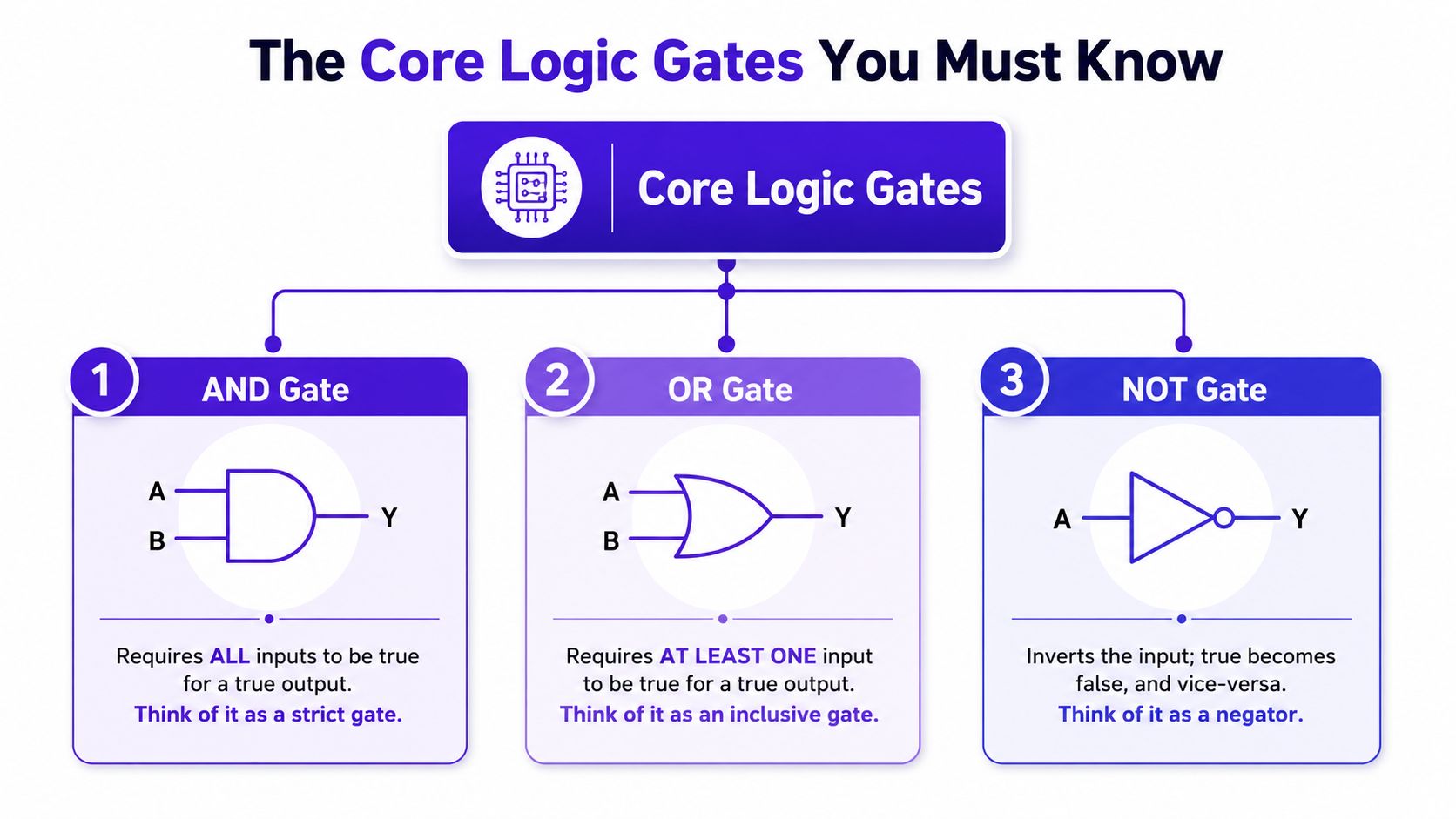
The whole topic rests on three gates: AND, OR, and NOT. If these are solid, everything else becomes easier because the larger circuits are built from the same logic.
AND gate
The AND gate is strict. Think of a secure door that opens only if you have a key and the correct code. One isn't enough. You need both.
For two inputs, the possible combinations are 00, 01, 10, 11, and this is part of the standard taught in UK Key Stage 4. The AND gate outputs 1 only when both inputs are 1, according to KuraPlan's KS4 logic gates lesson material.
Boolean expression: A AND B
Truth table:
| A | B | Output |
|---|---|---|
| 0 | 0 | 0 |
| 0 | 1 | 0 |
| 1 | 0 | 0 |
| 1 | 1 | 1 |
A common real-world classroom example is a system that only works when two conditions are met at once, like a school bell setup with multiple required signals.
OR gate
The OR gate is more relaxed. Think of a heater that turns on if the room is cold or someone presses the manual switch. Either condition can trigger the result.
For the same four input combinations, the OR gate outputs 1 in 3 of the 4 cases. The only time it gives 0 is when both inputs are 0.
Boolean expression: A OR B
Truth table:
| A | B | Output |
|---|---|---|
| 0 | 0 | 0 |
| 0 | 1 | 1 |
| 1 | 0 | 1 |
| 1 | 1 | 1 |
Students sometimes confuse OR with everyday speech. In normal conversation, “or” can sound exclusive. In logic at GCSE level, OR usually means inclusive OR unless the question specifically uses XOR.
A quick visual explanation can help if you prefer to hear it walked through:
NOT gate
The NOT gate only has one input, and it does one job. It flips the value.
If the input is 0, the output is 1. If the input is 1, the output is 0. It's the rebel of the group. Whatever you say, it says the opposite.
Boolean expression: NOT A
Truth table:
| A | Output |
|---|---|
| 0 | 1 |
| 1 | 0 |
What to remember under pressure
If you blank in the exam, don't try to recall a paragraph from your notes. Recall the behaviour.
- AND: all required
- OR: at least one
- NOT: opposite
When students go wrong here, it's usually because they memorised labels without attaching them to a simple situation.
Beyond the Basics NAND NOR XOR and XNOR
Once the core gates are secure, the next set feels much less random. These gates aren't brand-new ideas. They're combinations or twists of the basics.
NAND and NOR
Start with the names. They tell you almost everything.
- NAND means NOT AND
- NOR means NOT OR
So a NAND gate behaves like an AND gate first, then flips the output. A NOR gate behaves like an OR gate first, then flips the output.
That means you can reason them out instead of memorising them as separate monsters.
| Gate | Think of it as | Output idea |
|---|---|---|
| NAND | NOT(AND) | Opposite of AND |
| NOR | NOT(OR) | Opposite of OR |
If AND only gives 1 when both inputs are 1, then NAND will only give 0 in that case. If OR only gives 0 when both inputs are 0, then NOR will give 1 only in that case.
XOR and XNOR
XOR means exclusive OR. This is the one students often half-know, which is dangerous in an exam.
XOR means one or the other, but not both. If the inputs are different, the output is 1. If they match, the output is 0.
So for two inputs:
- 0 and 0 gives 0
- 0 and 1 gives 1
- 1 and 0 gives 1
- 1 and 1 gives 0
That “different means 1” rule is usually the easiest way to remember it.
XNOR is the flipped version of XOR. It outputs 1 when the inputs are the same.
Memory shortcut: XOR spots difference. XNOR rewards matching.
Why this matters in larger circuits
When you meet a longer expression or circuit, these gates often appear as part of a bigger function. If you know how they relate to the basic gates, you don't have to start from scratch.
That saves thinking time. Beyond that, it cuts down panic. A NAND gate stops looking like a weird extra symbol and starts looking like an AND gate with a NOT attached.
Building Complex Truth Tables Like a Pro
This is the point where many students go from “I get the basic gates” to “Why does this question suddenly look impossible?” The problem usually isn't the logic. It's the organisation.
UK revision guides note that learners often struggle when they have to break down 3-input Boolean expressions into intermediate columns, and that 3-input tables require exactly 8 rows. They also point out that worked examples for expressions such as (A AND B) OR C are often underserved in many resources, as discussed in this OCR Boolean logic revision guide.
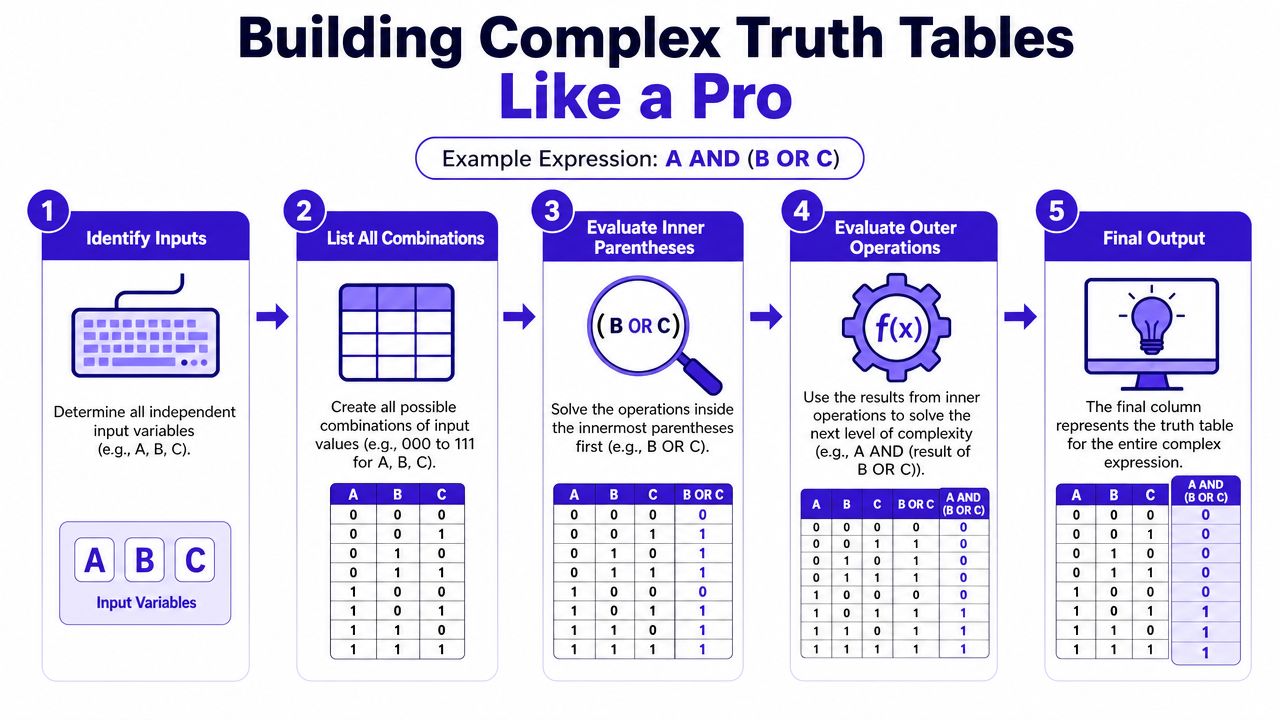
The method that stops the chaos
Use this order every single time:
Write the inputs
Identify the variables. For example, A, B, and C.List all combinations
For three inputs, there are 8 rows. Write them systematically.Work inside brackets first
If the expression is A AND (B OR C), calculate B OR C before anything else.Add intermediate columns
Don't try to do it mentally. Give each mini-step its own column.Complete the final output
Use the intermediate result to calculate the last column.
For targeted practice after learning the method, it helps to apply it across lots of GCSE Past Papers so the row patterns and common traps stop feeling new.
Worked example with A AND (B OR C)
Set up the rows in binary order:
| A | B | C | B OR C | A AND (B OR C) |
|---|---|---|---|---|
| 0 | 0 | 0 | 0 | 0 |
| 0 | 0 | 1 | 1 | 0 |
| 0 | 1 | 0 | 1 | 0 |
| 0 | 1 | 1 | 1 | 0 |
| 1 | 0 | 0 | 0 | 0 |
| 1 | 0 | 1 | 1 | 1 |
| 1 | 1 | 0 | 1 | 1 |
| 1 | 1 | 1 | 1 | 1 |
Notice what's happening. The middle column, B OR C, tells you whether either of those inputs is on. The final column then checks whether A is also on at the same time.
Where confusion usually starts
Students often make one of these errors:
- They skip the bracket column. Then they mix up the order of operations.
- They use the wrong row order. That leads to repeated or missing combinations.
- They calculate the final column too early. That usually creates a chain of mistakes.
Don't “see” the answer. Build the answer.
A quick check before moving on
Ask yourself these questions:
- Have I included every input combination once?
- Have I created a column for each bracketed part?
- Does the final output match the rule of the expression?
If yes, the question becomes far more manageable. This is why logic gates truth tables can become a strength. They reward neat, visible thinking.
From Truth Tables to Exam Marks
Knowing the logic is one thing. Turning it into marks is another. Examiners don't watch your brain work. They only mark what's on the page.
GCSE-style example
Suppose you're given the expression (A AND B) OR C and asked for the truth table.
A strong exam response starts by splitting the expression into parts. Create one column for A AND B, then one final column for (A AND B) OR C.
| A | B | C | A AND B | (A AND B) OR C |
|---|---|---|---|---|
| 0 | 0 | 0 | 0 | 0 |
| 0 | 0 | 1 | 0 | 1 |
| 0 | 1 | 0 | 0 | 0 |
| 0 | 1 | 1 | 0 | 1 |
| 1 | 0 | 0 | 0 | 0 |
| 1 | 0 | 1 | 0 | 1 |
| 1 | 1 | 0 | 1 | 1 |
| 1 | 1 | 1 | 1 | 1 |
This layout is examiner-friendly. It shows understanding, not just an answer.
Examiner tip: If a mark scheme allows method marks, intermediate columns can protect you even if the final output contains a slip.
What AQA, OCR, and Edexcel usually reward
Different boards phrase questions differently, but they tend to value the same habits:
- Clear row order: The combinations are complete and systematic.
- Visible working: Intermediate logic appears in separate columns.
- Correct gate interpretation: AND, OR, NOT, and XOR are used accurately.
- Neat final output: The answer is easy to read and easy to verify.
Teachers are often sceptical of polished revision advice because much of it sounds nice but ignores mark schemes. This topic is different. Presentation and sequencing matter because they make the method visible.
A-Level example with a Half Adder
At A-Level, one classic task is the Half Adder. UK AQA A-Level Computer Science specifications require students to construct and test a 2-input Half Adder cell using XOR and AND gates, with the truth table showing the sum and carry outputs for all input combinations, as set out in the referenced specification material.
For a Half Adder:
- Sum is produced by XOR
- Carry is produced by AND
So the truth table looks like this:
| A | B | Sum | Carry |
|---|---|---|---|
| 0 | 0 | 0 | 0 |
| 0 | 1 | 1 | 0 |
| 1 | 0 | 1 | 0 |
| 1 | 1 | 0 | 1 |
This makes sense if you connect it to binary addition. Adding 0 and 1 gives a sum of 1. Adding 1 and 1 gives a sum bit of 0 and a carry of 1.
For timed revision, questions like this are ideal for focused Exam Practice for GCSE, especially when you want repeated exposure to structured mark-scheme habits.
Show both outputs clearly labelled. “Sum” and “Carry” are not decorative. They tell the examiner that you understand the circuit's purpose.
Small habits that save marks
Write the gate names carefully. Keep your rows aligned. If a circuit looks ugly, translate it into smaller steps before touching the final column.
That's what high-scoring students do. Not because they're guessing less, but because they're leaving less to chance.
Your Next Steps to Full Marks Mastery
At this point, the path is simple. Know what each gate does. Stay systematic with row order. Use intermediate columns whenever an expression gets even slightly crowded.
That approach turns a topic many students fear into one of the most controllable parts of the paper. It also helps teachers and tutors spot exactly where a learner's thinking goes wrong, because every step is visible.

If you want this to feel automatic by exam day, you need regular, exam-shaped practice rather than random notes. That's where AI Powered Revision can help, especially if you want questions aligned to UK exam boards and feedback that reflects how marks are awarded.
If you want to turn logic gates truth tables from a weak spot into dependable marks, try MasteryMind. It gives UK students examiner-aligned practice for GCSEs and A-Levels, with feedback that helps you fix mistakes fast and build the habits that matter on the day.
Ready to master this topic?
Practise with quizzes, blurt exercises and exam questions on MasteryMind.
7 days Premium · Then free forever · No card, no charge