Long Term Memory: Your Guide to Acing GCSE & A-Level Exams

You sit down to revise, open three tabs, highlight half a textbook, copy a neat summary into your notes, and tell yourself this time it's going in. Then the next morning you try a past paper and your mind goes blank on the very topic you revised for hours.
That feeling is horrible, especially when exams are getting close and everyone keeps saying “just revise more” as if time alone fixes it.
It doesn't. Technique matters.
Long term memory isn't a gift that some students get and others don't. It's a system. If you understand how that system works, revision stops feeling like pouring water into a leaky bucket. It starts feeling organised, purposeful, and much more useful for assessments, especially if you're facing AQA, Edexcel, OCR, or WJEC questions where knowing a fact is only half the job.
The Revision Black Hole And How to Escape It
A lot of students fall into the same trap. They revise in a way that feels productive, but doesn't hold up under pressure.
Take a common GCSE evening. A student spends two hours on Biology. They re-read the page on the heart, highlight key words, and make colourful notes on circulation. It feels solid. The next day, the teacher asks them to explain double circulation in a short answer question, and they can't organise the explanation.
That's not because they're lazy. It's not because they're “bad at memory”. It's because they practised recognising information, not retrieving it.
Why this catches so many students out
The problem gets worse in UK exams because mark schemes don't just reward remembering isolated facts. They reward using knowledge in the right shape.
AQA might ask you to describe, explain, or analyse, and those command words are not interchangeable. One asks for clear features. Another asks for causes or reasons. Another asks you to break something down and connect ideas. That gap matters. Guidance discussed in this long term memory teaching guide highlights that retrieval practice is treated as a strong strategy for long-term retention, but many students still aren't shown how to retrieve structured answers for GCSE and A-Level mark schemes.
You can know the content and still underperform if you haven't practised getting it back in exam form.
What escape actually looks like
The fix isn't “revise harder”. It's building revision around what the brain needs to keep and use information.
That means:
- Testing, not tracing. Closing the book and trying to recall.
- Spacing, not cramming. Returning to topics over time.
- Using exam language. Practising the difference between “state”, “describe”, “explain”, and “evaluate”.
- Building response shapes. Not just facts, but paragraph plans, chains of reasoning, and judgement statements.
For students trying to recover their grades, this is good news. You do not need a perfect start to build strong long term memory from here.
For keen students aiming high, the effective application of knowledge often separates top grades from decent ones. Strong students don't just remember more. They can pull the right knowledge out, in the right order, under time pressure.
How Your Brain Builds Long Term Memory
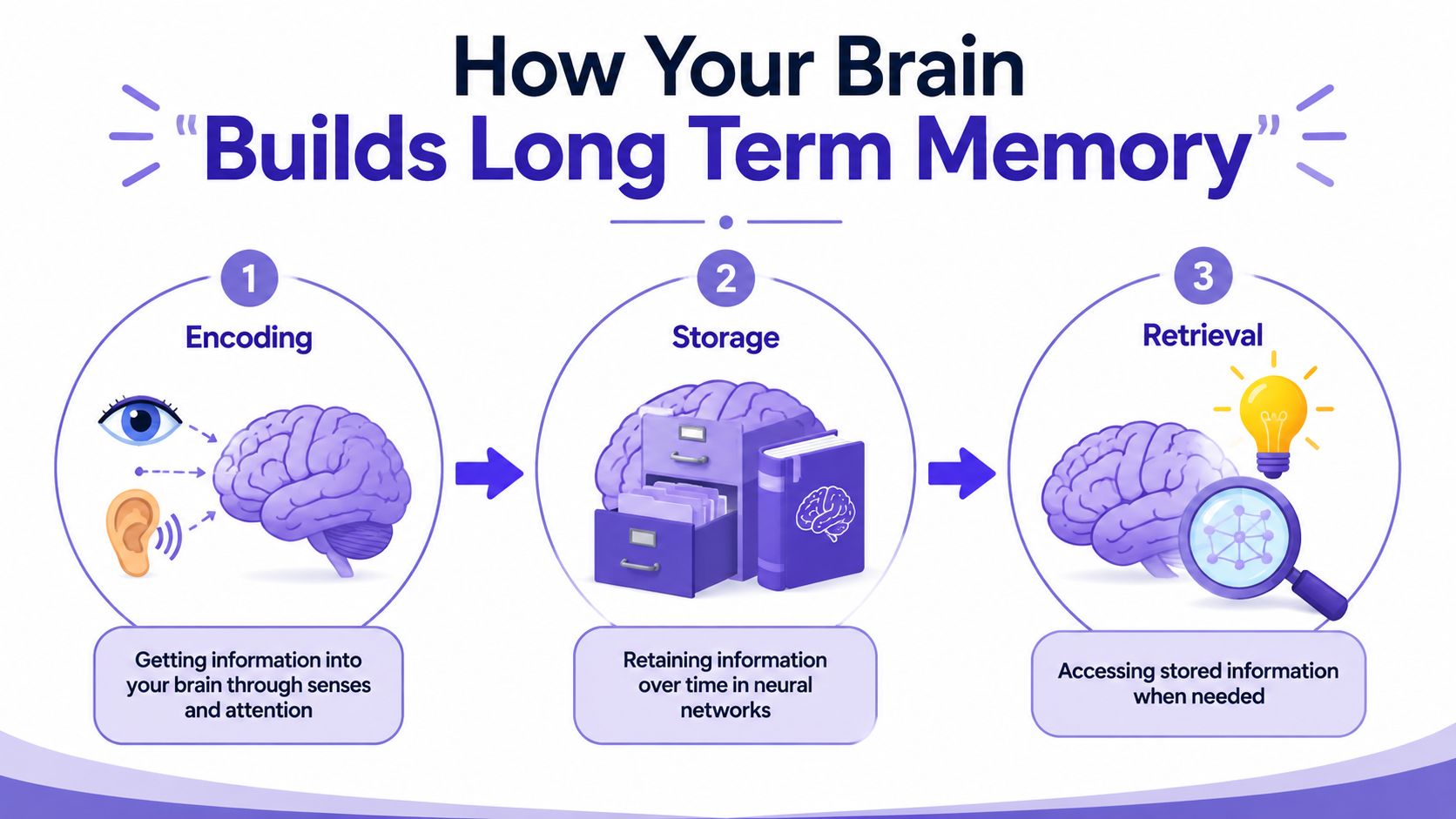
Your brain doesn't store revision as one giant folder called “Science” or “History”. It builds memory through a process. If you know the process, revision choices make more sense.
The process resembles saving a file properly. First you create it. Then you save it somewhere reliable. Later, you need to find it quickly when you need it.
Encoding means getting it in properly
Encoding is the first stage. This is when your brain takes in information and gives it meaning.
If you glance at a page while tired and distracted, encoding is weak. If you focus, connect the idea to something you already know, and put it into your own words, encoding is stronger.
A simple example:
- In Chemistry, reading “ionic bonding involves electrostatic attraction” is exposure.
- Explaining it aloud as “a metal loses electrons, a non-metal gains them, and the opposite charges attract” is encoding.
Attention matters here. Multitasking wrecks this stage. If your phone keeps pulling you away, your brain never really files the material in the first place.
Storage means making it stick
After encoding, the brain needs to store the information. During this storage, consolidation takes place.
The hippocampus helps lay down new memories, and over time wider brain networks help stabilise them. You don't need a neuroscience degree to use that idea. You just need the practical takeaway. Memories get stronger when you revisit them, use them, and sleep properly after learning them.
A useful way to picture this is a footpath across grass. Walk it once and it's faint. Walk it repeatedly over time and the route becomes obvious.
Researchers in a UK neuroimaging study found that retrieving episodic memories and semantic memories shares considerable overlap in the brain, which suggests revision should train this network through repeated recall rather than treating memory like separate boxes for “facts” and “experiences” in a simplistic way. You can read more in this University of Nottingham memory study.
Practical rule: If you want a memory to stay, don't just put it in once. Revisit it, use it, and pull it back out.
Retrieval means getting it back when it counts
Retrieval is the moment of truth. Can you bring the information back without the page in front of you?
This is the bit most students avoid because it feels uncomfortable. That discomfort is useful. Struggling to remember is often the work that strengthens the pathway.
For exams, retrieval has to match the task. Recalling a definition is one level. Reconstructing a 12-mark explanation or planning a 24-mark essay is another. That's why mastering active recall techniques matters more than reading your notes again.
A few retrieval examples look like this:
- English Literature: write three quotes from memory, then explain how one supports a theme.
- Maths: solve a problem cold, without checking an example first.
- History: answer “How far do you agree?” by building both sides and a judgement.
- Biology: draw a process diagram from memory, then label it.
The key idea is simple. Long term memory isn't built when information feels familiar. It's built when information is encoded clearly, stored through repeated use, and retrieved under slightly demanding conditions.
Why Your Revision Keeps Disappearing
The reason revision vanishes so quickly isn't mysterious. Your brain is selective.
If you don't return to information, the memory trace fades. That's one reason cramming can feel successful on the night and useless a week later.

The forgetting curve is brutal
The big lesson from the forgetting curve is simple. If knowledge goes unpractised, it drops fast. One summary of this research states that students can lose up to 80% of unpractised knowledge within weeks, while spaced retrieval at 2 to 3 days, then 1 week, then 2 weeks can flatten that curve and help move learning into long term memory, as discussed in this forgetting curve review.
That's why “I revised it already” means almost nothing on its own.
Why highlighting feels useful but often isn't
Highlighting and re-reading create a dangerous illusion. The page looks familiar, so your brain tells you the topic is secure.
But exam questions don't ask, “Does this look familiar?” They ask, “Can you produce this with no cues, in the right format, under time pressure?”
Here's the difference:
| Method | What it feels like | What the exam actually needs |
|---|---|---|
| Re-reading notes | Smooth and reassuring | Weak retrieval |
| Highlighting textbooks | Busy and organised | Little practice recalling |
| Watching revision videos | Clear in the moment | Easy to mistake understanding for memory |
| Self-testing | Harder and messier | Stronger exam preparation |
Forgetting isn't proof that you're failing. It's proof that your brain needs another retrieval round.
Your brain is not broken
Forgetting is part of normal memory function. Your brain can't keep everything at full strength all the time, so it prioritises what gets used.
That means your job during revision is to send a clear signal: this matters, keep it available.
A few warning signs show you're stuck in passive revision:
- You recognise answers when you see them, but can't produce them alone.
- You make neat notes but rarely test yourself on them.
- You keep restarting topics because none of them feels secure.
- You avoid past papers until late because they expose gaps.
Teachers see this all the time. Students aren't short on effort. They're often short on retrieval.
Science-Backed Techniques for Durable Learning
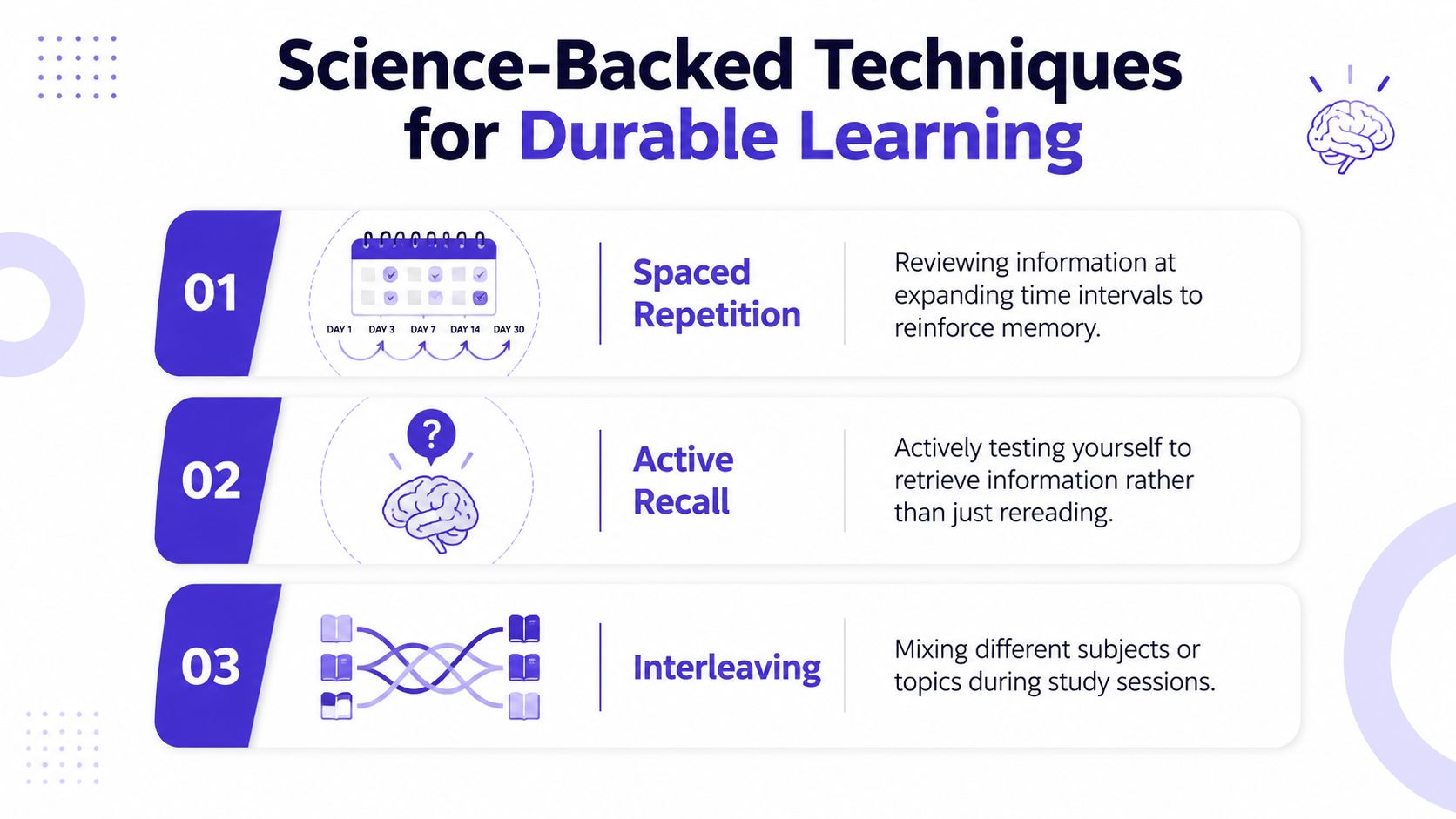
Good revision methods all do one thing well. They make the brain work to keep, connect, and retrieve knowledge.
This doesn't need to be fancy. It does need to be deliberate.
Spacing beats stuffing
The spacing effect shows that revision spread over 8 to 12 weeks produces much better long-term retention than cramming, and that matters because UK exam boards expect students to apply knowledge across mixed topics from the full course, as explained in this study skills overview of memory and revision.
If you revise all of electrolysis in one night and leave it for a month, you'll feel rusty fast. If you revisit it briefly and repeatedly across your term, recall becomes much steadier.
A practical pattern might look like this:
- First revisit a topic a few days after learning it
- Second revisit later that week
- Third revisit the following week
- Later revisits through mixed practice over the term
If you want a practical way to organise that, these Spaced repetition strategies for GCSE show how to turn the idea into an actual revision rhythm.
Retrieval practice means pull, don't peek
Retrieval practice means trying to remember without looking first.
That could be:
- Blank page recall for a Geography case study
- Flash questions on key Sociology terms
- Explaining aloud how to solve a Physics calculation
- Writing an essay plan from memory for English or History
This is also why language learners benefit from systematic recall. If you're revising vocabulary as part of French or Spanish, this guide on how to remember new words effectively gives a useful example of how spaced retrieval works outside standard subject notes too.
Interleaving helps your brain choose
Interleaving means mixing topics instead of doing one block for too long.
In Maths, that could mean algebra, then graphs, then ratio, rather than forty near-identical algebra questions. In History, it might mean switching between Elizabethan England, Cold War, and Medicine rather than staying in one era all night.
Why it works: your brain has to identify the type of problem, not just repeat a routine.
Here's a quick comparison.
| Technique | Why It Works | GCSE/A-Level Application |
|---|---|---|
| Spaced repetition | Revisits content before it fades too far | Revisit quotes, formulae, and key case studies across the term |
| Active recall | Strengthens retrieval pathways | Answer flash questions, blurting, mini quizzes, essay plans |
| Interleaving | Trains topic selection and flexible thinking | Mix Maths problem types or alternate essay topics in one session |
A short explainer can help if you want a visual walkthrough before trying it yourself.
Two often-missed techniques
Students usually hear about flashcards. They hear less about these:
- Elaboration. Ask “why does this happen?” and “how does this connect to what I already know?” In A-Level Biology, don't just memorise the steps of respiration. Explain why each stage matters.
- Sleep and basic routines. If you revise while exhausted and never revisit, memories stay fragile. Sleep supports consolidation. You don't need perfection, but all-night panic sessions usually cost more than they give.
Strong revision feels less smooth in the moment and more successful later.
Your Blueprint for an Unforgettable Revision Timetable
A timetable only works if it tells you what to do inside the session. “Revise Chemistry” is too vague. “Retrieve organic reactions for 20 minutes, then answer two six-mark questions” is usable.
Students usually need one timetable for memory and another for exam performance. That split wastes time. The smarter move is combining them.
A GCSE week that actually builds recall
Here's the difference between a weak plan and a better one.
Weak plan
- Monday: Biology notes
- Tuesday: History revision
- Wednesday: Maths practice
It looks tidy, but it doesn't say how memory gets trained.
Better plan
- Monday. GCSE Biology, blank-page recall on the circulatory system, then mark gaps from notes.
- Tuesday. GCSE History, answer one “describe” question and one “explain” question from memory.
- Wednesday. GCSE Maths, mixed set of topics so you have to choose methods.
- Thursday. Return to Biology for a short retrieval round on Monday's content.
- Friday. English Literature quote recall and a short paragraph using a specific theme.
- Weekend. One timed section from a past paper.
That timetable works because it includes return points. It also changes the retrieval task to match the subject.
A-Level revision needs depth, not just coverage
At A-Level, the challenge changes. Facts still matter, but so does synthesis.
A student doing Psychology and History might build a week like this:
- Monday evening. Psychology retrieval grid on research methods, then one application question.
- Tuesday evening. History essay plan from memory on causation.
- Thursday evening. Return to Psychology with mixed-topic questions, not the same subtopic again.
- Saturday morning. Timed essay or data response.
- Sunday. Short correction session based on errors, not full re-study.
That pattern keeps retrieval active while avoiding the trap of endlessly remaking notes.
Match revision to command words
Here, many students lose marks even when they know the topic.
A command word changes the retrieval job.
- Describe means recall clear features, steps, or characteristics.
- Explain means link cause and effect.
- Analyse means break down and explore how or why parts connect.
- Evaluate means weigh strengths, limits, and judgement.
So your revision should look different too.
| Command word | Retrieval task that fits |
|---|---|
| Describe | List key features from memory in the right sequence |
| Explain | Build a because-chain using linked reasoning |
| Analyse | Write two developed points showing relationships or effects |
| Evaluate | Plan both sides, then add a supported judgement |
A timed practice habit matters here. According to this Eduqas article on memory retention for exam revision, active revision such as completing past papers under timed conditions can improve retention and time-management confidence by 30% in UK students who complete at least 6 full papers, and that mirrors the kind of active retrieval expected under JCQ rules for coursework and NEAs.
If you need realistic practice material, using A-Level Past papers can make this far easier than hunting across different exam board pages.
Don't build a timetable around subjects alone. Build it around retrieval tasks, return points, and command words.
How MasteryMind Puts This Science on Autopilot
A lot of revision advice sounds sensible until you try to manage it across several subjects, different exam boards, and dozens of weak spots. Students know spacing helps. Teachers know retrieval helps. The hard part is organising it consistently.
That's where tools can help, if they mirror how memory works rather than adding more noise.

Where the system matches the science
AI Powered Revision is built around the same principles that make long term memory stronger in the first place.
- Spaced review scheduling helps students revisit topics instead of leaving them to fade.
- Mixed-topic practice supports interleaving, so students don't just repeat one routine.
- Voice-powered Blurt Challenge pushes active recall by getting learners to say what they know out loud.
- Exam-board alignment matters because GCSE and A-Level memory isn't just about facts. It's about recalling material in the form AQA, Edexcel, OCR, and WJEC papers reward.
- NEA Coach fits coursework support more carefully by using guidance and mark estimation rather than direct rewriting.
For teachers, that matters because the quality test isn't whether an AI tool sounds clever. The quality test is whether it supports retrieval, spacing, and examiner-shaped practice without muddying expectations.
Why this matters beyond simple storage
The wider challenge in learning technology is not just collecting information, but turning it into something usable. The same issue shows up in knowledge systems more broadly. This piece on how teams can transform data into smart assets is useful because it shows the difference between storing content and making it retrievable in a meaningful way.
That's the same distinction students face in revision. A folder full of notes is storage. A system that surfaces the right question at the right time is memory support.
For a student who's behind, that reduces friction. For a high-attaining student, it makes deliberate practice easier to sustain. For a sceptical teacher, it creates a clearer standard to judge by. Does the tool help learners retrieve, space, and apply knowledge in exam conditions? If yes, it's useful. If not, it's just another digital notebook.
From Forgetting to Remembering It's Your Move
If revision has felt like effort without payoff, that doesn't mean you've run out of time. It usually means your method has been too passive, too crammed, or too far removed from the way UK exams test memory.
Long term memory grows when you encode clearly, revisit at the right moments, and practise retrieval in the shape the exam demands. That's true whether you're trying to drag a grade up before mocks or push for top marks in the summer.
The students who improve most are rarely the ones with the prettiest notes. They're the ones who start testing themselves, spacing their review, mixing topics, and practising command words properly.
Teachers know this too. Knowing is not the same as being able to express knowledge under pressure.
So make tonight useful. Pick one topic. Close the notes. Retrieve what you can. Check what you missed. Schedule the next revisit. Then repeat.
If you want a simpler way to apply these ideas without building the whole system by hand, try MasteryMind. The free plan gives you a practical starting point for spaced review, active recall, and exam-board-aligned practice that matches how GCSE and A-Level students need to remember.
Ready to master this topic?
Practise with quizzes, blurt exercises and exam questions on MasteryMind.
7 days Premium · Then free forever · No card, no charge