Macbeth Essay Plans That Score Top Marks
You've got 40 minutes left, the Macbeth question is staring back at you, and your pen still hasn't touched the page. You know the plot, you remember several quotations, and you've revised ambition, guilt and the supernatural, but none of that helps if you can't turn it into a clear argument quickly.
That's where effective Macbeth essay plans make a difference. A plan isn't extra work before the final answer. It's the shortcut that helps you choose evidence, organise your thinking and keep answering the question when the clock is moving. Macbeth remains central to UK GCSE study, accounting for 22% of Shakespeare play teaching overall in a large survey, while 65% of respondents taught it for GCSE (Secondary Shakespeare in the UK survey). So if you're recovering your exam preparation or pushing towards the highest grades, learning to plan this play properly is time well spent.
Why Most Macbeth Essays Lose Marks Before the First Paragraph
The first problem usually isn't a lack of Shakespeare knowledge. It's starting without an argument spine, the central idea that gives every paragraph somewhere to go.
A student might begin with a confident plot summary: Macbeth meets the witches, hears the prophecy, kills Duncan and eventually dies. That proves knowledge of events, but it doesn't yet explain how Shakespeare presents a character, theme or idea. Examiners need to see what the events mean and how Shakespeare's choices create that meaning.
Three habits that quietly lower marks
Plot summary replaces analysis.
“Macbeth kills Duncan and then feels guilty” tells the reader what happens. “Macbeth's rhetorical question, ‘Will all great Neptune's ocean wash this blood / Clean from my hand?’, turns guilt into an enormous physical stain that cannot be removed” analyses Shakespeare's language and interpretation.
Every quotation gets forced into ‘evil'.
Macbeth is connected to violence, ambition, guilt, masculinity, kingship, the supernatural and appearance versus reality. If every quotation becomes evidence that “evil is bad”, your essay loses precision. A strong plan asks what changes, who causes the change and what Shakespeare wants the audience to notice.
Paragraphs jump between characters without a thread.
Moving from Macbeth to Lady Macbeth, then to Banquo and back to the witches can feel like revision notes rather than an argument. Each paragraph should develop the thesis, even when the focus shifts. For example, an essay about guilt might move from Macbeth's immediate horror to Lady Macbeth's apparent control, then show how both characters eventually suffer.
Practical rule: If a paragraph could be moved into an essay on almost any Macbeth theme, it's probably too vague.
A useful plan should therefore answer four questions before you write: What is my position? Which scene proves it first? Where else does Shakespeare develop it? How does the ending confirm or challenge it? Checking understanding command words in exams can also help you distinguish what questions such as “explore”, “how” and “to what extent” are asking you to do.
Turning the Question Into a Thesis You Can Defend
A thesis isn't a fancy introduction. It's your answer in one strong sentence, and it should control the choices you make afterwards.
Take the Macbeth-style question: “Explore how Shakespeare presents guilt in Macbeth.” Don't immediately search for quotations. First, slow the question down and identify its working parts.
Four moves from question to argument
Underline the command and concept.
The command is “explore”. The concept is “guilt”. “Explore” gives you room to consider development, contrast and complexity. It doesn't invite you to list every guilty moment in the play.Turn the prompt into a question you must answer.
Ask: What does guilt do to Macbeth and Lady Macbeth, and how does Shakespeare show its effects changing over the play?Write a tentative position.
A weak thesis says:“Guilt is important in Macbeth.”
It identifies the topic but makes no argument. It doesn't tell the examiner what guilt does, which characters it affects or how Shakespeare presents it.
A stronger thesis says:
“Shakespeare presents guilt as a force that corrodes Macbeth's masculinity until his final confession becomes hollow.”
This gives you several analytical routes. You can discuss Macbeth's fear after Duncan's murder, his attempts to appear ruthless, his growing dependence on violence and the emptiness of his final language.
Test the thesis against three paragraphs.
Could you prove it with the immediate aftermath of Duncan's murder? Could you connect it to Macbeth's behaviour at the banquet? Could you use the “Tomorrow, and tomorrow, and tomorrow” speech to examine his emotional collapse? If the answer is yes, the thesis has enough flexibility.
Why this works across exam boards
For AQA, AO1 rewards a clear, informed response supported by references, while AO2 focuses on Shakespeare's use of language, structure and form. AO3 addresses context, and AO4 rewards accurate spelling, punctuation and grammar, as explained by BBC Bitesize's AQA assessment overview. The same basic habit helps students working with Edexcel, OCR and WJEC, even though question wording and assessment details vary.
Your thesis gives AO1 direction. Your discussion of words, imagery, form and dramatic structure creates AO2 opportunities. Your comments on Jacobean kingship, regicide or witchcraft can support AO3 when they clearly clarify the argument, rather than appearing as a memorised context paragraph.
A thesis should also be flexible enough to survive different extracts. You're not trying to predict the exact question. You're building an argument that can begin with close analysis of the printed passage and then widen into the whole play.
Choosing Between PEE, PEEL and TEEL for Macbeth Analysis
The three structures are similar, but they don't produce equally strong paragraphs automatically. Use Macbeth's “Tomorrow, and tomorrow, and tomorrow” speech to see the difference.
| Structure | Moves | Strength | Weakness | Best For |
|---|---|---|---|---|
| PEE | Point, Evidence, Explanation | Fast and easy to remember | Can stop at plot explanation | Short practice paragraphs |
| PEEL | Point, Evidence, Explanation, Link | Reconnects analysis to the thesis | The link can become repetitive | GCSE Macbeth essays |
| TEEL | Topic sentence, Evidence, Explanation, Link | Makes the opening a mini-thesis | Requires a more controlled argument | A-Level sustained responses |
PEE gives you the basic movement
A PEE paragraph might begin: “Macbeth feels that life has lost meaning. He says life is ‘a tale / Told by an idiot, full of sound and fury, / Signifying nothing'. This shows that he is unhappy.”
That's a reasonable starting point, but “this shows he is unhappy” leaves a great deal unexplained. Which word matters? What does the metaphor suggest? Why does Shakespeare place this speech near the end of Macbeth's rule?
PEEL keeps the paragraph connected
A PEEL version develops the method:
“Shakespeare presents Macbeth's despair through the metaphor of life as ‘a tale / Told by an idiot'. The noun ‘tale' reduces human experience to a meaningless story, while ‘signifying nothing' creates a bleak final judgement. The speech's repetitive rhythm makes time feel mechanical and empty, reflecting Macbeth's emotional exhaustion. This links to the thesis because Macbeth's earlier ambition has not created fulfilment, but has stripped him of the moral purpose that once gave his life meaning.”
The final sentence doesn't just repeat the question. It explains why the quotation matters to the overall argument.
TEEL starts with a mini-thesis
TEEL would sharpen the opening further:
“By the end of the play, Shakespeare presents Macbeth's ambition as having destroyed his ability to find meaning in life.”
That topic sentence already makes an argument. The evidence and method analysis then prove it. This approach suits students who need to sustain a conceptual line across a longer response, particularly at A-Level.
For most GCSE students, PEEL is the safest choice. Pick one structure and use it consistently. Mixing PEE, PEEL and TEEL halfway through can make your paragraphs lose balance, especially when you're under pressure.
Picking Quotations That Flex Across Question Wordings
Quotation revision becomes much easier when you stop treating every line as a single-use tool. Choose a manageable bank of six to eight adaptable quotations, then test what each one can do for character, theme, method and context questions.
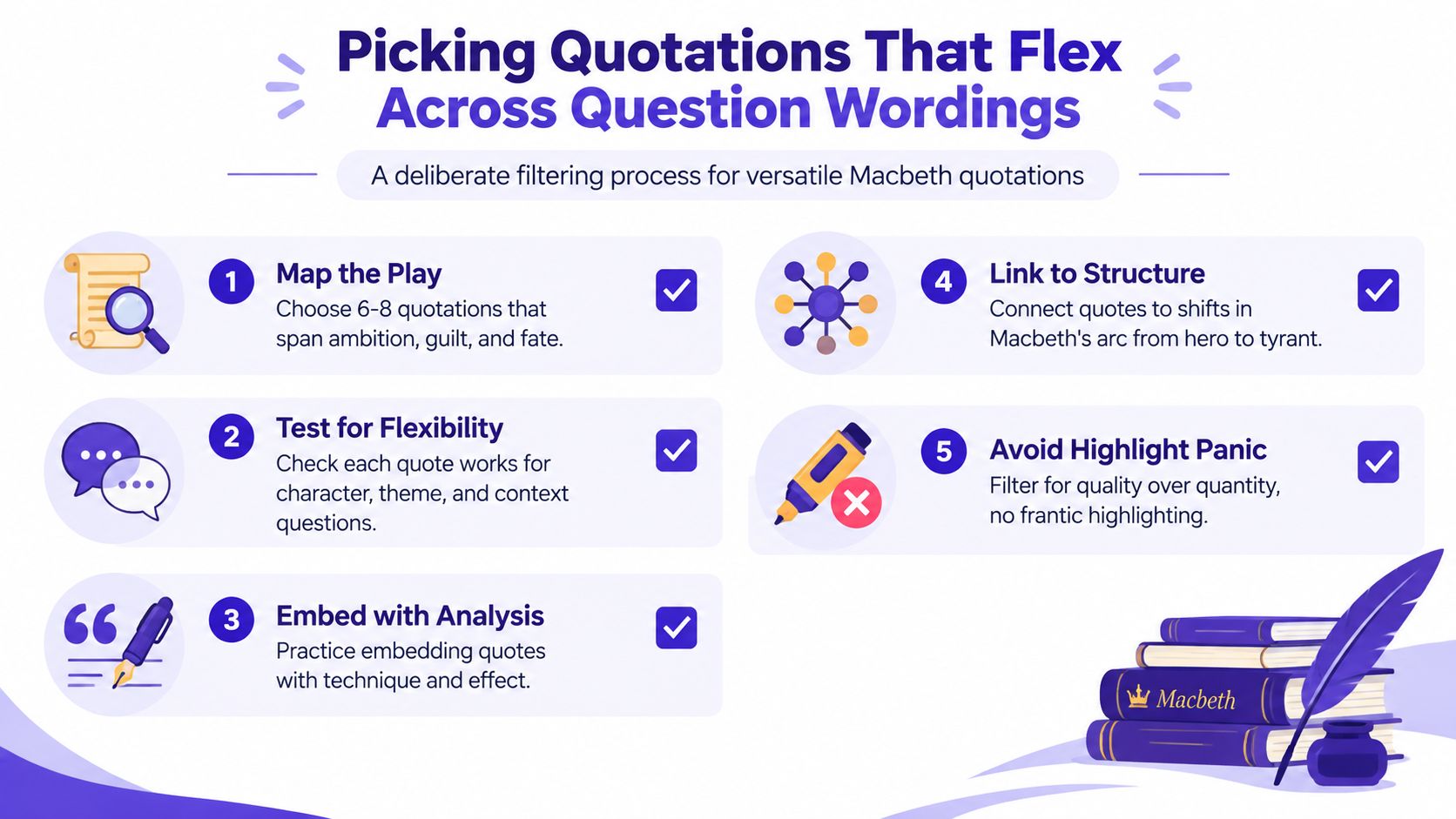
Start with a line that carries tension. “Vaulting ambition” is more flexible than a quotation that names one event. It can support an essay about Macbeth's tragic weakness, his changing masculinity, the danger of desire or the relationship between prophecy and personal choice. The image of ambition “o'erleaps itself” also gives you a clear method to analyse, because Shakespeare turns an abstract desire into a physical movement that goes beyond control.
“Is this a dagger which I see before me?” is powerful, but it does narrower work. It's excellent for hallucination, appearance versus reality, internal conflict and the supernatural. You can still use it for ambition, but you'll need to explain the connection carefully rather than forcing it into the paragraph.
Build a quotation map
A useful bank might include lines connected to:
- Ambition: “vaulting ambition”, especially alongside Macbeth's awareness that he has no moral reason to act.
- Guilt: “Will all great Neptune's ocean wash this blood / Clean from my hand?”
- Masculinity: “When you durst do it, then you were a man.”
- Supernatural influence: “Fair is foul, and foul is fair.”
- Power: “To be thus is nothing, but to be safely thus.”
- Appearance and reality: “Look like th' innocent flower, / But be the serpent under't.”
- Moral collapse: “I am in blood / Stepped in so far.”
- Emotional emptiness: “Tomorrow, and tomorrow, and tomorrow.”
You don't need to memorise every line in full if you can embed short, accurate fragments into analytical sentences. The key is to practise using the same quotation in different ways. Try a character question, a theme question and a language question, then change your explanation rather than changing the evidence automatically.
For further practice, use Macbeth exam questions practice and test whether each quotation answers the wording. You can also watch the video below as a reminder that quotation choice should support an argument, not replace one.
The strongest quotations contain contradiction, ambiguity or movement. Macbeth can be brave and morally weak. The witches can influence him without fully controlling him. Lady Macbeth can appear stronger than Macbeth before guilt overwhelms her. Those tensions give you something worth analysing.
Two Full Macbeth Essay Plans for Common Exam Questions
A plan should be detailed enough to guide your writing, but open enough to let you respond to the extract in front of you. These two examples show how to track an argument across the play without turning the essay into a plot retelling.
Plan A for Macbeth as a tragic hero
Question: How does Shakespeare present Macbeth as a tragic hero?
Thesis: Shakespeare presents Macbeth as a tragic hero whose courage and status are undermined by hamartia, as ambition overrides his moral imagination and turns a respected soldier into a violent tyrant.
Opening extract point: Begin with the printed extract, whatever scene it gives you. Identify how Macbeth's language reveals a conflict between the heroic public figure and the private man who understands the consequences of his choices. If the extract focuses on his hesitation, analyse questions, contrasts and modal verbs. If it shows his confidence, examine declarative statements and violent imagery.
Body point one, the prophecy and potential: Use “brave Macbeth” and “Noble Macbeth” to establish his starting position. His public reputation matters because tragedy depends on the audience seeing what he has lost. Contrast that praise with “If chance will have me king”, where Macbeth initially imagines kingship arriving without direct action.
Body point two, Duncan's murder: Use “I have no spur / To prick the sides of my intent, but only / Vaulting ambition”. Macbeth recognises that ambition is his only motive, which makes the murder a conscious moral decision rather than an unavoidable result of prophecy. Link the private soliloquy to the public consequences of regicide and disrupted kingship.
Body point three, the Banquet scene: Use Macbeth's reaction to Banquo's ghost to show that becoming king hasn't made him secure. “Thou canst not say I did it” reveals fear, denial and the return of guilt in public. His authority now looks fragile because he cannot control his own vision or his guests' response.
Body point four, the final battle: Use “I will not be afraid of death and bane” alongside “I have almost forgot the taste of fears”. Macbeth retains physical courage, but it no longer represents the honour of the opening soldier. His bravery has become numbness.
Closing line: Shakespeare makes Macbeth tragic because the qualities that once made him admirable cannot survive after he allows ambition to replace moral judgement.
Plan B for the role of the witches
Question: Explore the role of the witches in Macbeth.
Thesis: Shakespeare uses the witches to externalise Macbeth's suppressed desires, disturb moral order and tempt both Macbeth and the audience into questioning whether fate controls events or merely reveals what characters already want.
Opening extract point: If the extract includes the witches, examine their entrance and staging. The opening chorus-like scene places them before Macbeth appears, giving them an atmosphere of authority over the play's world. Their rhyme, repetition and unnatural setting can make them seem separate from ordinary human society.
Body point one, “Fair is foul”: The paradox introduces appearance versus reality. The witches do not merely predict events. They create a language in which moral categories become unstable, preparing the audience for a tragedy where respected appearances hide murderous intentions.
Body point two, Macbeth's response to prophecy: Use Macbeth's question, “Why do I yield to that suggestion”, to show that the witches awaken an idea already forming inside him. The word “yield” suggests surrender, but the question also proves that Macbeth recognises his own responsibility.
Body point three, the apparitions: The witches offer statements that sound reassuring but contain dangerous ambiguity. “None of woman born / Shall harm Macbeth” encourages overconfidence, while the moving forest prediction appears impossible. The supernatural therefore works through misleading half-truths rather than simple lies.
Body point four, the reversal of power: Lady Macbeth's line, “you should be women”, connects the witches with anxieties about gender and authority. Yet Lady Macbeth later collapses under guilt, while Macbeth becomes increasingly violent. Shakespeare unsettles the idea that power belongs naturally to one gender.
Closing line: The witches shape the tragedy by tempting Macbeth with a future he already desires, but Shakespeare leaves enough evidence for the audience to see that Macbeth chooses how to respond.
Use the same process for other questions. Your plan should include a thesis, an extract route, whole-play development and a final point that answers the question at the end of Macbeth. Students preparing for advanced assessments can also use A-Level Past papers to practise adapting the shape rather than memorising these exact paragraphs.
A 45-Minute Exam Plan That Stays on Track
A timed Macbeth response is partly a literature task and partly a decision-making task. AQA GCSE English Literature Paper 1 is worth 64 marks and 40% of the overall GCSE grade, while the Macbeth essay is worth 34 marks, including 4 marks for spelling, punctuation and grammar, according to this Macbeth assessment overview. You need a routine that protects thinking time without allowing planning to swallow the essay.
| Phase | Minutes | Task | Common Drift to Avoid |
|---|---|---|---|
| Question and thesis | 1 to 5 | Underline the command term and topic words, then write a working thesis | Rewriting the whole question without answering it |
| Skeleton plan | 5 to 10 | Choose the extract focus, then jot a four-line whole-play route with one quotation per point | Listing quotations without a clear order |
| Main writing | 10 to 35 | Write the body, using close analysis first and widening to the whole play | Retelling the plot after each quotation |
| Conclusion | 35 to 40 | Echo the thesis and answer the question with a fresh verb | Adding a new argument at the end |
| Final check | 40 to 45 | Check subject-verb links, quotation accuracy and method words | Reading only for spelling and missing analysis |
The extract-to-whole-play pivot
Start each main paragraph with the printed extract if the question provides one. Analyse a word, image, contrast, stage direction or structural moment from that passage, then use a linking sentence to move elsewhere in the play.
For example: “In the extract, Macbeth's repeated questions reveal uncertainty. This hesitation develops earlier in the dagger soliloquy, where the imagined weapon turns his intention into a disturbing visual experience.” That sentence pivots from close reading to whole-play knowledge without abandoning the original argument.
Don't write everything you know about the scene. Select the detail that proves your thesis. If your point is that ambition destroys Macbeth's judgement, a sentence about every character who appears in the extract will only dilute your focus.
Practise this routine with Exam Practice for A-Level, especially if you need to become more comfortable making decisions under timed conditions. The aim isn't to produce a perfect plan. It's to create enough control that your analysis keeps moving.
Examiner Mindset and the Final-Week Revision Checklist
Markers can tell when a student has memorised information without shaping it around the question. They reward a clear thesis, embedded quotations, accurate subject terminology and connections that travel across the play. They penalise plot retelling, vague comments and paragraphs that ignore the question's command verb.
Think of your final revision period as repeated rehearsal, not passive rereading. A strong routine might look like this:
- Practise thesis writing: Take a range of Macbeth questions and create a defensible one-sentence answer for each.
- Build flexible evidence: Memorise five adaptable quotations for each major theme you're revising, then test them against character and language questions.
- Rehearse PEEL from cold: Choose a quotation without looking at your notes and write one paragraph that identifies Shakespeare's method.
- Redraft one complete essay: Compare your response with the language of your exam-board mark scheme, checking whether each paragraph sustains an argument.
- Read two high-grade responses: Don't copy their wording. Mark where they answer the question, embed evidence and connect the paragraph to the whole play.
- Practise context with purpose: Link Jacobean ideas about kingship, regicide, witchcraft and divine order only when they sharpen your interpretation.
Keep this four-point desk card beside your revision notes:
- Thesis clear: Does the opening make a real argument?
- Quotes embedded: Do quotations fit grammatically into your sentences?
- Method first: Have you analysed Shakespeare's language, structure or form?
- Question answered: Does the final line return to the exact idea in the question?
MasteryMind offers UK learners exam-board-aligned practice, including Macbeth questions, command-word guidance and essay feedback organised around assessment objectives. Visit MasteryMind to practise turning Macbeth essay plans into timed responses, then use the feedback to target the paragraph habit that is holding your marks back.
Ready to master this topic?
Practise with quizzes, blurt exercises and exam questions on MasteryMind.
7 days Premium · Then free forever · No card, no charge