Mass Movement Geography: Your Exam-Ready Guide

You're probably here because mass movement geography sits in that annoying category of topics that looks simple in class and then turns slippery in an exam. You half remember that it involves gravity, cliffs, maybe mud, maybe landslides, but when a question says explain, assess, or evaluate, everything starts blending together.
That's exactly why this topic matters. It isn't just a definition-learning exercise. It links physical processes, terrain types, hazards, and human decisions. If you can explain mass movement clearly, you can pick up marks across coastal geography, hazard questions, and case study answers. For stronger students, it's a topic where detailed process knowledge pushes you into top-band responses. For students trying to recover their grade, it's also one of the easiest places to improve because the core logic is so learnable.
Why Mass Movement Geography Matters for Your Exams
Mass movement geography shows up again and again because it sits right in the overlap between physical geography knowledge and exam skills. You need to know what happens on a slope, but you also need to show cause and effect clearly. That's where marks are won.
In UK geography, this isn't some rare or distant hazard. The British Geological Survey's National Landslide Database records more than 16,000 landslides across the UK (USGS reference page). That matters for your exam because it proves mass movement is a widespread UK process shaped by geology and climate, not just something that happens in dramatic mountain ranges overseas.
Why exam boards like it
Examiners like mass movement because it tests several things at once:
- Knowledge of processes. Can you define it accurately?
- Understanding of causes. Can you explain why slopes fail?
- Use of examples. Can you apply theory to a place like a coastal cliff?
- Human impact and management. Can you connect physical geography to decisions people make?
Practical rule: If a question mentions cliffs, slopes, heavy rainfall, coastal erosion, instability, or hazard management, mass movement might be part of the answer even if the phrase itself isn't in the question.
Why it matters for your grade
A weak answer says, “Mass movement is when rock falls down a slope.”
A stronger answer says, “Mass movement is the downslope movement of weathered material under gravity, often triggered when water increases weight and reduces slope stability.”
That second version sounds sharper because it includes process, trigger, and key vocabulary. That's how you start moving from basic recall into explanation.
If you want extra support building that kind of subject language, Online Revision for GCSE can help you practise turning rough knowledge into exam-ready answers.
What Is Mass Movement and How Is It Classified
Think about a pile of sugar tipped onto a plate. If the plate is nearly flat, the sugar stays put. Tilt it far enough, and the sugar starts moving. That's the basic idea behind mass movement geography. Gravity pulls material downslope, while the slope and the material try to resist that pull.
The exam-friendly definition is simple. Mass movement is the downhill movement of rock, soil, or weathered material under the force of gravity. You don't need a river to carry it. You don't need the wind. Gravity is the key driver.
The classification idea that saves marks
Students often get confused because the names sound similar. The easiest way to classify mass movement is by asking two questions:
- How fast is it moving?
- How much water is involved?
That gives you a clean way to separate the main types.
Classification of Mass Movement Types
| Type | Speed | Water Content | Movement & Material | Example |
|---|---|---|---|---|
| Fall | Very rapid | Low | Material breaks away from a steep slope or cliff and drops vertically | Rockfall from a jointed cliff |
| Slide | Rapid to moderate | Low to medium | Material moves as a block along a slip plane | Landslide on a weakened slope |
| Flow | Variable, often rapid | High | Saturated material moves like a fluid | Mudflow on a wet slope |
| Creep | Very slow | Usually low to medium | Soil moves gradually downslope over time | Soil creep on a hillside |
The four you need to recognise
Falls
A fall happens when rock detaches from a steep face and drops. This usually happens where rock is jointed or cracked. In an exam photo, look for a steep cliff, loose material at the base, and angular broken rock.
Slides
A slide happens when material moves along a distinct surface called a slip plane. If the movement is more block-like and organised, slide is usually the right term. In coastal settings, this often happens where the base of the cliff has been weakened.
Flows
A flow involves material with a lot of water in it. Instead of moving as one solid block, it behaves more like a thick liquid. If a question mentions saturated soil, slurry-like movement, or mud, flow should be in your mind.
Creep
Creep is the slowest type, and students often forget it because it isn't dramatic. But exam boards like it because it shows that not all hazards are sudden. Creep can tilt fence posts, crack walls, and slowly distort roads.
The best classification answers don't just list types. They distinguish them using speed, water content, and style of movement.
A common exam mistake
Don't treat every downslope movement as a landslide. Landslide is only one type. If you can classify the movement more precisely, you sound more like a geographer and less like someone guessing.
One useful revision habit is comparing topics with similar naming problems. The way you separate different slope processes is a bit like how you separate plate boundaries by movement and effect. If that kind of comparison helps you, this revision guide to conservative plate margins is a good model for learning categories without muddling them up.
The Forces at Play Driving and Resisting Movement
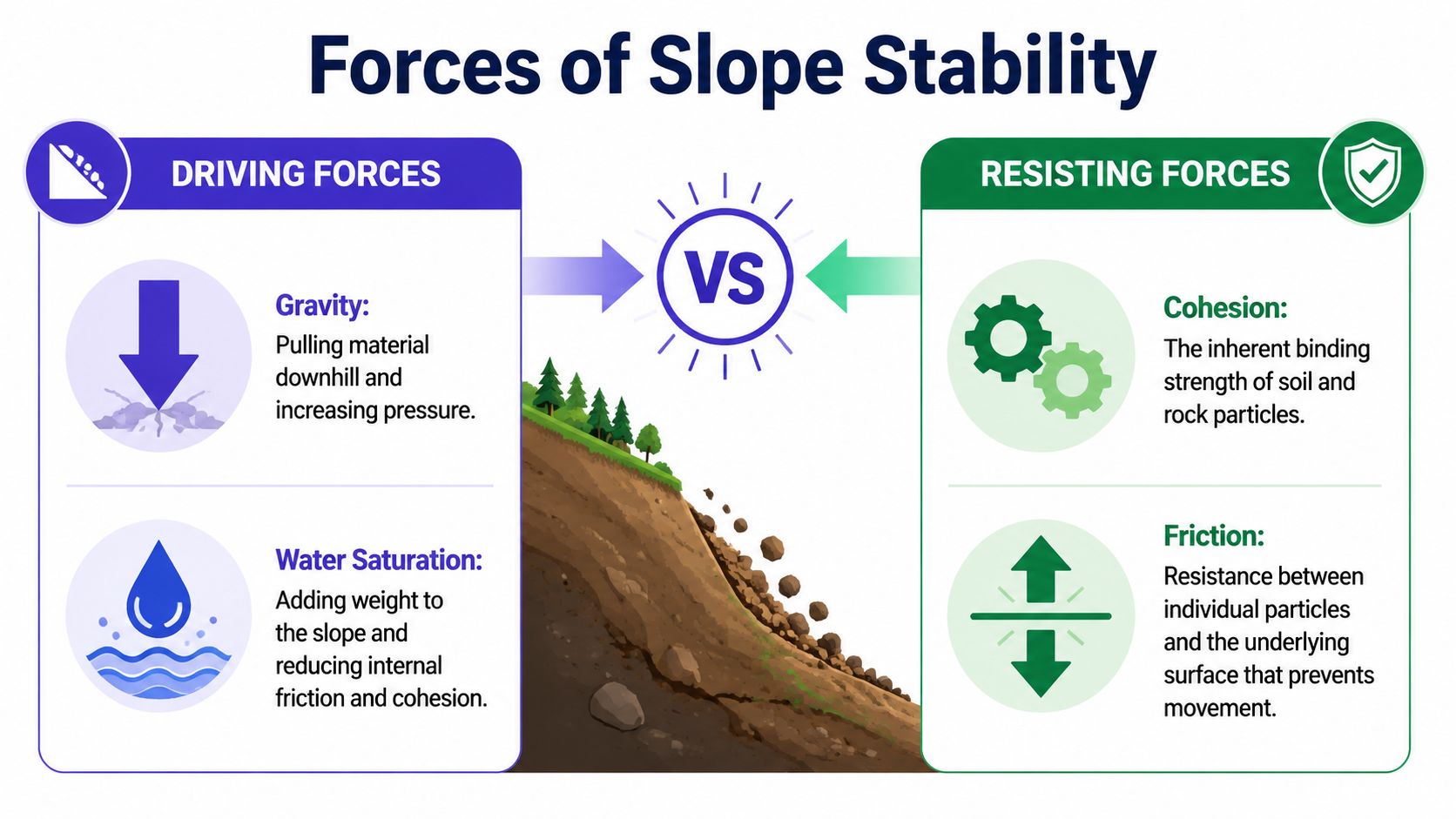
High-mark answers usually include one big idea. A slope is never just “stable” or “unstable” by magic. It's a contest between forces pushing material downhill and forces holding it in place.
Driving forces
Geographers often describe the downhill push as shear stress. You don't need to be a physicist to use that term well. It means the force encouraging material to move downslope.
The biggest driving force is gravity. On a steeper slope, gravity has a stronger downhill effect. If the material becomes heavier, that also increases the push.
Water matters here too. Once a slope becomes wet, the added water increases the load. That gives gravity more material to pull downhill.
Resisting forces
The forces stopping movement are often grouped under shear strength. This is the slope's ability to resist failure.
A slope is stronger when:
- Particles grip each other well through friction
- Material sticks together through cohesion
- Roots bind the soil and help hold it in place
- The slope angle is gentler, reducing the downhill pull
If those resisting forces are greater than the driving forces, the slope remains stable. If the driving forces become stronger, or the resisting forces become weaker, failure becomes more likely.
A simple way to remember it
Use this mental shortcut:
- Driving forces push
- Resisting forces hold
That sounds basic, but it helps under pressure in an exam. If you forget a technical phrase, you can still build an answer around that contrast.
A stable slope is really just a slope where resisting forces are still winning.
What examiners want to see
For a mid-mark answer, it's often enough to say that steep slopes are less stable because gravity acts more strongly downslope.
For higher marks, add the language of balance:
- The slope is in equilibrium when push and hold are balanced.
- Changes like added water or undercutting disturb that equilibrium.
- Once driving forces exceed resisting forces, movement happens.
Terms worth learning properly
A few terms are worth memorising because they enable better explanations fast:
- Shear stress. The downslope force encouraging movement
- Shear strength. The resistance within the material
- Slope stability. How likely a slope is to remain in place
- Equilibrium. The balance between driving and resisting forces
If a teacher asks for “the mechanics of slope failure”, this is what they mean. Not fancy maths. Just the balance of push against resistance.
How Mass Movement Happens The Processes and Triggers
Most slopes don't fail randomly. Something changes. Something tips the balance. In mass movement geography, the biggest trigger is often water.
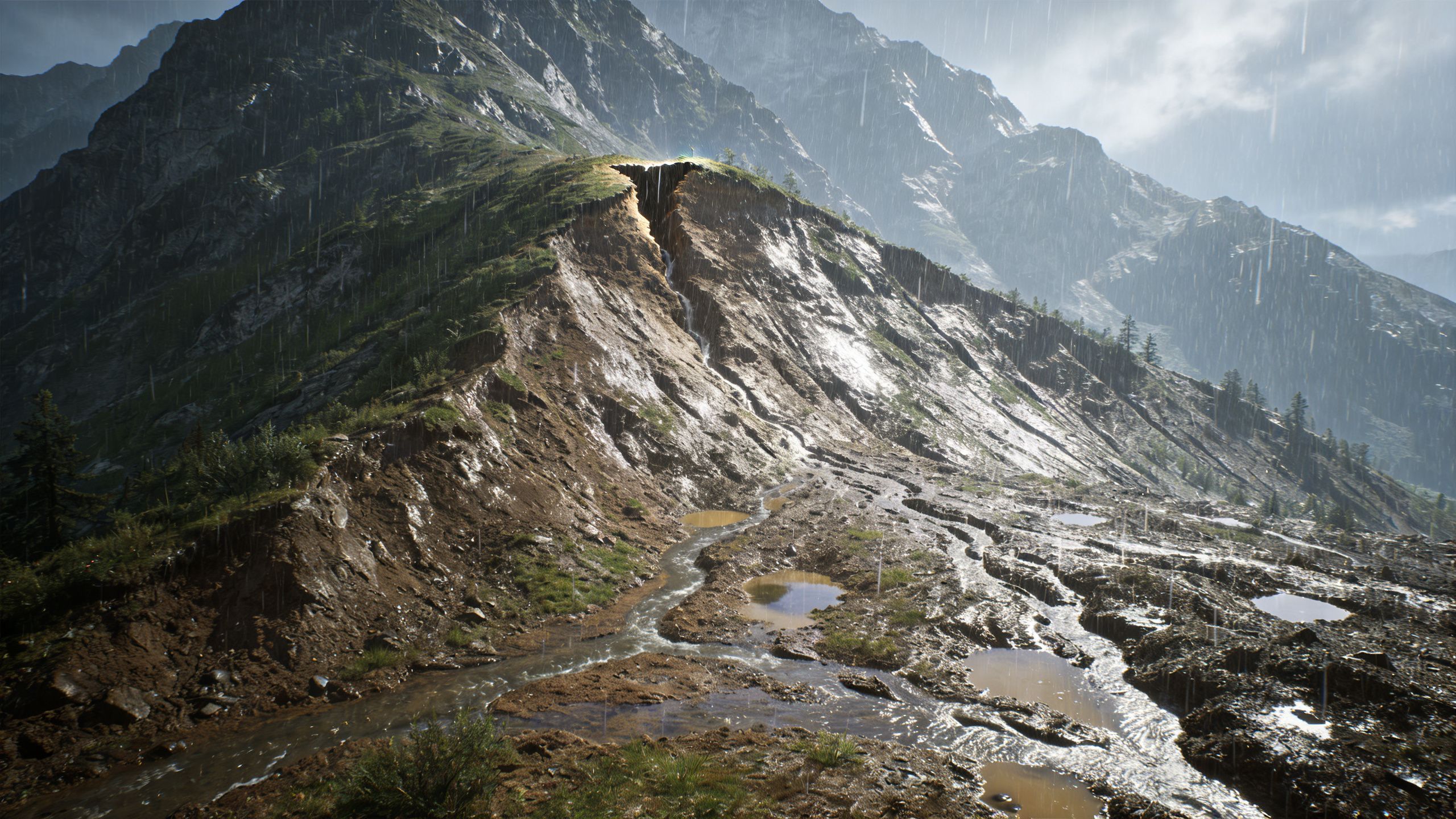
A key technical trigger is when repeated rainfall infiltration raises pore-water pressure. That reduces effective stress and lowers shear strength along weak layers in rock or soil, which is why saturated slopes fail more readily after prolonged wet periods (study guide reference).
Why water is such a powerful trigger
Students often hear “rain makes landslides happen” and stop there. That's too vague for top marks. You need the chain of reasoning.
Rainwater soaks into the slope. That water adds weight. It also fills the spaces between particles. As those spaces fill, the material has less grip and less strength. If there's already a weak layer inside the rock or soil, that layer becomes a likely failure surface.
A strong answer often uses a chain like this:
- Rainfall infiltrates the slope
- The slope becomes heavier and more saturated
- Pore-water pressure rises
- Shear strength falls
- The slope fails
That sequence is excellent exam material because it shows process, not just outcome.
Other natural triggers
Water is the headline trigger, but it isn't the only one.
- Marine undercutting removes support from the base of a coastal cliff
- Weathering weakens rock and opens cracks
- Freeze-thaw action can break rock apart on exposed slopes
- Earthquakes can suddenly shake already unstable material loose
If you're answering a coastal question, don't forget the role of the sea. A cliff can fail because waves remove the toe, leaving the upper slope unsupported.
If you see a question about prolonged wet weather followed by slope collapse, the missing phrase is often “reduced shear strength”.
Human triggers
Human activity can make a stable slope unstable surprisingly fast. This is one of the easiest places to add evaluation to an answer because it shows the hazard isn't purely natural.
According to Britannica's summary of mass movement, risk increases when drainage is altered, vegetation is removed, or slopes are oversteepened by cuttings and quarrying.
Exam-ready trigger examples
- Road cuttings can create a slope that is steeper than before
- Quarrying can remove support and oversteepen valley sides
- Deforestation removes roots that once helped bind soil
- Poor drainage can leave water trapped in the slope
- Leaking pipes or irrigation can keep slopes wetter than expected
The best answers don't throw these into a list and leave them there. They explain the mechanism. For example, cutting into a hillside increases slope angle, which increases the downhill force. Removing vegetation reduces root binding, so the material has less cohesion.
Impacts on People and How We Manage the Risk
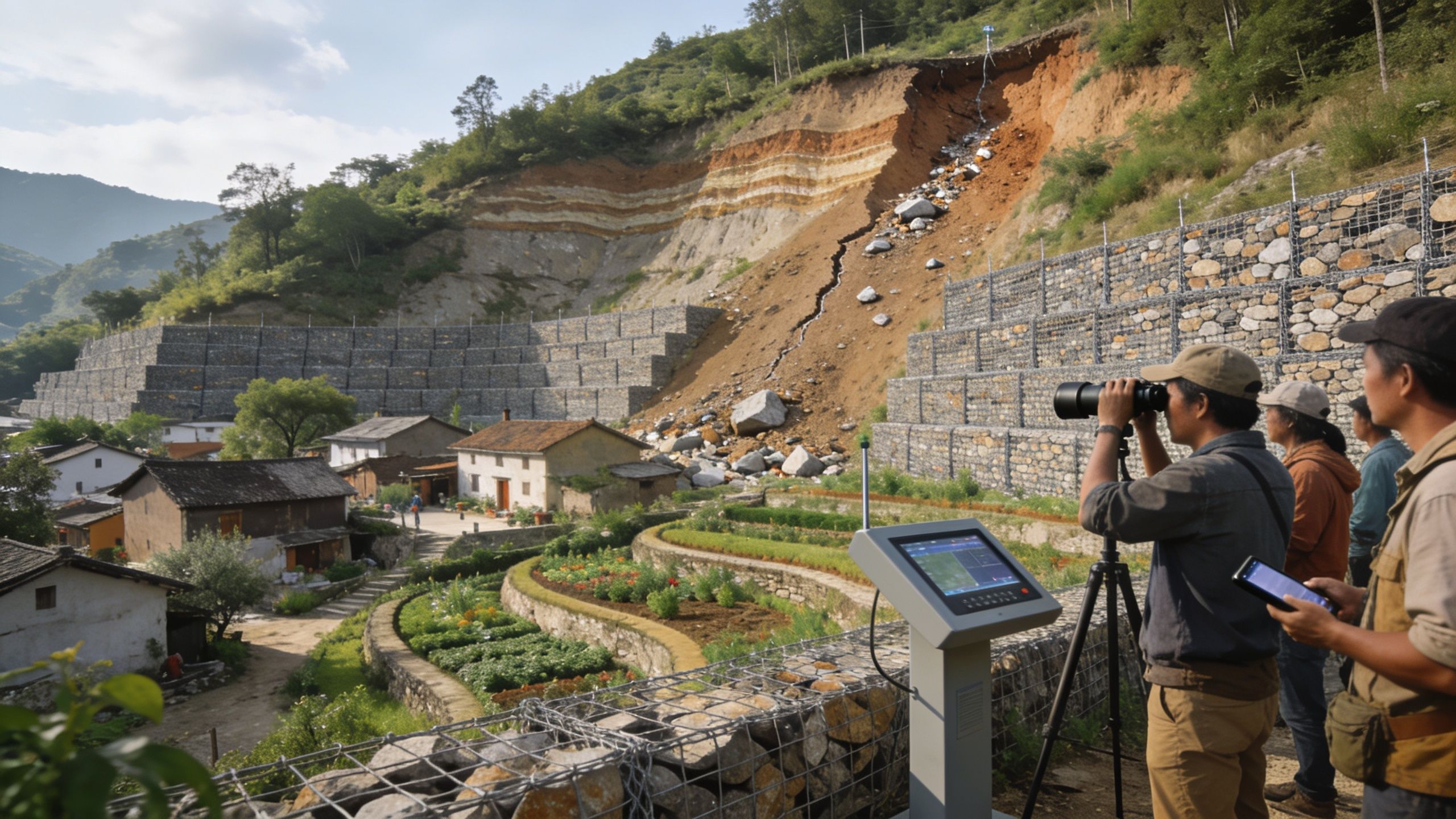
Mass movement becomes much more than a physical process once it affects roads, homes, farms, and services. That's why examiners often reward answers that connect landforms to people. In the UK, slope instability is also a land-use and infrastructure issue, especially where drainage has been changed, vegetation removed, or slopes oversteepened by development.
Social, economic and environmental impacts
A clear way to organise an answer is by impact type.
| Impact type | What it can involve |
|---|---|
| Social | Injury, displacement, stress, danger to communities |
| Economic | Damage to roads, railways, buildings, repair costs, disruption to local business |
| Environmental | Loss of vegetation, scarred slopes, blocked drainage routes, altered habitats |
This structure works because it keeps your answer organised. It also helps with longer “assess the impacts” questions, where loose paragraphs often lose marks.
Why infrastructure is often the real issue
A remote slope failure matters less than one beside a railway line, road cutting, or coastal settlement. That's why management focuses so heavily on places people have already built into risky terrain.
Think about it this way. The same process can be a natural part of terrain change in one place and a major hazard in another. The difference is exposure.
That idea also links well to rivers and flood management. If you're revising how physical processes become hazards once people build in vulnerable places, this river landforms revision guide is a useful comparison.
Hard engineering
Hard engineering tries to physically hold slopes in place or protect their base.
- Retaining walls support unstable material
- Rock bolts or netting secure loose rock on steep faces
- Drainage systems remove water from inside the slope
- Toe protection reduces undercutting at the base of coastal cliffs
These strategies can be effective, but they can be expensive and visually intrusive.
Soft engineering and planning
Soft engineering works more with the slope than against it.
- Vegetation planting can help bind soil
- Slope regrading reduces the angle of steep slopes
- Hazard mapping helps planners avoid the most unstable ground
- Monitoring helps authorities detect warning signs early
Here's a useful clip to reinforce the practical side of slope management and hazard response:
Exam tip: Management questions usually reward balance. Don't just describe a method. Judge whether it is suitable for the place, cost, and level of risk.
There's also a school and fieldwork angle here. If teachers plan visits to coastal or upland locations, understanding slope hazards matters beyond the classroom. Guidance on reducing school excursion liabilities is useful because it shows how risk assessment connects directly to real geography settings.
Real-World Examples UK and Global Case Studies
A 6-mark or 9-mark question asks for a named example of mass movement. You remember the process, but the place name will not come. That is how marks disappear.
Case studies matter because they turn general knowledge into exam evidence. Examiners reward named places, specific causes, and clear impacts. For GCSE, that often lifts an answer from basic description into applied knowledge. For A-Level, it also helps with AO2 because you are linking processes to a real setting rather than repeating a textbook definition.
Lyme Regis in Dorset
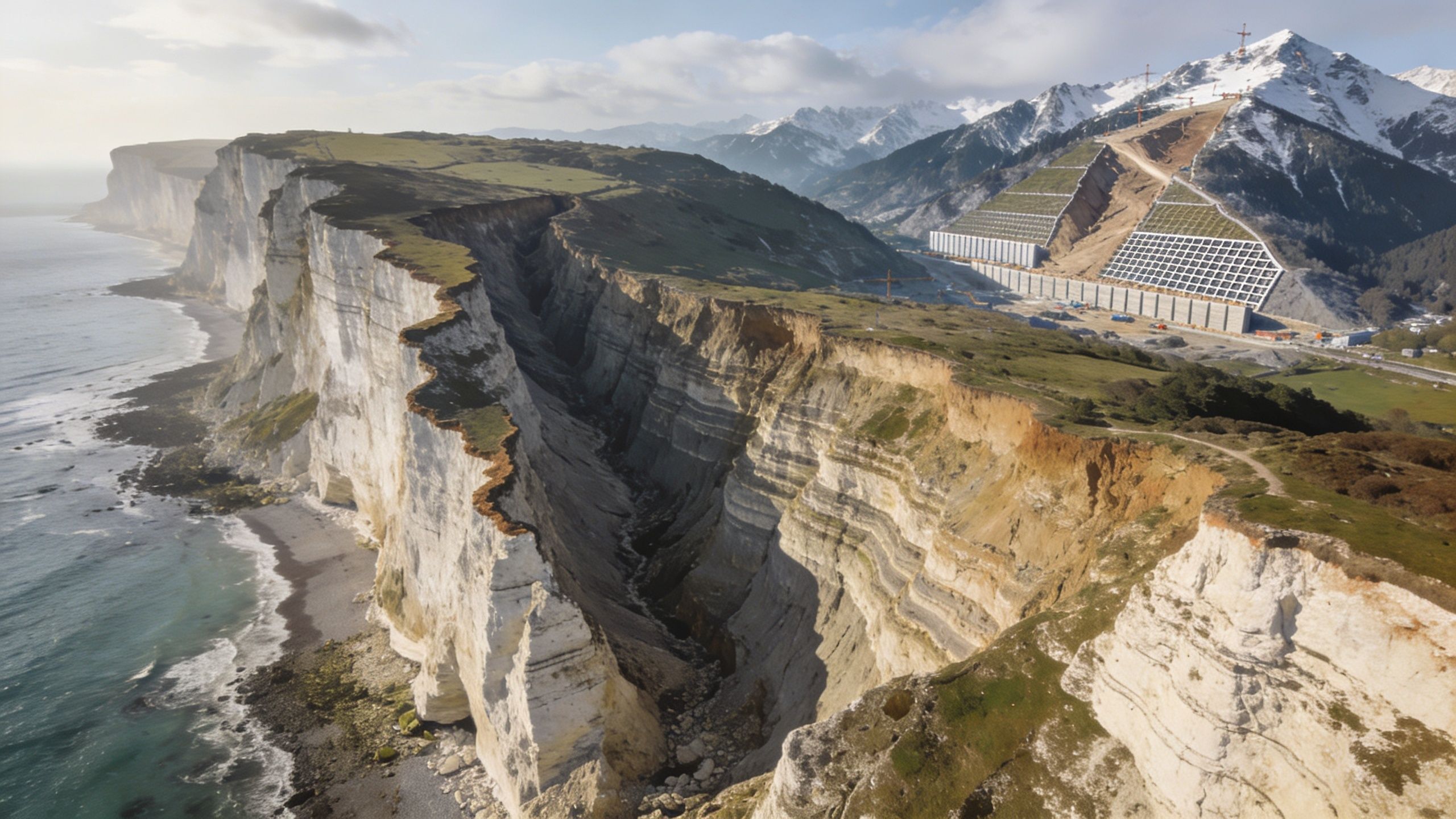
Lyme Regis is one of the strongest UK examples to revise because it gives you a full chain of reasoning in one place. The cliffs include weak Jurassic clay, water can build up within the slope, and wave erosion removes support at the base. Put those together and slope failure becomes much more likely.
This case study is useful for exam technique because it can answer several command words. If the question says describe, you can refer to repeated cliff instability and visible slumping. If it says explain, you can build the cause-and-effect chain from weak geology to saturation to undercutting. If it says assess, you can judge how far management can reduce risk in a place where the natural conditions still create instability.
A strong exam sentence could be:
At Lyme Regis, mass movement happens because weak Jurassic clays are easily saturated, while coastal erosion removes support from the cliff base, making repeated slope failure more likely.
That works because it does what the mark scheme wants. It names the place, identifies factors, and links them logically.
What to remember from Lyme Regis
Revision works better when each case study has a short set of facts you can recall under pressure. For Lyme Regis, keep these four ideas together:
- Named place: Lyme Regis, Dorset
- Geology: weak Jurassic clays and unstable materials
- Trigger and process link: rainfall and water saturation weaken the slope
- Coastal factor: wave attack removes support at the bottom of the cliff
That is enough for many GCSE answers. If you want to practise turning facts into exam responses, use real GCSE Past Papers and train yourself to fit the same case study to different command words.
A global contrast
A second example helps most in comparison questions. It shows range, and range often helps with higher-level judgement. If your teacher has given you a named global case study, use that exact one. Depth beats collecting random examples.
If you have studied a mountainous hazard zone outside the UK, focus on the contrast in setting and speed. UK coastal examples such as Lyme Regis often involve repeated instability and long-term management. Mountain case studies often involve steeper slopes, rapid movement, blocked roads, isolated communities, and emergency response.
That contrast is useful for 8-mark and 12-mark questions because it gives you something to compare. Different geology, different triggers, different impacts, different management challenges.
How to write case studies so they score
Many students lose marks by dropping in a place name and stopping there. A case study is not just a label. It is evidence.
Use this simple exam formula:
Place + process + cause + impact or management
For example:
Lyme Regis in Dorset experiences repeated slumping because weak clay cliffs become saturated and are undercut by wave erosion, threatening property and requiring ongoing management.
That structure is safe and high value. It meets AO1 through accurate knowledge and AO2 through application to a real place.
Why precision matters
Examiners can spot vague revision quickly. “A cliff somewhere on the south coast collapsed after heavy rain” sounds half-learnt. “Lyme Regis has repeated slope failure linked to weak clay and marine erosion” sounds secure.
The same precision matters outside the exam hall. Schools that take students to cliffs, valleys, or steep slopes have to plan for real hazards, not just name them in theory. Guidance on reducing school excursion liabilities shows how case study knowledge connects to fieldwork decisions and risk assessment in actual places.
How to Ace Your Exam Questions on Mass Movement
Knowing the content is only half the job. The other half is recognising what the command word is asking you to do. A lot of students know more than they score because they give the wrong type of answer.
What common command words really want
Explain
For explain, give a chain of cause and effect. Don't list. Build logic.
A strong structure is:
- State the factor
- Explain how it changes slope stability
- Show the result
Example starter:
- Mass movement occurs because...
- This leads to...
- As a result, the slope becomes unstable because...
Describe
For describe, focus on what happens or what you can observe. If it's a photo, comment on shape, direction, steepness, debris, or visible movement.
Don't slip into long explanations unless the question asks for them.
Assess or evaluate
These command words need judgement. You must weigh things up.
Useful starters:
- This factor is important because...
- However, its importance depends on...
- Overall, the most significant influence is...
A good evaluated answer on mass movement might compare rainfall, geology, and human activity, then judge which matters most in that setting.
The top band usually goes to answers that combine knowledge with judgement, not answers that simply know the most words.
AO1, AO2 and AO3 without the waffle
You don't need to obsess over assessment objectives, but you should know the basics.
- AO1 is knowledge. Definitions, terms, case study facts.
- AO2 is application. Using that knowledge on a photo, map, or named place.
- AO3 is judgement and analysis. Weighing causes, methods, or significance.
A solid answer usually mixes all three. If you only define terms, you'll cap your marks.
Revision that actually helps
Mass movement geography responds well to active recall because the topic is built around linked ideas.
Try these:
- Turn the classification table into flashcards. One side says “flow” or “creep”, the other side gives speed, water content, and features.
- Practise process chains. Write out rainfall to failure in five steps from memory.
- Memorise one named UK case study properly rather than half-learning three.
- Use real exam questions from GCSE Past Papers so you get used to command words and mark allocations.
- If you struggle with revision planning in general, this guide for students on exam prep has useful ideas you can adapt even when geography isn't multiple choice.
The shortest route to better marks
When you answer a mass movement question, check for these four things before moving on:
- Did I define the process accurately?
- Did I explain cause and effect clearly?
- Did I use a named example if needed?
- Did I judge or compare if the command word requires it?
Do that consistently and your answers will look much more exam-ready.
If you want a revision tool built for UK exams rather than generic study apps, MasteryMind is worth a look. It gives GCSE and A-Level students examiner-aligned practice, past-paper style questions, AO-based feedback, and active recall tools that help turn topics like mass movement geography into marks on the page.
Ready to master this topic?
Practise with quizzes, blurt exercises and exam questions on MasteryMind.
7 days Premium · Then free forever · No card, no charge