Maths GCSE Mark Scheme: How Marks Are Really Awarded
You've finished a past paper, checked the answers, and found something that doesn't seem fair. Your final answer is wrong, but most of the method looks right. Or perhaps you reached the correct number, then lost the mark because one line was missing. A few marks like that can separate the grade you expected from the grade printed on your results slip.
A maths GCSE mark scheme isn't just an answer key. It's a record of the evidence an examiner needs to see. Once you understand that evidence, you can look at your own working and predict which marks are secure, which are recoverable, and which were never available for that particular question.
The Night You Realised Marks Disappeared
The kitchen was quiet on the evening before results day. Your daughter had worked through the past-paper pack, checked her algebra, and usually scored strongly on the questions she recognised. At home, she often got seven or eight questions out of nine right in an algebra set. She had expected a grade 7.
When the results arrived, the grade was a 5.
Her first reaction was simple: “But I did it right.”
That sentence matters. Students often remember the method they intended to use, while the examiner can only mark the working that appears on the paper. A sign may have changed halfway through. A rounded number may have been used in the next line. A correct answer may have been written beside untidy, crossed-out work that no longer clearly supports it.
The useful question isn't “Did I know the topic?” It's “Which line of my solution gave the examiner evidence for a mark?”
A mark scheme can feel harsh when you first read it because it compresses a full mathematical argument into short codes. But the rules are often more forgiving than students expect. A wrong final answer doesn't automatically mean zero. A first error may not destroy every later mark. A complete method can still earn credit when the arithmetic goes wrong.
That's the promise of reading schemes properly. By the end, you should be able to take a worked solution and inspect it line by line. You'll be able to spot where a marker would award a method mark, where an accuracy mark depends on an earlier step, and where follow-through might rescue later working.
The four things to learn are:
- Method marks, for a valid mathematical process.
- Accuracy marks, for reaching the required result.
- Follow-through, when later work correctly uses an earlier value, even if that value was wrong.
- Silent mark losses, including early rounding, misread values, and unclear replaced working.
The missing marks may not have disappeared on the hardest content. They may have disappeared in the small decisions the mark scheme was designed to judge.
M Marks, A Marks, and B Marks Explained
AQA's marking guidance separates marks into method, accuracy, and independent statement or result marks. Pearson's guidance also distinguishes method marks, accuracy marks, working marks, and questions where working is required, so the meaning of a mark depends on the question's structure, not just the final answer. You can also compare this exam-focused view with guidance on formative and summative methods, which helps explain the difference between practising a skill and judging the finished performance.
Method marks show the process
An M mark rewards a valid mathematical step. It doesn't necessarily require the final answer to be correct.
Suppose the question says:
Solve (3x = 12).
A student writes:
(x = 12 \div 3)
(x = 8)
The final answer is wrong, but the division structure is correct. If the mark scheme awards a method mark for rearranging the equation, that method mark can be earned. The arithmetic error prevents the accuracy mark, but it doesn't erase the valid process shown above it.
A useful habit is to ask, “What was the first mathematically useful line I wrote?” That line is often where an M mark lives.
Accuracy marks depend on the result
An A mark rewards a correct result, usually after the required method has been carried out. If your method produces the wrong value, the accuracy mark normally cannot be awarded.
For the same equation, a complete answer would be:
(3x = 12)
(x = 12 \div 3)
(x = 4)
The division is the method, and (x=4) is the accurate result. If the scheme shows an M mark followed by an A mark, the A mark depends on arriving at the correct answer through the relevant process.
A final arithmetic slip can therefore leave you with credit for the method but not for accuracy. That's why checking the last line matters, even when the algebraic structure is sound.
B marks stand independently
A B mark rewards a correct fact, statement, or result that stands independently of a method. Some short questions may award a B mark for the correct value even when no working is required.
For example:
Write down the value of (15%) of 80.
If the student writes:
12
the mark may be awarded as an independent result. There's no rearrangement or chain of calculations for the examiner to inspect. The response either supplies the required value or it doesn't.
This doesn't mean you should hide working on every question. It means you should read the wording. A short “write down” question may be marked differently from a multi-step “show that” or “calculate” question.
Follow-through carries a value forward
Follow-through, often written as ft, applies when an earlier value is wrong but the student uses that value correctly in the next step.
Imagine a ratio question includes the value 4.5. A student misreads it as 5, then sets up the ratio correctly and carries the 5 through every later calculation. The final answer won't match the official answer, but the scheme may award later method or accuracy credit for work that is correct relative to the student's value.
The examiner isn't pretending that 5 was correct. The examiner is separating the original misread from the later mathematical process.
An early error can change the answer without cancelling every valid step that follows it.
Published AQA guidance also explains that a correct final answer without working can receive full marks unless the scheme says otherwise. That makes concise solutions possible on some questions, but it doesn't make incomplete working a safe general strategy. For targeted practice, use a resource such as GCSE mark scheme practice, then compare each line rather than checking only the final number.
One detail often confuses students: in published schemes, M and A are lower-case labels when they appear in combinations such as M1 or A1, while a capital B identifies an independent mark. Read the full allocation and notes, not just the letters.
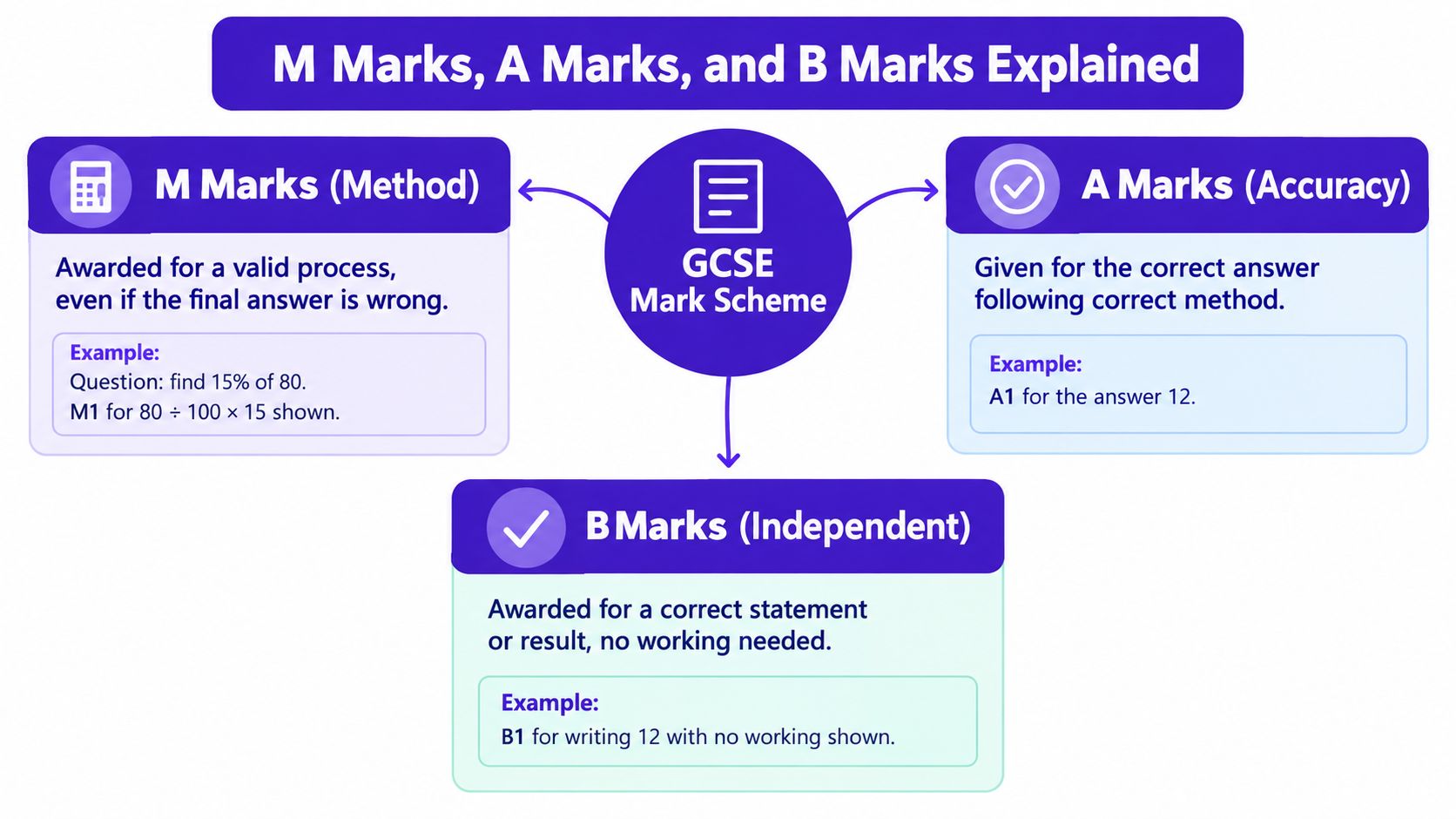
A short explanation can make these codes easier to remember:
Valid process        → M mark
Correct dependent result → A mark
Independent correct result → B mark
Correct later use of a wrong earlier value → ft
The point isn't to memorise a list of symbols for its own sake. The point is to turn every lost mark into a precise diagnosis: missing method, inaccurate result, or missed follow-through.
How Method and Accuracy Marks Chain Together
Consider this GCSE-style algebra question:
Solve (2(3x-4)=5x+3).
A clean solution might look like this:
(6x-8=5x+3)
(x-8=3)
(x=11)
The first line expands the bracket correctly. The second line collects the (x)-terms. The final line reaches the correct value.
Reading the marks line by line
A mark scheme might reward the structure like this:
| Working shown | What it demonstrates | Likely mark |
|---|---|---|
| (6x-8=5x+3) | Correct expansion of the bracket | M1 |
| (x-8=3) | Correct collection or rearrangement of terms | M1 |
| (x=11) | Correct final value | A1 |
| Answer line showing (x=11) | Required stated answer, where specified | B1 or included answer credit |
The exact allocation can vary with the published scheme, so don't treat this table as a universal code for every algebra question. The important pattern is the chain. Each line provides evidence for a particular stage of the solution.
Now change the first line:
(6x+8=5x+3)
The sign on the constant has been changed. The student has made an expansion error. They then continue consistently:
(x+8=3)
(x=-5)
The answer is wrong, but the later rearrangement may still show a valid method based on the student's own expression. The first accuracy-dependent mark is lost, while a later method mark and a follow-through accuracy mark may remain available if the scheme allows them.
That is what “follow-through” means in practice. It doesn't reward the original sign error. It rewards correct mathematics performed on the value produced by that error.
The dependency test
When you mark your own algebra, draw an arrow from each line to the next and ask:
- Did I transform the previous line legally?
- Did I use the value I obtained consistently?
- Is the final mark dependent on a value that was already wrong?
- Does the scheme mention ft, or does it require a correct answer only?
An early error only forfeits the marks that depend on it. It doesn't automatically forfeit every later mark. That distinction is one of the most valuable things a student can learn from a maths GCSE mark scheme.
Try the same annotation on your last past paper. Don't write only “wrong” beside an answer. Label the first missed method mark, the first accuracy mark that depended on it, and any later step that could have earned follow-through. If you want a structured place to repeat that process, Exam Practice for GCSE can support exam-style attempts, but the official board scheme remains the authority for marking.
How AQA, Edexcel, OCR, and WJEC Schemes Differ
A student can use the right algebra method and still misjudge the marks because the exam board's papers and marking notes are organised differently. A parent looking at one raw score beside a friend's score may assume the results are directly comparable. They are not always.
The board, tier, paper, question wording, and notes beside the mark allocation all affect how marks are awarded. Use the current scheme for the qualification you are sitting, rather than relying on claims that one board is always more generous or stricter.
| Board | Higher papers and marks | Total marks | Key scheme behaviour |
|---|---|---|---|
| AQA | Three papers, 80 marks each | 240 | Paper 1 is non-calculator. Papers 2 and 3 allow calculators. Each paper contributes equally. |
| Edexcel | Three papers, 80 marks each | 240 | Read the symbols and notes in the specific Edexcel scheme. Do not transfer assumptions from AQA. |
| OCR | Three papers, 100 marks each | 300 | The qualification is linear and externally assessed. Each paper carries one-third of the marks for its tier. |
| WJEC | Three papers, 100 marks each | 300 | Check the precise WJEC or Eduqas scheme for accepted forms, rounding, notation, and working requirements. |
AQA's specification gives three papers, each lasting 1 hour 30 minutes and worth 80 marks, for 240 marks altogether. Paper 1 is non-calculator, while Papers 2 and 3 permit calculators. Each paper contributes 33⅓% of the GCSE. The paper structure is set out in AQA's GCSE Mathematics features and benefits.
Edexcel has the same paper count and total marks as AQA in this comparison, but that does not make its mark scheme interchangeable. A method mark, accepted answer, or follow-through note must be read in the context of the Edexcel question and its own marking instructions.
OCR uses three papers worth 100 marks each, giving a total of 300 marks. Its qualification is linear, with examined components arranged across Foundation and Higher. A raw score from an OCR paper should therefore not be compared casually with a raw score from an AQA paper. See OCR's GCSE Mathematics specification for the qualification structure.
WJEC also uses three 100-mark papers, making 300 marks in total. Its scheme may set out specific accepted forms, rounding expectations, or notation rules. A correct-looking final number is not automatically enough if the question requires working.
At your desk, look for four details:
- Accepted answers, including wording such as “or equivalent”.
- Follow-through, which can allow a later mark after an earlier error.
- Rounding instructions, showing when a value must be rounded and to what accuracy.
- Working requirements, which can affect whether a final answer earns every available mark.
Across all four boards, the safest habit is consistent: show the full method, keep exact values until the final line, and read the notes attached to each question. A MasteryMind AQA revision tool can help you practise with board-specific examples, but the official paper and mark scheme remain the authority for your result.
Three Ways Students Quietly Throw Marks Away
Capable students rarely lose all their marks through one dramatic misunderstanding. More often, they give away a method or accuracy mark while believing the answer is safely under control.
Rounding before the calculation is finished
Suppose a calculation produces:
(4.376)
The student writes:
(4.4)
and uses 4.4 in the next calculation. If the later answer depends on the unrounded value, the final result may no longer be accurate enough. The method can still be visible, but the final A mark may be lost.
AQA's guidance says that rounding too early is typically penalised by one mark unless the question says otherwise. The fix is straightforward: keep the full calculator value, an exact fraction, or a surd in your working, then round only the final answer as instructed.
Write this reminder beside your paper: “Keep extra accuracy until the last line.”
Misreading or miscopying a value
A ratio, geometry, or calculator question can go wrong before any real calculation starts. You might read 4.5 as 5, copy a three-digit value incorrectly, or transfer a number from the calculator display with one digit missing.
The marking guidance allows follow-through in suitable situations. A genuine misread of copied values can limit the penalty to accuracy or independent marks, with the penalty capped at 2 marks, according to AQA's published guidance. That doesn't make misreading harmless. It means clear working gives the examiner a chance to separate the copying error from the valid method that follows.
For a ratio question, write the values into the equation before calculating. For a geometry question, label the diagram. For a calculator question, copy the display carefully and keep the substitution line visible.
Replacing correct work with unclear work
Examiners can't award marks for working that has been crossed out and replaced. The common trap is changing a correct intermediate value because it “looks wrong”, then leaving a less accurate value as the only readable line.
If you spot an error, cross out the line once, write the replacement clearly, and continue. Don't scribble over both versions. Don't leave two conflicting answers without making the final choice obvious.
Your script should let a stranger follow the mathematics without guessing which line you meant.
The practical rule across these three problems is evidence. Keep the original values, show the substitution, delay rounding, and make your final working readable. A marker can award a method mark only when the method remains visible.
Grade Boundaries and Why Chasing Them Backfires
“Exactly how many marks do I need for a grade 7?” sounds like a sensible question. It becomes unhelpful when students treat the answer as a permanent percentage or a promise about the next exam series.
For AQA GCSE Mathematics, the full subject is marked on a 240-mark scale across three papers. In the published June 2026 boundaries, a Higher grade 9 required 219 marks, grade 8 required 192, grade 7 required 166, grade 6 required 131, grade 5 required 97, grade 4 required 63, and grade 3 required 46. On Foundation, grade 5 required 187, grade 4 required 154, grade 3 required 115, grade 2 required 76, and grade 1 required 38. The official boundary document is available in AQA's June 2026 grade-boundary release.
Those figures describe that particular series. They don't tell you what the next boundary will be. AQA explains that boundaries are the minimum marks needed for each grade and are published on results day, after marking. The boundary therefore belongs to the exam series, not to the topic list in your revision guide.
The same raw mark doesn't have a permanent meaning
AQA's archive shows why students should avoid treating a raw-mark threshold as fixed. In June 2025, the Higher grade 9 boundary was 219 out of 240, while a November 2025 Higher Paper 1 table showed grade 9 at 71 out of 80 for that individual paper. The archive also records a Higher grade 4 boundary of 63 out of 240 in one 2025 summary and a Higher grade 5 boundary of 96 in another published 2025 summary. These are different series or summaries, so they shouldn't be blended into one prediction. The archive is available in AQA's published grade-boundary materials.
The qualification is graded on the total subject mark across all papers, not on one paper in isolation. That means a difficult first paper doesn't decide the whole result, and a strong final paper can recover marks later. A clear explanation of this total-mark principle appears in this guide to GCSE grade boundaries.
Use boundaries as context, not as your revision plan
A safer approach is to choose a target with a buffer, then improve the quality of every solution:
- Secure method marks: write the equation, diagram, substitution, or formula.
- Protect accuracy marks: check signs, units, rounding, and the final line.
- Recover follow-through: inspect later working after an early error.
- Track mark types: record whether each lost mark was M, A, B, or a presentation issue.
The useful comparison isn't “Am I exactly on the grade 7 boundary?” It's “Can I turn three recurring lost accuracy marks into secure marks?” That question remains useful even when the paper is harder or easier than expected.
A Mark-Scheme-Smart Revision Routine That Works
Revise the marking behaviour, not just the topic. A student who knows circle theorems but repeatedly rounds too early will keep losing the same type of mark. A student who studies every mistake as a marking decision starts building habits that transfer between algebra, ratio, geometry, and statistics.
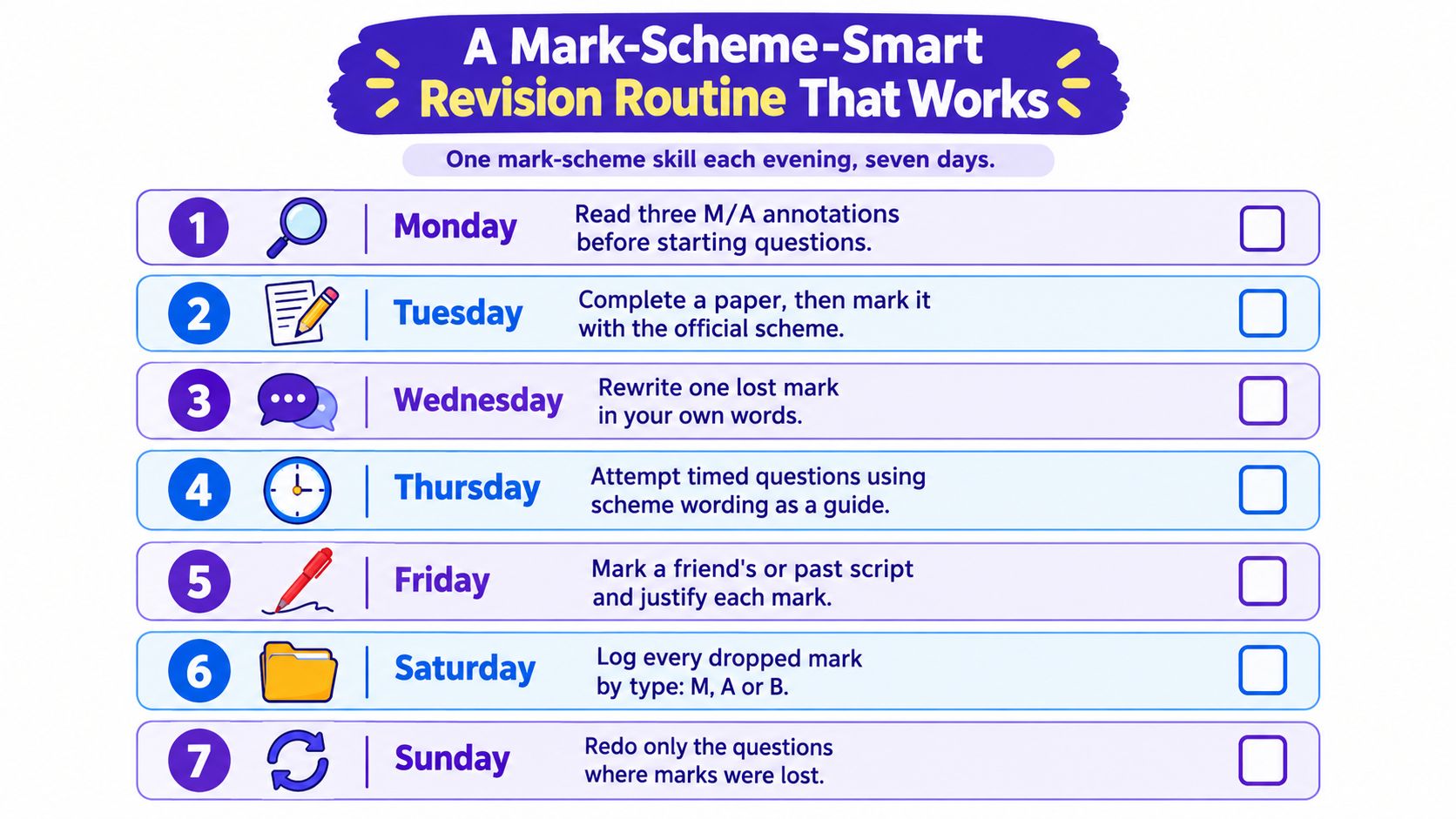
Here's a practical week.
Monday: Before attempting questions, read three M and A annotations from an official scheme. Say aloud what each mark rewards.
Tuesday: Complete a paper without checking answers. Mark it once for the score, then mark it again specifically for missed follow-through. Write “M”, “A”, “B”, or “ft” beside each lost opportunity.
Wednesday: Choose one topic and redraft two answers. Don't redo the entire questions. Rewrite only the lines that would have secured the lost accuracy marks.
Thursday: Attempt a timed paper or a set of longer questions. Compare your timing with the mark allocation and notice where you spend too long on low-value steps.
Friday: Red-line every notation you've ignored before, such as “oe”, “awrt”, or “ft”. Find one example in the official scheme and explain it in your own words.
Saturday: Revisit wrong answers. Write the sentence you should have matched, such as “I needed to keep the unrounded value until the final line” or “My method was valid after the misread, so I should have checked for follow-through.”
Sunday: Redo only the questions where marks were lost. If you can now earn them, move on. If not, ask your teacher to identify the first line where the method stopped being valid.
The GCSE Past Papers you use should always be paired with the correct board, tier, paper, and official mark scheme. Don't mark from memory or from an unofficial answer list when the distinction between method and accuracy matters.
Print this checklist and keep it beside your desk:
- Read the question wording carefully.
- Identify whether working is expected.
- Write the first valid method step.
- Keep substituted values visible.
- Keep full accuracy until the end.
- Check signs and copied digits.
- Look for follow-through after an error.
- Cross out replaced work neatly.
- State the final answer clearly.
- Record the type of every lost mark.
A mark scheme becomes useful when it changes what you do on the next question. After every paper, choose one behaviour to fix immediately, then test that behaviour on a near-identical question before you finish revising.
MasteryMind provides examiner-style maths feedback that checks working against mark-scheme expectations and identifies marking points reached or missed. If you want to practise method, accuracy, and follow-through with structured exam questions, visit MasteryMind and start with a paper matched to your GCSE board.
Ready to master this topic?
Practise with quizzes, blurt exercises and exam questions on MasteryMind.
7 days Premium · Then free forever · No card, no charge