10 Best Maths Practice Online Tools for GCSE and A-Level
Three weeks before mocks, a Year 11 student can have a pile of untouched past papers beside a phone full of apps promising to help. A Year 13 student may have finished the course and want harder questions than the textbook provides. Teachers have a fair question too: how far can AI-generated marks be trusted?
This guide compares ten UK-focused tools for maths practice online, including free and paid options. Each one is judged by its real job, whether that's daily recall, timed past-paper work, skills fluency, mark checking or coursework support. You'll also see which exam boards and levels they cover, what kind of questions they use and where each tool falls short. If you're also building revision quizzes, see these AI-generated quizzes for exam prep.
1. MasteryMind
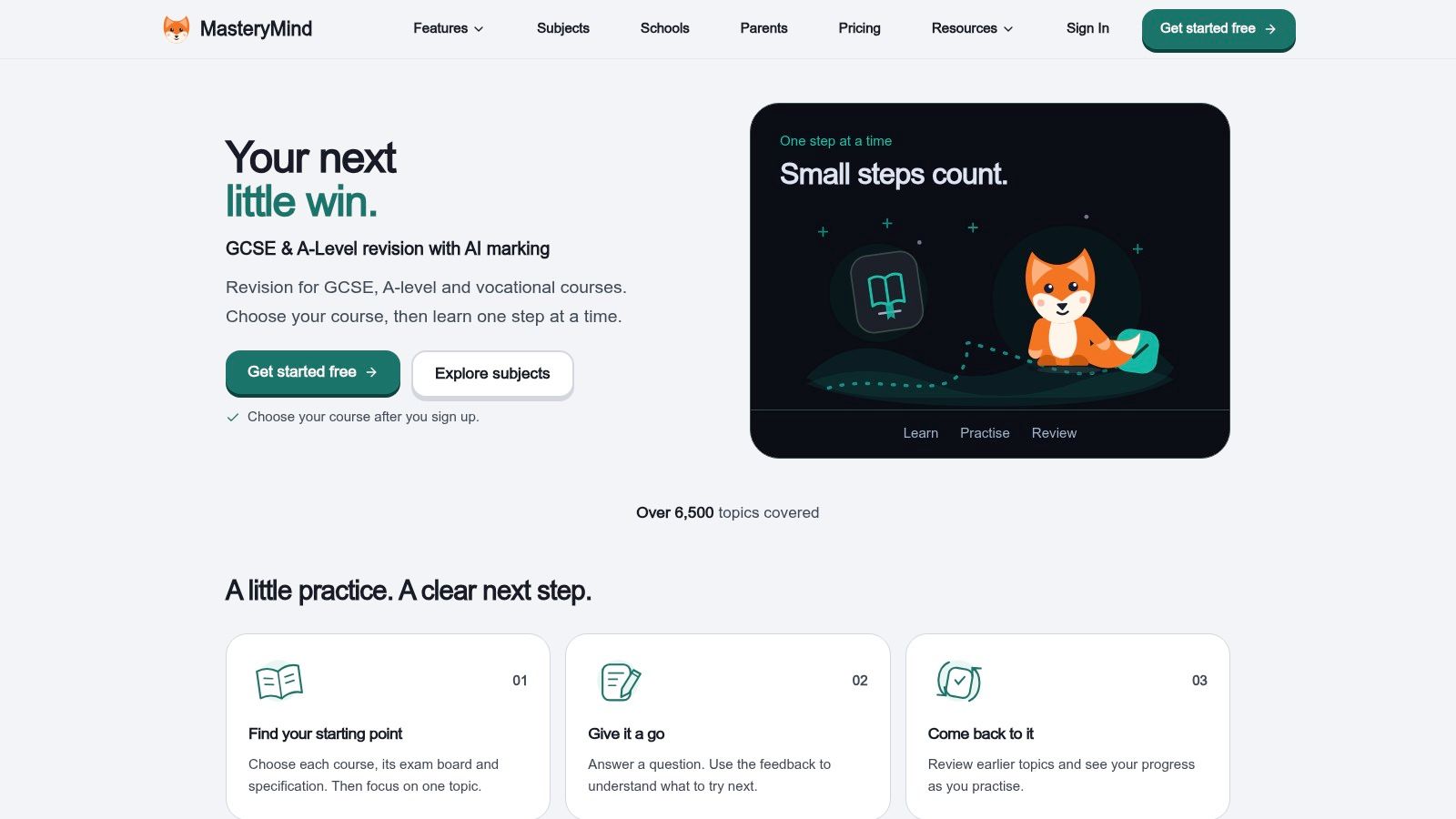
MasteryMind is the strongest all-round option for learners who want online maths practice to resemble the actual UK exam, rather than a generic bank of sums. It supports GCSE and A-Level mathematics across AQA, Edexcel, OCR and WJEC, with questions mapped to specifications, command words and mark allocations.
The useful difference is the feedback. Students can move from quick recall questions to multi-step exam problems, while maths working receives step-by-step verification and examiner-style guidance. That matters because a final answer can be right for the wrong reason, or a method can be mostly correct but lose marks through notation, accuracy or interpretation.
MasteryMind's site lists 6,500+ topics, 90+ course and subject options and support from Years 3 to 13. Those figures come from the platform itself, so check the current coverage before relying on a particular course. The maths tools include adaptive difficulty, mixed-topic practice and spaced review, which are more useful for long-term revision than repeatedly drilling the same comfortable skill.
Best uses and real limitations
The voice-powered Blurt Challenge adds active recall. A student explains an idea aloud, then receives follow-up questions linked to the curriculum objective. NEA Coach supports coursework through Socratic prompts and mark estimation without rewriting work or supplying direct solutions, which is important for JCQ compliance.
Practical rule: Treat AI marking as a second pair of eyes, not as an examiner's verdict.
A free plan lets students start, and new accounts receive a 7-day Premium trial without a card. Advanced features sit behind Premium, while specific pricing isn't displayed on the site, so families should check the current terms. AI feedback can make mistakes and should be checked against teacher advice and official mark schemes.
For students preparing under time pressure, Exam Practice for GCSE gives the platform a more exam-focused setting. It's a good choice for learners who need diagnosis and feedback, not just more questions.
Pros
- Board alignment: Practice follows AQA, Edexcel, OCR and WJEC specifications.
- Examiner-style feedback: AO breakdowns and step verification show where marks may be lost.
- Adaptive revision: Mixed-topic practice and spaced review support retention.
- Active recall: Blurt Challenge makes students produce an answer before seeing help.
- Broad coverage: The platform supports GCSE, A-Level and other courses.
Cons
- Not official marking: AI feedback is guidance and can be wrong.
- Premium limits: The most advanced features require a paid tier.
- Pricing changes: Current access and pricing should be checked before subscribing.
2. DrFrostMaths
DrFrostMaths is built for serious question volume and structured school use. It covers KS2 to KS5, including GCSE and A-Level mathematics, with material mapped to AQA, Edexcel, OCR and WJEC. The question banks include past-paper items and topic-based practice, so teachers can set work that connects directly to a specification.
For independent learners, core access is free. That makes it particularly useful when a student needs plenty of questions without committing to a subscription. The interface is functional rather than flashy, but that isn't a major problem when the priority is completing and reviewing work.
Teachers get more than a question bank. They can assign auto-marked tasks, use diagnostics and track performance across a class or school. Those features are where the platform becomes more valuable in a department, although richer assignment and tracking tools require school access.
The main weakness is that students working alone may not get enough explanation after an error. Auto-marking can tell you that an answer is wrong, but the learner still needs to understand whether the problem was algebraic manipulation, a misunderstood diagram or a careless entry.
Best for: Free, board-aligned practice and teacher-set homework.
Less useful for: Students who need detailed, conversational explanations after every mistake.
DrFrostMaths works best when a teacher, tutor or mark scheme supplies the explanation that auto-marking can't.
Students comparing platforms can also review A-Level and GCSE topic practice before choosing where to focus.
DrFrostMaths is a dependable choice for question banks, diagnostics and school tracking. It isn't the most polished option for motivation, but it gives learners and teachers a lot to work with.
3. Sparx Maths, including legacy HegartyMaths
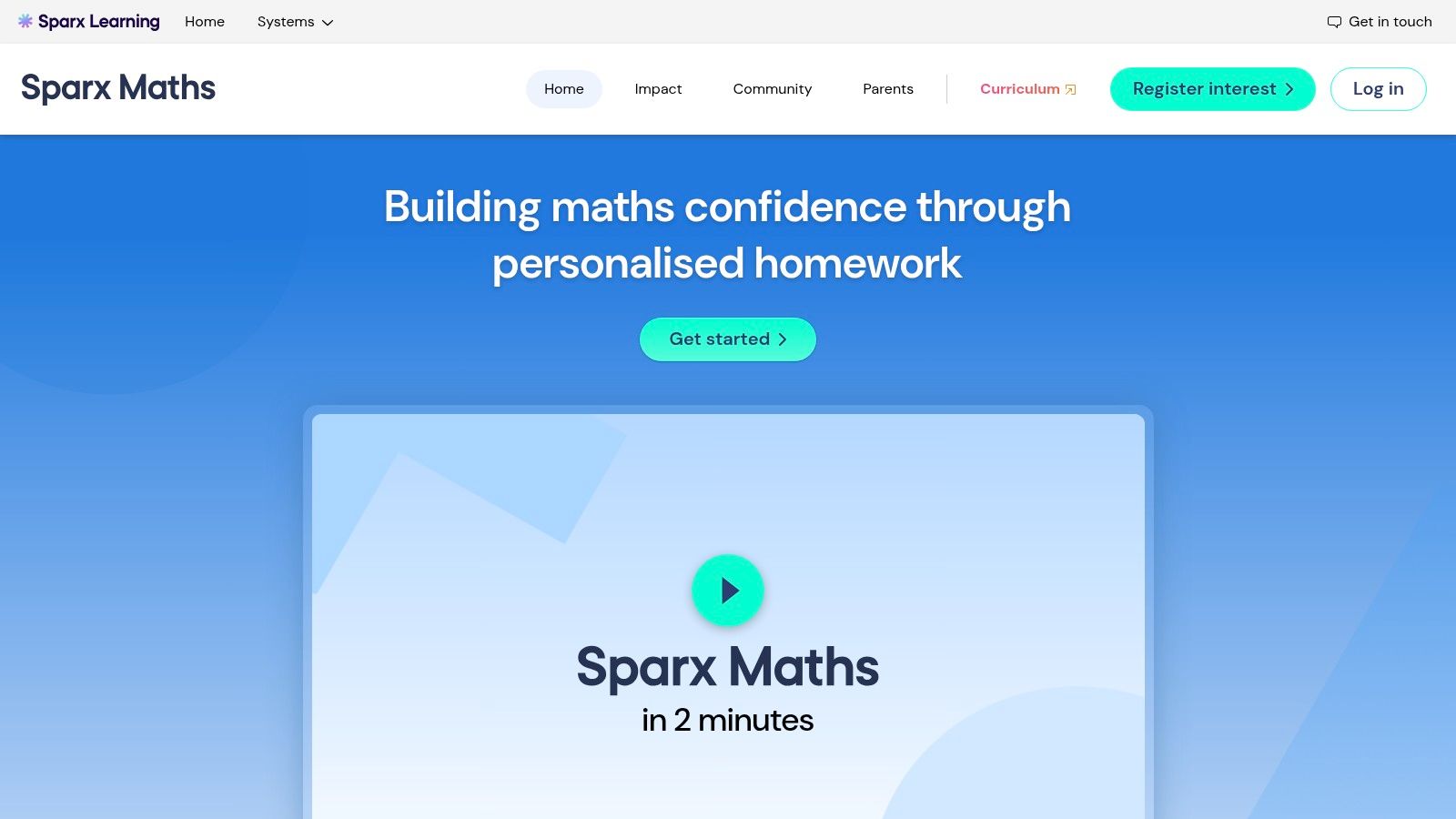
Sparx Maths is mainly a school homework and routine-practice system, not an open revision library for anyone to join. HegartyMaths has been folded into Sparx, so students who remember the older name may now find the relevant practice inside the wider Sparx platform.
Schools set the programme. Students usually log in through school credentials and complete structured weekly homework or school-specific practice. Enrolled pupils may also have access to an Independent Learning area, where they can revisit topics beyond the assigned work.
The strength is consistency. Bite-sized tasks make it easier to build a routine, and teachers can see whether pupils are completing work and where common difficulties appear. That suits students who keep postponing revision because they don't know what to do first.
The trade-off is access. There isn't an open individual sign-up in the same way as a public revision website. If your school doesn't use Sparx, you generally can't access the full experience. School pricing is quote-based rather than publicly listed, so parents can't compare the cost directly from the site.
Pros
- School integration: Homework connects closely to classroom programmes.
- Regular practice: Short tasks help build fluency and routine.
- Teacher visibility: Schools can manage assignments and monitor progress.
Cons
- Restricted access: Individual learners need a participating school account.
- Limited choice: The school controls much of the sequence and assignment.
- Not a full past-paper tool: Use another platform for timed exam papers.
Sparx Maths suits students who need structure imposed from outside. It's less suitable as a standalone tool for a motivated Year 13 student seeking difficult A-Level problem solving.
4. OnMaths
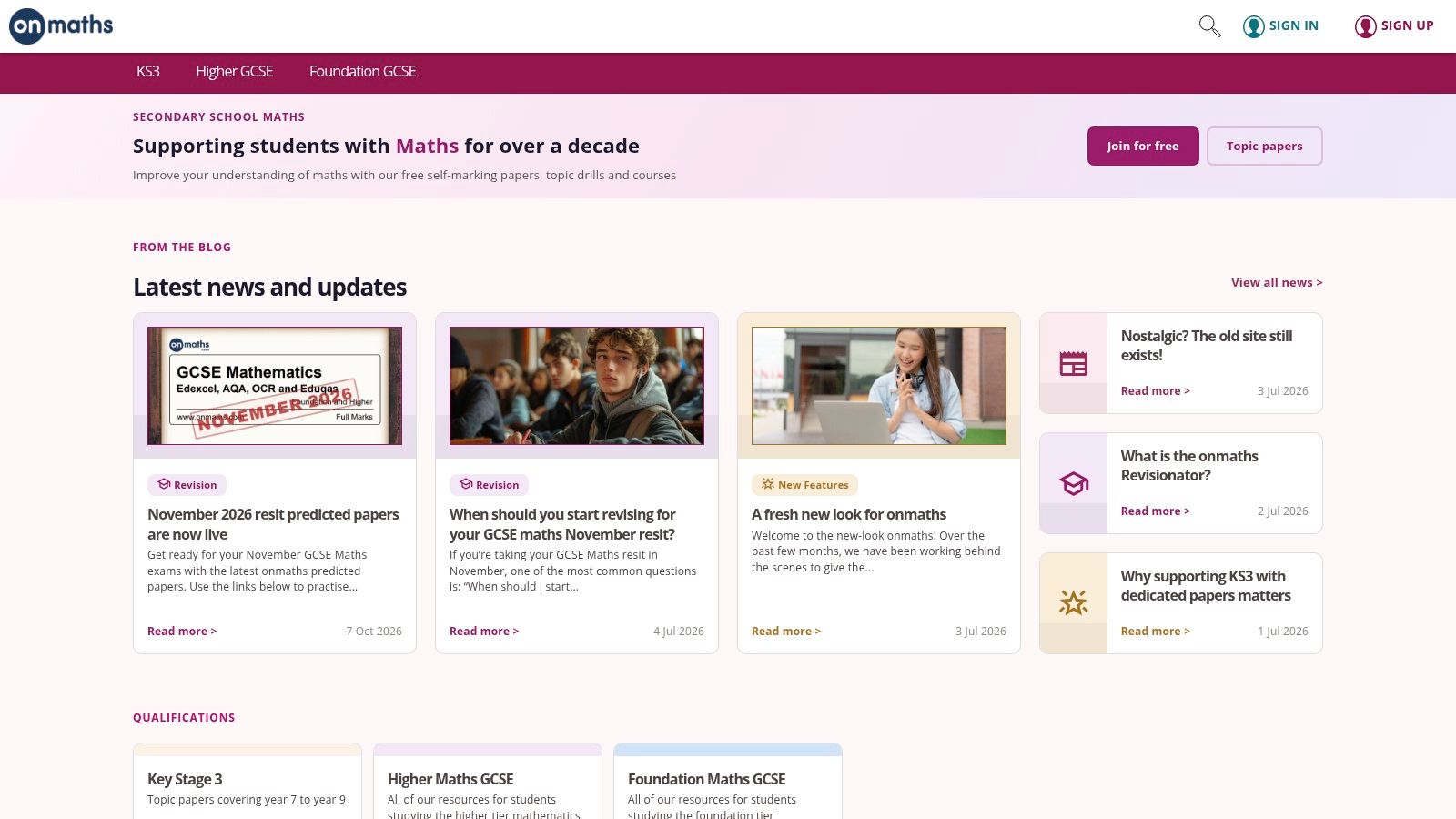
OnMaths is designed for the point where a GCSE student needs to practise under exam conditions. Its online predicted papers, topic papers and “Demon” papers feel closer to a real GCSE session than a quick quiz does. It supports Edexcel, AQA, OCR and Eduqas, so students should choose papers that match their own board.
The live scoring is useful. Students can see their running score and a grade-boundary estimate while completing an online paper. That creates urgency and helps a learner understand how much work remains, although a live estimate isn't the same as an official grade.
Free practice is available, while the paid Ultimate tier adds full solutions, videos and downloadable PDFs. The solutions matter most after the paper. A score without a careful review often produces false confidence, especially when a student remembers the final answer but not the method.
OnMaths is particularly useful for a student with three weeks before mocks. Start with a topic paper to expose weak areas, then use a full paper under timed conditions. Don't treat a predicted paper as a forecast of the exact questions that will appear. It's still a practice paper, not a guarantee.
Best for: GCSE exam-style papers, timing and immediate scoring.
Not best for: A-Level preparation or adaptive diagnosis across a whole course.
Use it carefully: Grade-boundary estimates can motivate revision, but they shouldn't replace the official mark scheme or teacher judgement.
OnMaths has a strong GCSE focus and a practical exam feel. Its limitation is equally clear, it doesn't offer the depth or breadth needed for A-Level learners.
5. Corbettmaths
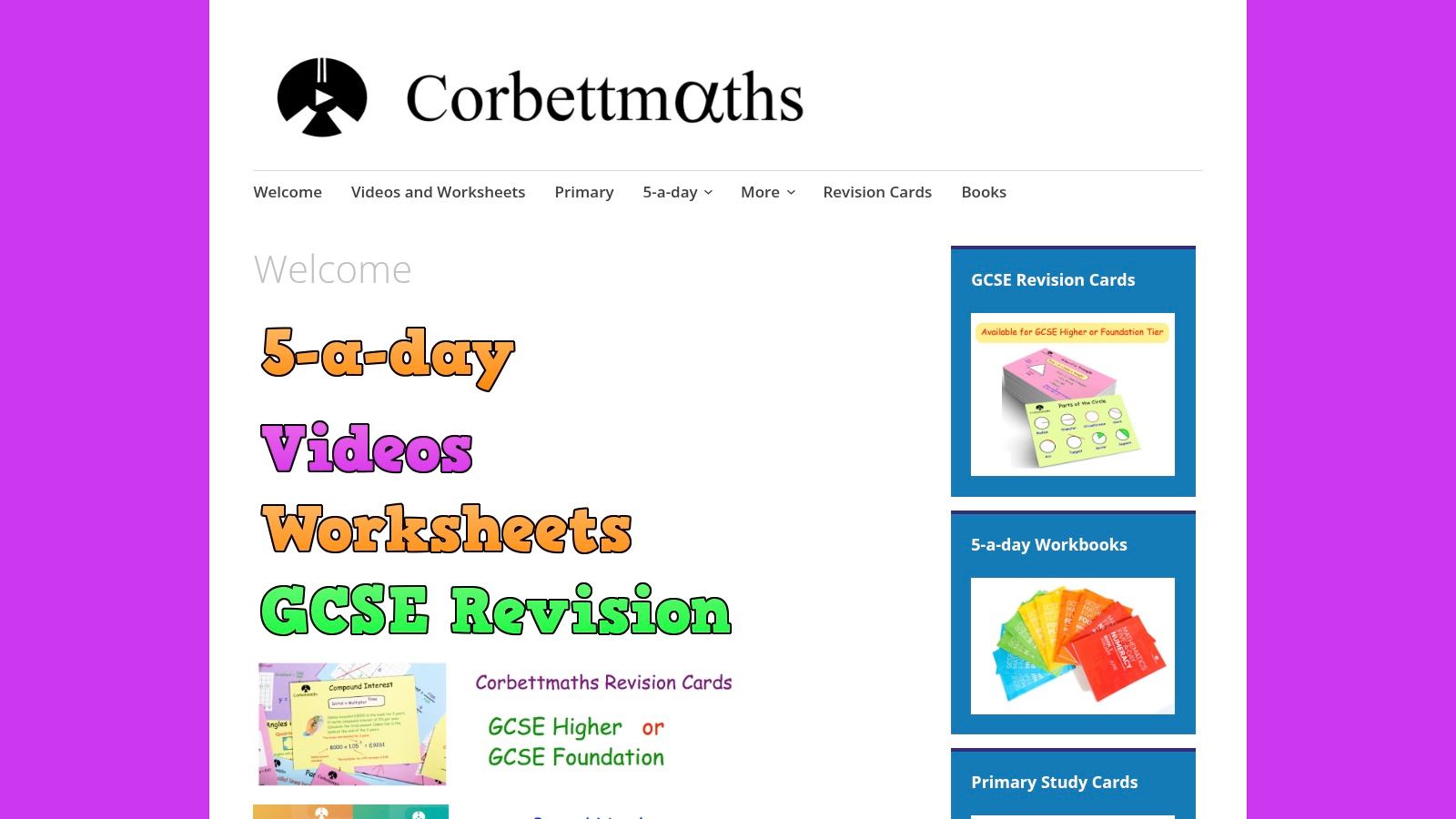
Corbettmaths is the tool to open when a student says, “I keep forgetting that topic.” Its short videos explain one idea at a time, then worksheets and practice questions give the learner something to do with it. The 5-a-day sets are especially useful for building a daily habit across levels from Foundation to Higher+.
The core content is free, which makes it easy for families and schools to recommend. A student can complete a small set before school, after dinner or during a study break without setting up a complicated course. That low friction is a real strength.
Corbettmaths also supports Primary and KS3 through a dedicated site. Its GCSE depth is stronger than its A-Level coverage, so it isn't the right main resource for a Year 13 student. It also doesn't provide a personal adaptive engine. The learner must choose the level, topic and next step.
That requires honest self-assessment. A student who always selects familiar questions can feel productive without repairing the weak areas that matter most.
Good choice for
- Daily recall: The 5-a-day format keeps revision regular.
- Fast explanations: Short videos refresh a forgotten method.
- Free access: Core videos and practice don't require a subscription.
- Targeted repair: Worksheets let learners focus on one topic.
Watch out for
- No automatic personalisation: Students must plan their own sequence.
- Limited A-Level depth: Use a more advanced resource alongside it.
- Passive viewing: Watching a video isn't enough without completing questions.
Watch the explanation, close the page, then solve a question without copying the method line by line.
Corbettmaths is one of the best options for a simple daily maths practice online routine. Printed workbooks and revision cards are available too, but the free core site is enough to get started.
6. Maths Genie
Maths Genie combines a large resource library with a clear exam focus. It provides past papers, topic-sorted questions, worksheets, videos and a mock exam builder for GCSE and A-Level learners. That makes it useful when a student wants to move from a weak topic directly into exam-style practice.
The free core resources remain the main attraction. Students and teachers can find plenty of material without immediately paying. In 2026, the site introduced user accounts and paid Plus and Pro tiers while retaining free resources and a mock exam builder. Because platform terms can change, check the current account and paid-tier details before planning a full revision programme around them.
The site is strong when you already know what you need. Search for simultaneous equations, trigonometry or differentiation, choose a worksheet, attempt it and review the solutions. It's less helpful for a learner who can't identify their weaknesses or needs a system to schedule review automatically.
Some users have also raised concerns about recent changes and the quality of AI-generated items. That doesn't make the resource unusable, but it does make checking important. Use official past papers and mark schemes for high-stakes practice, especially when an answer looks unusual.
Best for: Large topic libraries, worksheets, mocks and past-paper-style questions.
Main trade-off: Breadth comes with more responsibility for selecting and checking material.
Maths Genie is a useful self-study library for GCSE and A-Level. It works better as a resource shelf than as a complete personal tutor.
7. Seneca Learning
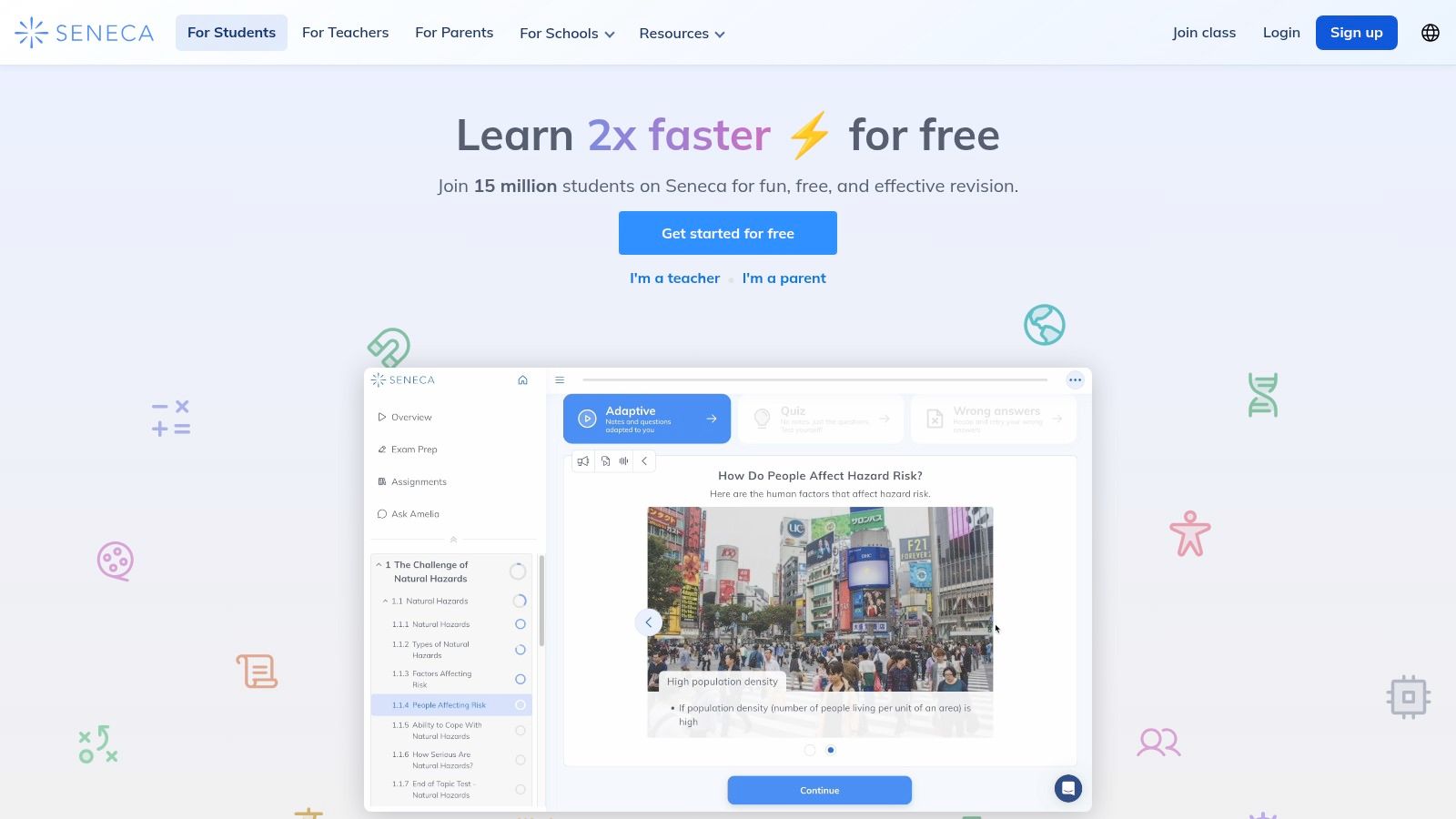
Seneca Learning is a practical choice for students revising several subjects at once. Its maths courses span KS2 to A-Level, and the free adaptive courses make it easy to fit short sessions around English, science and other GCSE subjects.
The platform uses Smart Learning Mode to prioritise weaker areas. It also offers AI-marked responses for some higher-mark questions and photo-work uploads in teacher flows. School plans add analytics and MIS integration, which can help teachers see engagement across a cohort.
Seneca's strength is recall. It can help a student remember definitions, methods, vocabulary and key steps. It is less convincing as the only place to develop deep problem solving, especially when the learner needs to write a full chain of reasoning or handle an unfamiliar context.
Premium value also varies by subject and by learner. Someone using Seneca for several subjects may find the wider subscription more useful than a maths student who only needs difficult exam questions. Test the free material first rather than assuming the paid plan will solve every revision problem.
Use Seneca for
- Short revision bursts: Complete a focused session when time is limited.
- Course recall: Revisit methods and facts across GCSE or A-Level topics.
- Mixed-subject planning: Keep maths alongside other subjects.
- Weak-area prompts: Let Smart Learning Mode suggest what to review.
Don't use it alone for
- Full exam simulation: Add timed papers elsewhere.
- Detailed proof practice: Check whether feedback covers the reasoning you need.
- Independent mark decisions: Verify AI-marked work with a teacher or mark scheme.
Read this AI revision tools compared before deciding whether Seneca's strengths match your revision style.
Seneca Learning is accessible and broad. It's a good supporting tool, but students chasing top A-Level grades need harder, written problem-solving practice too.
8. BBC Bitesize
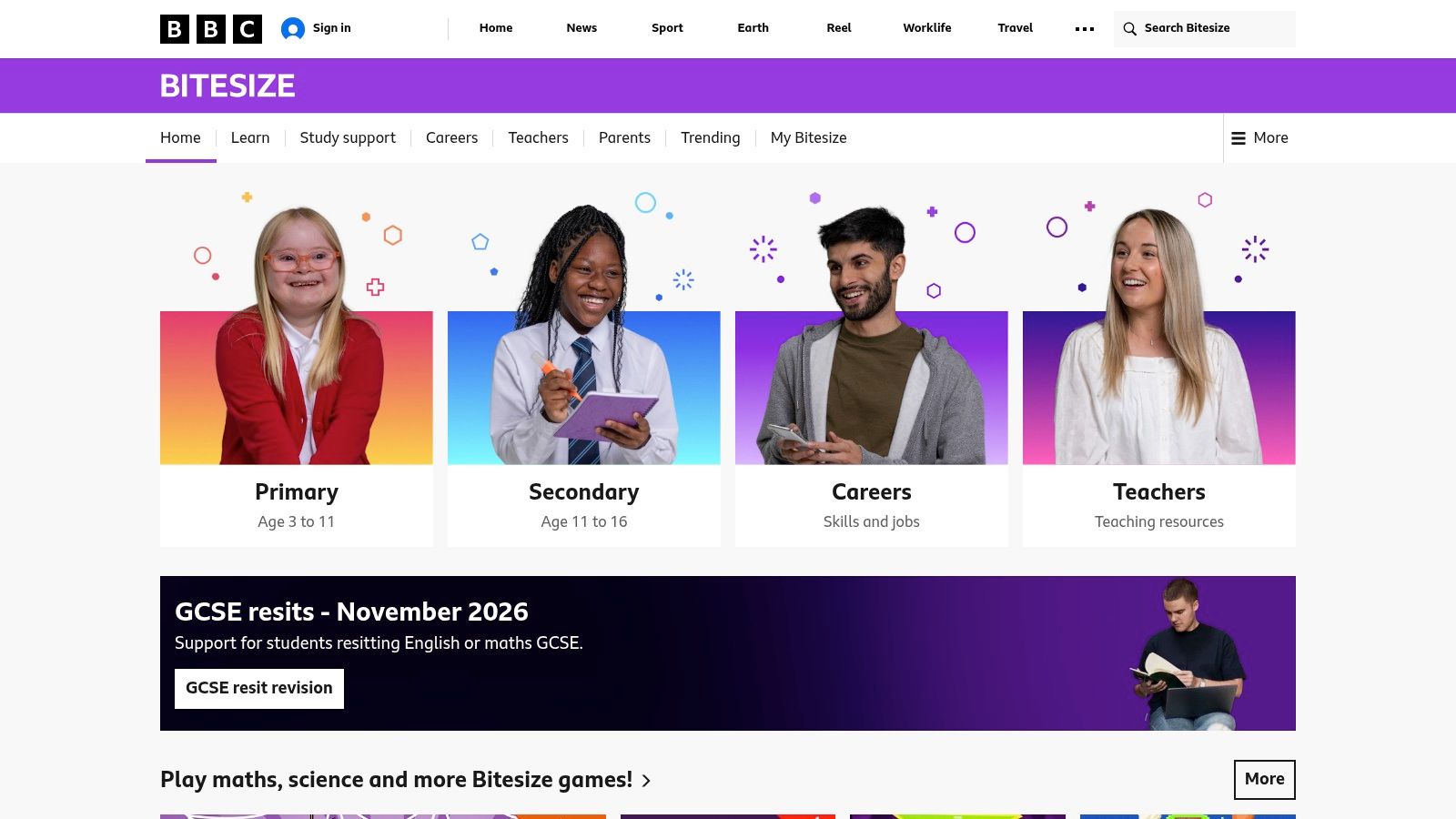
BBC Bitesize is a strong starting point when a learner doesn't understand a topic yet. Its GCSE Maths pages provide explanations, worked examples, interactive quizzes and printable mock materials for Foundation and Higher. The content is free and familiar to many UK students, which removes the barrier of finding a trustworthy first explanation.
It works particularly well before a heavier practice session. Read the explanation, attempt the interactive questions, then move to a worksheet or past paper. Students often jump straight to difficult papers and become stuck because the underlying method isn't secure. Bitesize gives them a straightforward way to rebuild that foundation.
The limitations are clear. Progress tracking is less detailed than on specialist platforms, and the practice volume is lighter than on large past-paper banks. It also won't give a teacher the same topic-level dashboard as a school platform.
Use it as a calm explanation resource, not as your entire revision plan. A student recovering an exam may need Bitesize to understand fractions or graphs, then Corbettmaths or DrFrostMaths for repetition, followed by an official paper for exam transfer.
Best fit: GCSE learners who need clear explanations before attempting harder questions.
Less suitable: Students who need automated sequencing, detailed analytics or extensive A-Level practice.
The GCSE Past Papers resource can help students move from explanation into formal exam practice.
BBC Bitesize is dependable, free and straightforward. Its weakness isn't accuracy or clarity, it's the smaller amount of personalised practice after the explanation.
9. IXL
IXL is built around skills practice rather than exam papers. Its UK edition maps maths skills across the England curriculum from Reception to Year 13, with a Continuous Diagnostic that identifies levels and suggests skills to practise. Families can subscribe directly, while schools can use licences.
The main advantage is precision. If a student needs to practise expanding brackets, interpreting graphs or simplifying fractions, IXL can keep the session focused on that skill. Its question bank is broad, and automatic marking gives immediate information about whether the response is correct.
That precision can become repetitive. Some learners find the push towards high smart scores grindy, especially when the platform keeps serving similar questions until mastery is reached. For a student who needs motivation, a long run of nearly identical items may feel like punishment rather than progress.
IXL also doesn't feel like a GCSE paper. It develops fluency, but it won't fully rehearse the command words, multi-topic switching and written reasoning that exams require. Pair it with official papers or an exam-board-mapped platform.
Choose IXL if
- Fluency is the problem: You need repeated practice on a specific skill.
- The learner is younger: Its curriculum mapping works across Primary and Secondary stages.
- A diagnostic is useful: You want suggested skills rather than a blank worksheet.
Choose something else as well if
- Timing is the problem: Use full papers for exam pacing.
- Reasoning is weak: Add questions that require written explanations.
- Motivation is fragile: Avoid making smart-score chasing the only goal.
IXL UK is best viewed as a skills gym. It can strengthen individual movements, but students still need to play the full match.
10. MME Revise, Maths Made Easy
MME Revise is a GCSE-centred ecosystem combining online practice, printed materials and tuition. The site advertises 10,000+ GCSE-level practice questions, alongside board-specific topic tests, mock exams, predicted papers and the paid MME Premium online GCSE course.
That mix suits students who want everything in one place. A learner can review a topic online, print practice, complete a mock and use a revision guide without switching between several providers. Teachers and parents may also like the option of adding tuition when independent study isn't enough.
The focus is mainly GCSE. A-Level coverage is lighter, so Year 12 and Year 13 students should check the exact course material before subscribing. Premium resources and predicted papers are paid, and perceived value depends on whether a learner uses the full ecosystem or only wants occasional questions.
Predicted papers should be handled sensibly. They can provide extra exam-style practice, but they can't reproduce the actual paper perfectly. Official past papers remain essential for understanding the board's genuine wording, structure and mark allocation.
Strongest for
- GCSE breadth: Topic tests, mocks and exam-style questions cover the main boards.
- Combined resources: Online and printed revision sit in one ecosystem.
- Course structure: MME Premium gives learners a defined GCSE route.
Limitations
- Paid extras: Some useful resources require a subscription or purchase.
- GCSE emphasis: A-Level students may need another main platform.
- Predictions aren't guarantees: Use them for practice, not paper forecasting.
MME Revise is a sensible choice for a GCSE student who wants a broad revision package rather than one isolated worksheet site.
Top 10 Online Maths Practice Platforms, Comparison
| Platform | Core features | Quality (★) | Value / Price (💰) | Target (👥) | Unique selling points (✨) |
|---|---|---|---|---|---|
| MasteryMind 🏆 | Exam-board-aligned Qs (AQA/Edexcel/OCR/WJEC); adaptive progression; AO-style feedback; maths step-verification; Blurt voice recall; NEA Coach | ★★★★☆, examiner-style, adaptive | 💰 Free plan + Premium (7‑day trial; pricing not public) | 👥 GCSE & A‑Level students, teachers, tutors | ✨ AO-aligned practice, voice Blurt Challenge, JCQ‑compliant NEA Coach |
| DrFrostMaths | Huge question bank incl. past papers; auto-marked tasks; diagnostics; school tools | ★★★★☆, extensive past‑paper mapping | 💰 Free core; school subscription for advanced features | 👥 KS2–KS5 learners & schools | ✨ Large charity-run bank, strong topic mapping |
| Sparx Maths (inc. Hegarty) | School-tailored weekly homework; Independent Learning; school management & tracking | ★★★★☆, school-integrated workflow | 💰 School licence (quote); no open individual sign-up | 👥 Pupils in participating schools | ✨ High school adoption; structured weekly routine |
| OnMaths | Predicted/mock papers by board; live grade estimates; teacher PDFs | ★★★★☆, exam-style mocks | 💰 Free practice + Ultimate (solutions/videos) | 👥 GCSE students & teachers | ✨ Live grade estimates, regularly refreshed predicted papers |
| Corbettmaths | '5-a-day' daily practice; concise videos & worksheets; free core | ★★★★☆, clear explanations, daily habit focus | 💰 Completely free core; paid printed materials | 👥 KS2–GCSE students, self-learners | ✨ Daily practice sets, highly teacher-recommended |
| Maths Genie | Past papers & topic-sorted Qs; mock exam builder; account tiers | ★★★★☆, large trusted resource | 💰 Free core; Plus/Pro paid tiers (pricing unclear) | 👥 GCSE & A‑Level students | ✨ Extensive past-paper library, mock builder |
| Seneca Learning (Maths) | Adaptive courses, AI-marked responses, Smart Learning Mode; school analytics | ★★★★☆, adaptive recall-focused | 💰 Free adaptive access; Premium for extras | 👥 KS2–A‑Level students & schools | ✨ Smart Learning prioritisation, wide subject breadth |
| BBC Bitesize (GCSE Maths) | Topic guides, worked examples, interactive quizzes, printable mocks | ★★★★☆, trusted, clear explanations | 💰 Completely free | 👥 GCSE students, teachers, parents | ✨ Nationally trusted resource with clear step-by-step help |
| IXL (UK edition) | Curriculum skill maps, Continuous Diagnostic, huge practice bank | ★★★☆☆, diagnostic & repetitive practice | 💰 Subscription: family or school licences | 👥 Families & schools (Reception–Y13) | ✨ Diagnostic-driven skill targeting, extensive scope |
| MME Revise (Maths Made Easy) | 10,000+ GCSE Qs, board-specific topic tests, mock exams, online course | ★★★☆☆, broad GCSE focus | 💰 Free core + Premium course & paid materials | 👥 GCSE students | ✨ Combines online practice with printed resources and tuition options |
Pick Two Tools, Practise Daily, Check Every Mark
Don't try to use all ten platforms. Pick one tool for a daily habit and another for timed exam work. Corbettmaths, Seneca or IXL can support short recall and skills sessions, while OnMaths, Maths Genie, MME Revise or official papers can provide longer exam practice. Students using Sparx Maths will usually need to work within their school's system first.
A sensible plan for a Year 11 learner is simple. Spend around fifteen minutes a day on short questions and one longer session each week on a full paper. The fifteen-minute suggestion is a practical routine, not a research statistic, so adjust it around school, homework and concentration. The important point is to practise regularly rather than wait for a free weekend that never arrives.
Use the tools for different jobs. A video can repair understanding. A topic set can build fluency. A mixed set can test whether the method transfers. A timed paper can reveal whether the student can choose the right method without a topic label telling them what to do.
Match the tool to the failure
If a student keeps forgetting methods, choose daily recall and spaced review. If they know the method but lose marks in unfamiliar questions, use mixed-topic and problem-solving practice. If they run out of time, complete papers under realistic conditions and review every skipped question.
Teachers should be cautious with automated feedback. Check any AI-generated mark against the official mark scheme and ask a teacher when the two disagree. AI can spot useful patterns, but it can also misunderstand working, accept a weak explanation or miss why a method earns or loses a mark.
The best platform isn't the one with the most questions. It's the one that makes the next mistake visible.
Parents should also check access before paying. Plans, prices and account rules change often, and a school login may give access to features that an individual account can't. Confirm what is currently free on each site, test the workflow with a real topic and only then commit to a paid tier.
For teachers, the key test is not whether a platform looks modern. Ask whether it maps to the right board, shows the working, supports the assessment objectives and gives you evidence you can act on. For students, ask a simpler question: after using it, do you know exactly what to practise next?
MasteryMind offers UK GCSE and A-Level maths practice aligned to AQA, Edexcel, OCR and WJEC, with adaptive quizzes, mixed-topic revision, spaced review and step-by-step verification of working. Visit MasteryMind to start with the free plan and see whether its examiner-style feedback fits your next revision session.
Choose your next course task
Use this idea with Mathematics. Confirm the qualification, awarding organisation and course version before choosing practice, assignment preparation or evidence planning.
Choose your Mathematics course