Maths Problem Solving: A Step-by-Step Framework
You're sitting in front of a maths question that looks unfamiliar. You know the formula, your calculator is ready, and yet nothing happens. You try a number, rearrange something that doesn't need rearranging, then look at the clock and decide you're “just bad at maths”.
That conclusion is usually wrong. The problem is often diagnosis, not intelligence or memory. Strong maths problem solving starts before calculation, with working out what the question is really asking, which information matters, and which method fits.
Why Students Get Stuck on Maths Problems
A student I coached once spent several minutes staring at a question about a rectangle, a ratio, and an unknown length. They knew how to solve equations. They knew the formula for area. They could use a calculator accurately. But they began by multiplying the two visible lengths, even though one of them was expressed in terms of the unknown.
The first error wasn't arithmetic. It was strategic. The student had started calculating before deciding what the information meant.
Knowledge errors and strategy errors
These two mistakes feel similar under pressure, but they need different solutions.
- Calculation error: You choose the correct method but make an arithmetic, algebraic, rounding, or calculator mistake.
- Strategy error: You choose the wrong method, use information in the wrong order, or fail to translate the words into mathematics.
- Communication error: Your method is reasonable, but you don't show enough working, include a unit, or interpret the result.
More practice with multiplication won't fix a strategy error. You need practice identifying the structure of a problem and explaining why a particular method belongs there.
England's national curriculum has treated problem solving as a core mathematical goal for decades. It expects pupils to apply mathematics to routine and non-routine tasks, break complex problems into simpler steps, select suitable methods, and handle unfamiliar situations through the national mathematics curriculum.
Why Assessment Objective 3 matters
This expectation appears directly in GCSE assessment. In the reformed GCSEs, Assessment Objective 3, problem solving, carries 30% of Higher tier marks and 25% of Foundation tier marks, as described in the Department for Education's mathematics subject content.
That means a student can know many individual techniques and still lose a substantial number of marks by failing to connect them. A question might require ratio first, then algebra, then interpretation. The examiner isn't only checking whether you can perform each step. They're checking whether you can recognise the route.
The wider attainment picture makes this worth taking seriously. In 2019, 71.5% of pupils in England achieved GCSE grade 4 or above in maths, while 20.4% achieved grade 7 or above, according to the Department for Education mathematics subject report. Problem solving often separates a memorised method from a flexible one.
Teacher's rule: If you're stuck, don't immediately learn another formula. First ask, “What exactly have I been told, and what exactly must I find?”
The Diagnostic Phase Before You Calculate
The most useful habit in an unfamiliar question is to delay calculation briefly. Read it as though you're marking it. Identify the target, the data, the relationships, and the restrictions before choosing a technique.
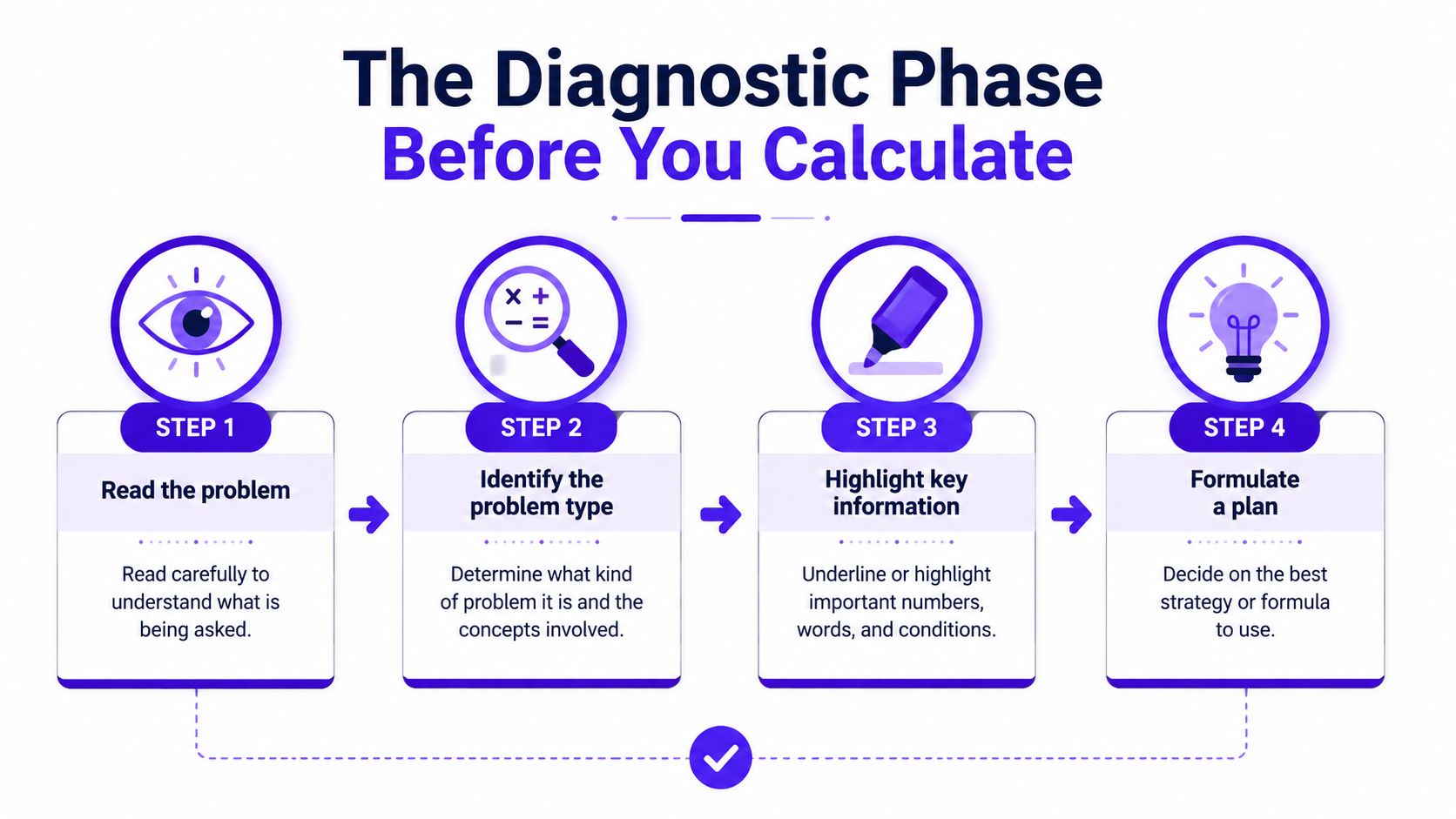
Four questions to ask first
Read the problem once without writing equations. What situation is being described? Is it about a shape, a change over time, a probability experiment, a sequence, or a combination?
Separate what's given from what's needed. Circle values, underline units, and mark the unknown. A question may give more information than you need, or hide the important relationship in a sentence rather than a diagram.
Notice the command word. “Calculate” usually asks for a numerical result. “Show that” requires a convincing chain of working. “Explain” requires mathematical reasoning in words. “Estimate” signals that a sensible approximation may be enough, provided your method supports it.
Predict the mathematical form of the answer. If the question asks for a length, your answer shouldn't be a probability. If it asks for an angle, check whether your final result is plausible for the diagram. This prediction becomes a useful error check later.
The University of Hull presents a Pólya-style sequence of understand the question, devise a plan, carry out the plan, then look back and reflect in its guidance on solving mathematical word problems. The conversion from everyday language into mathematical expressions is often the hardest part. If that translation is wrong, perfect algebra will only produce a precise wrong answer.
For example, “the larger number is five more than twice the smaller number” should become something like (L = 2s + 5), not (L = 5s + 2). Write a sentence beside the equation if necessary. The sentence protects you from swapping the roles of the variables.
A quick language check can prevent avoidable confusion in every subject. If wording trips you up, a short resource on understanding affect vs effect can help you distinguish similar terms accurately.
Make the plan visible
Write a mini-plan in ordinary language:
- Find the missing side using the given relationship.
- Substitute it into the area formula.
- Solve the resulting equation.
- Check the value against the diagram.
That plan is not wasted time. It tells you whether the problem needs one technique or several, and it gives you a route back if you make a mistake.
Video explanations can also help you observe how someone reads before calculating.
If you're using an online revision system, AI Powered Revision can be used alongside your own written diagnosis. Don't let a tool replace the thinking. Use feedback to identify whether your error was in reading, planning, carrying out, or checking.
Choosing the Right Strategy for Each Problem Type
Once you've identified the structure, choose a method that matches the evidence. Students often search their memory for a question that looks similar. That can work for routine recall, but unfamiliar exam questions punish surface matching. Ask what relationships are present, not what the page resembles.
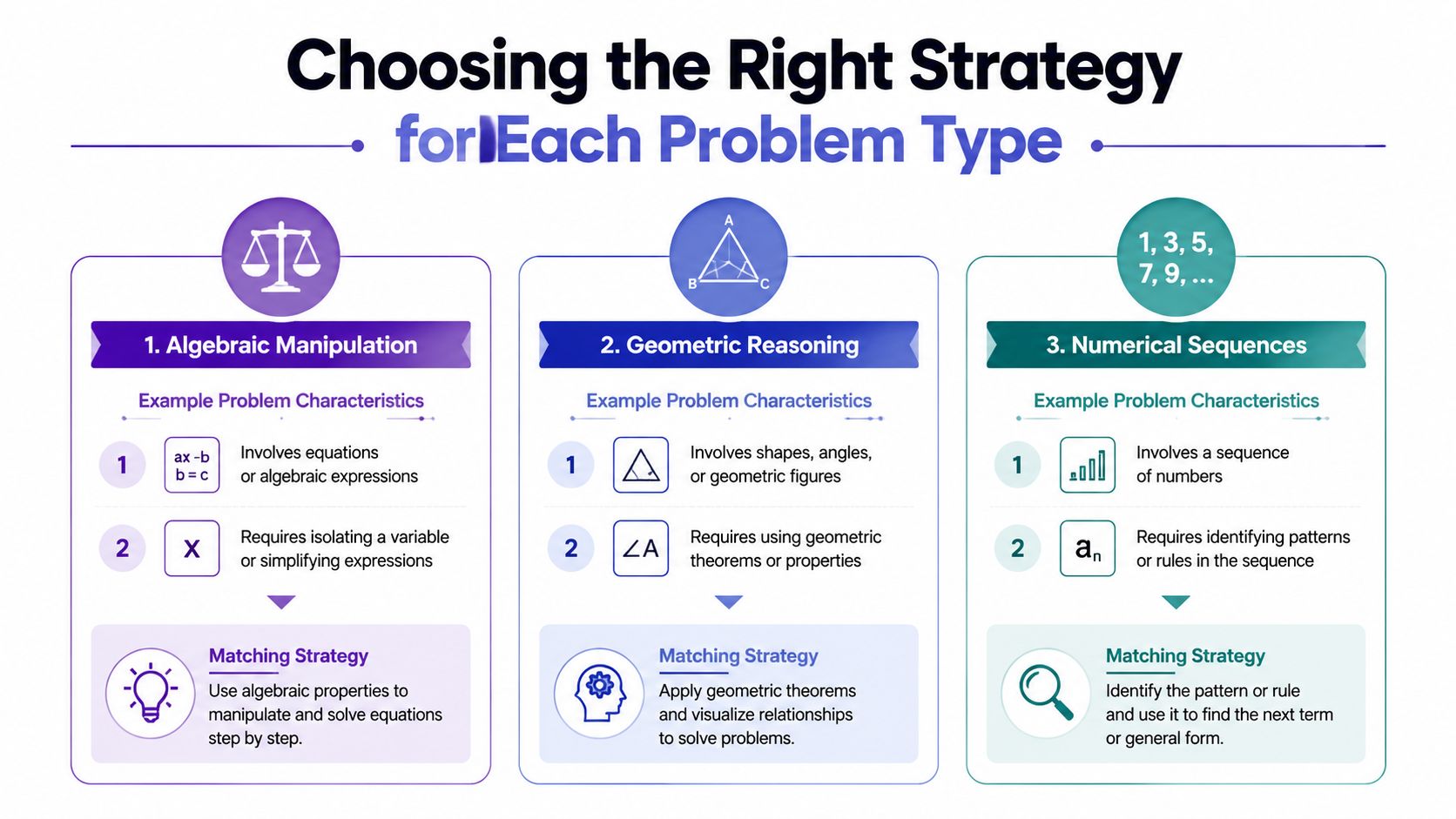
Match the clues to the method
An algebraic approach is suitable when the unknown appears in a relationship. Words such as “total”, “difference”, “more than”, “equal to”, or “in terms of” often signal an equation or inequality. Define the variable carefully, translate each sentence, then solve while preserving the meaning of the original statement.
Geometric reasoning is stronger when the question gives a diagram, angle relationships, parallel lines, congruence, similarity, or measurements linked by a shape. Mark the diagram with known values. A drawn line can reveal a right angle, a symmetrical pair, or two triangles that share a useful relationship.
Sequences require a different kind of attention. List terms, inspect first differences, and consider whether the pattern is linear, quadratic, geometric, or defined recursively. Don't assume that the first visible pattern is the whole rule.
Some problems deliberately combine areas. A scale drawing might lead to similarity, which leads to a ratio, which then feeds an equation. Your plan should name those links rather than treating the question as one large blur.
Use the A-level cycle
The Department for Education's A-level expectations describe a repeated problem-solving cycle. You may need to:
- Recognise and simplify structure, removing irrelevant detail while preserving relationships.
- Construct extended arguments in an unstructured context, where the route isn't signposted.
- Interpret the solution in context, checking what the number means.
- Use numerical methods when an exact analytic solution isn't available.
- Evaluate accuracy and limitations, including reasoned estimates.
This matters at GCSE too. If an exact answer isn't required, estimate first. If your calculation produces a value far from the estimate, stop and investigate. If you're working backwards, use the given result to reconstruct earlier steps, but check that the answer satisfies the original conditions.
A useful decision is whether the question wants an exact value or a sensible approximation. “Estimate the cost” invites rounding and a reasoned method. “Give your answer to a specified degree of accuracy” requires a calculation followed by controlled rounding. “Show that” normally needs exact algebra or clearly justified transformations.
For structured topic practice, MasteryMind mathematics support can sit beside exam-board papers. The important point is to classify each mistake by strategy, not merely record that the final answer was wrong.
Worked Examples from Quick Recall to 24-Mark Problems
A systematic approach works at every level. The difference is the amount of structure you must manage and the clarity of your working.
Example one, quick recall
Suppose you're asked to find the gradient of a line from two coordinates. The recall is the gradient formula, but the problem-solving habit is still important.
- Identify the two changes, vertical change and horizontal change.
- Subtract in a consistent order.
- Divide the changes.
- Check the sign against the direction of the line.
If the line rises as you move from left to right, a positive gradient is sensible. That final sentence is a check, not decoration.
Example two, a multi-step equation
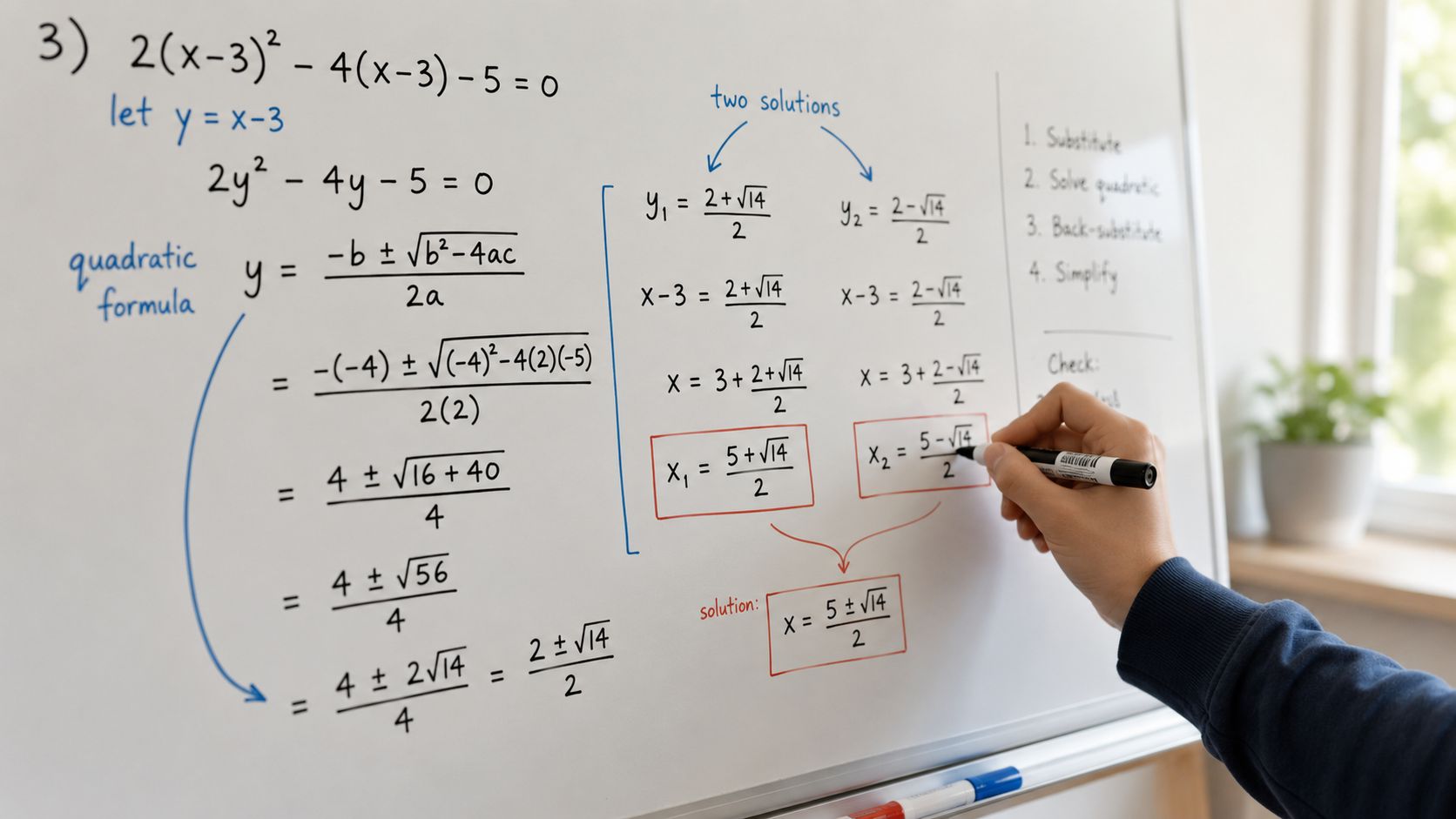
Consider a rectangle with width (x) and length (x + 3), and an area of 40 square centimetres.
The diagnosis is algebraic and geometric. The area relationship gives:
[
x(x+3)=40
]
Expand and rearrange:
[
x^2+3x-40=0
]
Factorise:
[
(x+8)(x-5)=0
]
So (x=-8) or (x=5). A length cannot be negative, so the valid width is (5) centimetres and the length is (8) centimetres.
Notice the interpretation step. Stopping after finding two algebraic roots would leave the mathematical model unchecked. The context removes one root.
Example three, an extended problem
A long question might combine a diagram, a ratio, a quadratic equation, and a percentage change. Don't try to hold the whole thing in your head. Build a chain of smaller claims.
- First claim: define the unknown and label the diagram.
- Second claim: use the stated ratio or geometric relationship to form an equation.
- Third claim: solve and reject values that violate the context.
- Fourth claim: apply the percentage or later condition.
- Final claim: state the result with the requested unit and accuracy.
Write each relationship before substituting numbers. If the final answer is wrong, this layout gives you a chance to earn method marks and lets you locate the first incorrect step.
A student who can't finish should still write the correct formula, substitute known values, and show the rearrangement attempted. Empty space earns nothing. Structured working communicates mathematical intent.
Use GCSE Past Papers to practise this progression, but don't complete papers passively. After each question, annotate the point where you diagnosed the type, selected the strategy, and checked the result.
Partial-credit habit: Put a line of reasoning on the page before you reach for a new method. Examiners can award marks for valid progress, but they can't award marks for thoughts you kept in your head.
Exam Technique That Maximizes Your Marks
A correct method isn't enough if your paper hides it. Exam technique matters because marks are attached to decisions, relationships, substitutions, and conclusions, not only to the final number.
Let the marks guide your effort
A short question may need a direct calculation. A higher-mark problem usually signals a chain of linked decisions. Give yourself permission to move on when you've made a genuine attempt and can't identify the next step. Mark the question clearly, then return after collecting marks elsewhere.
Show working in a form another mathematician can follow. Avoid one unexplained calculator entry as your entire solution. Write the formula, substitute, simplify, and state the answer. If you use a calculator, keep enough intermediate detail to recover your method.
Grade boundaries change by exam board, tier, and exam series. For example, OCR Higher in June 2025 used 300 total marks, with Grade 4 at 47, Grade 7 at 166, and Grade 9 at 258, according to the OCR grade-boundary table. AQA Higher in June 2025 used 240 marks, with Grade 4 at 63, Grade 7 at 164, and Grade 9 at 219, while AQA Foundation used Grade 4 at 160 and Grade 5 at 188, as shown in AQA GCSE maths boundary guidance.
| Exam Board | Tier | Grade 4 | Grade 7 | Grade 9 |
|---|---|---|---|---|
| OCR | Higher | 47 | 166 | 258 |
| AQA | Higher | 63 | 164 | 219 |
| AQA | Foundation | 160 | Not available on Foundation | Not available on Foundation |
The raw score isn't a permanent definition of your grade. Focus on secure marks, read the paper carefully, and avoid throwing away interpretation marks at the end.
Calculator and non-calculator decisions
On calculator papers, estimate before entering values. Check the mode, brackets, negative signs, and rounding instruction. On non-calculator work, simplify before multiplying, use known fraction and percentage relationships, and keep exact forms where they make the reasoning clearer.
If you're comparing revision systems or organising practice for a centre, resources about test prep center software may help with administration. For your own preparation, Exam Practice for GCSE should be used to rehearse decisions under timed conditions, not just to chase completed questions.
Common Pitfalls and How to Avoid Them
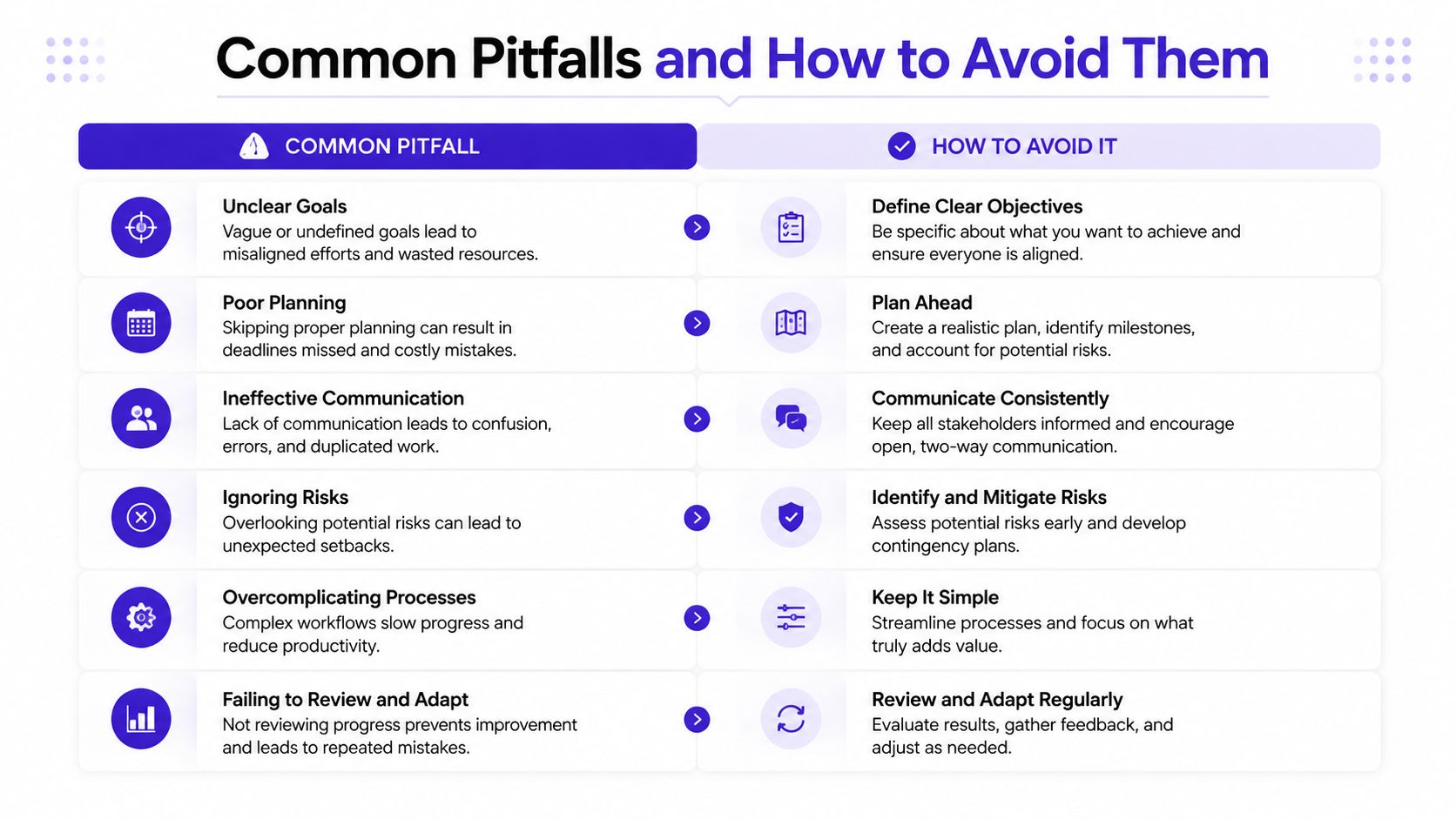
More questions don't automatically create better results. Repeating the same comfortable exercise can create recognition without building the ability to choose a method when the wording changes.
The errors worth hunting
Rushing into calculation means you may solve a different problem from the one printed. Force yourself to write the target and one relationship first.
Translating words inaccurately is especially damaging in algebra. Read your equation back as a sentence. If it doesn't match the wording, revise it before solving.
Underdeveloped algebraic modelling can appear even when a student knows how to execute familiar methods. OCR's review of reformed GCSE mathematics reported that teachers saw improvements in problem-solving skills, while also noting that algebraic skills could remain underdeveloped, as recorded in the GCSE mathematics assessments review.
Poor working loses opportunities for method marks. One line per meaningful step is usually clearer than either a page of unexplained arithmetic or a bare final answer.
Calculator dependence can hide weak estimation. Ofqual's Functional Skills review identifies a discrete non-calculator component worth 25%, showing that mental structure, simplification, and sensible approximation remain assessed needs in some UK qualifications, as outlined in the Ofqual Functional Skills review.
Misreading the context produces answers that may be algebraically valid but practically impossible. Check units, signs, size, and whether the question asks for a whole number, a measure, or an interpretation.
Turn mistakes into a diagnosis
Keep an error log with three columns: what I did, why it failed, and what clue I missed. Label each mistake as strategic, algebraic, numerical, calculator-related, or interpretive. Then practise the missing decision in a new context, rather than copying the original question.
Building a Practice Schedule That Actually Works
A useful revision schedule starts with evidence. Don't begin by dividing your time equally across every topic. Complete a small mixed set, inspect your errors, and decide whether each weakness comes from recall, translation, strategy, execution, or checking.
Build sessions around decisions
A productive session can move through distinct demands:
- Quick recall: retrieve a formula, definition, or standard relationship without notes.
- Translation practice: turn sentences, diagrams, and tables into mathematical statements.
- Mixed problems: choose the method without being told the topic.
- Extended reasoning: sustain a chain of linked steps and interpret the ending.
- Reflection: explain the first wrong decision and rewrite it correctly.
Space the revisits rather than studying one topic until it feels familiar. Mix topics once the basic method is secure, because real exam papers don't label every question with the technique you need.
A strong record tracks more than scores. Note whether you recognised the problem type, selected a suitable strategy, showed the working, and checked the answer. A student who gets a question right through guessing hasn't demonstrated the same mastery as a student who can explain the route.
Use feedback to refine the route
For GCSE and A-level learners, feedback should identify the exact stage that broke down. “Wrong answer” isn't enough. You need to know whether the equation was translated incorrectly, a formula was selected poorly, an algebraic step failed, or the final value wasn't interpreted.
The adult skills picture also shows why foundational fluency matters. In England's 2023 Survey of Adult Skills, 21% of adults were at PIAAC Level 1 or below in numeracy, while 15% reached Level 4 or above, according to the NFER report on adult skills. Those figures aren't a prediction of your result, but they reinforce a practical point: multi-step reasoning becomes harder when basic calculation and reading load compete for attention.
Use a teacher, peer, past-paper mark scheme, or digital feedback tool to test your explanation. MasteryMind provides step-by-step maths feedback and an AI mark-scheme checker that identifies marking points reached or missed. Treat it as a mirror for your working, then redo the problem without assistance.
Finish each week by choosing one strategic target, such as “I'll check the meaning of every variable” or “I'll estimate before calculator use”. That target is specific enough to observe and broad enough to transfer across topics.
MasteryMind offers UK exam-board-aligned maths practice, step-by-step verification of working, and examiner-style feedback that helps you see which problem-solving decisions earned marks. Visit MasteryMind to practise from quick recall through mixed-topic and extended questions, then use the feedback to plan your next revision session.
Ready to master this topic?
Practise with quizzes, blurt exercises and exam questions on MasteryMind.
7 days Premium · Then free forever · No card, no charge