Media Studies A Level Your Ultimate 2026 Guide
You’re probably here in one of two moods.
Either you’ve looked at your media studies a level notes, realised there are theorists everywhere, and thought, “I might be cooked.” Or you’re the kind of student who wants the A*, knows the subject is deeper than “watching films”, and wants a sharper way to turn opinions into marks.
Both groups belong here.
Because the weirdly comforting truth about A-Level Media Studies is this. If you’ve spent time on TikTok, watched Netflix with strong opinions, followed a creator’s cancellation arc, noticed when an advert feels fake, or argued over whether a superhero film is “just content” or says something bigger about gender, race, power or money, you’ve already got raw material. You’re not starting from zero. You’re starting from life.
The jump from everyday media habits to exam success is mostly about translation. A student says, “This character feels stereotypical.” A strong media student says, “The text uses costume, dialogue and narrative positioning to reproduce a limited representation of gender.” Same instinct. Better language. More marks.
Teachers know students often encounter a particular difficulty. They can spot patterns in media instantly, but they struggle to formalise those ideas under exam pressure. That’s why a tool like MasteryMind makes sense for revision. It turns that instinctive noticing into board-aligned practice, so students aren’t just having good ideas, they’re learning how to write them in the form the exam rewards.
Your A-Level Media Journey Starts Now
The student version of panic usually sounds casual.
“I get the vibe of it, I just don’t know how to write it.”
“I know the theory when I see it.”
“I’ll revise the set products later.”
Then later turns into mock season, and suddenly every text looks the same, every theorist blurs together, and every essay plan becomes “talk about representation somehow”.
That’s the trap. Media feels familiar, so students often mistake recognition for mastery.
You already know more than you think
If you scroll through your feed and notice that one creator edits everything like a mini-documentary while another uses chaotic jump cuts, that’s media language.
If you clock that the “strong female lead” in a blockbuster still gets framed mainly through attractiveness or romance, that’s representation.
If you know a platform pushes certain content because of algorithms, brand deals or ownership priorities, that’s media industries.
If you’ve ever hate-watched something, shared a meme ironically, or stitched a clip to argue back, that’s audiences.
The subject takes those instincts and gives them names, methods and evidence. Suddenly your opinions stop sounding like general chat and start sounding analytical.
You don’t need to become a different person for media studies a level. You need to become more precise about what you already notice.
What makes students feel stuck
Most confusion comes from three places:
- Too much jargon at once. Students hear semiotics, hegemony, intertextuality, hyperreality, postmodernism, and assume the subject is built for people who already speak academic.
- Set product overload. Everything can feel important, so nothing feels memorable.
- Theory without application. Memorising a theorist’s name is not the same thing as knowing when to use them.
A better way in is simple. Start from the media you consume, then map the course onto it. Your TikTok habits help with audience theory. Reality TV helps with ideas about performance and authenticity. Film franchises help with industry and ownership. News on social media helps with representation and regulation.
A more useful mindset
Think less “I need to know everything” and more “I need to analyse deliberately”.
That means learning to answer questions like:
- What choices has the producer made?
- How do those choices create meaning?
- Who is being represented, and how?
- Who benefits from the product succeeding?
- How might different audiences respond?
Students who are behind can use those questions to catch up fast. Keen students can use them to deepen every answer. Teachers can use them as a clean classroom routine that turns vague discussion into examinable thinking.
What Actually Is A-Level Media Studies
A-Level Media Studies is easiest to understand if you treat it like detective work.
You’re given a media text. It might be an advert, magazine cover, film extract, music video, TV episode, online page or news item. Your job is to investigate how it works, why it was made that way, who it speaks to, and what bigger ideas sit underneath it.
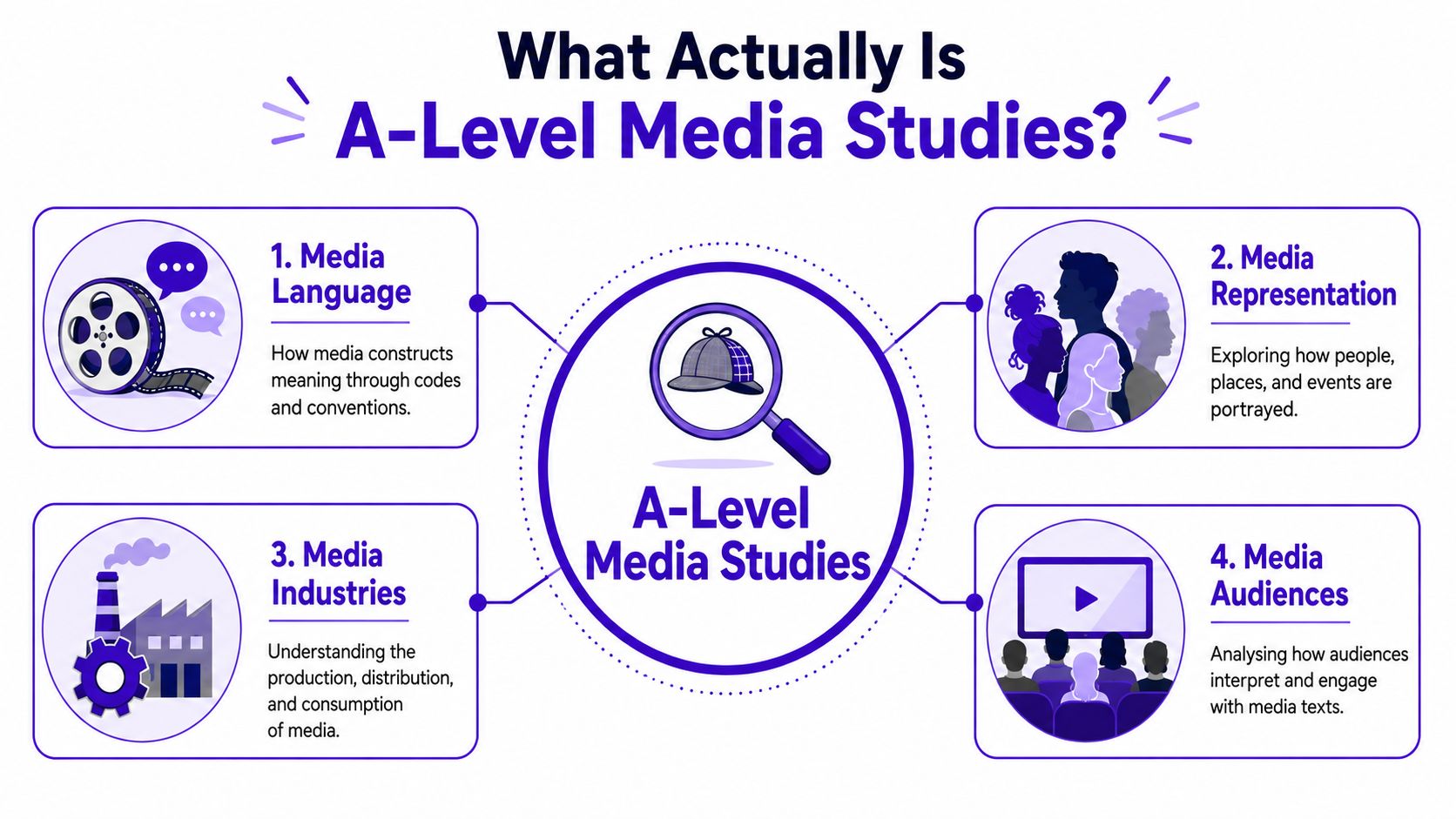
Across the main UK exam boards, the subject is built around four core concepts: media language, representation, audiences, and industries, with assessment typically split into 70% written exams and 30% non-exam assessment according to the Department for Education subject content for AS and A Level Media Studies.
The four concepts in plain English
Media language
This is the “how”.
It covers the choices that construct meaning. Camera angles. Lighting. Editing. Font. Colour. Layout. Sound. Headlines. Costume. Even where a character stands in the frame.
If a thriller trailer uses dark lighting, sharp cuts and a distorted soundtrack, that isn’t random. It’s building tension and genre expectations. If a lifestyle magazine uses soft colours and handwritten fonts, that also isn’t random. It signals a mood, a brand identity and an imagined audience.
Media language is the fingerprint left by production choices.
Representation
This is the “who” and “how”.
Representation asks how people, places, events and social groups are shown. Are they complex or stereotyped? Powerful or marginalised? Present at all, or missing?
A character can look progressive on the surface but still be limited by narrative role. A news story can claim neutrality while framing one group as threatening and another as respectable. A game can celebrate choice while still centring one kind of hero.
Students often think representation only means race or gender. It also includes class, age, disability, region, sexuality, nationality and the values attached to all of them.
Audiences
This is the “for whom” and “what happens next”.
Audiences don’t just receive media. They interpret it, share it, remix it, reject it, love it, mock it, clip it and meme it into new meanings.
That matters because the same product can land differently with different groups. A satirical advert might feel funny to one audience and offensive to another. A nostalgic reboot might excite older viewers and leave younger ones cold. A fandom can even create meanings the producer never intended.
Industries
This is the money, power and systems side.
Who owns the company? How is the product funded? How is it marketed? What role do regulation and platforms play? Why does one film get a huge release while another survives on niche audiences and critical praise?
Industries turns media from “art we watch” into “systems we can understand”.
Why the four concepts work together
Students sometimes revise these as separate boxes, then struggle in essays because real analysis blends them.
A useful way to consider this is:
| Concept | Detective question | Everyday example |
|---|---|---|
| Media language | How is meaning being made? | Why that filter, soundtrack or thumbnail? |
| Representation | Who is shown, and in what way? | Why does this show make one group look aspirational and another comic? |
| Audiences | How might people read or use this? | Why did this clip go viral with one crowd and annoy another? |
| Industries | Who profits and controls distribution? | Why is this franchise everywhere at once? |
Practical rule: if you’re analysing a text and only talking about one concept, your answer probably isn’t developed enough yet.
What students actually do
You won’t just write opinions about films.
You’ll study set products, apply theory, compare texts, respond to unseen material, and create your own media product for coursework. The course also requires breadth. Students study varied media forms and products, including older texts, texts for non-English speaking audiences, and work outside the commercial mainstream, all within a framework designed to build critical thinking and analysis.
That’s why media studies a level isn’t “easy because it’s modern”. It’s rigorous because it asks you to connect culture, politics, business, creativity and audience behaviour in one argument.
Choosing Your Battlefield A-Level Exam Boards Compared
Your school usually chooses the board, but students still need to know what kind of game they’re playing.
AQA, OCR, and Eduqas/WJEC all teach the same broad subject, but they don’t always feel the same in the classroom. The set products differ. The wording of questions differs. The habits that help you score highly can differ too.
If you ignore that and revise in a generic way, you make life harder than it needs to be.
The comparison that actually matters
| Feature | AQA | OCR | Eduqas/WJEC |
|---|---|---|---|
| Core concepts | Uses the shared national framework of media language, representation, audiences and industries | Uses the shared national framework of media language, representation, audiences and industries | Uses the shared national framework of media language, representation, audiences and industries |
| Overall feel | Often suits students who like clear structure and comparative essay practice | Often rewards students who are comfortable moving between theory, contexts and changing media forms | Often feels strong on set product specificity and applied analysis |
| Set products | Chosen by the board and can mix historical and contemporary products across forms | Chosen by the board with clear emphasis on contemporary media changes and critical debates | Chosen by the board and often revised through tightly focused product knowledge |
| Exam style | Extended writing and close application to set products and unseen materials | Strong emphasis on analysis of changing media relationships, contexts and theory use | Detailed textual knowledge is especially useful, alongside secure theory application |
| Coursework | Follows the national NEA model, creating an original media product in response to briefs | Follows the national NEA model, creating an original media product in response to briefs | Follows the national NEA model, creating an original media product in response to briefs |
| Best revision habit | Build flexible essay plans and comparison grids | Practise applying theory to current media examples | Keep a disciplined evidence bank for set products and production work |
AQA feels like this
Students on AQA often do well when they can balance product knowledge with clean essay structure.
If that’s your board, don’t just memorise facts about set products. Practise writing paragraphs that move from evidence to interpretation fast. Teachers often notice that students know the texts but leave marks behind because they don’t push analysis far enough.
AQA tends to reward clarity. If your argument is organised and your examples are sharp, you’re in a good place.
OCR feels like this
OCR often attracts discussion around changing media forms, digital culture and how newer platforms affect production and audience behaviour.
That makes it a good fit for students who naturally connect old and new media. If you’re the person who can compare a traditional news brand with how content circulates on social platforms, OCR thinking will feel natural. It also means teachers can make lessons more alive by linking set products to contemporary media habits.
Strong OCR answers usually do more than identify a theory. They show why that theory helps explain a changing media landscape.
Eduqas and WJEC feel like this
Eduqas/WJEC can reward precise handling of set products. Students often benefit from strong notes on specific scenes, covers, sequences, headlines, posters or marketing choices.
That doesn’t mean “memorise and dump”. It means knowing your evidence well enough that you can select the right detail for the right question. Teachers often see students improve when they stop revising whole texts vaguely and start revising moments within texts.
What doesn’t change across boards
Some things are bigger than board personality.
- The subject core stays the same. You still need to understand language, representation, audience and industry.
- Essay control matters. Students who write everything they know usually score worse than students who answer the exact question.
- Coursework needs intention. Creative work scores better when choices are explained, not just made.
- Current media awareness helps. Even where the set products are fixed, wider context makes answers more mature.
One practical move for any student is to ask your teacher for the exact specification code and the latest set product list, then build revision around those texts only. Not every cool example you find online is useful for your board.
Cracking the Code Key Theories You Need to Know
Students hear “theory” and often panic because it sounds like something you memorise in a flashcard graveyard.
That’s not what good theory use looks like.
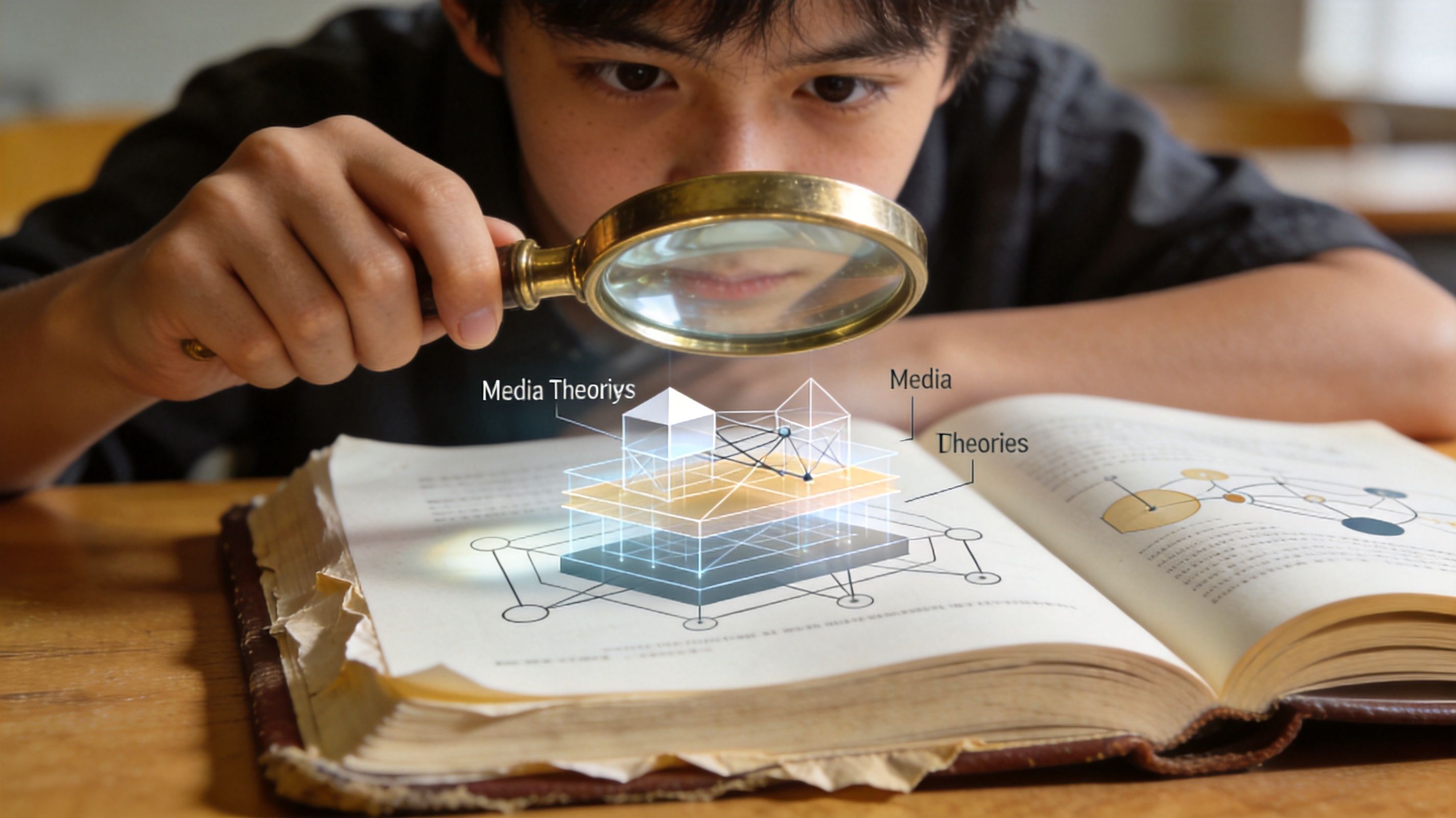
A theory is just a lens. It helps you notice something more clearly. If media language is the evidence, theory is the interpretation tool. It gives your argument shape.
The subject has grown into a major A-Level option, with over 10,000 students entering annually in recent years, including 11,500+ in 2022, and it explores media ownership, regulation and digital convergence, including how platforms let individual producers bypass traditional gatekeepers, as noted in this Media Studies course overview used in school induction materials.
Theories that help with meaning
Semiotics
Semiotics is about signs. A sign can be an image, a colour, a word, a sound, a logo, a gesture.
A trainer advert doesn’t just show a shoe. It sells speed, status, identity and attitude. Black and gold might suggest luxury. Handheld camera movement might suggest realism. A cracked urban wall behind the model might signal grit and authenticity.
You don’t need to say “semiotics” every five seconds. You need to explain how signs create meaning.
Genre theory
Genre isn’t just a label. It’s a contract with the audience.
A horror trailer promises dread. A romcom promises emotional obstacles plus payoff. A news homepage promises seriousness, authority and up-to-date information. But media products also twist those expectations. That tension between familiarity and surprise is often where good analysis lives.
Theories that help with identity and power
Feminist approaches
Students often overcomplicate this. Start basic. Ask who gets agency, who gets looked at, who drives the narrative, and who gets reduced to appearance.
You can test this on almost any film, series or music video. Is the female character active, or mostly reacted to? Does the text challenge sexism, package it more attractively, or do both at once?
bell hooks is useful when discussing intersectionality and the way race and gender combine in representation. That’s especially helpful when a text appears progressive but still centres a narrow version of who gets to be visible and desirable.
Postcolonial ideas
These help when analysing how media represents nations, cultures and power relations shaped by empire.
Who gets framed as civilised, modern, dangerous, exotic, or in need of rescue? Who is allowed complexity? Who is the default hero? Big-budget blockbusters, travel advertising, historical dramas and news coverage can all reveal these patterns.
Theories that help with reality and digital culture
Baudrillard and hyperreality
This one sounds scary but students usually get it fast once you use the right example.
Hyperreality is when representations feel more real, more desirable or more meaningful than reality itself. Think reality TV where “real life” is heavily edited into dramatic identity. Think influencer culture, where a bedroom, breakfast, skincare routine or “candid” crying video becomes a polished performance of authenticity.
The point isn’t to force Baudrillard into every answer. The point is to use him when a text blurs the line between real and constructed.
If a media product sells an experience of “realness” that has clearly been styled, filtered, edited or branded, hyperreality may be useful.
How to revise theory so it sticks
A lot of students revise theory badly. They memorise definitions with no application. Then the exam asks about a set product and their mind goes blank.
A better method:
- Pair each theory with one modern example. Semiotics with a trainer advert, hyperreality with influencer content, feminist theory with a film or music video.
- Pair it again with one set product. This stops your knowledge becoming too general.
- Write one sentence that starts “This helps explain…”. If you can’t finish that sentence, you don’t know the theory well enough yet.
- Practise choosing, not dumping. Examiners reward relevant theory, not all the theory you know.
For teachers, this is also where modelling matters. Students need to hear theory used in normal language before they can write it confidently. That’s one reason I like resources that focus on how people learn difficult ideas. LearnStream's advice on learning theories is useful here because it reminds us that retention improves when students connect abstract concepts to meaningful examples instead of treating them like isolated terms.
Deconstructing Your Exams and NEA Coursework
The assessment split matters because it changes how you should work all year.
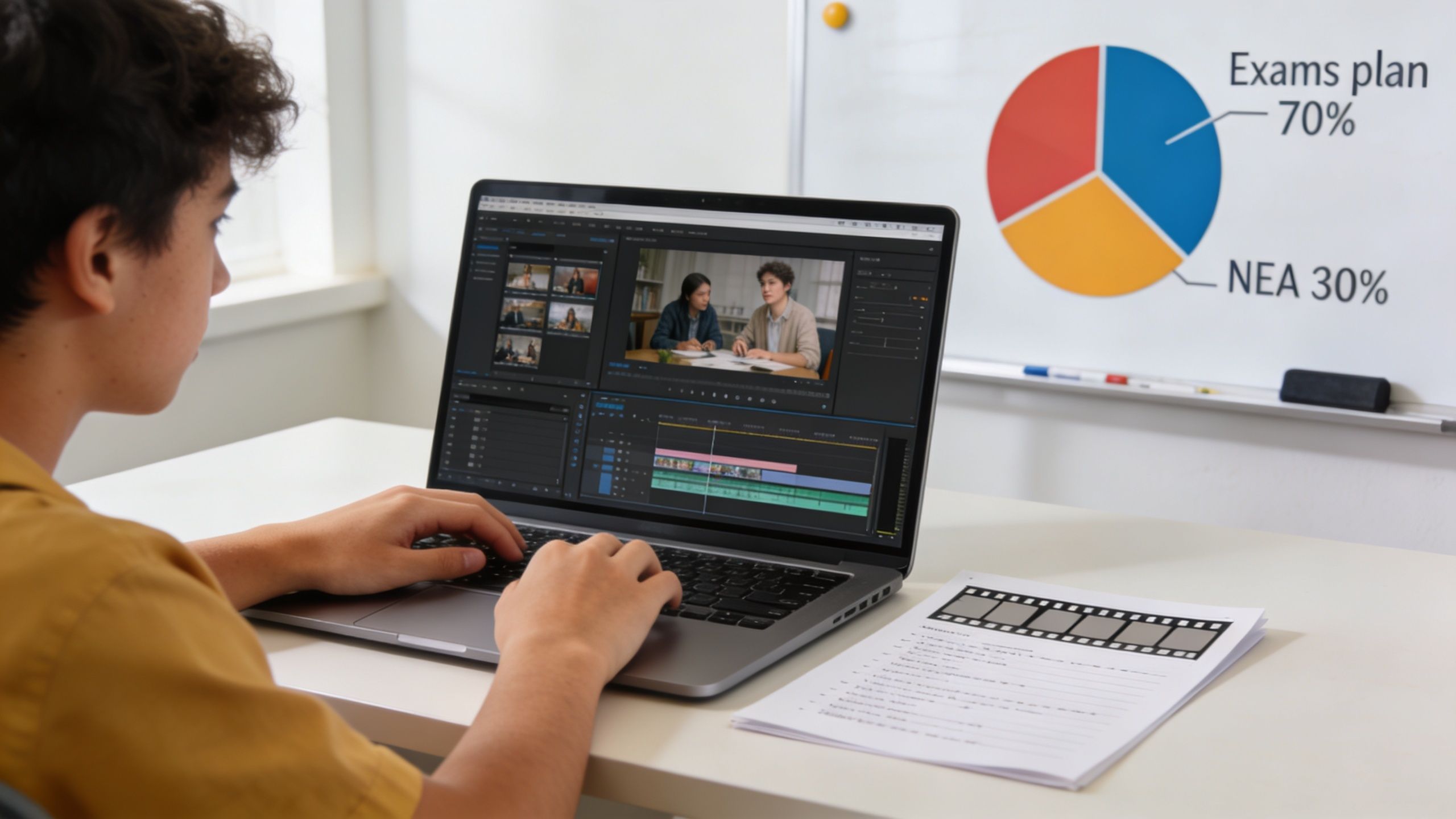
Your final grade usually comes from 70% exams and 30% coursework, but that doesn’t mean coursework is the easy bit. In many classes, the NEA becomes the silent grade killer because students underestimate how much planning, reflection and justification it needs.
What the NEA actually rewards
Coursework in A-Level Media Studies asks you to create an original media product in response to a brief. Depending on your board and brief, that could mean things like promotional material, moving image work, print design or cross-media production.
The important phrase is not “make something cool”.
The important phrase is make something deliberate.
According to the Cambridge International Media Studies specification information, coursework weighting is 30%, AO3 assesses “advanced practical skills”, and top-mark exemplars show clear cause and effect in their creative decisions. The same source notes that 65% of top-band Eduqas submissions included 50+ blog artefacts.
That last point matters. High-performing students usually document the process in detail.
What top coursework folders tend to include
Not every teacher uses the exact same workflow, but strong NEA work often shows:
- Research that feeds decisions. Mood boards, competitor analysis, audience profiles, and notes on conventions.
- Planning with evidence. Drafts, scripts, shot lists, sketches, layouts, location tests.
- Production choices explained. Why this font, why this framing, why this sound bridge, why this colour palette.
- Reflection and refinement. What changed after testing, what didn’t work, what got improved.
Students often ask, “Do I really need to keep all the messy drafts?” Usually, yes. The mess is evidence of thinking.
The examiner can’t reward a decision they can’t see you made.
What goes wrong in the NEA
The most common problems are painfully fixable.
Style over purpose
A student uses a dramatic edit or expensive-looking effect but can’t explain what meaning it creates.Research that stays decorative
Mood boards look nice but never feed into actual decisions.Weak audience targeting
The product exists, but the imagined audience feels vague.Thin production logs
The final piece may be decent, yet there’s little visible development behind it.
Structured guidance offers a solution. MasteryMind's NEA Coach features are designed around Socratic support and mark estimation, which is useful when students need prompting to justify choices without someone doing the coursework for them.
What the exam papers really want
Written papers reward a different skill set. Here, your job is to read the question carefully, select the right evidence quickly, and build an argument that stays focused.
Students often lose marks because they revise by product instead of by question type.
A better way is to prepare for three common demands:
| Exam demand | What you need to do | Common mistake |
|---|---|---|
| Unseen analysis | Read the text closely and infer meaning from choices | Writing generic points that could apply to anything |
| Set product comparison | Use specific evidence from both texts | Describing one text much more than the other |
| Extended essay | Build a line of argument using theory and context | Listing theorists without linking them to the question |
A simple exam paragraph model
Try this structure when practising essays:
- Point. Make a direct claim answering the question.
- Evidence. Use a precise detail from the product.
- Analysis. Explain how meaning is created.
- Theory or context. Bring in a relevant lens only if it sharpens the point.
- Mini-judgement. Show why this matters for the question.
That model works because it stops you drifting into plot summary or vague appreciation.
From Panic to Plan Your A* Revision Strategy
The fastest way to feel worse at media studies a level is to revise passively.
Rewatching a set episode while half-looking at your phone is not revision. Reading your notes and thinking “yeah, I know that” is not revision. Highlighting every theorist in the same colour until your page looks radioactive is also not revision.
Active revision feels slightly harder in the moment and much better in the exam.
The biggest revision mistake
Students often revise media by consuming it again instead of interrogating it.
That’s understandable because the subject is built on media texts. But the exam doesn’t ask whether you remember a scene existed. It asks whether you can explain how and why it matters.
So the right question isn’t “Have I watched this?”
It’s “Can I turn this into analysis without the text in front of me?”
A weekly plan that actually works
Try a rotation instead of a marathon.
- One session for set products. Revise specific scenes, covers, sequences or pages. Write three analytical points from memory.
- One session for theory. Match each theory to one set product and one current media example.
- One session for audience and industry context. Think platforms, ownership, circulation, regulation, fandom, monetisation.
- One session for timed writing. Even one paragraph under time pressure is useful.
- One short retrieval session. Speak your answers aloud, blurting everything you know before checking notes.
That mix works because it trains memory, application and speed together.
Use current media without drifting off task
One area students struggle with is bringing in contemporary examples in a way that helps.
There’s a real gap here. The OCR specification material discussed in current guidance highlights changing media contexts, and the same verified source notes that 64% of UK 16 to 24-year-olds now use TikTok as a primary news source, up from 51% in 2024. Yet students often get very little practical help on how to turn that kind of trend into a paragraph.
The trick is not to bolt on a random example.
Try this instead:
- Link the example to the question directly. If the question is about audiences, discuss participation, sharing or interpretation.
- Name the media behaviour. Don’t just say “TikTok is popular”. Talk about short-form news circulation, creator-led framing, or algorithmic visibility.
- Bring it back to the set product. The current example should sharpen your comparison, not replace it.
Exam habit: a modern example only helps if it makes your argument about the actual question more precise.
Here’s a useful revision video if you need a reset on study habits and exam prep:
Tools that reduce the blank-page problem
Students rarely fail because they’re lazy. More often, they fail because they don’t know how to start.
That’s why active tools beat passive resources. A bank of A-Level Past papers helps because it puts you in contact with the task itself. Speaking answers aloud helps because exams punish fuzzy recall. Adaptive quizzes help because they force you to apply ideas to unfamiliar examples, which is closer to what the papers demand.
Teachers will recognise the value here too. Retrieval, low-stakes testing and spaced review aren’t gimmicks. They create the repetition and application students need if they’re going to remember theory under pressure and use it flexibly.
If you’re behind, do this first
If revision has gone off the rails, strip it back.
- Learn the core argument of each set product.
- Know which theories fit which products.
- Memorise a handful of precise examples, not everything.
- Practise paragraph writing before full essays.
- Mark your own answer against the question, not your effort level.
That last one hurts, but it works.
Why Media Studies Matters More Than Ever
You wake up, check TikTok, skim a headline on your phone, laugh at a meme in the group chat, and by 9 a.m. you have already consumed a stack of media texts. A-Level Media Studies teaches you how to read that morning properly. Not as random content, but as a set of choices about audience, power, representation, and profit.
That is why the subject matters so much now. Screens shape what people notice, what they ignore, and what starts to feel normal. If you can explain how a close-up creates intimacy, how an algorithm rewards outrage, or how a brand sells “authenticity” through careful styling, you are doing far more than exam prep. You are training the same analytical muscle you use to question a campaign slogan, a viral clip, or a supposedly spontaneous influencer post.
The subject turns everyday scrolling into literacy
Students often hear “literacy” and picture novels, essays, and annotated poems. Media literacy is wider than that. It means reading edits, camera angles, captions, thumbnails, platform design, and comment culture with the same care you would give a written text.
That matters because modern persuasion rarely arrives as a formal argument. It arrives as a reaction video, a podcast clip, a “relatable” ad, or a YouTube title designed to trigger curiosity. A strong Media Studies student can look at that material and ask the kind of question examiners reward. Who made this? Who benefits? What assumptions are built in? Which audience is being targeted, and how?
Representation is a good example. Weak analysis says a media product is “positive” or “negative.” Better analysis gets specific. Which identities are visible? Which are sidelined? Who gets complexity, and who gets reduced to a type? Once students start asking those questions, theory stops feeling like a wall of names and starts working like a set of lenses.
A strong media student does not stop at “Is there representation?” They ask what kind of representation is being repeated until it feels natural.
Why teachers keep backing the subject
Teachers value Media Studies because it brings together interpretation, evidence, argument, and cultural awareness in one classroom. It also gives many students an academic way in. The student who struggles to care about a Victorian poem may write a sharp paragraph on Barbie, The Daily Mail, or a drill music video because the text already means something to them.
That is the hidden strength of the course. Students are not starting from zero. They already know more than they think. They have opinions about celebrities, streaming platforms, gaming culture, reality TV, online masculinity, fandoms, and news credibility. Good teaching turns that familiarity into disciplined analysis.
For teachers who want practical resources alongside the course, ready-to-use lesson plans for educators can support lessons on source checking, visual analysis, and digital credibility. Those classroom habits connect neatly with the kind of close reading Media Studies rewards.
The bigger payoff
Media Studies helps students become harder to fool.
That sounds dramatic, but it is true. The course teaches students to notice framing, omission, ideology, and commercial intent. It helps them separate “this feels true” from “this is constructed persuasively.” In a world of sponsored content, AI-generated images, political spin, and endless reposted clips, that skill carries real weight.
It also travels well into future study and work. Journalism, marketing, film, law, politics, teaching, social media, public relations, and advertising all rely on reading messages closely and building clear arguments from evidence. Even if a student never studies media again, they keep the habit of asking better questions.
If you are a student reading this and feeling behind, remember this. You already consume media every day. The jump to A or A star analysis is not about becoming a different person. It is about learning how to turn your instinctive reactions into precise written points.
MasteryMind can help with that process through board-aligned practice, active recall, and structured support for essay planning and coursework reflection. It keeps the focus where it should be, on helping you think more clearly, not on handing you ready-made opinions.
Ready to master this topic?
Practise with quizzes, blurt exercises and exam questions on MasteryMind.
7 days Premium · Then free forever · No card, no charge