Mixture of Elements: Definition, Examples and Separation
A mixture of elements is two or more elements physically combined, not chemically bonded to each other, so each keeps its own properties and the amounts can vary.
You're looking at a revision question. There are coloured circles in a box, and the answer options all sound almost the same. Whether you're catching up before an exam or pushing for a top grade, the useful question isn't just which elements are present. It's how their atoms are arranged and whether a new substance has formed.
What a Mixture of Elements Actually Is
Tip some different-coloured marbles into a bag. Shake it. You've changed their arrangement, but you haven't changed the marbles themselves. You can pick them apart again or add more of one colour without needing a particular recipe.
That's a useful model for physical mixing. A bag of mixed sweets works in the same way: each sweet remains recognisable. Neither example is strictly a mixture of chemical elements, though. They're models of how separate components can sit together without becoming a new substance.
From a bag of marbles to a chemical sample
Compare mixing ready-made sweets with cooking sugar to make a sweet. Cooking can involve chemical changes that produce new substances, rather than merely rearranging ingredients. Don't use appearance alone to decide which process has happened.
Chemists distinguish an element, a compound and a mixture by what the sample contains and how its atoms are joined. An alloy is a particular kind of metallic material made with other elements.
Element, compound, mixture and alloy at a glance
| Type | What it is | Chemically bonded? | Composition | Example |
|---|---|---|---|---|
| Element | One kind of atom | Not applicable to joining different elements; atoms may bond to the same element | Fixed identity | Iron (Fe) |
| Compound | Different elements chemically joined | Yes, a new substance forms | Fixed ratio | Water (H2O) |
| Mixture of elements | Different elements physically combined | No chemical bonding between the separate constituents | Varies | Iron filings and sulphur powder, stirred together |
| Alloy | A metal mixed with other elements, used as a solid | Metallic bonding occurs; some alloys also contain compound phases | Varies, chosen by design | Brass, made with copper and zinc |
The alloy row needs care. A mixture doesn't mean there are no bonds anywhere in the material. It means the constituents haven't all become a single compound with a fixed chemical formula.
Use the concept map as a memory aid, keeping the sweets analogy separate from the chemical definition.
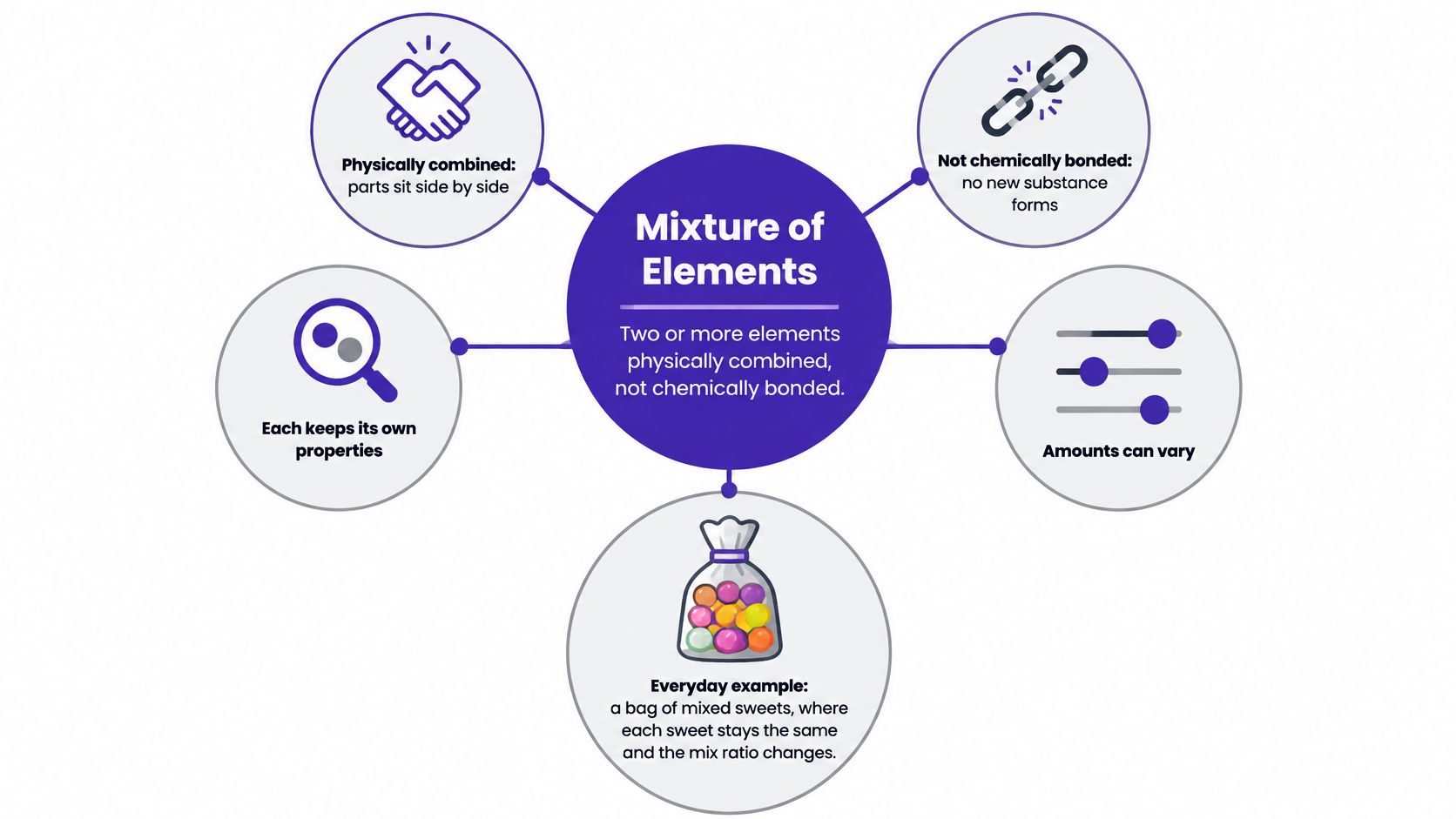
Starting test: If no new substance has formed and physical methods can separate the constituents, classify the sample as a mixture.
When you practise chemistry with MasteryMind, justify your classification with evidence rather than giving the label alone.
Physical Properties That Give a Mixture Away
Sea water can look clear even though it contains dissolved salts. You can't identify every component just by looking through the water. A uniform appearance is therefore a poor test of chemical purity.
Physical properties give you better evidence. The AQA GCSE chemistry content on mixtures and purity connects mixture separation to differences in physical properties and distinguishes the sharp melting or boiling temperatures of pure substances from the ranges generally associated with mixtures.
Look for these physical clues
A constituent keeps a recognisable property. Iron filings stirred into sulphur powder are still attracted to a magnet. That observation supports the conclusion that the iron remains present as iron, rather than having been completely converted into a new substance.
The proportions can change. You can stir extra salt into a heap of sand without creating a different compound. Water is different: its formula describes a fixed relationship between hydrogen and oxygen atoms. Changing the amount of water doesn't change that relationship.
A change of state may happen across a range. A pure substance has a characteristic sharp melting or boiling temperature under specified conditions. A mixture generally behaves differently because its composition affects the transition. A measured range is useful evidence, not a reason to ignore pressure, heating conditions or experimental uncertainty.
Appearance can conceal several substances. A salt solution may look the same throughout. That doesn't make it a pure substance. Dissolved particles don't have to remain visible for the sample to count as a mixture.
What a temperature result can actually tell you
Suppose you're given a heating graph and asked whether a sample is pure. Don't just describe the line as flat or sloping. Connect the observation to the substance: a sharp transition supports purity, while a transition across a range supports the presence of a mixture.
You should also distinguish a clue from complete proof. An unreliable thermometer or uneven heating can affect your measurements. In a practical evaluation, explain what else you'd check before making a confident conclusion.
A sample can look uniform and still contain several substances. In chemistry, “pure” describes composition, not how clean or clear something looks.
For an exam answer, pair the observation with its meaning. “The sample melts over a range, suggesting it's a mixture” explains more than “it isn't pure”.
Four Questions That Sort Any Sample
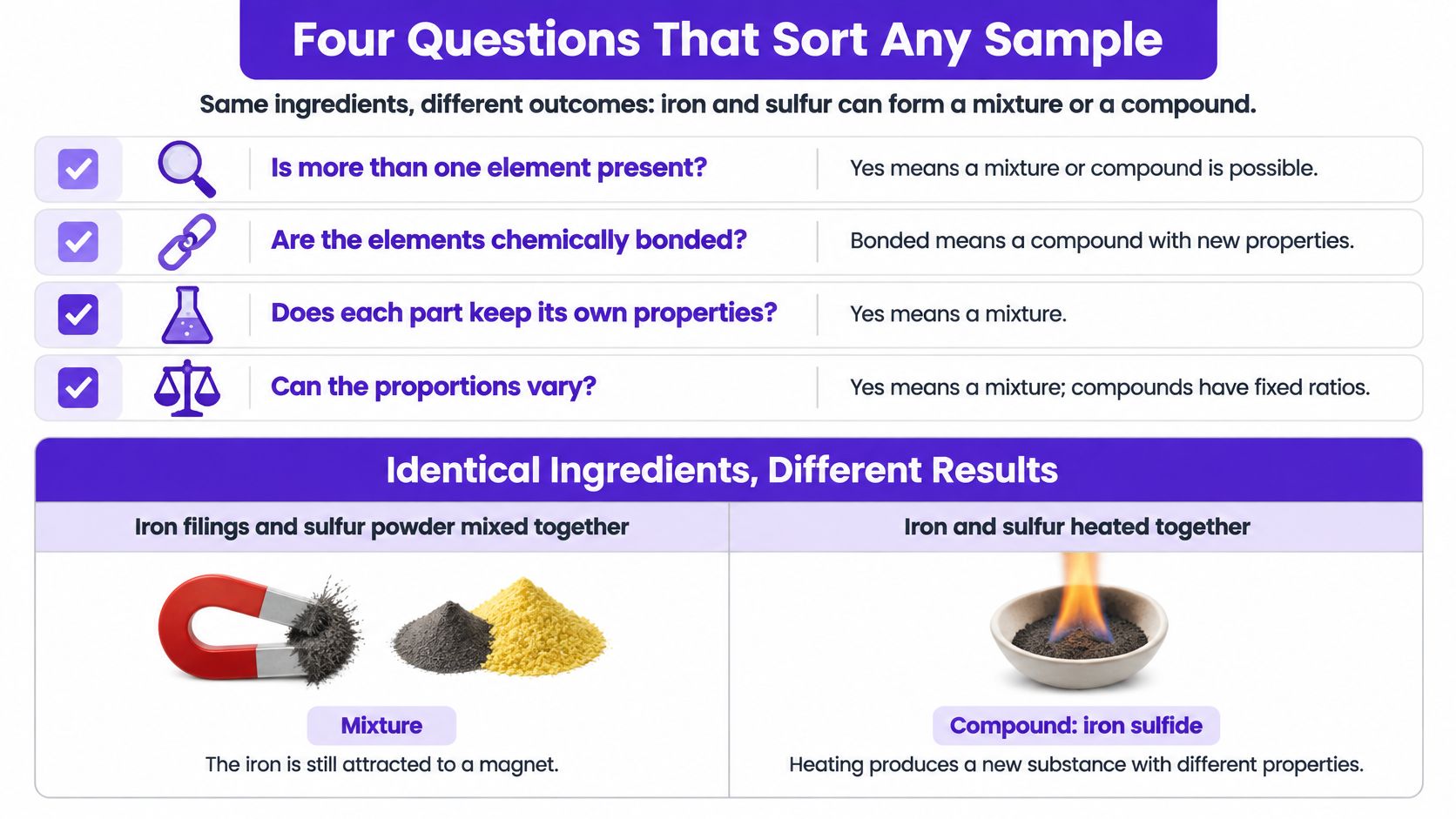
Iron filings and sulphur powder stirred together in a dish make a mixture. Heat them under suitable conditions so that they react, and you get iron sulphide, a compound. Same two elements, two different classifications. The ingredient list never settles the question; the reaction does.
Particle diagrams ask the same skill of you. Different colours usually stand for different elements, but counting colours is only the start. You still have to check which atoms are joined to which, and how many different particle types sit in the box.
Same ingredients, different outcomes
| Situation | Result | Evidence |
|---|---|---|
| Iron filings and sulphur powder, stirred together | Mixture of elements | Iron remains attracted to a magnet; the constituents are physically separable |
| Iron and sulphur heated together and fully reacted | Compound, iron sulphide | A new substance forms; a magnet doesn't recover the original iron |
| Hydrogen and oxygen gases in one container | Mixture of elements | Separate hydrogen and oxygen particles remain present |
| Hydrogen and oxygen burnt to form water | Compound, H2O | A new substance forms with the fixed atomic relationship shown by its formula |
| Salt dissolved in water | Mixture containing compounds | Salt remains a compound and can be recovered by removing the water |
The heating rows assume the reaction has occurred. Heating alone isn't proof of reaction, and an incompletely reacted sample can still contain unreacted starting materials. These demonstrations belong in a supervised laboratory, not a home revision experiment.
Run the questions in order
What kinds of particles are present? Identify atoms and molecules, then ask whether they contain the same element or different elements. A molecule containing only oxygen atoms is still an element.
Is there a fixed composition within each compound particle? Inspect the repeated particle units. The overall proportion of colours across a box isn't enough, because someone could deliberately draw a mixture in matching proportions.
Has a reaction produced a new substance? Joined atoms of different elements within a particle provide evidence of a compound in a standard molecular diagram. Several different compound particle types together indicate a mixture of compounds.
Could physical methods separate the constituents? Use the information given about their properties. A mixture isn't automatically easy to separate, so check what the question tells you before claiming it is.
The visual checklist connects those questions to the iron and sulphur example.
Write the evidence, not just the category
The AQA examiner report on particle-diagram classification shows a familiar pattern: candidates often label a diagram as a mixture of compounds when it in fact shows a mixture of elements. Examiners want the justification, not just the tick.
A strong explanation names particle types, bonding and evidence. For example: "The diagram shows separate particles of different elements, with no bonding between those elements."
Use Exam Practice for GCSE to rehearse that explanation, not just the multiple-choice selection.
Everyday Examples, Starting With the Air
Air gives you a real sample that looks uniform but contains many gases. Its main components are elements, but some of its smaller components are compounds.
The amounts below come from the Met Office explanation of Earth's atmosphere. The dry-air figures are approximate; the water-vapour row is included separately to show how moist air differs.
Composition of dry air by component
| Component | Type | Typical amount |
|---|---|---|
| Nitrogen (N2) | Element | About 78% by volume |
| Oxygen (O2) | Element | About 21% by volume |
| Argon (Ar) | Element | About 1% by volume |
| Water vapour | Compound | Up to about 3%, varying with place and time; excluded from dry air |
| Carbon dioxide (CO2) | Compound | About 416 ppm |
| Neon (Ne) | Element | About 18 ppm |
| Helium (He) | Element | About 5 ppm |
| Methane (CH4) | Compound | About 1.8 ppm |
| Krypton (Kr) | Element | About 1.1 ppm |
The catch in calling air a mixture of elements
Nitrogen, oxygen and argon are elements. Carbon dioxide, methane and water vapour are compounds. The precise description of air is therefore a mixture of elements and compounds, not exclusively a mixture of elements.
You also shouldn't add rounded dry-air percentages to a maximum water-vapour value and expect an exact total. Rounding, trace constituents and changing moisture content mean those entries aren't an exact recipe for a single sample.
The Met Office also explains that oxygen's proportion remains approximately stable as altitude increases near the surface, while pressure falls. There's less oxygen available in each breath because the air is less dense, not because its oxygen proportion has disappeared.
Other familiar mixtures need different labels
- Sea water contains water and dissolved salts. It's a useful example of a mixture containing compounds, rather than a mixture made only from elements.
- Stainless steel is an alloy. Its constituent elements are selected to produce a useful material, rather than left as visibly separate powders.
- Granite contains different minerals, mostly compounds. A rock can therefore be a mixture even when its components are solid and closely packed.
These examples test whether you can distinguish the type of sample from the identities of its constituents. Gas, liquid and solid samples can all be mixtures.
When you browse combined science exam preparation, practise classifying unfamiliar examples as well as memorising familiar ones.
Alloys as Element Mixtures Engineered to Order
A metal's name doesn't tell an engineer everything they need to know. An alloy's composition and cooling conditions help determine the material that forms, so an ingredient list is only the starting point.
An alloy is a metallic material containing a metal and other elements. For GCSE purposes, it's commonly treated as a mixture. For more advanced work, remember that alloys can contain different phases, including compound phases, so “all alloys contain no compounds” is too broad.
Familiar names don't mean a universal recipe
- Brass contains copper and zinc and is used for items such as fittings and musical-instrument components.
- Sterling silver contains silver with copper and is used in jewellery and silverware.
- Mild steel is based on iron with a relatively small carbon content and is used for general fabrication.
- Stainless steel contains iron and chromium, with nickel present in some grades, and is used where corrosion resistance matters.
- Traditional solder contains tin and lead and is used for joining materials. Lead-free solders use different formulations.
These names help you recognise the materials, but they don't justify assigning every sample the same composition. The grade or specification matters.
Why engineers measure the recipe
Composition can be expressed as mass percent, wt%, or atomic percent, at%. These aren't interchangeable when the constituent atoms have different masses: equal masses don't necessarily contain equal numbers of atoms.
The University of Southampton alloy phase-diagram practical describes preparing alloys across a composition range, recording cooling curves and identifying when solidification begins. Plotting those results helps construct the liquidus and related phase boundaries.
A phase diagram connects composition and temperature with the phases expected under equilibrium conditions. Most alloys begin and finish solidifying at different temperatures, rather than following the sharp transition associated with a pure element. Near a eutectic composition, however, liquid can transform at a characteristic temperature into a multiphase structure.
Engineering distinction: The bulk properties of an alloy can differ from those of its constituent elements. Keeping chemical identity doesn't mean every property of the finished material stays unchanged.
Engineers adjust composition and processing to target strength, ductility, castability or corrosion performance. That's why changing carbon or chromium content can matter more than recognising iron in the recipe.
How to Separate a Mixture of Elements
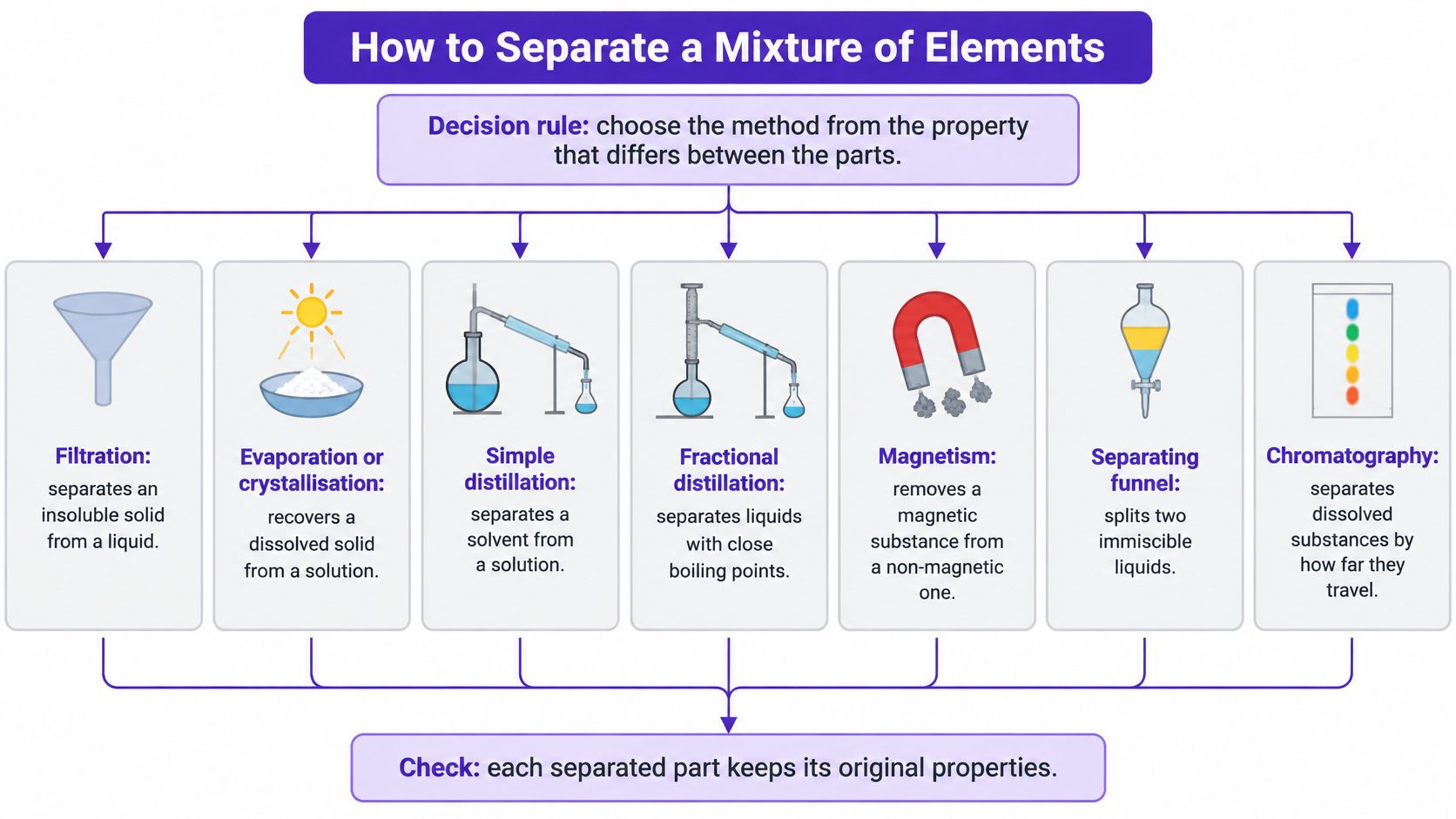
Choose the method from the property that differs between the components. Don't choose filtration just because the question mentions a liquid. First establish whether the substance you want is dissolved or insoluble.
Use this flowchart to connect the sample's properties with suitable apparatus.
Separation methods and the property each one uses
| Method | Separates | Property used | Example |
|---|---|---|---|
| Filtration | Insoluble solid from a liquid | Particle size | Sand from water |
| Evaporation or crystallisation | Dissolved solid from its solvent | Solvent volatility; solubility also matters in crystallisation | Salt from salt water |
| Simple distillation | Liquid from a solution containing a dissolved solid | Boiling behaviour and volatility | Water from sea water |
| Fractional distillation | Miscible liquids with different boiling points, including close ones | Boiling-point differences | Fractions of crude oil |
| Chromatography | Several dissolved substances | Different attractions to the mobile and stationary phases | Inks and food colourings |
| Magnetism | Magnetic from non-magnetic solids | Magnetic attraction | Iron filings from sulphur |
| Separating funnel | Immiscible liquids | Separate layers, ordered by density | Oil from water |
The AQA combined science specification on separation and purification expects students to suggest appropriate techniques, as well as describe and explain them. That means an exam can test your choice and sequence, not just your ability to name apparatus.
Work through sand, salt and iron filings
This teaching example contains elements and compounds, so it isn't exclusively a mixture of elements. It's useful because each component needs a different physical property for separation.
Remove the iron with a magnet. Pass a covered magnet over the dry mixture. Iron is attracted; the sand and salt aren't removed by that attraction. A covering helps you release the collected filings.
Add water and stir. The salt dissolves, while the sand remains insoluble. You've now created a liquid containing dissolved salt and suspended sand.
Filter the mixture. Sand stays as the residue. Salt solution passes through as the filtrate. Filter paper doesn't remove the dissolved salt.
Recover salt crystals. Gently concentrate the solution, then use suitable crystallisation conditions. If you also wanted to collect the water, distillation would be the more appropriate choice.
Explain why the sequence works
“Filter it” isn't enough when the question asks you to explain. Name what stays behind, what passes through and why. Equally, state whether your aim is to recover the dissolved solid, the solvent or both.
Each separation relies on physical differences. You aren't deliberately rearranging atoms to manufacture different chemical substances. Components may change state or dissolve during the procedure without becoming new compounds.
Watch the practical sequence and pause before each apparatus choice to predict its purpose.
Telling Components Apart in a Real Sample
Separating a sample and identifying its contents are different tasks. A method can produce separate fractions without telling you exactly what those fractions contain.
Chromatography separates suitable dissolved substances so that you can compare their movement. Matching a sample spot with a reference under the same conditions supports an identification, but matching movement alone isn't absolute proof.
Read the evidence correctly
- Chromatography evidence concerns movement through a system. The solvent, stationary phase and comparison conditions matter.
- Emission spectroscopy evidence concerns characteristic wavelengths of light. Each element produces a distinctive spectrum, so sample lines can be compared with known elements.
In a flame demonstration, sodium gives a yellow colour and copper can give a green colour. Spectroscopy provides a more detailed pattern than a simple description of the visible flame.
The OCR examiner report on analytical chemistry explanations highlights weak answers that called spectroscopy more accurate or quicker without explaining the distinctive spectra of elements. A stronger answer connects the observed lines to the identification of elements.
Neither technique automatically establishes whether the original material was a compound or a mixture. Identifying elements doesn't, by itself, reveal how they were bonded in the original sample.
Exam Tips and a Quick Self-Check
Knowing that a hydrocarbon contains carbon and hydrogen doesn't make it a mixture. Those elements are chemically bonded within the compound. Describing the ingredients without describing their relationship is the mistake to avoid.
Match your answer to the command word
| Command word | Weak answer | Stronger answer |
|---|---|---|
| Describe | “Separate it.” | “Filter the sample and collect the insoluble residue.” |
| Explain | “The filter works.” | “The insoluble solid is retained while the solution passes through.” |
| Compare | “They're different.” | “A mixture has variable proportions; a compound has a fixed composition.” |
| Evaluate | “Distillation is best.” | “Distillation collects the solvent, but requires heating and suitable apparatus.” |
For physical separation questions, say which property allows separation. For classification questions, identify the particles and bonding. Don't use “pure” to mean “contains only an element”, and don't give a conclusion without supporting evidence.
Check your understanding aloud
- Air and water: Why is air a mixture while water is a compound?
- Sea water: Which method would you choose to recover the salt, and would your choice collect the water?
- Particle diagrams: What would you draw for unreacted hydrogen and oxygen gases in a jar?
Answer without notes, then check your reasoning using GCSE Past Papers. Revisit the questions after a short gap and again later, rather than repeating an answer immediately until it feels familiar.
MasteryMind offers curriculum-aligned chemistry practice, examiner-style feedback and a voice-powered Blurt Challenge that compares your spoken explanation with curriculum objectives and generates follow-up quizzes. Answer the self-check questions today, then visit MasteryMind tomorrow to practise the gaps in your explanations of mixtures, compounds and separation.
Choose your next course task
Use this idea with Chemistry. Confirm the qualification, awarding organisation and course version before choosing practice, assignment preparation or evidence planning.
Choose your Chemistry course