Master Monomers And Polymers For Exam Success
You’re probably here in one of two moods.
Either polymers are that topic you meant to revise properly weeks ago and now you need them to make sense fast, or you already know the basics and you want the version that helps you write better answers than everyone else in the room.
Both are fixable.
Monomers and polymers show up across GCSE and A-Level Chemistry, and they also cross into Biology. They look simple at first. A monomer joins to another monomer, then another, and that makes a polymer. But exam questions rarely stop at the definition. They ask you to draw repeating units, compare addition and condensation polymerisation, explain why one polymer is flexible and another is rigid, or evaluate recycling methods using chemistry rather than vague opinions.
That’s where students usually lose marks. Not because the topic is impossible, but because the link between the science and the wording of the answer isn’t clear enough.
Your World is Built From Monomers and Polymers
You pick up a water bottle before school, pull on a polyester jumper, charge your phone, and open a lunch wrapped in plastic. Later, in Biology, you revise proteins and DNA. These can feel like separate topics. In chemistry, they connect through one simple idea: many small building units can join to make a much larger substance.
That pattern matters because exam boards use it again and again. AQA, Edexcel, and OCR do not only test whether you recognise the words monomer and polymer. They often want you to apply the idea to an unfamiliar molecule, identify a repeating unit, or explain why a material has the properties it does. Students usually lose marks when they know the basic story but write it too vaguely for the mark scheme.
A good starting point is to treat polymers as one of chemistry’s big organising ideas. The same theme links everyday materials such as poly(ethene) and nylon to biological molecules such as proteins, starch, and DNA. Once that clicks, a lot of questions stop looking like separate facts and start looking like variations on the same model.
Why this topic keeps appearing in exams
Polymers are popular with examiners because one topic can test several skills at once:
- Knowledge: giving clear definitions and naming examples
- Application: working out what polymer forms from a given monomer
- Explanation: linking bonding and structure to flexibility, strength, or melting point
- Evaluation: judging uses, disposal methods, and recycling options using chemistry
That mix makes polymers a high-return topic for revision.
One common source of confusion is scale. A polymer is not just a slightly larger molecule. It is a very large molecule made from many repeating units joined in a chain. In an exam answer, that idea needs to be stated clearly. Writing “a polymer is made of many monomers chemically bonded together” will score far better than a loose phrase like “plastic made from small bits.”
Here is the exam-smart way to hold the topic in your head. Start with the small unit. Ask how those units join. Then ask how that structure affects the material you can hold, stretch, heat, recycle, or find inside a living cell. If you build your answers in that order, you match the way mark schemes are written and make harder polymer questions much easier to handle.
The Building Blocks Monomers and Polymers Explained
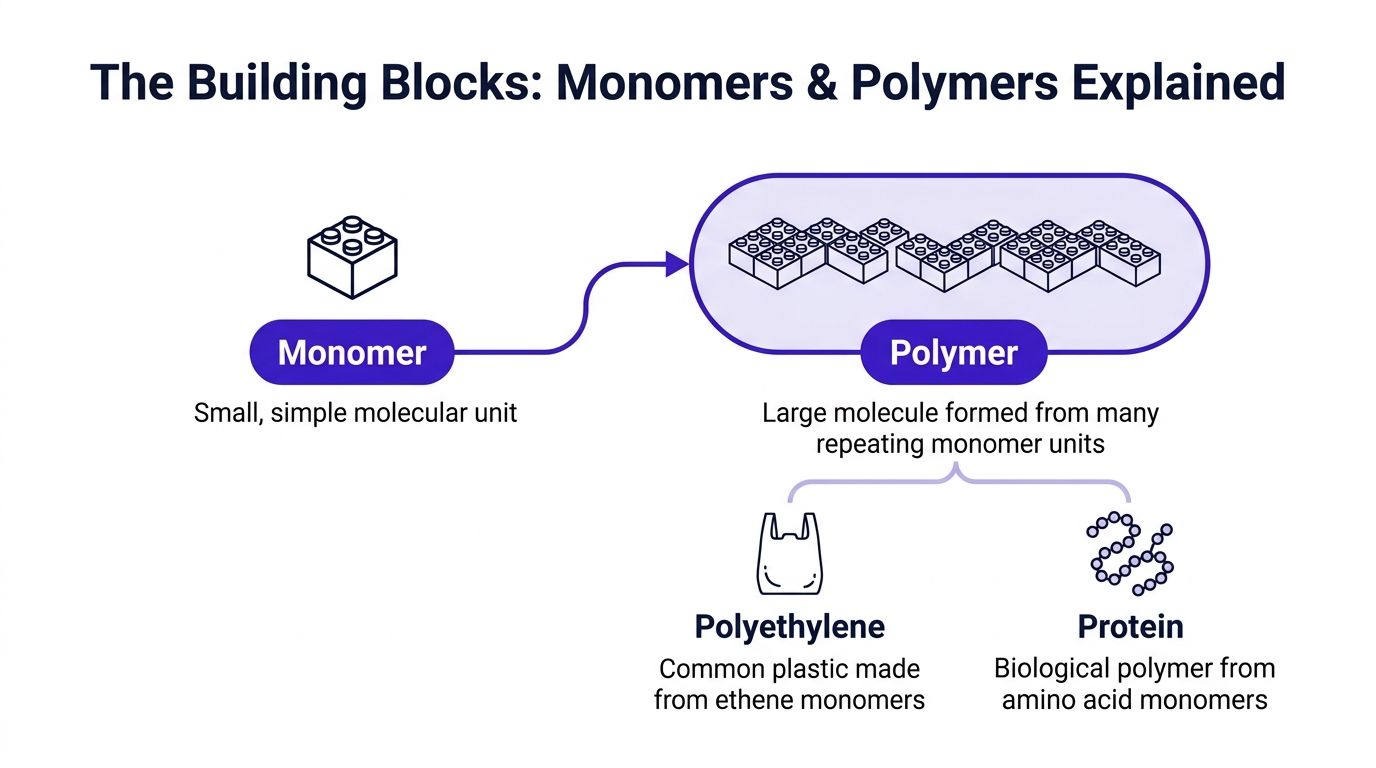
The cleanest way to understand monomers and polymers is to borrow a LEGO idea.
A monomer is one brick. A polymer is the long structure you build when lots of those bricks join together in a repeating pattern. Chemistry uses molecules rather than plastic bricks, but the logic is the same.
What the key words actually mean
Students often mix up three terms that need to stay separate.
- Monomer means a small molecule that can join to others.
- Polymer means the large molecule formed after many monomers join.
- Repeating unit means the section of the polymer structure that appears again and again along the chain.
That last one causes a lot of trouble. The repeating unit is not always drawn exactly the same way as the monomer. In many exam questions, spotting that difference is the whole challenge.
Ethene to poly(ethene)
Take ethene, which has the formula C2H4. It contains a carbon-carbon double bond. When many ethene molecules react together, they form poly(ethene).
A simple way to picture it is:
- Start with lots of ethene molecules.
- The double bond opens.
- Each molecule links to its neighbours.
- A long chain forms.
The monomer is ethene. The polymer is poly(ethene). The repeating unit is the two-carbon section repeated along the chain.
You’ll often see the repeating unit shown in brackets with bonds sticking out on both sides. Those outward bonds matter because they show that the chain continues.
If a student draws a complete monomer inside brackets and calls it a repeating unit, the chemistry idea is close, but the exam answer is usually not precise enough.
A quick way to recognise repeating units
When you’re given a polymer and asked for the monomer, reverse the process mentally.
Ask yourself:
- Where is the repeated pattern?
- What single unit would recreate that pattern?
- Was there probably a double bond in the original monomer?
For addition polymers, the answer is often “yes”. You reconstruct the alkene monomer from the repeating unit.
For biological polymers, the principle is the same even though the structures are more varied. Amino acids join to form proteins. Nucleotides join to form DNA. Glucose units join to form polysaccharides such as starch. The scale and detail change, but the underlying pattern does not.
The confusion to avoid
Here are the mistakes I see most often:
- Calling a polymer a mixture. It isn’t a random pile of monomers. It’s a chemically joined large molecule.
- Forgetting the word repeating. Examiners want you to show that the same structural unit appears many times.
- Mixing biological and synthetic examples without naming the monomer. If you say “protein is a polymer”, finish the thought. Protein is a polymer made from amino acid monomers.
A strong short definition for most exams is this:
A monomer is a small molecule that can bond to others like it. A polymer is a large molecule made when many monomers join together in a repeating chain or network.
That answer is simple, accurate, and mark-friendly.
How Polymers Are Made Addition vs Condensation
Once the basic idea clicks, the next hurdle is polymerisation. Examiners love this because it lets them test both recall and comparison. If you only memorise one sentence for each type, you’ll miss the deeper questions. You need to know what changes, what stays, and what clues in the question tell you which process is happening.
Addition polymerisation
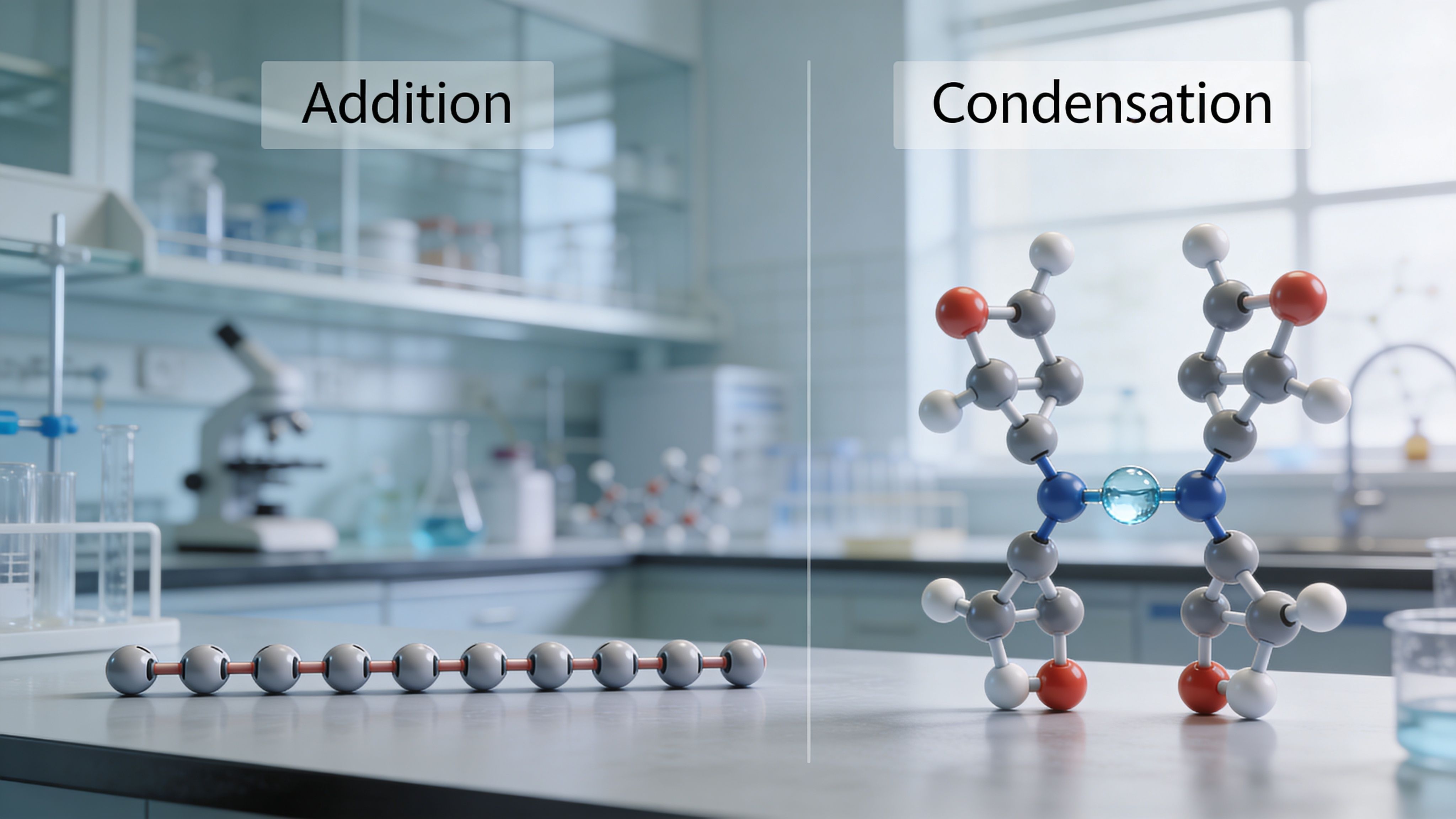
Addition polymerisation usually starts with an alkene monomer. The key feature is the carbon-carbon double bond.
That double bond opens, and each monomer links to the next. No small molecule is lost in the process. The atoms from the monomer all end up in the polymer.
Ethene to poly(ethene) is the classic example. If you’re revising GCSE organic chemistry alongside this topic, this AQA organic chemistry guide is useful because it places alkenes and polymerisation in the same wider topic.
Condensation polymerisation
Condensation polymerisation works differently. Instead of relying on a double bond opening, it usually involves monomers with two functional groups. As they join, they form links between molecules and release a small molecule such as water.
At A-Level, nylon 6,6 is a standard example. It is formed from adipic acid and hexamethylene diamine, and water is released as the polymer forms. That “small molecule lost” clue is one of the easiest ways to identify condensation polymerisation in an exam question.
Side by side comparison
| Feature | Addition Polymerisation | Condensation Polymerisation |
|---|---|---|
| Starting monomers | Usually alkenes | Usually monomers with two functional groups |
| Key structural clue | Carbon-carbon double bond | Reactive groups at both ends |
| What happens during joining | Double bond opens and monomers add together | Bonds form between monomers and a small molecule is removed |
| Small molecule formed | None | Often water |
| Typical examples | Poly(ethene), PVC | Nylon, polyesters |
What examiners want you to say
A weak answer says, “Addition adds things and condensation removes water.”
That’s not wrong, but it’s thin.
A stronger answer says:
- In addition polymerisation, unsaturated monomers such as alkenes react because the double bond opens and forms long chains.
- In condensation polymerisation, monomers with two reactive groups join together and release a small molecule, often water.
That second version explains the chemistry rather than just naming the process.
Common traps
Students often lose marks in the same places:
- Writing “addition” just because the question uses one monomer. Some condensation polymers can form from one monomer with two functional groups.
- Forgetting the small molecule in condensation. If the question asks for why it’s called condensation, mention the elimination of a small molecule.
- Drawing the monomer unchanged inside the polymer. In addition polymerisation, the double bond has changed. Your diagram must reflect that.
A quick test you can use under pressure
If you’re unsure which type you’re looking at, ask:
Is there a C=C double bond in the monomer?
If yes, think addition.Are there functional groups on both ends of the monomer or two different monomers joining?
If yes, think condensation.Is a small molecule such as water produced?
If yes, it’s condensation.
Exam habit: Don’t just identify the polymerisation type. Add the chemical reason. That extra phrase often separates a basic answer from a high-mark one.
A Tour of Everyday and Biological Polymers
One reason monomers and polymers can feel messy is that there are so many examples. Students try to memorise a giant list, then all the names blur together. A better approach is to attach each polymer to a simple story: what monomer it comes from, what the structure is like, and why that makes it useful.
Poly(ethene)
Poly(ethene) is usually the first synthetic polymer students meet. Its monomer is ethene. Because it’s made by addition polymerisation, the monomer’s double bond opens and links into a long chain.
You’ll meet poly(ethene) in packaging and everyday plastics. The exact properties depend on how the chains are arranged, which matters later when you compare low-density and high-density forms.
PVC
PVC stands for poly(chloroethene), also known as polyvinyl chloride. The monomer is chloroethene.
What students often miss is that the chlorine atom is part of the repeating structure, and that changes the properties. You don’t need a dramatic speech about it in every answer. You do need to recognise that a small structural change in the monomer can lead to a polymer with different uses from poly(ethene).
Polyesters and nylon
Polyesters and nylons are important because they bring in condensation polymerisation.
At A-Level, a named example matters. Nylon 6,6 forms from adipic acid and hexamethylene diamine, releasing H2O. If you’re asked for a condensation polymer example and can name both monomers, you instantly sound more secure.
Polyesters are also common in clothing. That’s useful because students often think polymers only mean hard plastics. They don’t. Fibres can be polymers too.
Biological polymers
Chemistry and biology join up neatly here.
Three pairings matter a lot:
- Amino acids → proteins
- Nucleotides → DNA
- Glucose units → polysaccharides such as starch
The exam trick is to keep using the monomer-to-polymer pattern, even when the molecules are biological rather than industrial.
The examples students should be able to say out loud
A quick spoken drill helps more than rereading notes. Try saying these complete sentences:
- Ethene is a monomer that forms poly(ethene).
- Chloroethene is a monomer that forms PVC.
- Adipic acid and hexamethylene diamine form nylon 6,6 by condensation polymerisation.
- Amino acids are monomers that form proteins.
- Nucleotides are monomers that form DNA.
If you can say those without hesitation, your written answers usually improve too.
A good polymer example in an exam answer does three jobs at once. It names the monomer, names the polymer, and links the structure to the use or process.
Where students get tangled up
Two confusions appear again and again.
First, some students think every polymer is synthetic. That’s false. Proteins and DNA are polymers too.
Second, some students know examples but not categories. They can tell you nylon is used in clothing, but not that it’s a condensation polymer. They can tell you starch is important in biology, but not that it’s built from repeating smaller units.
If you fix those two habits, the topic becomes much easier to organise in your head.
Why Polymers Behave The Way They Do
A past-paper question asks why one plastic bag bends easily while a plastic chair stays stiff and keeps its shape. If you only know the names of the polymers, you are stuck. If you know how structure controls properties, the answer becomes much easier to build, and that is exactly what GCSE and A-Level mark schemes reward.
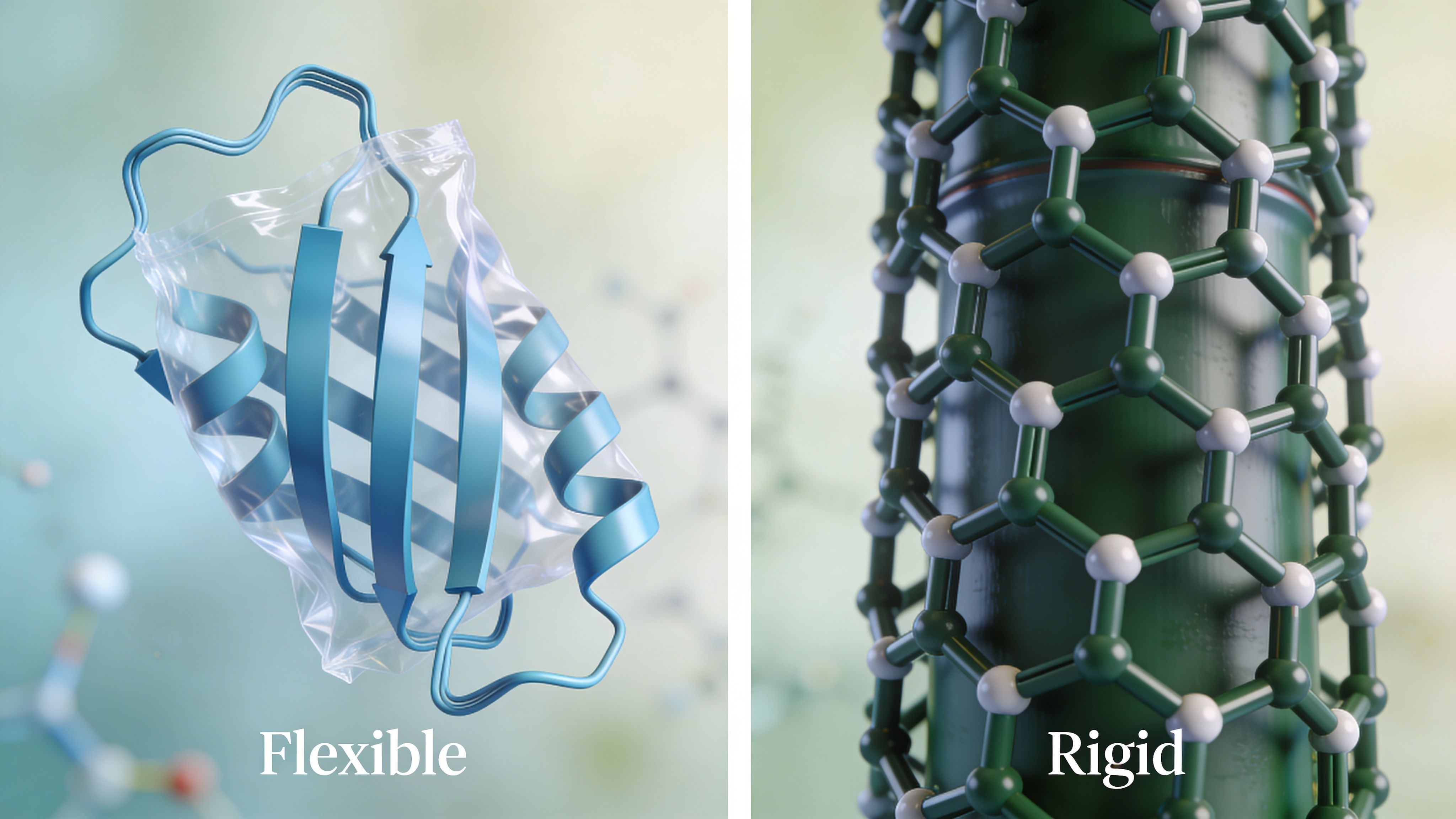
The big idea is simple. Polymer chains do not all arrange and interact in the same way. Some lie close together. Some are branched and spaced out. Some are tied to neighbouring chains by cross-links. Those structural differences decide whether a material is flexible, tough, rigid, or heat-resistant.
Chain length and intermolecular forces
Start with chain length. A longer polymer chain has more contact with nearby chains, a bit like longer strips of Velcro having more area to grip. More contact means stronger intermolecular forces, especially van der Waals forces in simple polymers such as poly(ethene). Stronger forces make it harder to pull the chains apart, so the polymer is usually stronger.
Students often lose marks here by jumping straight from “longer chain” to “stronger polymer” with no link in the middle. Examiners want the missing step:
longer chains → more contact between chains → stronger intermolecular forces → more energy needed to separate chains
That chain of logic is the sort of explanation that scores well with AQA, Edexcel, and OCR mark schemes.
Branching changes how well chains pack
Branching is another major factor. If a polymer chain has lots of side branches, the chains cannot pack neatly. They stay a little further apart, so the intermolecular forces are weaker.
That is the key difference between LDPE and HDPE.
- LDPE has more branching, so chains pack less closely.
- HDPE has more linear chains, so chains pack more closely.
- Closer packing leads to stronger intermolecular forces.
- Stronger intermolecular forces give greater rigidity and tensile strength.
Students often write, “HDPE is stronger because it has stronger bonds.” That is not accurate enough. The covalent bonds along each chain are strong in both materials. The exam answer usually depends on the forces between chains, not the bonds within one chain.
Cross-linking makes movement difficult
Cross-links are covalent bonds between different polymer chains. They act like ties holding a bundle of ropes together. Once those links are present, the chains cannot slide past each other so easily.
That is why cross-linked polymers tend to be harder, less flexible, and more resistant to heat. A polymer with many cross-links does not soften and flow as easily because the chains are restricted. This pattern helps explain why thermosetting polymers behave differently from thermosoftening polymers, even if students are not asked to use those exact terms.
One useful source on how monomer choice and polymer structure affect final properties is this guide to polymer design and structure-property relationships.
Glass transition temperature without confusion
Glass transition temperature, written as Tg, often sounds more intimidating than it really is. It is the temperature range where a polymer changes from a harder, more glassy state to a more flexible state.
A higher Tg means the polymer stays stiff at a higher temperature. A lower Tg means it becomes flexible more easily.
You do not always need a textbook definition. In many exam questions, a clear applied sentence is better: if cross-linking or stronger attractions between chains raise Tg, the polymer keeps its rigid behaviour at higher temperatures.
A revision table that links structure to property
| Structural feature | Effect on behaviour |
|---|---|
| Longer chains | More intermolecular contact, so greater strength |
| More branching | Poorer packing, usually more flexibility and lower density |
| More linear chains | Better packing, so greater rigidity and strength |
| More cross-links | Chains cannot move easily, so the polymer is harder and more heat-resistant |
Exam tip: “Flexible,” “rigid,” or “strong” are only half-answers. Top-mark responses explain the property by linking it to chain arrangement, packing, and forces between chains.
How to write the answer examiners want
If the question asks, “Why is HDPE stronger than LDPE?”, a high-scoring answer follows a clear sequence:
- HDPE has less branching and more linear chains.
- The chains pack closer together.
- Closer packing increases intermolecular forces between chains.
- More force is needed to separate the chains.
- Therefore HDPE has greater tensile strength.
That structure works well because each sentence earns the next one. It also matches the style of explanation that appears repeatedly in mark schemes.
If your paper connects polymer use to waste, recycling, or materials choice, it also helps to see the topic through an Environmental Science lens. Exam questions increasingly reward students who can connect material properties to real-world consequences.
Polymers and the Planet Recycling and Sustainability
A common exam scenario starts with something ordinary: a drinks bottle used for ten minutes, then thrown away. The chemistry behind that bottle explains both its usefulness and its environmental cost. Polymers are chosen because they last, resist water, and can be shaped easily. Those same features mean many polymer products stay in the environment for a long time if waste systems fail.
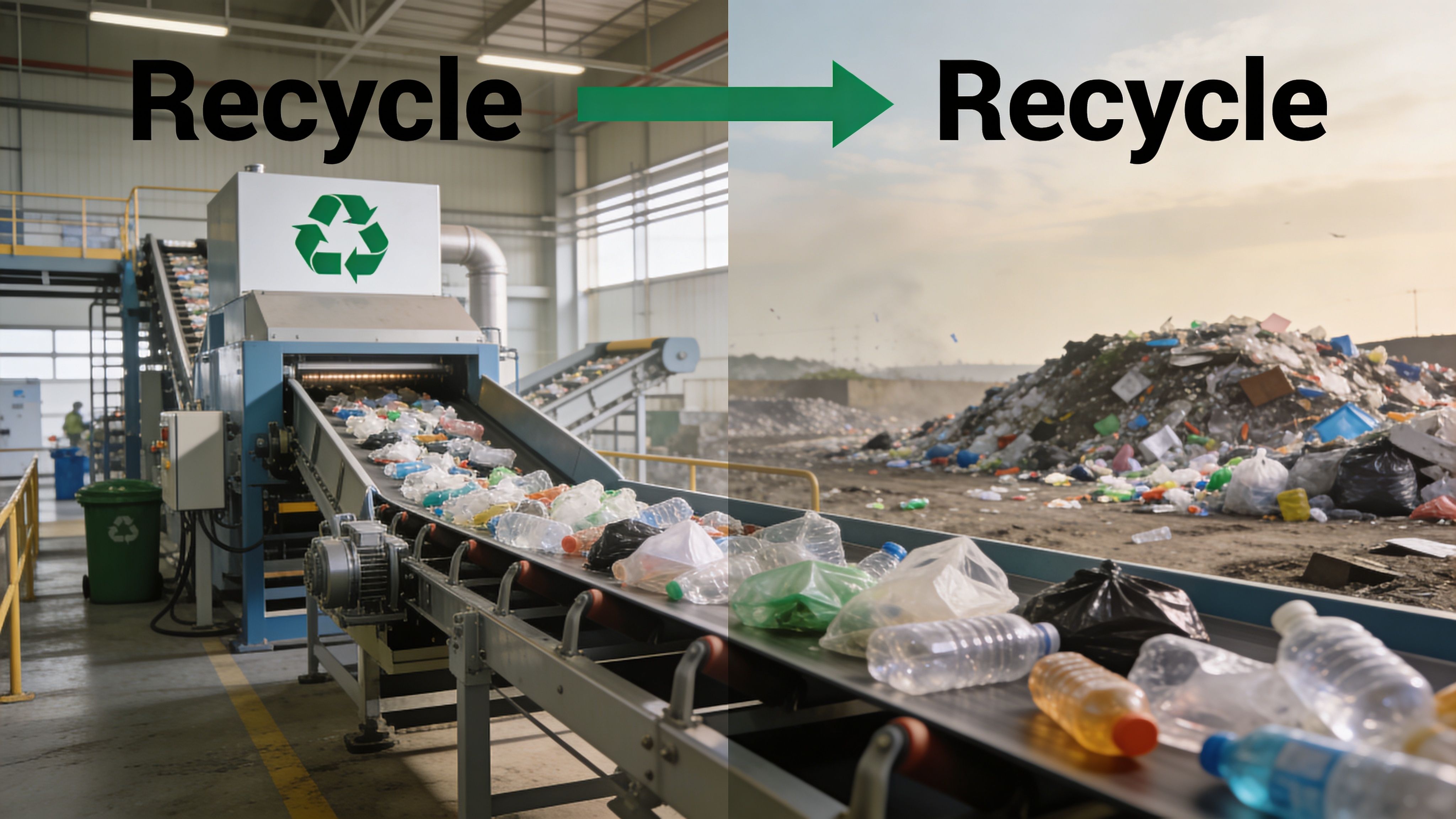
In the UK, polymer waste reached 2.4 million tonnes in 2024, which is why sustainability questions now appear naturally in chemistry revision and exam papers, not as an afterthought (UK polymer waste and depolymerisation trend).
Students often lose marks here because they switch from chemistry into opinion. Examiners at AQA, Edexcel, and OCR reward answers that stay tied to material structure, processing, and consequences. If a question asks you to evaluate polymers, your job is not to praise or criticise plastics in general. Your job is to explain the trade-offs clearly.
Mechanical recycling and chemical recycling
Mechanical recycling works a bit like melting and reshaping candle wax, although plastics are usually sorted, cleaned, shredded, and processed much more carefully. The polymer chains are kept mostly intact. That makes the method practical for many common plastics, but it also means the quality can fall if the material is contaminated or mixed with a different polymer.
Chemical recycling takes a different route. Instead of keeping the long chains, it breaks them into smaller molecules and, in some cases, back into monomers. That matters in exam answers because it links straight back to the core idea of this topic. A polymer can sometimes become feedstock for making new polymer again.
That is the sustainability idea students should hold onto. Mechanical recycling reuses the chain. Chemical recycling tries to rebuild from smaller pieces.
One useful exam phrase is circular use of materials. If you use it, follow it with chemistry. For example: “Chemical recycling may support a more circular use of materials because polymers can be broken into smaller molecules or monomers and used again.”
What examiners want you to say
A strong 4 to 6 mark answer usually includes three layers:
- Why polymers are widely used: they are durable, lightweight, and easy to shape.
- Why they create environmental problems: many do not break down quickly, and waste can be hard to sort and process.
- How chemistry can reduce the problem: better design for recycling, improved collection, and methods that recover useful molecules.
That structure matches the way mark schemes reward balanced reasoning.
For revision, it helps to practise this style with real questions rather than just rereading notes. Working through GCSE Past Papers makes it much easier to spot the difference between a one-mark comment and a full evaluation.
To widen your understanding of the environmental side, students often find Environmental Science helpful because it connects material choices to waste, ecosystems, and sustainability rather than treating chemistry in isolation.
Here’s a short explainer that fits well with this topic:
The balanced judgement examiners reward
A high-scoring judgement sounds measured. It does not say “all plastics are bad,” and it does not say “recycling solves everything.” It compares benefits and limits.
You might write that polymers are useful because their durability gives products a long working life. You could then explain that this same durability can create disposal problems, especially where sorting systems are poor or materials are contaminated. Finally, you could judge that recycling helps, but different polymers need different solutions, so the best answer depends on the type of material and how it will be collected and processed.
A simple way to remember this is: use, problem, solution, judgement.
Sustainable polymer questions reward balance and clear chemistry. Link each claim to properties, processing, or waste handling, and your answer will read much more like the mark scheme.
Ace Your Exams Typical Questions and Model Answers
Knowing monomers and polymers is one thing. Turning that knowledge into marks is another. This is the part students often skip, then wonder why their test answers feel weaker than their notes.
GCSE and A-Level specifications across AQA, Edexcel, and OCR regularly test monomer-polymer relationships in 4 to 6 mark questions, and a 2024 Ofqual analysis reported 15% lower attainment in polymer-related evaluation questions among UK state school pupils, often because students misread command words (exam question trend and command word issue).
Command words matter more than students think
A lot of lost marks come from answering the wrong type of question well.
Here’s the difference:
- Define asks for a precise meaning.
- Describe asks for what happens.
- Explain asks for why it happens.
- Compare asks for similarities and differences.
- Evaluate asks for a judgement supported by reasons.
If a question says “explain why HDPE is stronger than LDPE”, a list of properties is not enough. You must link structure to strength.
Model answer one
Question: Define a monomer and a polymer.
Model answer:
A monomer is a small molecule that can bond to many others like it. A polymer is a large molecule made from many repeating monomer units chemically joined together.
Why this scores well:
- It gives both definitions.
- It uses the phrase repeating monomer units.
- It avoids vague wording like “small bit” or “big chain”.
Model answer two
Question: Describe the difference between addition and condensation polymerisation.
Model answer:
Addition polymerisation involves monomers, usually alkenes, joining as the carbon-carbon double bond opens, and no small molecule is formed. Condensation polymerisation involves monomers with reactive functional groups joining together, and a small molecule such as water is released.
Why this works:
- It gives one clear difference in starting monomers.
- It gives one clear difference in what happens during the reaction.
- It includes the key clue of a small molecule being formed.
Model answer three
Question: Explain why cross-linked polymers are more rigid.
Model answer:
Cross-linked polymers have covalent bonds between different chains. These bonds stop the chains moving past each other easily. Because the chains cannot slide freely, the material is more rigid and more resistant to heat.
That answer is short, but every sentence earns its place.
A checklist before you stop writing
Use this when you answer longer polymer questions:
- Have you named the monomer or polymer correctly?
- If the question says explain, have you used because-style reasoning?
- If it’s compare, did you include both sides?
- If it’s evaluate, did you make a judgement rather than just list points?
- Did you use the structure-property link where needed?
Most polymer answers improve when students add one missing sentence: the sentence that explains why.
Best revision move before a test
Don’t just reread notes. Practise actual questions.
Use GCSE Past Papers to spot the recurring patterns. You’ll notice that the same ideas keep returning with slightly different wording, and that’s good news. Once you can decode the wording, the topic becomes much more predictable.
From Monomer to Master
Monomers and polymers aren’t a random topic to survive. They’re one of the clearest examples in science of how tiny structural changes produce big differences in behaviour. If you understand the building-block idea, the two types of polymerisation, and the way structure controls properties, you’re already most of the way there.
Top grades don’t come from memorising disconnected facts. They come from linking the fact, the reason, and the exam wording. That’s learnable.
Keep practising with questions, keep naming examples precisely, and keep explaining the chemistry step by step. If you want a focused place to do that, Online Revision for GCSE can help you turn this topic from shaky to secure.
If you want revision that feels closer to a real examiner than a generic quiz app, try MasteryMind. It’s built for UK learners, matches AQA, Edexcel, OCR, and WJEC specifications, and helps you practise the exact command words, question styles, and mark schemes that make the difference on exam day.
Ready to master this topic?
Practise with quizzes, blurt exercises and exam questions on MasteryMind.
7 days Premium · Then free forever · No card, no charge