My Last Duchess Context Your Guide to a Grade 9
You're probably here for one of two reasons. Either the exam is creeping closer and My Last Duchess still feels like a weird poem about a rich man showing someone a painting, or you already get the basics and want the kind of context that effectively lifts marks instead of padding out an essay.
That second bit matters. A lot of students revise context like it's a pile of random history flashcards. Dates. Italy. Victorians. Patriarchy. Medici. Then they walk into the exam and dump all of it into one paragraph like they're emptying a rucksack onto the floor. Examiners don't reward that. They reward context that sharpens analysis.
That's what this guide is for. Not just what the my last duchess context is, but how to use it when you're analysing lines like “That's my last Duchess painted on the wall” or “I gave commands; / Then all smiles stopped together”. If you can connect historical detail to Browning's methods and message, your AO3 gets much stronger and your whole essay sounds more intelligent.
Why Context Is Your Secret Weapon for This Poem
You open the exam paper, spot a quotation like “That's my last Duchess painted on the wall”, and write that the Duke sounds possessive. Good start. Plenty of students will do that.
The answers that score higher go one step further. They explain what Browning wants that possessiveness to reveal about power, marriage, class and control. That is where AO3 earns its marks.
For this poem, context works like a torch in a dark room. The words are already there on the page, but context helps you see the shape of what Browning is exposing. Without it, you may describe the Duke as creepy or arrogant. With it, you can explain that Browning places this speaker among elite men who expected obedience, treated marriage as a status arrangement, and used culture and wealth to display authority. That turns a simple comment on character into a sharper argument about ideas.
What examiners actually want from context
Examiners are not looking for a detached paragraph about history. They want context that helps you explain a quotation more precisely and more convincingly.
In this poem, context can help you show:
- why the Duke's language sounds entitled
- why the Duchess is spoken about like an object he owns
- why a Renaissance court is the right setting for this kind of abuse of power
- why Victorian readers might also hear a criticism of attitudes closer to Browning's own time
That last point is where strong AO3 often appears. Browning is not giving you a history lesson on Italy for its own sake. He is using that setting to present a man with status, taste and social power, then letting that man condemn himself through his own speech. If you connect context to that method, your analysis becomes much stronger.
A useful exam rule is simple. After analysing a word or image, ask yourself, what larger social idea does this reveal?
For example, if you write that “my” in “my last Duchess” is possessive, that is solid AO2. To push it higher, add the context behind the possessiveness. In aristocratic and strongly patriarchal societies, wives could be treated less as equal partners and more as extensions of a man's name, wealth and reputation. Browning uses that attitude to make the Duke sound proud of ownership rather than love. That is AO3 tied directly to the line, which is exactly what examiners reward.
The same method works with “I gave commands; / Then all smiles stopped together.” You do not need a huge block of historical detail. You need one clear contextual link. A powerful nobleman in a rigid hierarchy could expect his will to be carried out without challenge. That context helps you argue that the Duke speaks like someone used to absolute control, which makes the euphemistic violence of “commands” even more chilling.
This is the difference between knowing context and using it. Knowing context is remembering that the poem is set in Renaissance Italy. Using context is showing how that setting explains the Duke's obsession with rank, obedience and ownership, then linking it back to Browning's criticism of power.
If you want more exam-style practice on building those links under pressure, curriculum-aligned English Lit practice can help keep your revision focused on the assessment objectives rather than loose note-taking.
The Man Behind the Monologue Robert Browning
Robert Browning wasn't writing a random historical horror story. He was a Victorian poet with a fascination for the darker corners of human behaviour, and Renaissance Italy gave him the perfect setting for that.
He published My Last Duchess in 1842. That matters because Browning was writing in a society obsessed with appearance, respectability and hierarchy. Those concerns sit all over the poem. The Duke sounds polished, civilised and cultured, but the more he talks, the worse he reveals himself to be. Browning clearly enjoys that contradiction.

Why Browning liked Italy so much
Browning was drawn to Italy before 1842, and that attraction fits the poem well. Renaissance Italy gives him grandeur, violence, art, aristocracy and power politics all in one place. It's glamorous on the surface and brutal underneath, which is exactly the atmosphere My Last Duchess needs.
That setting also lets Browning create some distance. A reader can look at a Duke in Ferrara and think, “What an appalling man,” before realising the poem is also poking at attitudes much closer to Victorian home life.
Browning's likely perspective on marriage
A useful way to think about Browning is this. He doesn't just present a cruel husband. He presents a husband who thinks he has the right to control his wife's emotions, expressions and social behaviour.
That suggests judgement, not admiration.
You can push that idea in an essay by arguing that Browning is interested in the difference between real relationship and ownership disguised as marriage. The Duke doesn't want companionship. He wants obedience. He doesn't want a wife with feelings. He wants a wife with correct reactions.
Browning's brilliance is that he never says “the Duke is monstrous.” He lets the Duke prove it himself.
How this helps your analysis
When you analyse Browning as a writer, keep your comments focused on intention:
- He chooses a historical setting to explore power safely and sharply.
- He creates a speaker who condemns himself through his own voice.
- He links beauty with control so the poem becomes more than a murder story.
If you're revising Browning across poems, MasteryMind's GCSE English revision tools can also help when comparing the controlling male speaker here with the speaker in Porphyria's Lover, because that comparison often reveals Browning's wider interest in obsession and possession.
Decoding the Dramatic Monologue Form
The Duchess never speaks. That isn't an accident. It's the point.
My Last Duchess is a dramatic monologue, which means one character speaks for the whole poem and, while doing that, reveals more about himself than he intends. A simple way to think about it is hearing one side of a phone call. You never hear the other person, but you can still work out what kind of relationship is happening.
Here, Browning gives the Duke all the space. That makes the poem feel controlled, but also suspicious. If one man is controlling the whole conversation, you start noticing what he's hiding.

Why the form matters so much
The Duke thinks he's showing off his taste. Browning lets us hear something else. We hear vanity, jealousy, class pride and a chilling lack of remorse.
The poem's method is clever because the Duke doesn't announce himself as a villain. He speaks like a polished host. That contrast is what makes the poem unsettling. In UK GCSE English Literature specifications, the poem's dramatic monologue form is closely analysed alongside enjambment and iambic pentameter, and AO2 is worth 30% of marks. An AQA chief examiner report, cited in this guide to My Last Duchess form and analysis, notes that top-band responses link the rhyming couplets' “upbeat” rhythm to the Duke's ironic detachment, which masks the implied murder.
That's a strong clue for your own writing. Don't just say “it's a dramatic monologue”. Say what that form allows Browning to do.
The strange effect of smooth rhythm
The Duke says awful things in an almost elegant flow. That's where students often get confused. They expect a murderer to sound wild or explosive. Browning does the opposite.
The regular movement of the verse can suggest control. The Duke sounds measured. He sounds composed. He sounds like someone used to being obeyed.
At the same time, enjambment keeps the speech moving forward, like his mind slipping past moral boundaries. It can feel conversational, but it can also feel like he can't quite stop revealing himself.
Try analysing it like this:
- Rhyming couplets suggest order and neatness, which mirrors the Duke's obsession with control.
- Iambic pentameter gives the poem a polished, aristocratic sound.
- Enjambment makes the monologue feel natural, but it also lets disturbing thoughts slide out too casually.
A line that shows form and character working together
Take “I gave commands; / Then all smiles stopped together.”
The horror of the statement sits inside a calm, tightly controlled voice. That's the point. Browning makes the Duke sound composed even when he implies murder. The gap between tone and meaning creates unease.
You could write about it in this order:
- Quote the line
- Notice the euphemistic, controlled phrasing
- Comment on the calm rhythm
- Link that control to the Duke's personality
- Then add context about male authority and power
That's how AO2 and AO3 start working together instead of sitting in separate boxes.
Meet the Real Duke of Ferrara A History
A man shows a visitor around his palace. He pauses at a painting of his dead wife, controls the conversation, and then casually hints that he may have arranged her death. That scene feels dramatic, but Browning did not build it from nothing. He drew on a real Italian ruler, which gives the poem a harder, sharper edge in an exam answer.
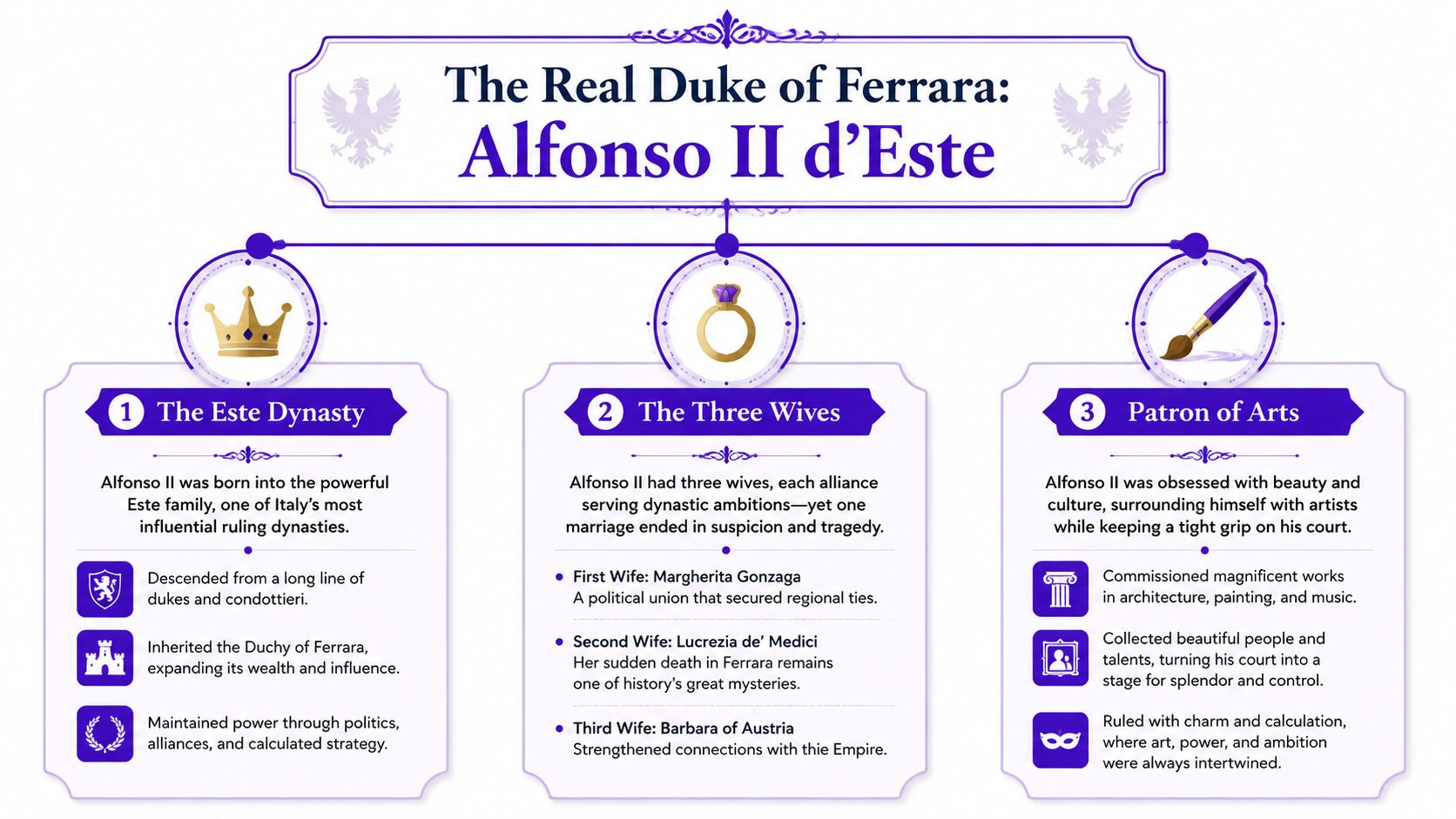
The historical figure behind the speaker is usually linked to Alfonso II d'Este, Duke of Ferrara. His first wife, Lucrezia de' Medici, was very young when they married and died only a few years later. You do not need to turn the poem into a history lesson. You do need to use that background to explain why the Duke's attitude to marriage sounds so cold, entitled, and dangerous.
That is where many students lose marks in AO3. They mention the historical Duke, then stop. A stronger answer connects the history to a line and shows what Browning gains by using it.
Why Lucrezia's age matters
Lucrezia's youth matters because it helps you read the marriage as a political arrangement, not a relationship between equals. In powerful Renaissance families, marriage often worked like a contract between dynasties. Status came first. Obedience came with it.
That context sharpens the line “my gift of a nine-hundred-years-old name”. The Duke presents his title as if it should be enough to secure gratitude and submission. He sounds less like a grieving husband and more like a collector who believes the value of the item lies in the name attached to it.
That is a strong AO3 move because the context explains the language. You are not dropping in a fact about Renaissance marriage. You are using it to show why the Duke treats his Duchess as part of a status bargain.
Why the rumours around her death matter
Lucrezia's early death later attracted suspicion, and Browning uses that historical shadow carefully. He never gives the reader a legal confession. He gives us the chillingly neat line, “I gave commands; / Then all smiles stopped together.”
The vagueness matters. It works like a locked door. We cannot see inside, but the fact that the Duke stays calm makes the line more disturbing, not less. Context helps here because a Renaissance court was a place where rank could protect powerful men and silence weaker voices. Browning uses that setting to make the Duke's hint of violence feel plausible.
If you want to push this to Grade 9, write the point in two stages:
- The line is euphemistic and controlled.
- The historical setting makes that control believable because aristocratic power could reach into marriage, reputation, and even life or death.
Ferrara as a court of display
Ferrara was also a court culture shaped by image, patronage, and public status. That matters for the poem's objects. The Duke does not merely remember the Duchess. He curates her. He shows the portrait, names Fra Pandolf, and later points out “Neptune... taming a sea-horse” as if he is guiding the envoy through a private gallery.
That pattern tells you something important. In his world, art is not only beautiful. Art is a way to display control. The painted Duchess is safer for him than the living Duchess because the portrait stays where he puts it and smiles when he chooses to reveal it.
A useful comparison is a collector who prefers a framed photograph to a real conversation, because the photograph cannot answer back.
The historical details that earn marks
| Historical detail | How it helps your reading | Best poem link |
|---|---|---|
| Marriage to a very young bride | Suggests an unequal, dynastic marriage shaped by male authority | “my gift of a nine-hundred-years-old name” |
| Early death and later suspicion | Makes the Duke's controlled hint of violence more sinister | “I gave commands” |
| Court culture built on display and patronage | Explains why the Duke treats people and artworks as possessions | the portrait, Fra Pandolf, Neptune statue |
Here's a useful explainer if you want a short visual recap before revising from your notes:
How to phrase this in an essay
A basic comment sounds like this: Browning based the Duke on a real man from Ferrara.
A stronger comment sounds like this: By drawing on the history of Alfonso II d'Este and his young bride, Browning places the speaker in a courtly culture where marriage could function as a status arrangement, which helps explain why the Duke presents his “nine-hundred-years-old name” as a gift and speaks about the Duchess as if she were his possession.
That kind of sentence scores better because it does the full job. It gives context, links it to a quotation, and explains how Browning uses it. That is AO3 doing useful work.
Renaissance Italy Through a Victorian Lens
A common mistake is treating My Last Duchess as if it's only about sixteenth-century Italy. It isn't. Browning wrote the poem in Victorian England, and setting it in Renaissance Ferrara gave him useful cover.
He could expose possessive, patriarchal attitudes at a distance. Readers could stare at an Italian Duke and feel safely superior, while Browning indirectly nudged them toward recognising similar ideas in their own culture.

Why the historical distance helps Browning
Consider a modern TV drama set in a fantasy kingdom, allowing the writer to discuss present-day politics without naming current politicians. The costumes are old. The argument is current.
That's how Browning uses Italy. The Renaissance setting brings out extreme versions of aristocratic pride, arranged marriage and male control, but the poem still speaks to Victorian concerns about marriage, status and women's place in society.
For Edexcel and WJEC cohorts, contextual study often links Duke Ferrara's jealousy to Victorian-era reflections, and PMT revision data cited in this analysis of My Last Duchess context states that 78% of Grade 8+ achievers benchmarked the poem against debates around the 1850s Married Women's Property Acts, improving AO3 evaluation.
What that means in plain English
Victorian marriage was still shaped by male authority. So when Browning presents a husband who thinks his wife's smiles should be regulated, he isn't just inventing one monstrous exception. He's pressing on a wider belief that a husband should have power over his wife.
That doesn't mean the Duke is merely an average Victorian man. He's more extreme than that. But extreme characters often expose the logic of a system more clearly than ordinary ones do.
A sharp argument you can actually use
Try this line of thought in an essay:
- The Duke treats his wife as if her behaviour should reflect his status.
- That reflects patriarchal ideas in Renaissance aristocratic marriage.
- Browning's Victorian readers would also recognise debates about women's independence and marital power.
- So the Duke becomes both a historical figure and a warning.
Exam shortcut: If your context point helps explain Browning's criticism, it's probably useful. If it just sounds like biography or trivia, cut it.
Linking the poem to Victorian debates
You don't need to force legal history into every paragraph. Use it when it fits. For example, if you're writing about ownership, then Victorian debates about whether married women had rights over property and money become relevant because the poem keeps blurring the line between wife and possession.
That's especially powerful when paired with the Duke's language of status and display. He wants admiration, obedience and social credit. The Duchess's warmth frustrates him because it can't be fully owned.
A concise AO3 sentence might look like this:
- Browning's Renaissance setting creates distance, but the Duke's possessive view of marriage would also have challenged Victorian readers living in a society still debating how much legal and social autonomy wives should have.
That's contextual analysis. It's brief, relevant and tied directly to the poem's ideas.
Art Power and Owning a Person
The poem begins with a painting and ends with a sculpture. That isn't decorative detail. It's the Duke's mindset in material form.
He introduces the Duchess as an artwork before he presents her as a human being. “That's my last Duchess painted on the wall” is chilling because the portrait has solved his problem. In life, she smiled too freely. In art, she's fixed, framed and silent.
Why the portrait matters
The painting lets the Duke do what he couldn't do in marriage. Control access. Control interpretation. Control the gaze.
He even controls the curtain. Only he decides who gets to look. That turns art into a technology of possession. The Duchess is no longer a person with responses he can't manage. She's now part of his collection.
This is why art in the poem doesn't equal beauty in any innocent sense. For the Duke, art means:
- Display. It shows his wealth and taste.
- Control. It freezes beauty into obedience.
- Status. It proves he can own rare things, including people.
Why he names the artists
Students often ask why Browning includes names like Fra Pandolf and Claus of Innsbruck. The easiest answer is that the Duke likes sounding important. The better answer is that named artists increase the sense of prestige and possession.
The Duke doesn't just own a portrait. He owns a portrait painted by someone worth naming. He doesn't just own a statue. He owns a bronze rarity made for him.
That detail matters because his attitude to art mirrors his attitude to marriage. He values things partly because they reflect on him.
If you're trying to get better at spotting patterns like that across a whole text, this guide on how to use literary themes is helpful because it shows how repeated images and ideas build a theme rather than sitting as isolated details.
Neptune and the fantasy of taming
The statue of “Neptune, though, / Taming a sea-horse” is one of Browning's smartest endings. Neptune is a god-like figure. The sea-horse is something smaller, mastered and directed.
That image works as a miniature version of the Duke's whole worldview. He admires domination. He sees “taming” as admirable. He wants hierarchy, not mutuality.
You can write about that symbol in a very direct way:
The Duke's admiration of Neptune “taming” a sea-horse suggests that he sees power as the right to subdue another being, which reinforces his treatment of the Duchess as an object to control rather than a partner to respect.
That's strong because it links image, theme and context without wandering off into general art history.
How to Weave Context into a Grade 9 Essay
You are halfway through an exam, you know the quotes, and then the panic hits. You have context in your head, but every sentence starts sounding like a history note instead of literary analysis. That is usually where marks slip.
AO3 rewards context that sharpens your reading of the poem. Examiners are not looking for a detached paragraph about Italy, patriarchy, or Browning's life. They want to see context working on the quote in front of you, almost like a torch helping you see more clearly into a line.
A useful rule is this: context should answer the question, "So what does this quotation suggest in its world, and why might Browning want us to notice that?" If your context does that, it is earning marks.
A simple method that works
Use Point, Evidence, Explain, Context as a safety rail. It works like adding the final layer to an argument. The quote gives you the raw material. Context shows why that detail matters beyond the surface.
Point
Make a clear claim about Browning's presentation of the Duke.Evidence
Choose a short quotation that proves it.Explain
Analyse the language, form, or structure first.Context
Add the historical idea that deepens your interpretation of that exact detail.
The order matters. If context comes first, it can sound bolted on. If it comes after analysis, it feels earned.
| Context Point | Key Quote | How to Analyse for AO3 |
|---|---|---|
| Patriarchal marriage encouraged men to view wives as possessions | “That's my last Duchess” | Start with the possessive pronoun “my”, then connect it to aristocratic attitudes in which marriage could involve status and control rather than equality |
| Noble lineage shaped the Duke's pride | “my gift of a nine-hundred-years-old name” | Analyse how he treats his family name like something valuable he has bestowed, then link that to elite marriage as a social contract and status exchange |
| Power could hide violence behind polished language | “I gave commands” | Examine the euphemism. He avoids direct confession, which suits a powerful man used to authority and to controlling how events are presented |
| Art allows control after death | “painted on the wall” | Explain how the Duchess is fixed, silent, and displayed, then connect that to the wider idea that women in the poem are treated as objects to be arranged and owned |
Here is the difference students need to hear clearly. Weak AO3 names a fact. Strong AO3 uses a fact to push the interpretation further.
Weak version:
Browning wrote in Victorian times and the poem is set in Italy. Women had fewer rights.
That comment stays general. It could fit dozens of poems.
Stronger version:
In “That's my last Duchess”, the possessive pronoun suggests that the Duke treats marriage as ownership. Browning places this attitude in a Renaissance court, but Victorian readers would still recognise the patriarchal assumption that a husband could expect control over a wife.
That earns more because the context is attached to a word from the poem and helps explain Browning's purpose.
A model paragraph you can adapt
Browning presents the Duke as a man who values control more than human connection. In “That's my last Duchess painted on the wall”, the possessive pronoun “my” immediately suggests ownership, while “painted on the wall” turns the Duchess into something displayed rather than someone remembered. The dramatic monologue form strengthens this idea because she never speaks, so the reader only receives the version of her that the Duke chooses to present. This links to the patriarchal values associated with aristocratic marriage, where wives could be treated as extensions of male status. Browning uses that setting to criticise a mindset his Victorian audience would still recognise, which helps the poem work as more than a historical portrait of one controlling husband.
That is the level to aim for. Quote first. Analysis next. Context attached tightly to the language.
One more exam trick helps. Build mini context links, not massive detours. A short phrase such as “reflecting aristocratic ideas of status” or “echoing patriarchal control over women” is often far stronger than a long sentence of background that drifts away from the poem.
If you want to practise this under timed conditions, use real GCSE Past Papers so you can train yourself to attach AO3 to quotations quickly. If you also want a quick refresher on how formal citation works in academic-style writing, the Contesimal guide on adding citations is a handy reference for keeping evidence organised.
Ready to master this topic?
Practise with quizzes, blurt exercises and exam questions on MasteryMind.
7 days Premium · Then free forever · No card, no charge