OCR a Level Biology Notes That Actually Work

You've got a folder full of OCR A Level Biology notes. The pages are tidy, the headings are colour-coded, and yet a practice question about an unfamiliar investigation leaves you staring at the page. You know the topic, but your answer doesn't quite explain the mechanism, use the data, or make the judgement the mark scheme is looking for.
That's the awkward truth about revising OCR Biology. Knowing the content is only part of the job. You also need to translate specification statements into precise exam answers, respond to command words, handle practical contexts, and recognise whether a question is testing AO1, AO2 or AO3. The approach below is useful whether you're recovering after a slow start or pushing for the highest grade, and it gives teachers a clearer way to judge whether notes are building exam skill.
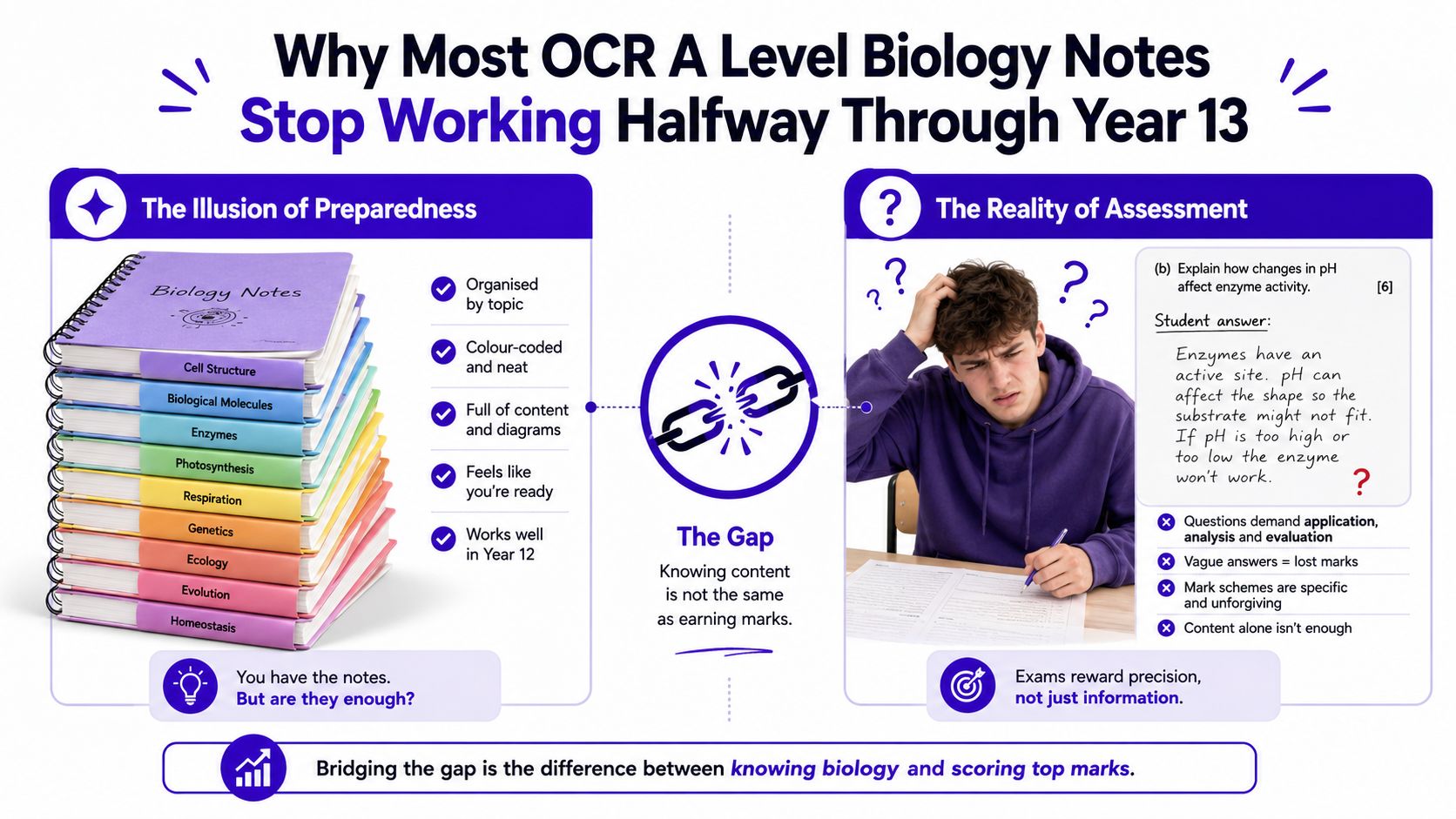
Why Most OCR A Level Biology Notes Stop Working Halfway Through Year 13
A Year 13 student can spend hours producing beautiful notes and still write vague, disorganised answers. The issue usually isn't a lack of effort. It's the gap between recording biology and producing marks.
A page titled “Respiration” might contain glycolysis, the link reaction, the Krebs cycle and oxidative phosphorylation. That's useful for recall, but it won't automatically prepare you for questions such as “explain why the rate changes”, “state the products” or “evaluate the investigation”. Each command word demands a different type of response.
Build notes around marks
Useful OCR A Level Biology notes should connect five things:
- Specification knowledge: the exact facts, definitions and processes you must recall.
- Mechanisms: links between cause and effect, which help you answer application questions.
- Visuals: labelled diagrams and pathways you can reproduce without copying.
- Quantitative work: equations, units, calculations and graph interpretation.
- Exam prompts: likely ways OCR can turn the same content into a question.
Add an AO column beside important points. A definition mainly supports AO1. A linked explanation may target AO2. A conclusion, limitation or improvement can move into AO3. This simple label stops you treating every page of notes as if it has equal exam value.
Practical rule: A practical should produce a method, variables, table headings, processed results, uncertainty notes and an evaluation. A list of apparatus isn't a write-up.
Turn revision into retrieval
Rereading makes a topic look familiar, but familiarity doesn't prove that you can recall it under pressure. Close the notes and attempt a diagram, definition, calculation or short question. Then mark it carefully and record the exact gap.
Your finished notes should become a compact question bank, not a decorative folder. They should expose repeated misconceptions, missing units, weak command-word responses and problems with timing before the mock or final paper.
The OCR A Level Biology A Specification at a Glance
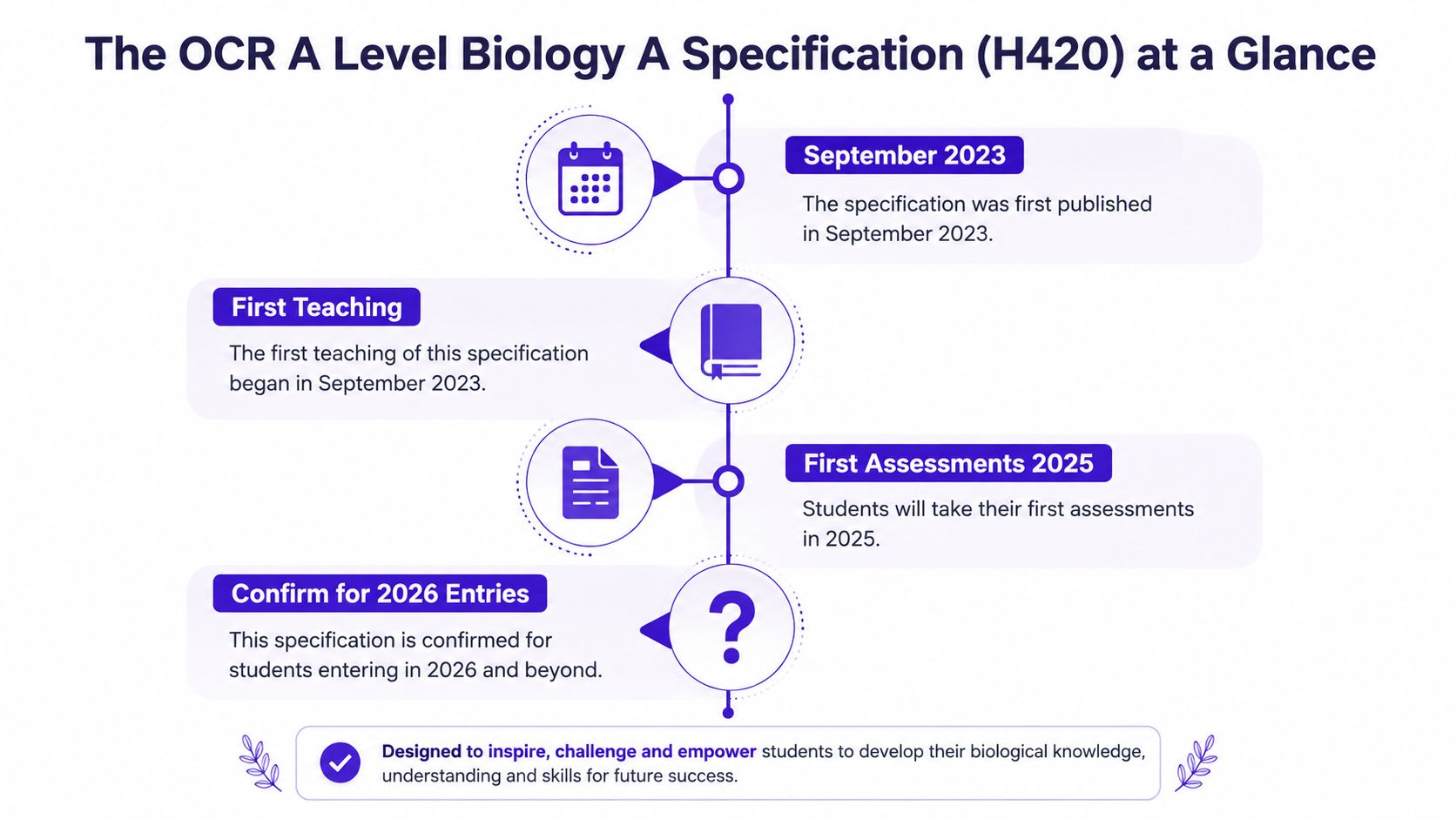
The current qualification is OCR A Level Biology A, H420. OCR states that the current specification was first taught from September 2023 and first assessed in Summer 2025, replacing older versions. If you're revising for a later sitting, check that your OCR A Level Biology notes match this specification rather than a legacy course.
The qualification uses six modules:
- Module 1, Development of practical skills in biology
- Module 2, Foundations in biology
- Module 3, Exchange and transport
- Module 4, Biodiversity, evolution and disease
- Module 5, Communication, homeostasis and energy
- Module 6, Genetics, evolution and ecosystems
OCR also states that learners must complete all four components, with the Practical Endorsement reported separately from the written qualification. The current OCR A Level Biology A specification gives the authoritative learning outcomes and qualification details, including qualification code H420 and qualification number 601/4260/1.
Use the modules as a map, not a revision order
The module headings are only the outline. For every specification statement, your notes should identify:
- the biological knowledge required
- any linked practical skill
- the mathematical or graphical demand
- the likely command word
- the evidence or limitation you may need to evaluate
Don't assume you must revise in numerical order. Membrane transport supports later work on kidney function. Enzyme kinetics helps with photosynthesis and respiration. Gene expression links genetics to biotechnology and whole-organism control.
The specification works best as a cross-referenced exam system. A teacher can use it to audit coverage, while a student can use it to find exactly which knowledge, application or evaluation skill is missing.
How the Three Papers and Practical Endorsement Are Weighted
Revision time should follow marks, not page count. OCR Biology A has three written papers totalling 270 marks. Paper 1 is worth 100 marks, Paper 2 is worth 100 marks, and Paper 3 is worth 70 marks, as shown in OCR's qualification information and assessment materials for OCR Biology A.
| Component | Covers / Role | Marks / Weight |
|---|---|---|
| Paper 1 | Modules 1, 2, 3 and 5 | 100 marks, roughly 37% |
| Paper 2 | Modules 1, 2, 4 and 6 | 100 marks, roughly 37% |
| Paper 3 | All six modules, practical skills, data analysis and synoptic assessment | 70 marks, roughly 26% |
| Practical Endorsement | Separate non-exam assessment of practical competence | Reported separately |
Modules 1 and 2 appear across the first two written papers, so revising them only for one paper leaves an obvious weakness. Paper 3 is broader and more synoptic, which means isolated topic summaries won't be enough. You need to practise connecting ideas, interpreting data and applying practical knowledge to unfamiliar situations.
The Practical Endorsement isn't part of the final exam grade. It's a mandatory separate non-exam assessment, reported as pass or unclassified, as OCR explains in its guidance on common practical pitfalls. Strong notes can prepare you for written practical questions, but they can't replace competent work in the laboratory.
Plan written practice around the mark allocation. Don't count questions and assume the workload is balanced. Use Exam Practice for A-Level to practise answers in an exam-shaped setting, then inspect where marks disappeared.
Mapping AO1 AO2 and AO3 to Every Answer You Write
Think of the assessment objectives as three different jobs.
- AO1: recall accurate biological knowledge.
- AO2: apply that knowledge to a context, process, practical or calculation.
- AO3: analyse information, evaluate evidence and make justified conclusions.
OCR's H420 assessment objectives carry fixed weighting ranges: AO1 is 31 to 34%, AO2 is 40 to 43%, and AO3 is 25 to 28%, according to OCR's assessment story for Biology A question papers. AO2 is the largest component, so a revision page made entirely of definitions is incomplete.
A six-mark example
Question: Explain how a competitive inhibitor affects the rate of an enzyme-controlled reaction.
A strong response might work like this:
- AO1: The inhibitor has a similar shape to the substrate and can bind to the enzyme's active site.
- AO2: This prevents some substrate molecules from binding, so fewer enzyme-substrate complexes form in a given time.
- AO2: Increasing substrate concentration can reduce the inhibitor's effect because substrate molecules are more likely to collide with and occupy active sites.
- AO1: The inhibitor is not permanently attached to the active site.
- AO3: The conclusion should be based on the pattern in the data, including whether the rate approaches the control rate at higher substrate concentration.
A weaker answer may define enzymes, describe active sites and mention denaturation. Those facts can be correct, but they don't answer the mechanism being tested.
| AO | Weighting | Skill | Typical stem |
|---|---|---|---|
| AO1 | 31 to 34% | Recall and accurate terminology | State, name, define |
| AO2 | 40 to 43% | Apply knowledge and link mechanisms | Explain, calculate, suggest |
| AO3 | 25 to 28% | Analyse and evaluate evidence | Evaluate, assess, conclude |
Before submitting an extended answer, ask yourself three questions: Have I linked cause to effect? Have I used the data or context? Have I judged the method or evidence where required? If the answer to all three is no, you've probably written an AO1 answer to an AO2 or AO3 question.
Command Words That Decide Whether You Score or Drop Marks
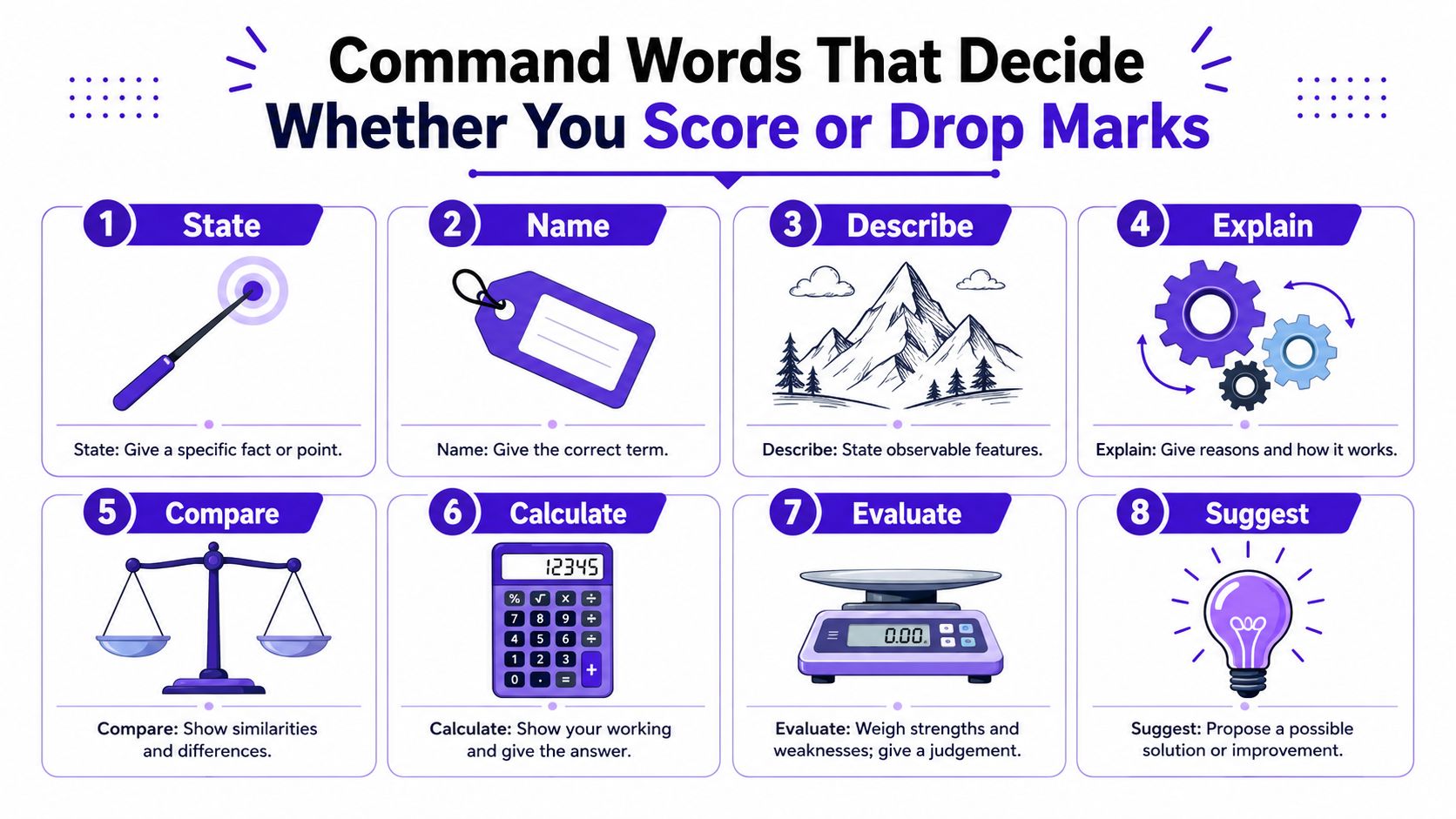
Command words aren't decoration. They tell you what kind of evidence the examiner wants.
State needs a short fact. Name needs the correct term. Describe reports observable features or a pattern. Explain gives a biological reason or mechanism. Compare identifies similarities and differences, rather than describing each item separately. Calculate requires a working method, answer and suitable units where relevant. Evaluate weighs strengths and limitations before reaching a judgement. Suggest asks you to use biological reasoning in a situation that may not appear word for word in your notes.
Before and after
Question: Evaluate the use of genetically modified crops.
Weak answer: “Genetically modified crops can have resistance to pests. They may produce higher yields and can contain useful characteristics. Some people don't agree with genetic modification.”
This mostly describes possible features and opinions. It doesn't weigh the evidence or reach a conclusion.
Improved answer: “Pest resistance could reduce crop losses and limit the need for chemical control, but the outcome depends on whether the crop trait remains effective in the local environment. Possible effects on biodiversity and gene flow also need investigation. Therefore, genetically modified crops may be useful where the benefit is supported by reliable field data and risks are monitored.”
The second answer makes a judgement, includes conditions and recognises limitations. It doesn't need to sound dramatic. It needs to be reasoned.
Don't fear suggest
For “suggest”, start with what you know and build a logical chain:
- If a plant has fewer stomata, suggest how gas exchange might change. A reasonable answer could link fewer openings to reduced diffusion of carbon dioxide, which may limit photosynthesis.
- If an inhibitor reduces enzyme activity, suggest how changing substrate concentration might affect the result. Link more substrate to increased competition for active sites, while recognising that another limiting factor may eventually control the rate.
Read the command word first, then write the answer it demands. The embedded explanation below reinforces the distinction between describing an observation and explaining a mechanism.
A Topic by Topic Revision Route Through the Six Modules
The textbook order is convenient for teaching, but it isn't automatically the best order for revision. Build your route around assessment coverage and prerequisite knowledge.
- Start with Module 2, Foundations in biology. Secure cells, biological molecules, enzymes, nucleic acids, membranes and cell division. These ideas appear throughout the course.
- Keep Module 1 beside it. Add microscopy, experimental design, variables, data handling and practical terminology as you revise each content area.
- Move to Module 4, Biodiversity, evolution and disease. Classification, pathogens, immunity, evolution and biodiversity give you rich opportunities for application and evaluation.
- Study Module 3, Exchange and transport, in depth. Connect transport surfaces, circulation, gas exchange and plant transport rather than memorising disconnected diagrams.
- Work through Module 5, Communication, homeostasis and energy. Nervous and hormonal control, respiration, photosynthesis and homeostasis demand linked explanations.
- Finish with Module 6, Genetics, evolution and ecosystems. Use it for synoptic practice, probability, gene technologies, ecosystems, conservation and extended data questions.
This order gives early attention to foundational and broadly connected material. Saving the most synoptic work until you've built the underlying concepts makes it easier to produce clean AO2 links and AO3 judgements.

If writing notes feels slow, record a spoken explanation and convert it into a concise page later. A practical guide to voice notes for students can help you capture explanations while travelling or between lessons, but you still need to check the biology against the specification.
Use A-Level Past papers to test whether your route is working. A topic isn't secure because you've read it. It's secure when you can answer a new question without being told which module it belongs to.
Required Practicals and How to Write Them Up for Full Marks
OCR's required practical work should appear in your notes as an exam skill, not just a memory of what happened in the laboratory. For each investigation, record the independent variable, dependent variable and control variables, then explain why the chosen method measures the question being asked.
A useful practical page has this order:
- Aim: what relationship or effect is being investigated?
- Variables: what changes, what gets measured and what stays controlled?
- Method: enough detail to show valid measurement and safe procedure.
- Raw data: headings, units and repeats.
- Processing: means, rates, graphs or transformations where appropriate.
- Conclusion: the pattern supported by the results.
- Evaluation: limitations, anomalies, uncertainty and improvements.
A weak sentence says, “The enzyme worked faster.” A stronger answer states that the rate increased, identifies the pattern in the results, and links it to more successful collisions between substrate molecules and active sites. It might then explain why buffer pH was controlled, because a pH change could alter ionic interactions and the active-site shape.
Common errors are remarkably consistent. Students omit units, plot raw timings when a rate such as 1/t is needed, or calculate a mean without considering an anomalous result. A result that doesn't fit the trend isn't automatically disposable. Explain how it affects confidence in the conclusion and propose a way to investigate it.
Keep the same write-up structure for every practical. That consistency makes it quicker to retrieve the method and gives you language for AO2 and AO3 questions even when an experiment produces messy results.
Building a Revision Schedule That Uses Spaced and Mixed Practice
Treat the six modules as a workload to distribute, not a reading list to finish once. Give each module a planned teaching and revision block, then bring earlier content back through short mixed reviews. The exact timetable will depend on lessons, work and other subjects, but the pattern should remain stable.
| Point in cycle | Task |
|---|---|
| Week 1 | Learn and retrieve new content |
| Day 5 | First review without notes |
| Day 9 | Mix the topic with an earlier module |
| Day 14 | Retrieve again, then attempt exam questions |
Write practical notes soon after the laboratory session, while the method and sources of error are still clear. Later, revisit the same practical through a data question rather than rereading the method.
A workable weekly pattern includes:
- New learning: specification points from the current module.
- Spaced retrieval: definitions, diagrams, equations and pathways.
- Mixed questions: one question from the current topic and others from older modules.
- Exam analysis: mark the response and classify each lost mark as knowledge, application, terminology or evaluation.
- Recovery time: leave space for sleep and rest, because exhausted revision produces careless errors.
The MasteryMind revision method can provide a structure for spaced review, but a paper planner, flashcards or a spreadsheet can work too. The important test is whether old material returns often enough to reveal what you've forgotten.
Quick Reference Diagrams Definitions and Equations to Memorise
Some biology marks depend on accurate recall of structures, pathways and equations. Don't just look at diagrams. Cover them, draw them, label them and explain the function of each feature.
| Item | Module | Recall prompt |
|---|---|---|
| Fluid mosaic membrane | Module 2 | Sketch and label the membrane, then explain selective permeability |
| Mitochondrion and chloroplast ultrastructure | Module 2 | Draw both and link structures to energy-transfer processes |
| Cardiac cycle pressure-volume loop | Module 3 | Label pressure changes, valves and volume changes |
| Dichotomous key | Module 4 | Construct a key using observable contrasting features |
| Action potential trace | Module 5 | Label rest, depolarisation, repolarisation and hyperpolarisation |
Keep definitions precise. Practise terms such as mass flow in phloem and endothelium in blood vessels in the wording expected by the specification, rather than relying on loose everyday descriptions.
The equations need the same treatment. Recall magnification = image size ÷ actual size, cardiac output = stroke volume × heart rate, Simpson's index of diversity, chi-squared, and the Hardy-Weinberg equation p² + 2pq + q² = 1, including its five assumptions.
Use prompts that force production:
- “Sketch and label a chloroplast.”
- “State the five Hardy-Weinberg conditions.”
- “Calculate cardiac output from the values given.”
- “Explain why the pressure-volume loop changes.”
- “Use the data to evaluate biodiversity.”
If you can't produce the diagram or equation without looking, it belongs on the next retrieval list.
Using MasteryMind to Turn Notes into Exam Ready Answers
Static notes become useful when they generate marked output. MasteryMind is one option for this workflow. Its OCR-aligned practice can organise questions around assessment objectives, command words and mark allocations rather than presenting biology as a set of isolated facts.
A practical loop looks like this:
- Import or select the content for one module.
- Complete a mixed drill containing recall, application and evaluation.
- Inspect the AO breakdown to see whether the weakness sits in AO1, AO2 or AO3.
- Redo the weakest AO2 responses using examiner-style feedback.
- Finish with a spoken Blurt Challenge on the same module.
The value of that sequence is diagnostic. If your answer contains accurate facts but doesn't link them to the graph, you need application practice. If you identify the pattern but don't comment on reliability, you need evaluation practice. If your definitions are vague, return to AO1 terminology.
The Online Revision for A-Level platform also includes spaced review and mixed-topic practice, which fit the way OCR questions move between knowledge, unfamiliar contexts and evidence. You should still compare any feedback with your teacher's advice and the official OCR materials, especially where a question has several acceptable biological routes.
Cross References and Where to Go Next in Your Notes
Your index should let you move from a weak answer to the exact resource that fixes it. Record each module alongside its content focus, practical context, command words and assessment objective.
| Module | Priority links | Useful question focus |
|---|---|---|
| Module 1 | Practical design and data handling | Calculate, suggest, evaluate |
| Module 2 | Cells, molecules, enzymes and membranes | State, explain, calculate |
| Module 3 | Exchange, transport and physiology | Describe, explain, compare |
| Module 4 | Biodiversity, evolution and disease | Suggest, evaluate, conclude |
| Module 5 | Communication, homeostasis and energy | Explain, calculate, evaluate |
| Module 6 | Genetics, ecosystems and conservation | Calculate, compare, evaluate |
Add cross-references where topics overlap. Enzymes connect digestion and energy transfer. Photosynthesis and respiration generate data-analysis opportunities across different biological contexts. Genetics probability links inheritance to later work on populations and ecosystems.
For each question you mark, write the destination of the correction: content note, diagram, equation, practical log, command-word example or AO practice. That stops you rereading an entire module when the issue is one missing link in an explanation.
Your next steps are straightforward. Consolidate your OCR A Level Biology notes into one searchable set, book a mock-paper review with a teacher or tutor, and set a weekly Blurt Challenge reminder so recall remains part of your routine.
MasteryMind gives you OCR-focused practice, AO breakdowns and examiner-style feedback that can turn a page of notes into a specific correction task. Visit MasteryMind and use it to test one module, identify your weakest assessment objective, and rebuild your next revision session around the marks you're dropping.
Ready to master this topic?
Practise with quizzes, blurt exercises and exam questions on MasteryMind.
7 days Premium · Then free forever · No card, no charge