OCR a Level Chemistry Past Papers: Ace Your Revisions
You've revised the chapters, watched the videos and perhaps even completed a few topic questions. Then you open an OCR Chemistry paper, see an unfamiliar data set and discover that knowing the chemistry doesn't automatically mean collecting the marks. That gap is where many students lose confidence, especially when the same paper can produce a comfortable pass one week and a much stronger grade after focused feedback.
OCR A Level Chemistry past papers are most useful when you treat them as diagnostic tools, not as piles of questions to finish. The score matters, but the reasons behind the score matter more. A missed mark might come from a chemistry misconception, an incomplete explanation, an omitted unit or a failure to respond to the command word. The right workflow exposes that difference and gives you something specific to fix.
Turning Past Papers Into Top Grades
A student can spend an evening reading about equilibrium and still freeze when a question asks them to explain the effect of changing conditions. They may recognise the topic, remember Le Chatelier's principle and understand the broad idea, yet write an answer too vague for the mark scheme. The problem isn't always a lack of knowledge. Often, it's the difference between understanding chemistry privately and communicating it in the form the examiner can reward.

A past paper creates pressure that notes can't reproduce. You have to choose a method, interpret information, manage time and decide how much detail belongs in the answer. That combination reveals weaknesses quickly. A calculation may be correct but lose credit because the units are missing. A practical question may contain the right observation but fail to connect it to particle-level reasoning. A longer explanation may include relevant chemistry without making the required cause-and-effect link.
Stop treating completion as progress
The first attempt should be active. Put your notes away, use the permitted data sheet where appropriate and answer every question you can. Don't pause after each difficult item to search for a worked solution. Mark the question, move on and return later. That process gives you useful evidence about recall, decision-making and timing.
Afterwards, record more than a percentage. For each lost mark, identify the category:
- Knowledge gap: You didn't know the chemistry required.
- Application gap: You knew the topic but couldn't use it in the unfamiliar context.
- Expression gap: Your idea was relevant but incomplete or imprecise.
- Process gap: You missed a unit, condition, working step or instruction.
A resource such as A-Level Past papers can support a more organised routine, particularly when you want to work through papers as individual questions rather than treating each sitting as an isolated event.
Practical rule: A paper is only half-finished when you put your pen down. The second half is finding out why each lost mark disappeared.
Top grades usually come from removing repeatable losses. If the same student completes the paper again after correcting vague equilibrium explanations, practising calculations with units and answering command words precisely, the improvement comes from better execution rather than rereading the textbook. That's why past papers can move a student from a shaky result to a strong one without changing the paper itself.
Where to Find OCR Chemistry Papers and Resources
Start with the official OCR qualification page, not a random collection of uploaded PDFs. The current UK qualification is OCR A Level Chemistry A, specification code H432, with qualification number 601/5255/2. OCR assesses it through three written papers plus a practical endorsement, and all components include synoptic assessment, so revision needs to account for connections across the course rather than isolated chapter recall. (OCR specification at a glance)
The written papers have different timings and weightings, which should shape how you practise. Paper 1, H432/01, is 100 marks over 2 hours 15 minutes and counts for 37%. Paper 2, H432/02, is also 100 marks over 2 hours 15 minutes and counts for 37%. Paper 3, H432/03, is 70 marks over 1 hour 30 minutes and counts for 26%. The exact structure matters because a short burst of topic questions doesn't test the same stamina or decision-making as a complete paper.
Use the complete assessment pack
OCR's official materials are organised through its qualification pages and Teach Cambridge. Depending on the exam series, you can find:
- Question papers: Use these for authentic wording, data presentation and command words.
- Mark schemes: Check which distinct ideas, working steps, conditions and units earn credit.
- Examiner reports: Look for technical aspects examined, strong performance and areas needing improvement.
- Candidate exemplars: Compare how responses communicate ideas, particularly in extended and practical answers.
- Data sheets and supporting documents: Keep the documents used with the relevant paper so your practice resembles the assessment.
OCR states that the previous year's materials are published at the beginning of May, including the full assessment pack for candidates such as private candidates. (OCR guidance on downloading past papers and resources) That release timing has a practical consequence. Don't build a revision plan that depends on a paper you expect to appear before it has been officially released. Use available series for learning and reserve newer material for a realistic mock when you can analyse it properly.
OCR's materials finder provides free resources from past series and practice materials for selected new qualifications. However, OCR's past paper policy says papers remain available on its website for five years. Older material may be requested for private research through OCR's past-exam material service, where a search-and-copy fee applies. (OCR past papers materials finder and policy)
For organised preparation, OCR revision with MasteryMind can sit alongside the official archive. Keep the OCR PDF, mark scheme and examiner report as your authority, then use digital practice to revisit the specific question types that caused trouble.
The Examiner-Approved Revision Workflow
The most reliable routine has three essential documents: the paper, the mark scheme and the examiner report. OCR's published guidance points candidates towards practising with past papers, examiners' reports and exam-builder resources, and its reports are written to identify technical aspects examined, strong performance and areas that could improve. (OCR Chemistry A examiner report)
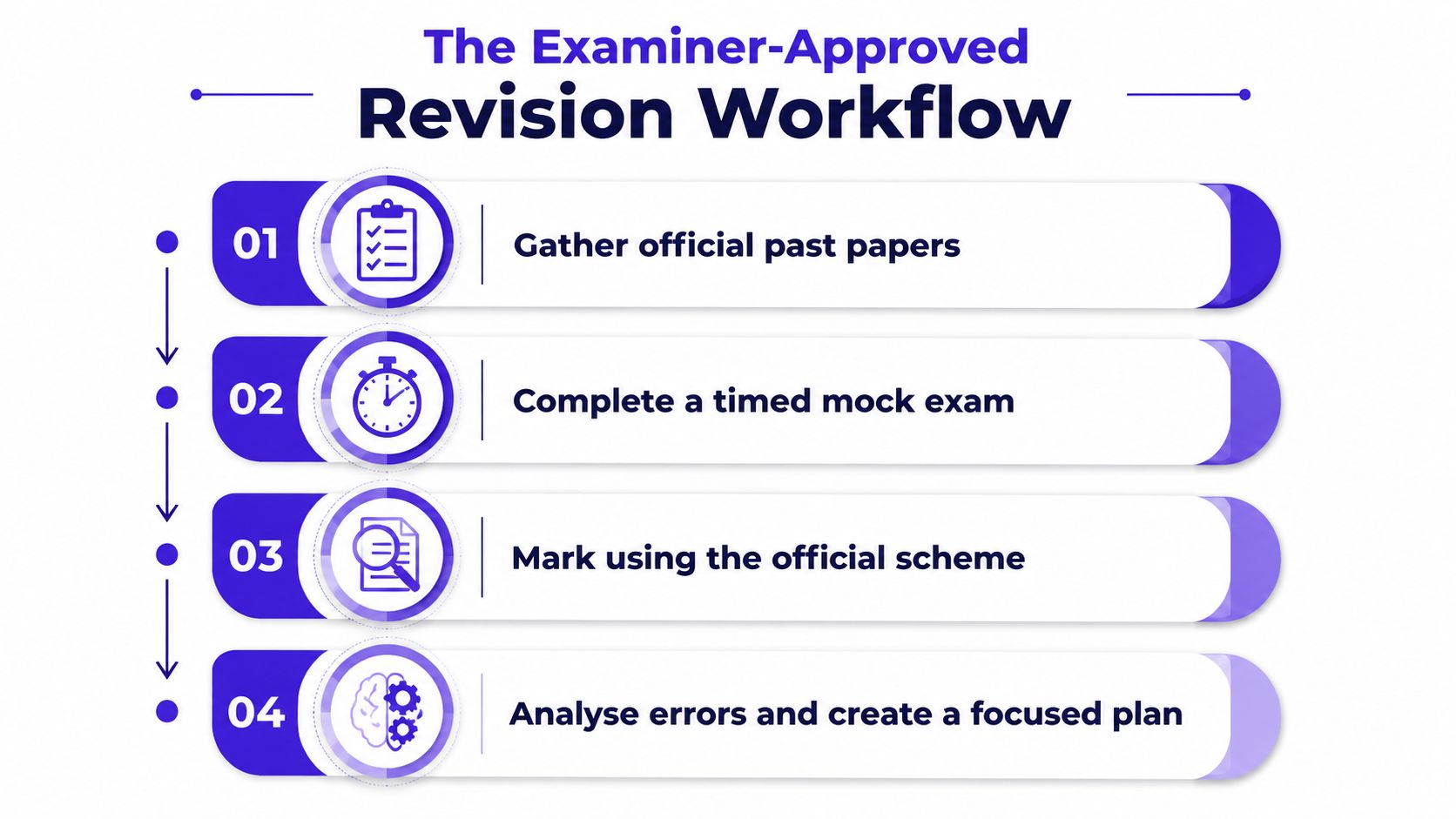
Step 1 Complete the paper honestly
Choose the correct paper and recreate the conditions as closely as you can. Clear your desk, prepare the permitted materials, set the paper's time limit and avoid checking notes between questions. If you need to guess, make the best attempt and mark the question with a small symbol so you can distinguish uncertainty from confidence later.
Don't stop the clock every time a calculation feels difficult. A timed attempt tells you whether the issue is chemistry, method selection or pace. It also shows whether you're spending too long chasing a single mark while leaving easier questions incomplete.
Step 2 Mark for credit, not comfort
The mark scheme isn't just an answer key. Treat it as a scoring checklist. For every question, identify the distinct chemistry ideas the examiner can reward and compare them with your response.
A useful marking routine looks like this:
- Award only supported marks: Don't give yourself credit because the answer feels close. Match your wording to the scheme and accept alternatives only where the scheme allows them.
- Underline the evidence: Highlight the exact phrase, equation, unit or condition that earned each mark.
- Separate errors: Label a lost mark as knowledge, application, expression or process.
- Rewrite selectively: Rewrite answers that could become correct with clearer terminology. Don't copy every model answer into your notes.
For calculations, check the sequence rather than only the final number. Did you select the correct equation? Did you substitute values accurately? Did you show sufficient working? Did you include the required unit and sensible precision? A final answer that happens to look plausible isn't proof that the method is secure.
Step 3 Read the examiner report with a pen
The report explains how candidates approached the paper and where responses fell short. Read the comments beside the questions that caused you problems, then turn the language into an instruction for your next attempt.
If the report highlights incomplete explanations, write a better response that states the chemical change and its particle-level reason. If it identifies weak data handling, practise interpreting axes, gradients, significant figures or anomalous results. If it describes missing conditions, add a final check to every relevant calculation and practical answer.
Don't read an examiner report like a summary. Read it like feedback on your own script.
Step 4 Build a short retest
A mistake log becomes useful only when it leads to another attempt. Record the question reference, topic, error type, corrected wording and the date of your retest. Then create a small set of related questions and complete them under time pressure.
You're looking for transfer. If you corrected one acid-base calculation, can you apply the same checking process to a different data set? If you improved one explanation about equilibrium, can you produce precise cause-and-effect reasoning when the question uses a new reaction? Exam Practice for A-Level can provide a structured environment for timed work, but the official paper, scheme and report should remain central to your judgement.
Common Mistakes and How to Avoid Them
OCR examiner reports repeatedly direct attention towards technical execution, not content recall alone. That distinction explains why two students with similar notes can receive very different marks. One gives the required number of precise points and includes the necessary conditions. The other writes around the topic, hoping the examiner will infer the intended idea.
The wording problem
Vague chemistry often sounds sensible but doesn't answer the question tightly enough. “The equilibrium shifts to oppose the change” may be a starting point, but it may not explain which species increases, which particles collide differently or why the observed result follows. Match your answer to the command word:
- State: Give the requested fact without adding irrelevant explanation.
- Describe: Report a pattern, observation or change accurately.
- Explain: Link the reason to the result using chemical reasoning.
- Suggest: Apply known chemistry to an unfamiliar context and justify it.
Use the mark allocation as a guide to the number of distinct ideas required. If the question offers several marks, check whether your answer contains several separate rewardable points rather than one repeated statement.
The calculation problem
Students often lose marks after selecting the right method. Missing units, omitted working, incorrect conditions and premature rounding can undermine an otherwise sound answer. Write the equation, substitute clearly, carry units through the calculation and check whether the result fits the context.
Practical questions create a similar trap. An observation such as a colour change is not always enough. Link what you see to the relevant particles, ions, bonding or reaction process. If a question asks for an improvement, name the specific change and explain how it improves reliability, validity or control of variables.
Turn errors into a retest system
Your mistake log should stay concise enough to use. A table works well:
| Question type | What went wrong | Replacement action |
|---|---|---|
| Explanation | Cause and effect was incomplete | Write the particle-level link |
| Calculation | Unit or condition omitted | Use a final units-and-conditions check |
| Data handling | Trend described without evidence | Quote the relevant relationship from the data |
| Practical method | Improvement was too general | Name the variable and explain its control |
AI feedback can help you generate targeted follow-up questions from these categories, while official marking remains the final authority. Use technology to increase the number of focused attempts, not to replace careful comparison with OCR's wording.
Integrating AI Tools for Smarter Revision
Manual marking and AI-assisted feedback solve different problems. The official mark scheme tells you what OCR can reward. An AI tool can help you organise repeated practice, explain why your response is incomplete and produce another question aimed at the same weakness. Neither approach works well when used lazily.
For example, after marking an OCR paper, you might tag several errors as weak explanation rather than missing knowledge. A platform can then help you practise that skill through new prompts, mixed-topic questions and follow-up work. That's more useful than assigning another entire paper when the issue is a recurring sentence structure or failure to connect evidence to a conclusion.
What manual marking does better
Official materials have the strongest authority for exam-specific credit. They show accepted wording, alternative answers, working requirements and the boundaries of the question. Teachers can also recognise patterns that a generic feedback tool might miss, such as a student using a term incorrectly across several topics.
Manual marking takes time, though. It can also become inconsistent when you're tired or when you're marking your own work and want to award credit for an intention that isn't written down.
What AI support can add
An AI-powered revision platform can process your mistake categories and keep practice focused. MasteryMind is one option that provides OCR-aligned chemistry practice, question-level work from uploaded past paper PDFs, adaptive difficulty, spaced review and examiner-style feedback. Its feedback can support areas such as assessment-objective breakdowns and step-by-step maths verification, while you should still verify high-stakes decisions against OCR's own scheme and report.
That division of labour keeps the process sensible. OCR defines the assessment standard. A teacher provides professional judgement. AI handles repetition, organisation and targeted practice. If you dictate reflections after marking, a tool such as macOS dictation for notes and essays can help you capture the reasoning while it's fresh, then turn those notes into a clear mistake log.
Students should also challenge feedback rather than accepting every suggestion automatically. Ask whether the comment relates to the command word, the mark allocation and the actual chemistry in the question. Teachers can use AI-generated follow-up practice as a starting point, then review whether the questions match OCR H432 expectations.
The useful comparison isn't human versus machine. It's authority plus responsiveness. The scheme supplies the standard, while AI Powered Revision can help you return to a weak skill before it fades from attention.
Planning Your Final Revision Schedule
A strong schedule doesn't treat every revision hour as interchangeable. Content review is useful when you have a genuine knowledge gap. Past papers are more valuable when you already know the material but need to improve application, timing, explanation or calculation accuracy. Your plan should make room for both, but it shouldn't hide from the task that exposes your weaknesses.
Start by sorting topics into three groups:
- Secure: You can answer questions accurately and explain the method without prompts.
- Unstable: You recognise the topic but lose marks through wording, application or working.
- Weak: You lack the underlying knowledge or can't begin unfamiliar questions.
Spend your first sessions on unstable topics because they often offer the quickest practical gains. Review the relevant chemistry, complete targeted questions, then return to a mixed set so you can test whether the improvement transfers outside the chapter context.
Give every paper a job
Don't use every available paper as a full mock. Some are better for topic diagnosis, some for command-word practice and some for realistic exam rehearsal. Keep a record of the paper, your score, the main error categories and the retest result. A rising score is encouraging, but a falling number of repeated errors is often more meaningful.
Space your full-paper attempts so you have time to analyse them properly. The sequence should be deliberate:
- Complete the paper under timed conditions.
- Mark it against the official scheme.
- Read the relevant examiner-report comments.
- Review or relearn the weak chemistry.
- Retest the error type with new questions.
- Return to a mixed paper later.
This prevents the common cycle of doing paper after paper, seeing similar mistakes and calling the activity revision. It also lets you use dashboards or a spreadsheet to track topic mastery without confusing activity with progress.
Protect the final stretch
In the final phase, avoid replacing sleep and recovery with unplanned cramming. Use shorter, focused sessions for equations, definitions, practical reasoning and recurring mistakes, then complete selected exam questions with clear time limits. Read the question carefully, respond to the command word and leave enough time to check units, conditions and omitted steps.
Past papers aren't a punishment reserved for students who are behind. They're the closest rehearsal for the decisions the exam demands. Put the paper, mark scheme and examiner report at the centre of your schedule, then use targeted practice to repair the exact errors that keep costing you marks.
Use MasteryMind to turn OCR A Level Chemistry past papers into focused practice, with question-level revision, adaptive follow-up work and examiner-style feedback alongside the official OCR materials. Visit MasteryMind and start building a revision routine based on the marks you're losing.
Ready to master this topic?
Practise with quizzes, blurt exercises and exam questions on MasteryMind.
7 days Premium · Then free forever · No card, no charge