The Ultimate 2026 Guide to OCR Computer Science Past Papers
Whether you're staring at the calendar thinking 'how did exams get so close?' or you're methodically aiming to smash every record, you're in the right place. This isn't just another boring list of links. We're diving deep into the absolute goldmine that is OCR Computer Science past papers, showing you precisely where to find them and, more importantly, how to use them to level up.
For students, this guide will turn these papers from simple practice into a strategic tool for decoding what examiners really want. Forget just answering questions; we’re mapping out a recovery mission for your grades or the final polish on your Grade 9 strategy. We’ll show you how to spot common traps, nail the command words, and build a revision plan that actually works.
For teachers, we know you're looking for quality, reliable resources that go beyond a basic PDF. Sceptical about new tech? We get it. We'll critically assess which platforms offer real value, from the official OCR source to newer AI-driven tools that provide automated feedback. We'll look at how you can weave these resources into your teaching, saving you time and boosting student outcomes.
This article is your complete hub for turning exam papers into exam success. We provide direct links, screenshots, and honest analysis for every resource, so you can quickly find the best fit for your GCSE or A-Level revision. Let's get started.
1. MasteryMind
Best for: AI-powered, exam-specific practice and feedback
MasteryMind stands out as a powerful, AI-driven revision platform built specifically for UK students. Unlike sites that just dump PDFs on you, it deconstructs OCR Computer Science past papers into their core components. Every question, from 2-mark definitions to complex algorithms, is mapped directly to the OCR spec. This means the practice you do is an exact match for what you’ll face in the exam hall, building both your knowledge and your confidence.
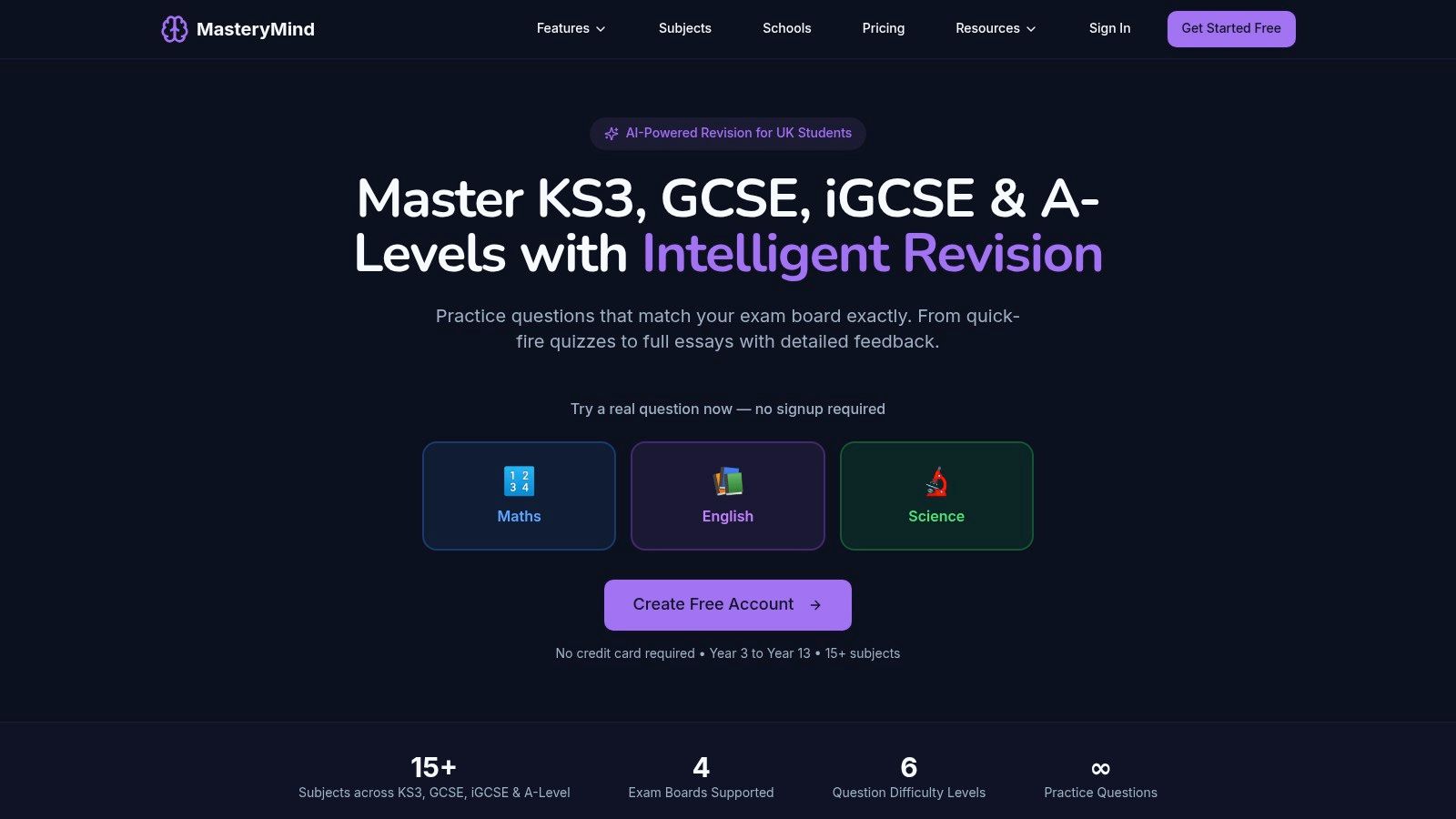
The platform’s real killer feature is its instant, examiner-style feedback. For Computer Science, this includes interactive tools for trace tables and binary/hex conversions, which are way more effective than just checking a static mark scheme. The AI gives you a breakdown of your performance against Assessment Objectives (AOs), highlights common mistakes, and suggests what to do next. This level of detail makes your revision incredibly efficient, targeting your weak spots precisely. It’s a significant step up from standard Online Revision for GCSE and A-Level resources.
Key Features and How to Use Them
- Specification-Aligned Questions: Don’t just do random practice. Use MasteryMind’s topic filters to zero in on areas like ‘Data Structures’ or ‘Network Security’ that you find tricky. The platform adapts the difficulty, moving you from simple recall to tougher application questions as you improve.
- Active Recall with Blurt Challenge: This voice-powered tool is awesome for locking in knowledge. Speak your answer to a prompt like "Explain the fetch-decode-execute cycle," and the AI will check your response against the curriculum, then create a targeted quiz to fill any gaps.
- JCQ-Compliant NEA Coach: For your coursework (Non-Examined Assessment), this feature is a game-changer. Upload your project (PDF/Word), and the AI gives you Socratic guidance and section-by-section feedback without just giving you the answers, keeping you compliant with exam board rules.
Our Take
MasteryMind is an exceptional tool for students who want structured, effective revision. The free plan is generous, letting you try a good number of exam-style questions right away. While the most advanced features like the NEA Coach need a premium subscription, the core function of targeted practice and smart feedback offers huge value on its own. For teachers, the AI's strict adherence to mark schemes provides a reliable way to supplement classroom teaching and homework, even if it shouldn't entirely replace expert human feedback for high-stakes assessments.
Website: https://masterymind.co.uk
2. OCR (official) – GCSE Computer Science (J277) Assessment
Your revision journey for OCR Computer Science past papers should always start here. This is the official source, the ground truth for what you can expect in an exam. The OCR website provides direct access to all released GCSE Computer Science (J277) assessment materials, making it an essential, non-negotiable stop for every student. It's where you find the authentic question papers, mark schemes, and invaluable examiner reports straight from the people who will be marking your work.
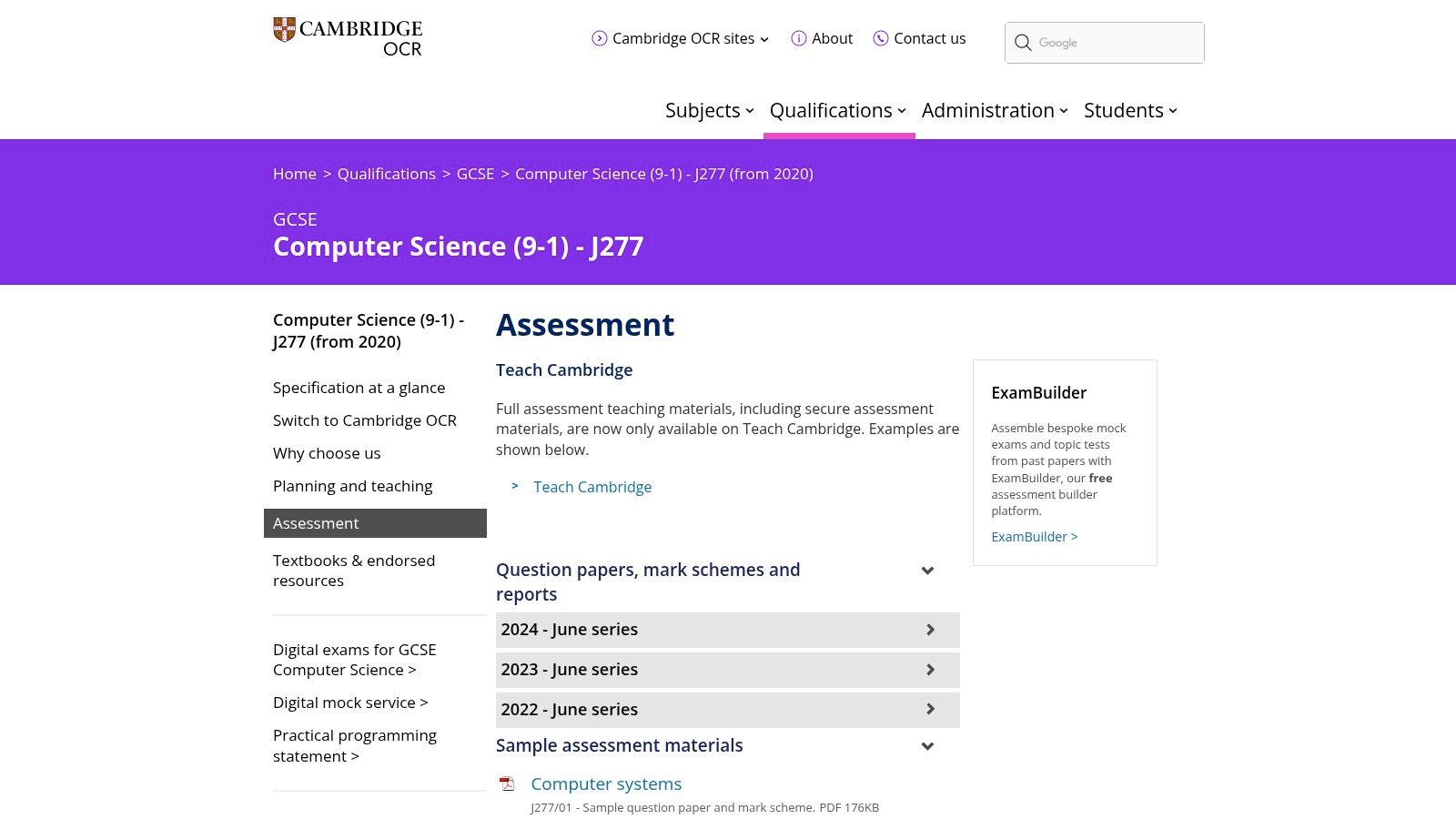
The primary reason this site is so critical is its 100% syllabus accuracy. You can be certain every document perfectly aligns with the current specification. This is particularly important for spotting changes in question style or topic emphasis from one year to the next.
Practical Tips for Use
While the navigation can feel a bit clinical and "exam-boardy" compared to student-focused platforms, getting what you need is straightforward. Use the filters to find papers by year, but pay special attention to the examiner reports. These documents are gold dust, offering a behind-the-scenes look at common mistakes students made in previous exams, helping you avoid the same pitfalls.
Expert Insight: Use the sample assessment materials (SAMs) first. These are designed by OCR to show you the exam format and are a great starting point before you dive into timed past papers from specific years.
What Makes It Stand Out?
- Authenticity: These are the real deal. No guesswork, no third-party interpretations.
- Examiner Reports: Provides direct feedback from markers on what separated top-grade answers from the rest.
- Cost: Completely free. All published materials are available for immediate download without needing a login.
The main drawback is that the most recent exam series is often locked away for teachers before its general release. However, for building a solid foundation, the huge back-catalogue is more than enough.
Website Link: OCR GCSE Computer Science (J277) Assessment
3. OCR (official) – AS/A‑level Computer Science (H046/H446) Assessment
For A-level students, this is the official hub and your first port of call. The OCR website provides direct, unfiltered access to all released AS/A-level Computer Science (H046/H446) assessment materials. It’s the definitive source for authentic past papers, mark schemes, and examiner reports, ensuring your revision is based on the real thing, not on a third party's interpretation.
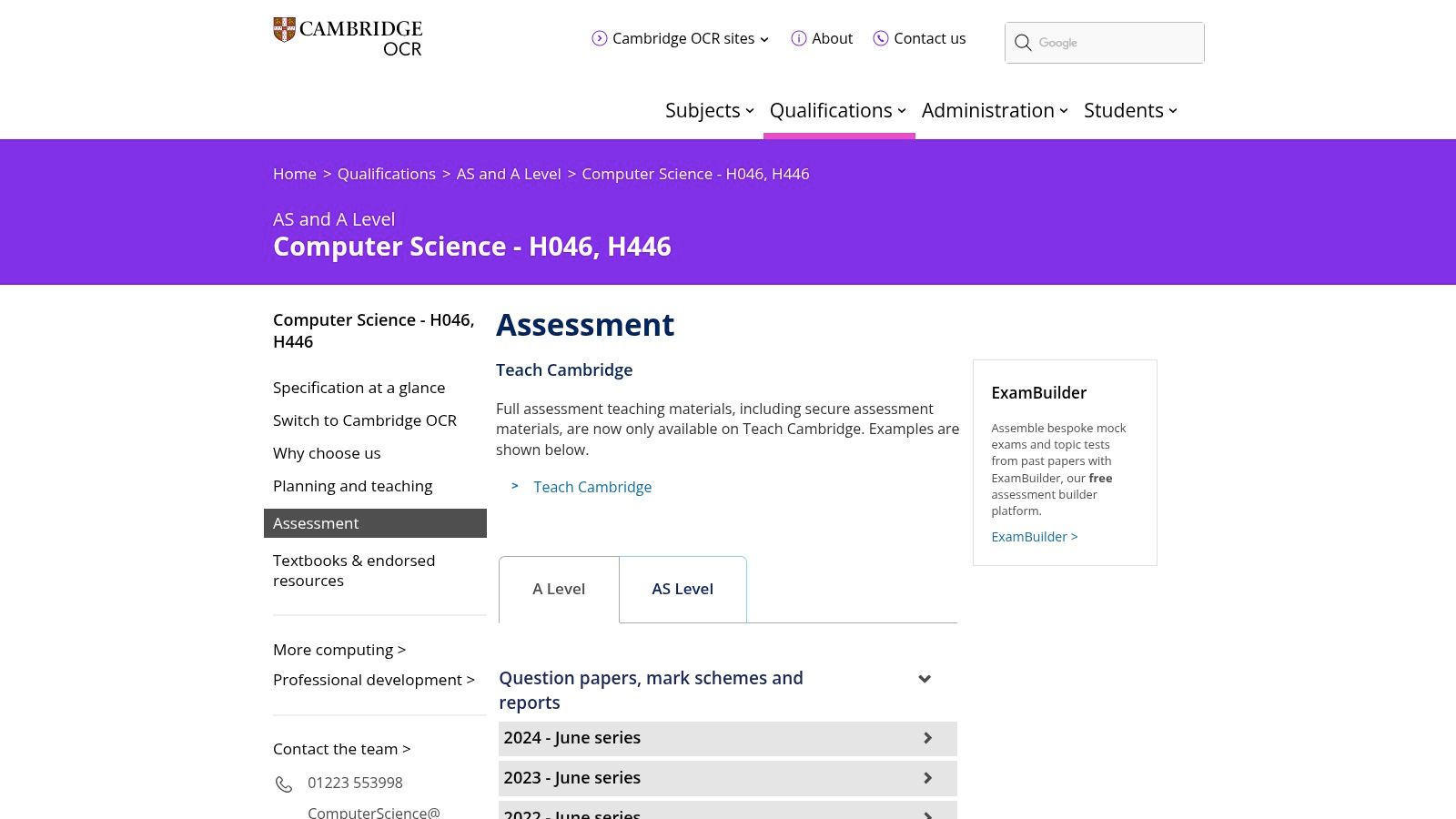
The undeniable benefit here is complete syllabus accuracy. You can trust that every question and mark scheme is perfectly aligned with the specification, which is crucial given the depth and complexity of A-level topics. It’s the only way to be certain you are preparing for the exact style and standard of the final exam.
Practical Tips for Use
While the website's design is more functional than flashy, finding what you need is simple. Once on the assessment page, you can filter by year and exam series to download the relevant OCR Computer Science past papers. Make sure to download the examiner reports alongside the mark schemes. These reports provide invaluable commentary on where students commonly went wrong and what top-scoring answers included.
Expert Insight: Start with the Sample Assessment Materials (SAMs). Then, move on to the earliest available past papers and work your way forward to the more recent ones. This lets you see how question styles may have evolved over the life of the specification.
What Makes It Stand Out?
- Authenticity: This is the ground truth. The materials are created by the same people who write and mark your exams.
- Examiner Reports: Crucial for A-level, these reports explain the nuances of high-grade answers and common pitfalls in complex topics.
- Cost: Completely free. All publicly released materials are available to download without any charge or login.
The main drawback is that the most recent papers are often locked behind a teacher-only area (the OCR Interchange) for a period after the exam series. However, the wealth of papers from previous years provides more than enough material for thorough revision.
Website Link: OCR AS/A-level Computer Science (H046/H446) Assessment
4. Physics & Maths Tutor (PMT)
A staple for UK students, Physics & Maths Tutor (PMT) is a massive, free library that organises OCR Computer Science past papers from multiple exam boards. While not an official source, its straightforward presentation and speed make it an incredibly popular and efficient revision hub. It gathers years of question papers and mark schemes into clean, easy-to-navigate lists, saving you from clicking through layers of menus on exam board websites.
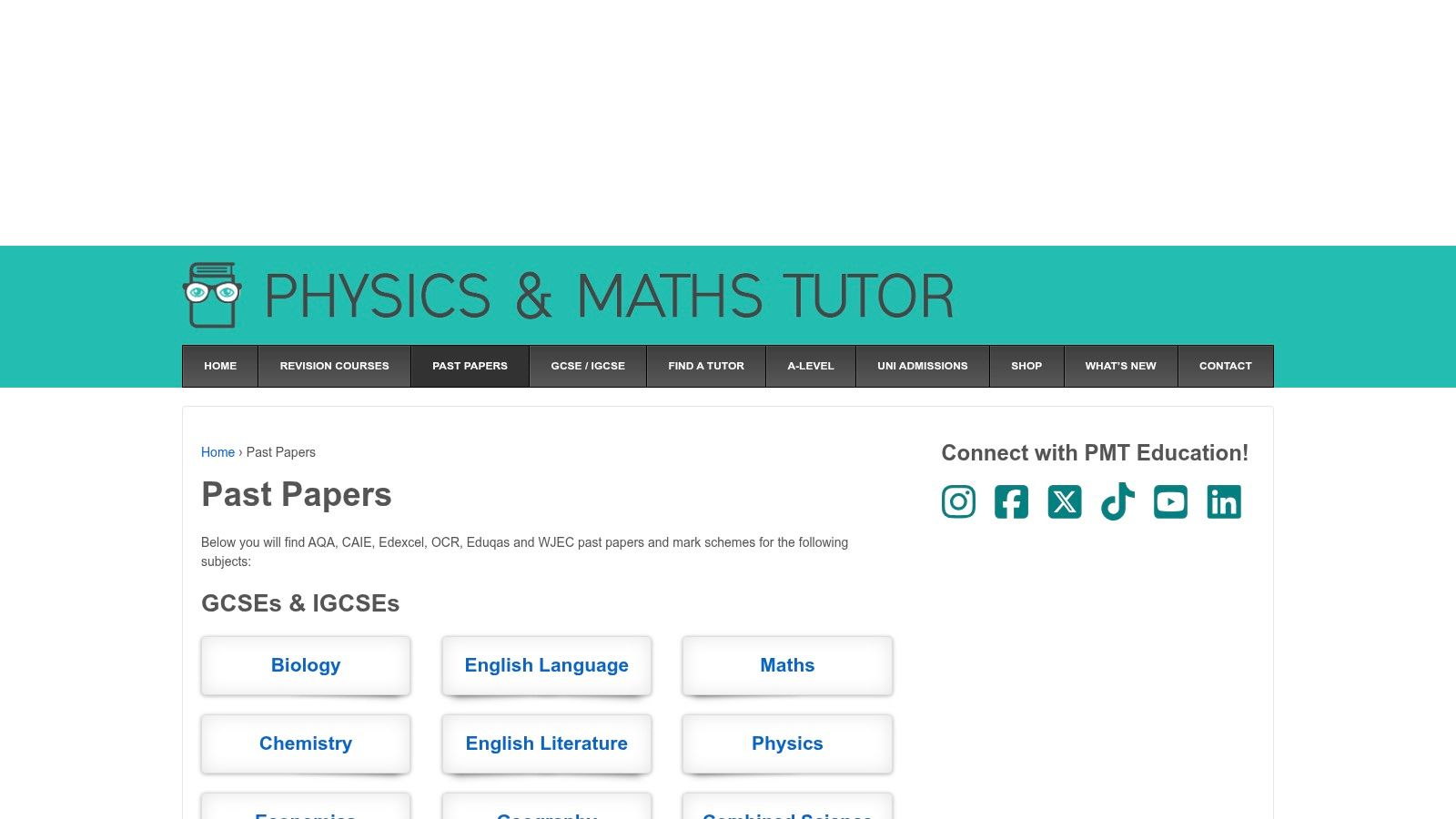
The main draw of PMT is its convenience. You can find dedicated pages for OCR GCSE J277 and A-Level papers, organised by year and session. This clear structure makes it perfect for quickly grabbing the exact paper you need for a timed practice session without any hassle.
Practical Tips for Use
Use PMT as your go-to library for downloading papers in bulk. Before a big revision session, you can quickly gather several years' worth of papers and mark schemes in one go. Because it also hosts papers from other exam boards like AQA, you can use them for extra practice on common topics like algorithms or data representation to test your knowledge in unfamiliar contexts.
Expert Insight: PMT is particularly useful for finding older papers from the H446 A-Level specification. This is great for tracking how certain question types have evolved over time and for building a deeper bank of practice material.
What Makes It Stand Out?
- Convenience: All papers and mark schemes are presented in simple lists for fast access and download.
- Breadth of Content: Hosts papers for multiple subjects and exam boards, making it a one-stop-shop for revision.
- Cost: Completely free to use, with no registration required.
The key limitation is the absence of official examiner reports; you get the questions and the answers, but not the official commentary on student performance. For the very latest exam series, you may find it links back to the official OCR site, but for everything else, it’s an essential, no-fuss resource.
Website Link: Physics & Maths Tutor Past Papers
5. Save My Exams
Save My Exams is a popular revision site that curates past paper resources into a clean, student-friendly layout. It’s often one of the first results when you search for OCR Computer Science past papers, and for good reason. The platform provides easy access to question papers and mark schemes for both GCSE and A-Level, organised neatly by exam series. It gets rid of the clinical feel of official exam board websites, presenting the essentials in a more approachable format.
While the free access to past papers is a major draw, the platform's real power is unlocked through its premium features. These paid extras, like topic-specific questions and model answers, are designed to speed up your understanding and self-assessment process beyond just downloading a PDF.
Practical Tips for Use
For free users, the site is a brilliant alternative for quickly grabbing papers without navigating a complex official site. If you're thinking about the paid subscription, consider how you'll use the extra tools. The topic tests are excellent for targeted revision on areas where you feel less confident, such as algorithms or network security, letting you focus your efforts effectively.
Expert Insight: Before you pay for a subscription, use the free past paper library extensively. If you find yourself wishing you had model answers or need help breaking down questions by topic, the premium features will likely be a worthwhile investment for you.
What Makes It Stand Out?
- Student-Focused Interface: Much easier and faster to find the exact paper you need compared to some official sources.
- Added-Value Content: The optional premium features (like model answers) provide support that official sites don't offer.
- Broad Subject Range: If you study other subjects, a single subscription can cover your revision needs across the board.
The main drawback is that the most valuable features are behind a paywall. The free offering is essentially a well-organised library of freely available documents, so its value depends on whether you're willing to pay for convenience and extra revision tools.
Website Link: Save My Exams OCR Computer Science Past Papers
6. Revision World
Think of Revision World as your reliable backup for finding OCR Computer Science past papers. It's a free UK-based resource that conveniently lists downloadable GCSE (J277) and A-Level (H446) papers and their mark schemes by year. While the official OCR site should be your first port of call, Revision World is an excellent secondary source, especially if the main site is running slow or you want a simple, no-fuss layout.
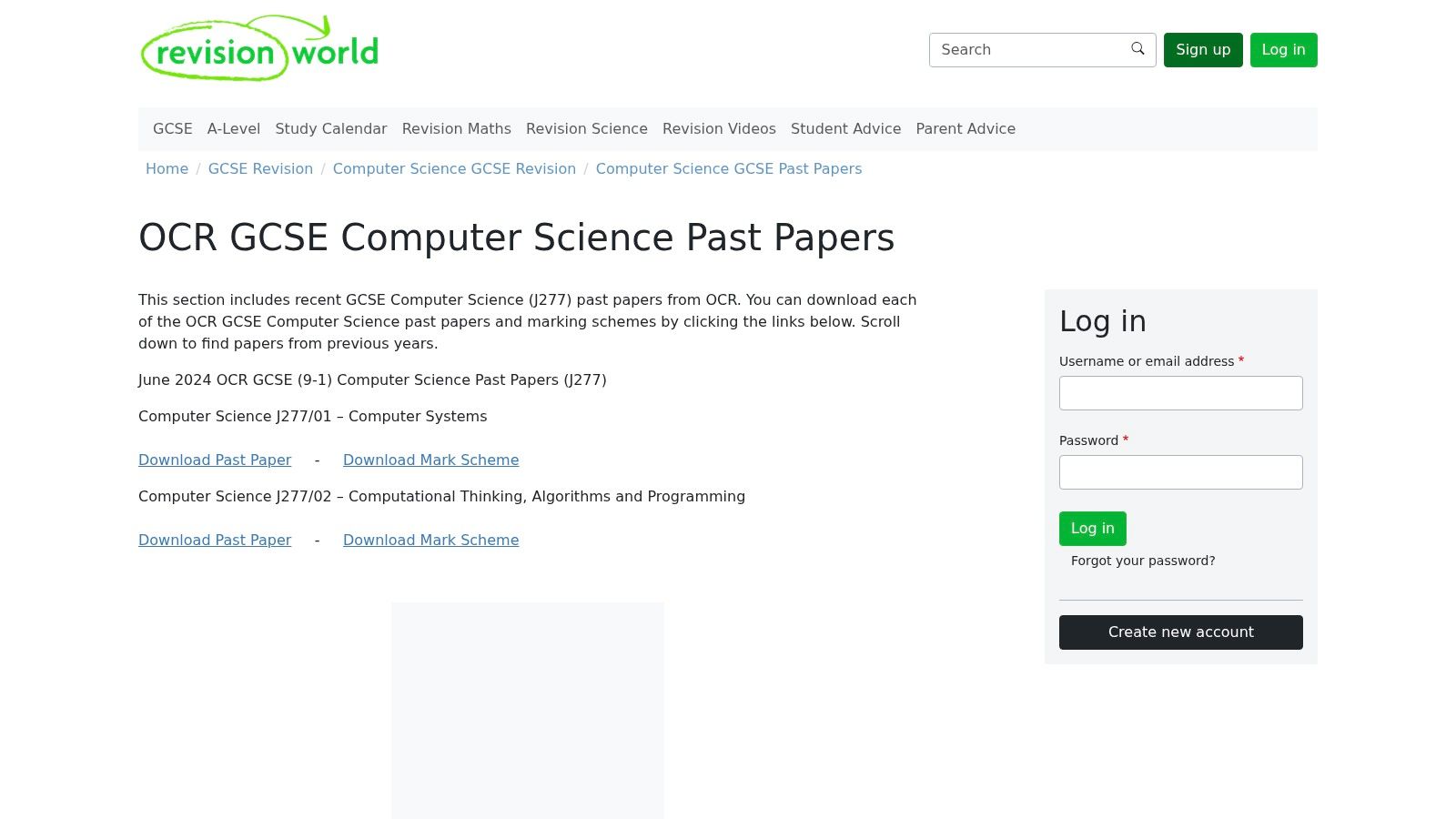
The site’s strength is its straightforward year-by-year indexing. You can quickly find the specific exam series you need without navigating complex menus. It serves as a great plan B for grabbing a paper when you need it fast.
Practical Tips for Use
The user interface is basic but effective. You’ll find separate pages for GCSE and A-Level, each presenting a simple list of papers. Use it to quickly download a specific year's materials to supplement your main revision schedule. It’s also handy for cross-referencing to ensure you haven’t missed any available papers from previous years.
Expert Insight: Use this site to fill in the gaps. If you've worked through the main papers on the OCR site, check Revision World for any specimen or sample papers you might have overlooked. It's all about maximising your exposure to different questions.
What Makes It Stand Out?
- Simplicity: No logins, no complex filters. Just direct links to PDF documents.
- Good Coverage: It provides both GCSE and A-Level OCR papers in one place, making it useful for students across different key stages.
- Cost: Completely free access to all listed materials.
The main drawback is the potential for occasional dead links, as it's a third-party aggregator. The layout can also feel slightly inconsistent between the GCSE and A-Level sections, but this is a minor issue. For a quick and easy-to-use repository of OCR past papers, it’s a solid bookmark.
Website Link: Revision World OCR GCSE Computer Science
7. MME Revise (MME Revise) – GCSE Computer Science Past Papers
MME Revise offers a clean, no-fuss approach to accessing OCR GCSE Computer Science J277 past papers. The platform acts as a straightforward hub, collating papers and mark schemes into a single, easy-to-navigate page. It’s perfect for those moments right before a mock exam or a timed practice session when you just need the files without clicking through multiple menus.
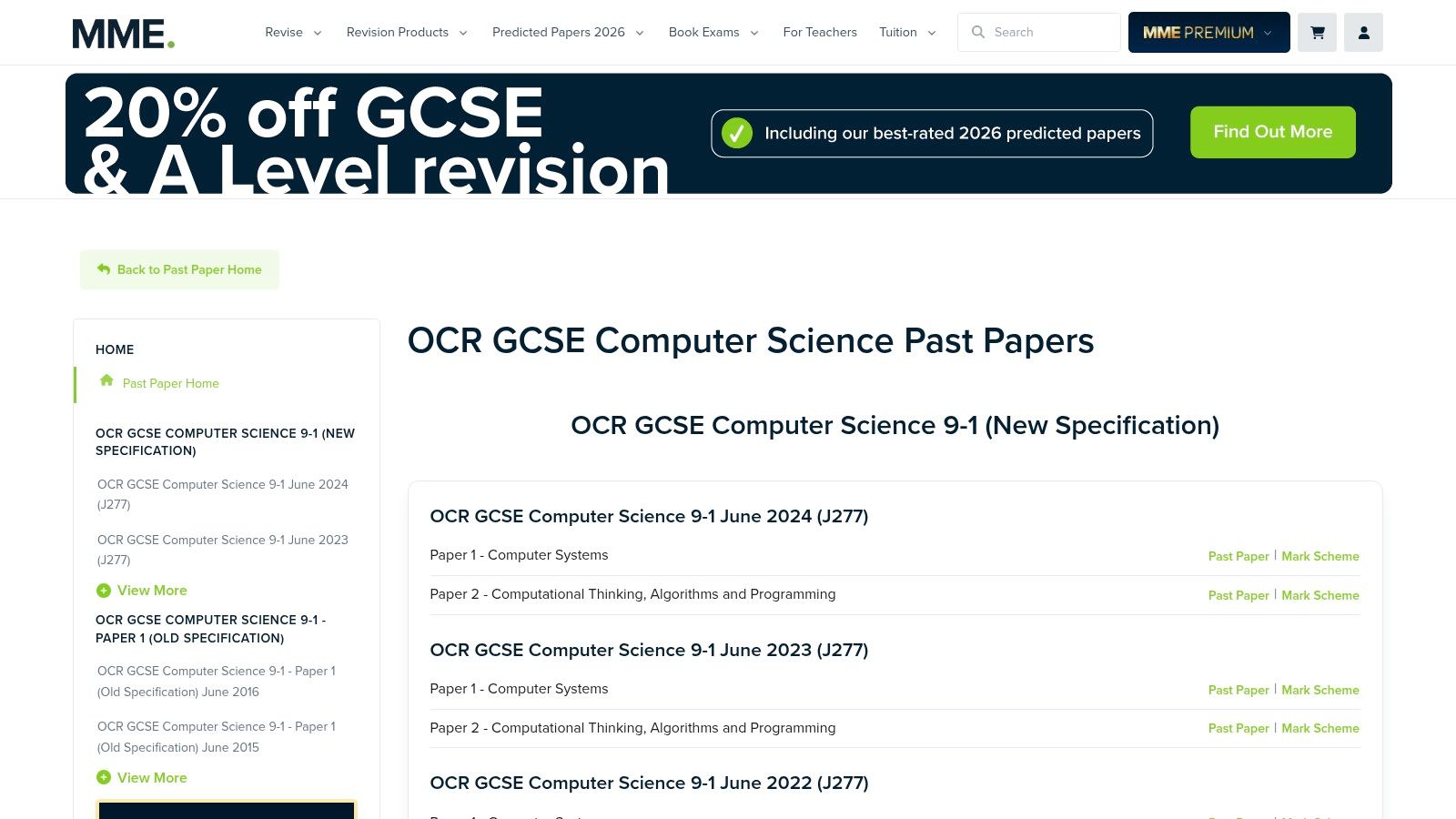
The primary appeal here is speed and simplicity. While other sites might have more features, MME Revise presents a clear list of available exam series, from sample materials to the latest publicly available papers, allowing for quick downloads. Its student-friendly layout makes finding your specific OCR computer science past papers a matter of seconds.
Practical Tips for Use
This site is best used for rapid resource gathering. The one-page index format means you can quickly grab multiple years' worth of papers and mark schemes at once. Because it also links to other OCR GCSE revision materials within its network, it can serve as a good starting point if you're looking for topic-specific practice alongside full papers.
Expert Insight: The simplicity of the page is its strength. Bookmark it for those times you need to download a paper quickly without any distractions. It cuts out the noise and delivers exactly what you need.
What Makes It Stand Out?
- Efficiency: A single-page list of all J277 sessions means no complex navigation.
- Student-Centric Layout: The design is clean and built for students who want to find resources fast.
- Cost: Completely free access to all listed papers and mark schemes.
The main limitation is its exclusive focus on GCSE. A-Level students will need to look elsewhere. It also lacks supplementary documents like examiner reports, so you’ll need to pair it with the official OCR site for deeper analysis of common mistakes.
Website Link: MME Revise OCR GCSE Computer Science Past Papers
8. PapaCambridge
PapaCambridge is a well-known archive for UK exam papers, acting as a huge digital library for students. It's particularly useful for sourcing a broad range of OCR Computer Science past papers, including those from legacy specifications like GCSE J276 and A-Level H046/H446. Think of it as the go-to place when you need to dig up older materials that are still relevant for topic-specific practice.
The main draw here is the sheer volume of historical content. While newer specifications have different question styles, the core concepts of algorithms, programming, and data representation often remain the same. Using these older papers helps you build a deeper understanding and gives you a near-endless supply of practice questions beyond the last few years.
Practical Tips for Use
The website’s navigation can feel a bit cluttered due to ads, so be prepared to focus on finding the download links. The search and filter functions are your best friends here. Use them to pinpoint the exact year and series you need. Be aware that the site often mirrors documents from various sources, so download speeds can vary.
Expert Insight: Don't just stick to the most recent papers. Use PapaCambridge to download a paper from five or six years ago and compare it to a new one. This shows you how the exam has evolved and helps you practise foundational skills that are always tested.
What Makes It Stand Out?
- Legacy Paper Access: Excellent for finding historical papers (J276, H046) that are hard to locate elsewhere.
- Breadth of Content: It’s not just question papers; you’ll often find mark schemes, inserts, and examiner reports bundled together.
- Cost: All materials are completely free to access and download, with no registration required.
The key drawback is the user experience, which is functional but not as polished as official exam board sites or subscription platforms. The presence of ads can also be distracting. However, for a free resource with such a deep back-catalogue, it’s an invaluable tool for any student wanting extra practice.
Website Link: PapaCambridge
9. GCSE Computer Science Tutor
Run by a Computer Science tutor, this website acts as a clean and simple hub for past paper access. It strips away the corporate feel of official exam board sites and presents OCR Computer Science past papers in a straightforward, student-friendly list. If you find the official OCR website a bit tricky to get around, this could be a great alternative for quickly grabbing the papers you need.
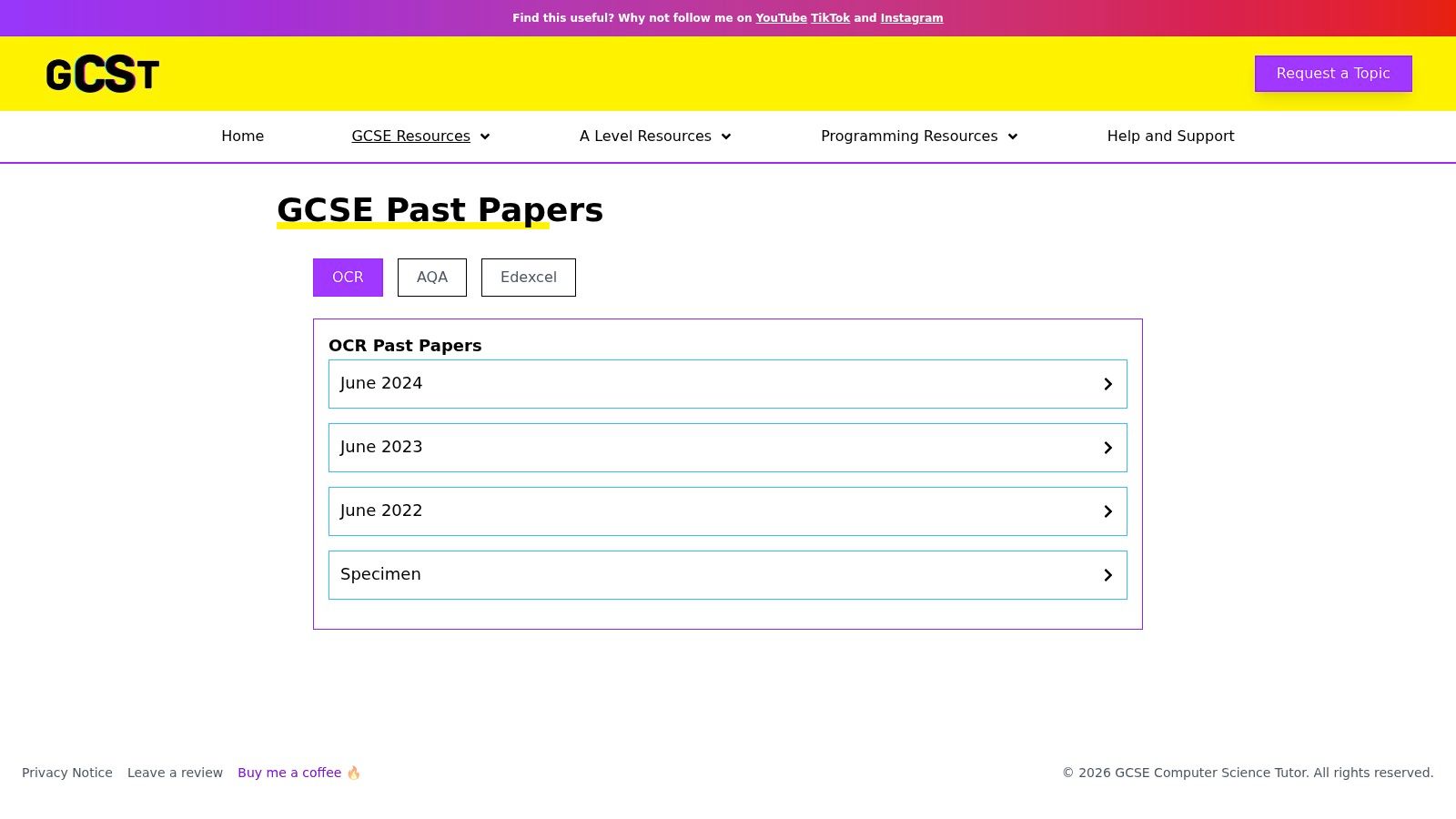
The site organises papers, mark schemes, and other key documents by exam board and level (GCSE and A-Level), making it easy to find exactly what you’re looking for. It’s particularly useful for students who want to branch out and practise with papers from other exam boards without having to learn a new website layout each time.
Practical Tips for Use
The main draw here is simplicity. The past paper pages are just direct links to PDF documents, so you can get straight to practising. Beyond the papers, the site also contains topic-specific explanations and resources that are written in an accessible style, which can be helpful for clarifying tricky concepts before you attempt a full paper.
Expert Insight: Because this site is curated by an individual, check back periodically. The content and organisation might be updated based on their teaching experience, potentially offering new resources or a different perspective on revision.
What Makes It Stand Out?
- Student-Focused Design: Clear, simple lists without the complex navigation of official sites.
- Multi-Board Access: Easily find papers for other exam boards like AQA and Edexcel alongside OCR.
- Cost: Completely free to access all papers and resources, with no login required.
The main limitation is that its collection isn’t always as complete as the official OCR source, especially regarding examiner reports. However, for quick and easy access to a good range of papers, it’s an excellent bookmark to have.
Website Link: GCSE Computer Science Tutor - Past Papers
10. Teach Computer Science
For students and teachers who want a no-fuss, consolidated source for GCSE papers, Teach Computer Science delivers. It gathers numerous OCR GCSE J277 past papers and their corresponding mark schemes onto a single, easy-to-navigate page. This saves you the time you might spend clicking through different year groups on the official exam board website, presenting everything in a clean, scannable list.
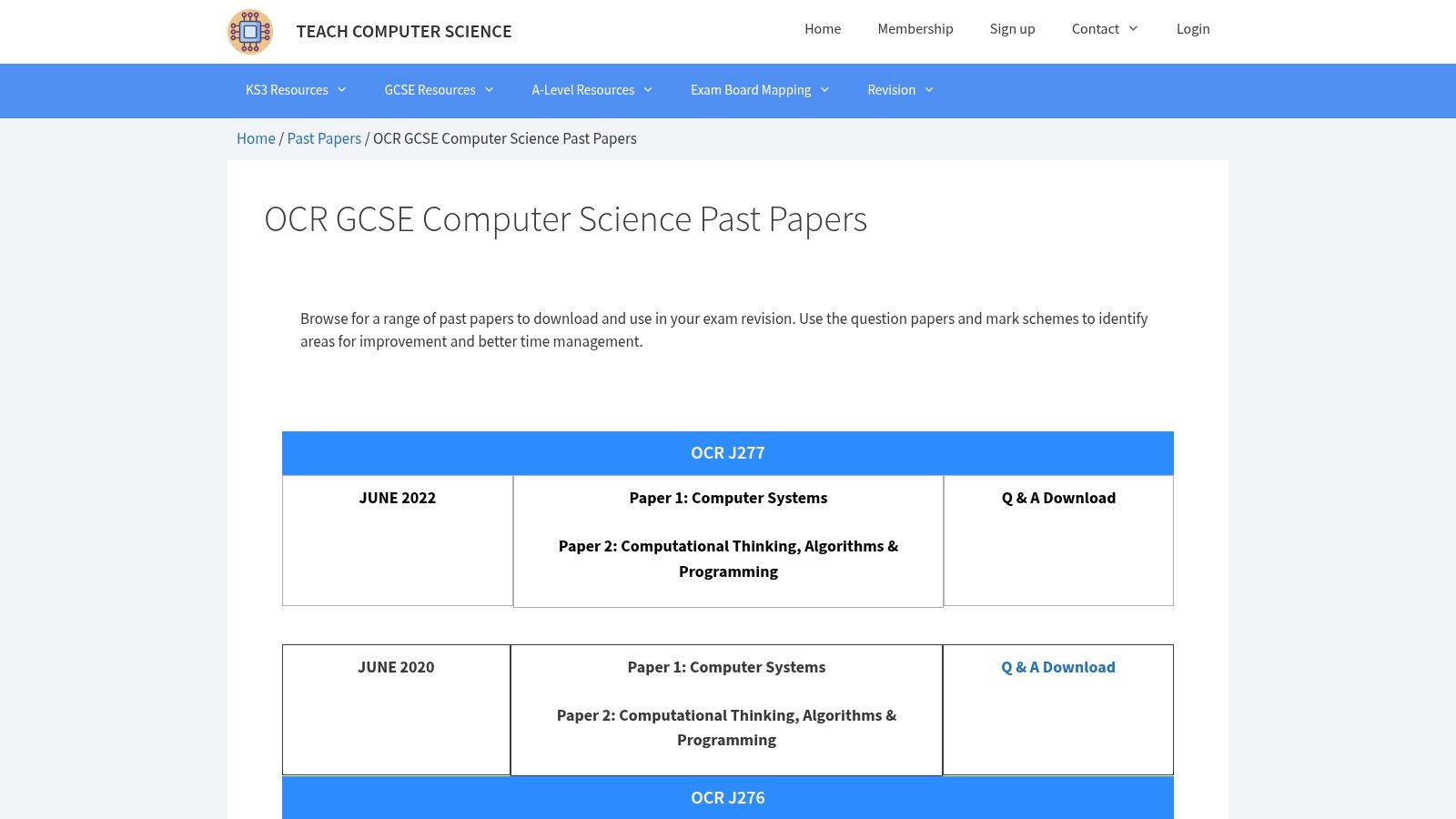
The site is designed with both individual revision and classroom teaching in mind. While the past papers are free, the platform also offers paid revision resources like notes and workbooks. This makes it a handy two-in-one stop if you're looking for supplementary materials to accompany your practice with official OCR Computer Science past papers.
Practical Tips for Use
Head straight to the past papers page and bookmark it. It’s a great place for a quick download before a timed practice session. While there, check out their other resources; even if you don’t purchase them, they can give you ideas on how to structure your own revision notes. For educators, the site’s teacher-oriented focus is clear. For those involved in educating the next generation of computer scientists, effective strategies for developing training curriculum can be invaluable.
Expert Insight: Use this site as your quick-access library. When you only have 30 minutes and want to tackle a specific paper, its simple layout is faster than navigating a more complex site. Download several years' worth of papers at once to build your own local revision folder.
What Makes It Stand Out?
- Consolidation: All GCSE papers are conveniently listed on one page for quick downloads.
- Teacher-Focused: Offers structured, paid materials that complement the free papers, ideal for classroom use.
- Cost: The past paper and mark scheme archive is completely free and accessible.
The main limitation is its focus on GCSE (J277), with A-Level past papers being less prominent. Additionally, to access the full suite of structured notes and workbooks, there is a cost involved, as these are premium teaching packs.
Website Link: Teach Computer Science OCR GCSE Past Papers
11. PastPapers.co (OCR directory)
Think of PastPapers.co as a rapid-access backup for your revision files. It’s an aggregator that indexes past papers from various exam boards, including a dedicated section for OCR. While not as polished as other platforms, its simple, file-directory layout provides a no-frills way to quickly find specific OCR Computer Science papers for both A-Level (H446) and GCSE, assuming you know the exam codes you're after.
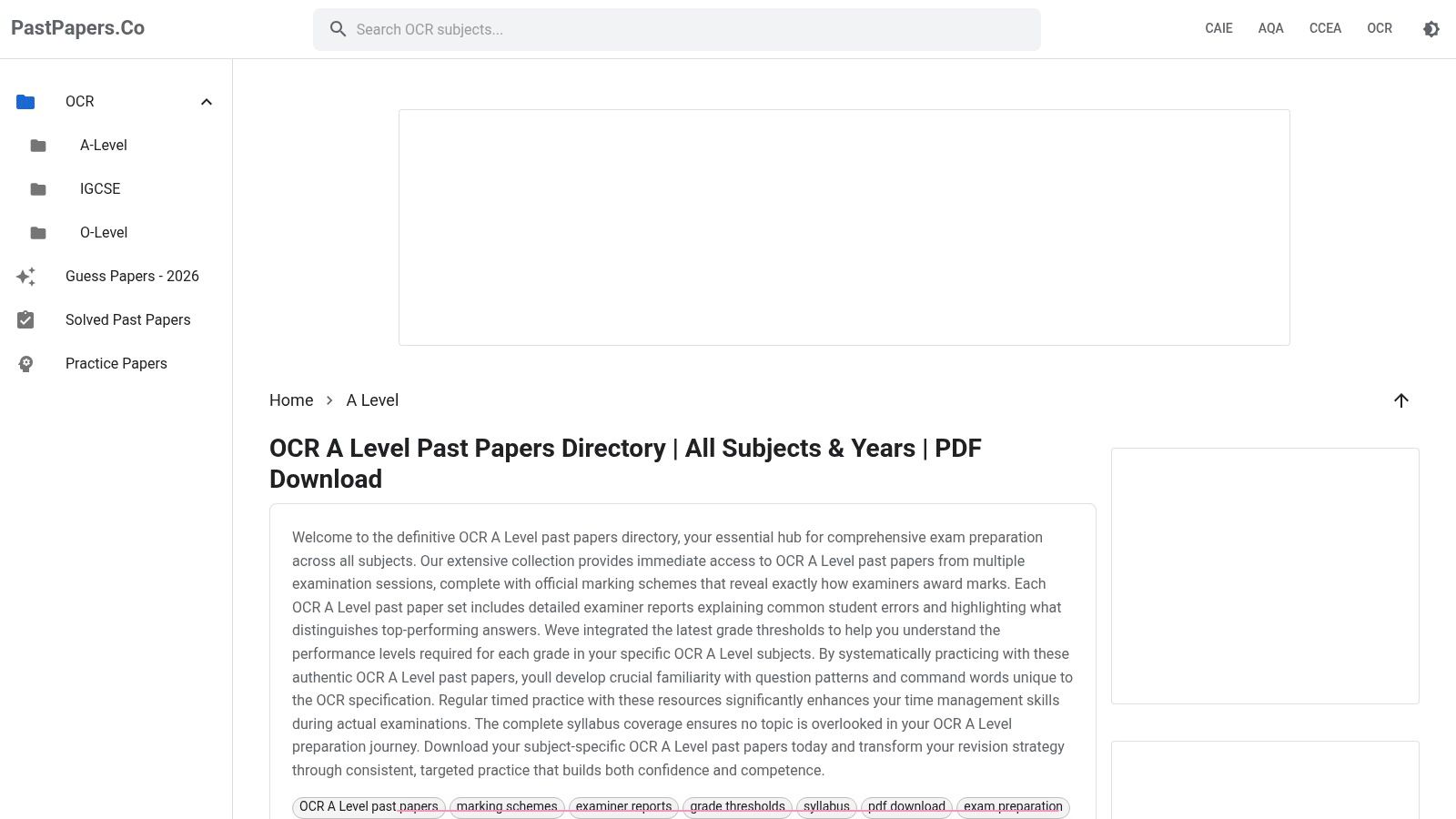
Its main value lies in being a handy redundancy. If the official site is down for maintenance or you’re struggling with another platform’s navigation, PastPapers.co often comes through. It’s a direct, folder-based system that feels like browsing files on your own computer.
Practical Tips for Use
The interface is extremely basic, so don't expect any fancy features. You click through folders labelled by qualification, then subject, then year/series. This makes it very fast if you know exactly what you need, such as "A-Level/Computer-Science-H446/". Be aware that coverage can be inconsistent; you might find a question paper but not its corresponding mark scheme, so always cross-reference.
Expert Insight: This site is best used for targeted downloads, not for browsing. If you need the June 2019 Paper 1, you can often grab it here in seconds without navigating complex menus. It’s a tool for speed and convenience.
What Makes It Stand Out?
- Simplicity: The file-style navigation is incredibly straightforward and quick.
- Good Backup: A reliable alternative when official or more complex sites are unavailable or slow.
- Cost: Completely free to access and download all available papers.
The most significant drawback is its barebones nature and occasional missing files. It's a useful secondary resource for your OCR computer science past papers collection, but it shouldn't be your primary one.
Website Link: PastPapers.co (OCR A-Level Directory)
12. Revision Genie
Revision Genie is built for the student who wants more than just a PDF of a past paper. It combines access to OCR J277 past papers with a layer of guided practice and instant help, framing revision in a way that feels less like a lonely chore and more like a supported learning session. It’s designed specifically for GCSE students, structuring content around the familiar Paper 1 (Computer Systems) and Paper 2 (Algorithms & Programming) format.
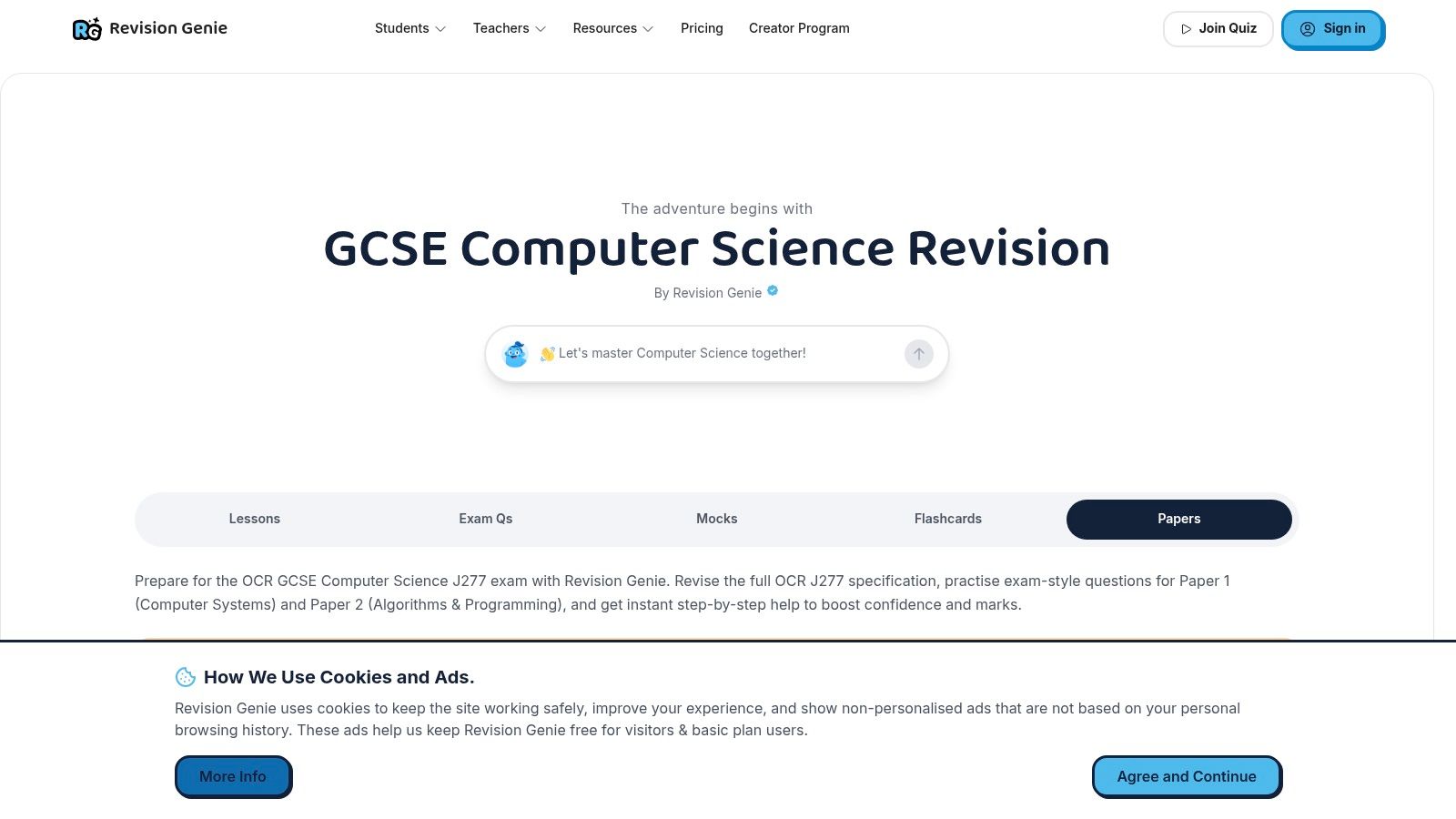
This platform’s approach is ideal if you often find yourself stuck on a question and wish you had a teacher looking over your shoulder. Instead of just giving you the mark scheme after you’ve struggled, Revision Genie aims to provide scaffolding as you work through the papers, making it a great bridge between learning a topic and testing it under exam conditions.
Practical Tips for Use
Start by using the platform for topics you feel less confident about. The guided support is most valuable when you’re tackling your weaknesses. Use the structured practice to solidify your understanding of a specific area of the OCR specification before attempting a full timed paper within the same environment. This helps you build confidence incrementally.
Expert Insight: Think of this site as a digital tutor. Use its "instant help" features to unpack tricky questions one by one. This is far more effective for learning than just looking up the final answer in a mark scheme.
What Makes It Stand Out?
- Scaffolded Practice: It doesn't just give you the paper; it provides support tools to help you work through it.
- GCSE Focus: The entire experience is built around the OCR J277 specification, so there's no irrelevant content.
- User-Friendly Framing: Organises past papers by the Paper 1/Paper 2 split, which is how students think about the exam.
The main limitation is that it’s purely for GCSE; A-level students won’t find H446 resources here. As a newer platform, its depth of features might not match some long-standing revision giants, but its specific focus on supportive practice for OCR computer science past papers makes it a strong contender.
Website Link: Revision Genie OCR GCSE Past Papers
OCR Computer Science Past Papers — 12-Resource Comparison
| Product | Core features | Unique selling points | UX Rating | Target audience | Price/value |
|---|---|---|---|---|---|
| MasteryMind 🏆 | AQA/Edexcel/OCR/WJEC‑aligned Qs; adaptive difficulty; examiner‑style feedback; NEA Coach; Blurt voice recall | ✨ AI‑powered AO‑aware feedback; step‑by‑step maths checks; exam‑style editors; spaced review | ★★★★★ | 👥 Years 3–13 students, tutors, teachers, schools, parents | 💰 Freemium — Free plan; Premium unlocks NEA & advanced analytics |
| OCR (official) – GCSE J277 Assessment | Official past papers, mark schemes, examiner reports | ✨ Definitive, syllabus‑accurate materials | ★★★★ | 👥 Teachers & students needing official materials | 💰 Free (official releases) |
| OCR (official) – AS/A‑level H046/H446 Assessment | Official A‑level past papers, mark schemes, examiner reports, teacher tools | ✨ Authoritative A‑level resources and examiner commentary | ★★★★ | 👥 A‑level students, teachers, examiners | 💰 Free (official releases) |
| Physics & Maths Tutor (PMT) | Aggregated past papers, clear organisation, fast downloads | ✨ Quick access & tidy indexing across boards | ★★★★ | 👥 Students & schools for fast revision downloads | 💰 Free |
| Save My Exams | Curated past papers, model answers, test builders, SmartMark | ✨ Student‑friendly layout + paid marking/answer tools | ★★★★ | 👥 Students seeking marking aids and structured practice | 💰 Freemium — Free papers; paid extras |
| Revision World | Year‑by‑year OCR paper index and mark schemes | ✨ Good backup when official site is slow | ★★★ | 👥 Students looking for simple year indexes | 💰 Free |
| MME Revise | One‑page J277 index, links to OCR resources | ✨ Single‑page quick list for GCSE downloads | ★★★ | 👥 GCSE Computer Science students | 💰 Free |
| PapaCambridge | Broad OCR archive including legacy J276/H046 papers | ✨ Strong for locating older or legacy papers | ★★★ | 👥 Teachers & students needing legacy papers | 💰 Free (ads) |
| GCSE Computer Science Tutor | Aggregated past papers + topic resources and explanations | ✨ Tutor‑run clarity with extra topic support | ★★★ | 👥 Students seeking guided topic resources | 💰 Free |
| Teach Computer Science | J277 papers plus teacher packs, notes, printable materials | ✨ Teacher‑oriented packs complement paper practice | ★★★ | 👥 Teachers & GCSE students | 💰 Free + paid teaching packs |
| PastPapers.co (OCR directory) | File‑style OCR directories by unit and session | ✨ Simple redundancy when other sources are down | ★★ | 👥 Users needing quick file indexes (H446/J277) | 💰 Free |
| Revision Genie | J277 past papers with guided practice & instant help | ✨ Scaffolded practice layered onto past papers | ★★★ | 👥 GCSE OCR students wanting guided revision | 💰 Free (feature‑limited) |
From 'Just a Paper' to a Grade-Winning Plan: Your Next Steps
We've covered a lot of ground, from the official OCR archives to dedicated revision platforms like Physics & Maths Tutor and innovative tools like MasteryMind. The sheer volume of OCR Computer Science past papers available can feel overwhelming, like a digital mountain you’re expected to climb. But here's the key takeaway: hoarding PDFs on your desktop isn't a revision strategy. A past paper is just a static document until you turn it into an active learning tool.
The real value comes from how you use these resources. Just downloading and glancing at a mark scheme won't magically improve your grade. The path to success, whether you're aiming to pass or aiming for a top grade, is built on a cycle of practice, analysis, and targeted improvement. This article has given you the map; now it’s time to start the journey.
Tailoring Your Strategy: From Recovery to High-Flying
Your personal goals should dictate your approach. Let's be honest about where you are right now and what you need to do next.
- For Students on a Grade Recovery Mission: If you feel behind, your mission is clarity and focus. Don't try to complete every paper from the last decade. That’s a recipe for burnout. Instead, pick one recent paper. Set a timer, put your phone in another room, and work through it under exam conditions. Then, mark it ruthlessly using the official mark scheme. Every single mark you lost points to a gap in your knowledge or exam technique. Those topics are now your priority revision list.
- For Students Aiming for Top Grades: You've already got the basics down. Your challenge is mastering the nuances that separate a Grade 7 from a Grade 9. Your secret weapon is the Examiner’s Report. This document is a direct line into the mind of the person marking your script. It highlights where top students secured their marks and, more importantly, where they stumbled. Pay close attention to comments on high-mark questions, command word interpretation ('explain' vs 'describe'), and common logical errors. This is where you’ll find the extra 5-10% you’re looking for.
A Note for Teachers and Tutors
For educators, the challenge is often scalability. How do you provide individual, detailed feedback to a whole class? This is where blending traditional resources with modern tools becomes essential.
A past paper is an excellent diagnostic tool. Use one at the start of a revision block to identify common areas of weakness across the cohort. Are half your students struggling with binary arithmetic? Is network protocol knowledge patchy? The results can directly inform your lesson planning for the crucial weeks before the exam.
Platforms like MasteryMind can then take this a step further. Once you've identified that "Databases and SQL" is a weak point, you can set a targeted assignment on that specific topic. The platform’s automated marking gives students instant feedback on their mistakes, freeing you up to focus on providing higher-level strategic guidance rather than getting bogged down in repetitive marking.
Ultimately, the goal is to transform the passive act of 'doing a paper' into an active feedback loop. The resources we've explored, from the simple PDF on the OCR website to the intelligent workflows of practice platforms, are all just cogs in that machine. Your job, as a student or teacher, is to get that machine running. Don't just collect the papers; use them to build knowledge, perfect your exam technique, and develop the confidence to walk into that exam hall knowing you are truly prepared.
Ready to turn those past paper insights into targeted, effective practice? Instead of just identifying your weak spots, start fixing them with MasteryMind. Our platform maps directly to the OCR specification, allowing you to practise specific topics you struggled with in a past paper and get instant, intelligent feedback on your answers. Sign up for MasteryMind today and transform your revision from passive reading into active, grade-boosting learning.
Ready to master this topic?
Practise with quizzes, blurt exercises and exam questions on MasteryMind.
7 days Premium · Then free forever · No card, no charge