OCR Maths Past Papers: A Smart Revision Guide
You're probably here in one of two moods.
Either you've left OCR maths revision later than you meant to, and now you've got a desktop full of PDFs with names like “J560_01_June…” and no idea which one matters. Or you're the organised one in the room, the student who wants every paper to count because doing random questions feels like fake productivity.
Both groups usually hit the same problem. They find the papers, but they don't know what to do with them.
That's why OCR maths past papers need more than a download button. You need the right paper for your tier or route, a marking routine that matches how OCR awards marks, and a way to use examiner reports so the same mistakes stop turning up every week.
The Night Before Mock Season
It's a very familiar desk setup.
A Year 11 student has printed three OCR GCSE maths papers, one of them is definitely Foundation, one might be Higher, and one has no cover page because it came from a revision site and got saved under “maths paper final final”. A Year 13 student has A Level papers open in separate tabs, is staring at Paper 3, and can't remember whether this is the one with statistics and mechanics or whether that was another specification.
The panic is usually quite quiet. It doesn't always look dramatic.
It sounds more like this: should I start with the oldest paper or the newest one? Am I meant to check the mark scheme after each question or only at the end? If I'm hovering around the grade boundary, am I wasting my time on the wrong tier? If I got stuck on one paper, does that mean I'm bad at maths or just bad at choosing revision properly?
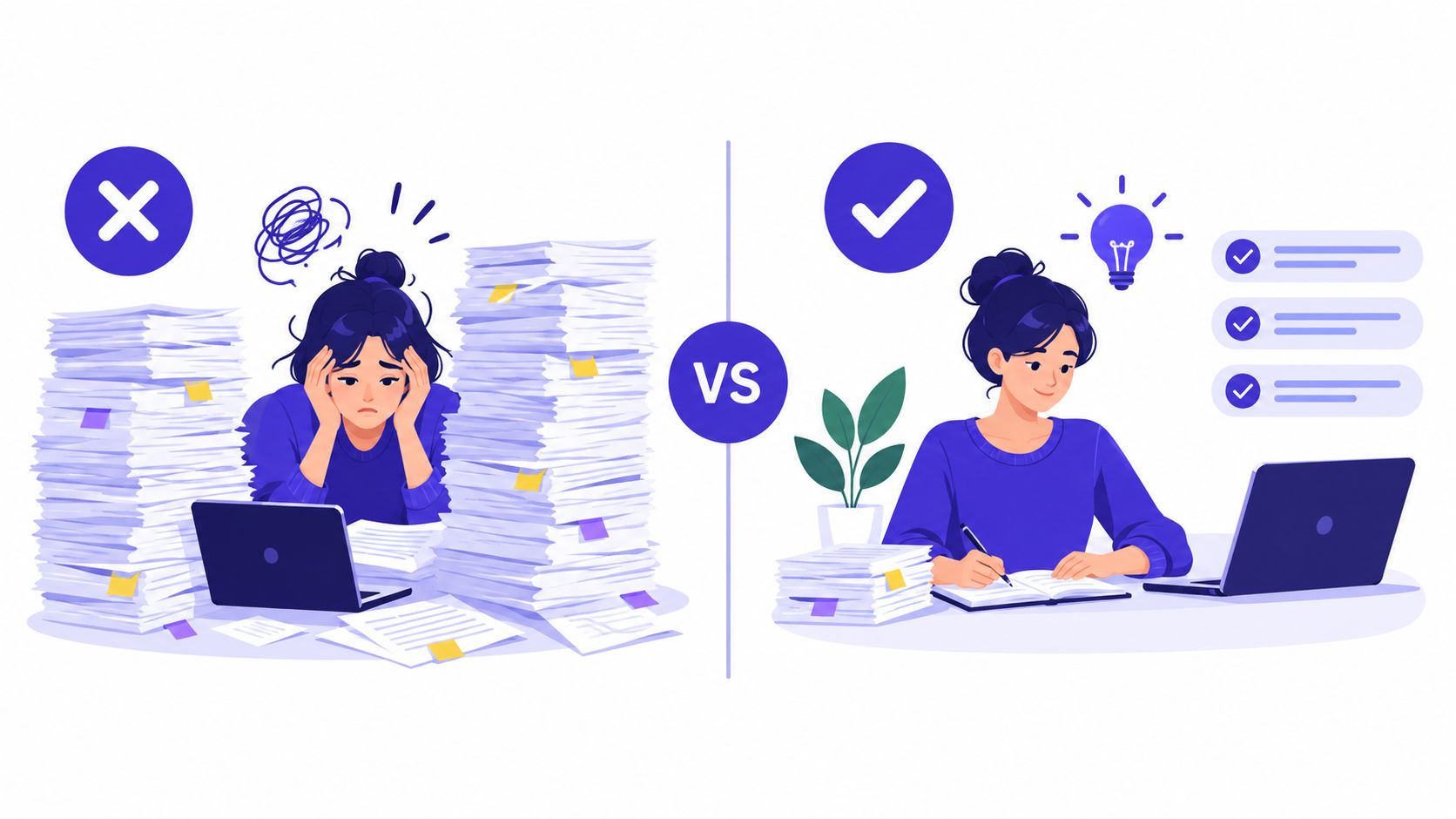
The pile is the problem
Most students think the problem is motivation. Often it isn't. The problem is too many papers with no system.
One student does a full paper untimed on the bed, half-marks it, feels awful, then moves on to another one. Another spends forty minutes choosing which PDF to open and calls that revision. A third keeps doing harder papers because it feels ambitious, even though the marks they need are sitting in more standard questions they keep missing.
Practical rule: A past paper only helps if it has a job. It should test the right course, the right paper type, and one clear next step after marking.
That's the shift worth making. Every OCR paper on your desk needs a purpose.
Some papers are for a full timed run. Some are for learning the paper structure. Some are for checking whether a weak topic still falls apart under pressure. Some are mainly useful because the examiner report tells you why students lost marks on that question.
Once you start treating OCR maths past papers like that, the stack stops looking like guilt and starts looking like a plan.
Where to Find OCR Maths Past Papers
You sit down to revise, type "ocr maths past papers", and get a jumble of PDFs, forum uploads, old screenshots, and school portal links. Half the battle is knowing which files are the real thing, and which ones belong together.
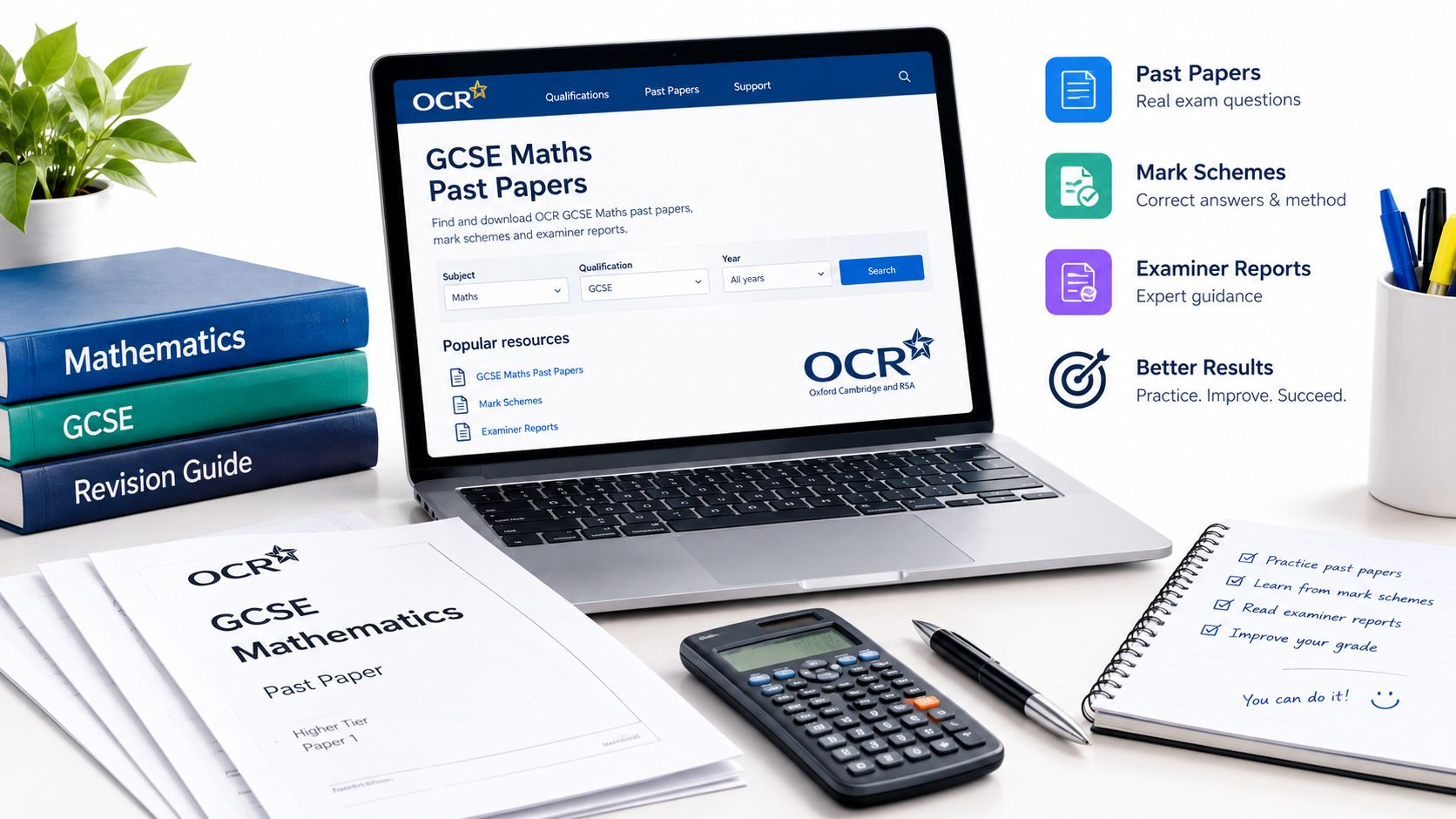
Start with OCR's own Past Paper Finder. It keeps the paper, mark scheme, and examiner report in the same place, which matters more than students realise. A past paper on its own is only the question sheet. The mark scheme shows how marks were given. The examiner report shows where students threw marks away for reasons that feel obvious only after the exam.
That is the difference between random paper practice and revision that works like a marker would want it to.
If you are building a revision folder, save the official OCR page first. Then, if you want a broader subject-by-subject index alongside it, GCSE Past Papers is useful for finding the right board and subject quickly. Keep OCR as your reference copy so the naming, tier, and series stay clear.
The quickest route on the OCR site
GCSE students should look for GCSE Mathematics J560. A Level students should look for A Level Mathematics A H240. Once you are on the qualification page, open the past papers or assessment materials area and check that the series and paper labels match what your teacher has entered you for.
It should feel orderly. If it feels like you are guessing, stop and check the qualification code again.
What to download together
Download the full set, not just the question paper.
For OCR maths past papers, that usually means:
- Question paper, so you can attempt it properly
- Mark scheme, so you can see method marks and accepted working
- Examiner report, so you can spot patterns in lost marks
- Practice material, where OCR has provided extra support
This is the bit many students miss. They collect ten papers, but not the reports. That is like doing a driving lesson with the mirror covered. You can still move forward, but you miss the feedback that helps you correct the habit.
Use the OCR version where possible. Third-party re-uploads often split the files up, label them badly, or leave out the examiner report altogether. That is usually the most useful document after the paper itself.
Some schools also host OCR materials through portals such as Kerboodle or ExamBuilder. That can save time, but still check the paper title, series, and qualification code before you spend an evening on it. A tidy folder beats a big folder.
Choosing the Right Tier, Route, and Paper
It is 8:15 on a Tuesday night, your mock is close, and you have three OCR papers open in different tabs. One says Foundation, one says Higher, one looks familiar but you are not even sure it is your course. That is how students end up doing plenty of work that does not turn into marks.
The paper choice should feel almost boring. Good revision usually does. You are not trying to prove bravery by picking the nastiest paper in the folder. You are matching your practice to the exam you will sit, then pairing that paper with the mark scheme and examiner report so the practice teaches you something.
For GCSE, the structure is set out clearly in the OCR GCSE Mathematics specification. J560 is split by tier. Foundation students sit Papers 1 to 3. Higher students sit Papers 4 to 6. Each paper lasts 1 hour 30 minutes and carries 100 marks, so your revision should stay inside the lane your entry has put you in.
A Level needs the same kind of care. OCR Maths is not one big pile of interchangeable papers. You need the right route and the right paper, otherwise you can spend an evening practising a structure that does not match the assessment in front of you later. It is a bit like training for the 1500m by turning up to hurdles. You are still on a track, but the session is wrong.
| Paper | Marks | Duration | Calculator | Content split |
|---|---|---|---|---|
| GCSE J560 Foundation Papers 1 to 3 | 100 each | 1 hour 30 minutes each | Check your paper instructions and school guidance | GCSE Mathematics at Foundation tier |
| GCSE J560 Higher Papers 4 to 6 | 100 each | 1 hour 30 minutes each | Check your paper instructions and school guidance | GCSE Mathematics at Higher tier |
| A Level Mathematics A Paper 1 | 100 | 120 minutes | Check your paper instructions | Pure |
| A Level Mathematics A Paper 2 | 100 | 120 minutes | Check your paper instructions | Pure |
| A Level Mathematics A Paper 3 | 100 | 120 minutes | Check your paper instructions | Check your course materials for the exact content mix |
If you are unsure about GCSE tier, ask your teacher before you start printing papers. Pride causes a lot of wasted revision. Students sometimes keep forcing Higher papers when the basics are still shaky, or stay on Foundation papers long after they need the stretch of Higher. Both choices can trap your score.
That is the part many guides skip. They hand you a download page and leave you to guess. A better method is to pair each paper with three checks: is it your tier or route, does the mark scheme match the session, and have you got the examiner report ready for after marking? That is how stronger students revise. They do not collect random papers. They build a set that matches the exam and the feedback OCR gives about it.
For teachers and tutors sorting this across a class, automated planning with Teacher Planner can help map which students should attempt which papers and when.
A quick video can help if you want a visual reset before picking papers:
Use a simple rule. Pick the paper that matches the exam entry, not your mood. Then repeat that choice often enough that the format stops feeling unfamiliar and starts feeling normal.
A Practice Routine That Actually Builds Marks
Students often say they've “done loads of papers”. When you ask what that means, it usually turns out they've looked at loads of papers. That's different.
A routine that builds marks is repetitive in a good way. It removes decisions. You sit the paper, mark it properly, log the losses, then come back to the exact weak points before they drift out of your head.
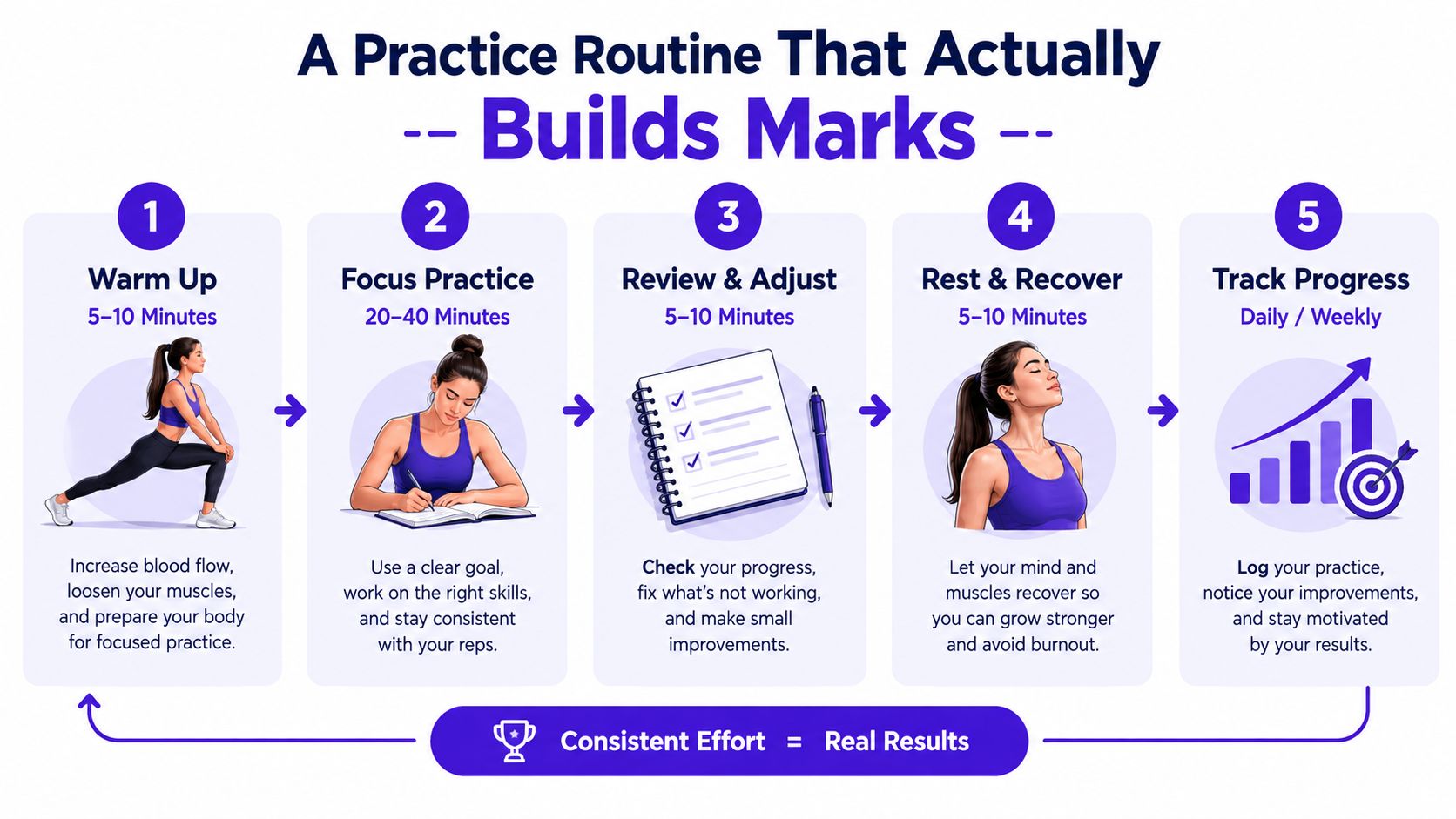
The four-part routine
Choose one paper on purpose
For GCSE, that means the correct J560 tier. For A Level, it means the correct OCR route and paper. Sit it in silence, with no notes, no phone, and a visible clock. Match the official duration for your course.Mark like an examiner, not like a disappointed student
Use a coloured pen. Go line by line. If the mark scheme gives credit for method, tick the method mark even if the final answer is wrong. A lot of students are harsher than OCR is.Keep an error log
One notebook page is enough. Write the question number, the topic, and the exact slip. Not “bad at algebra”. Write “missed negative sign in rearranging” or “used wrong probability denominator”.Re-attempt later
Leave it, then return on a fresh page. The point is to prove the fix held, not to admire a corrected answer while it's still warm in your memory.
The part students skip
Most improvement hides in the bit after marking.
OCR's GCSE examiner reports are built to identify technical aspects examined in the questions, point out where performance was strong or weak, and explain why candidates struggled, including issues caused by lack of knowledge or poor exam technique in the OCR GCSE examiner report material. That means your routine shouldn't stop at a score. It should end with a reason.
If you want to practise timed work digitally, Exam Practice for GCSE is one way to recreate pressure without losing the structure of paper, mark, review, and repeat.
A marked paper with no follow-up is just a diary entry. A marked paper with an error log becomes revision.
That's the difference between feeling busy and moving.
Reading Examiner Reports Like a Marker
Examiner reports are one of the least glamorous revision tools in maths, which is exactly why strong students use them. They aren't there for entertainment. They're there to show you where candidates gave away marks in ways that felt small at the time.
Start with the comments that describe difficulty. OCR's reports are useful because they don't just say a question was hard. They explain the kind of misunderstanding behind the dropped marks.
What to look for first
Open the report next to your marked paper and scan for patterns like these:
Candidates struggled to interpret the question
Usually means a reading or setup issue, not pure content knowledge.Responses lacked clear working
Usually means method marks were available but invisible.Errors occurred in a later step
Often means the student started correctly and then lost accuracy.Units, rounding, or notation caused problems
This is exam technique. Annoying, but fixable.
| Recurring Examiner Comment | What It Usually Means | One Concrete Revision Action |
|---|---|---|
| Candidates misread the question | You rushed the setup | Underline what is being asked before writing any method |
| Insufficient working was shown | You may know the maths but didn't display it | Write one extra line of method on multi-mark questions |
| Many lost the final mark | The process was mostly right but accuracy slipped | Do a short set of finish-the-solution questions under time pressure |
| Units or conversions caused errors | Technique broke under pressure | Drill conversion and unit-check questions this week |
Turn a report into an action
Say your answer to a Higher GCSE question had the right first method, the second line was still acceptable, then the final answer fell apart because you converted units wrongly. That's not “I'm rubbish at ratio” or “I don't get worded problems”. It's much narrower.
Your revision action becomes specific. Practise conversions. Re-do that question. Then test the same skill again without looking.
For the marking stage, using official ocr mark schemes alongside the report helps you separate a real knowledge gap from a presentational one. Teachers know this matters. Students often don't, until they realise a weak-looking solution still picked up method marks they would have thrown away.
Read examiner reports with a pen in your hand. Every comment should become either a note in your error log or a topic to revisit.
That's how the reports start earning their place.
Targeting Weak Topics Without Burning Out
When students panic, they revise everything at once. That usually means they do a bit of algebra, half a paper, a video on histograms, then nothing sticks.
A better approach is narrower. Keep one slot for your weakest topic, one slot for mixed exam practice, and one slot for repairs from your error log. That gives revision enough variety to stay useful without becoming a blur.
Use the paper structure to choose the topic
For GCSE, look at the questions you're repeatedly missing and group them by topic family. Don't overcomplicate it. Algebra, ratio, geometry, probability, graphs. OCR papers revisit core areas regularly, so repeated weakness in one family is worth attacking directly.
For A Level, the structure helps even more. OCR's current specification gives you a consistent three-paper format, so students can organise practice by paper role rather than guessing from question titles. That makes it much easier to decide whether your next session should be a full paper, a pure-skills session, or a targeted statistics or mechanics repair job.
Keep the weekly plan small
Three focused sessions per maths subject per week is enough if the sessions are deliberate.
Weak-topic slot
Use OCR topic questions or selected past-paper questions on the one area that keeps costing marks.Mixed-paper slot
Sit a section or a full paper in timed conditions so you don't become good only at isolated textbook questions.Repair slot
Re-do the questions from your notebook that exposed actual mistakes.
If you need a structure for spacing those returns, the MasteryMind revision technique guide gives a sensible framework for revisiting material after the first attempt instead of cramming everything into one long evening.
Stop before your brain goes foggy
There's a point where more topic drills stop helping. You'll notice it when you can do the skill neatly in isolation, but still drop marks when it appears in a mixed paper.
That's your cue to switch back to fuller OCR maths past papers. Not because topic work failed, but because the next stage is applying it under exam conditions.
Why More Papers Is Not Always the Answer
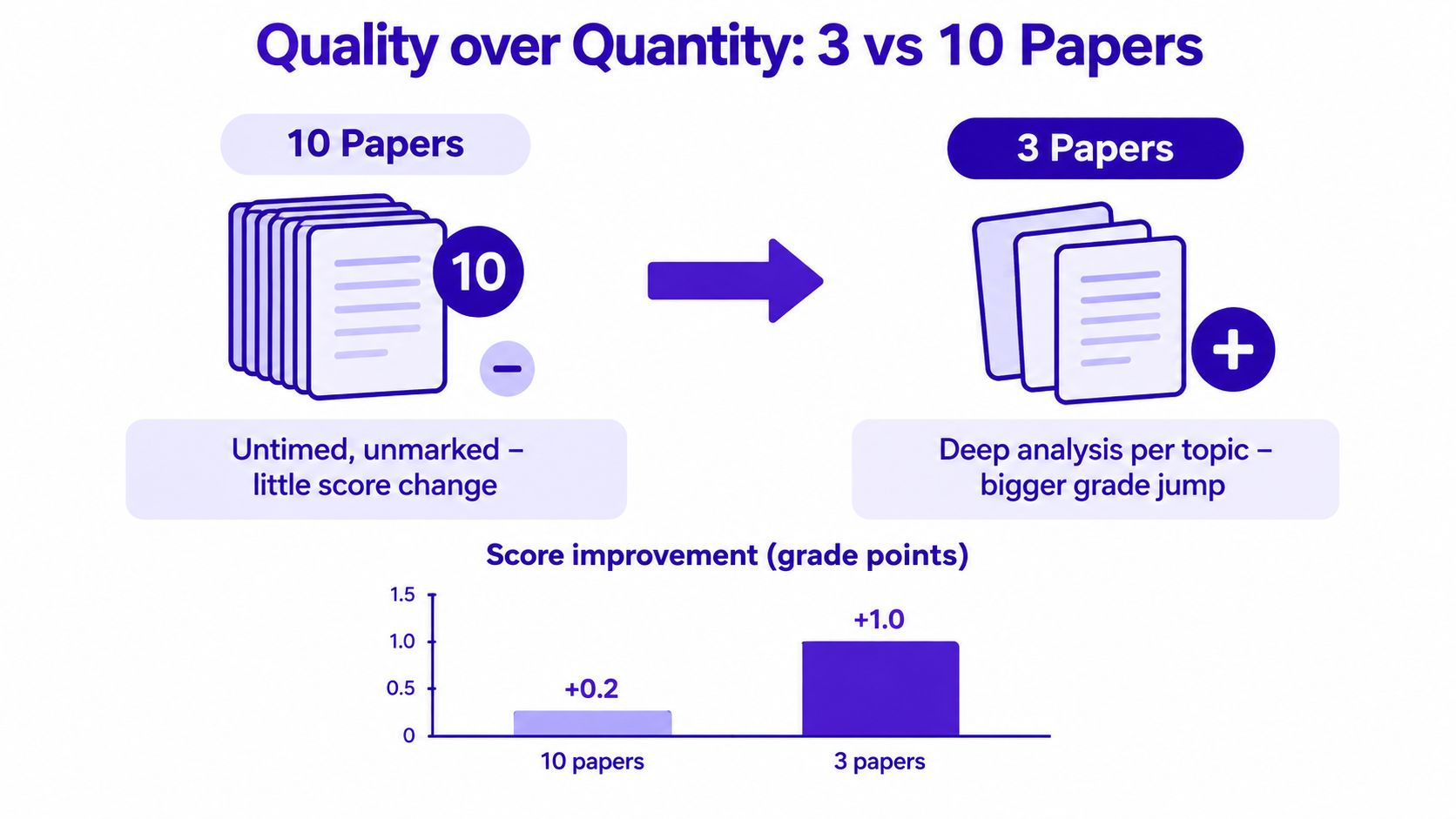
Students like counting papers because it feels concrete. “I've done eight papers” sounds productive. Sometimes it is. Often it just means the same mistakes have been repeated eight times with better stationery.
Examiners don't reward volume. They reward what is on the page.
The difference between 2 out of 5 and 4 out of 5
Take a typical multi-mark maths question. A student who gets 2 out of 5 may have identified the right topic and written one useful step, then drifted off course. A student who gets 4 out of 5 may use exactly the same opening, but keeps the method organised, labels values clearly, and avoids one final slip.
That's why checking the total score isn't enough. The gap between those two answers is rarely “work harder”. It's usually one of these:
- Method broke halfway through
- Working wasn't clear enough to reward
- Arithmetic or algebra slipped near the end
- The final instruction was ignored
Deep review beats random repetition
Doing another full paper immediately can feel virtuous. It can also hide the fact that you never fixed the actual reason marks were lost.
Students improve faster when they ask:
- Which mark did I lose first?
- Did I understand the method?
- Did I show enough for method marks?
- Was this knowledge, accuracy, or technique?
That style of review mirrors how an examiner reads a script. They don't care that you revised for three hours. They can only award what they can see.
More papers help only when each one changes the next attempt. If nothing changes, you're rehearsing the same score.
There's also a practical reason not to burn through every available PDF too early. OCR's older materials exist across different paper names and legacy structures, with archived OCR A Level maths listings stretching from June 2005 through June 2019 on long-running revision archives such as Colman Web's OCR A Level mathematics listings. That historical depth is useful, but only if you understand whether you're using it for current-spec style, old-topic drilling, or broader pattern spotting.
The sharpest students don't just do more. They get more out of each paper they do.
Your Four Week OCR Maths Revision Plan
A good four-week plan should remove the nightly debate about what to do next. You shouldn't be standing over your desk negotiating with yourself.
For GCSE, start with a paper from a slightly older live series, then move towards the more recent ones. For OCR J560, live June-series papers begin in 2017, and students also have official specimen material to practise with according to Study Vector's OCR GCSE maths paper index. That gives you a sensible runway without touching the very latest paper first.
For schools, there's one admin point worth knowing. JCQ says past examination question papers, internal school tests, and mock examinations must not be kept in a centre's secure storage facility, and exam materials should only be accessed in line with the awarding body's instructions in the JCQ Instructions for Conducting Examinations. Teachers will already know why that matters. Students benefit from knowing that paper handling has rules too.
A four-week model that works
| Week | Papers to Attempt | Core Task | Feedback Source |
|---|---|---|---|
| Week 1 | One older live paper or specimen paper that matches your tier or route | Sit under full timed conditions and mark carefully | Official mark scheme and your own error log |
| Week 2 | One second paper from a different series, plus selected weak-topic questions | Separate knowledge gaps from exam-technique slips | Mark scheme plus examiner report comments |
| Week 3 | One recent paper and one short re-attempt set from logged mistakes | Shift from paper volume to adaptive repair work | Error notebook, re-attempts, and report patterns |
| Week 4 | One of the most recent suitable papers, or a full timed section if energy is low | Practise pacing, finish quality, and calm decision-making | Final mark review and last-round correction list |
What each week should feel like
Week 1 is diagnostic. Don't obsess over the score. Your job is to find out where marks leak.
Week 2 is usually where students start seeing the same issue appear twice. That's helpful. Repeated mistakes are easier to fix than random-looking ones.
Week 3 is the pivot. By now, a seventh extra paper often helps less than targeted repair. Examiner-aligned feedback becomes more useful than sheer volume.
The checklist to stick above your desk
Right qualification
OCR GCSE J560 or the correct A Level OCR routeRight paper
Correct tier, correct series, correct componentReal timing
Full official duration, no pausingProper marking
Method marks counted, not just final answersError log updated
Every lost mark given a reasonReport checked
Common candidate mistakes compared with your ownWeak topic repaired
Before the next full paper
One last practical note. OCR says papers are generally available on its website for five years, but accessibility and completeness can vary because some files were made for print, some may remove third-party content, braille versions are available, and older materials may need a separate research service under the OCR past paper policy. So if a file looks awkward to use, that's not you being hopeless. Sometimes the format itself is the nuisance.
If you keep the system simple, OCR maths past papers stop being a pile of panic and become what they were supposed to be all along. Clear practice, clear feedback, and fewer repeated mistakes.
If you want extra help turning OCR maths past papers into organised revision, MasteryMind gives UK learners a way to practise exam-style questions, upload past papers, and get examiner-aligned feedback without losing the structure that makes paper practice useful. It's handy when you want your marking routine, weak-topic repair, and spaced review in one place rather than scattered across tabs and notebooks.
Ready to master this topic?
Practise with quizzes, blurt exercises and exam questions on MasteryMind.
7 days Premium · Then free forever · No card, no charge