Online Tutoring Economics: Your Guide to Acing Exams
You open the paper, read the question, and your brain goes blank.
“Assess whether government intervention is the most effective way to correct market failure.” You know the words. You've seen the diagrams. But turning that into a sharp, well-structured answer under time pressure feels like a different skill entirely.
That's where most students get stuck with economics. Not because they're lazy. Not because they're “bad at essays”. They're trying to revise a subject that demands content knowledge, diagram accuracy, application, and judgement all at once. If you're behind and trying to recover, or you're already decent and aiming for the top grades, the fix usually isn't “work harder”. It's getting the right kind of support, then using it properly.
Teachers know this too. A student can understand inflation perfectly well in class, then still throw marks away because they miss the command word, fail to apply to the context, or give evaluation that sounds generic. Economics punishes vague thinking fast.
Staring at a 25-Marker and Feeling Lost? Here's the Fix
A lot of students hit the same wall in economics around the middle of Year 12 or early in Year 13. Up to that point, they can survive on notes, flashcards, and half-remembered class explanations. Then the longer questions arrive and expose every weak spot at once.
A student might know what price elasticity of demand is, for example, but still freeze when asked to apply it to taxation, consumer behaviour, and firm revenue in one answer. Another might memorise definitions of externalities and market failure, then lose marks because the diagram is scruffy and the chain of reasoning never lands. That isn't unusual. It's normal.
Online tutoring changed the game because it gives students targeted help exactly where they're breaking down. It's no longer some niche extra for a tiny group of families either. The global online tutoring market was valued at USD 10.91 billion in 2025 and is projected to reach USD 26.03 billion by 2031, according to Mordor Intelligence's online tutoring market analysis. For UK students, that growth means more access to exam-focused support in subjects like economics.
What students usually get wrong
The biggest mistake is treating economics like a reading subject.
It isn't. Economics is a performance subject. You have to perform under exam conditions using the exact language and structure examiners reward. A proper online tutor helps you practise that performance. They can stop you halfway through an answer and say, “That point is descriptive, not analytical,” or “You've explained the policy but you haven't evaluated it.”
That sort of correction is hard to get from a textbook.
Practical rule: If your revision doesn't produce better answers on actual exam questions, it isn't enough.
What the fix looks like in practice
A useful tutoring setup does three things quickly:
- Identifies the core weakness. Not “market failure” as a whole, but maybe negative production externalities, weak chains of analysis, or poor judgement in conclusions.
- Explains it live. You ask the awkward question you didn't want to ask in class.
- Checks whether you can now use it. That's where automated assessment tools can help between sessions, because understanding something once is not the same as being able to write it under pressure.
If you're staring at a 25-marker and feeling lost, don't panic and don't just reread the chapter. Get specific. Find the exact skill that's failing, then attack that.
Why Online Economics Tutoring Actually Works
Online economics tutoring works when it's focused, structured, and tied to exam performance. It fails when it turns into a cosy chat about the topic.
That distinction matters.
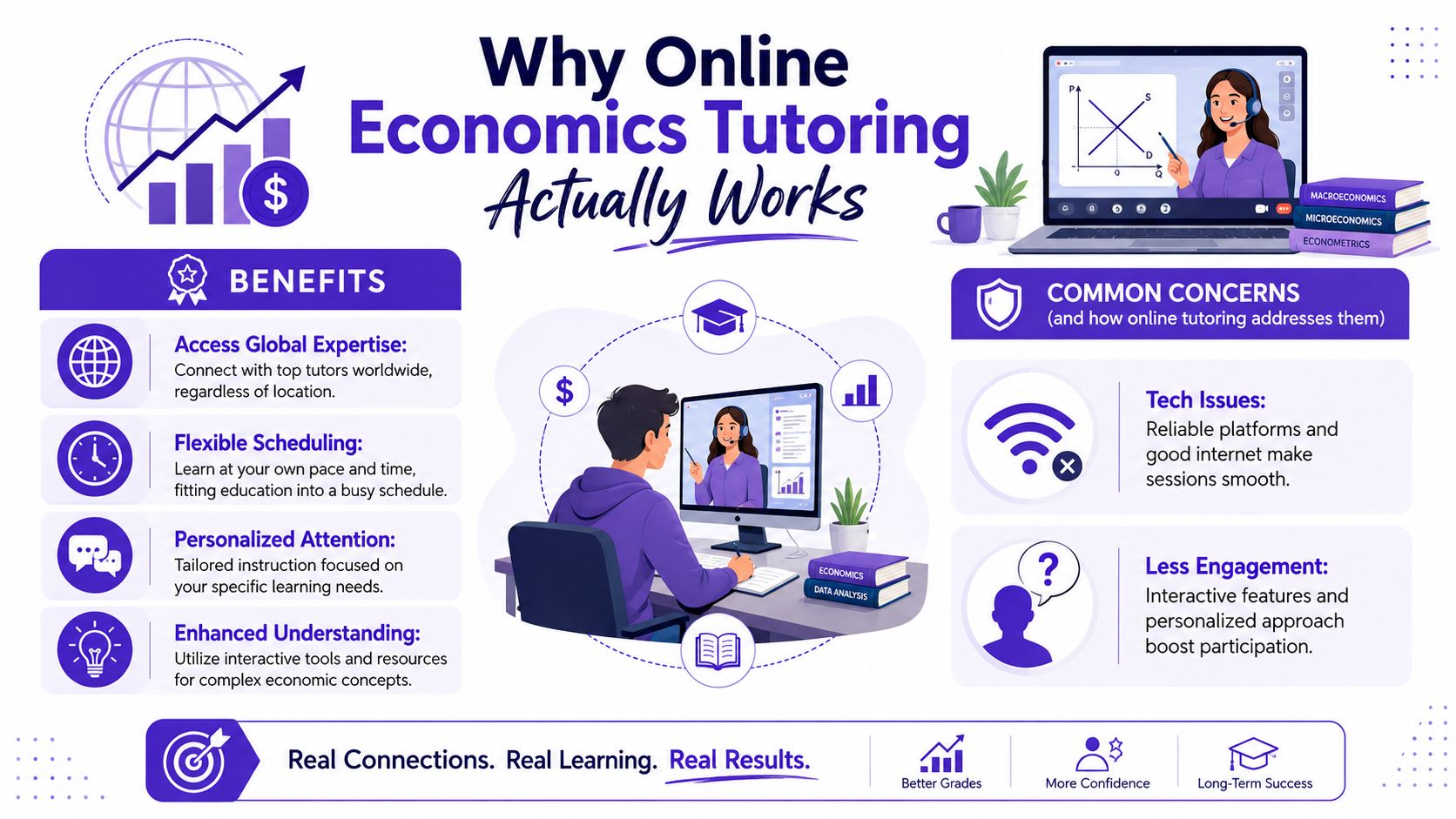
A proper session gives you something school often can't. You can interrupt instantly. You can say, “I still don't get why the deadweight loss triangle appears there,” and stay on that point until it clicks. You can share your screen, draw the diagram, get corrected in real time, and then try again. In a classroom, that's hard. Online, it's efficient.
It gives you honest feedback fast
Economics students often don't need another explanation of the topic. They need someone to point out exactly where their answer stops earning marks.
That could be:
- Weak application. You mention a real-world issue from the question, but you don't link it properly to the theory.
- Thin evaluation. You tack on “however” and think that counts.
- Broken analysis. Your answer jumps from policy to outcome without showing the mechanism.
Online tutoring is effective because a tutor can isolate those faults immediately. Then you practise fixing them while the mistake is still fresh.
Consistency matters more than intensity
The strongest evidence for online tutoring isn't based on wishful thinking. Independent research on a randomised online tutoring programme found that three hours of individual tutoring per week increased maths performance by 0.22 standard deviations, with stronger effects at higher dosage, as reported in the American Economic Association study. The study isn't UK-specific and it focuses on maths, but the lesson is clear. Consistent, focused online support can produce meaningful academic improvement.
Economics rewards that kind of repetition. Not endless repetition of notes, but repeated correction of thinking.
Online tutoring works when the student turns up with questions and the tutor turns those questions into better exam habits.
It suits students who need flexibility
Some students are trying to recover from a messy term. Others are already strong but want sharper essays and cleaner evaluation. Online sessions fit both.
You can slot them around school, sport, or part-time work. You also get access to specialist support beyond your local area. That matters in subjects where teacher confidence and student demand vary a lot.
If your household is looking across subjects, it helps to compare what makes tutoring effective more broadly. There's a useful example of how structured support can boost science grades and confidence through clear teaching and flexible delivery. The principle is the same in economics. Targeted help beats vague encouragement.
For students who need extra independent practice between sessions, these resources for A Level students can help fill the gaps without wasting time on unfocused revision.
How to Find an Economics Tutor Who Gets It
A polished profile means nothing if the tutor can't teach economics the way exams reward it.
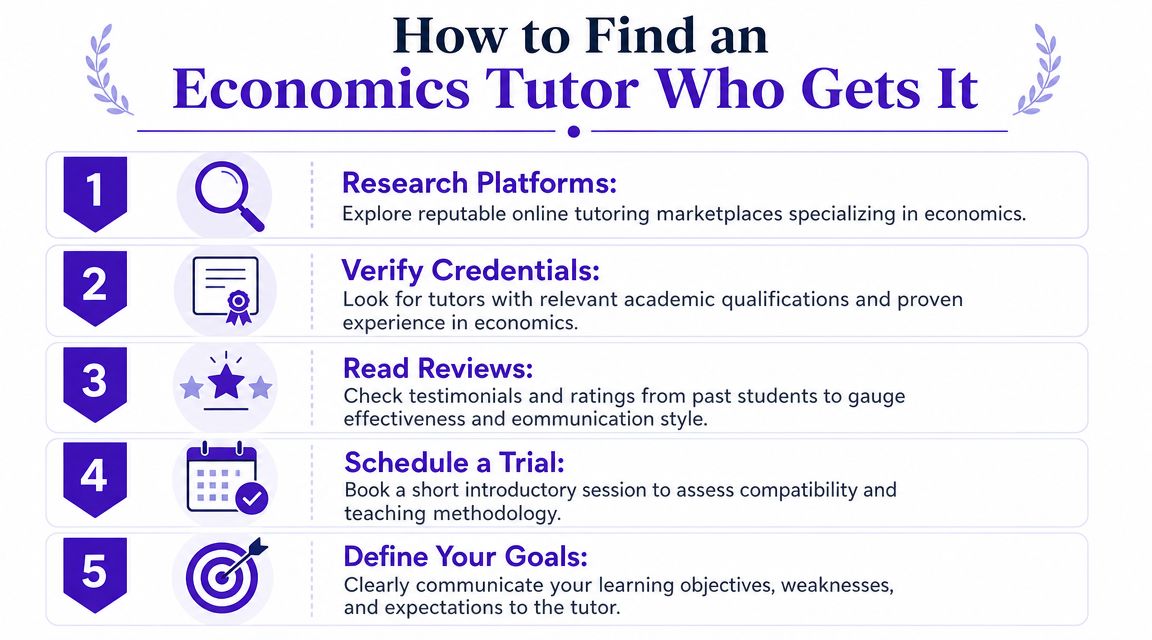
You're not hiring someone to “go over content”. You're looking for someone who understands specification language, mark schemes, and how students lose marks on the same topics again and again. A-level economics tutoring works best when it focuses on command words, assessment objectives, worked examples, essay planning, and targeted feedback on higher-mark questions, as noted in this overview of economics tutoring approaches.
The profile checklist that matters
Ignore the shiny adjectives for a minute. Look for signs that the tutor can improve your papers.
- Exam-board fluency. Do they mention AQA, Edexcel, OCR, or WJEC clearly, or are they speaking in broad slogans?
- Essay experience. Can they help with 15, 20, and 25-mark responses, not just short questions?
- Diagram teaching. Economics is visual. If they never mention diagrams, that's a concern.
- Feedback style. You want evidence that they correct structure, application, and evaluation, not just whether your economics is “basically right”.
A student who wants an A or A* should be picky. A student trying to pull a grade up fast should be even pickier.
Questions to ask in the trial session
A trial lesson should feel like an interview, not a sales call.
Ask direct questions such as:
- How do you teach evaluation in long essays?
- What do you do when a student understands the topic but still scores badly?
- How do you adapt for different exam boards?
- Will you mark my paragraphs and explain why they do or don't score?
- How do you use past-paper questions in sessions?
If the answers are vague, move on.
Ask this directly: “When I write a weak paragraph, how would you diagnose whether the problem is knowledge, analysis, application, or evaluation?”
That one question exposes a lot.
Here's a useful short video if you want to compare tutoring styles and think more carefully about what “good teaching” looks like in practice:
Don't confuse convenience with quality
Some platforms make it easy to book. That doesn't mean the tutor is right for economics.
A simple way to judge them is this table:
| What weak tutors do | What strong tutors do |
|---|---|
| Re-explain the textbook | Train you to answer actual questions |
| Praise effort without diagnosis | Identify the exact reason marks were lost |
| Cover broad topics | Break topics into exam skills |
| Talk most of the session | Make you think, explain, and write |
If you're a parent or tutor looking at the practical side of online teaching, systems matter too. Even admin affects reliability. Something as basic as managing language teacher payments shows how better organisation supports smoother tutoring relationships in any subject.
Maximising Every Minute of Your Tutoring Session
Students waste tutoring time in the same predictable ways. They turn up late, haven't looked at the topic, can't find the question they struggled with, and expect the tutor to somehow rescue the session.
Don't do that.
Tutoring is expensive in time, energy, and usually money. Treat each session like a high-value workshop. If you prepare properly, one hour can fix a week's worth of confusion. If you drift in unprepared, that same hour vanishes into half-useful explanation.

Before the session
Your tutor shouldn't have to guess what you need.
Send over the material in advance. That could be a past-paper question, a paragraph you wrote, a list of weak topics, or even a photo of a marked essay. The more specific you are, the sharper the session becomes.
Use this pre-session checklist:
- Pick one main struggle. “Market failure” is too broad. “My evaluation on indirect taxes is weak” is useful.
- Send evidence. A question, your answer, and any teacher comments are enough.
- Write down what confuses you. Don't rely on memory once the call starts.
- Review the basics first. Your tutor should fix problems, not read definitions to you for the first time.
During the session
In this scenario, students either improve quickly or sit there passively.
Talk through your thinking. Draw the diagram yourself. Ask the tutor to stop and challenge your explanation. If they solve everything for you, you'll feel better for an hour and still mess it up in the exam.
A strong session often includes things like:
- Live annotation on shared documents or whiteboards
- Think-aloud modelling where the tutor explains how they build analysis or evaluation
- Mini rewrites of poor paragraphs rather than full model answers handed to you
- Quick checks on linked ideas so the session doesn't stay trapped in one narrow point
If you can't explain a diagram out loud without notes, you don't know it well enough yet.
That applies whether you're dealing with subsidies, tariffs, or labour markets.
Sometimes it helps to anchor abstract theory to simple calculations. If you're shaky on business costs, for instance, revisiting total cost calculation principles can sharpen the logic behind firm behaviour questions.
After the session
The session isn't the result. What you do after it is the result.
Within a day, you should use what you learned on a fresh question. Not the same one. A related one. That's how you find out whether the fix has stuck.
Try this short routine:
- Rewrite your notes into a compact page of rules or reminders
- Redo one weak paragraph from memory
- Attempt a related exam question under timed conditions
- Flag what still feels shaky so the next session starts fast
Students who improve fastest don't just attend tutoring. They build a routine around it.
Common Tutoring Pitfalls and How to Avoid Them
A lot of tutoring is mediocre.
That's the truth parents and students need to hear. Some tutors are knowledgeable but disorganised. Some are friendly but soft. Some know economics well and still can't teach it in a way that raises marks. If you choose badly, tutoring becomes expensive reassurance.
There's also a fairness issue in the background. A 2024 Sutton Trust report found that 30% of pupils in England have had private tutoring, with use highest among GCSE and A-level students, as noted in this summary of private tutoring demand. Online delivery can reduce some access barriers, but cheaper doesn't automatically mean effective.
The red flags students ignore
Students often stay with weak tutoring for too long because they like the tutor personally.
That's understandable, but it's not the point. If the sessions aren't changing how you answer questions, the relationship isn't doing its job.
Watch for these warning signs:
- No structure. Every session starts with “So, what do you want to do today?” and never builds into a plan.
- No exam focus. The tutor explains economics well but doesn't train you for mark schemes.
- Too much talking. They perform knowledge at you while you sit.
- They rescue you too quickly. The tutor gives the answer before making you think.
- No visible progress checks. Nobody tracks whether your weak areas are narrowing.
Price is not the main filter
Families often start with price. That's understandable too. But low cost can become high cost if the tutoring is vague and drags on.
A better question is: does this tutor create clear movement in the skills that matter?
| Good value tutoring | Poor value tutoring |
|---|---|
| Focuses on specific exam weaknesses | Covers topics in a broad, repetitive way |
| Gives feedback you can use immediately | Gives praise without diagnosis |
| Builds independent habits | Creates dependence on the tutor |
| Makes each session measurable | Leaves progress feeling fuzzy |
A tutor should make themselves less necessary over time, not more.
If you're not becoming more independent, something's off.
Fix the problem early
Don't wait months to act.
If a session feels unfocused, say so. Ask for more past-paper work. Ask for written targets. Ask the tutor how they'll improve your evaluation, your data response technique, or your diagram explanations. Good tutors won't be offended. Weak ones usually get defensive.
And if the fit is wrong, switch. Better to lose one session than lose a term.
The Ultimate Combo: Your Tutor Plus Smart AI Practice
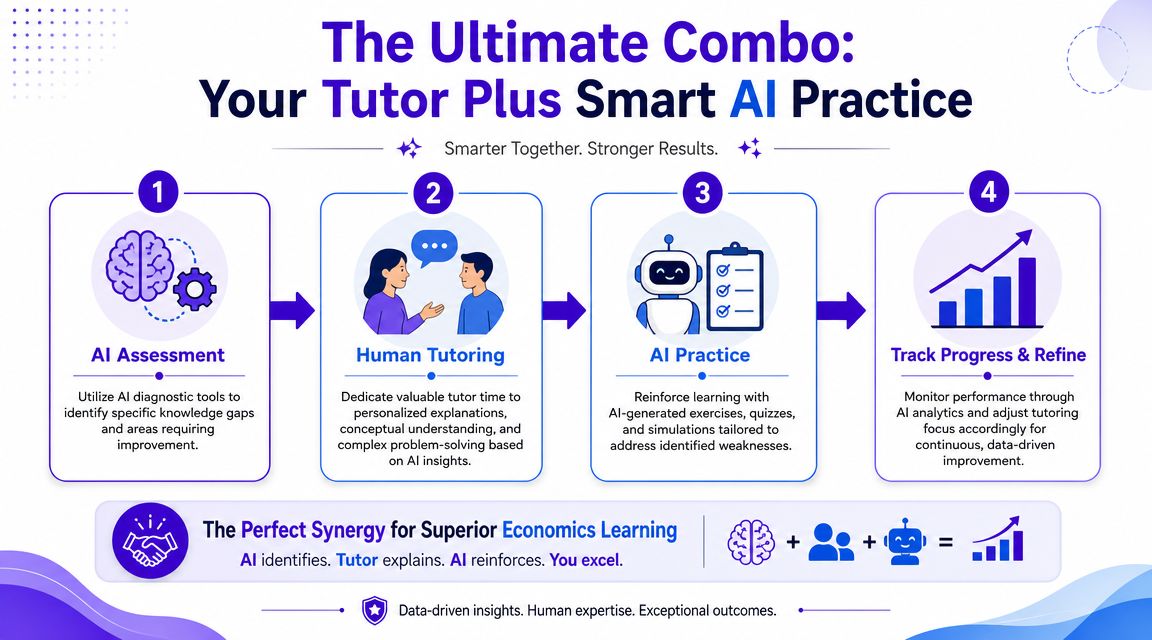
The smartest way to handle online tutoring economics isn't tutor only and it isn't AI only. It's both, used for different jobs.
Human tutoring is best for the parts of economics that need judgement, live questioning, and flexible explanation. AI practice is best for repetition, retrieval, feedback loops, and examiner-aligned drilling at scale. Put them together and you get a proper study ecosystem instead of a patchwork of random revision.
That matters because one of the biggest problems in UK economics support is misalignment. Students don't just need “help with economics”. They need help with the exact wording, structure, and standards of their exam board. A key issue for UK students is whether tutoring helps with specific mark schemes. With economics being a niche A-level, many learners need direct support with command words and essay structure for AQA, Edexcel, or OCR, and targeted AI practice can help fill that gap, as discussed in this guide to finding economics tutoring support online.
What the tutor should do
Use tutor time for the hard stuff.
Not for copying notes. Not for reading the specification aloud. Use it for the problems that need a human brain in the room.
That includes:
- Conceptual knots. Why a tariff might improve one group's welfare while damaging another.
- Essay planning. Turning a messy set of ideas into a clear line of argument.
- Socratic challenge. A tutor pressing you on whether your evaluation evaluates.
- Repairing bad habits. Fixing a weak introduction, shallow chain of reasoning, or lazy conclusion.
This is where live dialogue matters. A strong tutor can hear your thinking break down in real time.
What AI should do
AI is most useful when it handles the volume work that students usually avoid.
That means regular low-friction practice, quick checks, and repeat exposure to weak areas without needing to book another lesson every time. One option in this space is the MasteryMind adaptive revision platform, which is built around UK exam specifications and can be used for examiner-aligned practice, command-word training, and feedback between tutoring sessions.
That's the right division of labour. Human for nuance. AI for scale.
A practical weekly loop might look like this:
- Diagnose weak areas with AI practice
- Bring the worst gaps to your tutor
- Get live correction and strategy
- Return to AI for repetition and consolidation
That loop is far stronger than waiting a week between tutor sessions and doing vague revision in between.
Why this ecosystem works better than either one alone
Students often expect one tool to do everything. It won't.
A tutor can't always provide endless custom questions, instant marking on demand, and daily retrieval practice. AI can't fully replace the live pushback that sharpens judgement and clears up confusion. Together, they cover each other's limits.
Teachers tend to be sceptical of AI for good reason. A lot of it is generic. A lot of it is sloppy. The only useful kind is tightly aligned to specifications and mark schemes, with boundaries that support learning rather than shortcut it.
That principle applies beyond education as well. In other fields, people use specialist tools for one exact job rather than expecting a single platform to do everything. For example, creators looking for production support might use an AI video solution for creators for one part of the workflow while still relying on human input for judgement and refinement. Revision works the same way. Use the right tool for the right task.
The goal isn't to replace the tutor. The goal is to stop wasting tutor time on tasks a smart system can handle faster.
If you're serious about improving in economics, build an ecosystem. Use tutoring to fix thinking. Use AI to stress-test it repeatedly. That's how grades move.
If you want a cleaner revision system for GCSE or A-level economics, MasteryMind gives you specification-aligned practice, examiner-style feedback, and adaptive question flow that fits around tutoring instead of trying to replace it. Use it to spot weak areas, practise command words properly, and make each tutor session more focused.
Ready to master this topic?
Practise with quizzes, blurt exercises and exam questions on MasteryMind.
7 days Premium · Then free forever · No card, no charge