Osmosis in Plants: Your Ultimate GCSE & A-Level Guide 2026

You've probably landed here in one of two moods.
Either your biology exam is getting uncomfortably close and “osmosis” still feels like one of those words you can define but not really use, or you're the kind of student who wants every easy mark available and knows this topic shows up everywhere. Teachers know that too. Osmosis turns up in cell biology, plant transport, practical work, graph questions, required practicals, and those annoying explain questions where vague wording loses marks fast.
The good news is that osmosis in plants is one of the most learnable topics in biology. Once the logic clicks, a lot of plant biology stops feeling random. Wilting makes sense. Root hair cells make sense. Stomata make sense. The potato practical stops being a recipe and starts becoming a story about water potential.
Why Your Sad Houseplant Is a Tiny Physics Lesson
A drooping plant looks like a care problem. In biology, it's also a water movement problem.
You water the plant, and a few hours later the leaves often look firmer. That change isn't magic and it isn't the water “going straight to the leaves” in some cartoon way. It starts with osmosis, the movement of water through a partially permeable membrane.
What you're actually seeing
Plant cells need water inside them to stay firm. When water enters those cells, the contents push outward against the cell wall. That pressure helps stems and leaves stay upright. When cells lose water, that support drops and the plant starts to look limp.
A lot of students stop at “plants need water”. Exams want the next layer. They want the mechanism.
Practical rule: If a question asks why a plant wilts, don't stop at “not enough water”. Go further: reduced water uptake means less turgor pressure in cells.
That's why this topic matters beyond a definition. Osmosis helps explain:
- Why roots absorb water
- Why leaves become floppy
- Why stems stay firm
- Why watering habits matter
If you've ever looked up care for a thirsty fiddle leaf fig, guides like Jungle Story's plant care advice are really describing the visible consequences of cell water balance, even when they're written for plant owners rather than exam students.
Why exam boards love this topic
AQA, Edexcel, OCR, and WJEC all reward precision here. They don't just want “water goes in”. They want phrases like down a water potential gradient, through a partially permeable membrane, and turgor pressure.
That's the difference between sounding like you half-remembered Year 9 and sounding like someone who knows exactly what's happening.
The Core Rules of Water Movement in Plants
The simple GCSE definition of osmosis is useful, but it's only the starter version. The stronger answer uses water potential.
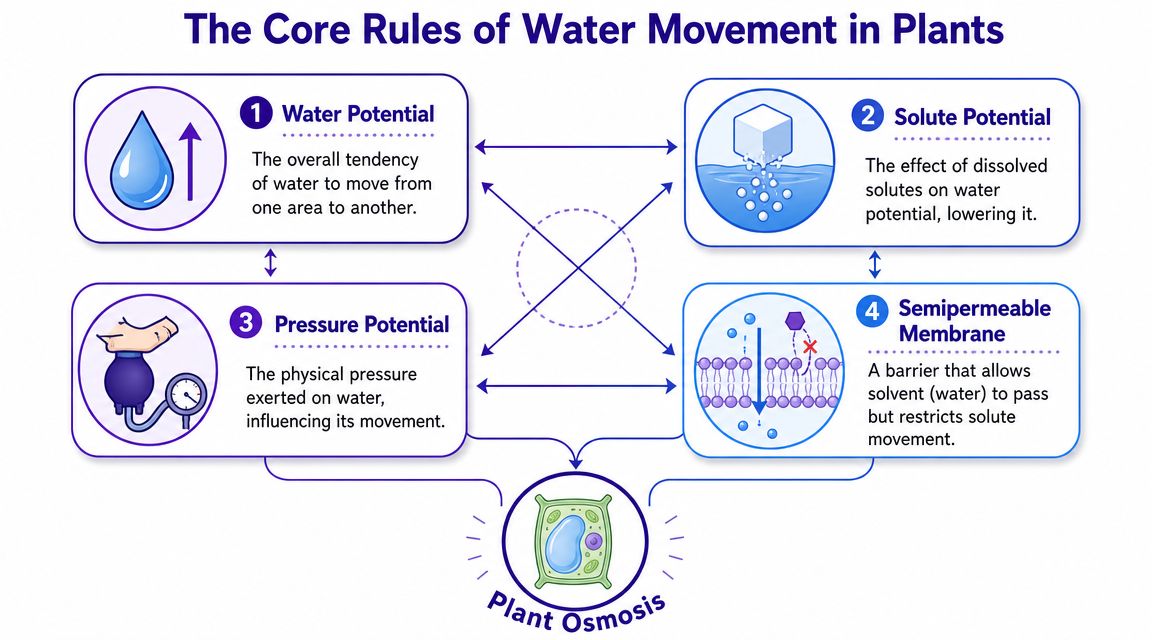
Think of water potential as the tendency of water to move. Water moves from higher water potential to lower water potential. That's the rule underneath almost every exam question on osmosis in plants.
Water potential without the waffle
A good analogy is a ball rolling downhill. The ball moves because there's a difference in height. Water moves because there's a difference in water potential.
The key fact is that, at cell level, osmosis in plants is driven by water-potential differences rather than a simple “water concentration” rule. Adding solutes lowers water potential, so water moves toward the compartment with the higher solute concentration, meaning the lower water potential, as explained in StatPearls on osmosis and osmotic pressure.
That one idea clears up a lot of confusion.
The two big influences
At A-Level, and in top GCSE answers, it helps to separate the causes clearly.
| Factor | What it does | What students should say |
|---|---|---|
| Solute potential | Dissolved substances lower water potential | More solute means lower water potential |
| Pressure potential | Physical pressure affects the movement of water | Pressure can oppose or contribute to movement |
If you add sugar or salt to water, you lower its water potential. Water is then more likely to move into that solution if there's a partially permeable membrane separating it from a region with higher water potential.
Water doesn't “decide” where there is less water. It moves according to a water potential gradient.
That wording is much better than “from dilute to concentrated”, which can work in basic questions but often causes mistakes when pressure is involved.
Why this matters in real plants
Roots only absorb water well if there's a suitable gradient between the soil and the root cells. If the compost dries out badly, that gradient weakens. The cells can't draw water in effectively, and the plant begins losing firmness.
That's why tools people use for keeping soil moisture more stable, like Little Green Leaf hydration solutions, are really about maintaining the conditions that let osmosis keep happening.
The membrane matters too
Osmosis only happens across a partially permeable membrane. Water can pass through. Some solutes cannot pass through freely.
That phrase matters. In exams, write partially permeable membrane, not “semi-permeable skin” or “thin layer” unless the question gives different wording.
A compact exam answer usually needs these pieces:
- Water moves from higher to lower water potential
- Movement is across a partially permeable membrane
- Solutes lower water potential
- Pressure can affect water movement in cells
Get those four ideas straight and a lot of plant biology becomes easier to reason through.
A Day in the Life of a Plant Cell
Take one plant cell and move it between different solutions. Suddenly, osmosis stops being abstract.
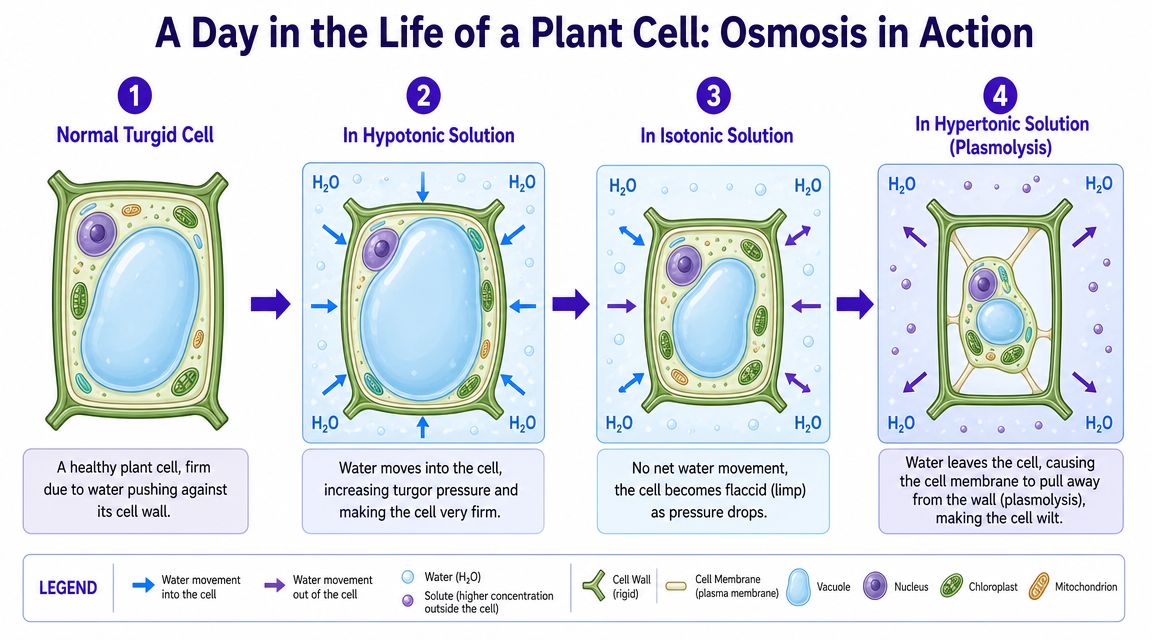
A plant cell has a cell wall on the outside and a cell membrane just inside it. The wall is strong and supportive. The membrane is the selective barrier that matters for osmosis.
In pure water
Put the cell in water with a higher water potential than the cell sap. Water enters by osmosis. The vacuole swells, the cell contents press outward, and the membrane pushes against the wall.
The cell becomes turgid. That means firm and swollen with water, not bursting. The wall stops it from bursting.
In a balanced solution
If there's no net movement of water, the cell won't build much internal pressure. It becomes flaccid.
Students often mix up flaccid and plasmolysed. They are not the same thing. Flaccid means the cell is limp because pressure is low. The membrane has not pulled dramatically away from the cell wall.
In a concentrated solution
Now place that cell in a solution with lower water potential than the cell interior. Water leaves the cell. The vacuole shrinks. The membrane can pull away from the wall.
That is plasmolysis.
| Cell state | What happens to water | What the examiner wants to hear |
|---|---|---|
| Turgid | Water enters | High turgor pressure supports the cell |
| Flaccid | No net gain of water | Pressure is reduced |
| Plasmolysed | Water leaves | Membrane pulls away from the wall |
If you can define turgid, flaccid, plasmolysed, and turgor pressure cleanly, you've already secured a lot of marks on this topic.
Why these changes can happen quickly
This isn't all happening by painfully slow leakage. Plants use aquaporins, specialised water channels in membranes. A review in Plant Physiology describes aquaporins as major routes for water transport across membranes, with fluxes that can exceed simple diffusion through a lipid bilayer by orders of magnitude, and notes they can transport about 10^9 water molecules per second in this Oxford Academic review on aquaporins in plants.
That matters because plants often need rapid changes in water balance, especially in cells involved in movement and gas exchange.
A useful mental picture
Think of the cell wall as a rigid box and the cell membrane plus contents as a water-filled balloon inside it.
- More water in: the balloon presses firmly against the box
- Less water in: the balloon relaxes
- Water leaves strongly: the balloon shrinks away from the box
That's much closer to reality than the common but unhelpful idea that the whole cell just “gets bigger or smaller”.
If you want a real-world extreme version of how plants handle water stress, how do cactus survive is a helpful read because desert plants are basically specialists in controlling water loss and storing water effectively.
How Osmosis Powers the Whole Plant
A single cell becoming turgid is interesting. A whole plant staying alive is better.
Osmosis in plants matters because it scales up. The same movement of water at cell membranes supports water uptake from soil, keeps soft tissues firm, and helps guard cells control stomata.

Root hair cells start the process
In UK-grown plants, osmosis is the primary mechanism for water uptake. The Royal Horticultural Society explains that water moves from moist soil into root cells by osmosis, after which it passes through root tissues into xylem for upward transport in their guide to how plants absorb water.
Root hair cells are well designed for this. They sit in contact with the soil solution and help establish the conditions for water to enter. Once water enters these outer cells, it can move across the root and into the xylem.
A strong answer here separates two jobs:
- Osmosis loads water into root cells
- Other forces move water up through the xylem
That distinction saves marks.
Plants stand up because their cells are pressurised
Herbaceous plants don't have thick woody trunks holding everything rigid. Much of their support comes from turgor pressure.
When many cells are turgid at once, stems and leaves feel firm. When they lose water, the whole structure softens. That's why lettuce goes limp and why an unwatered basil plant can look tragic by the end of the day.
A wilting plant is often a tissue-level sign of cell-level water loss.
This is one of the nicest links in biology because the microscopic explanation and the visible result match so neatly.
Guard cells use osmosis cleverly
Guard cells sit around stomata on leaf surfaces. When they gain water, their shape changes and the stomata open. When they lose water, the stomata close.
Students often learn that as a separate topic, but it's part of the same story. Osmosis isn't just for roots. Plants use it again and again in different tissues for different jobs.
If your photosynthesis notes still feel shaky, it helps to pair transport ideas with clear explanations of PSII and PSI, because stomata, gas exchange, and water movement all feed into the bigger picture of plant function.
Water moves upward, but not by osmosis alone
This is the bit that catches people out. Water enters root cells by osmosis. But the upward movement in the xylem is mainly associated with transpiration pull, plus cohesion and adhesion.
A lot of weak answers blur all of that into one sentence and lose accuracy.
Here's a useful recap in motion:
One process, three visible outcomes
When examiners ask about osmosis in plants, they may be targeting different scales of understanding. The same core idea can appear as:
Root uptake
Water enters root hair cells from the soil.Support
Turgor pressure keeps non-woody tissues firm.Stomatal control
Guard cells change water content and alter pore opening.
That's why this topic feels as if it pops up everywhere. It does.
Nailing the Potato Osmosis Practical
The potato practical looks simple. It's also where students throw away marks through sloppy method, weak graph skills, and vague conclusions.
The core idea is straightforward. Potato cells gain or lose water depending on the water potential of the solution they're placed in. You measure that change through mass.
A method that actually scores marks
Cut potato cylinders or chips to similar size
Similar dimensions reduce variation. If one chip has a much larger surface area, it may exchange water differently.Measure the initial mass of each chip
You need a starting value or you can't judge change properly.Place chips into different sucrose concentrations
Each concentration creates a different external water potential.Leave them for the same length of time
Time is a control variable. Different durations would make the comparison unfair.Remove and gently dry each chip before reweighing
This matters a lot. If you leave solution on the outside, you aren't measuring the potato fairly. You're partly measuring liquid clinging to it.Measure final mass and calculate change
This tells you whether water entered or left the potato tissue.
What examiners want you to control
A better answer doesn't just describe the method. It names the variables.
| Type of variable | Good examples |
|---|---|
| Independent variable | Sucrose concentration |
| Dependent variable | Change in mass of potato chips |
| Control variables | Size of chips, volume of solution, time left in solution, temperature, type of potato |
If a question asks how to improve reliability, strong options include repeating each concentration and calculating a mean. If it asks for accuracy, students often mention using a cork borer and cutting chips to equal length.
Why percentage change in mass is often better
If potato chips don't all start at exactly the same mass, comparing raw mass change can be less fair. Percentage change helps standardise the comparison.
That's one of those details that lifts an answer from “I know the practical” to “I understand how data should be handled”.
Examiner move: If the chips had different starting masses, percentage change is usually the safer choice to discuss.
The graph and the isotonic point
Plot concentration on the x-axis and change in mass, or percentage change in mass, on the y-axis. The place where your line crosses zero is the important bit.
That point means the solution had the same water potential as the potato cells. There was no net movement of water.
Students often write “the potato did not do osmosis”. That's not right. Water may still move in both directions. The point is that there is no net movement overall.
Typical mistakes that lose marks
- Saying “water concentration” only when the question really needs water potential
- Forgetting to blot dry before final weighing
- Not naming control variables
- Confusing accuracy with reliability
- Writing “equal concentration” instead of “same water potential”
If you want extra practice on practical method, data, and graph interpretation, doing topic-specific questions from the best GCSE Biology quizzes is much more useful than just rereading notes.
A model conclusion
A strong conclusion sounds like this:
“The potato gained mass in more dilute solutions because water entered the cells by osmosis. It lost mass in more concentrated sucrose solutions because water left the cells. The concentration where there was no change in mass represents the solution with the same water potential as the potato tissue.”
That's concise, scientific, and mark-friendly.
Busting Common Osmosis Myths and Misconceptions
The biggest mistakes in osmosis in plants are nearly always language mistakes. Students half-know the idea, then phrase it in a way that sounds fine in conversation but falls apart in a mark scheme.
Myth one: osmosis moves water up the stem
It doesn't.
A common misconception is that osmosis moves water up the plant's stem. In reality, osmosis loads water into root cells from the soil, while upward movement through the xylem is mainly driven by transpiration pull, cohesion, and adhesion, as explained in this breakdown of osmosis and transpiration in plants.
Bad answer: “Osmosis pulls water up the plant.”
Better answer: “Osmosis moves water into root hair cells. Water then moves up the xylem mainly due to transpiration pull.”
Myth two: any membrane will do
For osmosis, exam boards want partially permeable membrane.
Not “thin membrane”. Not “cell wall”. Not “semi-solid barrier”. The cell wall is important for support, but the membrane is the selective barrier involved in osmosis.
Myth three: turgid means the cell is about to burst
That's much closer to what happens in animal cells in a hypotonic solution. Plant cells become turgid because the cell wall resists expansion. Turgid means firm and supported.
Myth four: diffusion and osmosis are the same thing
Osmosis is a special case involving water and a partially permeable membrane. If you blur the terms, your answer becomes less precise.
A quick correction table helps:
| Weak phrasing | Better phrasing |
|---|---|
| Water goes from where there is more water to less water | Water moves from higher to lower water potential |
| Osmosis takes water up the stem | Osmosis moves water into root cells |
| Water passes through the cell wall by osmosis | Water moves across a partially permeable membrane by osmosis |
If you want to sharpen this under timed conditions, Exam Practice for GCSE is the kind of thing that helps because it forces you to use exact wording instead of just recognising the right answer in your head.
How to Answer Exam Questions on Osmosis Like a Pro
Students often know more than they score. The problem isn't always knowledge. It's answer structure.
A high-mark response on osmosis in plants usually does three things well:
- uses precise vocabulary
- follows a clear cause-and-effect chain
- avoids mixing up osmosis, diffusion, and transpiration
GCSE style question
Question: Explain why a plant wilts when it is not watered.
Model answer:
When the soil has less available water, the water potential difference between the soil and root cells is reduced. Less water enters the root cells by osmosis through partially permeable membranes. As less water reaches plant cells, they lose turgor pressure and become less turgid. This makes leaves and stems lose support, so the plant wilts.
Why that answer works
It doesn't just say “the plant dries out”. It gives the chain.
- Reduced water availability outside the plant
- Less water uptake by osmosis
- Reduced turgor pressure
- Visible wilting
That's what examiners reward. If it's a 4-marker, you usually need a chain, not one isolated sentence.
A-Level style question
Question: Explain how osmosis contributes to turgor in plant cells and why pressure matters.
Model answer:
Osmosis is the movement of water across a partially permeable membrane down a water potential gradient. When water enters a plant cell, the vacuole expands and the cell contents push against the cell wall. This generates turgor pressure. Pressure matters because the physical explanation of osmosis involves pressure differences across the membrane, and that pressure contributes to the final equilibrium reached by the cell.
This answer is stronger because it moves beyond definition and links water movement to cell mechanics.
A modern physical explanation of osmosis includes a pressure drop across the membrane. Britannica's definition gives the broad concept of solvent movement through a semipermeable membrane, and a 2023 Journal of General Physiology article discussed in that context argues that osmosis is often misunderstood as mere diffusion and instead involves a pressure drop across the membrane, linking water flow to pressure and solute concentration in a way that matches experiment in biological systems, as summarised in Britannica's entry on osmosis.
Good exam answers usually earn marks because each sentence does a job. One defines. One explains movement. One links to outcome.
Keywords that raise your score
Use these when they fit the question:
- Water potential gradient
- Partially permeable membrane
- Turgor pressure
- Turgid
- Flaccid
- Plasmolysis
- Solute concentration
- Pressure
A quick mark scheme mindset
When you read an osmosis question, ask yourself:
- Is this asking for a definition?
- Is this asking for a mechanism?
- Is this asking for a result in the whole plant?
- Is this really a practical/data question in disguise?
If you practise enough past questions, patterns start repeating. For essay-style and longer-answer practice, A-Level Past papers are where you see that repetition most clearly.
The students who improve fastest are rarely the ones with the prettiest notes. They're the ones who train themselves to turn knowledge into mark-scheme wording.
If you want examiner-style practice on topics like osmosis, practicals, and longer biology explanations, MasteryMind is built for that exact job. It gives UK learners GCSE and A-Level questions aligned to major exam boards, with feedback that helps you tighten wording, fix weak logic, and practise until the science sounds like exam science.
Ready to master this topic?
Practise with quizzes, blurt exercises and exam questions on MasteryMind.
7 days Premium · Then free forever · No card, no charge