Physics Flash Cards for GCSE and A-Level

You don't need more cards. You need cards that find the exact mark you're losing, then make you fix it. That's true if you're behind and trying to recover ground fast, and it's true if you're keen and aiming for the top grades. Good physics flash cards don't copy the textbook. They force a short answer from memory, show you the mark point you missed, and send that card back soon enough to stick.
Why a Short Physics Deck Beats a Huge Unused Set
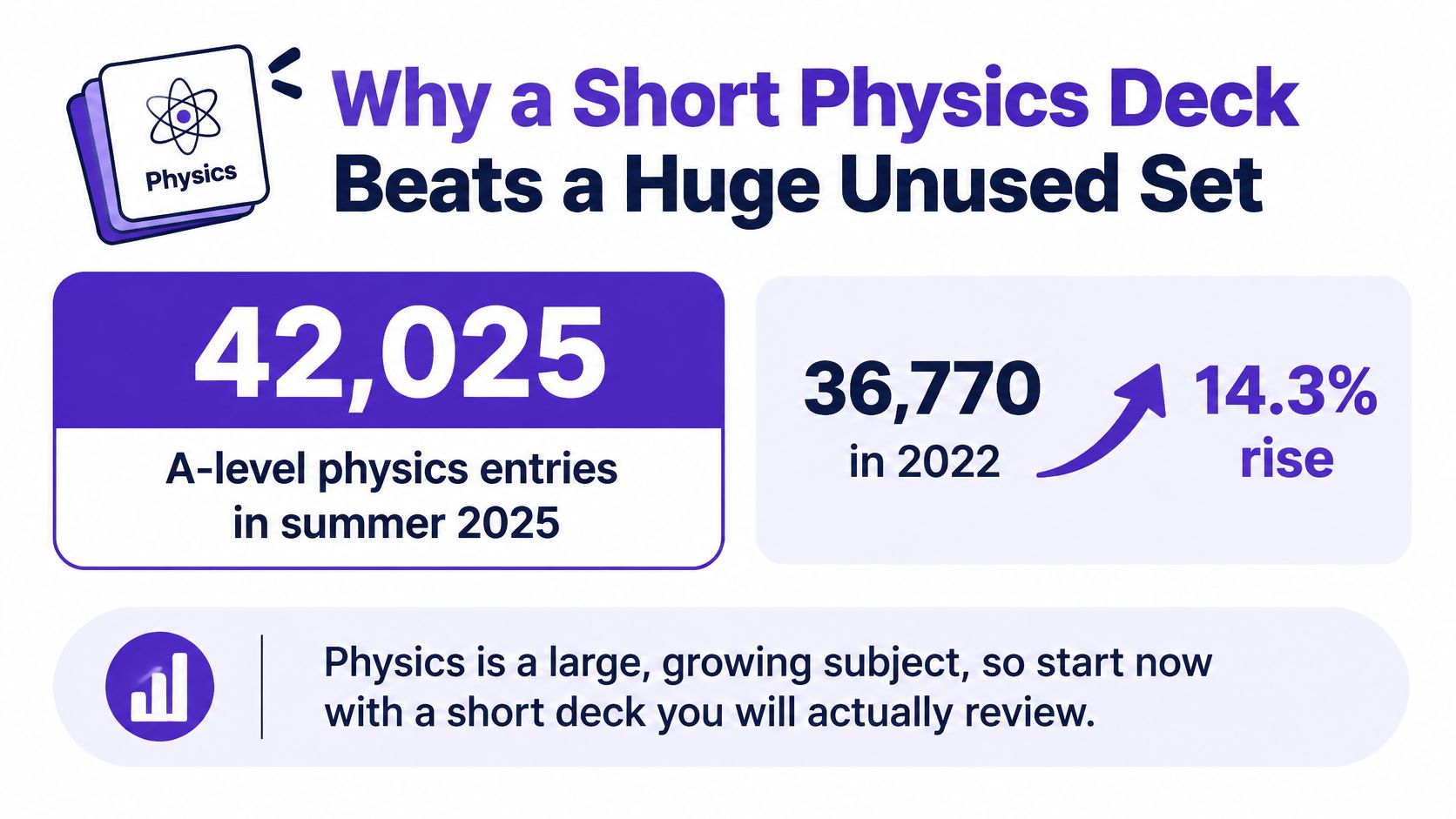
Ofqual's provisional-entry data for England records 42,025 A-level physics entries in summer 2025, up from 36,770 in 2022, a 14.3% rise. Physics isn't a niche subject with a niche trick. It's a large, recurring post-16 subject, and thousands of students face the same formulae, units, graphs and required practicals each year.
That number doesn't prove cards raise grades. It tells you the cohort is real and growing, so a short deck you review beats a huge set sitting in a drawer. If you're behind, you need marks still available this month. If you're aiming high, you need fewer wasted evenings rereading notes you already recognise.
What one useful card does
Say you're revising momentum the night after a poor test. A weak card says "momentum" on the front and a paragraph on the back. You read it, nod, and learn nothing about what you'd write under pressure.
A useful card works differently. You generate an answer first. Then you check one mark point, one unit or one command word. Did you state the direction? Did you give kg m/s? Did you explain, rather than just state? That tiny check is the whole point.
A card is not a mini textbook. It's a prompt that makes you produce something markable.
For teachers checking quality, that test is simple. Could an examiner award the answer on the back? If the back is fluent but vague, it won't survive a mark scheme, however neat it looks.
What you'll build
You'll get three things in order. First, a menu of card jobs so you know which type to write tonight. Second, a writing routine tied to specification points and mark schemes. Third, a spacing pattern of same day, 1 to 3 days, about a week, and several weeks later.
Keep the caveat beside the plan. Retrieval helps memory more reliably than it helps transfer into new questions. Card streaks are a warm-up, and mixed GCSE or A-level questions are the check. Start with the card menu next, and build tonight's pile from it.
Physics Card Jobs and How to Split the Deck
A physics paper asks for more than remembered facts, so a deck built only from definition cards leaves most of it untrained. Five card jobs cover the rest. Sort tonight's pile across the rows below before you write anything.
Physics flash card jobs for GCSE and A-level
| Card job | Example prompt | Exam demand | Share of card time |
|---|---|---|---|
| Pure recall | State gravitational field strength and its SI unit | AO1 knowledge | About one third |
| Equation selection | Choose, rearrange and substitute for this collision, with units | AO2 application; the GCSE formulae sheet makes choosing the skill, not memorising it | Inside the two-thirds application block |
| Misconception contrast | Why is impulse not the same as force here? | Near-miss answers that lose method marks | One card per repeated error |
| Practical and data | State one control, find the gradient and spot the anomaly | Working scientifically on every written paper | Several cards per required practical |
| Extended link | Order the physics points into a reasoned explanation | AO3 and A-level structure marks | A short set, not the whole deck |
The Education Endowment Foundation evidence summary on retrieval practice reports a mean effect size of 0.63 for retention versus 0.53 for transfer. Retention is the easier win. Getting the same idea to work in an unfamiliar question is harder, so your deck cannot stop at definitions.
That matches how papers are built. Knowledge marks sit alongside application and analysis marks, and only the first row of the table serves the first group. If every card asks "what is", you're training for a slice of the paper and hoping the rest looks after itself. It won't.
How to pick a row
Use pure recall when the mark needs one precise fact. "State gravitational field strength and its SI unit" works because the answer is short and exact. Keep these to about one third of your card time, and make each back checkable at a glance.
Use equation selection for most of the rest. With a formulae sheet available at GCSE, memorising every equation by heart is poor value. The marks live in choosing the right equation, naming each symbol, rearranging it and finishing with the correct SI unit. A card that shows the equation on the front gives away the hardest step, so put the situation on the front and the working on the back.
Pick misconception contrast when you keep making the same near-miss. Don't ask "What is impulse?" Ask why impulse isn't force in this situation, or why a graph's gradient isn't its area. You have to rule out the tempting wrong answer, not just repeat the right one. Examiners write distractors from exactly these slips, which is why each repeated error earns its own card.
Choose practical and data cards for controls, gradients, anomalies and uncertainties. Working scientifically appears across papers, not in one tidy practical topic. A forces question can still ask you to read a graph or spot an anomalous result.
Save extended link cards for answers that need a chain. The prompt asks you to order points into linked reasoning, compare two situations or evaluate a method. One word won't do, and that's the point. Keep the set short so the deck stays quick to review.
The trap to avoid
Easy, familiar cards feel like mastery. They aren't. If you only review mechanics in a mechanics pile, the pile tells you which equation to reach for before you have to think. A shuffled deck works like an unlabelled paper: nothing announces the topic, so the choice itself gets practised.
Mix mechanics, electricity, waves, fields and required practicals in one sitting. When the topic heading can't supply the answer, you find out what you know. Spend roughly one third of card time on pure retrieval and two thirds on short application, then check yourself with unseen questions.
After each attempt, sort the result. Was it correct recall, correct but stuck on a new context, a procedural slip, a misconception, or a units and presentation error? Only the misses earn follow-up cards, and each miss tells you which row of the table it belongs to.
How to Write One Mark-Scheme Physics Card
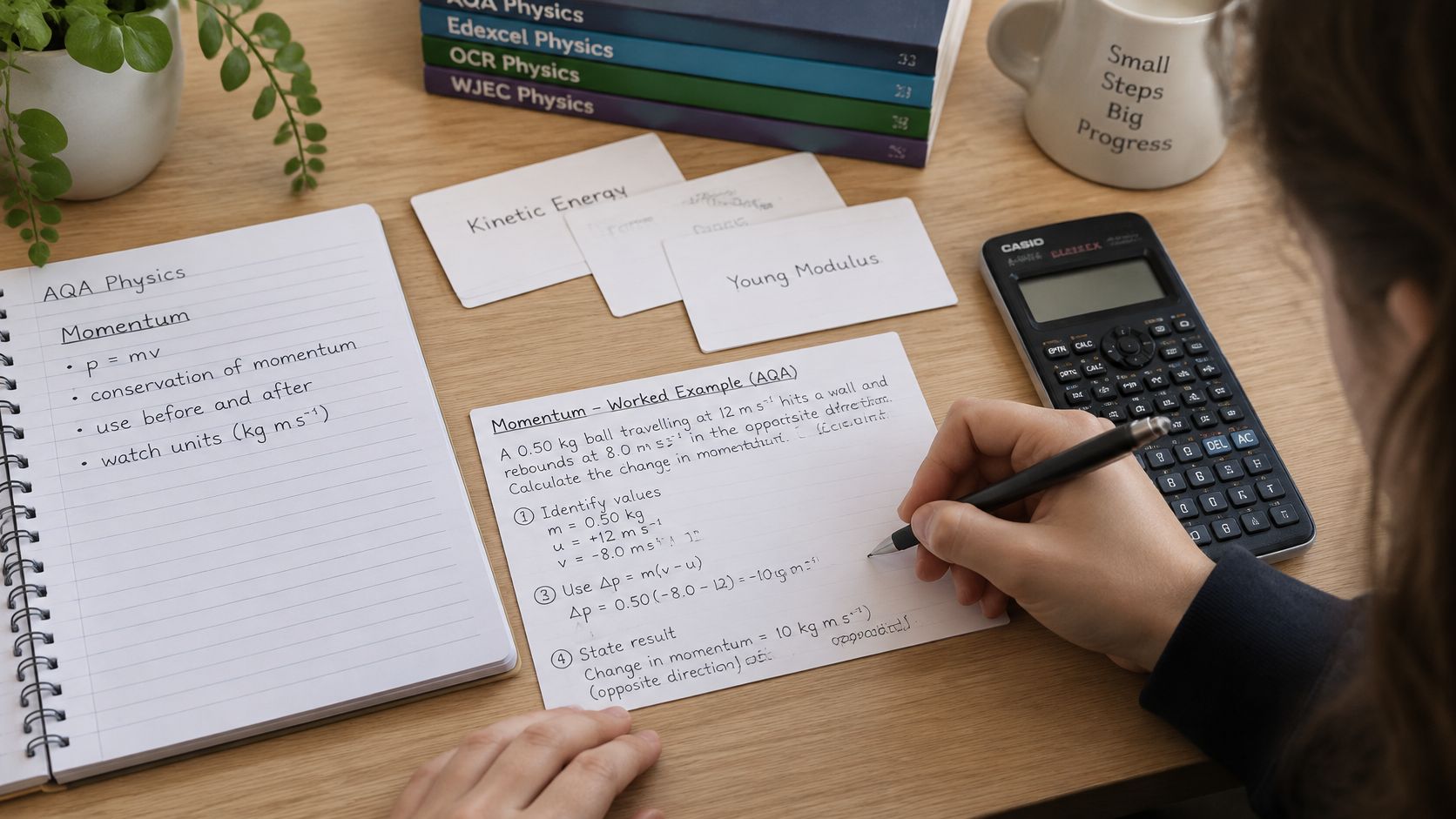
Use one example all the way through. Here it's a momentum calculation, but the same routine fits Young modulus, circuits or waves, and it fits Edexcel, OCR and WJEC once you swap the specification point.
This desk setup shows the working style you need, with notes, calculation and cards together rather than cards alone.
The seven steps
1. Choose the board, course and one specification point. Don't write cards for "forces". Write for one point, such as momentum change in a collision. A narrow target makes the back of the card checkable.
2. Open a mark scheme before you write anything. AQA GCSE Physics mark schemes show the marks available for each part, the total marks for the question, expected answers, additional examiner guidance, the Assessment Objective and the relevant specification content. Note all of them. For a teacher, that's the audit any AI draft must pass.
3. Write a prompt that makes you generate. "Determine the momentum change and state the unit" forces an answer. "Do you remember momentum?" doesn't. Strong prompts use real command words, and active recall techniques for GCSE revision only work when you commit to an answer before checking.
4. Put mark points on the back, not a paragraph. For this calculation, list them in order:
- Equation choice: momentum change equals mass multiplied by velocity change
- Substitution: values placed with signs or directions kept clear
- Rearrangement: shown if you're solving for velocity or mass
- Unit and precision: kg m/s, with sensible significant figures
That list trains method. A lone final number can't tell you whether you'd have earned the working marks.
5. Tag the card. Add board, topic, assessment objective and command word. This one might read AQA, momentum, AO2, determine. Tags let you mix topics later without losing track of what each card was for.
6. Add one plausible wrong answer. Write why it earns nothing in one line. For momentum, a common slip is giving the answer in newtons, as if momentum change were a force. Naming that error on the back stops you repeating it.
7. File it in the right pile. Recall, application or practical. This card is application, so it joins that block rather than swelling the definition pile.
This short video walkthrough shows the same write, check and correct rhythm in action.
Why A-level cards need more
At A-level the demand steps up. Longer papers carry more marks for linked structure, not just correct content. Your explanation cards should label whether marks come from knowledge, application or evaluation, and the back should show the order of points, not a heap of facts.
For a Young modulus card, that means the back separates the gradient calculation from the statement of what the gradient means. If you'd write them as one blurred sentence in the exam, the card should catch that now. Build one card this way and you've got a template. Every card after it is faster.
When to Review Each Physics Card
Learn the cycle first. The timetable only works if each review follows it.
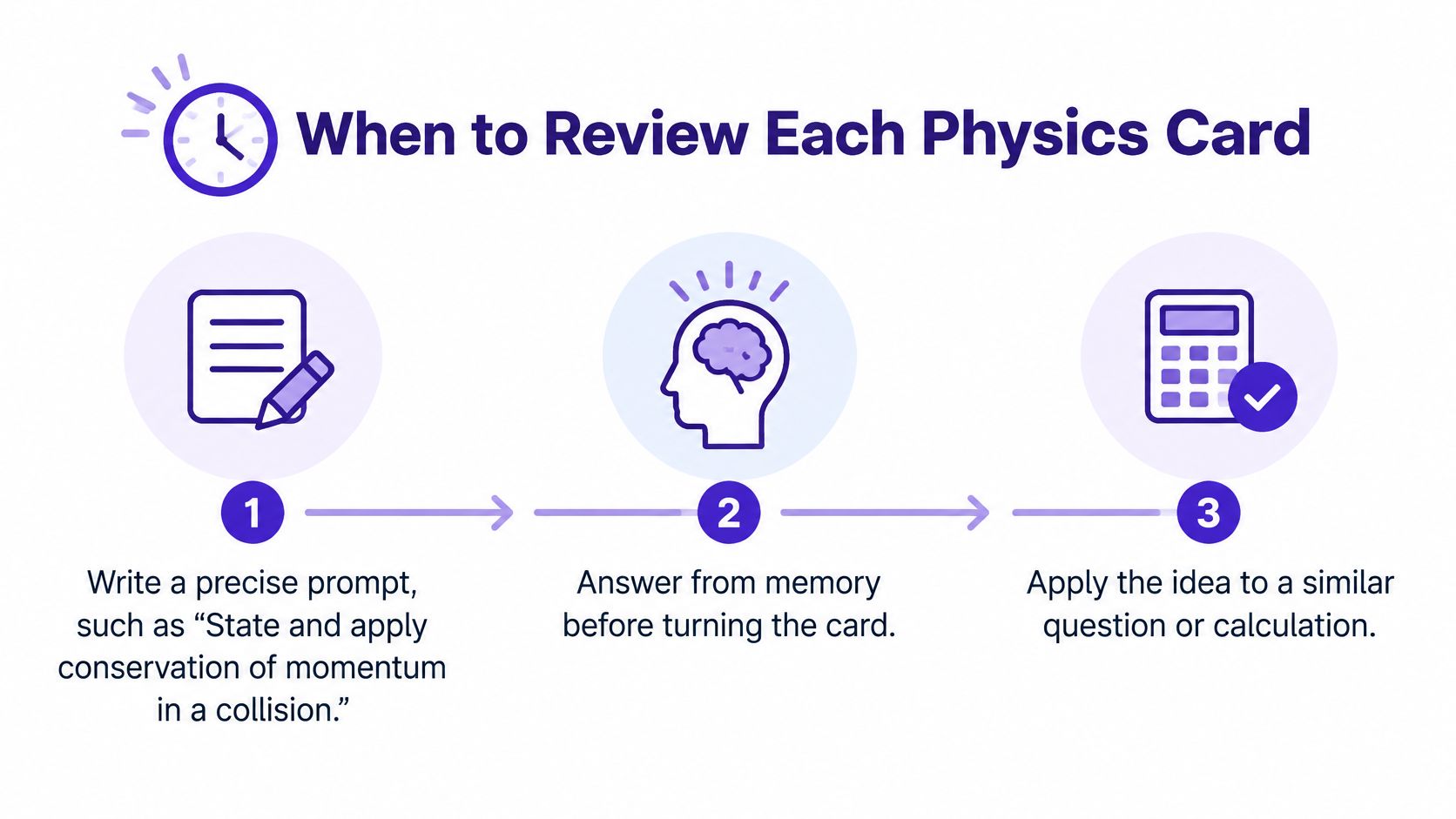
- Write a precise prompt, such as "State and apply conservation of momentum in a collision."
- Answer from memory before you turn the card over.
- Apply the idea to a number, a graph, a practical method or an unfamiliar situation.
- Compare your answer with a mark-scheme style back.
- Record the actual miss, such as an omitted unit, a sign, an assumption or a command word.
- Reschedule the card based on that result.
Skipping step 2 turns the whole thing into rereading. Skipping step 5 means you know you got it wrong but not why, so you'll get it wrong the same way next week.
This timeline shows the first part of that cycle, from prompt to memory attempt to application.
Why spacing beats hammering
UK government teacher-training guidance on how pupils learn reports that multiple practice opportunities improve final recall, while rapid successive practice has minimal benefit compared with spaced practice, and the Education Endowment Foundation reports mean effect sizes of 0.67 in classroom studies and 0.83 across the available secondary-school effects, with transfer at 0.53.
Read those figures carefully. They're encouraging, but they aren't a physics guarantee. Drilling one card ten times in a row feels productive because the answer is still in your head from thirty seconds ago. Leaving a gap forces real retrieval, which is the effort that helps.
If you want help structuring the gaps, you can build a spaced repetition routine around the intervals below rather than guessing each evening.
Spacing gaps for a physics deck
| Gap | When to use it | If the card failed |
|---|---|---|
| Same day | End of the session that created or missed the card | One fresh attempt, then into tomorrow's pile |
| 1-3 days | The next short sitting | Return it early; do not drill it ten times in a row |
| About 1 week | A mixed-topic weekly set | Keep it with other topics so the heading cannot give the answer |
| Several weeks | The run-up to timed papers | Keep only cards still losing units, signs, assumptions or command words |
How to read the table
Same day is a short retry, not a second full session. You missed the unit at 7pm, so you try once more before you finish. Then it goes into tomorrow's pile.
1 to 3 days is your next sitting. Failed cards come back early, but you don't hammer them. One honest attempt, check, record, move on.
About 1 week is where mixing matters most. Put the momentum card beside electricity and waves. If you can still pick the right approach without a topic label, it's starting to stick.
Several weeks later is the pre-paper pass. Correct cards move out. Keep only the stubborn ones, the cards still dropping units, signs, assumptions or command words. Your deck should shrink as exams approach, not grow.
Honest check: card accuracy is not the verdict. Unseen mixed-topic questions under timed conditions are.
A deck that copies the textbook only trains recognition. You'll recognise the equation when you see it and still freeze when a question hides it. Keep prompts generative, keep gaps real, and let exam questions judge the result.
Voice, Maths and Audit Checks for Weak Cards
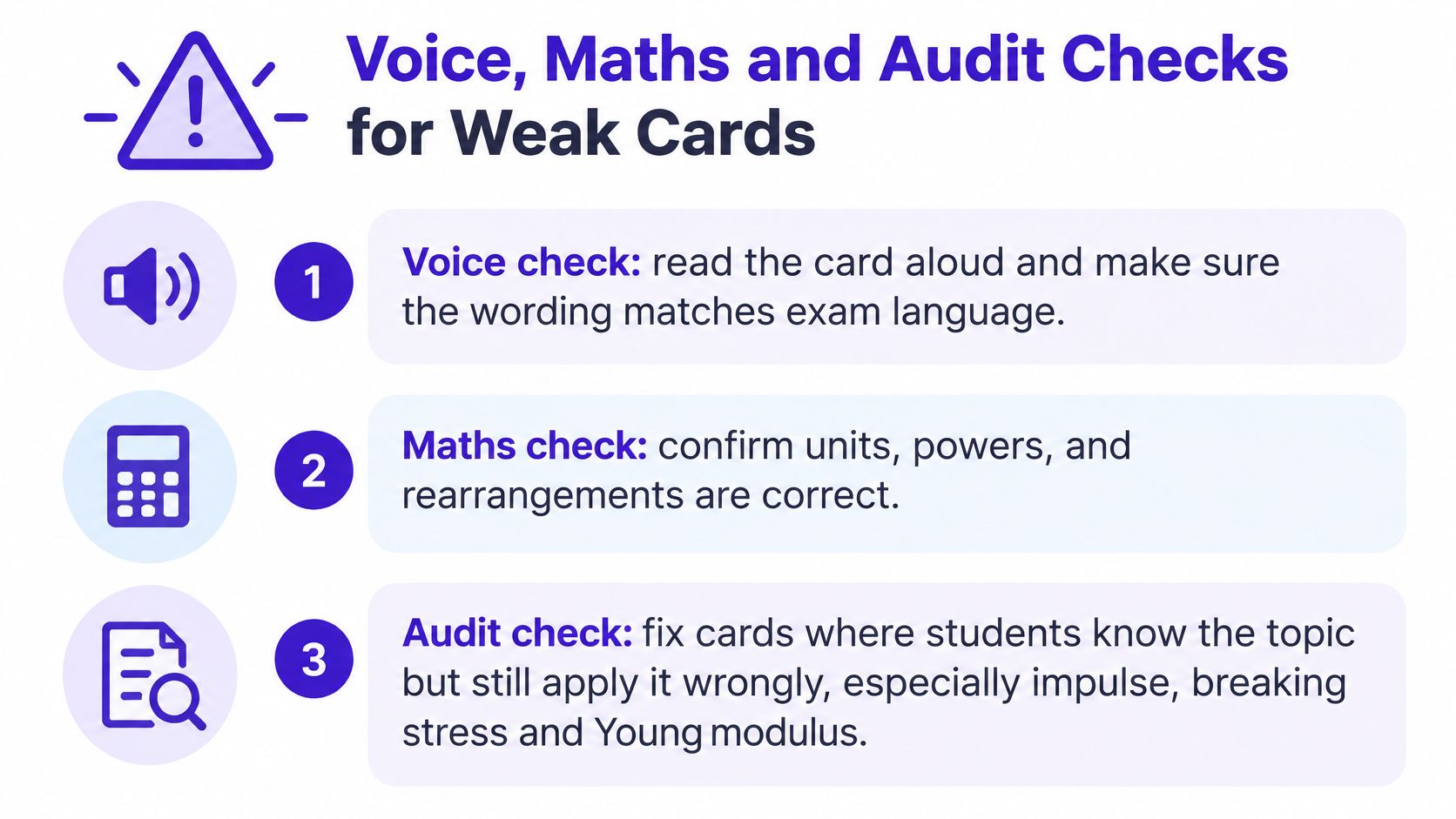
Examiners keep seeing the same pattern. Students know the topic and still apply it wrongly. AQA's June 2025 Physics reports flag common errors including treating impulse as force, confusing breaking stress with Young modulus, and interpreting wave motion rather than energy transfer.
Other reports note confusion between random molecular motion, Brownian motion and radioactive decay, plus muddles on gravity, pendulums, gravitational field strength and energy stores at GCSE. These aren't students who did nothing. They're students whose knowledge was close, but not precise enough to earn the mark.
So turn each error into a contrast prompt. "Why is impulse not force?" "Which quantity changes here?" "What in the question rules out the tempting answer?" A card that shows a plausible wrong answer, explains why it fails, then demands the corrected version is worth five definition cards.
These three checks summarise how to catch weak cards before they waste your time.
Four checks that catch most problems
Say it out loud. Speak your full answer before turning the card. Your voice exposes a vague definition that your eyes forgive. If you trail off or wave your hands, the card has found something.
Tick four maths points. Even when the number looks right, check equation choice, substitution, sign or direction, and unit plus precision. A correct value with a missing unit is still a lost mark, and your card back should say so plainly.
Only repeat errors earn new cards. One slip is noise. The same miss classified twice, such as units or a command word, earns a targeted follow-up card. That keeps your deck short and personal.
Name the practical skill. On practical cards, say which skill is being tested. One control variable, improving reliability, calculating a gradient, or spotting an anomalous result. Vague prompts like "understand the practical" test nothing.
Teachers can audit in minutes. Take three cards and check them against marks available, expected points, assessment objective and specification link, then test the idea in A-Level Past papers. Bin any card that sounds fluent but couldn't be awarded.
Partial, sloppy knowledge, not a total lack of revision, is what blocks the last marks.
Track Mastery Without Fooling Yourself
Confidence is a poor record. Keep one log line per card, not per session, and let the log tell you what is improving.
Each line needs the card name, board, specification point, assessment objective, last result and next gap. That sounds like admin, but it takes seconds, and it stops you reviewing cards you've already nailed while your real weaknesses sit untouched.
The three piles
Sort every card into solid, shaky or misconception. Solid cards go to the several-weeks pass. Shaky cards return within 1 to 3 days. Misconception cards get a contrast partner card that attacks the wrong idea directly.
A card counts as mastered only after two correct application attempts on different days and one unseen mixed-topic question that touches it. One good evening proves nothing. Correct answers spread across days, in a context you haven't seen, prove a lot more.
Example mastery log lines
| Card | Last result | Next gap | Pile |
|---|---|---|---|
| Impulse versus force | Conceptual misconception | Return in 1-3 days | Misconception |
| Momentum change with unit | Correct but untransferable | About 1 week | Shaky |
| Gravitational field strength and unit | Correct recall | Several weeks | Solid |
Read the log once a week
Count your misses by type, not just by topic. If units or command words top the list, rewrite your prompts to ask for them explicitly. A prompt that ends "and state the unit" trains the habit you're missing.
If correct recall dominates every line, your deck is too easy. The next batch must be application, with numbers, graphs and unfamiliar settings. Comfortable logs and disappointing papers often belong to the same student.
Keep the log on paper or in a spreadsheet. A teacher should be able to read it in two minutes and see whether you're improving or only feeling confident, and timed checks such as Exam Practice for A-Level give that reading a reality test. If your log says solid but timed questions disagree, trust the questions and move the card back.
Start This Week and Check Real Mastery
Don't plan a perfect system. Write ten cards tonight from one specification point.
Make about three recall cards and seven short application cards. Tag each one with board, topic, assessment objective and command word. Put one plausible wrong answer on the back, with one line explaining why it fails.
Say each meaning out loud before you turn the card. Review your misses the same day, then again within 1 to 3 days. By the end of the week, mix mechanics with one other topic so the heading can't leak the answer.
Judge the week properly
Judge your week on a short set of unseen mixed questions, not on how many cards felt easy. If you scored well on cards and poorly on questions, your prompts are too kind. Rewrite them with numbers, graphs or a compare command word and go again.
The decision at the end of the week is simple. If your ten cards produced specific misses on units, command words or near-miss physics, keep the deck and feed those misses back in. If every card felt easy, the prompts aren't testing you, and the next set must be application.
Our lessons carry these same habits for UK GCSE and A-level physics across AQA, Edexcel, OCR and WJEC. Key words in the lessons are shown as cards, and you're asked to say each meaning before turning the card to reveal the reminder. Interleaved Practice is a free tool that mixes topics and subjects in one practice session, which matches the mixed weekly set described above.
Look at the current plan details on our site before choosing a tier, and plan around what it lists. A teacher can still reject any prompt that lacks a mark point, and should. The tool carries the routine, but the mark scheme stays in charge.
Start with ten cards, one specification point and one honest log. That's a week of revision you can measure, whether you're recovering lost ground or chasing the final few marks.
Build your first ten mark-scheme cards tonight, then keep the say it before you turn it habit going with specification-aligned physics practice across AQA, Edexcel, OCR and WJEC. Visit MasteryMind to mix topics, space your reviews and check your card work against timed exam-style questions.
Choose your next course task
Use this idea with Physics. Confirm the qualification, awarding organisation and course version before choosing practice, assignment preparation or evidence planning.
Choose your Physics course