Power and Conflict Poems: Your Complete GCSE Revision Guide
You're two weeks from the exam. Your anthology is open on a crowded desk, but instead of feeling prepared, you're staring at 15 dense power and conflict poems and wondering which lines you're supposed to remember. Maybe you've missed lessons, left revision late, or revised hard but still freeze when a question pairs two poems you wouldn't have chosen.
That panic usually comes from treating the anthology as 15 separate memory tests. It works better as a comparison toolkit. You need enough knowledge of each poem to make a clear argument, select useful evidence, analyse the writer's choices and connect context only when it sharpens your point.
What the Power and Conflict Cluster Actually Is
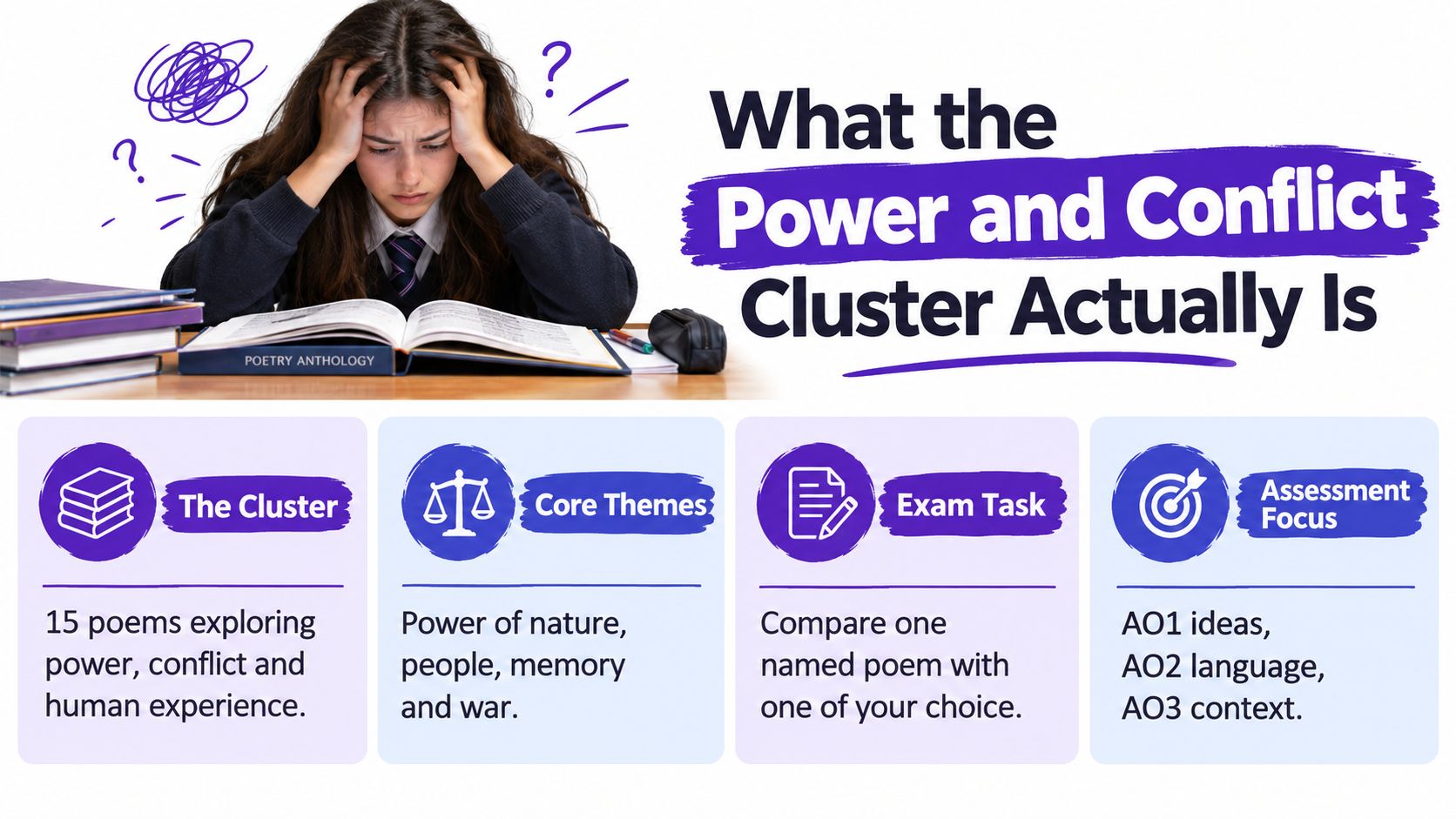
The AQA Power and Conflict anthology is a fixed cluster of 15 poems studied for GCSE English Literature in the UK. The official AQA specification treats it as one of the two poetry clusters for the qualification, so you're expected to study the whole set rather than pick a comfortable selection. The poems run from Shelley's “Ozymandias”, published in 1818, to Beatrice Garland's “Kamikaze”, first published in 2013, giving you nearly 200 years of literary and historical context to compare across the Power and Conflict anthology.
The poems explore power between individuals, groups, nations, institutions, nature and memory. That sounds broad, but the cluster keeps returning to a few recognisable questions. What happens when someone abuses authority? What does conflict cost ordinary people? Can memory protect identity, or does it trap people in guilt and grief? Does nature outlast human ambition?
The exam task
In Paper 2, Section B, you compare one printed anthology poem with another poem you choose from the same cluster. The comparison question is worth 30 marks, assessing AO1, AO2 and AO3. The mark split is 12 marks for AO1, 12 for AO2 and 6 for AO3 in the AQA comparison guidance.
That means you can't list a theme and attach a quotation. A strong response needs a sustained argument, detailed analysis of language, form and structure, and relevant context that changes how the reader understands the poem. The task is explicitly comparative, so discussing one poem for most of the answer and adding the other at the end leaves marks behind.
The stable 15-poem structure is useful. Every comparison question can be answered using poems from the same set, and recurring threads create conversations between poets. If you want a quick starting point for individual texts, these conflict anthology poem summaries can help you build a basic map before moving towards comparison.
The useful shift: Don't ask, “What does each poem say?” Ask, “What argument does each poet make, and which other poem challenges it?”
The Big Arguments Running Through the Anthology
The anthology makes more sense when you arrange the poems by argument, not just by theme. A theme such as power is too wide on its own. An argument tells you what the poet thinks about that theme.
| Argument Thread | Key Poems | Core Tension |
|---|---|---|
| The corrupting nature of power | “Ozymandias”, “My Last Duchess”, “The Charge of the Light Brigade” | Does authority create control, arrogance or obedience? |
| The human cost of conflict | “Bayonet Charge”, “Exposure”, “War Photographer”, “Poppies” | Who pays the emotional and physical price of war? |
| Memory, guilt and remembrance | “Poppies”, “Kamikaze”, “Remains”, “War Photographer” | Does remembering preserve the past or prolong suffering? |
| Identity and oppression | “Checking Out Me History”, “London”, “The Emigree”, “Tissue” | Who controls a person's story, identity and freedom? |
| Nature against human power | “Ozymandias”, “Storm on the Island”, “The Prelude”, “Exposure” | Can human beings control forces larger than themselves? |
Take the first thread. In “Ozymandias”, Shelley presents political power as temporary. Ozymandias tries to make his authority look permanent, but the broken statue and empty desert expose the weakness behind the boast. “My Last Duchess” shows a different form of control. The Duke still has a voice and social status, yet Browning makes that power disturbing because the Duke treats another person as property.
“The Charge of the Light Brigade” complicates the argument. Tennyson honours the soldiers' courage while exposing the consequences of an order that sends them into danger. The soldiers have little control over the decision, but they become symbols of loyalty and sacrifice.
Poets answering one another
Shelley, Duffy and Armitage all explore power, but they don't make identical claims. Shelley suggests that time and nature defeat tyrants. Duffy presents personal power as possessive and dangerous. Armitage often focuses on the way conflict damages the individual mind, especially when a soldier carries an experience long after the event.
This gives you ready-made comparison hooks. You might compare “Ozymandias” with “Tissue” to examine whether human structures last. You could compare “London” with “Checking Out Me History” to explore how institutions control people's lives and identities. You could place “Poppies” beside “Kamikaze” to discuss how conflict continues inside families after the public event has ended.
The surprise question becomes less frightening when you know the tensions. You're not searching for a perfect pair from memory. You're looking for a poem that agrees, disagrees or adds a different perspective to the printed poem.
How to Pick the Quotes That Actually Earn Marks
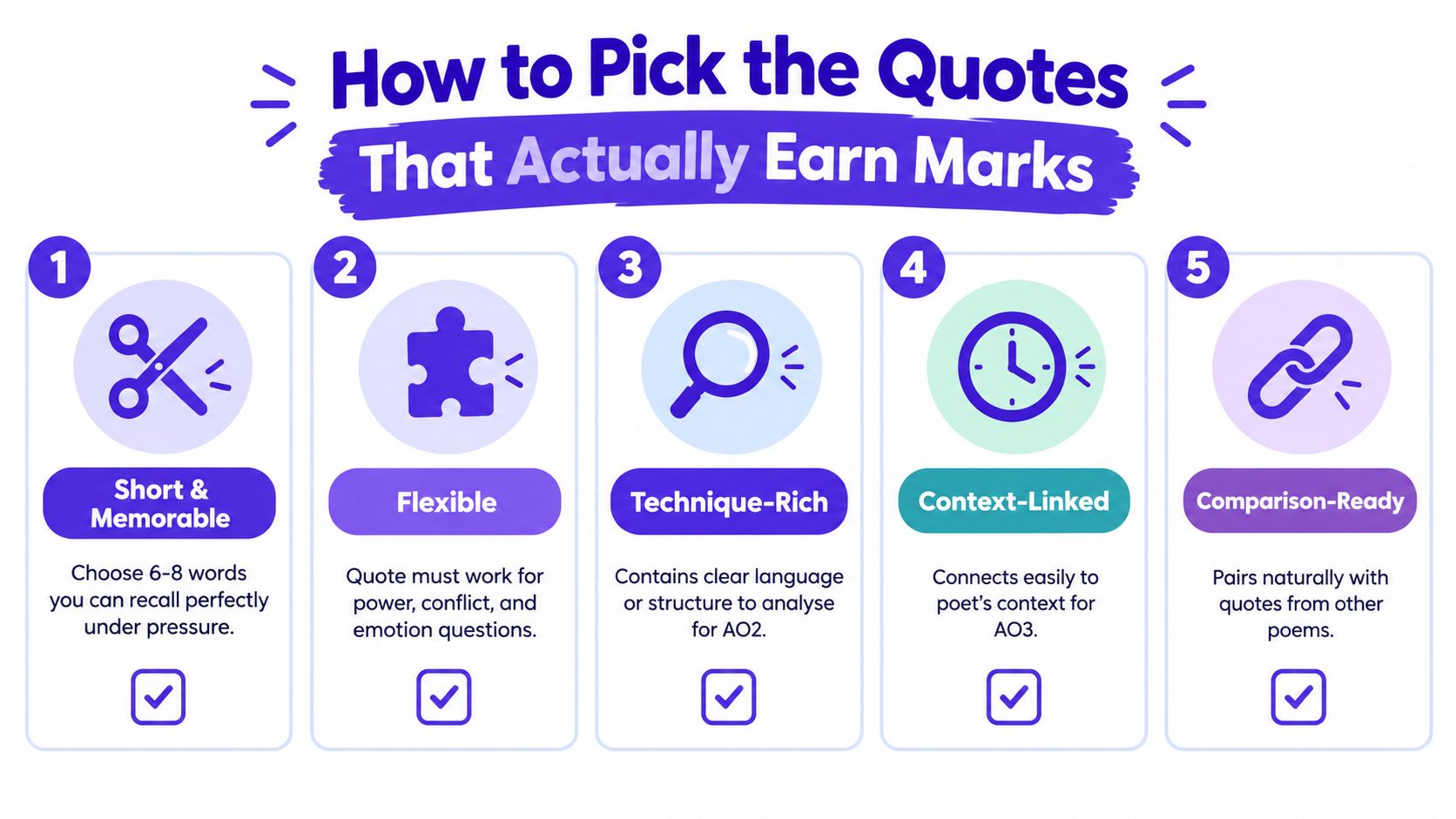
You don't need a suitcase full of quotations for every poem. You need two or three short, flexible quotations that you can recall accurately and analyse in more than one direction.
Filter every quotation
Start with the technique. Choose a line containing a loaded word, a striking image, a structural shift, a sound pattern or an interesting form. A quotation doesn't earn marks because it's famous. It earns marks when you can explain how the writer's choice creates meaning.
Next, test flexibility. Can the quotation help with power, conflict, memory or identity? A line that only answers one narrow question may be useful, but it shouldn't be the centre of your revision. You need evidence that can adapt when the wording changes.
Finally, keep it short. Under exam pressure, a brief phrase you know perfectly is safer than a long line you half remember. Don't lose time trying to reproduce punctuation or a complete stanza when three meaningful words will support the point.
A practical example
In “The Charge of the Light Brigade”, “cold, fused” is a useful quotation because the clipped phrasing and half-rhyme create a hard, uncomfortable sound. You can discuss the physical condition of the weapons, the emotional coldness surrounding military orders or the way the compressed phrase interrupts the poem's rhythm.
The safer quotation “Into the valley of Death” is still important, but it's more obvious and can tempt students into repeating the narrative without analysing Tennyson's choices. You could explore the Biblical allusion and personification, but only if you connect them to the poem's presentation of danger, courage or authority.
Use this test for each quotation:
- Technique: Is there a word, image, sound or structural choice to examine?
- Flexibility: Could it answer more than one kind of question?
- Accuracy: Can you write it correctly when you're tired?
- Comparison: Can you connect it to an idea in another poem?
Revision rule: If a quotation only fits one question, it's a luxury you probably can't afford.
A strong quotation bank is not a collection of impressive lines. It's a small working set. Write the quotation, identify the method, note two possible meanings and add one neighbouring poem. That turns memorisation into preparation for an argument.
Walking Through Five Poems You Need to Know
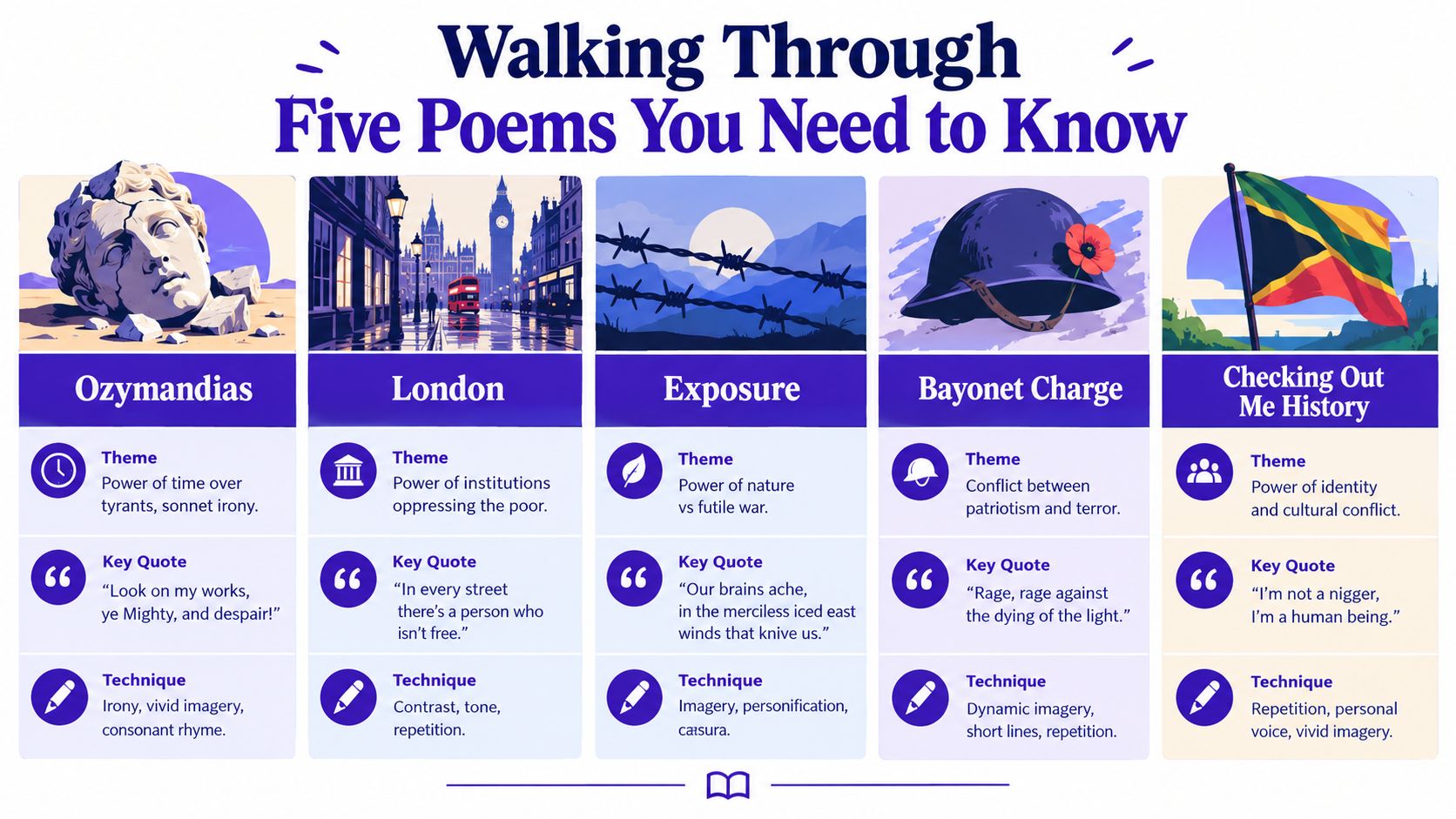
The quickest way to understand the method is to watch it work. These five poems cover different kinds of power and conflict, and each one offers a comparison route.
“Ozymandias”
Gist: Human power claims permanence, but time and the natural world reduce it to ruins.
Useful evidence includes “sneer of cold command”, which makes the ruler's expression sound contemptuous and authoritarian. The phrase “colossal wreck” combines great size with complete destruction, while “boundless and bare” leaves the statue surrounded by emptiness.
Shelley's central argument is that political authority is temporary. The sonnet form looks controlled, but the shifting rhyme and layered narration prevent Ozymandias from controlling the story. For comparison, connect it to “My Last Duchess”, where another powerful man tries to control how others see him.
You can find a focused breakdown of Ozymandias by Shelley if you need help securing the basic meanings before practising comparisons.
“London”
Gist: Social and political institutions control ordinary people, creating suffering that spreads through the city.
The repeated word “chartered” suggests ownership and restriction. “Mind-forged manacles” turns oppression into an image of invisible chains, while “black'ning Church” attacks an institution that should offer moral care.
Blake's argument isn't that London is unpleasant. He presents suffering as organised and repeated, with institutions helping to create or tolerate it. Compare the poem with “Checking Out Me History”, where systems also control what people are allowed to know about themselves.
“Exposure”
Gist: Nature becomes the most powerful enemy, making the soldiers' military action seem futile.
The repeated phrase “But nothing happens” creates frustration and emotional exhaustion. “Merciless iced east winds that knive us” personifies the weather as an attacker, while the repeated question “What are we doing here?” undermines patriotic certainty.
Owen's central argument is that war is not glorious when soldiers are left waiting, freezing and losing hope. The poem's cyclical structure makes the men seem trapped. Compare it with “Storm on the Island”, where human confidence also weakens when nature demonstrates its force.
“Bayonet Charge”
Gist: A soldier's abstract patriotism collapses into immediate fear and physical survival.
The opening image, “Suddenly he awoke and was running”, places the reader inside confusion. “King, honour, human dignity, etcetera” reduces grand patriotic ideas through the dismissive “etcetera”, while “his terror's touchy dynamite” presents fear as explosive and unstable.
Armitage questions whether soldiers understand the political ideas behind the conflict. The poem's sudden movement and fragmented thinking reflect panic. Compare it with “The Charge of the Light Brigade”, which presents soldiers as disciplined and heroic rather than inwardly confused.
“Checking Out Me History”
Gist: A speaker resists an education system that has hidden or reduced his cultural identity.
The repeated phrase “Dem tell me” creates a controlling outside voice. In contrast, the personal statement “I carving out me identity” presents active resistance. The irregular rhythms and Caribbean voice challenge the neat authority of the imposed history.
Agard's argument is that power controls identity by controlling which stories receive attention. The poem doesn't merely ask for more historical information. It shows the speaker reclaiming the right to define himself. Compare it with “The Emigree”, where memory protects identity even after displacement.
Watch this short visual explanation before you practise. Then pause it and write your own comparison hook rather than copying the wording.
Reading the Question and Building a Comparison Thesis
A comparison question gives you a direction, not a theme to mention once. Words such as “compare”, “in what ways” and “similar” tell you to develop relationships between the poems.
If the question asks how poets present power, don't write, “Both poems are about power.” That identifies a topic but makes no argument. A stronger thesis might say:
Both poets present power as a corrosive force, but Shelley suggests that time destroys political authority while Browning shows a powerful individual using control to damage another person.
That sentence gives you a shared idea, a difference and a reason the difference matters.
A reliable formula
Use:
argument verb + shared theme + point of difference + so what
Argument verbs include presents, challenges, exposes, celebrates, questions and undermines. The final “so what” explains the larger message, such as whether power lasts, whether conflict changes identity or whether memory offers resistance.
| Prompt Wording | Underlying Task | Model Thesis |
|---|---|---|
| “Compare the ways poets present power.” | Find a shared view and a meaningful difference. | Both poets expose power as damaging, but Blake focuses on institutional oppression while Browning shows private control inside a relationship. |
| “In what ways are the effects of conflict similar?” | Compare consequences, not just events. | Both poems show conflict continuing after the event, although Armitage presents personal guilt while Garland presents family silence and social rejection. |
| “Compare how poets present nature.” | Analyse nature's role and its effect on people. | Both poets show nature overpowering human confidence, but Owen presents it as a merciless enemy while Wordsworth presents it as a force that changes the speaker's understanding. |
Watch for a question that asks about one named poem only, even if it contains a thematic word such as conflict. Don't force a second poem into every literature answer. In Section B, the anthology comparison task requires the printed poem and one poem of your choice, but your chosen poem should support the question rather than appear as an afterthought in the assessment overview.
What a Top-Band Comparison Paragraph Looks Like
A strong paragraph doesn't treat AO1, AO2 and AO3 as three boxes to tick separately. It makes an argument, proves it with a method and quotation, explains the effect, compares the second poem and uses context only where it changes the interpretation.
Here's a model using “Ozymandias” and “Tissue”:
Both Shelley and Dharker question the permanence of human power. In “Ozymandias”, the description of the statue as a “colossal wreck” combines impressive scale with complete destruction, so the oxymoronic image makes the ruler's authority appear both enormous and worthless. Shelley's sonnet gradually moves away from the statue and towards the “lone and level sands”, suggesting that nature and time have erased the political system Ozymandias believed would preserve his name. Dharker also presents human structures as fragile through the image of “paper”, a material that can carry laws, maps and religious ideas but can still tear. However, “Tissue” is less openly mocking because paper remains connected to human creativity and identity, whereas Shelley makes the ruler's proud inscription look ridiculous beside the empty desert. Both poems therefore argue that human power cannot control time, but Dharker leaves more room for ordinary human meaning to survive.
What each sentence is doing
The opening gives AO1 because it answers the question with a comparison. The analysis of “colossal wreck”, the oxymoron and the movement towards the desert provide AO2. The discussion of Shelley's criticism of political authority becomes AO3 because it connects the poem to ideas about rulers, monuments and historical power rather than dropping in biography.
The paragraph then moves to Dharker instead of writing a separate mini-essay. It identifies a shared material image, recognises a difference in tone and finishes with a judgement. That final sentence matters because it answers the so what.
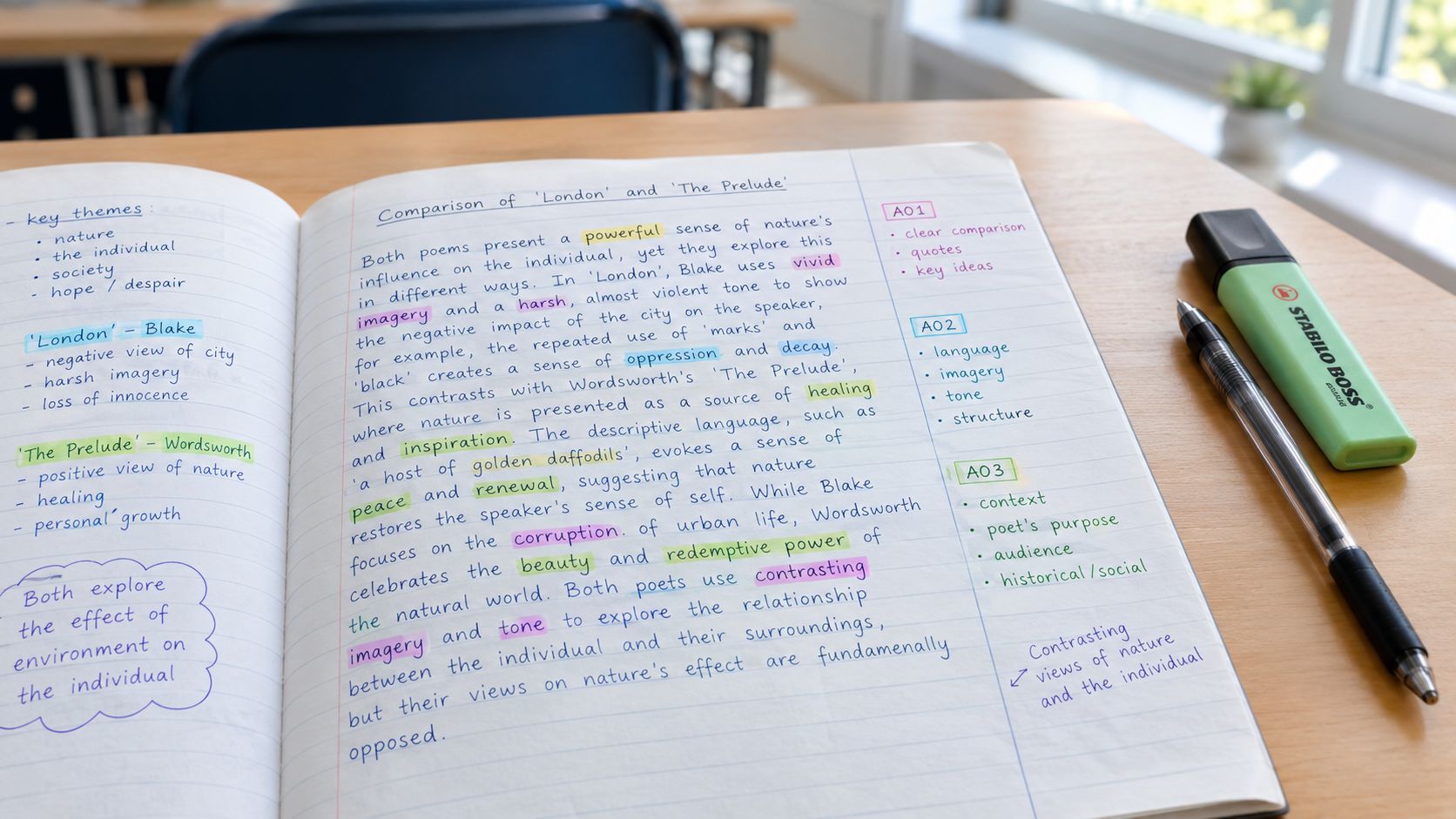
Three common mark-losing habits
- Theme spotting: Naming power, conflict or nature without explaining the poet's argument.
- Technique labelling: Writing “this is a metaphor” and stopping before discussing the connotations and effect.
- Delayed comparison: Analysing the first poem for a whole paragraph, then adding one sentence about the second.
Embed quotations naturally, zoom in on one important word and compare before the paragraph ends. You don't need a method in every sentence. You do need a clear explanation of why the writer's choice supports your interpretation.
Using Context Without Stuffing It In
Context should change the way a reader understands a quotation. It shouldn't be a biography paragraph attached to the end of an essay.
Weak context sounds like this: “Owen wrote this because he was a soldier in the First World War.” It may be relevant, but on its own it doesn't explain the language. A tighter version would connect the setting to the meaning: The poem's experience of prolonged exposure makes the soldiers' suffering feel less like heroic battle and more like a slow attack by the weather.
Choose the detail that shifts interpretation
For “Exposure”, Owen's experience of war and the poem's focus on waiting help you interpret the repeated frustration and the soldiers' physical vulnerability. In “Dulce et Decorum Est”, the presentation of exhausted soldiers challenges idealised accounts of patriotic sacrifice, especially when the poem turns towards the bitter Latin phrase at the end.
For “Kamikaze”, the cultural expectations surrounding Japanese kamikaze pilots make the father's return more complicated. He survives physically, but the family's silence and rejection show that social honour can become another form of power.
In “Bayonet Charge”, Armitage's presentation of the individual soldier matters more than a general history lesson. The soldier's confused thoughts expose the distance between public ideas such as honour and the immediate terror of running across a battlefield.
For “Tissue”, paper's connection to maps, money, law and religious texts helps the reader see why Dharker questions systems that people treat as permanent. The context belongs inside the analysis because it explains why the material image carries political meaning.
Context test: If removing the context leaves the quotation meaning exactly the same, cut the context.
A useful sentence pattern is: “The poem's setting in X means that…” For example, “The poem's setting in a culture where military sacrifice carries immense honour means that the father's silence is not personal sadness. It reveals the social punishment attached to refusing an expected role.”
That sounds like analysis because it explains consequences. It doesn't sound like a Wikipedia footnote because it stays attached to the poem.
How to Drill the Anthology So It Actually Sticks
Reading the poems repeatedly can make them look familiar without making you able to recall them. Retrieval practice feels harder because you're pulling information out without seeing it, but that effort is what makes recall more dependable.
Schools are already using layered practice rather than relying only on notes. The PiXL Power and Conflict booklet includes multiple-choice checks, poem-by-poem quizzes, academic reading tasks and exam-style questions, which reflects a move towards repeated retrieval and application in the PiXL student booklet.
Three drills that fit into a busy day
The one-minute blurt: Close the anthology and write every quotation, theme and technique you can remember for one poem. Open the poem, mark what you missed and repeat the missing items later.
The theme-to-poem match: Write a prompt such as “the power of nature” or “memory after conflict”. List two poems in silence, then add one quotation for each. This trains you to choose poems rather than wait for a memorised pairing.
The random comparison plan: Pick two poems without choosing your favourites. Give yourself five minutes to write a thesis, two comparison points and one quotation per poem. You're practising adaptability, which question banks often fail to teach on their own. Teachit provides 15 exam-style questions, while Save My Exams lists 287 practice questions for the cluster, but more questions won't automatically teach you how to build an argument from an unexpected pairing through the Teachit question resource.
Use A-Level revision with spaced repetition for the same retrieval principle applied to a wider revision routine.
Before exam day, make sure you can:
- Recall: Produce short evidence without looking.
- Match: Connect a theme to more than one poem.
- Compare: Explain agreement and difference.
- Apply: Plan from random poems under time pressure.
Your Two-Week Revision Plan Before the Exam
Start with a quick diagnostic. If you can write a clear thesis comparing any two poems in ten minutes, don't spend the fortnight making basic summary sheets. Move straight to timed paragraphs and full questions.
Days 1 to 3
Create one page for each poem. Include one central argument, a small quotation bank, one technique beside each quotation, one comparison link and one context point that changes interpretation. Don't copy whole revision guides. If you can't explain the point aloud, the page isn't finished.
Days 4 to 7
Write comparison paragraphs under timed conditions. Use different pairings each time, including poems you usually avoid. Ask a teacher, tutor or trusted study partner to check whether your paragraph compares throughout, analyses specific words and ends with a clear judgement.
Days 8 to 11
Complete full past-paper questions using GCSE Past Papers. Practise the whole process, reading the prompt, choosing the second poem, planning a thesis and sustaining the answer. Students who need broader exam organisation can also use these adult GCSE English revision tips for practical study support.
Days 12 to 13
Fix weaknesses found through marking. If your analysis is vague, practise zooming in on single words. If comparison disappears, write paired sentences. If context takes over, remove every detail that doesn't alter meaning.
Day 14
Consolidate lightly. Review your quotation cards, speak through your argument threads and avoid learning brand-new material. On the morning, reread two poems you know well enough to calm yourself, not two texts chosen because they still frighten you.
In the first five minutes of the paper, underline the question's focus, select your second poem and write a thesis before you start drafting. Keep checking that each paragraph answers the exact question, compares both poems and explains the writer's choices.
MasteryMind offers AQA-aligned Power and Conflict revision materials, including adaptive quizzes, spaced review and structured practice for poetry analysis. Visit MasteryMind to turn your quotation bank into targeted retrieval and comparison practice before the exam.
Ready to master this topic?
Practise with quizzes, blurt exercises and exam questions on MasteryMind.
7 days Premium · Then free forever · No card, no charge